Blog: Preparing for the Worst

My journey towards becoming a paramedic is not without its significant doubts.  I suppose I can take comfort in knowing that many people feel similar doubts when embarking into new career/life-paths.  Kevin Hazzard’s book “A Thousand Naked Strangers” opens with several chapters of how anxious he felt at the idea of being a medic and the responsibility it entails (book review forthcoming).

My fears are certainly not unique.  I have the typical worries around imposture syndrome, whether I can hack it physically, mentally, emotionally, and whether I’m good enough to get accepted into a very competitive program.  I also have spin-off worries concerning whether I will achieve a work-life balance with a future family, what toll my experiences will have on me, whether I can leave work “at the door” when I come home, whether I will be affected by mental health issues caused by work, etc.

Heck, I even worry that I won’t be able to stomach it because I’ve never seen anything graphically bad.  The three worst things I’ve seen are: 1.) a pedestrian struck by a car that I had to then treat; 2.) that time I broke my ankle with a hairline fracture; and 3.) that time I treated a guy who put his elbow through a window in rage.  In each of the cases, there was some blood (and bone from the window), but overall the outward injuries were fairly tame.

I’ve tried to mitigate this by following medical Instagram accounts that shows graphic medical procedures and injuries.  My hope is to desensitize myself from the shock of what I see so I can bypass those initial visceral reactions.  Likewise, I chose to read Hazzard’s book to learn more about what kind of horrible things I can expect to see.

But, there are some things you can’t prepare for.  Or, worse yet, there are things you didn’t anticipate being a problem.

I came across two blog posts recently  (written by the same author on two different sites) that discusses exactly this case.  I won’t spill too many of the details as I think it’s valuable to read the posts for yourself.  But the one I want to briefly mention here is where the author discusses the impact a ringing phone can have.

Imagine what it was like for the first responders at the recent Orlando mass shooting as they worked inside the club around all the deceased victims.  Keep in mind, there were 49 victims who died that night on scene.  49 people with families who likely heard about the tragedy on the television.  49 families who might have called to make sure their loved one was “ok.”  49 families who kept calling when no one picked up.  Imagine what kind of toll that might have on a person as they walk among the bodies.

It chills me just typing this.

There are things I might experience that I’ll never be prepared for.  These are things that worry me as I lay the groundwork to change careers.

Please, go read the blog posts for yourself.

The Sounds of Silence on The Happy Medic

The Worst Things I’ve Ever Felt As A Paramedic on Uniform Stories
 

Blog: Update on Diagramming – Active Learning

Back in my post about diagramming as a study strategy, I made reference to recent studies showing the effectiveness of long-hand writing and its correlation with retention and recall.  One of the  things I love about working at a post-secondary institute is I a.) mix it up with very smart people who teach for a living; and b.) have access to a well-funded library.

I love university and college libraries!  I don’t always make adequate use of their vast resources, but when I need them, they have my back.  For instance, my institute recently negotiated access for its employees to use Lynda.com.  As a nerd who loves to learn, this made me very happy.

Part of my job involves program review and quality assurance, which is outside of my educational wheel house.  Recently, I’ve been exposed to the concept of Active Learning Strategies as a method of engaging students in the classroom.  For instance, a passive learning strategy would be for students to read a textbook and learn the definitions of key words and concepts.  An active learning strategy would have the students read the text, then take those same key words/concepts and draw them in a relationship tree to show how the various parts fit together.

If you have access, I suggest you check out “Active learning strategies: three activities to increase student involvement in learning” by Catherine Wilcoxson Ueckert and Julie Gess-Newsome in The Science Teacher journal (75.9, Dec. 2008; p47.).  There, the authors discuss, as the title says, three alternative approaches to student engagement in the science classroom.  While these approaches assume a classroom, instead of a solo learning project like what I’m encountering, I think you can still extrapolate on the learnings and apply it outside of the traditional classroom.

Stay Awesome!

Ryan

Blog: Hubris and Good Grades

I have a confession: I’m great at BSing.  The polite way of describing this is that I’m very clever.  An awesome way to describe this is I’m resourceful.  But at the end of the day, I’m good at making stuff up on the fly.  I accomplish this because I’m able to absorb a lot of facts and data in a short amount of time.  The result of this is that my output and achievements are not always reflective of the amount of effort that appears to go into a result.

This habit started in high school.  Until this point, I worked hard on my home work.  My parents were very good at instilling (and monitoring) the discipline in me to do well.  In 10th grade, I was given the option to move to an enriched mathematics course because I had performed well the year before.  However, it was the beginning of the end in terms of my mathematical achievement for one very simple reason: there were no homework checks.

You’d think this shouldn’t be a problem, but it was my Achilles’ heel.  No homework checks meant I didn’t need to do my homework every night.  My young mind had missed the connection between progressive practice and performance during assessments.  My grades slipped.  I still graduated high school with good marks; marks that gained me entry into a good Canadian university.  But my work was less perspiration and more inspiration.

I bring this all up because I had an insight last night while studying for my respiratory system test.  Until now, I’ve been progressing through the course at around two chapters* every week.  That performance, comes with a footnote:

  • I registered for the 12-week course for a January start, but I found a loophole that my time wouldn’t start until I wrote the first test. I spent 3-4 months reading the textbook at the public library and was able to get ahead by 4 or so chapters before I “started the course.”

What appeared to be a reasonably diligent pace came because I was ahead of the game.  But, because I didn’t keep pace with the rate at which I was writing tests, I eventually caught up and now I’m trying to read two  chapters per week and write those tests the following week.  In principle, this shouldn’t be an issue.  But it’s proving to be a challenge.

In a real sense, I’m becoming a victim of my success.  Thus far, I’ve done well writing tests, and so when it comes time to prioritize study time, I’m finding myself placing its priority lower than other, seemingly more pressing concerns.  My rationale is “I should be studying, but I’ve done well so far and this other thing I’m stressed about requires my attention to get on track.”  And so, the other thing (relationship time, my two jobs, my volunteer activities, and yes, relaxation) will take priority over studying.  It’s the old Important/Unimportant/Urgent/Non-Urgent matrix.  I’m letting the things  that are Urgent take priority over the things that are, arguably, more important.  This matrix could be the topic of a future article.

What does this look like?

  • Friday – “I work tonight at my other job, so let’s relax because it’s the weekend.”
  • Saturday – “I should study, but today I’ll run errands, spend time on my relationship, indulge in R&R, etc.”
  • Sunday – “I should study, but I’m squeezing more long-distance relationship time in, spending time with friends that I don’t see during the week, dreading the work week, etc.”
  • Monday – “I should start studying/reading chapters for Monday’s test, but I also have commitment x/y/z.”
  • Tuesday – “I’ve bitten off more than I can chew, so how can I squeeze more efficiency into studying?”
  • Wednesday – “How many times can I review my notes during the work day before I write my test, grab a bite to eat, then go to my night job?”
  • Thursday – never used efficiently…
  • Rinse and repeat.

Because I haven’t had to rely on a structured 7-day schedule for studying but am now 70% through the course, that lack of planning has finally caught up to me and is putting me in a crunch.  I’ll have to grind out the last three or so weeks of the course, but this unsustainable practice is a lesson in why it’s important to work hard while also working smart.

Stay Awesome,

Ryan

PS – after drafting this post, I read an excellent, short meditation on the difference between IQ and DOT (discipline, organization, and thoughtfulness).  I’m happy that I’m not the only person who wrestles with this.

Study Strategies #2 – Make it about you

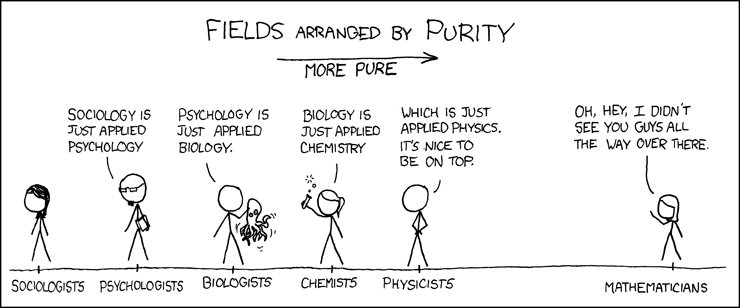
A common complaint you hear from students who study abstract concepts is that it’s hard to wrap your mind around ideas that you don’t have immediate (visceral) experience in.  I say this as a person who has an undergraduate and a graduate degree in philosophy; abstract ideas are my bread and butter.  Studying biology falls somewhere in the middle of that field – we all have a body that is a biological system, but outside of our subjective experiences of stimuli and physiological responses, we don’t have a lot of access to the inner mechanics of how the body operates.

(In my humble opinion, philosophy falls to the right of the image… Image: XKCD: https://xkcd.com/435/)

While this tip might be harder to apply in philosophy, a useful trick I’ve tried using recently is trying to break down anatomical and physiological processes in terms of my own personal experience.  Depending on your background, there are a number of ways you can cash this out, but I’ll give you three examples of where I’ve applied my past experiences and hobbies to learn key ideas and concepts.

1.) First Aid

The biggest crossover with studying biology I’ve had is from my experience in first aid.  During my undergrad, I joined a campus first aid team.  It was a team of student volunteers who actively trained throughout the year and covered shifts for events on campus.  Because we trained above the standard first aid level, we would get into topics that required some level of understanding the organism at the physiology level.  To understand how CPR mimicked the beating of a heart, we would learn how a normal heart functioned; to understand how shock affected the body, we would understand the cardiovascular, respiratory and nervous system operated; etc.

First aid is a stripped down version of what paramedicine is, so the two naturally dovetail with each other.  As I work my way through the course material, I’m able to see the connections between the medical interventions I was taught as a first aider and the biological systems the body uses to maintain healthy function (or, related to emergency medicine, how the body adapts to compensate for a loss of homeostasis).

2.) Lifting Weights

This example draws on a narrow set of my course materials, but it still cuts broadly through the textbook.  When you move out of the rookie phase of lifting weights, you naturally drift towards learning about anatomy and physiology.  As of writing this post, I completed a test last week where I labelled a diagram of the posterior superficial muscles entirely based on my experiences with weight-lifting.  As you dive deeper into exercise science, you are exposed to all sorts of cool applications of biology.  You learn about the gross skeletal and muscular anatomy, you learn about cellular metabolism and the use of ATP in muscle contractions, about how micro-tearing of tissues builds muscle and bone density, how nutrition affects the body, etc.  Even learning about exercise recovery helps deepen your exposure, such as learning about massage therapy, stretching any fringe forms of therapy, such as myofascile release and chiropractic medicine.

3.) That time I broke my ankle

A few years back, while out walking the dog during the first snowfall of the season, I was attacked by a roving horde of snow-ninjas who managed to put me down hard.  By that, I mean my foot slipped on a patch of ice, my ankle pivoted, inverted and my bodyweight came down on my ankle.  At the time, it seemed like a sprain because I was able to stand on the ankle and walk down the hill for help.  After a trip to the hospital and a follow-up, x-rays determined that I had a fine fracture in the fibula and I had displaced the talus bone.  It was recommended I have surgery to set the bones back into place with a series of screws and a plate.

The surgery was uneventful and the recovery went as predicted, and I’m now back to 99% (the occasional cold night makes my ankle stiff at work).  There is an element of black box magic that happens when you recover from a broken bone.  You receive a cast, are told to reduce movement for 6 weeks, then rehabilitate the muscles.  Recently, when I was studying the chapter on bones, I learn what happens in those six weeks.  It’s freaking awesome!

Assuming you can see the image above (being new to blogging, I’m not sure what’s considered fair-use for copyright materials – safe to assume, that image is not my creation), you can see the general phases of how bone gets repaired by the body.  When I learned about the process of osteogenesis, I was able to remember the phases of bone repair base on my lived experience of breaking a bone and healing from surgery.  It’s a hard and painful way of learning medicine, but it’ll stick with you!

These are a few examples of how my experiences help me make sense of the complexities of human anatomy and physiology.   What are some of the ways you make the material relevant to your life?  Let me know down below.  Hopefully it’s nothing as bad as physically injuring yourself!

Stay Awesome,

Ryan

Study Strategies #1 – Flashcards

While we can charitably say I’ve been a student for a long time, it has only been relatively recently that I’ve started paying attention to pedagogy and effective study strategies.  Sure, while I was still an active student, I would be exposed to the usual litany of strategies for student success – read/review text multiple times, practice questions, low-level frequent studying is superior to cramming, etc.  But of course, most of these would get dropped because of my poor time management and I would end up cramming and staying up the night before a paper was due to write in one marathon stretch.  But those were my habits during undergrad and grad school and I haven’t been a student in almost five years.  I know I lack some of the youthful fortitude to carry-on those habits while working a full-time job, part-time job and all of the other fun projects I have on the go.

So, rather than working hard, I’m trying to work smart.  I’m trying to use sound pedagogical approaches to learning that helps me to effectively learn the material on my own and retain it for future application.  Right now, I’m taking a preparatory biology distance education course at the College I work for.  I took physics and chemistry through high school, but I did not think I would need the biology.  If I hope to make a career change towards paramedicine, this is a gate-keeper that I must pass.

Because of the nature of the biology course, most of what I’m dealing with is rote memorization that emphasizes knowing how systems fit together rather than directly applying knowledge.  This means that what I need to know to pass the test will focus more on being able to recite facts, definitions, explain processes and label diagrams.  Understanding and recognizing this is beneficial to how I can structure my homework.

One strategy I’m using for this course is flashcards.  There are two purposes to the flashcard:

  1. The act of creating the flashcard helps in retaining information.  To make useful flashcards, you have to sufficiently understand the material to condense it down into a few meaningful points.  Also, the physical act of writing the cards out helps you to retain the information (over and above just reading highlighted text from your book).
  2. Flashcard drills can reinforce knowledge depending on how you use them.  You can use keywords to trigger a recall of definitions, or use Jeopardy-style recall of knowing a definition to trigger the recall of a technical term.  You can chain cards linearly to help walk you through a multi-stage process (i.e. cellular division, or mitosis), or you can shuffle the cards and break your dependence on moving through memorized steps and sequences.

I found that the more time I spent in designing and creating flashcards, the better I memorized and understood processes.  Take, for instance, protein synthesis.  By copying a diagram from my textbook, I was able to learn:

  • the difference between transcription and translation;
  • the differences between mRNAtRNA, and ribosomal RNA;
  • the process of how RNA encodes directions from DNA in the nucleus; and
  • how ribosomes outside of the nucleus create proteins.

All of that was memorized from one flashcard!

Everyone has different learning styles and unique ways of absorbing materials.  One way that is highly effective to me is brute force drills.  Once created, I use the flashcards to drill myself until the gaps start to fill in.  I first learned that brute force was effective for me in preparation for a probability course almost ten years ago.

After performing poorly on some quizzes and tests, I took the textbook and every practice question I could get my hands on, sat down in a Tim Horton’s and solved every question (sometimes multiple times!).  I kept solving them until I could instantly recognize which algorithm I needed based on the presented information and what I was asked to solve.  Those lessons I learned from probability theory almost ten years ago have helped me in my self-directed learning  today.

Flashcards are not the only tool you can use, but if you are looking to easily memorize concepts and schemas, they can be a highly effective strategy to help you out.

Stay Awesome,

Ryan


Have you ever used flashcards?  What did you use them for?  What strategies do you use to learn?  I’d be happy to read your input in the comments!


Welcome and First Post!

Hello and thank-you for stopping by my page!  I’m Ryan and as of this writing I am a hopeful future candidate for a path into paramedicine.

In a future post, I will go into a little more detail about who I am and my story into why I want to be a paramedic, but for now I will try to paint a picture of what I want to do with this website.

I’m looking to do a career shift and plan to apply to colleges early next year to be admitted into a paramedic program here in Ontario, Canada.  To date, I’ve been working on a number of fronts to prepare myself for my application – I’ve been organizing my finances to give myself a leg-up to return to school, I’ve been exercising to prepare my body for the job, and I’m currently taking a distance education course to get the biology credit I need to satisfy most school’s program pre-requisites.

While there is some element of vanity in this, I think this site would be a great opportunity to chronicle my journey.  I think writing about the things I do professionally and learn along the way will not only help me become a better paramedic, but it might also help educate and inspire others along their journeys.  I’m a student at heart and I love to share the things I learn along the way.  Despite my baser instincts towards laziness, I think this site might help push me to work a little harder.

I hope you find value in this passion project of mine, and maybe we can learn and laugh along the way.  For now, let’s just see if I can put some momentum on this beast.

Stay Awesome,

Ryan