What I’ve Been Reading (As of November 20th)

I haven’t updated this series since August, so I thought it would be a good time to check-in on what I’ve been reading as of late.

Becoming a Supple Leopard by Kelly Starrett

This book came as a recommendation from Jujimufu (aka. Jon Call) on YouTube.  In addition to putting a greater focus on fitness and health, I’ve been trying to be more mindful of the physical state of my body.  I know that carrying around a lot of extra weight is hard on the joints, but I do a lot of stuff that is also bad for my body, such as poor lifting mechanics, sitting and slouching in my chair at work all day, poor mobility and stretching habits, and not addressing niggling pains in my knees.  I picked this book up to help me be more mindful of good body mechanics, improve both my flexibility and mobility, and to address common pain I feel in my joints.

Mating in Captivity by Esther Perel

I first stumbled across Esther Perel through a TedTalk she gave a few years back, and again through the Audible Original mini-series released about her couples therapy experience.  I heard she recently released a book on infidelity, which got me looking at her other books.  I decided to pick up Mating in Captivity since I am getting married next year and it seemed relevant to future-me (the idea of sustaining passion in a relationship over the long term).  Are there problems with my love life?  No, but that doesn’t mean I can’t learn something from an expert to ensure I’m mindful of my relationship moving forward.  If I want to be the best partner that I can be, then it means I should pick up good practices and insights wherever I go.  Long-term relationships are subjected to a lot of life changes (career, family, children, age, economy, etc.), and I’d rather be aware and exposed to things that threaten to cool the passion over time to better handle them down the road.

The Bookshop on the Corner (A Novel) by Jenny Colgan

This was a splurge purchase through the Bookbub mailing list I joined (they send daily lists of discounted Kindle ebooks on Amazon’s website).  The story is about an ex-librarian who decides to take a chance and buy a large cargo-truck to turn into a mobile bookshop.  I’m about a third of the way through the book and am enjoying the story so far.  It partially takes place in Scotland, which was a happy coincidence for me (I traveled to Scotland in July of 2016).  Truthfully, one fantasy I have is to retire and own a bookstore.  While this might not be an accurate picture of my future, I can still dream, can’t I?

Find Your Why by Simon Sinek, David Mead, and Peter Docker

A burning question for me concerns itself with purpose.  In a broad sense, I’ve been reflecting on purposeful living and articulating my values, but in a narrow sense, I’ve been exploring what gives me a sense of purpose and accomplishment at work.  Because I lack that definitive feeling of purpose at work (that I’m working on what I’m meant to do, whatever that means), I’ve been doing some soul searching, working with a career adviser, and reading this book.  I’m not very far into the book, so I can’t provide a lot of comments from it, but I liked Simon Sinek’s previous books, and so I’m looking forward to working may way through this one.

Reaper Man by Terry Pratchett

This list wouldn’t be complete with an update on which Pratchett Discworld book I’m on.  I just finished Moving Pictures last week, so I’ve just now moved on to Reaper Man.  Death has been a favourite character of mine, so it was nice to return to a Death-centred story.

These aren’t all the books I’ve got on the go (shamefully, there are books on my previous lists that I’m still plugging away at), but it does give a good snapshot of what you’d likely see in my hands.

Stay Awesome,

Ryan


What I’ve Been Reading (as of August 21st)

I enjoyed writing my last reading update from back in June, so I thought I’d give an updated list.  In full disclosure, I have only completed three of the five books I mentioned (the two outstanding books are Brooks’s Character and the biography of Cato), so I won’t include those on this list.

Here are five more books I’m reading at present.

Montaigne: A Life by Philippe Desan 

Considered the father of the modern essay, Montaigne has popped up in various references during my reading, from stoicism to observational commentary and timeless meditations.  I’m a sucker for biographies, and this book was recently released in English as a fairly authoritative account of Montaigne’s life, not as an extraction from his essays, but as a picture of the historical figure.

William Tecumseh Sherman: In Service of My Country: A Life by James Lee McDonough

Did I mention I’m a sucker for biographies?  This was a birthday present to myself last year, but I’ve only started digging into it.  Sherman is held up as an exemplar of restrained greatness.  He’s considered great in equal parts from talent, study, and luck (though often it was luck that helped him out).  But the reason why I picked this up was how he is often held up as a contrast to Ulysses S. Grant, another U.S. Northern Civil War General, who mismanaged his life and the U.S. Presidency after the war, whereas Sherman quietly continued his duties in the army until retirement and didn’t seek political office (or so I’ve heard, I haven’t read very far into the book).  Like Washington before him who declined to be the first king of the United States, I like reading about figures who manage to avoid the hard fall from grace after they acquire fame, power, or authority.  Also like Washington, I think it’s important to understand a full picture of history, warts and all.

168 Hours: You Have More Time Than You Think by Laura Vanderkam

I don’t actually own this book.  It was laying around my fiancee’s office for about a year, so I decided to start reading it one day and take it home.  I don’t expect a lot of insight from this book, but I do like reading anecdotes of how other people manage their time so that I can glean possible tips and tricks to apply to my own life.  In the last year or so, I’ve started being more mindful of my time, hence why my reading lists include a disproportionate amount of productivity and personal development books.

80,000 Hours: Finding a Fulfilling Career That Does Good by Benjamin J Todd

I’ve also been more mindful of my career recently.  With losing out on a few jobs recently (before and after interviewing), I’ve been considering my options for improving my career prospects through opening up opportunities, strategic skill acquisition, and relationship building.  While the content of this book is entirely online for free through the 80,000 Hours website, I purchased the book anyway to have all the information in one place.

Middlemarch by George Eliot

This book is brand new to the list as I only grabbed it from the library this past weekend.  I read about George Eliot (Mary Anne Evans) in Brooks’s Character book (from the last list) and I was struck by her lauding of the average person in her fiction.  I, like many others, have found myself buying-in to the aspiration to greatness narrative – that to have a good life also means to be great, have impact, and cement yourself in history.  Middlemarch, and many other books by Eliot/Evans, chooses to laud the quiet efforts of the average person, who does their part and is praiseworthy in their steadfastness.  Brooks quoted the closing lines of Middlemarch in Road to Character that celebrated humble lives,

“But the effect of her being on those around her was incalculably diffusive: for the growing good of the world is partly dependent on unhistoric acts; and that things are not so ill with you and me as they might have been, is half owing to the number who life faithfully a hidden life, and rest in unvisited tombs.

Stay Awesome,

Ryan

What I’ve Been Reading (as of June 19th)

Drawing inspiration from Marginal REVOLUTION, a blog co-maintained by economist and author Tyler Cowan, I think I’ll insert an occasional update of the books I’m reading.  While Cowan and Alex Tabarrok update the site several times each day, and you’ll see these lists from them at least once a week, I do not have plans to update with any regular frequency.  However, I’ve been reading books at a decent pace, and I have enough books on the go that I can make a short list here from time to time.

For all the books I read last year, see My 2016 Reading List.  You can also follow my reading on my instagram account, where I post the covers of books as I finish them.

Here are five books I’m currently reading:

Reading the Humanities: How I Lost My Modernity by John Greenwood

This book was authored by one of my former professors from way back in first year of undergrad.  I still owe him two papers from the class I took with him – it’s the only class I failed at university (surprise, surprise).  I found myself in the university book shop on a recent visit to campus and decided to pick this up and check it out.  It’s exactly what you would want and expect from a professor who teaches literature and meditates on various topics relevant to life.  It reminds me a lot of what you see from The School of Life.


Mort by Terry Pratchett

I’ve been taking in the world of Terry Pratchett by audiobooks as of late.  It helps me pass the time on the commute to work, and I enjoy fictional books delivered by audiobook, as listening to the story is easier to absorb than nonfiction.  The titular character Mort is alright enough, but I’m really in this story for Death.  Everything about the character Death is awesome to me, especially his dry humour and the metaphysics that goes into explaining a character who reaps souls.


The Happiness Project by Gretchen Rubin

This book pops up in a lot of self-improvement and self-reflection blogs and books, so I think it was inevitable that I would read it eventually.  This is doubly so because she name-drops Aristotle on the cover (virtue ethics for the win!).  I actually stole this copy from my fiancee’s mother, so I should finish it and put it back on the bookshelf before anyone notices.  Amusing sidenote – I stole this book from her a couple months before Christmas, then my fiancee received a copy from her mother as a Christmas gift.  Really, I should just read the one we have a home…


 The Road to Character by David Brooks

Another book related to my future mother-in-law.  This was actually a book I had mentioned to my fiancee that I was interested in checking out and was planning on swiping from her mother (I really seem to have a problem with theft and books, specifically the books owned by my future mother-in-law…).  Well, my fiancee told her mom  that I was interested in the book, so I received it as a gift for last Christmas.  Funny how things work themselves out.


Rome’s Last Citizen by Rob Goodman and Jimmy Soni

I believe I saw this book recommended by Ryan Holiday on one of his monthly reading lists.  Last year, I was on a big stoicism kick, so the life of one of Rome’s most famous stoic practitioners appealed to me.  I am finding the read a little slow as there is a lot of extra history that is included to give context to the events of Cato’s life, but I’m still finding the book interesting and insightful.


Feel free to comment below with books that you are reading that I should check out.  I’d love to hear about them and grow my reading list.

Stay Awesome,

Ryan

Books That Helped Me Connect With People

Last year, I made a concerted effort to read more.  Having reflected on what I had read in 2015, I was disappointed with how few books I read, so I made the conscious choice to change it.  While I’m not saying that every book I read in 2016 was transformative or personally edifying, I’ve found that reading more has changed some of my behaviours as I’m able to draw up the experience of others and see connections between ideas.

A perfect example from work has illustrated this for me.  At the College, we are in the middle of several program review cycles.  A few engineering programs in my portfolio are undergoing major program reviews and revision, while every program is also currently engaging in their yearly reflection.  As with any quality assurance process, the fact-finding and documentation phases are at best detail-orientated, and at worst an endless stream of forms and checkboxes.  If left unstructured, all parties involved find the process long, boring, and frustrating.

Part of my expanded role has been to provide support to the parties involved.  The upfront result is that I can provide easier access to information and a sense of continuity with other programs in the School of Engineering, while the backend result is that I can help keep these reviews from spiralling out of control and going way over time.

Last week, I received a very warm and heartening piece of feedback from a faculty member.  After spending 3-hours locked in a room with the program team, we emerged with a decent SWOT analysis and some potential action items.  A faculty member approached me and praised me for my facilitation.  He noted that sometimes faculty can put on an air of negativity towards change or events that are beyond their control, and he felt that not only had I done a good job of redirecting negativity into something more constructive, but I also added a lot of valuable insight into the process, despite not being an engineer myself.

I thanked him for his comments and reflected on the process.  I realized that a lot of the tricks I used during facilitation were borne from books and ideas I’ve read recently.  I would be lying if I pretended to have come up with these ideas by myself.  Instead, I want to credit some of the books I’ve read with helping me to do my job better.

The following books are offered as potential sources of information.  I’m not including them because they are the best or the only authorities in their domains.  Instead, I include them because I found something valuable within their pages; value that helped me do my job better.

In no particular order, and with some brief comments, here are books that helped me connect with people and do my job better.

***

How To Win Friends & Influence People by Dale Carnegie

Slight disclosure – I haven’t had a chance to finish this book!  Perhaps a bad choice to kick off this list, but of the material I read it was already incredibly valuable.  Sure, this book is quite dated and perhaps is a reflection of a era that we have since abandoned.  However, as a person who found connecting with people difficult, I found the simple advice of empathy and seeking to solve the problems of others from their point of view to be useful in the workplace.  I often approach problems more collaboratively and with an open ear to the issues concerning others, which makes working with faculty a lot more productive.

***

Never Split The Difference by Chris Voss

Another confession – I haven’t finished this book yet (I only started it last week).  Chris Voss was an FBI hostage and terrorist negotiator, and has distilled his experience into this book.  Many of his suggestions run counter-intuitive to previous practices, but his claim is that they are effective.  Am I negotiating for the lives of hostages with faculty?  Absolutely not.  But am I working to find common ground with a group of people with diverse and unique needs?  You betcha I am.  Negotiation is all about establishing a report and making a connection with the other person, and I found that information in this book helps to open those doors with people who may or may not be fully invested in the process (or have agendas of their own).

***

The 80/20 Principle by Richard Koch

Finally, a book I’ve finished reading!  Including this book is less about helping me communicate with others and instead has helped me think differently on what we, as a team, need to put our effort towards.  Not every problem is worthy of our attention.  Through this book, I gained an appreciation for understanding that there is often an imbalance between the number of things that cause the bulk of our problems.  I’ve since started playing around with our review process and am proposing a radical reversal of how we think of program reviews.  Early feedback from Chairs and the Dean are quite positive, so I think I’m onto something when I propose that we find the key performance indicators for the top reasons why college programs do poorly.

***

Leaders Eat Last by Simon Sinek

Rather than a practical application book (though don’t misunderstand me, there is a lot of practical advice found here), I found the leadership philosophies discussed in this book to be insightful.  In order to get a collection of people moving in the same direction, you need to focus on what’s important and establish a top-down view of the organization.  Leadership starts at the top, but you need to also ensure that the people all down the line are empowered with a sense of direction, purpose and autonomy, and most importantly, a sense of trust.  While I don’t pretend to lead the team of faculty I’m working with, I can take steps to set up a safe environment where we can be free to discuss hard ideas, and we have a common direction to push towards.

***

Left of Bang by Patrick Van Horne and Jason A. Riley

I’m not including this to suggest that working at a College is like being in a war.  However, the same principles that this book discusses that keep Marines alive in combat can also be applied in everyday life.  I originally read this book to help me identify danger as a security guard at the bar, but I’ve also found that cluing into behavioural and environmental cues helps me to connect with others.  You learn to pick up on subtle nuances about how others think and feel, which can help you avoid problems and find common ground to work together.  Combat might be the extreme outlier, but that doesn’t mean you can’t learn something from it.

***

Tribes by Seth Godin

Another leadership entry on this list to close things off.  While I don’t pretend to have any authority over my colleagues, I make sure to, at minimum, function as a supportive member of a team, and often provide leadership to help guide and decide the direction of the process.  This isn’t necessarily a top-down authoritative act, though.  Leaders need to help the group feel cohesive and unified, and more importantly, needs to give a sense of purpose and direction to the group.  At the College, we are seeking to provide the best educational experience for our students so that they go out and become supportive, contributing members of their communities (whether that’s the larger social community they live within, or the workplace they belong to).  To get people on board, you have to be willing to make others feel like they are a part of the team, rather than a means to your own ends.  We all have jobs to do, and we rely on others in order to do our own jobs, but that doesn’t mean you can make the process feel more like a collaboration.

***

Let me know what books you’ve found helpful to connect with others.  I’m always looking for book recommendations!

Stay Awesome,

Ryan
Blog -Disrupting Routine

Remember how I was going on last week about starting a new routine in the morning?

As luck would have it, the day after that post went live, I came down with a cold.  Normally colds don’t bother me, but it was enough for me to cancel all of my Wednesday engagements to recover, then spend the next two days at work a tired, drippy, stuffy mess.  Apparently, something is going around the Region (and our office) because many people have been off ill or discussing it online.

I had an interesting moment last week as I decided to call in sick.  Normally, I’d try to push through and save my sick days for when I was genuinely incapacitated or in need of a mental health day.  I always feel guilty conceding to being sick.  But I realized that a.) much like with sleep, it’s important that I listen to my body’s cues, because in general I feel better when I respect my body’s natural rhythms; and b.) I have a big boy job that not only pays me to stay home when I’m sick, but also expects that I respect the office and not bring sickness to it.

So, rather than pushing it, I decided to take the week and weekend off from trying to be productive.  This morning, I resumed my rowing and reading, even if I wasn’t yet up to 100%.

Slow and steady.

Stay Awesome,

Ryan

Morning Productivity

I had an interesting morning last Tuesday.  As I’ve mentioned recently, I’ve been getting up early with my fiancee.  She typically leaves for work around 7am, and I don’t need to leave for work until around 9am, which leaves me with almost 2-hours to fill with how I wish.

I could go back to sleep and work on hitting my 7-hours of sleep per day goal (as of writing, I’m still failing on this goal, but only narrowly).

Or, I could try to use this quiet time to do some things distraction-free.

*If my fiancee is reading this, I mean distraction from technology and daily pressures.  Love you!*

I’ve been steadily adopting the latter option, and last Tuesday I had an amazingly productive morning.

First, I read for around 30 minutes.  I’ve been working my way through Tim Ferriss’s new book “Tools of Titans” which is hefty 700 pages.

Then, I opened up the Coursera app on my phone and did a few lecture videos on an introductory calculus course I’m working on, including practice problems on functions.  That was around 15-20 minutes.

Then I went upstairs to row for 10 minutes.  I started rowing two weeks ago in the mornings and I’ve already noticed an improvement – I’m less winded after the workout and my hips are not nearly so tight afterwards.  I’ll probably write a post about rowing soon, but for now it’s a small habit I’m trying to instill during the work week.

After rowing, I recorded two vlogs.  I recorded a short vlog for Art Press, my podcasting partner’s side-channel that features vlogs from artists who also exercise.  Then, I recorded my daily vlog that I upload privately to my channel as my version of a diary.  The two vlogs took me 5-7 minutes to record.

Then, I finally showered and got ready for work.

Reflection

I know that starting your day on the right foot is a key to success.  It sets you up with a positive mindset that you are accomplishing your goals and using you time well.  I certainly don’t want to do things for the sake of being busy.

I suppose I’m being a little arrogant by sharing this information within my social media feeds – I’ve been tweeting my progress on rowing, and sharing my small productivity wins as they happen.  Am I just looking for approval from others?  Does sharing this really keep me motivated and accountable?  Would I enjoy the process less if I didn’t share (boast) about it?  Am I looking to inspire others?  Lead by example?  Make them jealous?  I don’t have good answers for this.

I also don’t know whether I can keep this up regularly.  This system (I’m calling it a system for the sake of the argument) is fragilely held afloat because of my fiancee’s schedule.  If that were to change, I’m fairly confident I wouldn’t be able to wake up at 6am on my own – I have about of decade of anecdotal evidence to support this.  Also, will I be able to keep this pace?  Exercise, reading, studies, and vlogging takes up a lot of time; will I be able to guarantee that I’ll have enough time and mental focus everyday to continue this process.  Again, I don’t have an answer to this.

Time will tell.  After all, as of writing, I only have one data point to draw an inference from.  It’s important to not get too far ahead of myself and focus on hitting my targets tomorrow.


Stay Awesome,

Ryan

I Really Need to Sleep More

As the title says, I need more sleep.  It should surprise no one that sleep is good for you and you generally feel better getting more of it.

And yet, I’m terrible at it.  I’ve known for a while I’m terrible at managing sleep, but wearing a Fitbit over the last year really helped quantify how terrible I am.

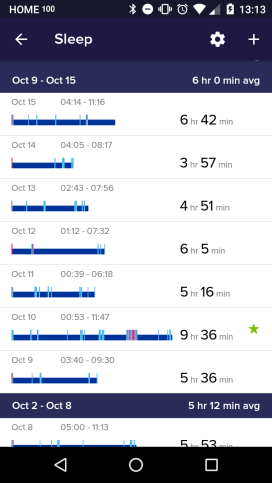
screenshot_20170201-131358

Here is a typical week for me back in mid-October, 2016.  As you can see, I was averaging less than 6-hours a week, and I would occasionally punctuate my sleepiness with a crash that would waste half a day by recuperating.  By the end of the academic term, I was turning into a zombie.  Things were starting to slide, I felt irritable, my weight had gone up; basically everything bad about not getting sleep was happening.  The only thing that thankfully did not happen was falling asleep behind the wheel.

A small part of me wore my fatigue like a badge of honour.  It was the natural consequence of hustling and being busy.  The problem with this is it was impressing no one, it was wearing me out, and it was pissing people off who I was failing to deliver to on my promises.

Something needed to change.

… And the Clock Strikes Twelve – New Year, New Rules

While I’m not a big new year’s resolutions guy, I saw the start of January as a good time to try and reclaim my sleeping habits.  I had wound down a bunch of my obligations, finished teaching, and was going to spend less time commuting for a long-distance relationship (the fiancee was moving back to my city), so January made sense to focus on cultivating a better sleeping habit.

Step one in any major change is to identify and isolate the variables you want to modify, and track the delta from your baseline.  After all, you can’t change what you don’t measure.

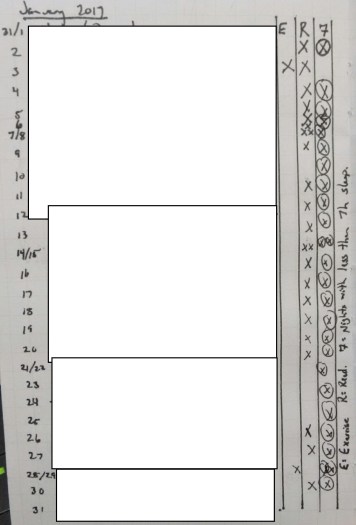
I set 7-hours as a good goal to strive towards as it was more sleep than I was used to but not an unreasonable jump that would set me up for failure.  I decided to track each day’s worth of sleep as a binary yes-no check in my notebook.  The Fitbit would auto-track my sleep, and I would manually log my sleep to ensure I was consciously paying attention to sleep.  I modified the Bullet Journal method and tracked the days I got less than 7-hours of sleep (alongside the days I read, and the days I exercised).

After one month, I look back at my progress.

img_20170201_131622
For privacy reasons, I’ve blocked out my calendar notes.

Yikes.

Needless to say, if January is my baseline, then at least I have nowhere to go but up.  I hit my target four times all month.  My reading habit was fairly strong, and my exercise is still abysmal.

Light on the Horizon

There is one thing that has changed in February so far that has given me hope: my fiancee has started a new job.

As of writing, she’s in her first week at her new job, and I have only now given notice to my apartment managers that I will be moving in with her, so I’m spending a few nights a week at her place to help support her as she starts the job.  This includes groceries, errands, and taking care of our dog.

Her new job is a few cities over, so she needs to commute about an hour each way, meaning she needs to get up before me and hit the road before I normal would wake up.  As a consequence, she needs to follow a fairly strict bed time while she adjusts to the new schedule.

At one point, I would have let her go to bed, then I would have gone to bed whenever I felt like it, and set my own alarm.  But, in the spirit of supporting her (and wanting to spend quality time with her), I’ve been going to bed at the same time as her, and getting up with her to tend to the dog’s morning needs.

The days where I’ve gotten 7+ hours of sleep have been the greatest I’ve felt in a long time.

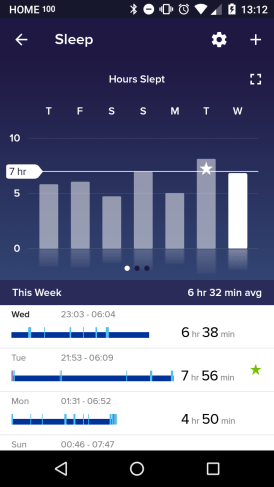
screenshot_20170201-131230
Wednesday would have been 7-hours if I hadn’t had restless sleep.  The Fitbit subtracts your restless period from the total duration of sleep.

Obviously, it’s too early to suggest that I’ve got my habit down, but subjectively I can report feeling better overall.  I have wanted to wake up early for some time now, and getting up with my partner has felt great.  I have time to enjoy my morning coffee while I read or listen to the news, and not feeling rushed out the door has lifted my spirits.  Ideally, I want to keep this going, so it’ll be interesting to see how the system adapts to other obligations in my life (working at the bar being the harshest pressure on my sleep schedule).

I know that rationally, sleeping is good.  It’s good for mental clarity, it’s good for decision-making, it’s good for general health as well as weightloss.  But knowing the facts has so far proven to be a challenge for me.  Perhaps focusing on my relationship and supporting my partner’s success is just the motivation I’ve needed to force me to take better care of myself.

We shall see where things go from here.

Stay Awesome,

Ryan

Blog – Breathing Room

This term has been killer for me.  I say “term” as a reflection of my added teaching load I’ve had since September.  I’ve been musing recently that I think I finally hit my stretch/break point.  Balancing all of my separate obligations is finally starting to test my ability to keep all the balls in the air.  In sum, these are the priorities I can think of off the top of my head:

  • Full time job at the college
  • Part time job at the bar
  • Part time job teaching
  • Treasurer of the ethics board I sit on
  • Podcasting
  • Maintaining this blog
  • Daily art project
  • Monthly mutual-improvement group meetings
  • Maintaining a long distance relationship
  • 2016 reading challenge (42 book finished as of last night)

These are just the things I’m managing to keep in the air.  Of course, to make space for these things, I’ve had to slack on some other priorities, namely:

  • Sleep (I’m averaging about 5.5 hours per night)
  • Nutrition (scaled back for budget reasons)
  • Gym (I’ve had a hard time justifying going for myself when I should be working)
  • Video game time (yes, this is a weird one, but I want more guilt-free downtime)
  • Other social time with friends (I rarely see friends outside of work or meetings)

These aren’t meant to be humble-brags.  I’m not one that thinks of “busy” as a badge of honour.  I know that busy people are notoriously unreliable in my circles.  There is a saying that if you want something done, give it to a busy person.  This is perhaps true in some cases, but in my experience the vast number of busy people tend to be chronically flakey on showing up and late on deadlines for deliverables.

Thankfully, there is some light at the end of the tunnel.  As of writing, I will be delivering my last lecture this week, and by December 21st I will be done with all course work grading.  Shortly after that, I’ll be on holidays from the College until the new year.  I’ll still have shifts at the bar, but those are select evenings.

Other aspects will change as well.  Podcasting will go on a holiday hiatus; the daily art project ends  at the end of December; and the long distance relationship will move back to a local distance relationship.  I will finally have some breathing room.  I plan to use that time to reflect on my obligations and regroup.  My birthday is coming up, and I always take that time to reflect on the past year as well as my current state of affairs with an eye towards my future.  This will be a well-deserved holiday break, when I finally get some breathing room.

Stay Awesome,

Ryan

My 2016 Reading List

2016 was a fairly productive year for me compared to 2015.  At the end of every year, I reflect on my life and sketch out a rough vision of how I want to tackle the new year.  Last year, I noted that I had read relatively few books (and completed even fewer).  Don’t get me wrong, I was reading a lot, but it was all online and typically blogs and articles.  My shallow reading was going strong, but my slow, in-depth reading with books was waning.

I felt a sense of shame at this realization – I had completed undergraduate and graduate studies in the Humanities, but my commitment to arts and letters was dismal at best.  I decided to use 2016 as a year to focus and develop myself.  Using a combination of physical and audio books I have, as of this post, read 41 books, which amounts to a hair under 13,000 pages of content.

See below for the complete list.  If I finish anything else before the end of 2016, I’ll ensure to issue an update.

Stay Awesome,

Ryan

Note – eagle-eyed readers will count 42 books on my list.  There is a book on my list that for personal reasons I’m not publicly disclosing.

Title Author Pages
Deep Work Cal Newport 304
The Way of the Superior Man David Deida 207
Intentional Living John C. Maxwell 288
The Power of Habit Charles Duhigg 416
The 4-Hour Work Week Timothy Ferriss 416
The Imperfect Board Member Jim Brown 224
Mate Tucker Max 384
The Art of Asking Amanda Palmer 352
The War of Art Steven Pressfield 190
The Way of Men Jack Donovan 192
Brave New World Aldous Huxley 272
Living in More Than One World Bruce Rosenstein 244
Man’s Search for Meaning Viktor Frankl 168
Start With Why Simon Sinek 256
Antifragile Nassim Taleb 544
Zero to One Peter Thiel 224
Level Up Your Life Steve Kamb 288
Quiet Susan Cain 368
The Willpower Instinct Kelly McGonigal 288
The $100 Startup Chris Guillebeau 304
The 4-Hour Body Timothy Ferriss 592
Leaders Eat Last Simon Sinek 256
A Thousand Naked Strangers Kevin Hazzard 288
Poorcraft: Wish You Were Here Ryan Estrada 132
The 7 Habits of Highly Effective People Stephen Covey 432
Essentials of Human Anatomy & Physiology Elaine Marieb 656
Born To Run Christopher McDougall 304
No Fears, No Excuses Larry Smith 272
Doctored Sandeep Jauhar 288
Wisdom Stephen Hall 352
The 48 Laws of Power Robert Greene 496
Awaken the Giant Within Tony Robbins 544
Tribes Seth Godin 160
Smarter Faster Better Charles Duhigg 384
Purple Cow Seth Godin 244
Free Prize Inside Seth Godin 256
Ego Is The Enemy Ryan Holiday 256
I Will Teach You To Be Rich Ramit Sethi 266
Thinking Fast And Slow Daniel Kahnaman 512
Born For This Chris Guillebeau 320
Total Pages Read
13,487 (revised)

Addendum

After this post went up, I added two more books to my list to round out 2016:

Title Author Pages
God is not Great Christopher Hitchens 320
Left of Bang Patrick Van Horne and
Jason Riley
228