A Late Merry Christmas 

Things have been hectic on my end. With the normal travel, family, holiday cheer and good eats (on top of grading, lack of exercise, strike recovery, etc), I wasn’t able to get a post up yesterday. Apologies if you were looking forward to reading something pithy in your pjays for Christmas.

I’ll have a new post up on January 8th. Until then, have a great rest of the holiday season and I’ll see you in the new year.

Stay Awesome, 

Ryan

Top books of 2017

On the internet, December marks the time of year where everyone releases lists of their top favourite things from the past year.  It’s my turn to add to that mighty tradition and announce my top books that I read in 2017.  I will post my total list of books read in 2017 in January.  For those curious, here are the 44 books I read in 2016.

Here are my top books that I read in 2017.

List Criteria:

For this post, I have three criteria notes.

  1. The book didn’t need to be published in 2017.  I’m nowhere near able to keep up with the new material getting pumped out every year, so for my list, I will include anything that I happened to read and complete in 2017.
  2. Having said that, I will only count books that I read for the first time in 2017.  You’ll see in my overall list of books for the year, there were a few books I revisited that I read in 2016.
  3. Finally, the biggest criteria for “best” is books that stuck with me – they gave me knowledge or wisdom that I use, or that has lasting mental/emotional impact.  This is admittedly a wishy-washy criteria, so to summarize, these are books that I found valuable to have read and I will likely re-read in the future.


Honourable Mention

The Art of Learning – Josh Waitzkin

This book goes on the honourable mention list because I haven’t finished reading it as of posting.  It’s really good, though, and would have made the list had I finished it in time.  Waitzkin is a bit of a wunderkind, having won chess championships as a child, then becoming a national push-hands championship, and now (post-book publication) has become a black belt in Brazilian Jiu-Jitsu.  I mention this because it gives credit to the idea that he’s given a lot of thought to the learning process, and his book provides many insights that I will use both as a student and as a teacher.


Top 5 Books (in no particular order)

American Gods – Neil Gaiman

I read relatively few works of fiction this year, but American Gods stuck out for me.  It’s been a while since I felt engrossed in a work of fiction the way I was for American Gods.  It was my first introduction to Neil Gaiman’s work, and it certainly won’t be my last.  I’m looking forward to checking out the television series.

The 80/20 Principle – Richard Koch

This is a book that I implemented at work with my role in program updating and renewals.  I took the 80/20 principle and started thinking about the relatively few problems that lead to massive delays in the program review process in order to find solutions to the workflow.  I didn’t get a chance to implement many changes before the Ontario College Strike put things on hold, but I’m looking forward to continuing the process when things even out a bit.

Never Split the Difference – Chris Voss

I wish I could say that I implemented the lessons from this book, but truthfully, I found it hard to absorb all the fine details from my first pass in the audiobook.  This book will be a prime candidate for a re-read in the near future, as I will be able to take my time and work through the material to assimilate the useful information in my work.

Discipline Equals Freedom – Jocko Willink

I think this one will end up being one of those books I pick up and thumb to a random page for an aspirational kick in the pants.  Jocko’s main lesson is that, paradoxically, if you want more freedom, you must get more disciplined.  That means doing what you need to do when you need to do it.  As he says, if you want more money, you need more financial discipline.  If you want a body that doesn’t let you down, you need to have discipline in diet and exercise.  As a former US Navy Seal, having this guy telling you to get on it, and why I have no excuses to stop is pretty powerful, even from the written word.

Tie: Mort and Pyramids – Terry Pratchett

This might be a cheat, but I simply couldn’t pick a favourite between these two.  Both have compelling stories, both have memorable characters, and both are awesome.  Mort is a story where Death looks for an apprentice, and Pyramids tells the story of a prince-turned-assassin who is recalled to rule when his father dies in a land resembling ancient Egypt.  Fantastical stories full of charm, and I laughed out loud while listening to them both.  Therefore, they make the list in a shared spot.

Keep an eye out for my complete 2017 list in January.  In the meantime, I really need to get on my Christmas shopping!

Stay Awesome,

Ryan
The Arts of Learning & Teaching

I’ve been in the apprenticeship phase of teaching for the last year, so I’ve largely been gaining experience in how information is conveyed and how to give feedback to students.  While I have given some consideration to course design and what kinds of courses I’d be interested in teaching, my primary focus has been on ensuring the students receive good content and (more importantly) good feedback on performance. Good performance management involves timely and specific feedback to either reinforce good behavioural outcomes, or quickly identifying and redirecting bad performance outcomes. It’s a challenge to ensure that feedback is both timely and useful, but it’s an important step of the process. 

I’m currently working my way through the Art of Learning by Josh Waitzkin, and I’ve started thinking about the process of learning.  While learning and teaching are separate domains, they are interconnected since they share similar goals.  However, being able to translate learning (whether being taught by a teacher or through self-teaching) into teaching to others is something that I have a lot of gaps in my knowledge about.

The first time I taught in-class in the college setting, I quickly became aware that my experiences with formal education (the university style lecture) was not a good mode of delivery to copy. While I am comfortable in the lecture setting, I saw that my students did not excel in that environment. I wish I could say that I had fixed my delivery before the end of the semester, but the reality is that I didn’t fully appreciate the situation until after the course was over and I reflected on the term. An environment where I stood at the front and spoke at length for two-hours was not one which the students could effectively absorb the material.

The problem I found is that how I think and absorb content is different from my students. Rather than teaching them to my style, I need to be more mindful of their talents and experiences. Waitzkin discusses this in his book, where he contrasts two kinds of teachers he’s had. One is the kind that teaches his own strengths and relies on rote memorization of strategies and techniques. In chess, this teacher has you studying opening moves to take early advantage of the board.  The other kind of teacher allows the student to play to their inner style, and teaches by building up concepts atomistically. In chess, this kind of teacher strip the board of all the pieces and focuses on the relationships between pieces at the end of the game. By showing how individual pieces play off each other, the student becomes comfortable across the game and learns not only how pieces fit together, but how to set yourself up for control at the end of the game.

I think my teaching style should embrace this second kind of teacher. Instead of dictating knowledge, I should focus on breaking the knowledge down and building up understanding in ways that make sense to the student. I can’t assume my students will have the prerequisite knowledge to compile the facts together on their own. It’s also the case that if I can’t break ideas down simply, the students might not get it, nor may I truly know what I’m talking about.  Afterall, Einstein and Feynman believed that if you couldn’t explain something simply, you probably don’t understand it very well yourself.

Stay awesome, 

Ryan

November 2017 Sleep Check-in

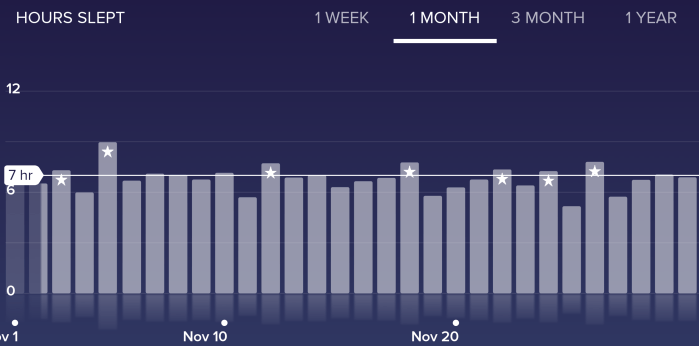
My stats from the October sleep check-in were below my target, so I was hoping to get things back on track for the month of November.  Let’s see how I did.

Screenshot_2017-12-03-21-40-56
7/30…

Double-ouch!

Not only did I miss my target again, but I did poorer overall than October (8 of 31).  Sadly, this is less an issue of poor quality sleep (you can still see a fair number of nights where I was really close to the target line, suggesting I was in bed for at least 7-hours, but I had disturbed sleep), and more a problem of me not having a solid night-time routine.  This time last year, my problem was that I couldn’t tear myself away from the internet at a reasonable time (remember when I used to shut-off my internet via timer?), whereas this year my problem is that my partner and I don’t get ready for bed at a decent time, and then stay up chatting passed 11pm.

I know that I will be doing better in December since I’ll have time off from work before and after Christmas, which will make up the bulk of the time I hit my sleep target.  Still, I should strive to hit more nights during the work-week, rather than leaving it up to the weekends to catch up on sleep.

Stay Awesome,

Ryan