What You Say “No” To

Last week I discussed some thoughts on being busy.  Near the start of the post, I made an off-hand comment about why I’m typically busy:

It’s often less of an issue of seeking achievement, and more the result of me absent-mindedly saying “yes” to obligations without regard to the impact it has on my time and calendar.

This is the perfect example of an answer to those interview questions of “what is a weakness of yours?”  It took a lot of self-reflection to realize that a lot of stuff I do is less because it fits within a plan, and more because it sounded like a cool thing at the time.  It was a habit I formed when I was single and life was simple.  However, as things started piling up, it made it really difficult to prioritize.  The most important things in my life (love, sleep, exercise, etc.) end up taking a back seat to those things that seemed cool when I said “yes” to an ask.

I was watching a video from Jon Call, aka Jujimufu on YouTube, and he was discussing email tips that he uses to stay organized.  However, around the 3:30 mark of the video, he drops a fascinating insight:

“If I said yes…, I’m basically saying ‘no’ to (my wife) Sam, I’m saying ‘no’ to (my friend) Tom, (and) I’m saying no to you guys…”

Whether you are talking about your email inbox, your work, or the important people in your life, it’s important to reflect on what you are saying “no” to when you decide to say “yes.”  It’s a hard lesson that I am still struggling with, and I’m thankful with how patient my loved ones have been.

I invite you to reflect on your own life: what are you saying “no” to?

Stay Awesome,

Ryan


“You’re an over-achiever”

Right off the top, I want to make clear that this post is not intended to be a humble-brag.  I’m hoping to use the observation in the title as a jumping-point for a meditation on my career and professional life.

I’m a busy guy.  It’s often less of an issue of seeking achievement, and more the result of me absent-mindedly saying “yes” to obligations without regard to the impact it has on my time and calendar.  I find it satisfying to be involved in all sorts of cool projects, but I also rationally know that “being busy” is a cop out.

Busy people are often flakey.

Busy people often use it as a status marker.

Busy people are often less effective than they believe.

That’s not to say that effective people aren’t busy.  However, I bet that the ratio of effective people to the merely busy is skewed.  But that’s besides the point.

The other day, a coworker and I were talking about career advancement and our track-records for interviewing for jobs and getting turned down.  I commented to my coworker that they could invest more in themselves through courses at the College.  They dismissed the idea as it didn’t fit their current career position (they are mid-career, so the investment in training has a lower return in their mind), but commented that it’s a good strategy for me.  Then they dropped the line from the title:

“You’re an over-achiever.”

The comment was meant in the context of working at the College, working as a bouncer at a bar, teaching, taking a class, podcasting, etc., and it wasn’t meant to be dismissive or condescending.

The funny thing is that I don’t associate “over-achiever” with me.  It’s not that I reject the idea being applied to me, but more that if I’m to associate words to describe me, it’s not one I would have thought of.  My colleague also referred to me as “ambitious,” which I would agree is a closer description of me, except I would code that word to be synonymous with “foolishly hoping for a good outcome”.

The problem I have with the concept of being an “over-achiever” is I associate it more with outcomes instead of process.  “Over-achievers,” to me, get results irrespective of how hard they may or may not work.  I’m critical of my successes because I don’t think I achieve a lot (especially relative to the effort I put in – how busy I am).

That’s the disconnect for me.  I often feel that for all my busyness, I’m not making a lot of headway.  I’m not landing jobs that I interview for, I have a lot of projects that are idle or slow-moving, and I’m constantly filling up my evenings with stuff to do while also wishing I had more downtime.

This might not be a fair evaluation of my professional life, but it’s a reflection of the standards I have on myself.  From a career perspective, I feel adrift and treading water.  Each day slips by as more time I didn’t use wisely towards some further goal.  Having these feelings hasn’t yet translated into action or a change of behaviour, and I don’t know if and when that might happen.

Other people I know (I won’t name names), whom I consider to have achieved something with their professional life, are also called under-achievers by people who know them best.  When I heard that, I compared it to my own life, and felt bad.  If they are under-achievers, what does that mean about me?

All is not lost.  During orientation at the college, I joked with some engineering students that I have two philosophy degrees and three jobs, so clearly I’m beating the odds.  I know that, rationally, I’m doing just fine; that I’m being too hard on myself, or I have unrealistic expectations on myself.  Progression through one’s career is about building (skills, knowledge, connections, etc).  It’s slow and methodical, not characterized by leaps forward.  I need to keep reminding myself of this.

Stay Awesome,

Ryan

What I’ve Been Reading (as of August 21st)

I enjoyed writing my last reading update from back in June, so I thought I’d give an updated list.  In full disclosure, I have only completed three of the five books I mentioned (the two outstanding books are Brooks’s Character and the biography of Cato), so I won’t include those on this list.

Here are five more books I’m reading at present.

Montaigne: A Life by Philippe Desan 

Considered the father of the modern essay, Montaigne has popped up in various references during my reading, from stoicism to observational commentary and timeless meditations.  I’m a sucker for biographies, and this book was recently released in English as a fairly authoritative account of Montaigne’s life, not as an extraction from his essays, but as a picture of the historical figure.

William Tecumseh Sherman: In Service of My Country: A Life by James Lee McDonough

Did I mention I’m a sucker for biographies?  This was a birthday present to myself last year, but I’ve only started digging into it.  Sherman is held up as an exemplar of restrained greatness.  He’s considered great in equal parts from talent, study, and luck (though often it was luck that helped him out).  But the reason why I picked this up was how he is often held up as a contrast to Ulysses S. Grant, another U.S. Northern Civil War General, who mismanaged his life and the U.S. Presidency after the war, whereas Sherman quietly continued his duties in the army until retirement and didn’t seek political office (or so I’ve heard, I haven’t read very far into the book).  Like Washington before him who declined to be the first king of the United States, I like reading about figures who manage to avoid the hard fall from grace after they acquire fame, power, or authority.  Also like Washington, I think it’s important to understand a full picture of history, warts and all.

168 Hours: You Have More Time Than You Think by Laura Vanderkam

I don’t actually own this book.  It was laying around my fiancee’s office for about a year, so I decided to start reading it one day and take it home.  I don’t expect a lot of insight from this book, but I do like reading anecdotes of how other people manage their time so that I can glean possible tips and tricks to apply to my own life.  In the last year or so, I’ve started being more mindful of my time, hence why my reading lists include a disproportionate amount of productivity and personal development books.

80,000 Hours: Finding a Fulfilling Career That Does Good by Benjamin J Todd

I’ve also been more mindful of my career recently.  With losing out on a few jobs recently (before and after interviewing), I’ve been considering my options for improving my career prospects through opening up opportunities, strategic skill acquisition, and relationship building.  While the content of this book is entirely online for free through the 80,000 Hours website, I purchased the book anyway to have all the information in one place.

Middlemarch by George Eliot

This book is brand new to the list as I only grabbed it from the library this past weekend.  I read about George Eliot (Mary Anne Evans) in Brooks’s Character book (from the last list) and I was struck by her lauding of the average person in her fiction.  I, like many others, have found myself buying-in to the aspiration to greatness narrative – that to have a good life also means to be great, have impact, and cement yourself in history.  Middlemarch, and many other books by Eliot/Evans, chooses to laud the quiet efforts of the average person, who does their part and is praiseworthy in their steadfastness.  Brooks quoted the closing lines of Middlemarch in Road to Character that celebrated humble lives,

“But the effect of her being on those around her was incalculably diffusive: for the growing good of the world is partly dependent on unhistoric acts; and that things are not so ill with you and me as they might have been, is half owing to the number who life faithfully a hidden life, and rest in unvisited tombs.

Stay Awesome,

Ryan

Vacation Time and the Gym

While on vacation, I had lots of free moments to address an issue I’ve discussed many times before – my poor track record with going to the gym to exercise.  While on vacation, I set the goal to attend the gym twice per week for the two-weeks I was home.  I didn’t set a specific time or day to go, only that I would make the effort.  Using the excuse log idea, I noted that when I didn’t feel like lifting heavy weights, I would commit myself to going and riding the bike for an hour.  As you can see below, I was successful in my goals.

Capture1Capture2

I noted a few observations that seemed to help spur me on to success.

  • I always strove to exercise while my fiancee was away at work.  That meant I would have more time with her when she was home since I had so much free time during the day to do anything else I wanted.  With this in mind, I knew that the closer I got to 5pm, the more likely I was to miss the window for the day to go to the gym.
  • Going during the day time, when everyone else was at work, was an amazing breath of relief.  While I may be passed the point of feeling super self-conscious about going to the gym, it was still refreshing to have a relatively empty gym to do whatever I wanted.
  • As noted above, my trips to the gym included both lifting weights and cardio-only sessions.  As part of my commitment, I knew that if I didn’t want to go, then I had to commit to just “30-min on the bike,” which I could turn into a full hour after I was already at the gym and sweating.
  • Getting dressed in my gym clothes at home also made it easier to go.  Maybe it’s because it cuts down on the overall time commitment, or because it primed me, or even because I always shower at home anyway (so why dirty street clothes?); whatever the reason, it helped.
  • I still couldn’t bring myself to go first thing in the morning.  I considered trying this during my vacation to see if I could potentially carry it over to when I returned to work.  This strategy would be the easiest to implement if I wanted to dedicate three days a week to the gym without sacrificing other obligations.
  • Likewise, I wanted to try swimming at an indoor pool once during my vacation as a form of exercise.  I was not able to make this happen.  I did, however, get time in the lake, so that should count for something.
  • I found the gym a good source of “therapy” when I was in a foul mood.

Overall, I’m happy with how things went and am looking to try and carry the 2-days/week practice into my normal routine.

Stay Awesome,

Ryan

“Up 30lbs over last year” – More Fitness Reflections

Happy Canada Day weekend for those who are observing it!

In preparation for the holiday, I’m writing this post a little early as I will be sans networked connection at the lake.  As of writing, I don’t yet have all of my sleep data recorded for June, so the typical sleep update will be delayed one week.

Instead, I want to briefly give some further health and fitness thoughts that I’ve been mulling over recently, in no particular order.


1. “I’ve put on some weight…”

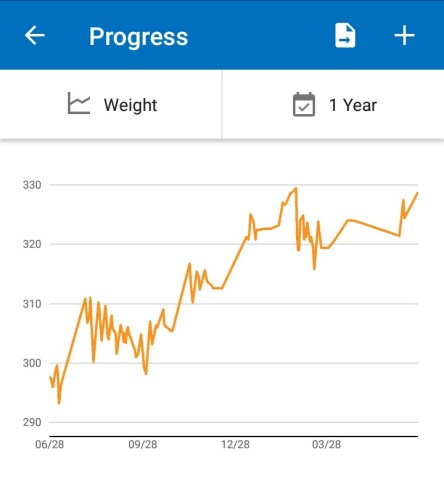
Exercise was a bigger part of my life last year, but I’ve recently recalled that my gym habit waned in the days before heading off to Scotland in July 2016.  Prompted by the realization that July starts next week, I looked up my weight stats for this time last year.  Ugly truth time!

IMG_20170627_120843
Starting Weight for June 27th, 2016 – 297.8lbs.  Starting Weight for June 27th, 2017 – 328.6lbs (+30.8lbs).


Needless to say, that’s a little disappointing.  Finding a system that I can stick to has been a challenge for a number of reasons that aren’t particularly compelling, and I’m disappointed in my progress so far.


2. Goal Setting with a Deadline

I realized that last Saturday was exactly 63 weeks away from our wedding day.  I’m hoping to leverage the not so far off wedding date as a concrete goal in my mind to spur action.  Every week that I do nothing in regards to exercise or fitness brings me one week closer to the wedding where I didn’t prepare.  With lots of lead-in, I have plenty of time to exercise safely to look good for my future-wife.


3. Tracking Excuses

I found a nifty idea on Reddit that I’m implementing in my notebook called the Excuse Log.   This will have the dual purpose of aiding purposeful reflection on why I don’t exercise when I plan to, and what I can do about it in the future.  In my notebook, I’ve penned in the table below:

Excuse Legitimate? Reality/Solution
 *What is the reason why I’m not going to the gym?  *Is this a legitimate reason?  I.e. would a good friend or professional excuse my absence based on this reason?  *If the excuse is not legitimate, reframe the problem to better reflect reality for next time. If the excuse is legitimate, what solutions can you implement to help you in the future.

This will help me be more mindful of those times when I didn’t exercise as I planned because I let my baser monkey brain trick me (you’re too tired, YouTube is more pleasant, you ate too big of a lunch, etc.).


4. Enjoy What You Do

I stopped rowing, ultimately, because I don’t enjoy cardio exercises all that much.  While it might be true that I like rowing over running, I truthfully don’t like rowing or running that much as compared to lifting weights, especially when it’s the only exercise I’m doing.

Going to the gym to lift weights comes with a whole host of mental barriers that I’ve thus far proven to be weak against.  I give in to temptation when I’m tired, I don’t have the discipline yet to hit the gym in the morning, I’m still self-conscious around others, and I seem to have an aversion to sweating.  Stacked together, I’ve got a lot of friction to fight against just to do the right thing.

A trick I’ve seen consistently in the exercise literature and the self-help sphere is to pick activities you like to do, because you’ll be more likely to stick to them.  I genuinely enjoyed going to the gym when life was simpler a year ago.  Now, having been away for so long, it’s hard for me to build up to the same level where I can coast on the routine.  I need a catalyst to help push me forward.  I need something I enjoy to be the keystone habit/activity that will force me to exercise.  John Green talked about it recently after completing his first half-marathon on his 100 Days YouTube channel.  In the video, he takes the advice that sticking to your fitness habits can be aided by signing up for competitions that you need to train for.

Recently, I participated in a crash course introduction to Brazilian Jiu Jitsu with some friends.  To say that it kicked my ass is a bit of an understatement; I was a hot, sweaty mess afterwards.  As of writing I still have bruises and broken blood vessels marking my upper arms and chest, and in the days afterwards I felt as though I had been run over by a mid-sized American pick-up truck.

And yet, I thoroughly enjoyed the experience.  In the past, I had also participated in a similar session for Krav Maga, and while I enjoyed it, too, the BJJ session was a lot more fun for me.  Despite what you may think about me moonlighting as a security guard, I’m not a big fan of striking combat.  I prefer grappling and restraint over throwing punches, so BJJ spoke to me on some level.

I’ve since looked up the fees and schedule offered by the recreation centre and I’ve been pondering whether I would want to join in on some of the drop-in classes.  To keep up and learn BJJ (or any martial art) would require me to improve my flexibility, mobility, and cardiovascular endurance; I’d also be more inclined to hit the weights to gain strength as well.  I haven’t made any decisions or commitments yet, but it’s something that’s been on my mind.

—–

Of course, this is all talk.  My problem is that I don’t translate talk into action.  All the best laid plans come unraveled when you can’t put the rubber to the pavement (worn cliched metaphors and all).  Or, as Mike Tyson has quipped, everyone has a plan until they get punched in the face.   In this case, lacking a solid fitness plan opens me up to the punches of day-to-day life, where every available excuse becomes a valid reason to not commit to exercise.

As I review this post, I realize the order I laid things out in creates a pretty good reflection of 1.) identifying the problem, 2.) setting a realistic timeline, 3.) anticipating roadblocks, and 4.) setting good plans of action.

I don’t know where this will go, but I’m curious to see what comes of it.

Stay Awesome,

Ryan


Books That Helped Me Connect With People

Last year, I made a concerted effort to read more.  Having reflected on what I had read in 2015, I was disappointed with how few books I read, so I made the conscious choice to change it.  While I’m not saying that every book I read in 2016 was transformative or personally edifying, I’ve found that reading more has changed some of my behaviours as I’m able to draw up the experience of others and see connections between ideas.

A perfect example from work has illustrated this for me.  At the College, we are in the middle of several program review cycles.  A few engineering programs in my portfolio are undergoing major program reviews and revision, while every program is also currently engaging in their yearly reflection.  As with any quality assurance process, the fact-finding and documentation phases are at best detail-orientated, and at worst an endless stream of forms and checkboxes.  If left unstructured, all parties involved find the process long, boring, and frustrating.

Part of my expanded role has been to provide support to the parties involved.  The upfront result is that I can provide easier access to information and a sense of continuity with other programs in the School of Engineering, while the backend result is that I can help keep these reviews from spiralling out of control and going way over time.

Last week, I received a very warm and heartening piece of feedback from a faculty member.  After spending 3-hours locked in a room with the program team, we emerged with a decent SWOT analysis and some potential action items.  A faculty member approached me and praised me for my facilitation.  He noted that sometimes faculty can put on an air of negativity towards change or events that are beyond their control, and he felt that not only had I done a good job of redirecting negativity into something more constructive, but I also added a lot of valuable insight into the process, despite not being an engineer myself.

I thanked him for his comments and reflected on the process.  I realized that a lot of the tricks I used during facilitation were borne from books and ideas I’ve read recently.  I would be lying if I pretended to have come up with these ideas by myself.  Instead, I want to credit some of the books I’ve read with helping me to do my job better.

The following books are offered as potential sources of information.  I’m not including them because they are the best or the only authorities in their domains.  Instead, I include them because I found something valuable within their pages; value that helped me do my job better.

In no particular order, and with some brief comments, here are books that helped me connect with people and do my job better.

***

How To Win Friends & Influence People by Dale Carnegie

Slight disclosure – I haven’t had a chance to finish this book!  Perhaps a bad choice to kick off this list, but of the material I read it was already incredibly valuable.  Sure, this book is quite dated and perhaps is a reflection of a era that we have since abandoned.  However, as a person who found connecting with people difficult, I found the simple advice of empathy and seeking to solve the problems of others from their point of view to be useful in the workplace.  I often approach problems more collaboratively and with an open ear to the issues concerning others, which makes working with faculty a lot more productive.

***

Never Split The Difference by Chris Voss

Another confession – I haven’t finished this book yet (I only started it last week).  Chris Voss was an FBI hostage and terrorist negotiator, and has distilled his experience into this book.  Many of his suggestions run counter-intuitive to previous practices, but his claim is that they are effective.  Am I negotiating for the lives of hostages with faculty?  Absolutely not.  But am I working to find common ground with a group of people with diverse and unique needs?  You betcha I am.  Negotiation is all about establishing a report and making a connection with the other person, and I found that information in this book helps to open those doors with people who may or may not be fully invested in the process (or have agendas of their own).

***

The 80/20 Principle by Richard Koch

Finally, a book I’ve finished reading!  Including this book is less about helping me communicate with others and instead has helped me think differently on what we, as a team, need to put our effort towards.  Not every problem is worthy of our attention.  Through this book, I gained an appreciation for understanding that there is often an imbalance between the number of things that cause the bulk of our problems.  I’ve since started playing around with our review process and am proposing a radical reversal of how we think of program reviews.  Early feedback from Chairs and the Dean are quite positive, so I think I’m onto something when I propose that we find the key performance indicators for the top reasons why college programs do poorly.

***

Leaders Eat Last by Simon Sinek

Rather than a practical application book (though don’t misunderstand me, there is a lot of practical advice found here), I found the leadership philosophies discussed in this book to be insightful.  In order to get a collection of people moving in the same direction, you need to focus on what’s important and establish a top-down view of the organization.  Leadership starts at the top, but you need to also ensure that the people all down the line are empowered with a sense of direction, purpose and autonomy, and most importantly, a sense of trust.  While I don’t pretend to lead the team of faculty I’m working with, I can take steps to set up a safe environment where we can be free to discuss hard ideas, and we have a common direction to push towards.

***

Left of Bang by Patrick Van Horne and Jason A. Riley

I’m not including this to suggest that working at a College is like being in a war.  However, the same principles that this book discusses that keep Marines alive in combat can also be applied in everyday life.  I originally read this book to help me identify danger as a security guard at the bar, but I’ve also found that cluing into behavioural and environmental cues helps me to connect with others.  You learn to pick up on subtle nuances about how others think and feel, which can help you avoid problems and find common ground to work together.  Combat might be the extreme outlier, but that doesn’t mean you can’t learn something from it.

***

Tribes by Seth Godin

Another leadership entry on this list to close things off.  While I don’t pretend to have any authority over my colleagues, I make sure to, at minimum, function as a supportive member of a team, and often provide leadership to help guide and decide the direction of the process.  This isn’t necessarily a top-down authoritative act, though.  Leaders need to help the group feel cohesive and unified, and more importantly, needs to give a sense of purpose and direction to the group.  At the College, we are seeking to provide the best educational experience for our students so that they go out and become supportive, contributing members of their communities (whether that’s the larger social community they live within, or the workplace they belong to).  To get people on board, you have to be willing to make others feel like they are a part of the team, rather than a means to your own ends.  We all have jobs to do, and we rely on others in order to do our own jobs, but that doesn’t mean you can make the process feel more like a collaboration.

***

Let me know what books you’ve found helpful to connect with others.  I’m always looking for book recommendations!

Stay Awesome,

Ryan
The Motivation of Failure

Last week, I was passed over on a job opportunity for a more qualified candidate.  Such is life, and I don’t bear any ill-thoughts for the results of the job search.  I’m disappointed, but not soured by the experience.  It’s an opportunity to learn and grow, and I find that more important to focus on than to give in to a fixed mindset of self-pity.

After the feelings of sadness ebbed, I found myself experiencing a different feeling – motivation.  This has happened a few times in my life, and it was strange to be reaquainted with it.  There have been a few critical moments in my life where I failed at something important, and that failure created a fire within that motivated me.

It happened when I climbed Mount Kenya in 2007 after I failed my summit in the summer of 2003 of a mountain in Alberta whose name I’ve forgotten.

It happened when I joined the Campus Response Team and became a Coordinator after I failed twice to be a residence don.

And it happened again last week when I wasn’t selected for the job.  The self-critical sadness was overtaken by a motivation to go to the gym.

As I’ve written previously, It’s been a while since I’ve visited the gym.  According to my fitness journal, the last time I was in the gym was around Hallowe’en.  I’ve been rowing this last month a few times a week in the mornings, but I haven’t lifted iron in around five months.

Initially, I stopped going to the gym after my routine was disrupted by travelling to Scotland.  Then I didn’t go out of laziness, and then I didn’t go because I didn’t feel like I could justify going to the gym when I was supposed to be marking assignments and prepping my lectures.  By the time December rolled around I had regained my weight, but I also proposed to my fiancee, and started the planning process for moving out of my apartment.  Along the way, I was tired from a lack of sleep and dissatisfied with what I saw in the mirror.  Yet, it was never enough to overcome my inertia.

Failing to get the job was the final push I needed to hit the gym.  Maybe I needed a physical outlet to vent some frustration.  Maybe it was a form of punishment.  I’d like to think it was something more constructive – I accepted that I failed but I also saw that I could do better next time.  It is within my power to learn from the experience and grow.  The failures seemed to stack until it hit a critical mass; a line was crossed that set off the warning bells that I was heading in a direction I didn’t want to go.

It was time to make the first step and correct my course.


I vlog occasionally for my buddy’s YouTube channel, Artpress, and posted this immediately after I got out of the gym.

So, I hit the gym and pumped some iron.  I was nervous to go back as a beginner again, and overcoming inertia was incredibly uncomfortable, but I did it.

Now the trick is to keep it up.  That’s, perhaps, the greater challenge I face.


Stay Awesome,

Ryan

I Don’t Interview Well

I had my interview on Friday for the new position I discussed last week.  At present, I haven’t heard anything back, and I don’t expect any news until probably tomorrow at the earliest.  Regardless if I get the job or not, I find value in the experience and I’m glad I attempted to advance myself at the College.

I tend to be fairly critical of myself, and the interview was no exception.  While I wouldn’t say it was a bad interview, I felt like I made a few mistakes that were easily avoidable if I were more mindful.  You see, a couple of times in the past, I’ve received feedback on my interviews that I am a tad verbose.  Actually, one friend commented that I’m like a fire-hose when I talk.  I tend to blast the person I’m talking to with all sorts of information.  In some contexts, this is a good thing, but in an interview, it’s better to side with caution and aim for brevity.

Friday was no exception.  I’ll give you a perfect example of this in action:

Interviewer: “Just a few more quick questions – first, does your current manager know you applied for this position?”

Me: “Yes… I was conflicted about applying for the position because of the loyalty I feel to the department and the School of Engineering, so I spoke with my boss about it last week.”

*I look down at the Interviewers sheet of paper and under that question is written one word: Yes.*

*Headsmack*

There were a few other things that tripped me up a bit, but overall it was a good interview in my opinion.  I realize that I’m always critical of myself, and rather than seeing it as a failure on my part, I try to frame the experience as a growth opportunity.

Hopefully I am the right candidate for the job, but if I don’t get the job, at least I know I was good enough to give it a shot.

Stay Awesome,

Ryan

Work Loyalty

I’ve got this problem with loyalty.  Well, it’s not a problem per se.  It’s a problem for me, but it’s great for my employer.  This might be a product of my tenancy to let inertia guide me, but when it comes to career progression, I tend to avoid rocking the boat as much as possible.

I’ve been at my current full-time job for 3.5 years.  I feel lucky that I got the job initially, and I’ve been fortunate enough to be surrounded by wonderful people who are committed to making the School of Engineering what it is.  There are obviously little petty stuff here and there, but it’s par for the course when you have to work on teams.  I, without reservation, like working with all the people I interact with on a regular basis.

I started here as a lowly research assistant on a 9-month contract.  I got lucky when my position’s predecessor decided to retire and positioned myself to be the likely next person in line.  I was hired to fill the outgoing assistant’s job, and I’ve been steadily building myself since by accepting new challenges and seeking out ways to improve my profile (getting involved in program reviews, offering my analysis to the Chairs, accepting bigger projects, teaching, etc.).  But I have always been in the same position in the same office.  My boss has encouraged me to keep an eye on career advancement within the college, as my talents are well beyond what my original role was intended for.  I appreciate that my boss, whom has a vested interest in me staying in my current role, has always encouraged me to be open to advancement.

When I was given the opportunity to teach, I felt conflicted bringing it to my boss.  I was worried that it would signal a disinterest in my job, that I was keeping one foot out the door in case I wanted to bolt.  I pitched the job to her as an opportunity to broaden my experience at the College.  She was supportive, and I had nothing to worry about.

A few weeks back, a new job was posted within the College.  It’s a few pay-grades above where I am, and will expose me to some pretty high-up work across the entire College.  One part of me wanted to go for the job – it’s about a 10% raise minimum, it’s an entirely new role for me on a new campus, I like the people I’ll be working with and for, it’s a soft-reboot for my job, and it puts me in touch with the highest levels of administration at the College.  That alone should have had me applying automatically.

But what held me back was the loyalty I felt to my department.  My boss and I have been working on formally redefining my job so that I would qualify for a higher pay-band (we are bound by the union rules, so she can’t arbitrarily change my salary; I am stuck on the prescribed annual raise amounts).  She has been giving me more autonomy and responsibilities over my projects and the work I am doing is both valued and appreciated by the Chairs and faculty I interact with.  Plus, I’m in the middle of some big program reviews, so leaving partway through would be an inconvenience for others.

I consulted with peers at the College, I talked it over with my fiancee, and with my supervisor at the bar for different views.  I know, deep down, that loyalty to a company doesn’t necessarily make sense.  The company isn’t necessarily loyal to me (though I feel that my supervisors and boss look out for me, so there is loyalty there on an interpersonal level).  But clinging to loyalty means I don’t grow and expand exponentially within my role.  Instead, it would be a slow, iterative progression up the ladder.

As a final move, I spoke to my boss about the opportunity.  After our regular monthly check-in, I told her that I was interested in the position.  She looked it over and flatly told me that while she’d hate to lose me, it would be a shame if I didn’t at least throw my hat in on something she couldn’t offer me (salary-wise).  In the end, she knows the game: people are expected to grow and fill opportunities that they stumble into.  I wouldn’t be quitting my job since it’s an internal position at the College, so there was no harm in applying and continuing to work as per normal.  She gave me her blessing, I revised my resume, and applied to the job last weekend.  I think my boss appreciated the heads-up, just in case.

An hour ago, I received a notice from HR that I’m being offered an interview in a week for the job.  As of writing, I have no idea how this will turn out, but I guess this means I know what I need to do this next week – it’s time to dust-off my interview skills.

Stay Awesome,

Ryan