It’s sleep check-in time! After the progress I made in July, I was curious to see if I could both hit my target 10-times, and if I could hit it intentionally, rather than the result of vacation rest.
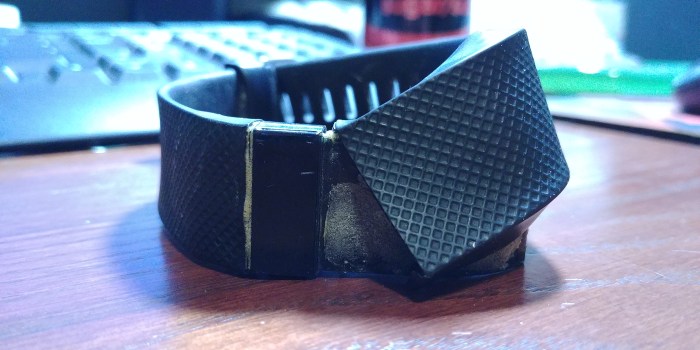
There was a hiccup in my plans, though, as I had to finally retire my old Fitbit unit when the patch job I used to keep the band from separating from the hardware gave out again.
When the unit started showing signs of damage from the band coming apart last year, I had notified Fitbit’s customer service and they sent me a replacement unit. The watch itself wasn’t damaged, so I used glue to repair the band and continued to use it. However, over time the adhesive wore off, and I figured it was time to make the switch.
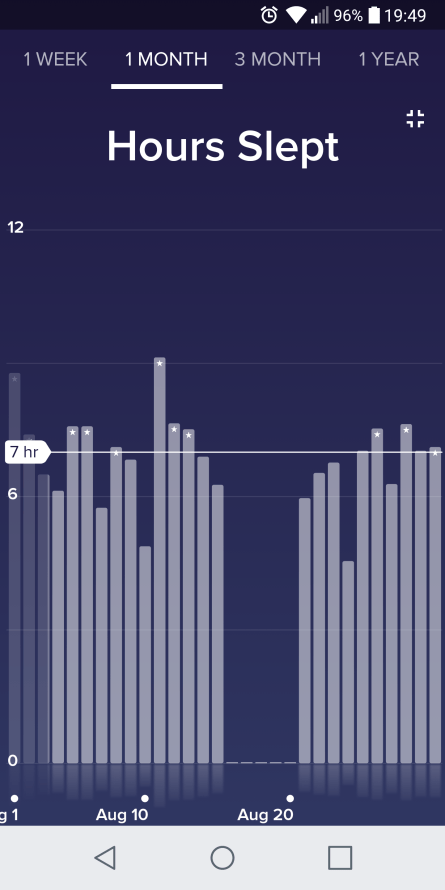
That wasn’t the hiccup, though. The problem I had was that I didn’t do a final sync to transfer data from the unit before I deleted the unit from my phone and synced up the new device. As a result, I lost about a week’s worth of data.
11/31
The unfortunate result is that 5 days of data is gone. Of the missing days, I think I can charitably say that I hit 7-hours or more of sleep once (on a Sunday). However, without the data to show for it, I’ve decided to live with the loss.
Nevertheless, of the data that remains, I hit 11 nights of sleep for the month, hitting the target I set for myself! A small disclaimer that deserves to be mentioned: my vacation from work spanned the last week of July and the first day of August, meaning that the first day of the month where I hit over seven-hours of sleep was during vacation time. Similarly to last month, I don’t consider this typical as I’m trying to be intentional with my sleep schedule while juggling my various responsibilities.
Regardless, I consider this a successful month and am looking forward to carrying the momentum forward into September.
I enjoyed writing my last reading update from back in June, so I thought I’d give an updated list. In full disclosure, I have only completed three of the five books I mentioned (the two outstanding books are Brooks’s Character and the biography of Cato), so I won’t include those on this list.
Considered the father of the modern essay, Montaigne has popped up in various references during my reading, from stoicism to observational commentary and timeless meditations. I’m a sucker for biographies, and this book was recently released in English as a fairly authoritative account of Montaigne’s life, not as an extraction from his essays, but as a picture of the historical figure.
Did I mention I’m a sucker for biographies? This was a birthday present to myself last year, but I’ve only started digging into it. Sherman is held up as an exemplar of restrained greatness. He’s considered great in equal parts from talent, study, and luck (though often it was luck that helped him out). But the reason why I picked this up was how he is often held up as a contrast to Ulysses S. Grant, another U.S. Northern Civil War General, who mismanaged his life and the U.S. Presidency after the war, whereas Sherman quietly continued his duties in the army until retirement and didn’t seek political office (or so I’ve heard, I haven’t read very far into the book). Like Washington before him who declined to be the first king of the United States, I like reading about figures who manage to avoid the hard fall from grace after they acquire fame, power, or authority. Also like Washington, I think it’s important to understand a full picture of history, warts and all.
I don’t actually own this book. It was laying around my fiancee’s office for about a year, so I decided to start reading it one day and take it home. I don’t expect a lot of insight from this book, but I do like reading anecdotes of how other people manage their time so that I can glean possible tips and tricks to apply to my own life. In the last year or so, I’ve started being more mindful of my time, hence why my reading lists include a disproportionate amount of productivity and personal development books.
I’ve also been more mindful of my career recently. With losing out on a few jobs recently (before and after interviewing), I’ve been considering my options for improving my career prospects through opening up opportunities, strategic skill acquisition, and relationship building. While the content of this book is entirely online for free through the 80,000 Hours website, I purchased the book anyway to have all the information in one place.
This book is brand new to the list as I only grabbed it from the library this past weekend. I read about George Eliot (Mary Anne Evans) in Brooks’s Character book (from the last list) and I was struck by her lauding of the average person in her fiction. I, like many others, have found myself buying-in to the aspiration to greatness narrative – that to have a good life also means to be great, have impact, and cement yourself in history. Middlemarch, and many other books by Eliot/Evans, chooses to laud the quiet efforts of the average person, who does their part and is praiseworthy in their steadfastness. Brooks quoted the closing lines of Middlemarch in Road to Character that celebrated humble lives,
“But the effect of her being on those around her was incalculably diffusive: for the growing good of the world is partly dependent on unhistoric acts; and that things are not so ill with you and me as they might have been, is half owing to the number who life faithfully a hidden life, and rest in unvisited tombs.
Having rested up from my vacation, it’s time to do my sleep check-in for the month of July. During my last check-in, I set the goal of hitting my sleep target at least 10 times in the month.
Let’s see how I did:
11/31
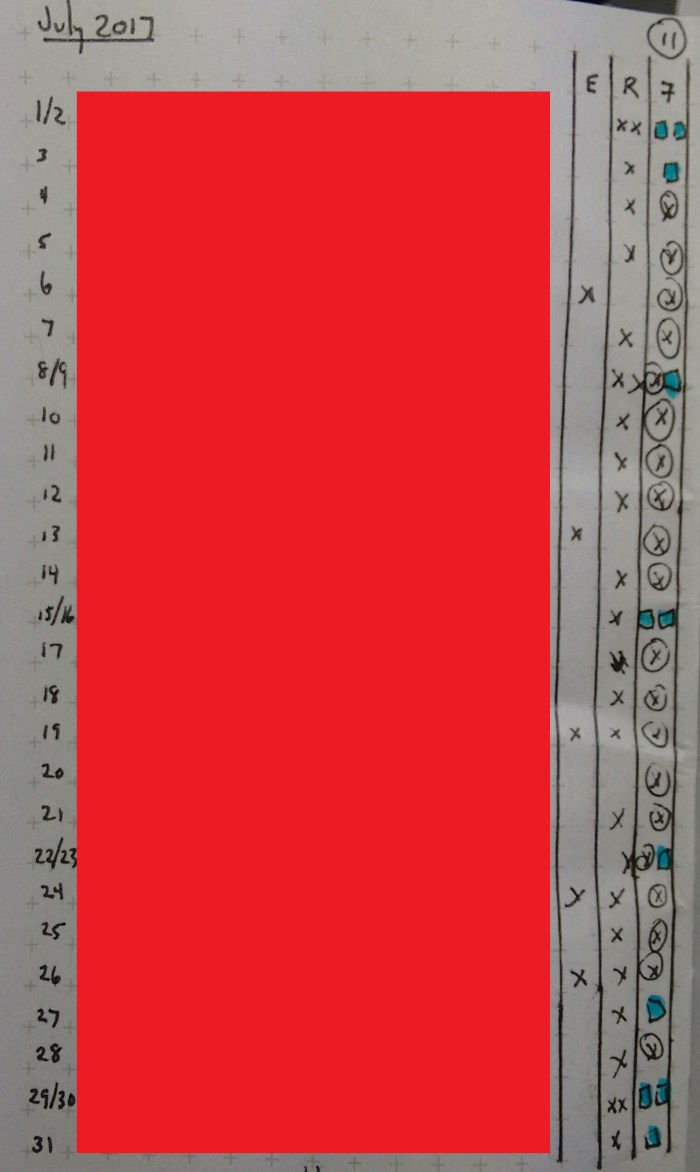
July proved to be a good month for sleep! I hit my target 11 times out of 31 days, or 35%. This is the best I have achieved since I started tracking my sleep at the start of the year.
Having said that, I do want to provide some context that will dampen the accomplishment a bit. The blocks of sleep at the start and end of the month (6-days) were during vacation periods – the start of the month was the Canada Day long weekend, and the block of time at the end were when I took 2-weeks off from my jobs and went to the cottage with my fiancee. Because she took time off, we both were able to sleep in and get lots of rest.
This means that had I not had that time off from work, I would likely have only hit my target around 5-6 times, which goes against my stated aim last month of hitting my sleep goals by being more mindful and intentional with my bedtimes.
So, while I can celebrate this month of more concentrated rest, I have to keep in mind that my habits themselves have not changed around sleep.
Therefore, I will keep my target going, and I will aim to hit my goal another 10-times in August. This will be a better measure of whether I can keep the trend going strong.
I was reading Mark Manson’s latest post last week and I connected with a simple truism that I often lose sight of. While I wouldn’t say that “hacking” productivity is the main thing I’m concerned with, if you were to poll close friends of mine, they’d probably label me as that kind of person.
You can read the full post here, but I’ve bolded the important part here:
There is no such thing as an optimum life. Sure, there are some habits and actions that are healthier than others. But the 80/20 here is pretty simple: just don’t fuck up the big stuff.
My fiancee and I had an argument recently. We were arguing over whether we should consolidate our cellphone plans under one carrier and share any of the benefits it may afford. Of course, the argument itself was a little stupid because what we were arguing over was slightly deeper issue around my desire to be in control. I may be laissez faire in many things, but my fiancee is often finding me stubbornly pig-headed in a few key areas that relate to finances and things I consider wasteful (overpaying for cell services I don’t actually need, using the AC all the time, leaving lights on, etc.).
Most instances of control around finances for me stems from wanting to set up systems that take care of the critical items – loan repayments, paying off other debts, savings, etc. I want to set up systems so that when they are up and running, I want to ignore them and focus on other things. I don’t want to go back in and have to constantly tweak the system to make up for bad habits and behaviours on my part.
Yet, sometimes my focus on the system can lead me to concern myself with the stupid nitty-gritty details. In this, I can focus too much on the little things and end up having stupid arguments about how I don’t want to switch a cell carrier because my system already works for me.
It’s important to remember to get the big things right and not sweat the small stuff. Rather than thinking I can set up an independent system (a relatively little thing) it’s more important for me to focus on the big things like having open conversations with my partner as we plan our future together, rather than taking pride in being unreachable by phone outside of major cities.
Back in January, I bought a new pair of running shoes for the gym. I had owned my old ones for a *long* time – I remember using those shoes more than a decade ago when I was exercising before my trip to Kenya. Those shoes were… well beyond worn.
I elected to get some Converse shoes as I hear that they are good for things like deadlifts, where you want solid contact with the ground (some of the pros deadlift barefoot). Since I like deadlifts, I thought I’d listen to people who seem to know what they are doing, and so I bought new shoes. I remember the feeling I had when I exited the store. I immediately wanted to hit the gym and try them out. There is something about new clothes that gives you a bit of a motivational kick.
Fast-forward to the present, I’ve been struggling a bit with maintaining a consistent schedule with going to the gym. Last week, I was checking out some blog posts from a fitness YouTuber that I’ve recently started following – Jon Call, aka Jujimufu. Seriously, the guy is freaking inspiring to me; I love his attitude and personality on camera. I’m not ashamed to admit I also may have a bit of a man-crush on him.
Try training in new outfits. When you feel like a bad ass because you think you look cool, you perform better. Owning the idea that you look great motivates you. Beef up your training wardrobe and suddenly you’ll want to train sometimes exclusively as an excuse to wear cool training outfits. Cool outfits kill training boredom.
Crimson Zubaz pants + wrist bands + face paint = Just another Jujimufu outfit.
I remembered back to when I bought the shoes, and how jazzed I felt to hit the gym, so I took this advice and hit up a local sporting goods store. To aid with my training, I bought three Under Armour tee-shirts, a pair of shorts, and some wrist-bands for wiping brow sweat. I like the design of UA shirts, and I find their fabric blend helps keep me cool in the gym.
With my new shirt in hand, I drove straight from the store to the gym to try it out. As expected, I felt really good wearing the shirt and I had a good workout.
While I can’t use this strategy all the time to find motivation, I’ll have to keep it in mind that shaking up the wardrobe could be just the trick I need in the future.
For more suggestions on how to kill training boredom, I suggest reading the full article or searching out Jujimufu online.
At the close of my May sleep check-in, I indicated that if I didn’t improve my sleeping habits over June, (that is, to be more mindful of the process), that I would set targets in July. Let’s see how I fared.
7/30
On the surface, I would say that I’ve done better during June than I did in May. In May I only hit 4 nights of 7+ hours of sleep, and in June I hit my target 7 times. Superficially, I have succeeded.
However, I don’t consider this a success as I’m clearly not mindful of my habits. You can see this manifested in where I’m most commonly hitting my targets: Sundays. Four out of the seven instances where I slept 7 or more hours were on Sundays where I was allowed to sleep in, and I didn’t work at the bar the night before (where I would normally be awake until 3am or later). This is not the result of me being busy most of the week, but instead the result of me not being mindful of my night-time routines and not getting into bed until 11pm.
And so, as promised, in July I’m setting a target. I will be aiming for 10-nights of getting 7+ hours of sleep. It’s a little ambitious as I typically don’t do better than 7 nights per month, but I think it is a manageable target.
Happy Canada Day weekend for those who are observing it!
In preparation for the holiday, I’m writing this post a little early as I will be sans networked connection at the lake. As of writing, I don’t yet have all of my sleep data recorded for June, so the typical sleep update will be delayed one week.
Instead, I want to briefly give some further health and fitness thoughts that I’ve been mulling over recently, in no particular order.
1. “I’ve put on some weight…”
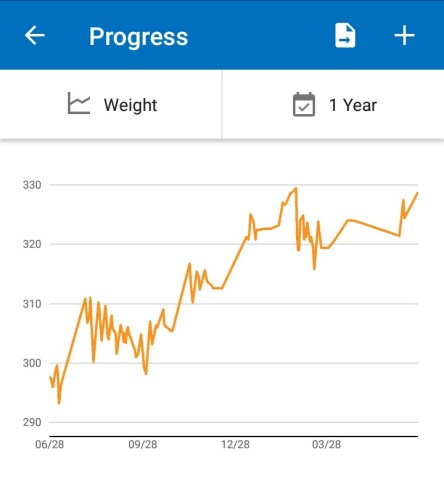
Exercise was a bigger part of my life last year, but I’ve recently recalled that my gym habit waned in the days before heading off to Scotland in July 2016. Prompted by the realization that July starts next week, I looked up my weight stats for this time last year. Ugly truth time!
Starting Weight for June 27th, 2016 – 297.8lbs. Starting Weight for June 27th, 2017 – 328.6lbs (+30.8lbs).
Needless to say, that’s a little disappointing. Finding a system that I can stick to has been a challenge for a number of reasons that aren’t particularly compelling, and I’m disappointed in my progress so far.
2. Goal Setting with a Deadline
I realized that last Saturday was exactly 63 weeks away from our wedding day. I’m hoping to leverage the not so far off wedding date as a concrete goal in my mind to spur action. Every week that I do nothing in regards to exercise or fitness brings me one week closer to the wedding where I didn’t prepare. With lots of lead-in, I have plenty of time to exercise safely to look good for my future-wife.
3. Tracking Excuses
I found a nifty idea on Reddit that I’m implementing in my notebook called the Excuse Log. This will have the dual purpose of aiding purposeful reflection on why I don’t exercise when I plan to, and what I can do about it in the future. In my notebook, I’ve penned in the table below:
Excuse
Legitimate?
Reality/Solution
*What is the reason why I’m not going to the gym?
*Is this a legitimate reason? I.e. would a good friend or professional excuse my absence based on this reason?
*If the excuse is not legitimate, reframe the problem to better reflect reality for next time. If the excuse is legitimate, what solutions can you implement to help you in the future.
This will help me be more mindful of those times when I didn’t exercise as I planned because I let my baser monkey brain trick me (you’re too tired, YouTube is more pleasant, you ate too big of a lunch, etc.).
4. Enjoy What You Do
I stopped rowing, ultimately, because I don’t enjoy cardio exercises all that much. While it might be true that I like rowing over running, I truthfully don’t like rowing or running that much as compared to lifting weights, especially when it’s the only exercise I’m doing.
Going to the gym to lift weights comes with a whole host of mental barriers that I’ve thus far proven to be weak against. I give in to temptation when I’m tired, I don’t have the discipline yet to hit the gym in the morning, I’m still self-conscious around others, and I seem to have an aversion to sweating. Stacked together, I’ve got a lot of friction to fight against just to do the right thing.
A trick I’ve seen consistently in the exercise literature and the self-help sphere is to pick activities you like to do, because you’ll be more likely to stick to them. I genuinely enjoyed going to the gym when life was simpler a year ago. Now, having been away for so long, it’s hard for me to build up to the same level where I can coast on the routine. I need a catalyst to help push me forward. I need something I enjoy to be the keystone habit/activity that will force me to exercise. John Green talked about it recently after completing his first half-marathon on his 100 Days YouTube channel. In the video, he takes the advice that sticking to your fitness habits can be aided by signing up for competitions that you need to train for.
Recently, I participated in a crash course introduction to Brazilian Jiu Jitsu with some friends. To say that it kicked my ass is a bit of an understatement; I was a hot, sweaty mess afterwards. As of writing I still have bruises and broken blood vessels marking my upper arms and chest, and in the days afterwards I felt as though I had been run over by a mid-sized American pick-up truck.
And yet, I thoroughly enjoyed the experience. In the past, I had also participated in a similar session for Krav Maga, and while I enjoyed it, too, the BJJ session was a lot more fun for me. Despite what you may think about me moonlighting as a security guard, I’m not a big fan of striking combat. I prefer grappling and restraint over throwing punches, so BJJ spoke to me on some level.
I’ve since looked up the fees and schedule offered by the recreation centre and I’ve been pondering whether I would want to join in on some of the drop-in classes. To keep up and learn BJJ (or any martial art) would require me to improve my flexibility, mobility, and cardiovascular endurance; I’d also be more inclined to hit the weights to gain strength as well. I haven’t made any decisions or commitments yet, but it’s something that’s been on my mind.
—–
Of course, this is all talk. My problem is that I don’t translate talk into action. All the best laid plans come unraveled when you can’t put the rubber to the pavement (worn cliched metaphors and all). Or, as Mike Tyson has quipped, everyone has a plan until they get punched in the face. In this case, lacking a solid fitness plan opens me up to the punches of day-to-day life, where every available excuse becomes a valid reason to not commit to exercise.
As I review this post, I realize the order I laid things out in creates a pretty good reflection of 1.) identifying the problem, 2.) setting a realistic timeline, 3.) anticipating roadblocks, and 4.) setting good plans of action.
I don’t know where this will go, but I’m curious to see what comes of it.
I stumbled across an interesting thought recently while browsing Quora. Apologies for the morbid nature of this post.
A member of the Quora community asked about what happens to cadavers after medical students are finished with them, to which user Daniel Lim offer this answer regarding medical schools in Taiwan. You can read his full answer linked here.
“The students spend a year dissecting the body, and at the end replace the organs and sew back the skin. They then conduct a mass remembrance ceremony and funeral for the Silent Mentors.”
The concept of the silent mentor is bound up in the following quote from Li He-zhen:
“I will give you my body to experiment; you can make as many mistakes on me, but never make a mistake on the patient.”
I found this to be a power quote that exemplifies an element of education that is sometimes overlooked in the modern economy. From my experiences, higher education is often seen as training first, before considerations of growth and development. When you complete your program, you will have been signed-off as competent in a field. This competence is granted after a series of lectures and tests; tests that you must not fail.
But failure is almost always viewed negatively. Bad grades are seen as a sign of deficiency – you are not smart if you are getting bad grades. Failure is costly to students as it sets them back, which costs time, money, reputation, etc. Education is cut-throat in the modern economy and everyone is in competition for a scarcity of jobs. If you fail, you are moved backwards relative to the pack.
Yet, failure can be an opportunity. It’s a chance to see where you have avenues of growth and development. Rather than seeing failure as an end-point, failure should be viewed constructively as the points that we need to focus on. Teachers shouldn’t be seen as punishing students for failing, nor should students be seen as inadequate for failing. Students should have permission to fail. School is the best time to fail, because the stakes (tuition notwithstanding) are so low. It’s a chance to test ideas, try things out and learn from the outcomes. Making mistakes should be instructive. Expertise is not just knowing the right answers, but also about having a powerful command of all the mistakes that are possible, too. Teacher have an obligation to instruct pupils properly, not to attempt to download the contents of their brains into the minds of the students. Education does not work that way.
If we approach failure this way, and encourage making mistakes in safe environments like school, then students will be better prepared to succeed when something as precious as life is on the line.
You can read further on the topic of the medical education and use of cadavers in Taiwan here and here.


 A Paramedic's Notebook