Books That Helped Me Connect With People

Last year, I made a concerted effort to read more.  Having reflected on what I had read in 2015, I was disappointed with how few books I read, so I made the conscious choice to change it.  While I’m not saying that every book I read in 2016 was transformative or personally edifying, I’ve found that reading more has changed some of my behaviours as I’m able to draw up the experience of others and see connections between ideas.

A perfect example from work has illustrated this for me.  At the College, we are in the middle of several program review cycles.  A few engineering programs in my portfolio are undergoing major program reviews and revision, while every program is also currently engaging in their yearly reflection.  As with any quality assurance process, the fact-finding and documentation phases are at best detail-orientated, and at worst an endless stream of forms and checkboxes.  If left unstructured, all parties involved find the process long, boring, and frustrating.

Part of my expanded role has been to provide support to the parties involved.  The upfront result is that I can provide easier access to information and a sense of continuity with other programs in the School of Engineering, while the backend result is that I can help keep these reviews from spiralling out of control and going way over time.

Last week, I received a very warm and heartening piece of feedback from a faculty member.  After spending 3-hours locked in a room with the program team, we emerged with a decent SWOT analysis and some potential action items.  A faculty member approached me and praised me for my facilitation.  He noted that sometimes faculty can put on an air of negativity towards change or events that are beyond their control, and he felt that not only had I done a good job of redirecting negativity into something more constructive, but I also added a lot of valuable insight into the process, despite not being an engineer myself.

I thanked him for his comments and reflected on the process.  I realized that a lot of the tricks I used during facilitation were borne from books and ideas I’ve read recently.  I would be lying if I pretended to have come up with these ideas by myself.  Instead, I want to credit some of the books I’ve read with helping me to do my job better.

The following books are offered as potential sources of information.  I’m not including them because they are the best or the only authorities in their domains.  Instead, I include them because I found something valuable within their pages; value that helped me do my job better.

In no particular order, and with some brief comments, here are books that helped me connect with people and do my job better.

***

How To Win Friends & Influence People by Dale Carnegie

Slight disclosure – I haven’t had a chance to finish this book!  Perhaps a bad choice to kick off this list, but of the material I read it was already incredibly valuable.  Sure, this book is quite dated and perhaps is a reflection of a era that we have since abandoned.  However, as a person who found connecting with people difficult, I found the simple advice of empathy and seeking to solve the problems of others from their point of view to be useful in the workplace.  I often approach problems more collaboratively and with an open ear to the issues concerning others, which makes working with faculty a lot more productive.

***

Never Split The Difference by Chris Voss

Another confession – I haven’t finished this book yet (I only started it last week).  Chris Voss was an FBI hostage and terrorist negotiator, and has distilled his experience into this book.  Many of his suggestions run counter-intuitive to previous practices, but his claim is that they are effective.  Am I negotiating for the lives of hostages with faculty?  Absolutely not.  But am I working to find common ground with a group of people with diverse and unique needs?  You betcha I am.  Negotiation is all about establishing a report and making a connection with the other person, and I found that information in this book helps to open those doors with people who may or may not be fully invested in the process (or have agendas of their own).

***

The 80/20 Principle by Richard Koch

Finally, a book I’ve finished reading!  Including this book is less about helping me communicate with others and instead has helped me think differently on what we, as a team, need to put our effort towards.  Not every problem is worthy of our attention.  Through this book, I gained an appreciation for understanding that there is often an imbalance between the number of things that cause the bulk of our problems.  I’ve since started playing around with our review process and am proposing a radical reversal of how we think of program reviews.  Early feedback from Chairs and the Dean are quite positive, so I think I’m onto something when I propose that we find the key performance indicators for the top reasons why college programs do poorly.

***

Leaders Eat Last by Simon Sinek

Rather than a practical application book (though don’t misunderstand me, there is a lot of practical advice found here), I found the leadership philosophies discussed in this book to be insightful.  In order to get a collection of people moving in the same direction, you need to focus on what’s important and establish a top-down view of the organization.  Leadership starts at the top, but you need to also ensure that the people all down the line are empowered with a sense of direction, purpose and autonomy, and most importantly, a sense of trust.  While I don’t pretend to lead the team of faculty I’m working with, I can take steps to set up a safe environment where we can be free to discuss hard ideas, and we have a common direction to push towards.

***

Left of Bang by Patrick Van Horne and Jason A. Riley

I’m not including this to suggest that working at a College is like being in a war.  However, the same principles that this book discusses that keep Marines alive in combat can also be applied in everyday life.  I originally read this book to help me identify danger as a security guard at the bar, but I’ve also found that cluing into behavioural and environmental cues helps me to connect with others.  You learn to pick up on subtle nuances about how others think and feel, which can help you avoid problems and find common ground to work together.  Combat might be the extreme outlier, but that doesn’t mean you can’t learn something from it.

***

Tribes by Seth Godin

Another leadership entry on this list to close things off.  While I don’t pretend to have any authority over my colleagues, I make sure to, at minimum, function as a supportive member of a team, and often provide leadership to help guide and decide the direction of the process.  This isn’t necessarily a top-down authoritative act, though.  Leaders need to help the group feel cohesive and unified, and more importantly, needs to give a sense of purpose and direction to the group.  At the College, we are seeking to provide the best educational experience for our students so that they go out and become supportive, contributing members of their communities (whether that’s the larger social community they live within, or the workplace they belong to).  To get people on board, you have to be willing to make others feel like they are a part of the team, rather than a means to your own ends.  We all have jobs to do, and we rely on others in order to do our own jobs, but that doesn’t mean you can make the process feel more like a collaboration.

***

Let me know what books you’ve found helpful to connect with others.  I’m always looking for book recommendations!

Stay Awesome,

Ryan
Compare You With You

Here’s an interesting quote I stumbled across:

Artists frequently hide the steps that lead to their masterpieces. They want their work and their career to be shrouded in the mystery that it all came out at once. It’s called hiding the brushstrokes, and those who do it are doing a disservice to people who admire their work and seek to emulate them. If you don’t get to see the notes, the rewrites, and the steps, it’s easy to look at a finished product and be under the illusion that it just came pouring out of someone’s head like that. People who are young, or still struggling, can get easily discouraged, because they can’t do it like they thought it was done. An artwork is a finished product, and it should be, but I always swore to myself that I would not hide my brushstrokes.

~Matthew Weiner (Creator of Mad Men)

Sometimes, we forget that when we see someone execute skill with percision and grace, we are not seeing the countless hours of practice and error that went into that moment.  There is an interesting question raised in the West Wing about pharmaceuticals:

How much does the first pill cost?
$1 million.
How much does the second pill cost?
$0.50.

The first pill is the culmination of time, dollars and research to create.  But once it’s created, the set-up cost is done.  You can reliably reproduce the product at only the cost of material.  Skills work the same way.  You go to school, you pay for an education, you put in time to gain experience, you practice endlessly, all for that one moment when you swiftly carry out what has been drilled into your head.

Therefore, there is a flaw in comparing your skill with those of an expert.  You should stick to comparing apples to apples.  Not apples to apple crisp.


Stay Awesome,


Ryan

Quarterly (+1 month) Sleep Review

Last week, I gave my fourth sleep check-in for 2017.  With four months of data, I thought I’d put it all together to see what trends shake out and what I might learn from the experience so far.

2017Q1 Sleep
(Note, I missed the opportunity to review a true quarter, but an extra month is just more data for me to dig into.)

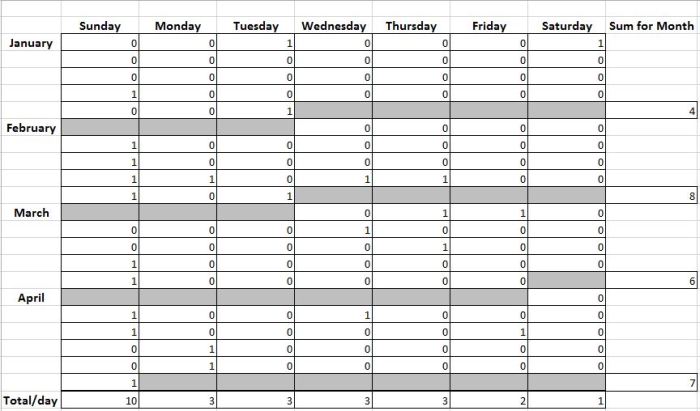
The single best day for sleep for me are Sunday’s.  This makes sense, as I typically don’t work Saturday nights at the bar anymore, and I consider Sunday to be a down day – I don’t set alarms unless I have something planned.  Therefore, it makes sense that I hit at least 7-hours of sleep 10 our of the 18 Sunday’s in the first four months (55.5%).

If Sunday’s are successful, why aren’t Saturday’s?  I attribute this largely to working at the bar Friday nights.  When I work a bar shift, I don’t get off work until 2:30am, which means that by the time I get home, wind down, and finally push myself to go to bed, it’s 4am or later.  Since I don’t like sleeping too late on Saturday’s and wasting the day, I’ll often get up by 10 or 11am, well before I hit the 7-hour sleep mark.  Because of this, it doesn’t surprise me that Saturday’s are displaying the worst results.

With the Monday through Friday results being largely similar, I can offer some brief commentary on their successes.  Sleep results from Monday, Tuesday, and Wednesday are the most likely to be successful for me since I often have those nights free, and am able to go to bed around 10pm.  In this case, I’m not successful because I’m usually not in bed until after 10:30pm, meaning any kind of restlessness while I sleep cuts into the narrow margins.  While the opportunity for success is there, poor execution on my part is to blame for the poor results.

Thursday’s results are curious.  Thursday’s come after I work the Wednesday night shifts at the bar, so you would expect me to have as poor of results as Saturday.  However, what’s not captured in the graph is the time I go into work Thursday mornings.  While I’m *supposed* to start work at 9:30am, I’m often sleeping in Thursday mornings and not getting to work until 10am.  That probably accounts for the times I’m hitting the 7-hours.

Friday’s are a little anomalous, as I would expect them to be on par with Monday through Wednesday.  I suppose there’s a few things going on there: I’m a little fatigued by the end of the week, so I’m making poorer choices; or perhaps my sleeping schedule shifts later because of Wednesday night.  It’s also possible that there are other externalities that I’m not accounting for, such as other events in my calendar that I’m not including here for simplicity.

Of course, it needs to be pointed out that we should not draw a lot of inferences here.  All things considered, four months is not a lot of data, and I’m still performing poorly in terms of the sleep challenge.  In the four months (120 days), I hit my target 25 times (20.8%).  Not accounted for, as well, are the near-misses where I slept over 6.5-hours in a night, but less than 7-hours.  Also not accounted for are the nights were I was asleep for 7 or more hours, but due to restlessness, getting up in the night, or being disturbed by my partner and pet, I was tracking less than 7-hours on my Fitbit.

Still, near-misses are failures, and I must accept those instances where I barely fail my goals.  With more intentionality, mindfulness, and better systems, it is possible for me to improve over the next four months.

Stay Awesome,

Ryan

April Sleep Check-in

Adding to my January, February, and March check-in’s, here is my sleep progress for April:

IMG_20170501_105717
7/30

No progress to speak of, as I kept pace with 7 nights of sleep for the month.  I’m starting to notice a few trends, having the month laid out for me in full.  For instance, I see that my most common day to hit my sleep target is Sunday.  While it’s not reflected here whether that means I’m going to bed at a reasonable hour (my gut tells me this is probably not the case), or if I’m sleeping in, it’s something worth reflecting on.

Over the next week, I’ll review my sleep progress for the first quarter of 2017 and see what the stats say, and what I can learn from my experiment so far.


Stay Awesome,


Ryan

Evolving Job Description

Having lost out on the competition for the new job at work, I’ve been motivated to consider how to position myself for future advancement at the college.  I’m trying to figure out what steps I can take to make myself a more attractive candidate.  One way I’m looking into is to turn back towards education and find a part-time online program I can take to add more credentials to my name.  I won’t dive too deep into what I’ve turned up yet, but I’m exploring a few options that could result in an additional bachelors degree in education, or even have me return for doctorate graduate studies.

Setting those aside for now, another way of improving myself is taking on additional roles and responsibility at work.  This is not to say that I’m looking to make myself busier, or becoming a martyr to work.  Instead, I’m looking at selectively adding roles that require me to learn more about curriculum and post-secondary education delivery.

I just got out of a meeting with my boss, where we discussed some avenues of growth she’s looking to take me in regarding student academic advising and program review process management.  By necessity, these new roles will require me to understand how curriculum fits together, and how students progress through their programs.  This deeper understanding will benefit me in the long-run and expose me to new areas of the college.

Coming out of this meeting, I reflected on my job at the college to date, and how it has evolved over time.  I realized that for each September I have been here (new academic year), my job changed from the previous year.

I started out as a temporary research assistant.

The next year, I was an assistant for the program advisory committees.

Then I added program review support the following year.

At the start of this year, I began teaching and I took on a more significant role with program reviews.  With this increased responsibility, my boss has also added academic advising at the start of 2017 – both to current and prospective students.

At each level, my job description has changed and evolved.  I’ve lost some minor, menial tasks, and I’ve automated others to free up cognitive space.  This is ultimately a good thing for me.  While I’ve been slowly improving my place at work (moving from contract, to part time, to full time permanent, and slowly earning more money along the way), I’ve been turning heads and catching people’s attention.  I may feel stagnant a times during the day-to-day grind, but it’s important to remind myself that I’ve been going nowhere but up since I started here.


Stay Awesome,

Ryan

March Sleep Check-in

I decided to hold off on posting the March sleep check-in in favour of discussing the job related stuff while it was fresh and ongoing.  However, now that the bulk of that is out of the way, I can return to updating my progress on getting more sleep.

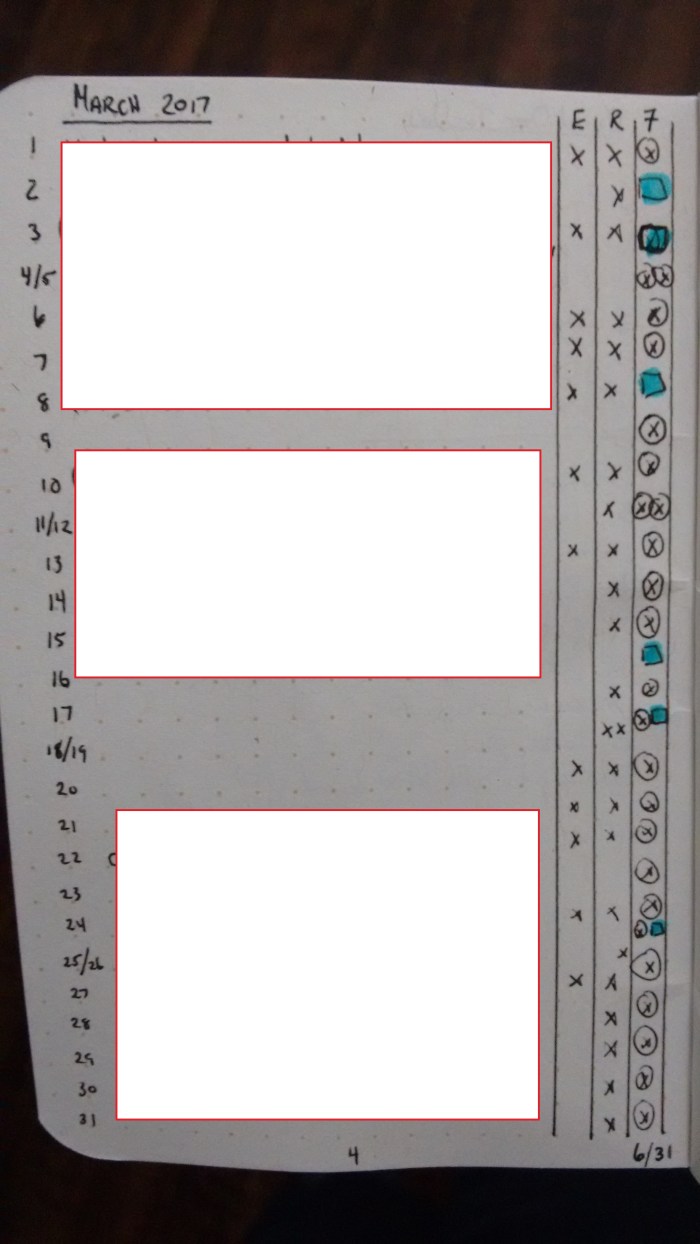
IMG_20170412_202637121
6/31 days, or 19.3%.

As you can see from my daily tracking, basically no change over February.  I did get one less night of sleep over 7-hours last month, but overall I stayed consistent with the previous month in the number of nights with over 7-hours in a month.  Obviously February and March don’t have the same number of days per month, but I’m treating this as a rough estimate.  Ideally, I would have liked to have seen an improvement, so it’s something to keep in mind for the rest of April.

Hope you had a great Easter weekend!  Talk to you next week.


Stay Awesome,


Ryan

The Motivation of Failure

Last week, I was passed over on a job opportunity for a more qualified candidate.  Such is life, and I don’t bear any ill-thoughts for the results of the job search.  I’m disappointed, but not soured by the experience.  It’s an opportunity to learn and grow, and I find that more important to focus on than to give in to a fixed mindset of self-pity.

After the feelings of sadness ebbed, I found myself experiencing a different feeling – motivation.  This has happened a few times in my life, and it was strange to be reaquainted with it.  There have been a few critical moments in my life where I failed at something important, and that failure created a fire within that motivated me.

It happened when I climbed Mount Kenya in 2007 after I failed my summit in the summer of 2003 of a mountain in Alberta whose name I’ve forgotten.

It happened when I joined the Campus Response Team and became a Coordinator after I failed twice to be a residence don.

And it happened again last week when I wasn’t selected for the job.  The self-critical sadness was overtaken by a motivation to go to the gym.

As I’ve written previously, It’s been a while since I’ve visited the gym.  According to my fitness journal, the last time I was in the gym was around Hallowe’en.  I’ve been rowing this last month a few times a week in the mornings, but I haven’t lifted iron in around five months.

Initially, I stopped going to the gym after my routine was disrupted by travelling to Scotland.  Then I didn’t go out of laziness, and then I didn’t go because I didn’t feel like I could justify going to the gym when I was supposed to be marking assignments and prepping my lectures.  By the time December rolled around I had regained my weight, but I also proposed to my fiancee, and started the planning process for moving out of my apartment.  Along the way, I was tired from a lack of sleep and dissatisfied with what I saw in the mirror.  Yet, it was never enough to overcome my inertia.

Failing to get the job was the final push I needed to hit the gym.  Maybe I needed a physical outlet to vent some frustration.  Maybe it was a form of punishment.  I’d like to think it was something more constructive – I accepted that I failed but I also saw that I could do better next time.  It is within my power to learn from the experience and grow.  The failures seemed to stack until it hit a critical mass; a line was crossed that set off the warning bells that I was heading in a direction I didn’t want to go.

It was time to make the first step and correct my course.


I vlog occasionally for my buddy’s YouTube channel, Artpress, and posted this immediately after I got out of the gym.

So, I hit the gym and pumped some iron.  I was nervous to go back as a beginner again, and overcoming inertia was incredibly uncomfortable, but I did it.

Now the trick is to keep it up.  That’s, perhaps, the greater challenge I face.


Stay Awesome,

Ryan

(Update) I Didn’t Get The Job

On Monday, I briefly commented that when it comes to job interviews, I am not particularly good at interviewing.  My native pessimism seems to have paid off because when I arrived at work yesterday morning, I had an email from HR thanking me for participating, but they will move forward with a more qualified candidate.

Yep, it stings and I’m disappointed.

I’m trying to keep my outlook positive, though.  I’m glad I went through the process – I had a chance to practice some skills I haven’t touched in a while, and I will learn from my mistakes and do better next time.

My immediate next step was to reply to HR, thanking them for the opportunity, and to ask  them for feedback or comments on my performance in order to grow.

Feedback

In this case, HR assured me that they went with a candidate that indeed had more experience related to the job than I; it was a competition, and I did not perform badly, all things considered.  I’ve heard through the grapevine who the successful candidate might be, and if it’s who I think it is, I feel at peace with losing to this person.  They are a great colleague, very good at their job, and will excel in the new role.  To put it in perspective, the person I believe got the job is also the person who has been instrumental in creating new, standardized processes for program reviews – templates and workflows that many of us at the college have adopted.  Further, I’ve been working with my manager to redefine my current position in order to qualify for a higher payband, and we’ve been using this person’s job description as an exemplar.  I don’t feel so bad losing if I lost to this person.  I wish them the best.

HR did have two bits of feedback that I can use to improve next time.

First contrary to what I said on Monday, they said I didn’t say enough, and didn’t go deep enough in my answers.

*Gasp!*

Ok, maybe we need to unpack that.  Keep in mind that I am a verbal train wreck at times, but the interview lasted maybe 20-25 minutes out of a 45 minute time slot.  So, what I’m taking from this is that while I may have said a lot of words, I wasn’t saying the right things.  They wanted more than direct answers – they wanted clear answers and elaborations.

I should have taken a cue from the fact that for a couple questions, the interviewers asked follow-up questions that prompted me for more answers.  It’s obvious now, but in the moment I missed that connection.  My answers needed to be commensurate with the level of responsibility the role requires.  In all likelihood, I would have done the right thing in the job, but at the interview level, I wasn’t able to articulate the depth needed to satisfy the interviewers.  It’s hard to pay attention to those cues in the moment when your mind is in a million different places and you are trying to summarize your experience in a coherent response.

The second bit of feedback I received was that I didn’t give a good explanation of why I was interested in the job.  HR’s feedback was that my reasons for wanting the job didn’t really align with the PDF (our initialism for the job description).

Sure, I played it smart by not being up-front that the pay raise played a huge role in it (it would have been 2-steps up from where I am).  What I had told them was  that the job was the next evolution of what I’m currently doing at the college, and since I started teaching last term, I’ve been seeking ways of further developing myself at the college.

A fine answer, sure, but it doesn’t really say anything about the job itself.  I could have given that answer for literally any job I applied for.

Instead, HR suggested I read the PFD and apply what the job description says to my answer.  Upon reflection, I should have mentioned that I’ve found an aptitude for program development and review.  I should have said that I enjoyed my experiences working on the 3 engineering degrees and the 3 post-graduate certificates we’ve developed since I’ve started at the college.  I could have discussed how I’ve taken on some leadership when it comes to program development to help the Chairs share the workload.

Those would have been good elaborations as to why I want to seek out roles that expand myself.  A hard lesson to learn, but important to keep in mind.  If I learned anything from my personal development reading last year (Covey, Sinek, etc.), it’s that you should have a clear sense of why in what you do.

Next Steps

There isn’t much more I can do at the moment but work on making my current position better with my manager and keep an eye out for the next opportunity.

However, one thing I did do is send thank-you cards to my interviewers.  I drafted them up last night and dropped them in the inter-office mail system this morning.  It’s not a common practice for people at my level, so it’ll a.) make me more memorable; and b.) signal my gratitude for the experience.

It may also send some good karma my way.


Stay Awesome,


Ryan

I Don’t Interview Well

I had my interview on Friday for the new position I discussed last week.  At present, I haven’t heard anything back, and I don’t expect any news until probably tomorrow at the earliest.  Regardless if I get the job or not, I find value in the experience and I’m glad I attempted to advance myself at the College.

I tend to be fairly critical of myself, and the interview was no exception.  While I wouldn’t say it was a bad interview, I felt like I made a few mistakes that were easily avoidable if I were more mindful.  You see, a couple of times in the past, I’ve received feedback on my interviews that I am a tad verbose.  Actually, one friend commented that I’m like a fire-hose when I talk.  I tend to blast the person I’m talking to with all sorts of information.  In some contexts, this is a good thing, but in an interview, it’s better to side with caution and aim for brevity.

Friday was no exception.  I’ll give you a perfect example of this in action:

Interviewer: “Just a few more quick questions – first, does your current manager know you applied for this position?”

Me: “Yes… I was conflicted about applying for the position because of the loyalty I feel to the department and the School of Engineering, so I spoke with my boss about it last week.”

*I look down at the Interviewers sheet of paper and under that question is written one word: Yes.*

*Headsmack*

There were a few other things that tripped me up a bit, but overall it was a good interview in my opinion.  I realize that I’m always critical of myself, and rather than seeing it as a failure on my part, I try to frame the experience as a growth opportunity.

Hopefully I am the right candidate for the job, but if I don’t get the job, at least I know I was good enough to give it a shot.

Stay Awesome,

Ryan