Keep Your (First Aid) Skills Sharp

I wrote my masters thesis in 2012 on the relationship of knowledge, first aid, and the moral requirements of rescue.  The thesis argued that 1.) if you have special knowledge or training (first aid), you are morally required to render aid, even if there is no pre-existing legal requirement; and 2.) everyone should be trained in first aid.  While it is the case that I have to keep my first aid certificates current in order to work at the bar, I believe that it’s important to keep these skills fresh and sharp regardless of your occupation.

You never know when you’ll need to draw upon the skills, so frequent practice is important if you want to be effective.

There have been two instances while working at the bar where a pedestrian was struck by an automobile while I was working.  The first was New Years Eve a few years back, and the second was this past St. Paddy’s Day.  Thankfully, in both instances the person did not seem to be critically harmed in the incident, and both were conscious when they were loaded into the ambulance to be taken to the hospital for further attention.  I suspect that while both had some degree of recovery ahead of them, they thankfully won’t likely experience prolonged physical suffering.

In both instances, I was working on the door, so I was the first responder on scene to start treatment.  In the case of a traffic collision, the most important steps are to protect yourself, and start control of the scene.  I can confidently say that I’m terrible at the first thing, and half-decent on the second.  This is why consistent practice is important.

Protect yourself

I fail on this in two regards.  I have a tendency to run out into the street to reach the pedestrian quickly, meaning that I put myself at risk of getting hit by a car while on scene.  The other thing I’m bad at is getting to the pedestrian and starting treatment before I finish the scene survey (which includes putting on medical gloves to protect myself).  These are big no-no’s.  I expose myself to unnecessary risk while trying to be first to the injured, when realistically I should take an additional 15-30 seconds to stop, take in the scene, and put on my gloves.

Control the Scene

I am adequate at this because I tend to default to immobilizing C-Spine and trying to talk to the pedestrian if they are conscious.  I could do this better in a number of way, such as having a fellow staff member control the spine while I assess for additional injuries and control the scene (directing people around me, updating EMS, taking notes, etc.).  In regards to the staff at the bar, I am probably the most experienced first aider, so removing myself from the decision-making portion of the response has benefits and drawbacks.  I am the best person to perform first aid until advanced medical care arrives, but I also have enough experience to understand the dynamics of the scene.  At this point, it’s best that I trust my fellow staff to respond appropriately.

Responding to a traffic incident is chaotic, noisy and confusing.  On top of this, adrenaline courses through your body, making your hands shake and your limbs jittery.  Your brain feels like mush because your thoughts are lightning quick.  Time seems to slow down, and that ambulance that is 5-8 minutes away always takes an eternity.  You are hyper-focused on your patient, but aware that there is a light din of noise at your periphery.  It’s like a bubble is around you, and you are hoping like hell that you don’t mess anything up under the spotlight of the gawking mass of people encircling the scene.

This is all normal.  It (sadly) gets easier the more you do it.  You become calmer each time you respond; it’s happening to me already.

The lesson to take from this is to always keep your certs current, and find time to meaningfully practice your skills.  Someones life may depend on it.

Stay Awesome,

Ryan


(Blog) Weak Will and my Monkey Brain

I did something bad last night.  I went against my better judgement and stayed up until just after 1:30am.

*Gasp!*

Ok, perhaps this isn’t the worst thing in the world.  In fact, given the demographics of the area I live in, there were plenty of other people in my neighborhood who were still awake well past my drifting off to sleep.

Why is this bad?

It’s bad for two main reasons.  First, it’s bad because it goes counter to my expressed goals of striving for 7-hours of sleep per night.  It also creeps in on my desire to not use YouTube late at night.  I’ve identified this as a problem before, and I know  that giving in to “just 10-minutes on YouTube” is a recipe for failure.

But the second and more pressing concern is that I knew better, because just 15-minutes before I sat down at the computer, I was musing on the car ride home from my shift at the bar that I should put my staff meal in the fridge and go straight to bed.  I got home, let the dog out, then sat down at the computer and thought “I haven’t done any late night surfing in a while, and I could unwind a bit since I’m not tired, so how about some YouTube?”

Big mistake.

Never mind that passively consuming online videos makes it easy to lose track of time as you spiral down the rabbit hole of content; never mind that staring at a screen is bad for your sleep and inhibits the production of chemicals that help you feel tired; I rationally knew and actively thought to myself that I know what I’m supposed to do, and I went and did the irrational thing anyway!

While I’m talking about this as if it’s an addiction, I know that this is less an issue of some sort of neuro-behavioral compulsion and more of a weakness of will.  Or, more specifically, it’s a lack of discipline on my part.  It’s thinking that I’m smarter than my own laziness.  Once again, my monkey brain won out and I ended up sabotaging my goals without really being aware of it.

You win this time, Laziness.


Stay Awesome,

Ryan

Sleep Check-in

February came to a close last week, which completed another full month of tracking my sleep.  This post builds on my observations made about January.

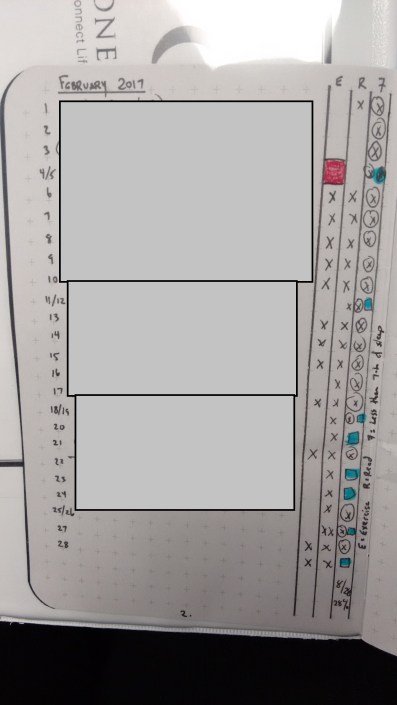
At the end of February, here’s where I stood:

img_20170228_113602200
8/28 days I hit 7 hours of sleep or more.  If it were a batting average, I’d be golden.

Eight days out of twenty-eight is still pretty terrible, but it’s a 100% improvement over January’s numbers.  I never expected to make an overnight change towards better sleep, so this kind of result is above my expectations while still giving me room to clearly improve.

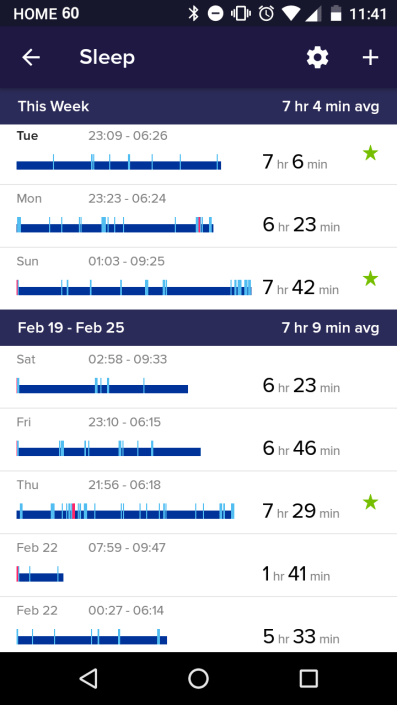
I track the results in my notebook as binary entries – either I sleep 7 hours according to my Fitbit or I do not.  Here’s a snapshot of what some of these nights looked like last week:

screenshot_20170228-114158
February 22nd was a day I called in sick and went back to sleep (I was legitimately ill, not just sleepy).

As you can see, I’m often just barely missing my deadlines because I’m a restless sleeper.  Nevertheless, I know of some various steps to explore to see if I can claim a few more nights of sleep, such as a more strict bedtime routine and possibly kicking the dog out of the bedroom at night (we spoil him rotten).

Subjectively, this is the best I’ve felt in a while.  Rising before 6:30am is getting easier, I feel less groggy in the morning, I’m more motivated and active, I feel like I need less coffee to function, and most importantly my mood has lifted a bit.  The morning exercise is probably also helping with my affect.

I’m looking forward to March’s numbers.  I’ll keep you posted.

Stay Awesome,

Ryan

To Rita

On my way to work, my commute takes me past a public school and every day I see the crossing guards out.  This morning, I had a sudden flashback of a face I haven’t seen in over a decade – my old crossing guard, Rita.

I haven’t seen Rita since I left for university.  She hadn’t been my guard since I left public school five year prior, but I remember her face.  She knew my name, which I suppose is what I remember most.  And she was always kind.

I suppose, as a child, I didn’t fully grasp how important she and the other guards were.  The roads we crossed weren’t very busy, and I was used to crossing the road on my own, but she was always there; she used her super-powers to stop traffic.

Now, I appreciate what these volunteers do.  How important they are and the value of what they protect.  That they stand stoically in inclement weather five days a week during the school year.

Maybe that’s why I remember her face now.  And her smile.

I don’t know where she is now, but I secretly hope Rita’s still out making an impression on others, and keeping children safe.

Take care, Rita.

~Ryan

Blog -Disrupting Routine

Remember how I was going on last week about starting a new routine in the morning?

As luck would have it, the day after that post went live, I came down with a cold.  Normally colds don’t bother me, but it was enough for me to cancel all of my Wednesday engagements to recover, then spend the next two days at work a tired, drippy, stuffy mess.  Apparently, something is going around the Region (and our office) because many people have been off ill or discussing it online.

I had an interesting moment last week as I decided to call in sick.  Normally, I’d try to push through and save my sick days for when I was genuinely incapacitated or in need of a mental health day.  I always feel guilty conceding to being sick.  But I realized that a.) much like with sleep, it’s important that I listen to my body’s cues, because in general I feel better when I respect my body’s natural rhythms; and b.) I have a big boy job that not only pays me to stay home when I’m sick, but also expects that I respect the office and not bring sickness to it.

So, rather than pushing it, I decided to take the week and weekend off from trying to be productive.  This morning, I resumed my rowing and reading, even if I wasn’t yet up to 100%.

Slow and steady.

Stay Awesome,

Ryan

Morning Productivity

I had an interesting morning last Tuesday.  As I’ve mentioned recently, I’ve been getting up early with my fiancee.  She typically leaves for work around 7am, and I don’t need to leave for work until around 9am, which leaves me with almost 2-hours to fill with how I wish.

I could go back to sleep and work on hitting my 7-hours of sleep per day goal (as of writing, I’m still failing on this goal, but only narrowly).

Or, I could try to use this quiet time to do some things distraction-free.

*If my fiancee is reading this, I mean distraction from technology and daily pressures.  Love you!*

I’ve been steadily adopting the latter option, and last Tuesday I had an amazingly productive morning.

First, I read for around 30 minutes.  I’ve been working my way through Tim Ferriss’s new book “Tools of Titans” which is hefty 700 pages.

Then, I opened up the Coursera app on my phone and did a few lecture videos on an introductory calculus course I’m working on, including practice problems on functions.  That was around 15-20 minutes.

Then I went upstairs to row for 10 minutes.  I started rowing two weeks ago in the mornings and I’ve already noticed an improvement – I’m less winded after the workout and my hips are not nearly so tight afterwards.  I’ll probably write a post about rowing soon, but for now it’s a small habit I’m trying to instill during the work week.

After rowing, I recorded two vlogs.  I recorded a short vlog for Art Press, my podcasting partner’s side-channel that features vlogs from artists who also exercise.  Then, I recorded my daily vlog that I upload privately to my channel as my version of a diary.  The two vlogs took me 5-7 minutes to record.

Then, I finally showered and got ready for work.

Reflection

I know that starting your day on the right foot is a key to success.  It sets you up with a positive mindset that you are accomplishing your goals and using you time well.  I certainly don’t want to do things for the sake of being busy.

I suppose I’m being a little arrogant by sharing this information within my social media feeds – I’ve been tweeting my progress on rowing, and sharing my small productivity wins as they happen.  Am I just looking for approval from others?  Does sharing this really keep me motivated and accountable?  Would I enjoy the process less if I didn’t share (boast) about it?  Am I looking to inspire others?  Lead by example?  Make them jealous?  I don’t have good answers for this.

I also don’t know whether I can keep this up regularly.  This system (I’m calling it a system for the sake of the argument) is fragilely held afloat because of my fiancee’s schedule.  If that were to change, I’m fairly confident I wouldn’t be able to wake up at 6am on my own – I have about of decade of anecdotal evidence to support this.  Also, will I be able to keep this pace?  Exercise, reading, studies, and vlogging takes up a lot of time; will I be able to guarantee that I’ll have enough time and mental focus everyday to continue this process.  Again, I don’t have an answer to this.

Time will tell.  After all, as of writing, I only have one data point to draw an inference from.  It’s important to not get too far ahead of myself and focus on hitting my targets tomorrow.


Stay Awesome,

Ryan

(Blog) A New Timeline

As of writing, it is February 3rd.

Yesterday, I had a realization – I am in a new timeline.  And I’m not sure how I feel about that.

The reference comes from an episode of Community where the characters are playing Dungeons & Dragons and the storyline focuses on six distinct timelines based on the character’s decisions.

At the close of February 1st, 2017, I officially entered a new timeline.

For the last year, my focus had been geared towards preparing to apply to a paramedic program before the deadline closed on Feb. 1st.  I took preparatory courses, read books on medicine, talked to teachers and industry people, exercised, and started laying some of the financial groundwork.

When I proposed to my fiancee, I had to re-evaluate my future career path.  My plan had assumed that I would be on my own, or at least my career wouldn’t necessarily be influenced by needing to consider anyone else.  However, by proposing, I was intertwining my life and career with my fiancee’s.  I’ve been at my current job for almost three years now and I enjoy a stable paycheck and good benefits.  My fiancee graduated from her program in April and just landed her first major job in her field.

After consideration, I decided to put going into paramedicine on hold indefinitely in order to help support her.  She’s only on a short contract, so she doesn’t have stable employment yet.  She also commutes about an hour each way, so her ability to manage the house and take care of the dog alone until I finish moving in is challenging.  It would put us in a bad spot if I were to stop receiving an income and re-enter school while she is focusing on putting down her own career roots.

Feb. 1st was the deadline for equal consideration applications to college programs, and it has since come and gone.  I am no longer preparing to make a career switch.  I have entered a new timeline.

It’s a little scary for me.  It’s not scary because of the unknown; I actually relish possibilities.  No, it’s scary because I no longer have a sense of direction.  All last year, I had a target to aim at.  I had a matrix to make decisions within.  Decisions were always made within the context of a mission and a set of values – does this bring me closer to my goal, or does this hold me back?

Now, I’m adrift again.  I don’t know what the next step is, or what I should be working towards.  If I learned one thing about myself this last year, it’s that I need purpose.  I need a mission.  With the close of Feb. 1st, I have neither for my career.

I have entered a new timeline, and it’s time to start getting my bearings.

Stay Awesome,

Ryan


Checking Intuitions – Is Facebook As Bad As We Think?

Last week, I published a long, rambley set of thoughts about my relationship to Facebook.  The following night, I sat down with a group of friends to discuss a taped forum discussion published by the CBC.  If you have never looked into CBC’s programming, particularly their show Ideas, and their daily program The Current, I highly recommend them.

http://www.cbc.ca/radio/ideas/screened-off-the-dangers-of-an-insular-web-1.3937638

It’s always good to check your intuitions and opinions against what others think, because sometimes its possible that your biases blind you to alternative considerations.

Now, what I’m about to write about is entirely unverified and does not serve as an argument on any side of this debate.  This post is not meant to deliver any definitive answers on the topic of whether Facebook (or the modern internet) is less democratized, more problematic, or having a polarizing effect on how people think.  What I wish to capture is how my mind expanded a bit when I listened to how others viewed the podcast topic and their reactions to it.

Going into the meeting, I felt that I aligned with the views discussed in the program.  I feel that people are polarizing in the online echo-chamber communities and that the internet, or specifically products created for the web, are designed to be attractive and modify behaviour to increase engagement.  Shallow content and emotional shortcuts are easily bypassing critical thought and our ability to maintain our attention is being eroded.

There were two counter thoughts brought up at the meeting that significantly shook my opinion.  Again, I pose these as items to consider, not definitive rebuttals to the original claims.

Rose-Coloured Nostalgia

The first assumption challenge by one friend was that the understanding and explanation of how the internet is currently, and how the internet “used to be,” do not adequately reflect reality.  In the first instance, the speakers on the program are only speaking to a mainstream understanding of social media.  They use Facebook as the default conversation piece because it is the highest trafficked site, however their descriptions do not account for all uses of the net, nor all demographic engagements.  In fact, Facebook-use is in decline among younger internet uses (“old people got on Facebook and ruined it”).

But in the second instance, my friend (whom is a few years older than I am) disagrees with the assumption that the internet in the late-90’s and early 2000’s was more democratized.  On a purely surface level, sure, it was more democratized because there were less corporate products.  But at the same time, the internet was more closed off to the mass market because no one knew how to use the internet.  Without the advent of streamlined user-interfaces, most people lacked the technical skills to adequately use the internet beyond services provided by internet providers (the Yahoo’s, the AOL’s, etc.).

I realized that my understanding and buy-in for the arguments is predicated on an understanding of the internet that I have no direct experience of.  I only started using the web in 1998, compliments of AOL and the many coasters they sent to our house.  Other than chat rooms and Slingo, my recollection of the net pre-2000 is pretty spotty.  I have nothing that informs my opinion on the matter, and it’s entirely possible that I’m agreeing with a characterization of the web that is out of line with reality.

Deep Data

Another excellent criticism that another friend raised is that Facebook isn’t necessarily forcing people into echo-chambers, nor are people necessarily becoming more radical in their views.  In fact, we don’t really know what’s happening relative to the pre-2000’s.  For the first time in history, we are able to collect massive amounts of data on the reading habits of people online.  Until recently, understanding where people seek out content, how they share, what they share, what they click through, etc, was not possible to the degree we are seeing now.  It’s bad for us to see the limited data and fit a worldview to it.  Quite simply, we don’t know if Facebook is changing anything, or if we are just able to glimpse into the minds of others for the first time.

But, you may say, “I’ve been on Facebook since the mid-2000’s and I’ve noticed a shift in my news feed.”  Yes, that’s true.  It’s also true that algorithms are more sophisticated now to curate your news feed.  The only thing missing from that consideration is that the sample size for you has changed.  If Facebook’s size had remained constant, we could potentially make an inference to how Facebook has impacted people.  Instead, Facebook has gone from being the domain of college students (a typically liberal-leaning demographic) to high school students (remember when we thought that was a mistake, and these kids shouldn’t be on the network) to when our parents joined Facebook (ugh! They ruined Facebook!).  Consider an alternative perspective – our experience of other people on Facebook was initially biased, and then regressed back to the mean once the user pool expanded to include non-university users (which is a fairly homogeneous class of people, all things considered).

Closing Thoughts

Truthfully, I’m not entirely sure what’s right, but I suppose that’s a good thing.  Recognizing that my own views and opinions should be treated as suspect is a valuable insight to have.  It requires a level of self-awareness that usually doesn’t get a lot of discussion in today’s media.  Instead, everyone seems to speak from a position of authority that I feel as though I lack in my internal monologue.  Maybe my friends are correct, and that the think-pieces about the dangers of walled-gardens and the role that social media has on our ability to think critically is all smoke and little fire.  To be fair, where there is smoke, there is usually fire, so there is *something* there that needs to be discussed.

I appreciate the insight my friends brought to the table.  It shouldn’t be surprising that the answers they gave above are wholly connected to their fields of expertise.  The first friend has a PhD in criminology and has studied deviance online.  The second friend works in marketing for a major Canadian food company.  Their experiences are helpful to provide alternative viewpoints to my own, and if it is true that you are the average of the 5 people you most commonly associate with, it’s a pretty powerful example to me of the value in a diversity (plurality) of thought.

Stay Awesome,

Ryan

Signal and Noise – Facebook, We Need to Talk

Continuing the emergent theme of January for this blog, I thought this post could discuss some of the thoughts that have been mulling around in my head for the last few months.  Once again, in the spirit of pulling back and simplifying, I’ll briefly comment on some thoughts I’ve had about Facebook (specifically) and social media (generally).

This won’t be a think piece about the problems with the various platforms, their social responsibility, the degree to which they are or are not responsible for the behaviours of their users, etc.  There are many great articles written on those topics that have spun out as a consequence of the American Presidential election late last year.  I have nothing new or clever to add to that conversation.

Instead, I want to focus on my relationship with social media – how it has affected me and my behaviour.  You, my dear reader, may or may not agree with my attitude towards social media.  That’s ok.  I’m not speaking to any sort of norms here.  I don’t think people should adopt my views if they don’t want to.  Your relationship with social media is wholly bound up in a different set of lived experiences which is not guaranteed to overlap with mine in any meaningful sense.  I will be describing my experiences here.

Birthday 2015

In 2015, I set a challenge for myself to cut back on my Facebook use.  I felt that I was spending far too much time endlessly and mindlessly scrolling through Facebook.  This challenge was motivated by a desire to be more productive in my life.  I wanted to consume less and produce more; I felt this was important for me to grow as a person.  Facebook was a constant and daily consumption habit where I binged on updates from my network of friends and family.  It was less about a sense of fear of missing out and more about seeking updates to what people were doing and things they found interesting.

So, on my birthday in 2015, I deleted the app off my phone.  The experiment wasn’t very successful as I logged into Facebook using my phones Chrome browser (I had legitimate reasons to need onto the site initially since my job at the bar uses a Facebook group for scheduling shifts).  When I didn’t log off from the browser, I essentially was left with Facebook on my phone.

It took until around September of 2016 to wise up to my usage, and I deleted the Chrome app from my phone.  For the last 4 months of 2016, I abided by the spirit of the original challenge and things were good.

Birthday 2016

Every year at the outset of my birthday, on the stroke of midnight, I deactivate my Facebook account for 24-hours.  I do this for a number of reasons.  It allows me to be more present in the day.  It allows room to reflect and introspect.  I don’t have a constant deluge of notifications from people wishing me a happy birthday (especially from people who only message me once a year because Facebook tells them it’s my birthday).  And it removes a mindless activity so that I can do more productive things with my birthday, such as exercising and volunteering.

This year was no exception on that front.  What was unique was that my birthday was buttressed against several days of travel and time with family.  For the better part of  the next five days,  I was busy with family and Christmas, and was never near a computer with enough time or the desire to check Facebook.  I realized only after my family expressed concern that I had possibly unfriended them (and my fiancee joking that she was no longer engaged to someone on Facebook) that I finally logged back in.

Upon logging back in, I realized that I hadn’t really missed the experience.  The first few days did have me missing Facebook in moments of boredom, but otherwise I hadn’t really missed using the service.  I was actually a little sad that I was giving in and returning to the service because it became a game to see how long I could go without using Facebook.

I also realized that I felt happier in my ignorance.  Well, that’s not true because I still followed the news and read articles; I kept up with current events.  But in not paying attention to the micro-updates in peoples lives and in unverified news, a weight had lifted from my psyche.

Signal and Noise

When I reflected on these thoughts, I realized that I should maintain some element of distance from using Facebook going forward and disengage.  My rationale has changed a little bit since 2015.  I still seek to favour production over consumption, but since the election, using Facebook has become, for a lack of a better expression, less fun.  Through a combination of fake news, false information on memes, politicization, activism, expressed attitudes and values I disagree with on many levels, and uninteresting updates, I don’t enjoy using Facebook like I once had.

What I realized is that the signal-to-noise ratio had skewed too far in the noise direction.  I personally don’t find Facebook all that useful outside of some very limited cases.  I was having a hard time filtering out all the distractions.  There are a number of reasons for this that, if I genuinely sought to address, I could fix.  I could start hiding posts, or reporting fake news.  I could unfriend people I don’t associate with, or I could hide posts and stop following updates from people in my network.  I could curate the experience to better suit my tastes.

There are two big reasons why I don’t follow this route.  First, I’m conscious of trying to avoid setting up an echo chamber that reflects back only things I agree with.  I value diversity of opinion, even if I disagree with it.  What I’m seeing on Facebook is not opposing viewpoints expressing themselves constructively.  This may make me a bad person, an abuser of my privilege, or a bad ally, but I don’t find value in only associating with people who narrowly share my values and beliefs.  It’s especially bad when I agree with the cause, I agree with the conclusions, but I disagree with the message or argument presented.  I value setting aside individual differences for common purposes.  I value good, sound arguments.  I value constructive input and critiques.  I value testing assumptions and arguments to ensure the burrs are smoothed out.  A consequence is that this does end up challenging my beliefs less; on that front, I acknowledge the consequence of my action.  I don’t have an adequate response to this and I need more time to reflect on it.

But the second reason why I don’t follow this route is that I don’t feel invested in the desire to fix the experience I have on the platform.  Instead, I’m much happier to step back from the noise and seek other areas of my life where I can boost the signal of things that matter to me.  I can focus on paying for news that I value (I recently purchased a subscription to The Economist, and a subscription for The New Yorker was gifted to me for Christmas).  I prioritize time with friends and family.  Being present with them is more important than cursory updates.  And I have the time to satisfy my desire to be constructive – making things, collaborating with friends, and learning.

To me, Facebook is an endless well of distraction.  Are there useful things on there?  Sure.  Are there important things on the platform?  Absolutely!  The activism and awareness campaigns that have popped up in the last year are a testament to how the platform can be useful to getting the conversation going for a mainstream audience.  I would never want to take that away from the experiences of others.  What I have a personal issue with is what the behaviour represents about me.  Facebook is a crutch I use to distract and occupy myself when I’m bored or procrastinating.  I seek out the notifications and the feedback.  I seek out validation and approval.

Facebook is built specifically to take advantage of this biological system in our brains.  I won’t go so far as to say it’s addictive, but I will say that the site is engineered to get people to frequently come back to the platform multiple times per day through posts, notifications and suggestions.  It leverages my desire for novelty and new content is frequently just a refresh away.

The same can be said for other platforms such as Twitter, Snapchat and Instagram.  I suppose where my bias shows is I’m less critical of Instagram because I can curate my experience better around my interests and hobbies.  On top of that, I find the experience purer on Instagram because I use it to share things I do and find interesting in my everyday life.  These are things that I experience and these are things I make.  It’s constructive, rather than consumptive.

Moving forward, I’m seeking to engage less with social media.  I don’t hate or think Facebook to be evil.  It’s a tool like any other.  My goal is to scale back my use and be more mindful.  I want to signal-boost the important things and tip the scales away from consumption into something more constructive.

Produce, not consume.

Stay Awesome,

Ryan