Within the Sound of My Voice

I attended a wedding this weekend, and have been reflecting on the service.  Specifically, I reflected on the nature of ritual and custom.  I often find that I take certain things for granted that are ubiquitous (and therefore, mundane).  Photography can sometimes feel cheapened because technology removes  the need to conserve resources like film in order to capture perfect moments.  DJ-played music fades into the background because the setlist is nearly endless.  And, thanks to social media, it would seem that everyone in my age bracket is getting married – my awareness of the intimate details of people’s lives blurs time together into a calendar of weekends punctuated with staged, curated pictures.

But this weekend felt different.  Maybe it’s because it’s my first wedding of the summer.  Maybe it’s because I’m preparing for my own wedding.  Or maybe because I’ve been more mindful lately of meaning in my life.  For whatever reason, the wedding this weekend felt special.  I didn’t concern myself with taking photos to post online (though, I did post one during the night).  I allowed myself to be fully present in the day and to pay attention to the details that infuse weddings with meaning.

There was something the officiant said  that has been playing out in my mind – “and let those know, within the sound of my voice…”  His voice was amplified for the benefit of those in attendance, but something about that sentiment stuck with me.  The wedding was a community of loved ones who came out in support of the couple.  It was a serious and sincere declaration of commitment, and a sharing of values.  We bore witness to a promise, and in doing so added weight to it.  It was not just a promise they made to each other, but it’s a promise made real by our attendance, within the sound of the minister’s voice.

While at the outset, I suggested that technology can cheapen moments like this, but I reflected on how technology intersected with this promise.  There is the obvious case where the officiant’s voice was amplified, so in principle his voice could reach more people.  But during the ceremony, there was another kind of amplification happening.  The bride had family in the UK who were unable to attend.  Rather than missing out, cellphones were used to stream the ceremony live to family abroad.  It widened the community by being inclusive.  More people were captured within the sound of his voice.

Technology wasn’t used to mediate the experience, but rather to amplify it.  The promise of love and commitment was strengthened because it allowed for more people to experience it in a meaningful way.

It may sound painfully obvious to people more mindful than I, but I saw the wedding in a different light.  We weren’t giving a gift because it’s expected.  We were sharing so that the couple could start their new life together on the right foot.  They weren’t just feeding us food because it was expected – they were sharing so that we could join them in celebration.  We didn’t put on dress clothes because it was expected – we put on our best so that we could signal that this moment was special.  And after dinner, the music wasn’t being played because that’s just what you do.  There was more meaning behind it.  The music and dancing was a way of expressing the joy within, taking the joy and putting it out in the world.

This weekend was the first time I appreciated that weddings aren’t something “you just do.”  Everything has a reason.  Everything is purposeful.  Everything is designed for one objective: to acknowledge a promise of commitment for two people and strengthen its resolve.  I had a chance to share in that moment and I was glad I could be included within the sound of the minister’s voice.

Congratulations to the lovely couple.

Stay Awesome,

Ryan

The Joy of Unboxing

20180723_180716

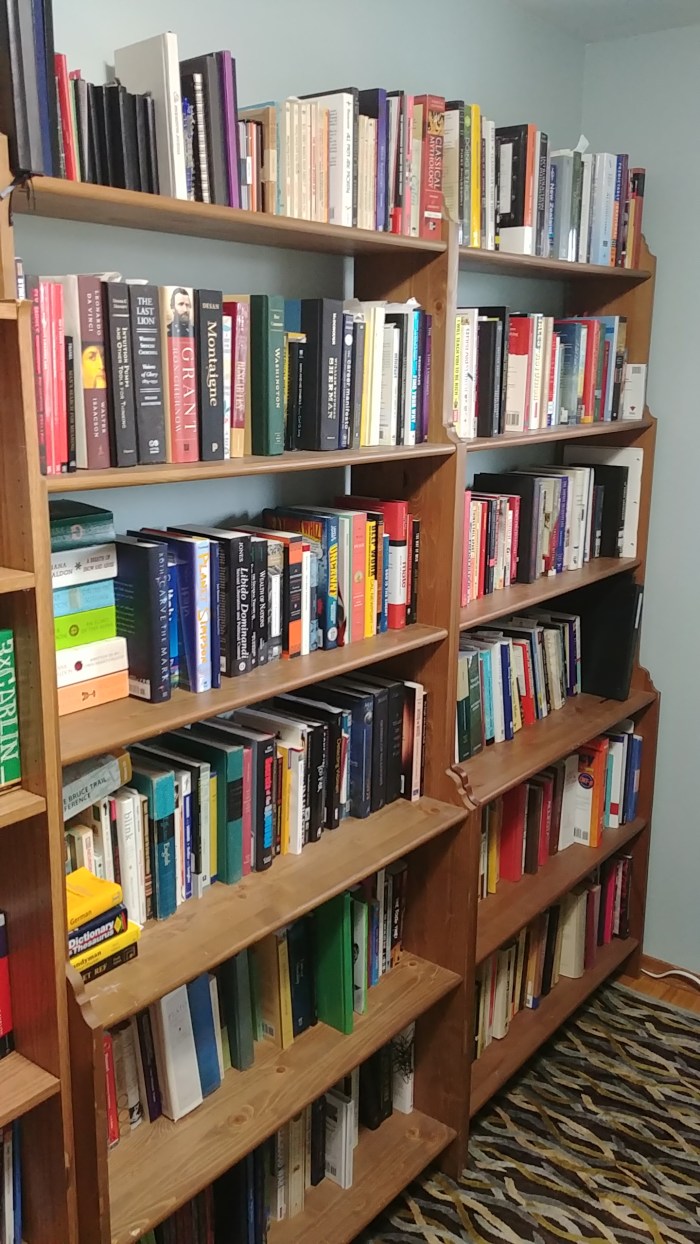
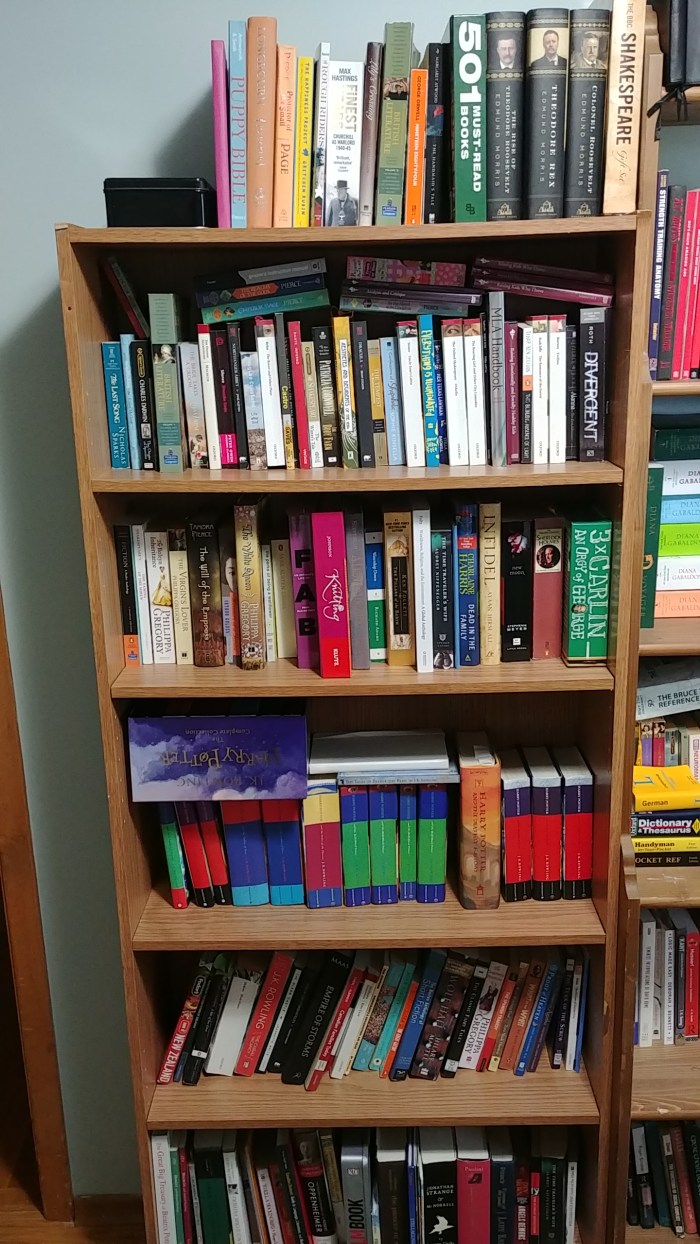
This weekend, I finally unpacked all of our boxes of books.  We were having some people over and thought it would be good to ensure the entire main floor was settled, which meant hauling all the books up from the basement and setting the office up.  I didn’t have the foresight to count them, but I estimate there were 20-30 big boxes of books that have been tucked away since the move last month.

Even before the move, we had boxed up a few bookcases in order to stage the house for sale, so some books have been in boxes and storage for almost three months.  As you can see, we have a lot of books – the natural result of the union of an English major and a Philosophy major.

20180723_180653

Humorously, when I started unpacking, I noticed several extra copies of Harry Potter books floating around.  After collecting them together in one spot and sorting them, I discovered a lot of duplicates.  We had *five* copies of the last two books in the series alone!

One side benefit I noticed in unpacking my books is that seeing the shelves full was making me happier as I went along.  When I started packing the books up a few months back, I noticed that not having my library on hand was affecting me.  I wouldn’t say it made me sad, but not seeing the books while in the office brought the mood down a bit.  It’s a hard feeling to articulate.  On the one hand, I don’t use the books everyday, so it didn’t impact my day-to-day life.  However, having my life and possessions stored away in boxes brought my mood down a bit, and I’ve been feeling it all through the moving experience.  Now that we are unpacking and setting up a new life in the new house, I’ve found myself feeling more optimistic, and my outlook feels a little brighter.

20180723_180706

Now that the books are all out, the only thing left is to start arranging them on the shelves and pick a theme for sorting.  It’s the little things that make me happy.

Stay Awesome,

~Ryan

20180723_180659

Honest Gym Update

Earlier in July, I joined a new gym.  It had been some time since I went to a gym, and indeed I had cancelled my last gym membership due to not attending in months.  I researched some of my local options, and I settled on a non-chain gym to join.

My first workout was July 5th.  The gym has 24-hour access for members, and I wanted to blow off some steam, so I went out to run on the elliptical and do some light weight lifting.

All in all, I like the gym so far.  The layout is different than what I’m used to, but I like the aesthetic and vibe.  You have a decent mix of people using it, from muscle-heads to grandmas, and everyone seems welcome.

However, since July 5th I have not been back to the gym.  Despite wanting to get back into the routine of exercising, I have yet to make any progress towards forming a new habit of going to the gym.

Granted, things have been hectic as we dealt with the fallout from the move, the renovations, wedding planning, etc.  Still, this is not a good excuse and I should be doing better.

I figured this accountability post would be a good thing to share, because it’s going to take some work before I change my behaviour.

Stay Awesome,

Ryan

Finding My Blog Voice

Last week, I reflected on the WootSuit Youtube channel about finding my voice.  There, the point of the video was reflecting on what kind of voice I wanted for the vlog (tone, topics, purpose, intent, delivery, etc.), but the reflection also covered this blog as well.

When I first set up the blog a few years back, it was intended to be an online public-facing journal of my return to school for paramedicine.  Then, life happened and I decided to indefinitely shelve that idea, but I kept blog running since I found value in it.  The blog forced me to be productive and write regularly every week with the intention of publishing.

Over time, the topics have tended to concentrate of a few areas, mostly related to my professional lives – being a board member and Chair of a non-profit, teaching and learning, personal development, and health/fitness.

Yet, throughout these roughly connected topics, I’ve yet to intentionally create a through line that presents a coherent, meaningful voice.  Thankfully I’m not intentionally trying to market myself through this blog because I don’t have the first clue who my audience is beyond myself.  That’s not all bad, though.  I write for myself and it’s a process of discovery for me.  Writing helps me to organize my thoughts as I attempt to articulate them outside of my head in a way that makes sense for someone else.

A consequence of this approach, though, is a haphazard set of reflections and a bit of a scattered voice.  Sure, it’s my voice, but it’s not one that I’m satisfied with.

As I said in the video, I don’t yet have a good answer.  This post is not intended to be an announcement of some new direction for the site.  It’s just a reflection from a person who still doesn’t really have things figured out (yet).

Stay Awesome,

Ryan

What I’ve Been Reading (As of July 2nd)

Happy long weekend!

I haven’t posted a reading update since back in February, and since I’m away on vacation for the weekend (with my nose hopefully buried in a book), I thought it would be appropriate to list some of the books I have on the go.

HVAC Handbook by Robert Rosaler

This is undoubtedly an odd one on the list.  A few weeks back, our AC unit froze and we decided to replace both of our 30+ year old AC unit and slightly newer furnace in the house.  I am not a handy guy by any stretch of the imagination, but I wanted to learn more about how a house’s HVAC system helps to control the indoor environment.  I renewed my library card and checked this book out.  I have no illusions that I can or should be performing my own repairs, but at least I can appreciate the engineering and design (or sometimes lack of) goes into my house’s climate control.

Interesting Times by Terry Pratchett

This list wouldn’t be complete without a Terry Pratchett book.  This book finally brings us back in touch with the Wizzard Rincewind, whom we last saw in Sourcery and was blown away to another dimension.  Set in the Counterweight Continent and the Agetean Empire, Rincewind, The Luggage, Twoflower, and Cohen reunite and get thrown in the middle of a peasant rebellion against the oppressive rule of the elite and a plot to murder the Emperor.  These are interesting times!

Extreme Ownership by Jocko Willink and Leif Babin

I quite enjoyed Jocko’s later book, Discipline Equals Freedom, so I thought I’d go back to check out his earlier book  that is largely the reason why he’s known now.  He and Babin are retired Navy SEALS who started a leadership consulting company after they retired from the forces.  The book is a distillation of their experiences and the lessons they learned about leadership that they have brought with them to their civilian careers.  It’s written, in part, as a no nonsense memoir, and I don’t get the impression that they are trying to waive any patriotic flags about being pro-military or pro-combat.

Madison’s Gift by David O. Stewart

Here’s another audiobook I grabbed from the library thanks to the Hoopla service.  While I should probably start reading biographies about figures other than American presidents, this one intrigued me since it’s about James Madison’s partnerships with key people who helped him with his achievements.  Rather than celebrating him as a visionary genius, it plays up the fact that he was fairly ordinary and unimpressive (the book’s description of him is “short, plain, balding, neither soldier nor orator, low on charisma and high on intelligence.”  Something about the description spoke to me, and I thought I’d check it out.

The Perfectionists by Simon Winchester

I blame the fact that I work in the School of Engineering that I decided to check this book out.  The Perfectionists covers the history of precision engineering after the industrial revolution.  While the book covers things relatively chronologically, it’s thematically grouped into various stories related to tolerance in measurements.  I’m only midway through the book, but the history of engineering design is incredible.  The creativity and patience shown by the various craftsmen in areas such as machining by hand, horology, and even lock-picking, is fascinating to learn about, and gives me a greater appreciation for good design (see HVAC above…)

If this was a long weekend for you, I hope you had a great and safe weekend!

Stay Awesome,

Ryan

New House, New Rules

We have recently moved houses (and cities), and we are still settling into our new abode.  It’s a bit of a chaotic time since we moved before our renovations were complete, so we are without a functioning kitchen until early next month, and though most of our washroom in the upstairs level is working, we still have to go downstairs in order to use a functioning sink.  It’s a minor inconvenience but one that we are fine to live with since the move has brought with it many perks – a quieter neighborhood away from university students, a shorter commute to work for my fiancee, and a nice backyard for barbecuing in.

In moving out of a condominium and into a house, it has brought new layers of responsibility.  Whereas before, our job was largely to ensure the unit was cared for (all things considered, a fairly minimal task), owning a house requires a fair amount of stewardship.  It’s a balancing act of routine upkeep, preventative maintenance, problem auditing, and financial mindfulness that is well beyond what was required of us at our last place.  For instance, in our old place, since it was a townhouse that was part of a condominium, all outdoor maintenance was taken care of by the condo’s management company.  This included repairs, lawn care, snow removal, gutter cleaning, building upgrades, etc.  Even things like water was handled though condo fees.

Now, all of those tasks fall to us, and more.  In some cases, a lot more.

Last weekend, our air conditioner froze.  Well, the A/C unit itself didn’t freeze, but the outdoor compressor and our interior coils above the furnace froze.  When we called a technician to come out and take a look at things, we found out several fun surprises – our until was installed in 1982, we were currently running on half the amount of refrigerant that the unit required to operate, that the refrigerant our unit uses is harmful to the environment and will no longer be manufactured by 2020, and that getting a crew out to find the leak and fix everything was going to be very expensive.  It was quite the house warming gift literally speaking, since the temperatures were up over 30 Celsius inside our house when the unit froze.

Did I mention that this happened the day after we moved in?  In fact, we noticed the lack of cool air the morning after I accidentally punched a hole in the wall while trying to hang some privacy curtains in the bedroom.

I am not the most handy of people.

I’m not discouraged by the turn of events, though.  Yes, it was an expensive way to kick off owning a new house, but the reality of it is that it’s a new house with new rules.  Along with the fun that comes with redesigning the house to meet your vision, it also comes with the responsibility of taking care of things to ensure it lasts.  Things will break down, unexpected costs will arise, and if you want the privilege of owning a house, you’re going to have to roll with the punches.

Stay Awesome,

Ryan


Policy vs. Guidance Pedagogy

During an ethics board meeting recently, we discussed ways of providing direction to faculty members who have student-based research in their courses.  For faculty who have research elements built into their courses, it can be a challenge to determine what counts as research, and whether said research is subject to the rules governing conducting research at an institution (specifically in our case, whether an ethics application would need to be submitted to the board).  Not every scholarly activity necessarily counts as research, and not every kind of research requires an approval from the institutional research ethics board.  Since this can be a bit of a murky area, we have been considering ways of providing direction.

The conversation abstracted away from the specifics of this case, and we discussed some of the issues concerning policy and guidance, which applies to education and pedagogy more generally.

The benefit of policy is that it spells out clear expectations of what is expected, what the division of responsibility looks like, and what consequences might be considered in the event of a policy breach.  Policy is designed to protect the institution through due diligence, and it focuses on expressing what rules need to be followed in order to not get into trouble.  Loopholes arise when the policies are not sufficiently rigorous the cover contingency cases and when policies are not harmonized laterally or vertically with other policies.  Policy documents focus on the “ends.”

On the other hand, guidance documents focus on the “means” by providing suggestions and best practices that could be followed.  Guidance documents typically do not include comprehensive rules unless it’s appropriate.  Instead, the purpose of the guidance document is to provide clarity in ambiguity without necessarily spelling things out.  They are deliberately left open because guidance documents are meant to supplement and add to ongoing conversations within a field or system.  While guidance documents also do not provide comprehensive options to contingent situations, the strength of the guidance document is that it’s educational in intent – it provides reasoning that helps the reader understand the position it takes, and paints a vision of what success looks like.

I realized in the meeting that this has a lot of crossover into considerations for teaching.  It’s is better, in my opinion, to teach students frameworks for thinking, rather than rules for success.  In the case of ethics, I would avoid teaching students what rules they need to follow, and what they need to do to avoid getting into trouble.  Instead, I would seek to build good practices and habits into the material I’m teaching so that I can model what success looks like and help them understand why.  This way of conceiving the material is forward-thinking.  It gets the students to envision what the end-step looks like, and allows them to work backwards to figure out how they want to arrive there.  By focusing on the principles you want the students to uphold (as opposed to rules to follow), the students learn to think for themselves and are able to justify the decisions they make.  This also has the benefit of avoiding the problem with prescriptive policies – students are prepared to reason through novel situations based on principles.


Stay Awesome,

Ryan


The Gap Between Reading and Doing


“For studying courage in textbooks doesn’t make you any more courageous than eating cow meat makes you bovine. By some mysterious mental mechanism, people fail to realize that the principal thing you can learn from a professor is how to be a professor — and the chief thing you can learn from, say, a life coach or inspirational speaker is how to become a life coach or inspirational speaker. So remember that the heroes of history were not classicists and library rats, those people who live vicariously in their texts. They were people of deeds and had to be endowed with the spirit of risk taking.”

— Nassim Nicholas Taleb, author of Skin in the Game

One of my big personal shortcomings is my inability to turn knowledge into action.  A few weeks back, I talked about how I tend to read a lot in the area of personal development, to the point of feeling over-saturated in the field.  However, for all the books I’ve read in the past two years in this area, I can’t really point to a lot of areas where I’ve successfully translated what I read into meaningful action.

This isn’t to say that I haven’t personally developed myself since 2016; I would say I’ve come a long way in two years to improving my life and myself.  Yet, in a pure comparison of books to identifiable changes, I can’t really say that a lot of specific changes have been made.  This seems somewhat at odds with the nature of the “advice” these books give, where you can deploy specific hacks, tips, and protocols, and everything will be better.

I don’t have a good explanation for why this is the case.  I feel it goes beyond just being lazy (though I am quite a lazy person).  I think the closest explanation that I can offer is something akin to a lack of confidence meeting decision paralysis.  I lack confidence in my ability to make decisions, so I research and read to see what others have done.  But there comes a point where I have too many options available, and I fail to cross the threshold from knowing to doing.  Rationally, I know that seeking more knowledge does not necessarily mean I’ll be more likely to act (there’s a quip that if knowing more was the solution, no one would need to diet and everyone would be healthy).  The gap between knowledge and action, where the will lies, stubbornly refuses to shrink for me.  This could be my fixed reality, but I’d like to think that I haven’t found the right combination of motivations yet that would bring me to where I want to go (setting aside the problems with the notion that I have to wait around for a muse to motivate me).

This could also be a problem because I have too many things on the go (the old “I’m too busy” rebuke).  With too many balls in the air, I’m worn down with just managing how things are going in the present, and I have little cognitive bandwidth left to steer me in a direction I want to go for the future.  This, too, is a personal shortcoming for me, but I think it’s a separate concern from the action-gap.

Truthfully, I don’t have a meaningful, satisfying way to close off this post.  I don’t have a magic bullet that will fix the problem for me.  I can’t say that I’ve found a solution to the problem, and that this post is building towards a resolution.  It’s an ongoing problem for me, and I hope that by bringing it to the surface, I can at least be aware of the problem and try to work around it until the gap can be plugged.

Stay Awesome,

Ryan


Reflections on Self-Help and Diminishing Returns

If you were to ask my fiancee, she’d tell you I have a book-buying problem.  I buy books faster than I can read them, and I have a small collection weighing down my shelves at home.  In a month’s time, we will be moving houses and part of the burden is to box the books and be mindful just how heavy books in boxes can actually be.  I prefer printed books, but I also have a steadily growing Kindle library and now an Audible library.

For 2018, the pace of my reading has slowed down significantly since 2016 and 2017.  At present, I have only completed 10 books for the year (with many half-read books strewn around the house).

If you go through the books I’ve read since my first reading list in 2016, you will notice a large proportion of my books fall under the self-help and personal development banners.  While I acknowledge that these books have been helpful in kicking off my attempts to make positive changes at work and in my life, I’m noticing a trend – I’m not really getting as much out of the books as I used to.  I seem to have hit a point of diminishing returns.  I started noticing it in the books I was reading, but it’s also spilled over into the daily lists of articles I get from Quora, Pocket, Medium, etc.

There is an over-saturation of the same studies being cited and a dearth of tips, tricks, tactics, protocols, hacks, systems, routines, mental models, and insights that tend to recycle similar themes.  Especially mental models – those seem to be in vogue right now with the online think-pieces and people creating courses for you to enroll in.

I also noticed that the further out from primary sources you get, the more recycling you find.  There tends to be four broad classes of folks who populate this domain:

  1. the innovators who write reflectively about what they did or the systems they created (the Ramit’s, the Dalio’s, the Covey’s, etc.);
  2. the populizers who interview, report, and connect ideas from the innovators (the Gladwell’s, the Duhigg’s, the Ferriss’s, etc.) ;
  3. the repeaters who recycle from columns one and two (this is typically the people writing Medium and Quora posts and asking you to sign-up for their email lists); and
  4. the folks who spend a year doing a thing then write a book about it, which pairs something they experienced with a study/book/system that is supposed to give insight or explain what happened in case study format (I won’t name names here, but the books are usually structured like those in group 3 above).

I wish the insight above was mine, but in full disclosure I had read this idea from someone and for the life of me I can’t remember where (the irony is not lost on me).  I suppose the only thing I’ve added to the above is item four.

I know it’s not fair to pigeon-hole people into only these four categories.  Some people in the second group produce novel insights that place them in group one, and some who write in group one are also guilty of slipping into group two from time to time.  The point is not to dismiss the books that are coming out, but rather to try and objectively draw circles around them in meaningful categories.

I think the diminishing returns I’m seeing is a result of my desire to find a magic bullet to fix whatever problem is “holding me back” from being in a place I want to be, mixed with one of my greatest flaws – I will read, and read, and read, and never make behavioural changes to take action.  Instead of making progress towards my goals in a meaningful way, I instead stay “productive” by reading.

Will this stop me from reading these kinds of books?  Probably not. Let’s be honest, these books are designed to be appealing.  They are a mix of relatable narratives and the promise of a better tomorrow.  They are my harlequin romance novels, my pulp reads.  They are easy to digest because someone else has done the thinking for you.  It’s my own kind of soma that keeps me peaceful and happy.  I know it’s not really that nutritious, but I enjoy it as a guilty pleasure nonetheless.

Stay Awesome,

Ryan