October 2017 Sleep Check-in

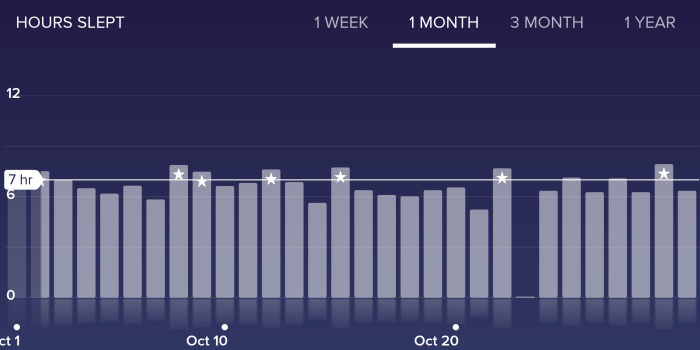
After missing my target by one night in September, and doing a quarterly check-in, I was hoping to get things back on track for October in terms of sleeping.  Let’s see how I fared.

Screenshot_2017-10-31-14-55-55
8/31 – Ouch…

Yep, I failed another month.  This was entirely because I was not intentional with my sleep habits.  I didn’t think about going to bed on time, and I didn’t make any effort to structure my evenings around winding down at a reasonable time.  It’s starting to show, too.  I’m finding that as of writing, I generally feel a bit more tired and groggy during the day.

This doesn’t mean it was all bad or completely negligent on my part.  From the above chart, you see many stretches (Oct 4-7, 16-21, etc), where I was consistently not going to bed at a decent time, but you also see instances where I just barely missed the 7-hour bar.

The restless sleeping seems to be an issue for me, and I’m not entirely sure what is causing it.  There are a few issues that could be contributing to it, such as the dog jumping on the bed during the night, or perhaps my weight is giving me some form of undiagnosed sleep apnea.  Whatever the cause, it does have an impact on my sleep targets: I am down for 7-hours or more, but I am logging less than 7-hours of sleep.

However, this is shifting the blame a bit to soften the blow.  The truth is, for every instance where I just barely miss my target, there are at least two nights where I didn’t have a proper shutdown before bed.  Fixing those errors should be my priority, not making excuses.

Stay Awesome,

Ryan

Skills Worth Developing – A Primer

I have recently made visits to my alma mater’s Career Centre for some career counselling.  Now that I have established myself solidly at work, I want to start planning the next steps for mid-career moves in a few years.  While I can certainly do a lot of work on my own, I find value in speaking with a professional who can help me work through the process from an objective outsider view.

Part of the process involves reflecting on skills and values.  Not only should I look at the skills I currently have, but I should also start looking towards jobs I’m interested in and analyzing the skills I will need.  This process asks a number of important questions:

  • What skills are required to be successful/effective in my desired position?
  • What skills will I need to develop, and what kind of training/experience will that require?  Is there any lateral movement I can make with existing skills or domains?
  • On what timeline do I need to plan for skill development?
  • (And, critically) Of the skills required of a position I’m looking at, do I really care about the skill or acquiring it?

I’m still in the early stages of this work, but it has gotten me thinking about skills more broadly.  If you spend time around the career or personal development blogospheres, there is a lot of lip-service paid to skills that lead to high paying jobs, especially those concerning STEM.  Oftentimes, I find that these skills are specific bits of knowledge, such as programming and design, but you still see some of the generic skills like communication or critical thinking.

While reflecting on this, I was thinking about skills that I don’t see mentioned often that would still be worth developing as they are cross-domain and useful in many contexts.  And so, from time to time, I will reflect on some of these skills here.  Next week, I will share some reflections on the skill of storytelling.

One thing to note here is that I think these skills are important irrespective of whether they are tied to high-paying work.  Yes, it can be important to seek high compensation for work.  However, my introspection on the topic of career moves is motivated less by wanting more money, and more tied to personal fulfillment.

Yes, I want more money – I am hampered by student loans and I look forward to the day when my comfort margins widen sans debt.  The reason, though, that I went to the career adviser in the first place is because I generally don’t feel satisfied by my work.  I want to feel a sense of purpose and intrinsic achievement in my life, both professionally and personally.  There are many aspects of my life that I am happy with, especially at home.  Where I feel an absence of satisfaction is in the intersections of work, production, and craft.  It’s not about being busy or productive.  It’s about making, producing, and working on interesting problems.  That’s what I feel is missing.

It’s what I intend to explore through thinking about skills worth developing.

Stay Awesome,

Ryan

Quarterly Sleep Review: July-Sept

Back in May, I thought I’d give a sleep update for that quarter to see what kinds of trends would shake out when taking a longer view of my sleeping habits.  I missed the opportunity to give an update for the April through June span, so instead I’ll skip it and give the update for July, August, and September.

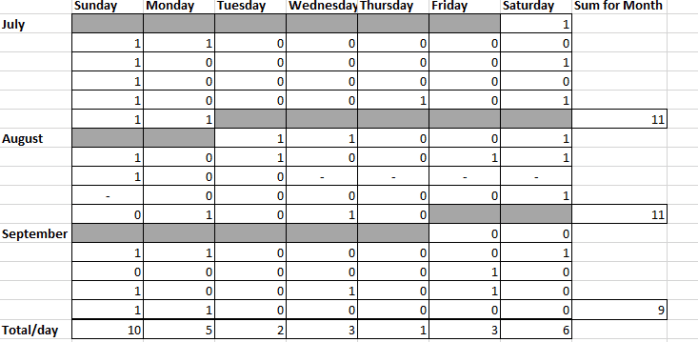
In the first quarterly sleep review, I was showing some pretty terrible numbers, with an overall success rate of 25/120 days, or 20.8%.  Let’s see where we are now.

Jul-Sep sleep

Here, we see a much better hit-ratio.  Between the months of July and September, I hit my target two out of three months, for 31 out of 92 days, or 33.7%, a more than 10% jump in sleep.

Some of my success in this quarter is because I’ve tried being more conscious of my sleeping habits, though I will admit that I still don’t do a good job of maintaining a night-time routine to get myself into bed at a decent time.

The sleep results for each of the days of the week are somewhat consistent from the last quarterly update, with the most sleep occurring Sundays, where I’m usually not up late and I can sleep in the next day.  Thursday continues to be a bad day for sleep since I’m still working at the bar Wednesday night’s.

The biggest improvement that was unexpected was my Saturday sleeping.  As I noted in the last quarterly update, Saturday’s typically suffer because I work at the bar, and so being up late usually means I won’t get a full 7-hours in.  In this quarter, I have fixed that issue somewhat, though admittedly not intentionally.  My best reason to account for this change is that I often take early cuts at the bar when we have lower patron turnout, so I’m able to go to sleep earlier than I otherwise would have.

A final caveat on my sleep results is that my July and August results are good because of the vacation I took from work.  The two weeks off between July and August meant I was able to keep a regular sleeping schedule, go to the gym twice per week, and have time with my partner, all while still being able to get work done from my to-do list.  That two-ish week period is a little bit of a deviation from the norm, which resulted in a higher sleep ratio for the month.

All in all, I’m happy with the results, and am looking forward to the next quarterly sleep review to close out 2017’s sleep tracking.

Stay Awesome,

Ryan

What You Say “No” To

Last week I discussed some thoughts on being busy.  Near the start of the post, I made an off-hand comment about why I’m typically busy:

It’s often less of an issue of seeking achievement, and more the result of me absent-mindedly saying “yes” to obligations without regard to the impact it has on my time and calendar.

This is the perfect example of an answer to those interview questions of “what is a weakness of yours?”  It took a lot of self-reflection to realize that a lot of stuff I do is less because it fits within a plan, and more because it sounded like a cool thing at the time.  It was a habit I formed when I was single and life was simple.  However, as things started piling up, it made it really difficult to prioritize.  The most important things in my life (love, sleep, exercise, etc.) end up taking a back seat to those things that seemed cool when I said “yes” to an ask.

I was watching a video from Jon Call, aka Jujimufu on YouTube, and he was discussing email tips that he uses to stay organized.  However, around the 3:30 mark of the video, he drops a fascinating insight:

“If I said yes…, I’m basically saying ‘no’ to (my wife) Sam, I’m saying ‘no’ to (my friend) Tom, (and) I’m saying no to you guys…”

Whether you are talking about your email inbox, your work, or the important people in your life, it’s important to reflect on what you are saying “no” to when you decide to say “yes.”  It’s a hard lesson that I am still struggling with, and I’m thankful with how patient my loved ones have been.

I invite you to reflect on your own life: what are you saying “no” to?

Stay Awesome,

Ryan


“You’re an over-achiever”

Right off the top, I want to make clear that this post is not intended to be a humble-brag.  I’m hoping to use the observation in the title as a jumping-point for a meditation on my career and professional life.

I’m a busy guy.  It’s often less of an issue of seeking achievement, and more the result of me absent-mindedly saying “yes” to obligations without regard to the impact it has on my time and calendar.  I find it satisfying to be involved in all sorts of cool projects, but I also rationally know that “being busy” is a cop out.

Busy people are often flakey.

Busy people often use it as a status marker.

Busy people are often less effective than they believe.

That’s not to say that effective people aren’t busy.  However, I bet that the ratio of effective people to the merely busy is skewed.  But that’s besides the point.

The other day, a coworker and I were talking about career advancement and our track-records for interviewing for jobs and getting turned down.  I commented to my coworker that they could invest more in themselves through courses at the College.  They dismissed the idea as it didn’t fit their current career position (they are mid-career, so the investment in training has a lower return in their mind), but commented that it’s a good strategy for me.  Then they dropped the line from the title:

“You’re an over-achiever.”

The comment was meant in the context of working at the College, working as a bouncer at a bar, teaching, taking a class, podcasting, etc., and it wasn’t meant to be dismissive or condescending.

The funny thing is that I don’t associate “over-achiever” with me.  It’s not that I reject the idea being applied to me, but more that if I’m to associate words to describe me, it’s not one I would have thought of.  My colleague also referred to me as “ambitious,” which I would agree is a closer description of me, except I would code that word to be synonymous with “foolishly hoping for a good outcome”.

The problem I have with the concept of being an “over-achiever” is I associate it more with outcomes instead of process.  “Over-achievers,” to me, get results irrespective of how hard they may or may not work.  I’m critical of my successes because I don’t think I achieve a lot (especially relative to the effort I put in – how busy I am).

That’s the disconnect for me.  I often feel that for all my busyness, I’m not making a lot of headway.  I’m not landing jobs that I interview for, I have a lot of projects that are idle or slow-moving, and I’m constantly filling up my evenings with stuff to do while also wishing I had more downtime.

This might not be a fair evaluation of my professional life, but it’s a reflection of the standards I have on myself.  From a career perspective, I feel adrift and treading water.  Each day slips by as more time I didn’t use wisely towards some further goal.  Having these feelings hasn’t yet translated into action or a change of behaviour, and I don’t know if and when that might happen.

Other people I know (I won’t name names), whom I consider to have achieved something with their professional life, are also called under-achievers by people who know them best.  When I heard that, I compared it to my own life, and felt bad.  If they are under-achievers, what does that mean about me?

All is not lost.  During orientation at the college, I joked with some engineering students that I have two philosophy degrees and three jobs, so clearly I’m beating the odds.  I know that, rationally, I’m doing just fine; that I’m being too hard on myself, or I have unrealistic expectations on myself.  Progression through one’s career is about building (skills, knowledge, connections, etc).  It’s slow and methodical, not characterized by leaps forward.  I need to keep reminding myself of this.

Stay Awesome,

Ryan

What I’ve Been Reading (as of August 21st)

I enjoyed writing my last reading update from back in June, so I thought I’d give an updated list.  In full disclosure, I have only completed three of the five books I mentioned (the two outstanding books are Brooks’s Character and the biography of Cato), so I won’t include those on this list.

Here are five more books I’m reading at present.

Montaigne: A Life by Philippe Desan 

Considered the father of the modern essay, Montaigne has popped up in various references during my reading, from stoicism to observational commentary and timeless meditations.  I’m a sucker for biographies, and this book was recently released in English as a fairly authoritative account of Montaigne’s life, not as an extraction from his essays, but as a picture of the historical figure.

William Tecumseh Sherman: In Service of My Country: A Life by James Lee McDonough

Did I mention I’m a sucker for biographies?  This was a birthday present to myself last year, but I’ve only started digging into it.  Sherman is held up as an exemplar of restrained greatness.  He’s considered great in equal parts from talent, study, and luck (though often it was luck that helped him out).  But the reason why I picked this up was how he is often held up as a contrast to Ulysses S. Grant, another U.S. Northern Civil War General, who mismanaged his life and the U.S. Presidency after the war, whereas Sherman quietly continued his duties in the army until retirement and didn’t seek political office (or so I’ve heard, I haven’t read very far into the book).  Like Washington before him who declined to be the first king of the United States, I like reading about figures who manage to avoid the hard fall from grace after they acquire fame, power, or authority.  Also like Washington, I think it’s important to understand a full picture of history, warts and all.

168 Hours: You Have More Time Than You Think by Laura Vanderkam

I don’t actually own this book.  It was laying around my fiancee’s office for about a year, so I decided to start reading it one day and take it home.  I don’t expect a lot of insight from this book, but I do like reading anecdotes of how other people manage their time so that I can glean possible tips and tricks to apply to my own life.  In the last year or so, I’ve started being more mindful of my time, hence why my reading lists include a disproportionate amount of productivity and personal development books.

80,000 Hours: Finding a Fulfilling Career That Does Good by Benjamin J Todd

I’ve also been more mindful of my career recently.  With losing out on a few jobs recently (before and after interviewing), I’ve been considering my options for improving my career prospects through opening up opportunities, strategic skill acquisition, and relationship building.  While the content of this book is entirely online for free through the 80,000 Hours website, I purchased the book anyway to have all the information in one place.

Middlemarch by George Eliot

This book is brand new to the list as I only grabbed it from the library this past weekend.  I read about George Eliot (Mary Anne Evans) in Brooks’s Character book (from the last list) and I was struck by her lauding of the average person in her fiction.  I, like many others, have found myself buying-in to the aspiration to greatness narrative – that to have a good life also means to be great, have impact, and cement yourself in history.  Middlemarch, and many other books by Eliot/Evans, chooses to laud the quiet efforts of the average person, who does their part and is praiseworthy in their steadfastness.  Brooks quoted the closing lines of Middlemarch in Road to Character that celebrated humble lives,

“But the effect of her being on those around her was incalculably diffusive: for the growing good of the world is partly dependent on unhistoric acts; and that things are not so ill with you and me as they might have been, is half owing to the number who life faithfully a hidden life, and rest in unvisited tombs.

Stay Awesome,

Ryan

Morning Productivity

I had an interesting morning last Tuesday.  As I’ve mentioned recently, I’ve been getting up early with my fiancee.  She typically leaves for work around 7am, and I don’t need to leave for work until around 9am, which leaves me with almost 2-hours to fill with how I wish.

I could go back to sleep and work on hitting my 7-hours of sleep per day goal (as of writing, I’m still failing on this goal, but only narrowly).

Or, I could try to use this quiet time to do some things distraction-free.

*If my fiancee is reading this, I mean distraction from technology and daily pressures.  Love you!*

I’ve been steadily adopting the latter option, and last Tuesday I had an amazingly productive morning.

First, I read for around 30 minutes.  I’ve been working my way through Tim Ferriss’s new book “Tools of Titans” which is hefty 700 pages.

Then, I opened up the Coursera app on my phone and did a few lecture videos on an introductory calculus course I’m working on, including practice problems on functions.  That was around 15-20 minutes.

Then I went upstairs to row for 10 minutes.  I started rowing two weeks ago in the mornings and I’ve already noticed an improvement – I’m less winded after the workout and my hips are not nearly so tight afterwards.  I’ll probably write a post about rowing soon, but for now it’s a small habit I’m trying to instill during the work week.

After rowing, I recorded two vlogs.  I recorded a short vlog for Art Press, my podcasting partner’s side-channel that features vlogs from artists who also exercise.  Then, I recorded my daily vlog that I upload privately to my channel as my version of a diary.  The two vlogs took me 5-7 minutes to record.

Then, I finally showered and got ready for work.

Reflection

I know that starting your day on the right foot is a key to success.  It sets you up with a positive mindset that you are accomplishing your goals and using you time well.  I certainly don’t want to do things for the sake of being busy.

I suppose I’m being a little arrogant by sharing this information within my social media feeds – I’ve been tweeting my progress on rowing, and sharing my small productivity wins as they happen.  Am I just looking for approval from others?  Does sharing this really keep me motivated and accountable?  Would I enjoy the process less if I didn’t share (boast) about it?  Am I looking to inspire others?  Lead by example?  Make them jealous?  I don’t have good answers for this.

I also don’t know whether I can keep this up regularly.  This system (I’m calling it a system for the sake of the argument) is fragilely held afloat because of my fiancee’s schedule.  If that were to change, I’m fairly confident I wouldn’t be able to wake up at 6am on my own – I have about of decade of anecdotal evidence to support this.  Also, will I be able to keep this pace?  Exercise, reading, studies, and vlogging takes up a lot of time; will I be able to guarantee that I’ll have enough time and mental focus everyday to continue this process.  Again, I don’t have an answer to this.

Time will tell.  After all, as of writing, I only have one data point to draw an inference from.  It’s important to not get too far ahead of myself and focus on hitting my targets tomorrow.


Stay Awesome,

Ryan

Signal and Noise – Facebook, We Need to Talk

Continuing the emergent theme of January for this blog, I thought this post could discuss some of the thoughts that have been mulling around in my head for the last few months.  Once again, in the spirit of pulling back and simplifying, I’ll briefly comment on some thoughts I’ve had about Facebook (specifically) and social media (generally).

This won’t be a think piece about the problems with the various platforms, their social responsibility, the degree to which they are or are not responsible for the behaviours of their users, etc.  There are many great articles written on those topics that have spun out as a consequence of the American Presidential election late last year.  I have nothing new or clever to add to that conversation.

Instead, I want to focus on my relationship with social media – how it has affected me and my behaviour.  You, my dear reader, may or may not agree with my attitude towards social media.  That’s ok.  I’m not speaking to any sort of norms here.  I don’t think people should adopt my views if they don’t want to.  Your relationship with social media is wholly bound up in a different set of lived experiences which is not guaranteed to overlap with mine in any meaningful sense.  I will be describing my experiences here.

Birthday 2015

In 2015, I set a challenge for myself to cut back on my Facebook use.  I felt that I was spending far too much time endlessly and mindlessly scrolling through Facebook.  This challenge was motivated by a desire to be more productive in my life.  I wanted to consume less and produce more; I felt this was important for me to grow as a person.  Facebook was a constant and daily consumption habit where I binged on updates from my network of friends and family.  It was less about a sense of fear of missing out and more about seeking updates to what people were doing and things they found interesting.

So, on my birthday in 2015, I deleted the app off my phone.  The experiment wasn’t very successful as I logged into Facebook using my phones Chrome browser (I had legitimate reasons to need onto the site initially since my job at the bar uses a Facebook group for scheduling shifts).  When I didn’t log off from the browser, I essentially was left with Facebook on my phone.

It took until around September of 2016 to wise up to my usage, and I deleted the Chrome app from my phone.  For the last 4 months of 2016, I abided by the spirit of the original challenge and things were good.

Birthday 2016

Every year at the outset of my birthday, on the stroke of midnight, I deactivate my Facebook account for 24-hours.  I do this for a number of reasons.  It allows me to be more present in the day.  It allows room to reflect and introspect.  I don’t have a constant deluge of notifications from people wishing me a happy birthday (especially from people who only message me once a year because Facebook tells them it’s my birthday).  And it removes a mindless activity so that I can do more productive things with my birthday, such as exercising and volunteering.

This year was no exception on that front.  What was unique was that my birthday was buttressed against several days of travel and time with family.  For the better part of  the next five days,  I was busy with family and Christmas, and was never near a computer with enough time or the desire to check Facebook.  I realized only after my family expressed concern that I had possibly unfriended them (and my fiancee joking that she was no longer engaged to someone on Facebook) that I finally logged back in.

Upon logging back in, I realized that I hadn’t really missed the experience.  The first few days did have me missing Facebook in moments of boredom, but otherwise I hadn’t really missed using the service.  I was actually a little sad that I was giving in and returning to the service because it became a game to see how long I could go without using Facebook.

I also realized that I felt happier in my ignorance.  Well, that’s not true because I still followed the news and read articles; I kept up with current events.  But in not paying attention to the micro-updates in peoples lives and in unverified news, a weight had lifted from my psyche.

Signal and Noise

When I reflected on these thoughts, I realized that I should maintain some element of distance from using Facebook going forward and disengage.  My rationale has changed a little bit since 2015.  I still seek to favour production over consumption, but since the election, using Facebook has become, for a lack of a better expression, less fun.  Through a combination of fake news, false information on memes, politicization, activism, expressed attitudes and values I disagree with on many levels, and uninteresting updates, I don’t enjoy using Facebook like I once had.

What I realized is that the signal-to-noise ratio had skewed too far in the noise direction.  I personally don’t find Facebook all that useful outside of some very limited cases.  I was having a hard time filtering out all the distractions.  There are a number of reasons for this that, if I genuinely sought to address, I could fix.  I could start hiding posts, or reporting fake news.  I could unfriend people I don’t associate with, or I could hide posts and stop following updates from people in my network.  I could curate the experience to better suit my tastes.

There are two big reasons why I don’t follow this route.  First, I’m conscious of trying to avoid setting up an echo chamber that reflects back only things I agree with.  I value diversity of opinion, even if I disagree with it.  What I’m seeing on Facebook is not opposing viewpoints expressing themselves constructively.  This may make me a bad person, an abuser of my privilege, or a bad ally, but I don’t find value in only associating with people who narrowly share my values and beliefs.  It’s especially bad when I agree with the cause, I agree with the conclusions, but I disagree with the message or argument presented.  I value setting aside individual differences for common purposes.  I value good, sound arguments.  I value constructive input and critiques.  I value testing assumptions and arguments to ensure the burrs are smoothed out.  A consequence is that this does end up challenging my beliefs less; on that front, I acknowledge the consequence of my action.  I don’t have an adequate response to this and I need more time to reflect on it.

But the second reason why I don’t follow this route is that I don’t feel invested in the desire to fix the experience I have on the platform.  Instead, I’m much happier to step back from the noise and seek other areas of my life where I can boost the signal of things that matter to me.  I can focus on paying for news that I value (I recently purchased a subscription to The Economist, and a subscription for The New Yorker was gifted to me for Christmas).  I prioritize time with friends and family.  Being present with them is more important than cursory updates.  And I have the time to satisfy my desire to be constructive – making things, collaborating with friends, and learning.

To me, Facebook is an endless well of distraction.  Are there useful things on there?  Sure.  Are there important things on the platform?  Absolutely!  The activism and awareness campaigns that have popped up in the last year are a testament to how the platform can be useful to getting the conversation going for a mainstream audience.  I would never want to take that away from the experiences of others.  What I have a personal issue with is what the behaviour represents about me.  Facebook is a crutch I use to distract and occupy myself when I’m bored or procrastinating.  I seek out the notifications and the feedback.  I seek out validation and approval.

Facebook is built specifically to take advantage of this biological system in our brains.  I won’t go so far as to say it’s addictive, but I will say that the site is engineered to get people to frequently come back to the platform multiple times per day through posts, notifications and suggestions.  It leverages my desire for novelty and new content is frequently just a refresh away.

The same can be said for other platforms such as Twitter, Snapchat and Instagram.  I suppose where my bias shows is I’m less critical of Instagram because I can curate my experience better around my interests and hobbies.  On top of that, I find the experience purer on Instagram because I use it to share things I do and find interesting in my everyday life.  These are things that I experience and these are things I make.  It’s constructive, rather than consumptive.

Moving forward, I’m seeking to engage less with social media.  I don’t hate or think Facebook to be evil.  It’s a tool like any other.  My goal is to scale back my use and be more mindful.  I want to signal-boost the important things and tip the scales away from consumption into something more constructive.

Produce, not consume.

Stay Awesome,

Ryan