Skills Worth Developing – Resisting “That’s Not My Problem”

The job I have at the college is my first full time job after I finished university.  Prior to the position I’m in, I have worked only full-time hours on contracts and a smattering of part time jobs.  I thought, like many others, coming out of university that I knew what it would mean to have a job, be an employee, and work responsibly.  I wouldn’t say I was unprepared to enter the workforce, but it would be charitable to say that I had a lot to learn, and many beliefs to update.

This is, in part, why I decided to occasionally write thoughts in a series of posts loosely connected with the theme “Skills Worth Developing.”  There are many hard skills that employees should pick up over time to help them do their jobs better and advance in their careers.  Organizations like Coursera, Udemy, Lynda, etc. are excellent resources to help one pick up those kinds of skills.  But many other skills (usually dubbed “soft skills”) are usually picked up through experience and self reflection.  This blog serves both to force me to write, but also to force me to make permanent any self-reflections I’ve had, and these reflections might be valuable to others.

The last time I discussed Skills Worth Developing, I discussed the merits of storytelling as a communication tool.  This time, I want to reflect on a phrase I heard a lot when I first started working – “That’s not my problem” or “That’s not my job.”

You might be wondering why I lump this in with the notion of skills, instead of some other attribute, such as attitude.  True, something like this will overlap with one’s “attitude” while on the job, but I view this as a skill because it’s a habit and ability that can be modified over time, practiced, and strategies can be employed to use it in the workplace.  Therefore, I loosely connect it under the skills area that should be developed and practiced over time.

One other observation I want to make is that this skill – avoiding falling into the “That’s not my problem” mentality – is something I exercised as a beginner.  I think this is a fantastic skill to develop early in your career, but I’m not entirely sure of it’s value when you are well-established in your role.  The value of this skill is that it increases your value to the company when you are still differentiating yourself.  The same can not be said for someone who is either well-established in their company or field, where their value is tied directly to their ability to focus on problems that they can uniquely solve.  In those instances, it’s probably a better strategy to limit distractions from your primary role and duties.

And so, we come to the problem of “That’s not my problem.”  I found early on that many employees in a work environment can take on the “not my problem” mentality for a variety of reasons.  Perhaps they were burned in the past and now refuse to extend themselves.  Some feel overworked and overstretched.  Some are lazy.  For whatever reason, they resist helping others in their duties.

I find two issues with this kind of mentality.  First, it goes against the spirit of cooperation, collaboration, and teamwork.  The workplace is a team of employees who are working towards common goals to advance the interests of the organization (while hopefully advancing their own personal interests in parallel).  Any time someone says to a coworker “that’s not my problem,” what they are in fact saying is “your problems aren’t important enough for me to take an interest.”  They end up placing themselves above the interests of their coworkers and the organization.  I’m not saying that this is wrong per se – I am sympathetic to the ideas that this mentality is easy for organizations to exploit, and that there is no moral imperative to place the company’s interests above your own, so you should guard against it taking advantage of you.  What I am saying is that taking this as a default position undermines the team.  Everyone is supposed to work together to solve problems and strive to the company’s mission.  If you don’t want to do that, what’s the point of working at that company?  I would hardly think that it’s just in service of the paycheque.

The second issue I have with this attitude is it closes you off to development.  I directly attribute my success so far to my willingness to learn outside of my prescribed job.  By helping others with their tasks (so long as it does not prevent me from taking care of my own job area), I am able to develop new hard skills and learn about areas laterally and vertically from my position.  I am better able to see how my role fits within the larger context of our department, which continuously exposes you to new opportunities for growth and development.  You become more valuable to the team and you strengthen your ties with your coworkers.  When you are just starting out, this is a valuable way of integrating yourself and setting yourself up for advancement.

When you ignore the impulse to say “that’s not my problem,” you acknowledge that your coworkers are people with their own problems, concerns, hangups and worries, while also setting yourself up as a person of value for the team.  It is a perfect opportunity to step up and be noticed in your workplace.

That is why I think resisting the impulse to say “that’s not my problem” is a skill worth developing.

Stay Awesome,

Ryan

The Arts of Learning & Teaching

I’ve been in the apprenticeship phase of teaching for the last year, so I’ve largely been gaining experience in how information is conveyed and how to give feedback to students.  While I have given some consideration to course design and what kinds of courses I’d be interested in teaching, my primary focus has been on ensuring the students receive good content and (more importantly) good feedback on performance. Good performance management involves timely and specific feedback to either reinforce good behavioural outcomes, or quickly identifying and redirecting bad performance outcomes. It’s a challenge to ensure that feedback is both timely and useful, but it’s an important step of the process. 

I’m currently working my way through the Art of Learning by Josh Waitzkin, and I’ve started thinking about the process of learning.  While learning and teaching are separate domains, they are interconnected since they share similar goals.  However, being able to translate learning (whether being taught by a teacher or through self-teaching) into teaching to others is something that I have a lot of gaps in my knowledge about.

The first time I taught in-class in the college setting, I quickly became aware that my experiences with formal education (the university style lecture) was not a good mode of delivery to copy. While I am comfortable in the lecture setting, I saw that my students did not excel in that environment. I wish I could say that I had fixed my delivery before the end of the semester, but the reality is that I didn’t fully appreciate the situation until after the course was over and I reflected on the term. An environment where I stood at the front and spoke at length for two-hours was not one which the students could effectively absorb the material.

The problem I found is that how I think and absorb content is different from my students. Rather than teaching them to my style, I need to be more mindful of their talents and experiences. Waitzkin discusses this in his book, where he contrasts two kinds of teachers he’s had. One is the kind that teaches his own strengths and relies on rote memorization of strategies and techniques. In chess, this teacher has you studying opening moves to take early advantage of the board.  The other kind of teacher allows the student to play to their inner style, and teaches by building up concepts atomistically. In chess, this kind of teacher strip the board of all the pieces and focuses on the relationships between pieces at the end of the game. By showing how individual pieces play off each other, the student becomes comfortable across the game and learns not only how pieces fit together, but how to set yourself up for control at the end of the game.

I think my teaching style should embrace this second kind of teacher. Instead of dictating knowledge, I should focus on breaking the knowledge down and building up understanding in ways that make sense to the student. I can’t assume my students will have the prerequisite knowledge to compile the facts together on their own. It’s also the case that if I can’t break ideas down simply, the students might not get it, nor may I truly know what I’m talking about.  Afterall, Einstein and Feynman believed that if you couldn’t explain something simply, you probably don’t understand it very well yourself.

Stay awesome, 

Ryan

Ongoing Education and Solving Problems

There is a general perception that going through the formal education process is sufficient for career success.  If you follow the standard formula of secondary school, followed by some form of post-secondary education, whether through trades, college, or through the university, you should have the necessary tools in order to enter the workforce and perform well in most situations.  While this might be true to some degree, I’m willing to bet that if you were to ask people of their thoughts on this process, you’d be met with a certain level of skepticism.  Yes, there are some critical problems with how we view and use higher education, but on the whole, I think the missing piece is this: the role of higher education should be to give students the ability to think and learn for themselves (often concurrent with learning some kind of job-market skill).

The value of higher education is the exposure to ideas and of ways of thinking about things.  By exposing students to ideas and problems they’ve never encountered, you are giving them experience that they can use to navigate life after the classroom.  I think most people get too hung up on the job-market skills and end up de-emphasizing the other stuff referred to as “the humanities” or “breadth electives.”  What is important is for students to be able to cross over the threshold of their vocational training and learn to navigate in systems of knowledge that they aren’t comfortable with so that they can learn to gather information, define problems, and test solutions for things that are applicable to them.

I have a small example of this in action for myself.  Recently, the provincial college system was brought to a halt during a labour dispute.  Once the teachers came back to work, everyone set to work on figuring out how to carry-on and salvage the remainder of the semester.  One of my tasks was to track student requests for accommodation once it was determined that the holiday break was being scaled back to allow students to complete the fall semester.  If students had made previous plans for travel, asking them to cancel their plans (which often was at a huge financial loss to the students) was something the college did not wish to do.  So, the goal is to see where we can find solutions for students missing class in the revised schedule.  My job is to track the requests from students and track the faculties responses.

I wanted a simple way of tracking the information electronically on spreadsheets, and avoid copying huge numbers of cells worth of information into emails.  My solution was to set up a database.  I’ve never created a database before (only used existing ones), so I turned to resources available for employees at my work to teach myself the skills.  I set up a simple database, laid a form over it to allow for a cleaner user experience, and created standardized Word documents with placeholder values that would automatically call information from the database into the document for me to email out streamlined messages to faculty and students.

I shared this database tool across the college, and have been receiving very positive feedback from people who are using it.  I even recorded a 30-minute tutorial video on how to use the database and manage the information, then hosted the video online for other employees to use at their discretion.

My educational background is in philosophy, which is quite different from data process management.  However, through philosophy I learned skills such as how to self-direct my learning, how to define problems, and how to test solutions.  These skills are what has allowed me to come up with a way of managing all the information coming at me, and how to teach that system to others for their own use.  Being able to help others, and sharing something that they value, makes me feel really good and engaged at work, and I’m happy to be able to help others do their jobs more easily.

I understand that students often don’t have the luxury to think broadly about how their skills fit in with a larger view of pedagogy, but I think it’s important to remember that the specific processes, tools, and systems we learn at school are the micro expressions of overall deeper ways that we live, understand, and view our lives.  Taking a narrow view of the value of education tends to miss the proverbial forest for the trees.  The point of higher education is not just about vocational training and preparing people to enter the economy, but instead it’s main purpose should be viewed as a way of preparing people to become better problem solvers.

Stay Awesome,

Ryan

Skills Worth Developing – Storytelling

A common skill I often hear referenced as either lacking in new grads or in online career development literature is communication.  In the various industry meetings I sit in on, employers observe that soft skills, and communication in particular, is something that needs to be fostered in students.  One problem I have with the idea that we should develop better communication skills is that, on its own, the idea is hard to action.  What does it mean to communicate better?

At its core, communication is the process of taking an idea from one mind and trying to reproduce it in the mind of another person.  When I was exposed to communication theory in undergrad, I was taught the basic mechanics of the transmission model.  The transmitter encodes and sends a message through some medium, and the receiver decodes the message and attempts to understand it.  If you take out considerations of how messages can be disrupted en route (think: playing the telephone game), a frequent problem I encounter with communication is poorly encoding/decoding a message.  When you are trying to send a message, explain an idea, persuade, evoke empathy, etc. in others, how you choose to structure you message becomes critical.  A tool you can use is storytelling.

I was first exposed to storytelling as a serious mode of communication in 2012 through my local Community Foundation.  They had a pilot project called the Centre for Community Knowledge, which helped train local nonprofits and charities to tell their stories better.  The thinking was that if you could effectively tell your story, you could more easily connect with volunteers, donors, and others to champion your cause.  There, the instructors provided workshops for organizations to draft compelling stories, film them, and present them on the Centre’s platform.

Storytelling is hard.  Selecting the right details and presenting them in the right sequence in order to maximize impact is challenging.  I still consider myself an amateur when it comes to the skill of storytelling.  But in the five years since I first learned about telling stories in the nonprofit world, I’ve learn 4 core truths about storytelling on why it’s a skillset worth developing.


1.) Effective storytelling is mindful of the audience.

You can’t tell an effective story if you don’t consider who your audience is.  Everything hinges on knowing who you are speaking to – their experiences, their knowledge, their interests and wants, their attitudes, etc.  How you craft a message will differ if you are speaking to children versus conservatives versus students.  Is your audience open to your message, or are they hostile?  Are you trying to convey information, persuade them to change their minds, or entertain them?  You can’t tell a good story if you don’t think through these considerations.

2.) It’s not about wowing or captivating; it’s about connection.

Sometimes, we get bogged down in thinking about storytelling or speeches from the entertainment point of view – how do I captivate my audience?  How do I grab their attention and hold it?  But effective storytelling is not about captivating your audience, but rather it’s about building a connection with them.  It’s about making an idea relatable, in terms your audience understands.  If you can make your audience connect with you as a person, or at least your story, then you are effectively communicating with them.

3.) Theory and data is hard to understand; that’s why stories and metaphors are so important.

If you take a cursory look at the most common scientific theories, you will find an interesting phenomenon: you’ll often see that the theory is communicated through some sort of analogy or metaphor.  That is largely because the concepts being described behind the observations are not immediately accessible to everyone.  People don’t understand what gravity is, or what light is, or what evolution is.  So, science communicates complex models through stories.  Selecting stories to fit data and theory is challenging because you don’t want to leave out important details, but if you can choose the right story to tell, you can open up whole new worlds of understanding for your audience.


4.) Stories are often told with a purpose in mind.

Does every story need a point?  No, not really.  We can tell stories simple to entertain one another.  But effective stories are often effective because they are communicating an important message to the audience; a lesson, a purpose, a greater understanding.  In earlier civilizations, we created myths to explain the world and transmit values through the generations.  To borrow a phrase from Simon Sinek, the nonprofits I mentioned above were seeking to communicate their Why to their audience – why they do what they do.  Good stories often tell more than an amusing account of events.  They impart lessons that edify the audience.


Storytelling is only one way to effectively communicate.  I don’t mean to say it’s the only form you should use (I doubt the engineers I work with want my reports to them to be parables about data), but it’s worth developing as a skill if you want to be able to connect with others to share your ideas and vision.  Whether you are seeking to entertain your friends, break down a complex idea, or persuade someone to follow you, being able to tell a good story will go a long way in bridging the gap between you and others.

Stay Awesome,

Ryan


What You Say “No” To

Last week I discussed some thoughts on being busy.  Near the start of the post, I made an off-hand comment about why I’m typically busy:

It’s often less of an issue of seeking achievement, and more the result of me absent-mindedly saying “yes” to obligations without regard to the impact it has on my time and calendar.

This is the perfect example of an answer to those interview questions of “what is a weakness of yours?”  It took a lot of self-reflection to realize that a lot of stuff I do is less because it fits within a plan, and more because it sounded like a cool thing at the time.  It was a habit I formed when I was single and life was simple.  However, as things started piling up, it made it really difficult to prioritize.  The most important things in my life (love, sleep, exercise, etc.) end up taking a back seat to those things that seemed cool when I said “yes” to an ask.

I was watching a video from Jon Call, aka Jujimufu on YouTube, and he was discussing email tips that he uses to stay organized.  However, around the 3:30 mark of the video, he drops a fascinating insight:

“If I said yes…, I’m basically saying ‘no’ to (my wife) Sam, I’m saying ‘no’ to (my friend) Tom, (and) I’m saying no to you guys…”

Whether you are talking about your email inbox, your work, or the important people in your life, it’s important to reflect on what you are saying “no” to when you decide to say “yes.”  It’s a hard lesson that I am still struggling with, and I’m thankful with how patient my loved ones have been.

I invite you to reflect on your own life: what are you saying “no” to?

Stay Awesome,

Ryan


“You’re an over-achiever”

Right off the top, I want to make clear that this post is not intended to be a humble-brag.  I’m hoping to use the observation in the title as a jumping-point for a meditation on my career and professional life.

I’m a busy guy.  It’s often less of an issue of seeking achievement, and more the result of me absent-mindedly saying “yes” to obligations without regard to the impact it has on my time and calendar.  I find it satisfying to be involved in all sorts of cool projects, but I also rationally know that “being busy” is a cop out.

Busy people are often flakey.

Busy people often use it as a status marker.

Busy people are often less effective than they believe.

That’s not to say that effective people aren’t busy.  However, I bet that the ratio of effective people to the merely busy is skewed.  But that’s besides the point.

The other day, a coworker and I were talking about career advancement and our track-records for interviewing for jobs and getting turned down.  I commented to my coworker that they could invest more in themselves through courses at the College.  They dismissed the idea as it didn’t fit their current career position (they are mid-career, so the investment in training has a lower return in their mind), but commented that it’s a good strategy for me.  Then they dropped the line from the title:

“You’re an over-achiever.”

The comment was meant in the context of working at the College, working as a bouncer at a bar, teaching, taking a class, podcasting, etc., and it wasn’t meant to be dismissive or condescending.

The funny thing is that I don’t associate “over-achiever” with me.  It’s not that I reject the idea being applied to me, but more that if I’m to associate words to describe me, it’s not one I would have thought of.  My colleague also referred to me as “ambitious,” which I would agree is a closer description of me, except I would code that word to be synonymous with “foolishly hoping for a good outcome”.

The problem I have with the concept of being an “over-achiever” is I associate it more with outcomes instead of process.  “Over-achievers,” to me, get results irrespective of how hard they may or may not work.  I’m critical of my successes because I don’t think I achieve a lot (especially relative to the effort I put in – how busy I am).

That’s the disconnect for me.  I often feel that for all my busyness, I’m not making a lot of headway.  I’m not landing jobs that I interview for, I have a lot of projects that are idle or slow-moving, and I’m constantly filling up my evenings with stuff to do while also wishing I had more downtime.

This might not be a fair evaluation of my professional life, but it’s a reflection of the standards I have on myself.  From a career perspective, I feel adrift and treading water.  Each day slips by as more time I didn’t use wisely towards some further goal.  Having these feelings hasn’t yet translated into action or a change of behaviour, and I don’t know if and when that might happen.

Other people I know (I won’t name names), whom I consider to have achieved something with their professional life, are also called under-achievers by people who know them best.  When I heard that, I compared it to my own life, and felt bad.  If they are under-achievers, what does that mean about me?

All is not lost.  During orientation at the college, I joked with some engineering students that I have two philosophy degrees and three jobs, so clearly I’m beating the odds.  I know that, rationally, I’m doing just fine; that I’m being too hard on myself, or I have unrealistic expectations on myself.  Progression through one’s career is about building (skills, knowledge, connections, etc).  It’s slow and methodical, not characterized by leaps forward.  I need to keep reminding myself of this.

Stay Awesome,

Ryan

Admin, Prof, and Student? 

In line with my desire to take positive steps for my career, I’ve been exploring options on how to get more experience. One option available to me is to take classes at work. A great benefit of working for a college is that you can have amazing discounts on classes. At my college, support staff can take classes for a flat rate of $20.  How could you not take advantage of that?

When I started this blog, I was taking a biology course to prepare for my entry into paramedicine. Having since abandoned that career path, I haven’t seen the need to enroll in classes. However, when I missed out on some recent career moves, I thought the time has come to see what courses I could take.

Looking through the course offerings, I stumbled across some management courses. One stood out to me:

MGMT1960 – Performance Management
This subject will focus on performance analysis, counselling, constructive feedback, conflict resolution, performance management systems and overall strategies for performance management.

Given my recent job shift towards student advising, it seemed like a good option to pursue. My boss signed-off on it, and now I’m course-loaded for a management class starting on Tuesday. The course is thankfully offered online, so it’ll give me some latitude to fit it into my schedule.

This also means that I am straddling three different areas at the college. I’m continuing my main duties as a administrative support staff, and I’m slated to teach another round of Quest for Wisdom online, and now I’ll also be a student. If nothing, I seem to like things interesting and keeping busy. Let’s see how this goes.

Stay Awesome,

Ryan

August 2017 Sleep Check-In

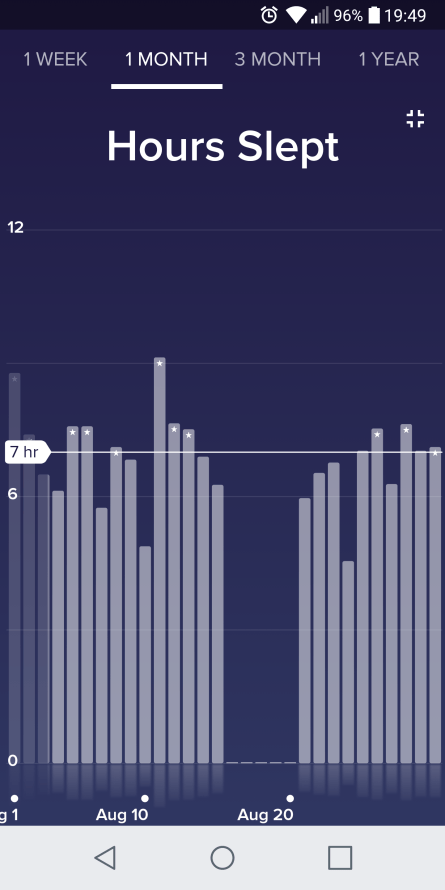
It’s sleep check-in time!  After the progress I made in July, I was curious to see if I could both hit my target 10-times, and if I could hit it intentionally, rather than the result of vacation rest.

There was a hiccup in my plans, though, as I had to finally retire my old Fitbit unit when the patch job I used to keep the band from separating from the hardware gave out again.

20170903_204640

When the unit started showing signs of damage from the band coming apart last year, I had notified Fitbit’s customer service and they sent me a replacement unit.  The watch itself wasn’t damaged, so I used glue to repair the band and continued to use it.  However, over time the adhesive wore off, and I figured it was time to make the switch.

That wasn’t the hiccup, though.  The problem I had was that I didn’t do a final sync to transfer data from the unit before I deleted the unit from my phone and synced up the new device.  As a result, I lost about a week’s worth of data.

Screenshot_2017-09-03-19-49-06
11/31

The unfortunate result is that 5 days of data is gone.  Of the missing days, I think I can charitably say that I hit 7-hours or more of sleep once (on a Sunday).  However, without the data to show for it, I’ve decided to live with the loss.

Nevertheless, of the data that remains, I hit 11 nights of sleep for the month, hitting the target I set for myself!  A small disclaimer that deserves to be mentioned: my vacation from work spanned the last week of July and the first day of August, meaning that the first day of the month where I hit over seven-hours of sleep was during vacation time.  Similarly to last month, I don’t consider this typical as I’m trying to be intentional with my sleep schedule while juggling my various responsibilities.

Regardless, I consider this a successful month and am looking forward to carrying the momentum forward into September.

Stay Awesome,

Ryan

Cross-Domain Skills Sets

A few months back, I met with a career adviser at my alma mater to help me start planning out what my next steps should be for my career.  Having established myself, it’s time to think about where I want to go, and what I need to do/learn to get there.  One thing that stuck out to me at the session was that as she was reviewing my resume, she commented that she didn’t see my security (bouncing) experience listed.  I did not include it, figuring it wasn’t relevant enough to an office job, however she demanded I put it on there as it’s an important set of skills that I’ll need if I’m shooting for managerial roles.

Flash forward to last week, and I’m really starting to appreciate how much working as a door guy at a bar can help.

It’s the last weeks of the summer term for the college, which means that we are balancing the demands of the incoming semester with the final business of the outgoing semester, including students who fail courses.

In one of our programs, we had a number of student perform poorly on the final exam, which means they subsequently did poorly in the course.  Understandably upset, they are coming to us in the office seeking guidance or some way of redeeming themselves.  It’s a very delicate situation, which is proving a challenge as we try to give the students as much leeway as we can within the confines of our policies and procedures.

In some cases, the decisions we are making are not in the student’s favour, and they are, again, understandably upset by this.  They are really advocating for improving their situation, which is quite commendable, and I interacted with several of them almost every day lastweek.  When meeting with them, you need to strike the right balance of fairness, openness, but firm adherence to our policies and academic standards.

A few coworkers have commented on my tact and negotiation skills in talking with the students, even when there is nothing I can do to help them improve their marks, complementing me how smoothly the conversations are going with (sometimes) large groups of students in our office.

I gave a somewhat sarcastic response that dealing with the students is easy when I know they aren’t going to swing at me, as might happen at the bar on a security shift.  But in truth, the skills I have learned as a security guard are wholly translating to this situation.

As a security guard, to do my job well, I must be open-minded, calm, and patient when dealing with intoxicated or angry patrons.  The adage that “the customer is always right” is false, and when the rules and reality of the situation come to head with the patron’s expectations, it sometimes leads to raised tempers and hostile interactions.  My job requires me to step-back from my ego, not take anything personally, and use every tool at my disposal to de-escalate the situation and bring about as calm of a resolution as I can.  Most of the time, we are successful and the patron leaves on their own.  Sometimes, we have to drag them out kicking and screaming.

I’ve worked as a security guard for 5-years now, so I have a fair amount of experience, which I’m starting to appreciate how cross-domain it can be when dealing with students.  The ability to not be dismissive or authoritarian in communicating our decisions is critical for maintaining a good relationship and a healthy work environment.  Suffice to say, cross-domain skills sets that help me avoid getting decked in the face are awesome!

Stay Calm,

Ryan