Problem Solving – A Framework

In my first post on principles, I had an entry regarding problem solving – specifically, guidance on defining problems.  That entry is actually a condensed version of something I have hanging in my cubicle at work:
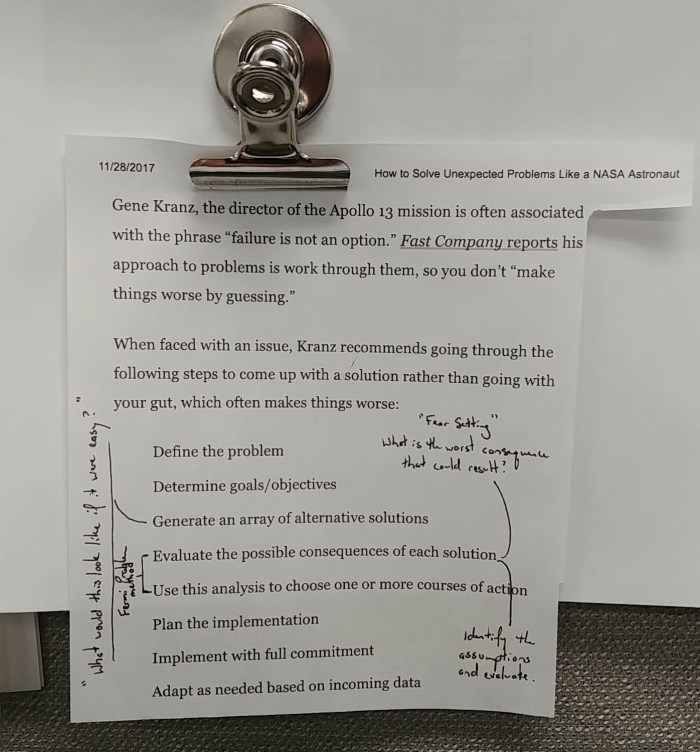
20181018_154129~2

I printed the post from a Lifehacker article, and have since annotated it with a few extra ideas.  On the left, I stole a line from Tim Ferriss’s Tribe of Mentors to supplement the step for generating possible solutions to your problem.  The simplicity of the question, “what would this look like if it were easy?” allows me to limit the choice pool by excluding unlikely scenarios while thinking about the positive outcomes.

When it comes to evaluation consequences and narrowing down the options, I have added three additional tools.  First, I borrow again from Tim Ferriss where he uses “Fear Setting” to determine the worst case scenarios possible, and then he goes through each outcome and asks himself whether the cost is something that he could live with.  By doing so, he reframes his concerns away from merely worrying about negative outcomes to only focus on the things that matter to him.

I also added a note to myself to ensure I’m capturing my assumptions.  A lot of the time I start with my conclusions and assume they are transparent in their reasoning.  However, if I ask a series of clarifying questions (usually the 5-why technique), I often end up drilling down to hidden assumptions or emotions that motivate the conclusion (rather than pure reason).

The final note I scribbled is in reference to Enrico Fermi who had an uncanny knack making stunningly accurate “guesses” off the top of his head.  Fermi used probabilities and statistics to make educated guesses to solve problems, which could then be further refined.  It’s a tool for quick and dirty estimates, and it helps to narrow down the choice pool.

My annotations aim at four tools I can use to supplement Kranz’s method: what is the best/easiest solution, what’s the absolute worst case, how easily can we figure this out, and what motivations are driving my decisions.  I try to keep those considerations in mind, though I’m not nearly as rational as I pretend to be.

Stay Awesome,

Ryan
Principled Thinking (part two)

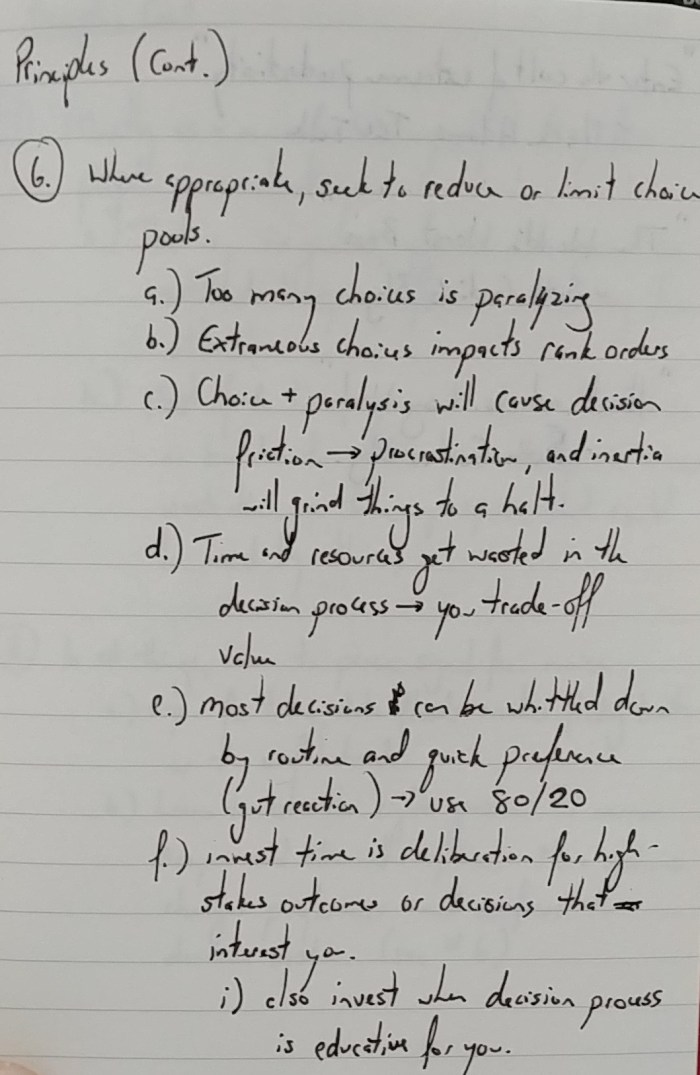
Since my last post on principles, I’ve jotted down a few more ideas in my notebook.  I’ve transcribed my thoughts under the photo below.

20181118_131600~2

6. Where appropriate, seek to reduce or limit choice pools.
a.) Too many choices is paralyzing.
b.) Extraneous choices impacts rank(ing) orders.
c.) Choice + paralysis  will cause decision friction –> procrastination, and inertia will  grind things to a halt.
d.) Time and resources get wasted in the decision process –> you trade off value.
e.) Most decisions can be whittled down by routine and quick preference (gut reaction) –> use 80/20.
f.) Invest time in deliberation for high stakes outcomes or decisions that interest you.
i.) Also invest when decision process is educative for you.

This entry largely captures what my behaviours are like when it comes to making decisions versus where I want them to be.  By nature, I’m a risk averse and indecisive person.  I tend to sit on decisions far too long, to the point where they can cause anxiety when it’s finally time for me to make the call.

I also tend to lack preferences in a lot of things.  For instance, I usually don’t have a strong preference when it comes to picking a place to eat, so I’m terrible at deciding where to go but I’m perfectly happy to go along with choices made by others.  There are many things I’m starkly black-and-white about (which is really annoying to my wife), but most of the time I sit in a middle state like Buridan’s ass.

Therefore, this set of principled notes captures where I want to be – to quickly narrow down extraneous choices (because too many options usually leads to diminished outcomes), and to automate where I can.  Then, I can focus on the really important decisions or use the deliberation process as a teaching tool for myself.

Stay Awesome,

Ryan


The Value of a Myers-Briggs Test

There seems to be a publishing cycle, where every year a new slew of articles are released to damn personality tests, such as the Myers-Briggs.  Lifehacker published one recently, and a book was released at the end of summer about the mother-daughter duo who created the assessment tool, which can be paired with a book released a decade ago discussing personality tests more broadly.

A few years back, I was thinking about my career, and I happened to take the test.  According to it, I’m a INTP, the Logician, an introverted big-thinker who is logical but adaptive.  A year later, I took the test again and I drifted into ENTJ territory; apparently in that time I became more extroverted and more rigid in my planning.

This, of course, is the biggest issue with these personality tests.  They tend to overly rely on generalizations of fluid behaviours and attitudes.  People rarely have stable traits over time, and the test tends to loosely clump these together in attempt to create a meaningful picture.  In this, the Myers-Briggs is nether reliable nor valid from a scientific point of view.  As the Lifehacker article points out, along with many others, it’s dangerous when you base decisions on the conclusions drawn from these tests for things like dealing with others or hiring employees.  The best thing you can do, the article claims, is to use it as a fun conversation starter and nothing more.

But I find value in the tests for another reason.

Humans are drawn to stories.  We like crafting narratives to explain events and give meaning to our lives.  While we would want our stories to align with true accounts of history or phenomena (a book I recently bought argues that it’s not possible), we can still find value in stories that are not, strictly speaking, true (I’m appealing to a coherence-model of truth, rather than a correspondence-model of truth; I never thought I’d drag that grad course back up in conversation again…).  We can find value in a story even if we are agnostic towards it being literally true or corresponding to a fact “out there” in the world.

When it comes to my career, one problem I have is that I have a hard time knowing how to sell myself.  When you are crafting your resume or CV, or when you are interviewing for a position, you are trying to create an appealing story of yourself.  You are painting a picture of the kind of person you are that aligns with the demands of the job or the needs of the employer.  Sometimes, it’s hard to create a compelling story for yourself.  You don’t know what to include, what to leave out, and what needs some mild spin.  You have to decide how to play-up key points and downplay unsavory details.  How you choose to connect the dots can make a large impact on what others will think of you as a candidate.  You don’t want to be dishonest, but sometimes the “truth” is very compelling.

One critical area that the Myers-Briggs can offer value is providing inspiration for how to tell that story.  It creates neat little packages that arranges details in interesting ways.  It allows you to take the generalizations and apply them to your own experiences.  It’s the same trick astrology uses – if you make a statement sufficiently ambiguous, you can find confirming evidence to support it.  Using this to your advantage, you can create a compelling backstory for yourself while also prompting you to fill in the details with good stories.

And if something does fit?  Leave it out and move on.

As long as you don’t pigeonhole yourself, you can tell a story about you that shows how valuable, interesting, and desirable you are to others.  The Myers-Briggs can offer some themes and typologies to help sell the best version of you.  Just don’t believe everything you read.

Stay Awesome,

Ryan

Post-Script: After I drafted this post last week, Seth Godin posted some thoughts about changing your story.  If I’m randomly coming up with ideas that coheres with advice from Seth, I count myself in good company.

~R

Hot Yoga Kicked My Ass – Some Thoughts

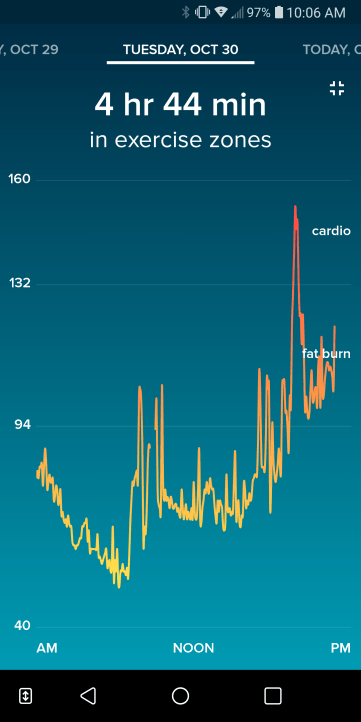
Last week, a group of friends and I attended a hot yoga session.  We, as a group, meet once per month to do an activity, and the October leader chose to have us join him for hot yoga.  I had some prior experience attending yoga classes, but this was my first time in a “hot yoga” session.  By the end of the hour, I looked like I had jumped in a lake.  My Fitbit tracked my heart rate and it had looked like I was running sprints.

Screenshot_2018-10-31-10-06-17.png
My max heart rate was 153bpm, during the hour-long session.

It was challenging, uncomfortable, and brutal.  In other words, it was awesome!

I’m not saying that I’m going to sign-up with my local studio or start buying into the lifestyle; I’m still paying for a gym membership that I don’t use, so I don’t need another cost to my monthly budget.  However, I found the experience interesting and invigorating, and I’d gladly go again in the future.

Cultural appropriation concerns aside, I’m fully on-board with the physical practice of yoga for health and fitness.  Western yoga tends to have a lot of stereotypes and negative perceptions attached to it, but the act itself can be a legitimately hard, physical activity that raises your heart rate, requires a lot of strength for the body-weight movements, and provides the same calming effect you get when you focus on process movements.

I’ve attended a handful of classes and tried routines at home a few times, so I’m not qualified to offer any opinions on yoga.  However, I’ll offer a few observations and thoughts on my experiences as a beginner:

  1. While I’ve never had a bad instructor, I was incredibly thankful that the two people I’ve had leading classes were super friendly, approachable, and accessible.  You feel incredibly awkward walking into your first class, and you assume that everyone is silently judging how bad you are at it.  Having a good instructor in front of you really helps you get into things, and their ability to break down the poses and movements with verbal cues really aids in immersing yourself in the experience.
  2. At the recommendation of a friend, I’ve attempted doing yoga at home by following along with an instructor’s video on YouTube (my go-to channel is Sarah Beth Yoga).  While doing yoga at home is more convenient, cheaper, and less awkward, I still find value in doing yoga in a group setting.  It feels more rewarding in the end to share the experience with others, and having a dedicated time to show up makes you more accountable.
  3. If you are going to buy anything, I recommend buying your own mat.  I’ve used it for yoga as well as doing tabatas at home.  I also recommend buying a thicker mat (the standard mat is really thin) because being a heavy guy, it helps cushion my wrists and knees in the various poses.  Bring a towel because the thicker mat doesn’t appear to have the same grip when you’re sweaty.
  4. BRING WATER!  STAY HYDRATED!  This applies to non-hot yoga as well.
  5. I found the act of yoga to help clear my mind.  Again, cultural appropriation questions aside, going through the motions intentionally and being mindful of what your body is doing or “saying” to you helps with the mind-body connection.  There is something about focusing on your breathing and your movements that creates a singular focus that pushes extraneous thoughts out of your mind.  The added layer of music and sanskrit words pulls your attention away from the past or future considerations and instead into the present.
  6. Speaking of sanskrit, I don’t get too bogged down in the culture.  When in the yoga studio space, I try to be mindful of others and the practice, but because I don’t know too much about the history or origins of yoga, I remain agnostic but open towards the cultural or spiritual side.  It’s not my place to judge, and smarter people than I can weigh-in on the validity of different kinds of yoga practices.  I find value in the physical movement and the slower pace of the activity.
  7. Having said that, I know that as a white dude participating in an appropriated practice from Hinduism, India, and the Desi people, it is loaded with problems (see the link above).  My participation adds to the watering down of a rich culture from which the original practitioners were forced to suppress their ways at the hands of their colonial occupiers.  I can’t square that circle and have to acknowledge it for what it is.


Stay Awesome,

Ryan