Last week I interviewed for a new position in the office. As I’ve mentioned before, I’m not very good in interviews. As of writing, I have not heard back whether I’m moving to the next round of interviews (successful candidates will have a further interview with the manager and an interview with the College President), however I’m not overly optimistic that I’ll be selected.
When I say that I don’t do well in interviews, I have to own the fact that not doing well in interviews is wholly my fault. For last week’s interview, I spent time studying for the position and about engineering educational accreditation processes, and constructing a presentation about the key domains of the accreditation process, but I spent next to no time preparing my answers to the interview questions themselves. My preparation was largely to watch two mini-courses on Lynda.com on interview prep, and to take notes on some case examples I could bring up for achievement or behaviour questions. Only the night before, for about twenty minutes, did I have my wife run some sample questions past me. My lack of preparation and practice on answering questions is entirely on me.
I did have one insight, though, that gives me some solace. In thinking about how poorly I thought my interview went, I reflected on how many interviews I’ve done in my career to date. This was my 5th interview, and only my third interview for a non-entry level position. I realized that one of the reasons why I was so unprepared, and why I didn’t spend more time prepping my answers is that I don’t know how to prepare for a mid-career interview. The phrase “what got me here won’t get me there,” comes to mind in this scenario. I don’t yet have a clear picture of what I should be aiming at in interview questions.
I know the mechanics of the interviews – I should be demonstrating value to the employer and painting a picture of what I can do for them. I should consider what their questions are trying to elicit from me and tailor the response accordingly. When giving a behavioural- or achievement-based answer, make sure to ground the example using the STAR method (situation, task, action, results). Link strengths back to the job competencies, and identify weaknesses from the job competencies that I’m actively addressing. I know these facts, but because I lack confidence in myself I have a hard time selling it to others because I don’t believe it for myself. No amount of resentment towards the dog-and-pony show process will elevate me above other candidates.
If I want to succeed, I need to get better at playing their game.
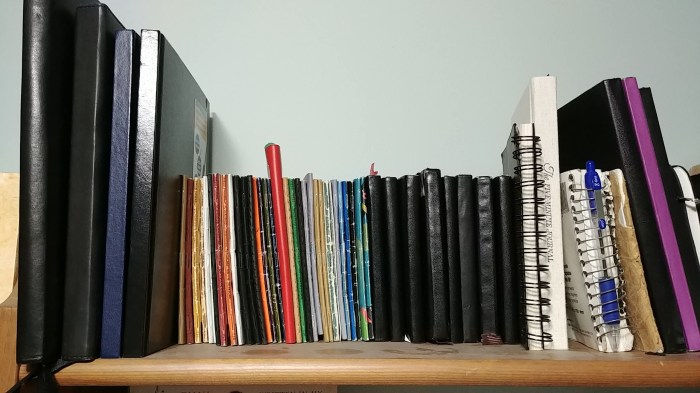
I have carried some form of notebook for the last seven years or so. It started back at the tail end of grad school where I felt I needed a way to help me remember important appointments, meetings, and to capture to-do items. I started off by purchasing a Moleskine weekly calendar, which was great, but my cheap student mind didn’t like the added cost of the specialty book, whereas I could make the same book from a regular, ruled Moleskine. For the next two years, I would measure out the spacing and draw in the lines for the year. I appreciated the simplicity of the task and found it almost meditative, however I grew tired of having to do this at the start of each year.
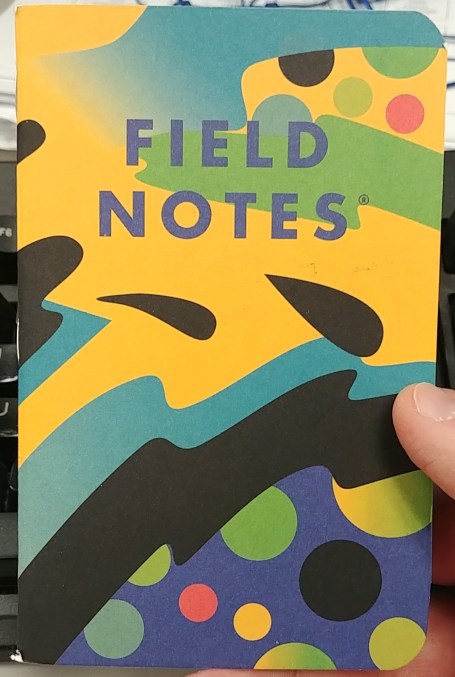
Later, I switched from larger Moleskine notebooks to smaller, pocket books. Over time, I adopted the Field Notes brand of pocket notebooks as my go-to medium to capture thoughts, though I do keep an assortment of notebooks on hand (or on my shelf) for specialty purposes. The early days of Field Notes had me using a notebook until it was full, whether this was notes from a single month or from multiple months.
Eventually I settled on using one book per month, and started a fresh book every month, regardless of whether I fill the book or not. In this post, I’ll show you how I set up a notebook for the month of January, and provide some commentary on my choices.
The first step is to get a fresh notebook. You don’t have to use Field Notes, but I like the brand and the quality of the product. My only criteria when selecting a book is I prefer at least 48-pages that uses good paper and a grid pattern (either solid lines or dots). The paper is important because I use a specific kind of pen (I’ve settled on the Uniball Deluxe Micro as my preferred pen) that can easily bleed or smudge on poor quality paper as I write leftie.
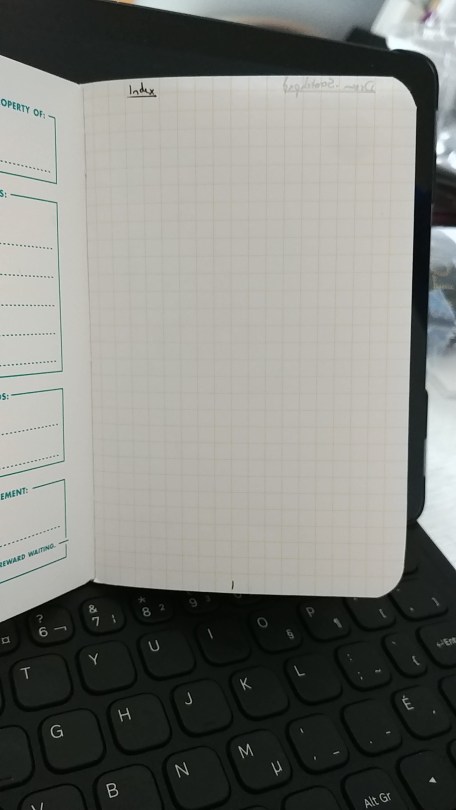
The next step is to go through and number all of my pages. This is important because after I’m done with a book, I use an index (see below) to capture important pages that I want to reference in the future. The index does not capture any of the standard pages I set up at the start of the month, nor does it capture my individual days. Instead, it captures main to-do lists, important notes, or other things that I’ll need to find later. For instance, I use these physical books to remember passwords I rarely need to type. If I update a password, I note the date in my online calendar with a book reference (month, year, and page), so that I can go back and see what I set the password to. This doesn’t work when I’m out of the house, but I find this helps with keeping my rarely used passwords secure (instead of constantly answering security questions to reset the password).
After the index, I titled the second page my dream scratch pad. This is where I can do pie-in-the-sky thinking about things I want to do, accomplish, strive towards, covet, etc. To be honest, I rarely use this page, but I like to keep it on hand in the same place.
Next, any major to-do items get carried over. A lot of these have been on my carried-over to-do’s for some time, but I don’t want to forget about them (things like rolling over my passwords regularly, or little things I want to do around the house. If to-do items can be grouped under a specific theme (say, specific home repairs), they get their own lists later in the book. This page carries over everything else.
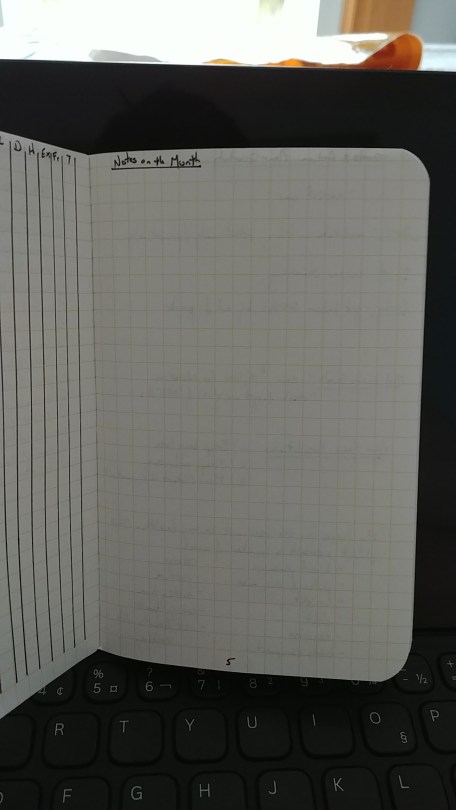
Tracked items, left to right – (Gr – German lessons on Duolingo), (L – when I’m late for something), (D – when I’m having a down or depressed day), (H – when I have a headache; at the bottom of the page I have a scoring system for how bad they are), (Ex – days I intentionally exercise), (Fr – time intentionally spent with friends or family), (7 – nights I track seven or more hours of sleep on my Fitbit).
Next is my tracker page. This is where I track habits and other regularly occurring items so I can see them at glance. I list the dates along the left side (weekends get doubled-up so I can fit the entire month in), and each category of things to be tracked gets its own column. Some metrics are good things to track, while some of them I want to use to monitor my general health and well-being.
Since the entries per day are pretty short (not a lot of space), I keep this facing-page blank for additional notes on the month, if I need it.
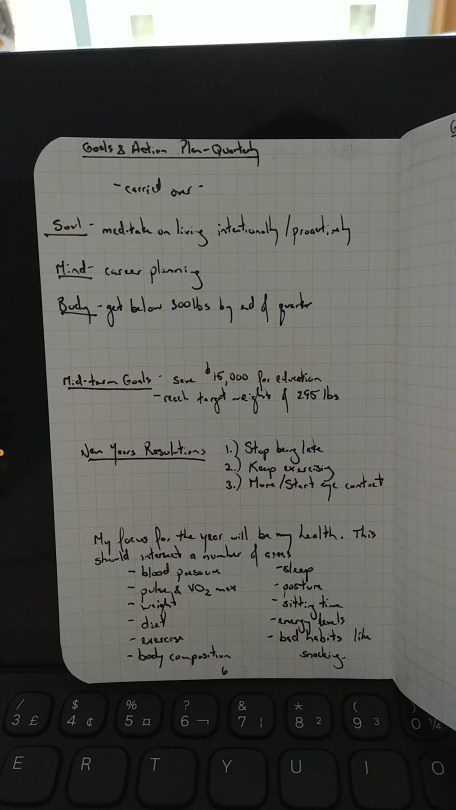
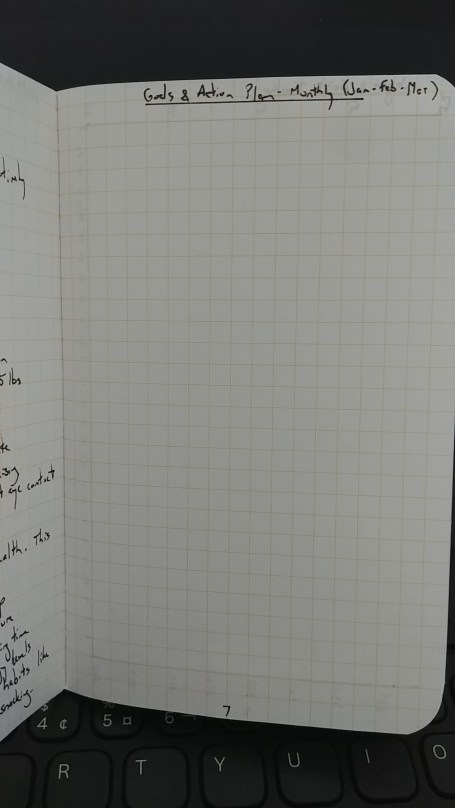
On page 6, I capture my intentions and goals. I track goals and intentions a few ways. First, I have a “soul,” “mind,” “body” theme which allows me to focus on specific areas of my life (soul – social, philosophical, spiritual, etc.), (mind – learning, planning, etc.), and (body – physical health and wellness). I realize you can’t try and change too many habits at once and be successful, so these are just ways of helping me to prioritize things into themes, short-term and longer-term goals, and things I want to change. If page 6 is my capture page, page 7 would be where I would focus myself to a limited number of things. I would pick something from the previous page and devote more time or attention to it with specific plans and actions.
On page 8, I track some specific health indicators – my weight on the scale (left side), and my waist measurements (on the right axis) over time (the x-axis). Static views of single health metrics aren’t very helpful, so I’ve chosen to track weight and my waist as a better indicator of my overall progress in fitness. I’ve also started tracking blood pressure, which I input results for the day the data is collected as the systolic/diastolic reading.
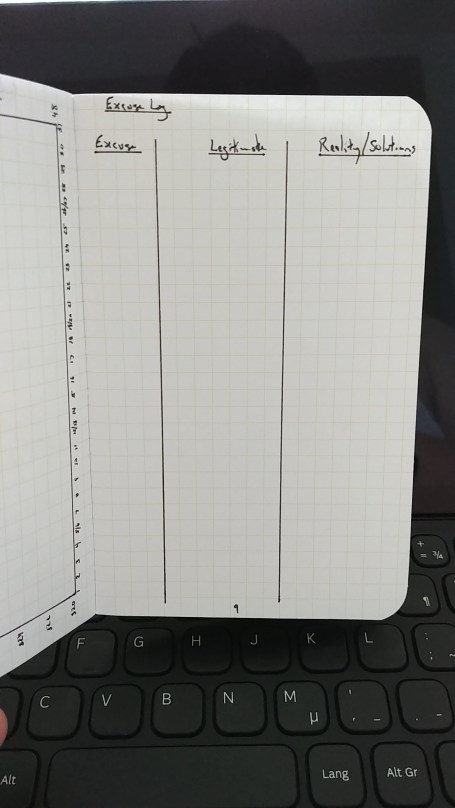
Then, on page 9, I borrow a system I found on Reddit to track excuses. This is where I can measure intentions against action. For instance, if I set an intention to exercise and I skip it, I can capture what my excuse is for skipping it, assess whether it is legitimate (yes/no), and make notes on any ways I can mitigate the reality or implement solutions to keep my intentions.
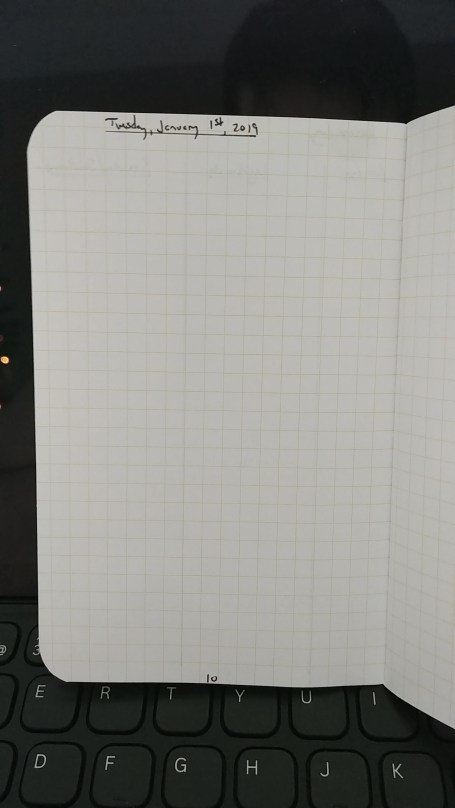
Finally, on page 10, I start my first entry. Every day that I record in my notebook will receive a new page. I put the date across the top, then fill in tasks for the day, ideas, interesting quotes, or things to remember. Sometimes I’ll migrate thematic lists into this section, such as tasks I need to complete as Board Chair or for things around the house to repair.
This is the system I currently use. It borrows from a couple different sources, such as the original Moleskine planner I began with, elements from the Bullet Journal method, and good ideas I’ve found rambling through sites like Reddit. The notebook set-up iterates over time. I add and remove things depending on how useful I find them. Some of the items discussed above might get removed soon since I haven’t done a good job of keeping up with them, and therefore are no longer useful to me.
It is a little tedious to set up a new notebook every 30 or so days, but on the whole I like the systems I’ve developed and have found it immensely useful in my day-to-day life.
Share with me down below what kind of systems you use to help keep yourself on top of things. I’m always looking to borrow good ideas! I hope you found something here that was useful.
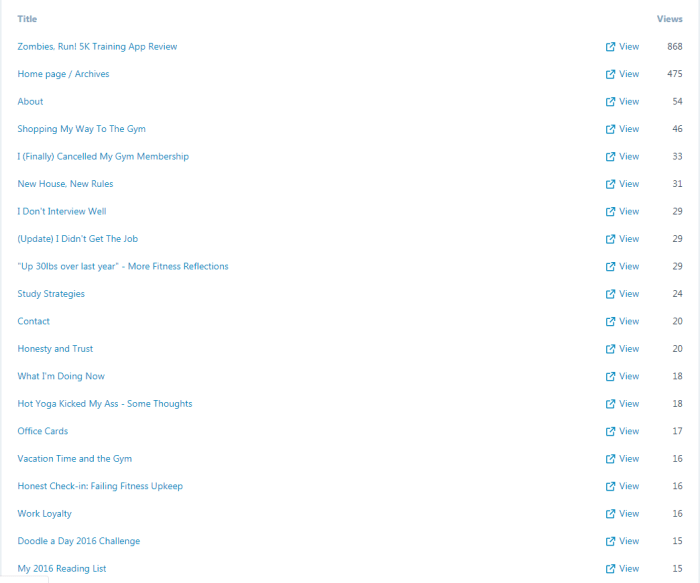
With the turning of the new year, I spotted an interesting trend for my blog traffic.
Starting on the 27th of December, I had a relatively huge spike in traffic for my blog. I’ve written about it before, but this was the first time I’ve seen such a consistent spike for a single article around a specific, meaningful date. In this case, as the new year approached, it would appear that people began searching for health and fitness options and through their searches, they stumbled across my brief review from January last year of the Zombies, Run! 5K Training app. I joked with a friend that since fitness posts generally account for my top posts here, if I wanted to monetize this site I should switch to posting just fitness content – seven of my top twenty posts of all time are fitness related.
I continued to see higher than usual traffic to that post over the week, but now my web traffic has starting to level off a bit, so I suppose whatever actions people intended to take for the new year are (hopefully) well under way. And for those who stumbled across my review, I hope that my words were useful for you. If you have used my post to help you make a decision about using the app, drop me a line in the comments. I’m curious what, if anything, you found valuable, and if I missed anything you were hoping to learn.
In the meantime, I hope your year has kicked off well and you are working hard towards your goals.
Here it is, my yearly update on what I read over the last 12-months. Overall, I far exceeded my 2016 and 2017 lists in terms of the number of books (42 in 2016, 44 in 2017, and now 57 in 2018) and even the number of pages (4,600 pages more over 2017’s total).
Title
Author
Date Completed
Pages
1
Saga, Volume One
Brian K Vaughan and Fiona Staples
12-Feb
160
2
Witches Abroad
Terry Pratchett
23-Feb
288
3
12 Rules for Life
Jordan Peterson
5-Mar
448
4
Skin in the Game
Nassim Nicholas Taleb
10-Mar
304
5
Proust and the Squid
Maryanne Wolf
11-Mar
336
6
Small Gods
Terry Pratchett
16-Mar
384
7
Conspiracy
Ryan Holiday
21-Mar
336
8
Lords and Ladies
Terry Pratchett
7-Apr
384
9
Thinking in Bets
Annie Duke
7-Apr
288
10
Sapiens
Yuval Noah Harari
13-May
464
11
Career Manifesto
Mike Steib
4-Jun
288
12
This Is The Year I Put My Financial Life in Order
John Schwartz
5-Jun
320
13
Men at Arms
Terry Pratchett
12-Jun
384
14
Soul Music
Terry Pratchett
24-Jun
384
15
Interesting Times
Terry Pratchett
8-Jul
352
16
The Achievement Habit
Bernard Roth
21-Jul
288
17
Discover Your Inner Economist
Tyler Cowen
26-Jul
256
18
Maskerade
Terry Pratchett
30-Jul
384
19
The Five Love Languages: Men’s Edition
Gary Chapman
31-Jul
208
20
David and Goliath
Malcolm Gladwell
3-Aug
320
21
Feet of Clay
Terry Pratchett
10-Aug
416
22
Originals
Adam Grant
13-Aug
336
23
Own the Day, Own your Life
Aubrey Marcus
17-Aug
448
24
Hogfather
Terry Pratchett
17-Aug
352
25
Tribe of Mentors
Timothy Ferriss
20-Aug
624
26
Better than Before
Gretchen Rubin
21-Aug
320
27
Jingo
Terry Pratchett
25-Aug
416
28
Books for Living
Will Schwalbe
27-Aug
288
29
The Last Continent
Terry Pratchett
6-Sep
416
30
Unshakeable
Tony Robbins
17-Sep
256
31
Shoe Dog
Phil Knight
17-Sep
400
32
What Happened
Hillary Rodham Clinton
26-Sep
512
33
When
Daniel H. Pink
28-Sep
272
34
A Higher Loyalty
James Comey
30-Sep
312
35
Creativity, Inc.
Ed Catmull
2-Oct
368
36
Why Buddhism is True
Robert Wright
15-Oct
336
37
The Element
Ken Robinson
19-Oct
320
38
Elon Musk (Biography)
Ashlee Vance
24-Oct
400
39
Reinventing You
Dorie Clark
26-Oct
240
40
What the Dog Saw
Malcolm Gladwell
4-Nov
448
41
The Daily Show: An Oral History
Chris Smith
12-Nov
480
42
Waking Up
Sam Harris
15-Nov
256
43
If You’re In My Office, It’s Already Too Late
James J. Sexton
24-Nov
288
44
A Life in Parts
Bryan Cranston
24-Nov
288
45
5 Love Languages
Gary Chapman
27-Nov
208
46
The Perfectionists
Simon Winchester
1-Dec
416
47
Entrepreneurial You
Dorie Clark
3-Dec
272
48
The Dip
Seth Godin
3-Dec
96
49
The Last Man Who Knew Everything
David N. Schwartz
7-Dec
480
50
Ikigai
Hector Garcia and Francesc Mirales
20-Dec
208
51
The One Thing
Gary Keller and Jay Papasan
20-Dec
240
52
This Is Marketing
Seth Godin
21-Dec
288
53
The Souls of Black Folk
W.E.B. Du Bois
23-Dec
272
54
The Artist’s Journey
Steven Pressfield
27-Dec
192
55
Running Down a Dream
Tim Grahl
28-Dec
198
56
Zen to Done
Leo Babauta
28-Dec
114
57
What I Talk About When I Talk About Running
Haruki Murakami
31-Dec/1-Jan
192
Total:
18544
As I mentioned last week, I have some thoughts and reflections while reviewing the list. First, when I was selecting my best 5 for the year, I noticed that the books in the latter part of the year were ones I felt resonate with me the most. I think this is for two, related reasons. First, this was a huge year for my wife and I. We renovated our old house, sold it, bought a new house, renovated the new one, moved cities, got married, and got me a new car. We had so much packed into one year on top of work and family, that the year seemed to have flown by without me realizing it. Someone pointed out to me that there was a Winter Olympics at the start of last year – I couldn’t believe it and had forgotten all about it.
The second, somewhat related reason is because of the sheer volume of books finished, I don’t think I gave the material time to properly settle in my mind. Fifty-seven books is a huge amount, and I think that by the end of the year, I couldn’t really remember what I had read during the first half of the year. Instead, most of the impact was felt in the readings from the latter half of the year. That’s not to say that the books from the start of the year are forgotten, because I feel that lessons taken from Skin in the Game and from Sapeins, for example, are prominent in my mind. It’s just that they didn’t really stick out in my mind at the end of the year when I was picking my top reads of the year.
Another reason why I think I have a hard time remembering what I read from the start of the year is because the vast majority of the books finished this year were audiobooks. Thanks to Audible and the Libby app, I was flushed with books to go through. And because I listen to books at a minimum of 1.5x speed, I can get through the books at a far faster rate than if I were carving out time to read physical books. This has its advantages, such as being exposed more rapidly to new ideas. However, this advantage comes at the cost of little overall integration of the information and general lowered retention of information over time. The speed at which I’m listening to books is more like skimming than true reading.
Nevertheless, I’m very satisfied with my accomplishment for the year. I’m not really interested in trying to top this list intentionally next year. I will keep reading/listening/consuming books at whatever rate I happen to finish them, but I will go with whatever pace I happen to settle in, rather than trying to hit weekly or monthly targets.
For the upcoming year, I’d like to try and move away from the self-help, business, and animated bibliography genres of books, and instead tackle more books on history, biographies, and fiction that’s not just Terry Pratchett (though I will still keep ploughing through the Discworld series – that’s not changing any time soon). If you have any book recommendations, feel free to let me know! I’ve already got “Educated” by Tara Westover and “When They Call You A Terrorist” by Patrisse Khan-Cullors and Asha Bandele on my bookshelf as recommended by friends. I’m always on the lookout for the next book to read.
One of the hardest lessons I grapple with is treating systems (especially bureaucracies) as a series of “games.” By games, I’m treating it in the academic sense as a series of interactions between parties that has rules, outcomes/payoffs, and strategies. Being the meek person that I am, I tend to default to the assumption that the stated rules are all that there is, and you are expected to follow the prescribed process if you are seeking an outcome. The truth is, in most cases there are multiple strategies that you can use to seek out advantageous outcomes for yourself. Depending on how the rules are set up, you can avail yourself of several options, both sanctioned and unsanctioned.
For instance, in the case of students, you need to achieve a certain grade to pass a course (say, a 55%). There are a number of strategies you can use depending on what outcome you are seeking:
If you are seeking the highest grade possible – you study the textbook, attend lectures, attend office hours, learn the rubric, do well on assessments, and challenge grades to bump your marks up.
If you are seeking mastery of the content – you study the textbook, attend lectures, attend office hours to resolve unclear topics, research the topic, create good study notes, take practice tests, and learn from mistakes.
If you are seeking a moderate pass – you prioritize the work and tackle the highest value graded units to achieve at least a minimal passing grade, and you disregard low-return work that requires lots of effort for little ROI, you attend only the lectures required to get information you need, and likely get notes from peers.
If you are seeking a pass regardless of content mastery – you can cheat and hope you are not discovered by your professor, then deny any wrong-doing if caught or present excuses to justify your behaviour. If that doesn’t work, you appeal using the institutions mechanism.
Something to keep in mind is that cheating is still considered at “legitimate” strategy as long as you don’t get caught, because the goal is to secure your desired outcome. If you aren’t caught, it’s because your strategy beat out your opponent, and you won your outcome. It might be that cheating goes against the system or the intended processes put in place, but if an adequate system to police the rules isn’t in place, you can exploit that strategy to your advantage.
I hope it’s obvious that I’m not advocating for academic cheating. I do my best to guard against cheating because I think it runs counter to my goals as a teacher. I want my students to learn to play the game as I see it should be played, because the skills and strategies used for my class are both useful and valuable outside of my class – the ability to read a variety of perspectives with an open-mind, the ability to articulate your position with evidence, the ability to connect ideas across different knowledge domains, etc.
I exploit the same rules when I help students navigate their way through the institution’s byzantine labyrinths and silo’d departments when they come to me with problems in their program. I want them to get through their education with the least institutional friction and cost possible – school is hard enough and I don’t want them wasting time jumping through frivolous hoops because the systems aren’t set up optimally.
I sometimes feel irked or offended when I catch a student cheating, or catch someone lying to me. I try to check myself in those instances because I know it’s not meant as a personal slight against me when these things happen; it’s because of the incentive structures in place. A legitimate strategy is not available to the person, so they seek an alternative strategy to get what they want. They are playing a game and their strategy is competing against mine when they submit plagiarized work, or hand me a fake ID at the bar I work at. If my strategy is sufficiently robust, I can catch and counter their strategy. But if I’m also using a sub-optimal strategy, then it’s more likely the case that their strategy will exploit my complacency.
It’s nothing personal. It’s just how the institutional games work.
Post-secondary education has never been more accessible to the average person. We may have a long ways to go in terms of making courses more accessible for learners and reducing the financial barriers that keep students from being successful in school, but it is nevertheless an undeniable fact that there are more people who have been to post-secondary schooling than the entire history of people attending higher learning.
One issue with the proliferation of access is that it’s getting harder to stand-out in the workforce. With so many people carrying credentials, the golden ticket that a diploma or degree used to confer has lost some of its value. Your choices are to either go to industries where they are starving for workers (if you are looking for a solid career with good prospects, you should become a welder NOW), or figure out a way to become a better problem-solver to stand out amongst the crowd.
Another issue that complicates matters is that industry and technology is changing at such a rapid rate that you can no longer rest on your laurels that your program of study will adequately prepare you for work in your industry. The techniques, technologies, and skills you learn in your first year may be obsolete by the end of your final year.
Therefore, it’s important to develop your ability to self-educate. Knowing where you can find free or cheap resources can be a huge advantage when developing yourself in your career. Here are some of the resources I use to teach myself.
Top Spot: your Public Library
In my humble opinion, the public library is one of the greatest inventions of all time. Whether you are taking classes they offer, using resources in their catalog, or availing yourself of the free access to materials like online journals and portals, there is almost no limit to the access your library card can provide. When my HVAC system went on the fritz, I was able to check out an HVAC manual to help me learn just what the heck an HVAC system does so that I could understand what repairs were needed, and how to better care for the system in the future.
YouTube
YouTube changed the game when it comes to sharing knowledge. Don’t get me wrong, books are great (the necessary precursor to the greatest invention of all time; see: public library entry), but unless your book has incredibly detailed diagrams, the video format will always be the superior resource for teaching hands-on skills. When I had to fix my roof, I turned to videos to learn how to remove individual shingles and replace them myself.
Coursera
Coursera is all the benefits of attending lectures without the associated costs. Granted, if you want formal recognition of completing Coursera courses, you’ll need to pay for the access. However, nearly every Coursera course has the option for you to audit the course for free, which gives you access to the lecture content and some of the supplementary material.
Reddit (and other specialty discussion forums)
I suppose I should have used “Google” as the category here since I often will search for solutions through Google’s indexed results. However, dedicated online communities are some of the best resources to learn from. They often post comprehensive resources and how-to manuals, and are usually great about providing solutions when you are stuck on specific problems. If you can find a good community that isn’t locked behind a paywall, you can lose yourself for hours in it’s wealth of information.
Lynda.com
While not a free resource, this is something that my employer has provided to its employees at no cost. You should check to see if your employer offers any services for employees to self-develop because you might be missing out on a ton of non-financial benefits. Lynda is a great resource for comprehensive courses on a wide variety of tech and business topics. It’s a bit restrictive if you are looking for non-business courses, but it’s worth checking out for learning the basics you’ll need to navigate your early career development.
Udemy
Another paid service, I find Udemy great for high tech courses where I want to develop specific skills, such as in Python or in using Adobe software. I wait for courses to go on sale, and I snap up courses up to 90% off their full price.
Ask friends
My final suggestion is to tap your friends to see if anyone can help you learn new skills. Obviously, you don’t want to exploit your friends – you should pay for their services where appropriate. However, in some cases your friends can be great resources to tackle projects. Not only do you get to leverage their unique skills or experience, but you also get quality time together. My entire podcast and music run for Woot Suit Riot has been some of the most formative experiences I’ve had, all because I was making stuff with friends.
All of this is framed as advice to help you in your career, however the truth is that you should be seeking to educate yourself for any project your’re interested in, regardless of whether you can get paid for the skills or not. I took painting classes earlier this year at my local art store because I wanted to learn how to paint. This isn’t a skillset that directly will get me promoted, but it rounds me out and allows me to explore my creative side.
The point of self-education or self-development is for you to become more of the person you want to be. It’s often hard work, but the experiences are well-worth the effort.
I carry a physical notebook with me pretty much at all times so that I can jot down to-do lists, ideas, quotes, etc. While my commonplace book system is great, I wanted a better system for tracking those spur of the moment ideas that I want to file away for later, such as blog posts, vlog ideas, career ideas, etc. I could record it in my notebook, but then I would either need a way to collect them at the end of each month when I switch to a new notebook, or I would be forced to copy them over month to month.
The system needed two things. First, it needed to be mobile. My notebook is mobile, but for the reasons above, it was proving to be inadequate. Tracking ideas in a document or spreadsheet from my computer solves the ease of use problem, but it limits the mobility. Similarly, just having a digital file on something like Dropbox is cumbersome because, while I can access it from my smartphone, navigating the file directory on my phone is tedious and updating files on a small screen is frustrating for something that I wanted to be quick and painless.
The second need, alluded to in the problems above, is that it needs to be frictionless. The more complex a system is, the less likely I am to use it over time. Hacks, systems, tricks, and tips are great, but if it’s a chore to use and implement, I tend to abandon them relatively quickly because, let’s face it, I’m weak-willed and lazy (see any of my posts about failing to go to the gym…)
With those two considerations in mind, I stumbled on an option and found inspiration in a video my vlogging partner, Jim, posted on Youtube:
I set about to appropriate his system and adapted it for my own use.
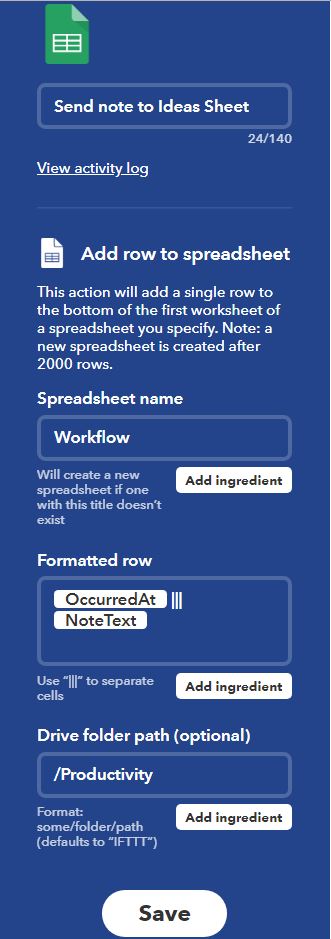
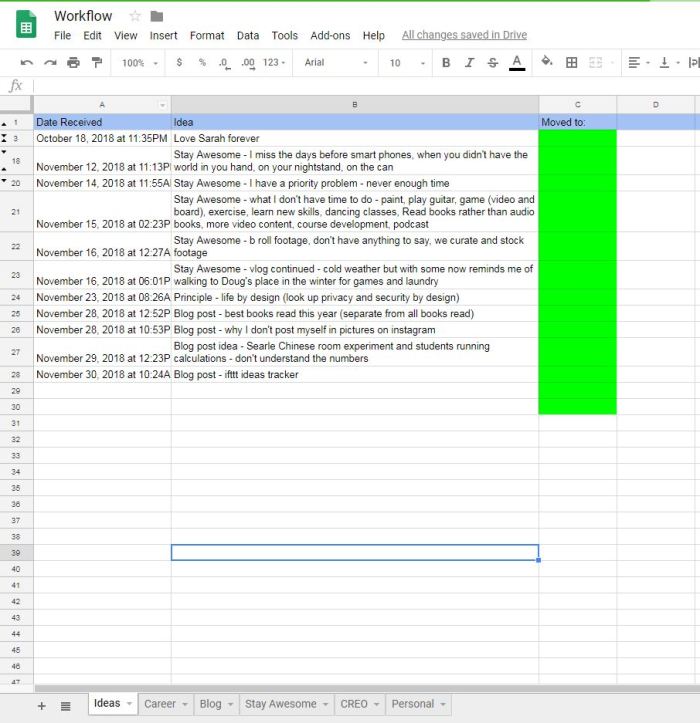
I created an IFTTT (IF This Then That) action that when I made a note from a homescreen widget on my phone, it would automatically save it to a designated spreadsheet in my Google Drive.
I have it set up to just record the date and time of the note, and the notes content to the next empty row.
In Google Drive, I set up a new spreadsheet with multiple tabs. This way, all the ideas come from my phone to the first tab of the spreadsheet. From there, I can move the ideas to different tabs to better organize them by category. In the green cells, I note where I moved the idea, then I hide the relevant row when the information is copied over. This allows me to have all the ideas collected in one place (the front page), but completed actions are hidden to streamline the process.
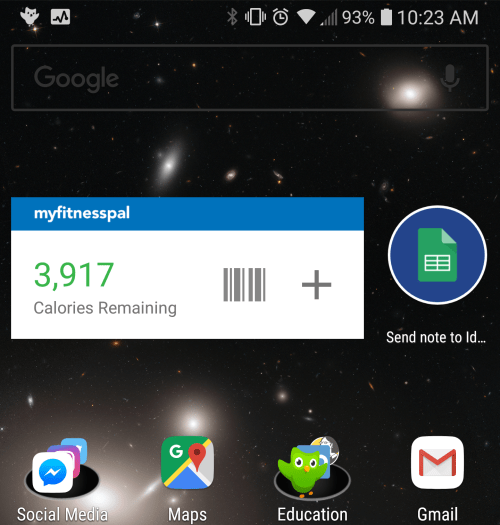
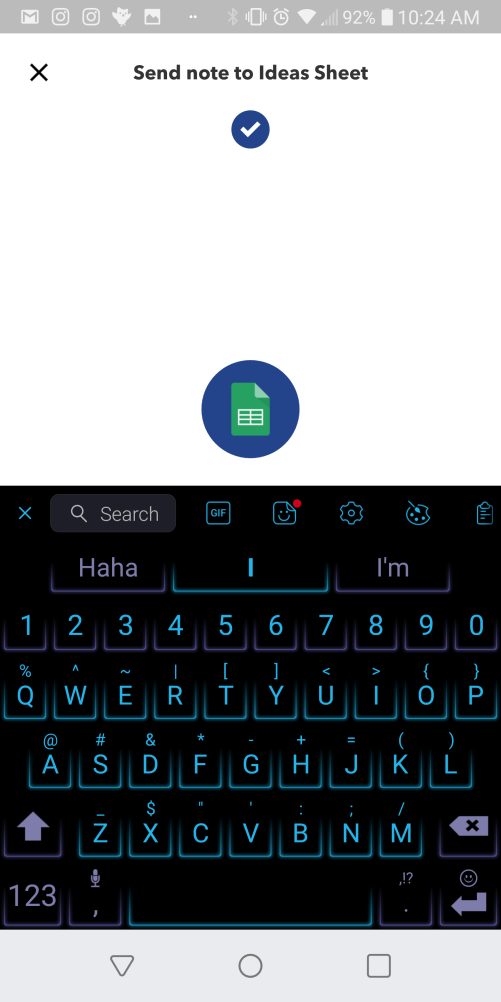
All that was left to do was set up a widget on my phone and start recording ideas. The widget for IFTTT was already available as an option, so I didn’t need to download any extra applications.
From my homepage, I tap the round icon at the top-right of my screen.
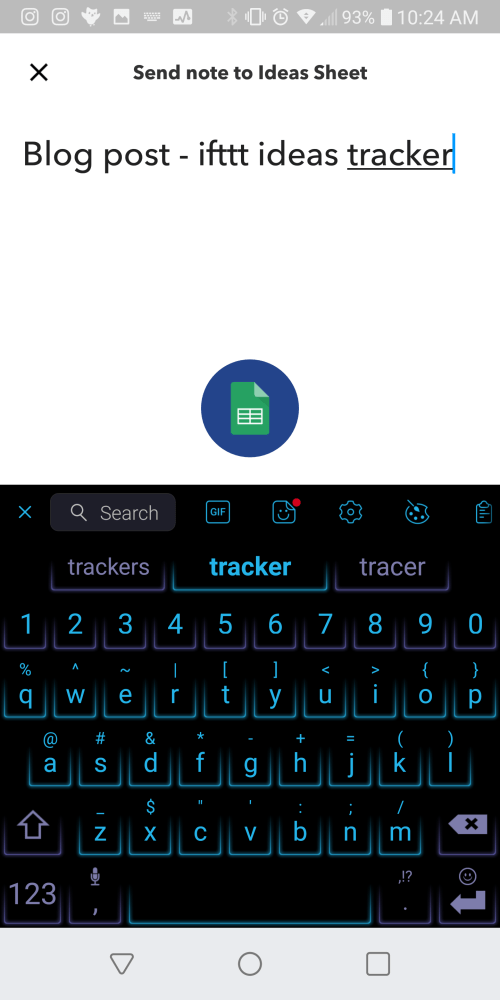
From there, I type in the idea, usually with a preface comment to help me sort things later.
I then tap the blue circle at the bottom of the note and it sends it to the spreadsheet.
It’s been a handy system so far. I can access the sheet from my phone, but primarily I need it on my computer, so the cross-platform utility is great for me. It also allows me to captures a wide variety of ideas without needing to put them to separate lists initially, whereas if I captured these in my notebook, it would be hard to sort, search, and categorize without dedicated lists. I like the flexibility and the streamlined process.
Let me know if you have any systems that you find handy. I’m always on the lookout for good ideas to test out.
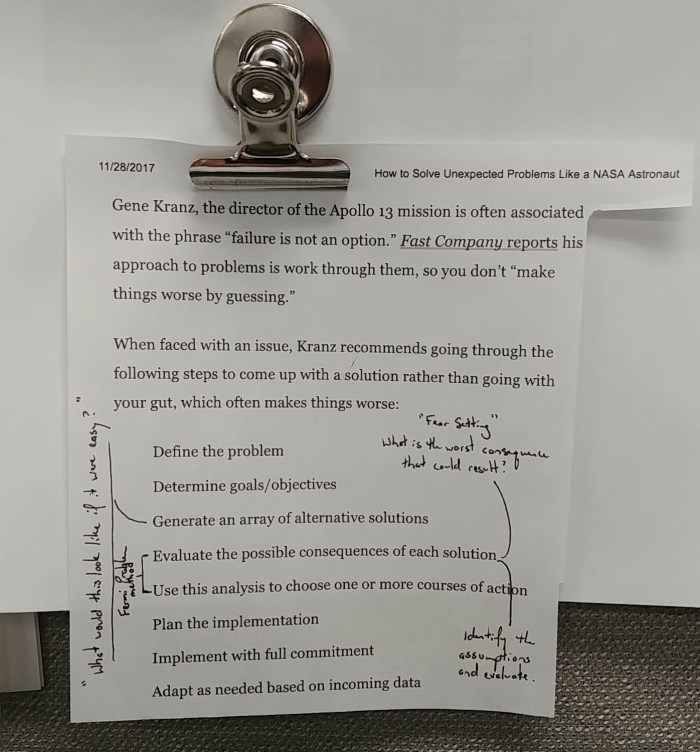
In my first post on principles, I had an entry regarding problem solving – specifically, guidance on defining problems. That entry is actually a condensed version of something I have hanging in my cubicle at work:
I printed the post from a Lifehacker article, and have since annotated it with a few extra ideas. On the left, I stole a line from Tim Ferriss’s Tribe of Mentors to supplement the step for generating possible solutions to your problem. The simplicity of the question, “what would this look like if it were easy?” allows me to limit the choice pool by excluding unlikely scenarios while thinking about the positive outcomes.
When it comes to evaluation consequences and narrowing down the options, I have added three additional tools. First, I borrow again from Tim Ferriss where he uses “Fear Setting” to determine the worst case scenarios possible, and then he goes through each outcome and asks himself whether the cost is something that he could live with. By doing so, he reframes his concerns away from merely worrying about negative outcomes to only focus on the things that matter to him.
I also added a note to myself to ensure I’m capturing my assumptions. A lot of the time I start with my conclusions and assume they are transparent in their reasoning. However, if I ask a series of clarifying questions (usually the 5-why technique), I often end up drilling down to hidden assumptions or emotions that motivate the conclusion (rather than pure reason).
The final note I scribbled is in reference to Enrico Fermi who had an uncanny knack making stunningly accurate “guesses” off the top of his head. Fermi used probabilities and statistics to make educated guesses to solve problems, which could then be further refined. It’s a tool for quick and dirty estimates, and it helps to narrow down the choice pool.
My annotations aim at four tools I can use to supplement Kranz’s method: what is the best/easiest solution, what’s the absolute worst case, how easily can we figure this out, and what motivations are driving my decisions. I try to keep those considerations in mind, though I’m not nearly as rational as I pretend to be.
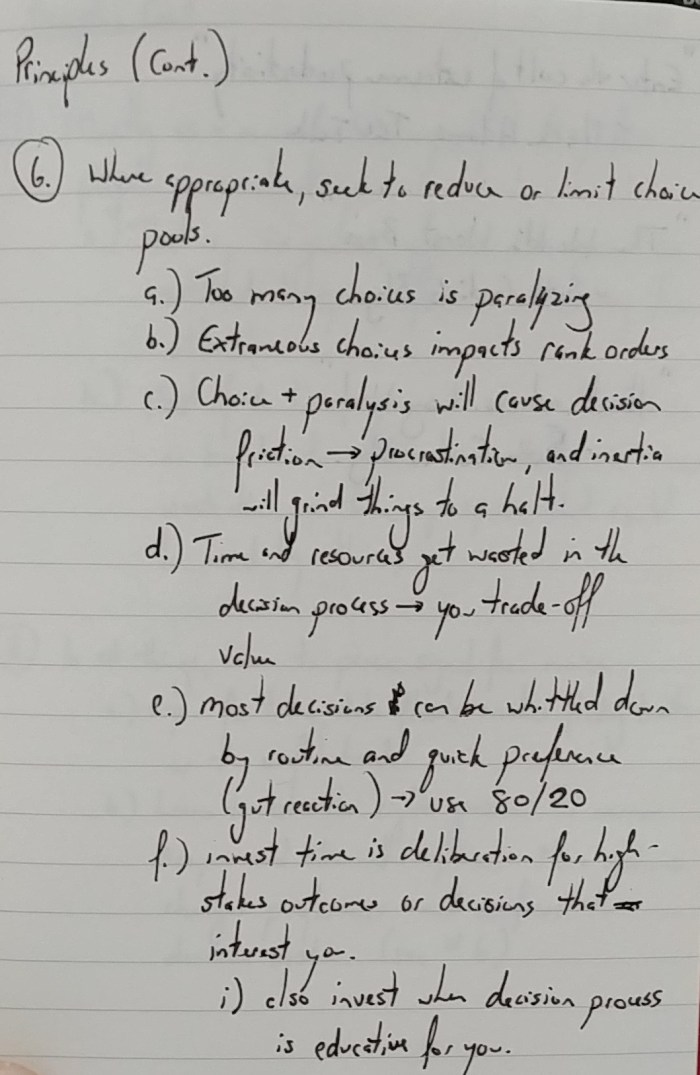
Since my last post on principles, I’ve jotted down a few more ideas in my notebook. I’ve transcribed my thoughts under the photo below.
6. Where appropriate, seek to reduce or limit choice pools.
a.) Too many choices is paralyzing.
b.) Extraneous choices impacts rank(ing) orders.
c.) Choice + paralysis will cause decision friction –> procrastination, and inertia will grind things to a halt.
d.) Time and resources get wasted in the decision process –> you trade off value.
e.) Most decisions can be whittled down by routine and quick preference (gut reaction) –> use 80/20.
f.) Invest time in deliberation for high stakes outcomes or decisions that interest you.
i.) Also invest when decision process is educative for you.
This entry largely captures what my behaviours are like when it comes to making decisions versus where I want them to be. By nature, I’m a risk averse and indecisive person. I tend to sit on decisions far too long, to the point where they can cause anxiety when it’s finally time for me to make the call.
I also tend to lack preferences in a lot of things. For instance, I usually don’t have a strong preference when it comes to picking a place to eat, so I’m terrible at deciding where to go but I’m perfectly happy to go along with choices made by others. There are many things I’m starkly black-and-white about (which is really annoying to my wife), but most of the time I sit in a middle state like Buridan’s ass.
Therefore, this set of principled notes captures where I want to be – to quickly narrow down extraneous choices (because too many options usually leads to diminished outcomes), and to automate where I can. Then, I can focus on the really important decisions or use the deliberation process as a teaching tool for myself.







 A Paramedic's Notebook