How I Set Up My Notebook

I have carried some form of notebook for the last seven years or so.  It started back at the tail end of grad school where I felt I needed a way to help me remember important appointments, meetings, and to capture to-do items.  I started off by purchasing a Moleskine weekly calendar, which was great, but my cheap student mind didn’t like the added cost of the specialty book, whereas I could make the same book from a regular, ruled Moleskine.  For the next two years, I would measure out the spacing and draw in the lines for the year.  I appreciated the simplicity of the task and found it almost meditative, however I grew tired of having to do this at the start of each year.
20190120_201034

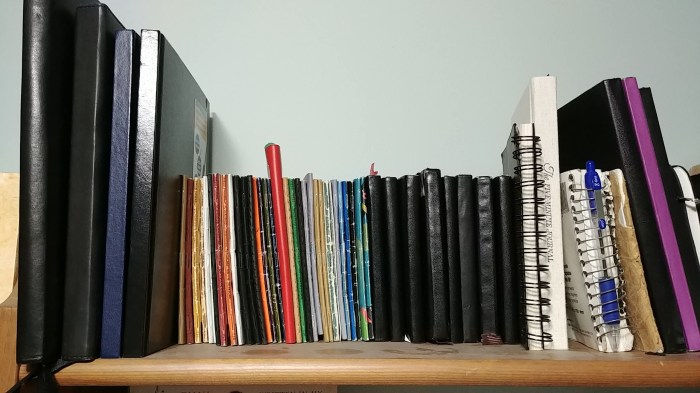
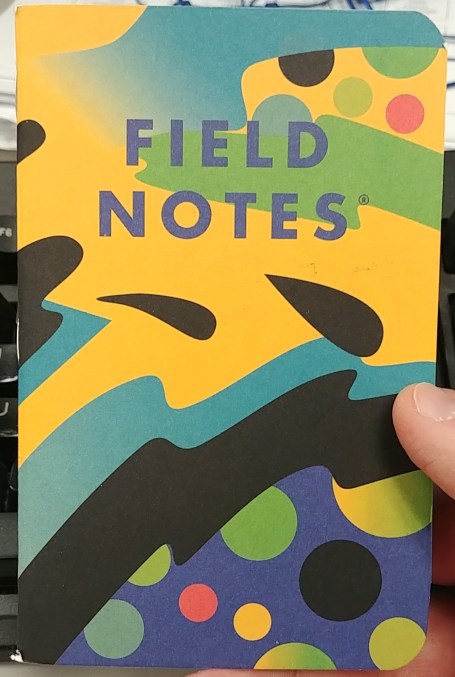
Later, I switched from larger Moleskine notebooks to smaller, pocket books.  Over time, I adopted the Field Notes brand of pocket notebooks as my go-to medium to capture thoughts, though I do keep an assortment of notebooks on hand (or on my shelf) for specialty purposes.  The early days of Field Notes had me using a notebook until it was full, whether this was notes from a single month or from multiple months.

Eventually I settled on using one book per month, and started a fresh book every month, regardless of whether I fill the book or not.  In this post, I’ll show you how I set up a notebook for the month of January, and provide some commentary on my choices.
20190102_115526~2

The first step is to get a fresh notebook.  You don’t have to use Field Notes, but I like the brand and the quality of the product.  My only criteria when selecting a book is I prefer at least 48-pages that uses good paper and a grid pattern (either solid lines or dots).  The paper is important because I use a specific kind of pen (I’ve settled on the Uniball Deluxe Micro as my preferred pen) that can easily bleed or smudge on poor quality paper as I write leftie.

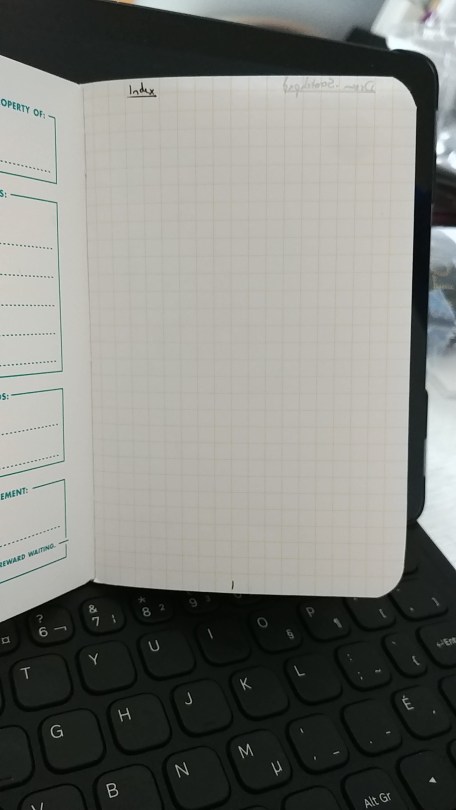
The next step is to go through and number all of my pages.  This is important because after I’m done with a book, I use an index (see below) to capture important pages that I want to reference in the future.  The index does not capture any of the standard pages I set up at the start of the month, nor does it capture my individual days.  Instead, it captures main to-do lists, important notes, or other things that I’ll need to find later.  For instance, I use these physical books to remember passwords I rarely need to type.  If I update a password, I note the date in my online calendar with a book reference (month, year, and page), so that I can go back and see what I set the password to.  This doesn’t work when I’m out of the house, but I find this helps with keeping my rarely used passwords secure (instead of constantly answering security questions to reset the password).
20190101_113104


20190101_113123

After the index, I titled the second page my dream scratch pad.  This is where I can do pie-in-the-sky thinking about things I want to do, accomplish, strive towards, covet, etc.  To be honest, I rarely use this page, but I like to keep it on hand in the same place.

inked20190101_113140_li

Next, any major to-do items get carried over.  A lot of these have been on my carried-over to-do’s for some time, but I don’t want to forget about them (things like rolling over my passwords regularly, or little things I want to do around the house.  If to-do items can be grouped under a specific theme (say, specific home repairs), they get their own lists later in the book.  This page carries over everything else.

20190101_113249
Tracked items, left to right – (Gr – German lessons on Duolingo), (L – when I’m late for something), (D – when I’m having a down or depressed day), (H – when I have a headache; at the bottom of the page I have a scoring system for how bad they are), (Ex – days I intentionally exercise), (Fr – time intentionally spent with friends or family), (7 – nights I track seven or more hours of sleep on my Fitbit).

Next is my tracker page.  This is where I track habits and other regularly occurring items so I can see them at glance.  I list the dates along the left side (weekends get doubled-up so I can fit the entire month in), and each category of things to be tracked gets its own column.  Some metrics are good things to track, while some of them I want to use to monitor my general health and well-being.
20190101_113257

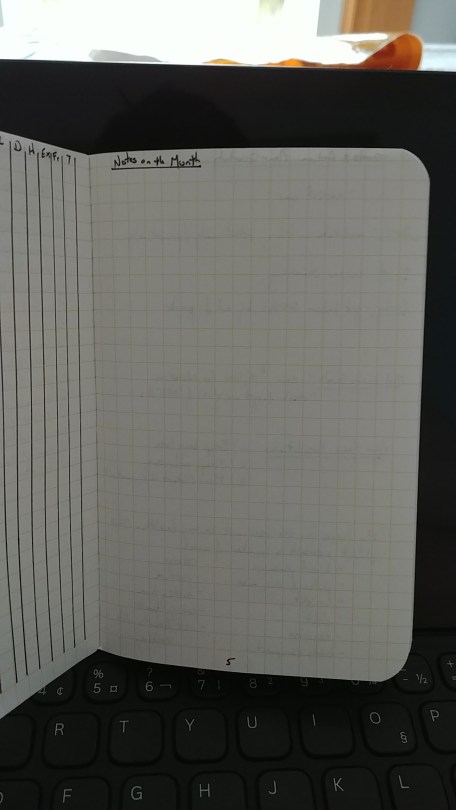
Since the entries per day are pretty short (not a lot of space), I keep this facing-page blank for additional notes on the month, if I need it.
20190101_113312

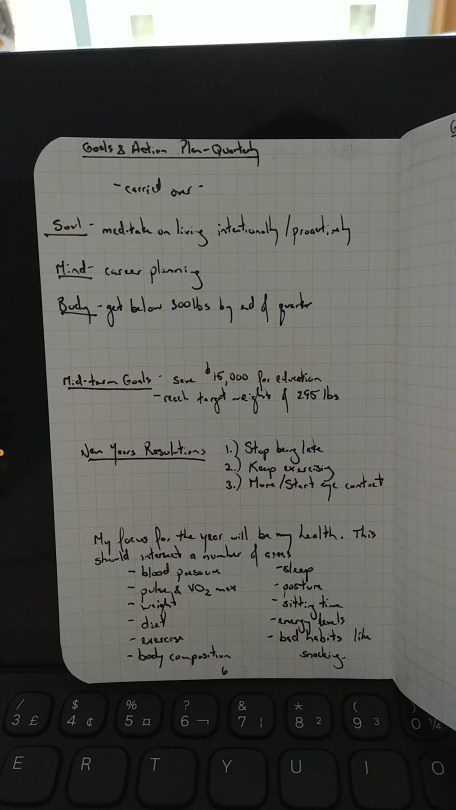
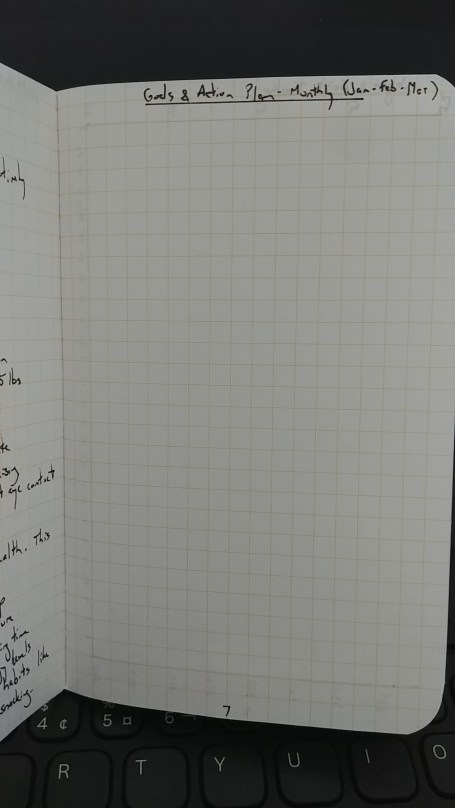
On page 6, I capture my intentions and goals.  I track goals and intentions a few ways.  First, I have a “soul,” “mind,” “body” theme which allows me to focus on specific areas of my life (soul – social, philosophical, spiritual, etc.), (mind – learning, planning, etc.), and (body – physical health and wellness).  I realize you can’t try and change too many habits at once and be successful, so these are just ways of helping me to prioritize things into themes, short-term and longer-term goals, and things I want to change.  If page 6 is my capture page, page 7 would be where I would focus myself to a limited number of things.  I would pick something from the previous page and devote more time or attention to it with specific plans and actions.
20190101_113322

On page 8, I track some specific health indicators – my weight on the scale (left side), and my waist measurements (on the right axis) over time (the x-axis).  Static views of single health metrics aren’t very helpful, so I’ve chosen to track weight and my waist as a better indicator of my overall progress in fitness.  I’ve also started tracking blood pressure, which I input results for the day the data is collected as the systolic/diastolic reading.

20190101_113350

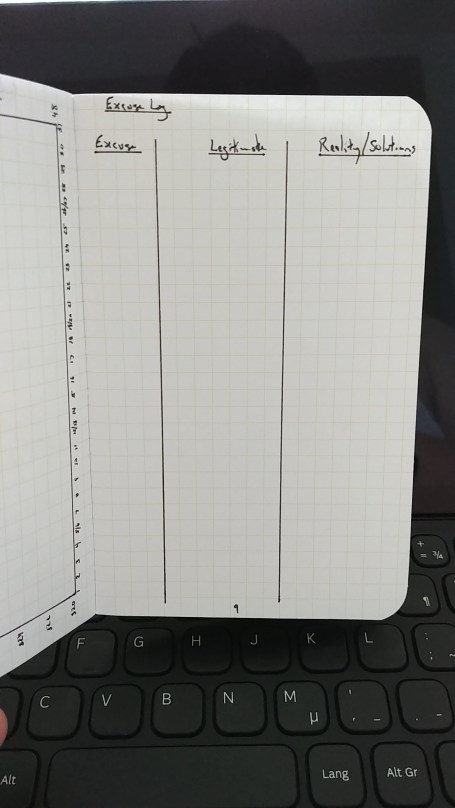
Then, on page 9, I borrow a system I found on Reddit to track excuses.  This is where I can measure intentions against action.  For instance, if I set an intention to exercise and I skip it, I can capture what my excuse is for skipping it, assess whether it is legitimate (yes/no), and make notes on any ways I can mitigate the reality or implement solutions to keep my intentions.
20190101_113403

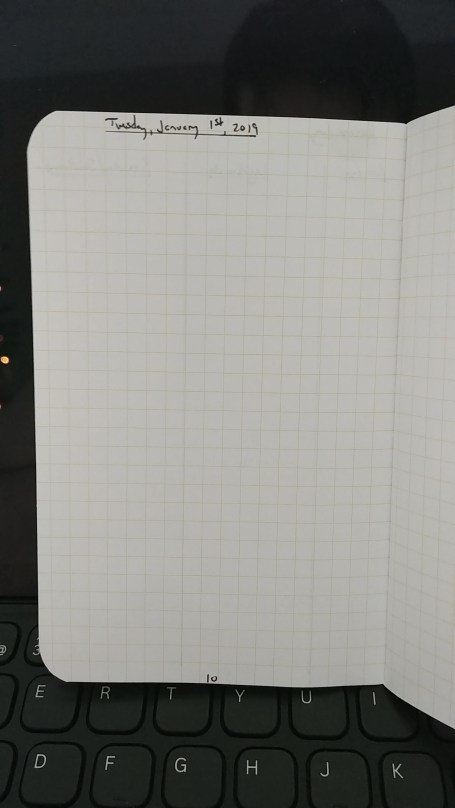
Finally, on page 10, I start my first entry.  Every day that I record in my notebook will receive a new page.  I put the date across the top, then fill in tasks for the day, ideas, interesting quotes, or things to remember.  Sometimes I’ll migrate thematic lists into this section, such as tasks I need to complete as Board Chair or for things around the house to repair.
20190101_113446

This is the system I currently use.  It borrows from a couple different sources, such as the original Moleskine planner I began with, elements from the Bullet Journal method, and good ideas I’ve found rambling through sites like Reddit.  The notebook set-up iterates over time.  I add and remove things depending on how useful I find them.  Some of the items discussed above might get removed soon since I haven’t done a good job of keeping up with them, and therefore are no longer useful to me.

It is a little tedious to set up a new notebook every 30 or so days, but on the whole I like the systems I’ve developed and have found it immensely useful in my day-to-day life.

Share with me down below what kind of systems you use to help keep yourself on top of things.  I’m always looking to borrow good ideas!  I hope you found something here that was useful.

Stay Awesome,

Ryan
 

What I Read in 2018

Here it is, my yearly update on what I read over the last 12-months.  Overall, I far exceeded my 2016 and 2017 lists in terms of the number of books (42 in 2016, 44 in 2017, and now 57 in 2018) and even the number of pages (4,600 pages more over 2017’s total).

Title Author Date Completed Pages
1 Saga, Volume One Brian K Vaughan and Fiona Staples 12-Feb 160
2 Witches Abroad Terry Pratchett 23-Feb 288
3 12 Rules for Life Jordan Peterson 5-Mar 448
4 Skin in the Game Nassim Nicholas Taleb 10-Mar 304
5 Proust and the Squid Maryanne Wolf 11-Mar 336
6 Small Gods Terry Pratchett 16-Mar 384
7 Conspiracy Ryan Holiday 21-Mar 336
8 Lords and Ladies Terry Pratchett 7-Apr 384
9 Thinking in Bets Annie Duke 7-Apr 288
10 Sapiens Yuval Noah Harari 13-May 464
11 Career Manifesto Mike Steib 4-Jun 288
12 This Is The Year I Put My Financial Life in Order John Schwartz 5-Jun 320
13 Men at Arms Terry Pratchett 12-Jun 384
14 Soul Music Terry Pratchett 24-Jun 384
15 Interesting Times Terry Pratchett 8-Jul 352
16 The Achievement Habit Bernard Roth 21-Jul 288
17 Discover Your Inner Economist Tyler Cowen 26-Jul 256
18 Maskerade Terry Pratchett 30-Jul 384
19 The Five Love Languages: Men’s Edition Gary Chapman 31-Jul 208
20 David and Goliath Malcolm Gladwell 3-Aug 320
21 Feet of Clay Terry Pratchett 10-Aug 416
22 Originals Adam Grant 13-Aug 336
23 Own the Day, Own your Life Aubrey Marcus 17-Aug 448
24 Hogfather Terry Pratchett 17-Aug 352
25 Tribe of Mentors Timothy Ferriss 20-Aug 624
26 Better than Before Gretchen Rubin 21-Aug 320
27 Jingo Terry Pratchett 25-Aug 416
28 Books for Living Will Schwalbe 27-Aug 288
29 The Last Continent Terry Pratchett 6-Sep 416
30 Unshakeable Tony Robbins 17-Sep 256
31 Shoe Dog Phil Knight 17-Sep 400
32 What Happened Hillary Rodham Clinton 26-Sep 512
33 When Daniel H. Pink 28-Sep 272
34 A Higher Loyalty James Comey 30-Sep 312
35 Creativity, Inc. Ed Catmull 2-Oct 368
36 Why Buddhism is True Robert Wright 15-Oct 336
37 The Element Ken Robinson 19-Oct 320
38 Elon Musk (Biography) Ashlee Vance 24-Oct 400
39 Reinventing You Dorie Clark 26-Oct 240
40 What the Dog Saw Malcolm Gladwell 4-Nov 448
41 The Daily Show: An Oral History Chris Smith 12-Nov 480
42 Waking Up Sam Harris 15-Nov 256
43 If You’re In My Office, It’s Already Too Late James J. Sexton 24-Nov 288
44 A Life in Parts Bryan Cranston 24-Nov 288
45 5 Love Languages Gary Chapman 27-Nov 208
46 The Perfectionists Simon Winchester 1-Dec 416
47 Entrepreneurial You Dorie Clark 3-Dec 272
48 The Dip Seth Godin 3-Dec 96
49 The Last Man Who Knew Everything David N. Schwartz 7-Dec 480
50 Ikigai Hector Garcia and Francesc Mirales 20-Dec 208
51 The One Thing Gary Keller and Jay Papasan 20-Dec 240
52 This Is Marketing Seth Godin 21-Dec 288
53 The Souls of Black Folk W.E.B. Du Bois 23-Dec 272
54 The Artist’s Journey Steven Pressfield 27-Dec 192
55 Running Down a Dream Tim Grahl 28-Dec 198
56 Zen to Done Leo Babauta 28-Dec 114
57 What I Talk About When I Talk About Running Haruki Murakami 31-Dec/1-Jan 192
Total: 18544

As I mentioned last week, I have some thoughts and reflections while reviewing the list.  First, when I was selecting my best 5 for the year, I noticed that the books in the latter part of the year were ones I felt resonate with me the most.  I think this is for two, related reasons.  First, this was a huge year for my wife and I.  We renovated our old house, sold it, bought a new house, renovated the new one, moved cities, got married, and got me a new car.  We had so much packed into one year on top of work and family, that the year seemed to have flown by without me realizing it.  Someone pointed out to me that there was a Winter Olympics at the start of last year – I couldn’t believe it and had forgotten all about it.

The second, somewhat related reason is because of the sheer volume of books finished, I don’t think I gave the material time to properly settle in my mind.  Fifty-seven books is a huge amount, and I think that by the end of the year, I couldn’t really remember what I had read during the first half of the year.  Instead, most of the impact was felt in the readings from the latter half of the year.  That’s not to say that the books from the start of the year are forgotten, because I feel that lessons taken from Skin in the Game and from Sapeins, for example, are prominent in my mind.  It’s just that they didn’t really stick out in my mind at the end of the year when I was picking my top reads of the year.

Another reason why I think I have a hard time remembering what I read from the start of the year is because the vast majority of the books finished this year were audiobooks.  Thanks to Audible and the Libby app, I was flushed with books to go through.  And because I listen to books at a minimum of 1.5x speed, I can get through the books at a far faster rate than if I were carving out time to read physical books.  This has its advantages, such as being exposed more rapidly to new ideas.  However, this advantage comes at the cost of little overall integration of the information and general lowered retention of information over time. The speed at which I’m listening to books is more like skimming than true reading.

Nevertheless, I’m very satisfied with my accomplishment for the year.  I’m not really interested in trying to top this list intentionally next year.  I will keep reading/listening/consuming books at whatever rate I happen to finish them, but I will go with whatever pace I happen to settle in, rather than trying to hit weekly or monthly targets.

For the upcoming year, I’d like to try and move away from the self-help, business, and animated bibliography genres of books, and instead tackle more books on history, biographies, and fiction that’s not just Terry Pratchett (though I will still keep ploughing through the Discworld series – that’s not changing any time soon).  If you have any book recommendations, feel free to let me know!  I’ve already got “Educated” by Tara Westover and “When They Call You A Terrorist” by Patrisse Khan-Cullors and Asha Bandele on my bookshelf as recommended by friends.  I’m always on the lookout for the next book to read.

Have a great new year and happy reading!

Stay Awesome,

Ryan

Top 5 Books Read in 2018

As of writing, I have powered through 55 books this year.  I choose the word “powered” deliberately, and I’ll have more to say about that next week when I list all the books I read for the year.  But in the meantime, I’ve been doing some reflecting on the year that is about to close, and I thought about the books that stuck with me the most.

In no order, here are the top 5 books I read this year.

Shoe Dog by Phil Knight

Shoe Dog details the early history of Nike’s founding and the struggle of getting the company off the ground.  While there are things that Knight did that had questionable ethics, you can’t deny that he and his team worked incredibly hard to secure their place in the world of shoes.  The story was compelling and hooked me in from the outset.

Creativity, Inc. by Ed Catmull

Another founder’s story, Catmull relates the history of Pixar’s founding and eventual merge with Disney.  If I was going to use one book to teach me leadership (especially when leading creative teams), this would be the bible to follow.

The Daily Show: An Oral History by Chris Smith

I loved the Stewart years of the Daily show, but if I regret one thing, it was that I didn’t watch it sooner.  I didn’t have the understanding of politics and history to get the show’s message while I was in high school.  In fact, I only came to the Daily Show after getting into the Colbert Report midway through undergrad.  I don’t think there is anything wrong with the show under Trevor Noah’s leadership, but it hasn’t been the same for me.  This book helped me catch up on the early history of the show and gain some context of the show while I was a viewer.  Finally, it answered my burning question of why Stewart decided to step away from the desk.

The Perfectionists by Simon Winchester

This book was so good, I gave it to my grandfather as a Christmas gift.  Maybe I’m biased because I work in an office full of engineers, but the history of precision engineering was amazing.  Winchester tells a compelling story of the various leaps forward in precision engineering, from machining and designing systems in entirely new ways.  While you might not think a history lesson of machining would be interesting, I urge you to check this book out.

The Last Man Who Knew Everything by David N. Schwrtz

The biography of Enrico Fermi’s life was a thrilling ride.  I like reading about the education and early development of brilliant thinkers, and Fermi didn’t disappoint.  Fermi is known for his uncanny ability to derive equations from first principles, and to understand systems almost intuitively.  Combine that with his ability to “eyeball” problems and create stunningly accurate approximations, it’s no wonder that he’s considered the father of the atomic age.  While it’s a shame that his work did create such devastating destruction during the war, the man himself was charming and well-worth getting introduced to.

Next week, I’ll list all the books I’ve read in 2018.  In the meantime, have a safe and happy New Year’s Eve and I’ll see you in 2019.

Stay Awesome,

Ryan

Self-Education Resources

Post-secondary education has never been more accessible to the average person.  We may have a long ways to go in terms of making courses more accessible for learners and reducing the financial barriers that keep students from being successful in school, but it is nevertheless an undeniable fact that there are more people who have been to post-secondary schooling than the entire history of people attending higher learning.

One issue with the proliferation of access is that it’s getting harder to stand-out in the workforce.  With so many people carrying credentials, the golden ticket that a diploma or degree used to confer has lost some of its value.  Your choices are to either go to industries where they are starving for workers (if you are looking for a solid career with good prospects, you should become a welder NOW), or figure out a way to become a better problem-solver to stand out amongst the crowd.

Another issue that complicates matters is that industry and technology is changing at such a rapid rate that you can no longer rest on your laurels that your program of study will adequately prepare you for work in your industry.  The techniques, technologies, and skills you learn in your first year may be obsolete by the end of your final year.

Therefore, it’s important to develop your ability to self-educate.  Knowing where you can find free or cheap resources can be a huge advantage when developing yourself in your career.  Here are some of the resources I use to teach myself.

Top Spot: your Public Library

In my humble opinion, the public library is one of the greatest inventions of all time.  Whether you are taking classes they offer, using resources in their catalog, or availing yourself of the free access to materials like online journals and portals, there is almost no limit to  the access your library card can provide.  When my HVAC system went on the fritz, I was able to check out an HVAC manual to help me learn just what the heck an HVAC system does so that I could understand what repairs were needed, and how to better care for the system in the future.

YouTube

YouTube changed the game when it comes to sharing knowledge.  Don’t get me wrong, books are great (the necessary precursor to the greatest invention of all time; see: public library entry), but unless your book has incredibly detailed diagrams, the video format will always be the superior resource for teaching hands-on skills.  When I had to fix my roof, I turned to videos to learn how to remove individual shingles and replace them myself.

Coursera

Coursera is all the benefits of attending lectures without the associated costs.  Granted, if you want formal recognition of completing Coursera courses, you’ll need to pay for the access.  However, nearly every Coursera course has the option for you to audit the course for free, which gives you access to the lecture content and some of the supplementary material.

Reddit (and other specialty discussion forums)

I suppose I should have used “Google” as the category here since I often will search for solutions through Google’s indexed results.  However, dedicated online communities are some of the best resources to learn from.  They often post comprehensive resources and how-to manuals, and are usually great about providing solutions when you are stuck on specific problems.  If you can find a good community that isn’t locked behind a paywall, you can lose yourself for hours in it’s wealth of information.

Lynda.com

While not a free resource, this is something that my employer has provided to its employees at no cost.  You should check to see if your employer offers any services for employees to self-develop because you might be missing out on a ton of non-financial benefits.  Lynda is a great resource for comprehensive courses on a wide variety of tech and business topics.  It’s a bit restrictive if you are looking for non-business courses, but it’s worth checking out for learning the basics you’ll need to navigate your early career development.

Udemy

Another paid service, I find Udemy great for high tech courses where I want to develop specific skills, such as in Python or in using Adobe software.  I wait for courses to go on sale, and I snap up courses up to 90% off their full price.

Ask friends

My final suggestion is to tap your friends to see if anyone can help you learn new skills.  Obviously, you don’t want to exploit your friends – you should pay for their services where appropriate.  However, in some cases your friends can be great resources to tackle projects.  Not only do you get to leverage their unique skills or experience, but you also get quality time together.  My entire podcast and music run for Woot Suit Riot has been some of the most formative experiences I’ve had, all because I was making stuff with friends.

All of this is framed as advice to help you in your career, however the truth is that you should be seeking to educate yourself for any project your’re interested in, regardless of whether you can get paid for the skills or not.  I took painting classes earlier this year at my local art store because I wanted to learn how to paint.  This isn’t a skillset that directly will get me promoted, but it rounds me out and allows me to explore my creative side.

The point of self-education or self-development is for you to become more of the person you want to be.  It’s often hard work, but the experiences are well-worth the effort.

Stay Awesome,

Ryan

Problem Solving – A Framework

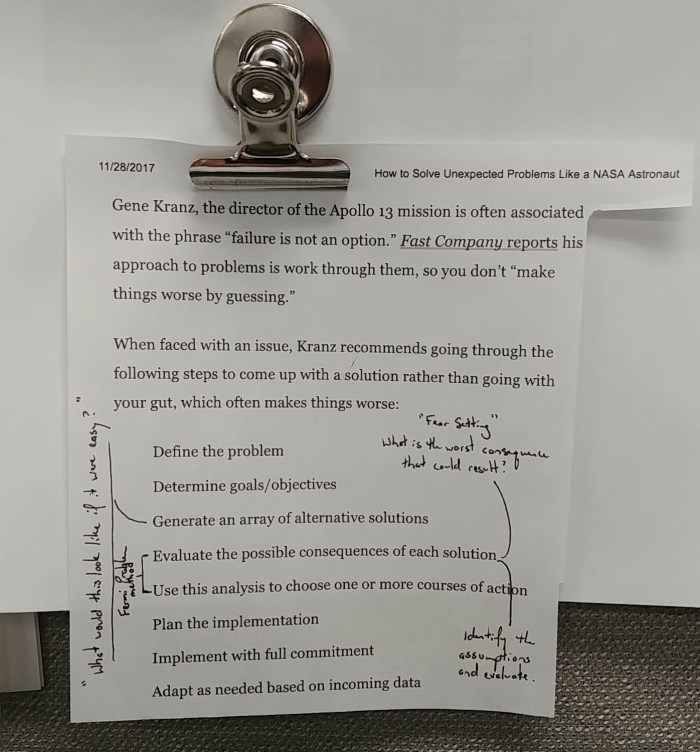
In my first post on principles, I had an entry regarding problem solving – specifically, guidance on defining problems.  That entry is actually a condensed version of something I have hanging in my cubicle at work:

20181018_154129~2

I printed the post from a Lifehacker article, and have since annotated it with a few extra ideas.  On the left, I stole a line from Tim Ferriss’s Tribe of Mentors to supplement the step for generating possible solutions to your problem.  The simplicity of the question, “what would this look like if it were easy?” allows me to limit the choice pool by excluding unlikely scenarios while thinking about the positive outcomes.

When it comes to evaluation consequences and narrowing down the options, I have added three additional tools.  First, I borrow again from Tim Ferriss where he uses “Fear Setting” to determine the worst case scenarios possible, and then he goes through each outcome and asks himself whether the cost is something that he could live with.  By doing so, he reframes his concerns away from merely worrying about negative outcomes to only focus on the things that matter to him.

I also added a note to myself to ensure I’m capturing my assumptions.  A lot of the time I start with my conclusions and assume they are transparent in their reasoning.  However, if I ask a series of clarifying questions (usually the 5-why technique), I often end up drilling down to hidden assumptions or emotions that motivate the conclusion (rather than pure reason).

The final note I scribbled is in reference to Enrico Fermi who had an uncanny knack making stunningly accurate “guesses” off the top of his head.  Fermi used probabilities and statistics to make educated guesses to solve problems, which could then be further refined.  It’s a tool for quick and dirty estimates, and it helps to narrow down the choice pool.

My annotations aim at four tools I can use to supplement Kranz’s method: what is the best/easiest solution, what’s the absolute worst case, how easily can we figure this out, and what motivations are driving my decisions.  I try to keep those considerations in mind, though I’m not nearly as rational as I pretend to be.

Stay Awesome,

Ryan

Principled Thinking (part two)

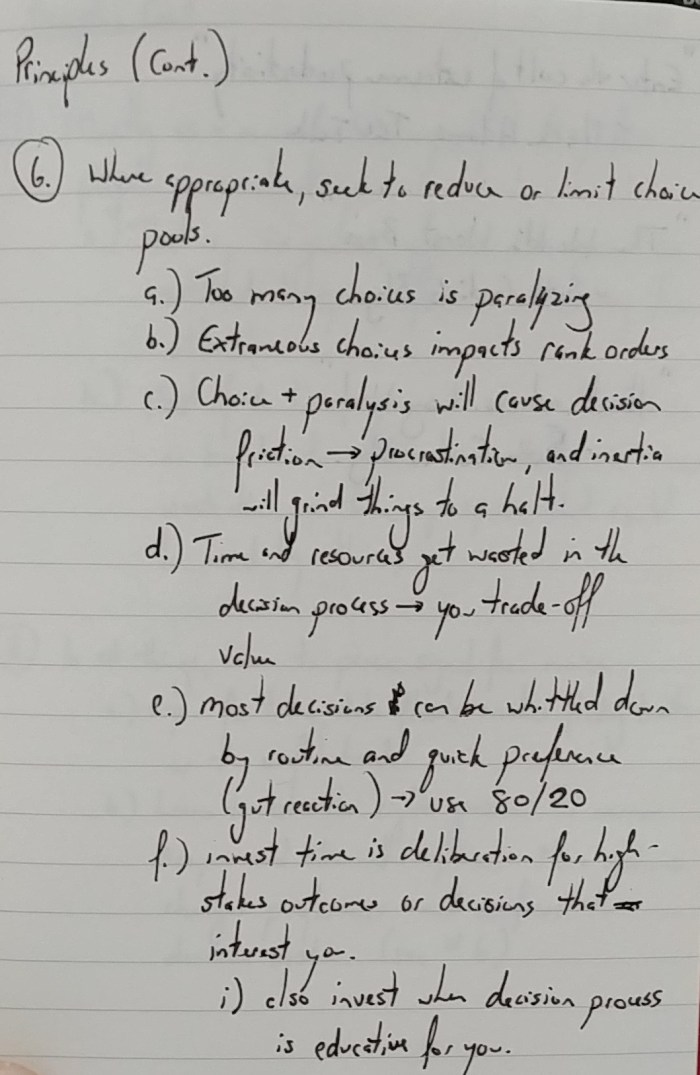
Since my last post on principles, I’ve jotted down a few more ideas in my notebook.  I’ve transcribed my thoughts under the photo below.

20181118_131600~2

6. Where appropriate, seek to reduce or limit choice pools.
a.) Too many choices is paralyzing.
b.) Extraneous choices impacts rank(ing) orders.
c.) Choice + paralysis  will cause decision friction –> procrastination, and inertia will  grind things to a halt.
d.) Time and resources get wasted in the decision process –> you trade off value.
e.) Most decisions can be whittled down by routine and quick preference (gut reaction) –> use 80/20.
f.) Invest time in deliberation for high stakes outcomes or decisions that interest you.
i.) Also invest when decision process is educative for you.

This entry largely captures what my behaviours are like when it comes to making decisions versus where I want them to be.  By nature, I’m a risk averse and indecisive person.  I tend to sit on decisions far too long, to the point where they can cause anxiety when it’s finally time for me to make the call.

I also tend to lack preferences in a lot of things.  For instance, I usually don’t have a strong preference when it comes to picking a place to eat, so I’m terrible at deciding where to go but I’m perfectly happy to go along with choices made by others.  There are many things I’m starkly black-and-white about (which is really annoying to my wife), but most of the time I sit in a middle state like Buridan’s ass.

Therefore, this set of principled notes captures where I want to be – to quickly narrow down extraneous choices (because too many options usually leads to diminished outcomes), and to automate where I can.  Then, I can focus on the really important decisions or use the deliberation process as a teaching tool for myself.

Stay Awesome,

Ryan


The Value of a Myers-Briggs Test

There seems to be a publishing cycle, where every year a new slew of articles are released to damn personality tests, such as the Myers-Briggs.  Lifehacker published one recently, and a book was released at the end of summer about the mother-daughter duo who created the assessment tool, which can be paired with a book released a decade ago discussing personality tests more broadly.

A few years back, I was thinking about my career, and I happened to take the test.  According to it, I’m a INTP, the Logician, an introverted big-thinker who is logical but adaptive.  A year later, I took the test again and I drifted into ENTJ territory; apparently in that time I became more extroverted and more rigid in my planning.

This, of course, is the biggest issue with these personality tests.  They tend to overly rely on generalizations of fluid behaviours and attitudes.  People rarely have stable traits over time, and the test tends to loosely clump these together in attempt to create a meaningful picture.  In this, the Myers-Briggs is nether reliable nor valid from a scientific point of view.  As the Lifehacker article points out, along with many others, it’s dangerous when you base decisions on the conclusions drawn from these tests for things like dealing with others or hiring employees.  The best thing you can do, the article claims, is to use it as a fun conversation starter and nothing more.

But I find value in the tests for another reason.

Humans are drawn to stories.  We like crafting narratives to explain events and give meaning to our lives.  While we would want our stories to align with true accounts of history or phenomena (a book I recently bought argues that it’s not possible), we can still find value in stories that are not, strictly speaking, true (I’m appealing to a coherence-model of truth, rather than a correspondence-model of truth; I never thought I’d drag that grad course back up in conversation again…).  We can find value in a story even if we are agnostic towards it being literally true or corresponding to a fact “out there” in the world.

When it comes to my career, one problem I have is that I have a hard time knowing how to sell myself.  When you are crafting your resume or CV, or when you are interviewing for a position, you are trying to create an appealing story of yourself.  You are painting a picture of the kind of person you are that aligns with the demands of the job or the needs of the employer.  Sometimes, it’s hard to create a compelling story for yourself.  You don’t know what to include, what to leave out, and what needs some mild spin.  You have to decide how to play-up key points and downplay unsavory details.  How you choose to connect the dots can make a large impact on what others will think of you as a candidate.  You don’t want to be dishonest, but sometimes the “truth” is very compelling.

One critical area that the Myers-Briggs can offer value is providing inspiration for how to tell that story.  It creates neat little packages that arranges details in interesting ways.  It allows you to take the generalizations and apply them to your own experiences.  It’s the same trick astrology uses – if you make a statement sufficiently ambiguous, you can find confirming evidence to support it.  Using this to your advantage, you can create a compelling backstory for yourself while also prompting you to fill in the details with good stories.

And if something does fit?  Leave it out and move on.

As long as you don’t pigeonhole yourself, you can tell a story about you that shows how valuable, interesting, and desirable you are to others.  The Myers-Briggs can offer some themes and typologies to help sell the best version of you.  Just don’t believe everything you read.

Stay Awesome,

Ryan

Post-Script: After I drafted this post last week, Seth Godin posted some thoughts about changing your story.  If I’m randomly coming up with ideas that coheres with advice from Seth, I count myself in good company.

~R

Hot Yoga Kicked My Ass – Some Thoughts

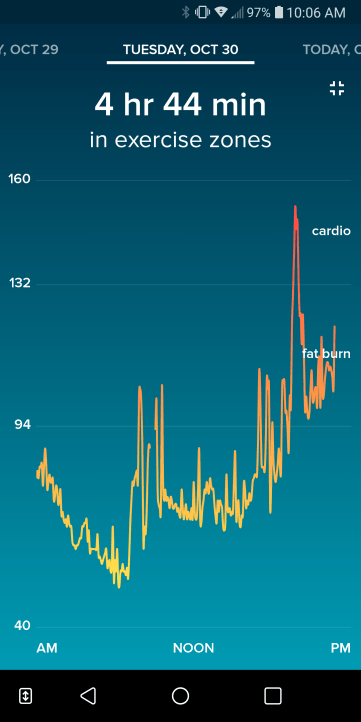
Last week, a group of friends and I attended a hot yoga session.  We, as a group, meet once per month to do an activity, and the October leader chose to have us join him for hot yoga.  I had some prior experience attending yoga classes, but this was my first time in a “hot yoga” session.  By the end of the hour, I looked like I had jumped in a lake.  My Fitbit tracked my heart rate and it had looked like I was running sprints.

Screenshot_2018-10-31-10-06-17.png
My max heart rate was 153bpm, during the hour-long session.

It was challenging, uncomfortable, and brutal.  In other words, it was awesome!

I’m not saying that I’m going to sign-up with my local studio or start buying into the lifestyle; I’m still paying for a gym membership that I don’t use, so I don’t need another cost to my monthly budget.  However, I found the experience interesting and invigorating, and I’d gladly go again in the future.

Cultural appropriation concerns aside, I’m fully on-board with the physical practice of yoga for health and fitness.  Western yoga tends to have a lot of stereotypes and negative perceptions attached to it, but the act itself can be a legitimately hard, physical activity that raises your heart rate, requires a lot of strength for the body-weight movements, and provides the same calming effect you get when you focus on process movements.

I’ve attended a handful of classes and tried routines at home a few times, so I’m not qualified to offer any opinions on yoga.  However, I’ll offer a few observations and thoughts on my experiences as a beginner:

  1. While I’ve never had a bad instructor, I was incredibly thankful that the two people I’ve had leading classes were super friendly, approachable, and accessible.  You feel incredibly awkward walking into your first class, and you assume that everyone is silently judging how bad you are at it.  Having a good instructor in front of you really helps you get into things, and their ability to break down the poses and movements with verbal cues really aids in immersing yourself in the experience.
  2. At the recommendation of a friend, I’ve attempted doing yoga at home by following along with an instructor’s video on YouTube (my go-to channel is Sarah Beth Yoga).  While doing yoga at home is more convenient, cheaper, and less awkward, I still find value in doing yoga in a group setting.  It feels more rewarding in the end to share the experience with others, and having a dedicated time to show up makes you more accountable.
  3. If you are going to buy anything, I recommend buying your own mat.  I’ve used it for yoga as well as doing tabatas at home.  I also recommend buying a thicker mat (the standard mat is really thin) because being a heavy guy, it helps cushion my wrists and knees in the various poses.  Bring a towel because the thicker mat doesn’t appear to have the same grip when you’re sweaty.
  4. BRING WATER!  STAY HYDRATED!  This applies to non-hot yoga as well.
  5. I found the act of yoga to help clear my mind.  Again, cultural appropriation questions aside, going through the motions intentionally and being mindful of what your body is doing or “saying” to you helps with the mind-body connection.  There is something about focusing on your breathing and your movements that creates a singular focus that pushes extraneous thoughts out of your mind.  The added layer of music and sanskrit words pulls your attention away from the past or future considerations and instead into the present.
  6. Speaking of sanskrit, I don’t get too bogged down in the culture.  When in the yoga studio space, I try to be mindful of others and the practice, but because I don’t know too much about the history or origins of yoga, I remain agnostic but open towards the cultural or spiritual side.  It’s not my place to judge, and smarter people than I can weigh-in on the validity of different kinds of yoga practices.  I find value in the physical movement and the slower pace of the activity.
  7. Having said that, I know that as a white dude participating in an appropriated practice from Hinduism, India, and the Desi people, it is loaded with problems (see the link above).  My participation adds to the watering down of a rich culture from which the original practitioners were forced to suppress their ways at the hands of their colonial occupiers.  I can’t square that circle and have to acknowledge it for what it is.


Stay Awesome,

Ryan

What I’ve Been Reading (As of October 29th)

While it’s only been a month since my last reading update, I’ve turned-over a fair number of books in that time.  Here’s what’s on my nightstand or playing from my speakers this month.

If You’re In My Office, It’s Already Too Late by James J. Sexton

No, I didn’t get this book because my relationship is in trouble.  In fact, it’s the exact opposite.  My relationship with my wife is great, and I want to keep it that way.  I first came across Sexton in a Lifehacker podcast along side Esther Perel and I thought he had some interesting perspectives on relationships as a divorce lawyer.  This book distills his 20-years of law experience and covers a gamut of reasons why relationships fail.  The thinking is that while he doesn’t know what makes a good relationship, he knows all sorts of reasons why they don’t work, and the reader of his book can learn from the mistakes of his clients.

The Laws of Human Nature by Robert Greene

I pre-ordered this a few weeks back and it just came in the mail, so I haven’t had a chance to get very far into it.  I first encountered Greene through a book recommendation from a friend of mine for his book, Mastery.  I was intrigued with the material in Mastery, so I’ve kept an eye on Greene since.  I listened to a the audiobook for the 48 Laws of Power, and I listened to a bit of his Art of Seduction (though I never finished it).  Greene, like his protege Ryan Holiday, is a master of research synthesis.  While his books are a bit of an animated bibliography, I think it’s the best representation of the genre.  He digs into history to learn lessons from key figures to articulate his thesis.  Instead of reporting on the achievements of others, Greene feels like a chronicler of insights.  I’m looking forward to what this book has to offer.

To Kill A Mockingbird by Harper Lee

I’m a bit embarrassed to admit that I’ve never read this one until now.  I’m familiar with the well-known courtroom scenes from the movie, but I was never assigned this while I was in school.  Since I’ve been reading a steady diet of non-fiction, I thought I should dig into some quality fiction.  I’m less than an hour into the audiobook, but already I find Scout to be an intriguing character (narrated by Sissy Spacek).

Harry Potter and the Deathly Hallows by JK Rowling

While my wife and I were heading off on our mini-honeymoon after the wedding last month, we found it difficult to talk about anything that wasn’t about the wedding.  The planning and lead-up to our nuptials was over a year in the making, so in the afterglow of the party, we didn’t have much to talk about.  Instead of riding in complete silence, we bought a copy of the Deathly Hallows on audiobook for the drive.  I’ve only read the book once, and that was way back in 2007 when it was released (I bought it during a layover in Heathrow Airport on my way home from Kenya).  We only listen to the book while together in the car during long(ish) drives between cities, and it’s funny how often we shut it off to talk about the story, or how stupid Harry (the character) is when you really think about it.  It’s honestly among my favourite times spent with my wife.

Ikigai: The Japanese Secret to a Long and Happy Life by Héctor García and Francesc Miralles

I bought this book with high hopes, but sadly I’m finding it a bit of a let down.  The Ikigai concept has floated around the interwebs and on my radar for a little over a year now.  It got picked up in the blogosphere (mostly on Medium for me), so when I saw the book I thought I should check it out.  This particular book is a hard animated bibliography.  I think its greatest sin is that it talks about Ikigai by first covering other well-known philosophical ideas, such as Frankl’s work in Man’s Search for Meaning.  I had hoped the concepts would stand on their own, or at least be situated with the original Japanese contexts that they were born out of.  Instead, it cobbles together a bunch of summaries of other publications and presents them in digest format.  Because the book is short with big font, I’ll slog through it, but it’s not what I had hoped it would be.

Stay Awesome,

Ryan