Brutally honest time: I’m not exercising regularly (yet again).
I will grant that I’ve been noticeably busier in the last week or so, however the last trip I logged at the gym was Tuesday, May 9th. I don’t even know off-hand the last time I rowed (and there’s no point in looking it up, since it probably won’t be good).
This latest round of trying to build a better habit of exercising has, so far, not taken root as I had hoped. This is not to say that I’m abandoning the effort. I don’t see a need to give up because I’ve failed to implement the system.
The important thing is to reaffirm that I want to commit to it, then get back on the horse to try again.
Last week, I gave my fourth sleep check-in for 2017. With four months of data, I thought I’d put it all together to see what trends shake out and what I might learn from the experience so far.
(Note, I missed the opportunity to review a true quarter, but an extra month is just more data for me to dig into.)
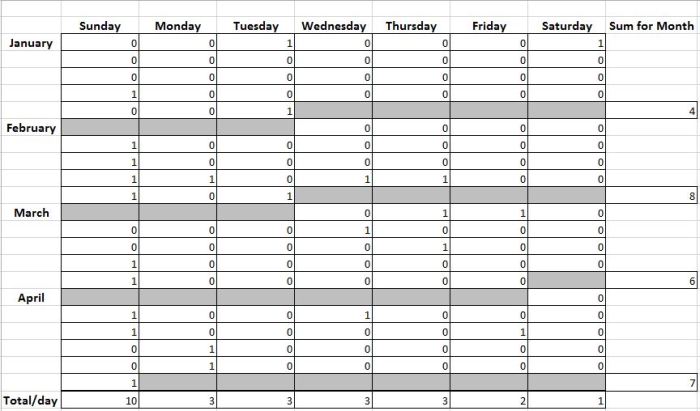
The single best day for sleep for me are Sunday’s. This makes sense, as I typically don’t work Saturday nights at the bar anymore, and I consider Sunday to be a down day – I don’t set alarms unless I have something planned. Therefore, it makes sense that I hit at least 7-hours of sleep 10 our of the 18 Sunday’s in the first four months (55.5%).
If Sunday’s are successful, why aren’t Saturday’s? I attribute this largely to working at the bar Friday nights. When I work a bar shift, I don’t get off work until 2:30am, which means that by the time I get home, wind down, and finally push myself to go to bed, it’s 4am or later. Since I don’t like sleeping too late on Saturday’s and wasting the day, I’ll often get up by 10 or 11am, well before I hit the 7-hour sleep mark. Because of this, it doesn’t surprise me that Saturday’s are displaying the worst results.
With the Monday through Friday results being largely similar, I can offer some brief commentary on their successes. Sleep results from Monday, Tuesday, and Wednesday are the most likely to be successful for me since I often have those nights free, and am able to go to bed around 10pm. In this case, I’m not successful because I’m usually not in bed until after 10:30pm, meaning any kind of restlessness while I sleep cuts into the narrow margins. While the opportunity for success is there, poor execution on my part is to blame for the poor results.
Thursday’s results are curious. Thursday’s come after I work the Wednesday night shifts at the bar, so you would expect me to have as poor of results as Saturday. However, what’s not captured in the graph is the time I go into work Thursday mornings. While I’m *supposed* to start work at 9:30am, I’m often sleeping in Thursday mornings and not getting to work until 10am. That probably accounts for the times I’m hitting the 7-hours.
Friday’s are a little anomalous, as I would expect them to be on par with Monday through Wednesday. I suppose there’s a few things going on there: I’m a little fatigued by the end of the week, so I’m making poorer choices; or perhaps my sleeping schedule shifts later because of Wednesday night. It’s also possible that there are other externalities that I’m not accounting for, such as other events in my calendar that I’m not including here for simplicity.
Of course, it needs to be pointed out that we should not draw a lot of inferences here. All things considered, four months is not a lot of data, and I’m still performing poorly in terms of the sleep challenge. In the four months (120 days), I hit my target 25 times (20.8%). Not accounted for, as well, are the near-misses where I slept over 6.5-hours in a night, but less than 7-hours. Also not accounted for are the nights were I was asleep for 7 or more hours, but due to restlessness, getting up in the night, or being disturbed by my partner and pet, I was tracking less than 7-hours on my Fitbit.
Still, near-misses are failures, and I must accept those instances where I barely fail my goals. With more intentionality, mindfulness, and better systems, it is possible for me to improve over the next four months.
Adding to my January, February, and March check-in’s, here is my sleep progress for April:
7/30
No progress to speak of, as I kept pace with 7 nights of sleep for the month. I’m starting to notice a few trends, having the month laid out for me in full. For instance, I see that my most common day to hit my sleep target is Sunday. While it’s not reflected here whether that means I’m going to bed at a reasonable hour (my gut tells me this is probably not the case), or if I’m sleeping in, it’s something worth reflecting on.
Over the next week, I’ll review my sleep progress for the first quarter of 2017 and see what the stats say, and what I can learn from my experiment so far.
I decided to hold off on posting the March sleep check-in in favour of discussing the job related stuff while it was fresh and ongoing. However, now that the bulk of that is out of the way, I can return to updating my progress on getting more sleep.
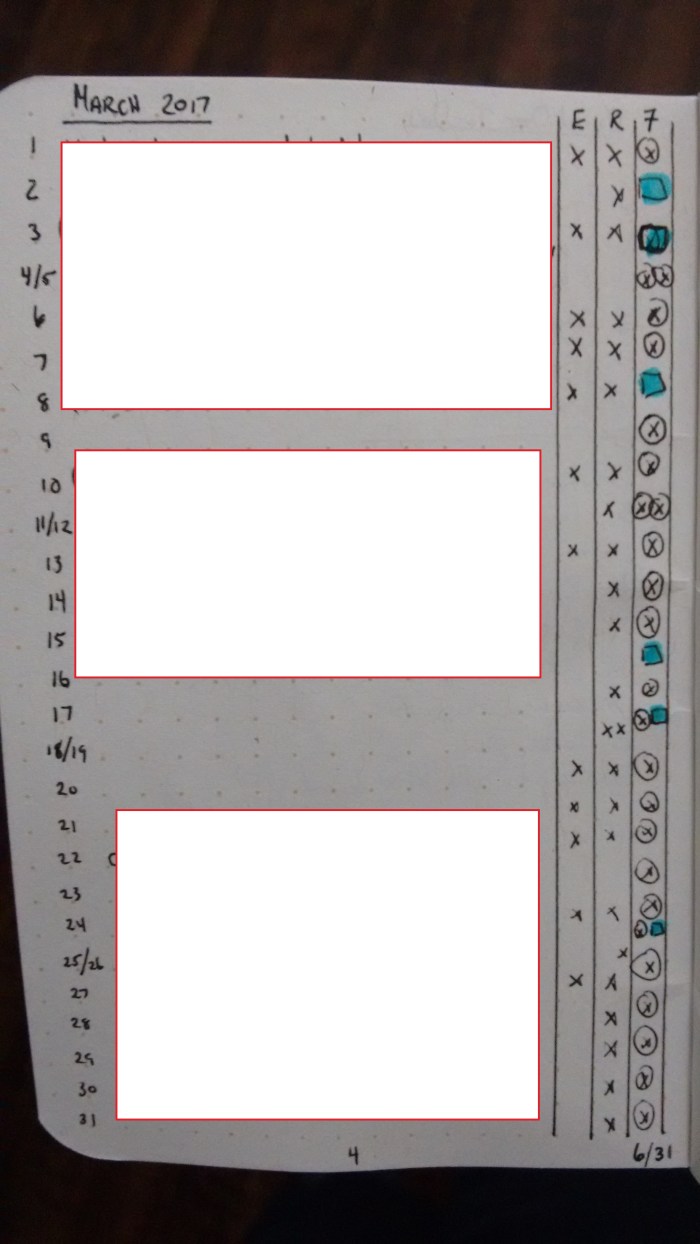
6/31 days, or 19.3%.
As you can see from my daily tracking, basically no change over February. I did get one less night of sleep over 7-hours last month, but overall I stayed consistent with the previous month in the number of nights with over 7-hours in a month. Obviously February and March don’t have the same number of days per month, but I’m treating this as a rough estimate. Ideally, I would have liked to have seen an improvement, so it’s something to keep in mind for the rest of April.
Hope you had a great Easter weekend! Talk to you next week.
Last week, I was passed over on a job opportunity for a more qualified candidate. Such is life, and I don’t bear any ill-thoughts for the results of the job search. I’m disappointed, but not soured by the experience. It’s an opportunity to learn and grow, and I find that more important to focus on than to give in to a fixed mindset of self-pity.
After the feelings of sadness ebbed, I found myself experiencing a different feeling – motivation. This has happened a few times in my life, and it was strange to be reaquainted with it. There have been a few critical moments in my life where I failed at something important, and that failure created a fire within that motivated me.
It happened when I climbed Mount Kenya in 2007 after I failed my summit in the summer of 2003 of a mountain in Alberta whose name I’ve forgotten.
It happened when I joined the Campus Response Team and became a Coordinator after I failed twice to be a residence don.
And it happened again last week when I wasn’t selected for the job. The self-critical sadness was overtaken by a motivation to go to the gym.
As I’ve written previously, It’s been a while since I’ve visited the gym. According to my fitness journal, the last time I was in the gym was around Hallowe’en. I’ve been rowing this last month a few times a week in the mornings, but I haven’t lifted iron in around five months.
Initially, I stopped going to the gym after my routine was disrupted by travelling to Scotland. Then I didn’t go out of laziness, and then I didn’t go because I didn’t feel like I could justify going to the gym when I was supposed to be marking assignments and prepping my lectures. By the time December rolled around I had regained my weight, but I also proposed to my fiancee, and started the planning process for moving out of my apartment. Along the way, I was tired from a lack of sleep and dissatisfied with what I saw in the mirror. Yet, it was never enough to overcome my inertia.
Failing to get the job was the final push I needed to hit the gym. Maybe I needed a physical outlet to vent some frustration. Maybe it was a form of punishment. I’d like to think it was something more constructive – I accepted that I failed but I also saw that I could do better next time. It is within my power to learn from the experience and grow. The failures seemed to stack until it hit a critical mass; a line was crossed that set off the warning bells that I was heading in a direction I didn’t want to go.
It was time to make the first step and correct my course.
I vlog occasionally for my buddy’s YouTube channel, Artpress, and posted this immediately after I got out of the gym.
So, I hit the gym and pumped some iron. I was nervous to go back as a beginner again, and overcoming inertia was incredibly uncomfortable, but I did it.
Now the trick is to keep it up. That’s, perhaps, the greater challenge I face.
I wrote my masters thesis in 2012 on the relationship of knowledge, first aid, and the moral requirements of rescue. The thesis argued that 1.) if you have special knowledge or training (first aid), you are morally required to render aid, even if there is no pre-existing legal requirement; and 2.) everyone should be trained in first aid. While it is the case that I have to keep my first aid certificates current in order to work at the bar, I believe that it’s important to keep these skills fresh and sharp regardless of your occupation.
You never know when you’ll need to draw upon the skills, so frequent practice is important if you want to be effective.
There have been two instances while working at the bar where a pedestrian was struck by an automobile while I was working. The first was New Years Eve a few years back, and the second was this past St. Paddy’s Day. Thankfully, in both instances the person did not seem to be critically harmed in the incident, and both were conscious when they were loaded into the ambulance to be taken to the hospital for further attention. I suspect that while both had some degree of recovery ahead of them, they thankfully won’t likely experience prolonged physical suffering.
In both instances, I was working on the door, so I was the first responder on scene to start treatment. In the case of a traffic collision, the most important steps are to protect yourself, and start control of the scene. I can confidently say that I’m terrible at the first thing, and half-decent on the second. This is why consistent practice is important.
Protect yourself
I fail on this in two regards. I have a tendency to run out into the street to reach the pedestrian quickly, meaning that I put myself at risk of getting hit by a car while on scene. The other thing I’m bad at is getting to the pedestrian and starting treatment before I finish the scene survey (which includes putting on medical gloves to protect myself). These are big no-no’s. I expose myself to unnecessary risk while trying to be first to the injured, when realistically I should take an additional 15-30 seconds to stop, take in the scene, and put on my gloves.
Control the Scene
I am adequate at this because I tend to default to immobilizing C-Spine and trying to talk to the pedestrian if they are conscious. I could do this better in a number of way, such as having a fellow staff member control the spine while I assess for additional injuries and control the scene (directing people around me, updating EMS, taking notes, etc.). In regards to the staff at the bar, I am probably the most experienced first aider, so removing myself from the decision-making portion of the response has benefits and drawbacks. I am the best person to perform first aid until advanced medical care arrives, but I also have enough experience to understand the dynamics of the scene. At this point, it’s best that I trust my fellow staff to respond appropriately.
Responding to a traffic incident is chaotic, noisy and confusing. On top of this, adrenaline courses through your body, making your hands shake and your limbs jittery. Your brain feels like mush because your thoughts are lightning quick. Time seems to slow down, and that ambulance that is 5-8 minutes away always takes an eternity. You are hyper-focused on your patient, but aware that there is a light din of noise at your periphery. It’s like a bubble is around you, and you are hoping like hell that you don’t mess anything up under the spotlight of the gawking mass of people encircling the scene.
This is all normal. It (sadly) gets easier the more you do it. You become calmer each time you respond; it’s happening to me already.
The lesson to take from this is to always keep your certs current, and find time to meaningfully practice your skills. Someones life may depend on it.
I did something bad last night. I went against my better judgement and stayed up until just after 1:30am.
*Gasp!*
Ok, perhaps this isn’t the worst thing in the world. In fact, given the demographics of the area I live in, there were plenty of other people in my neighborhood who were still awake well past my drifting off to sleep.
Why is this bad?
It’s bad for two main reasons. First, it’s bad because it goes counter to my expressed goals of striving for 7-hours of sleep per night. It also creeps in on my desire to not use YouTube late at night. I’ve identified this as a problem before, and I know that giving in to “just 10-minutes on YouTube” is a recipe for failure.
But the second and more pressing concern is that I knew better, because just 15-minutes before I sat down at the computer, I was musing on the car ride home from my shift at the bar that I should put my staff meal in the fridge and go straight to bed. I got home, let the dog out, then sat down at the computer and thought “I haven’t done any late night surfing in a while, and I could unwind a bit since I’m not tired, so how about some YouTube?”
Big mistake.
Never mind that passively consuming online videos makes it easy to lose track of time as you spiral down the rabbit hole of content; never mind that staring at a screen is bad for your sleep and inhibits the production of chemicals that help you feel tired; I rationally knew and actively thought to myself that I know what I’m supposed to do, and I went and did the irrational thing anyway!
While I’m talking about this as if it’s an addiction, I know that this is less an issue of some sort of neuro-behavioral compulsion and more of a weakness of will. Or, more specifically, it’s a lack of discipline on my part. It’s thinking that I’m smarter than my own laziness. Once again, my monkey brain won out and I ended up sabotaging my goals without really being aware of it.
February came to a close last week, which completed another full month of tracking my sleep. This post builds on my observations made about January.
At the end of February, here’s where I stood:
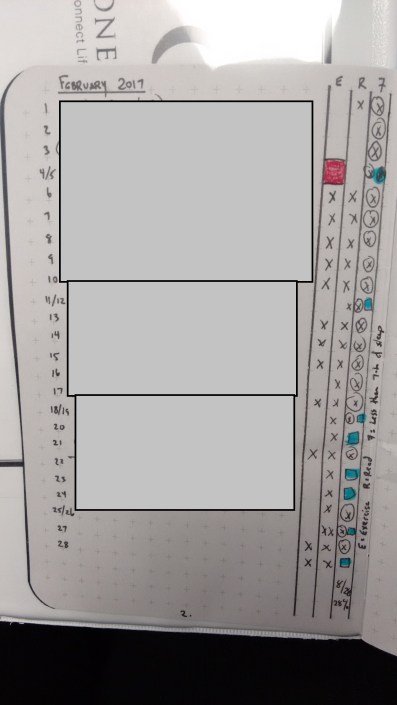
8/28 days I hit 7 hours of sleep or more. If it were a batting average, I’d be golden.
Eight days out of twenty-eight is still pretty terrible, but it’s a 100% improvement over January’s numbers. I never expected to make an overnight change towards better sleep, so this kind of result is above my expectations while still giving me room to clearly improve.
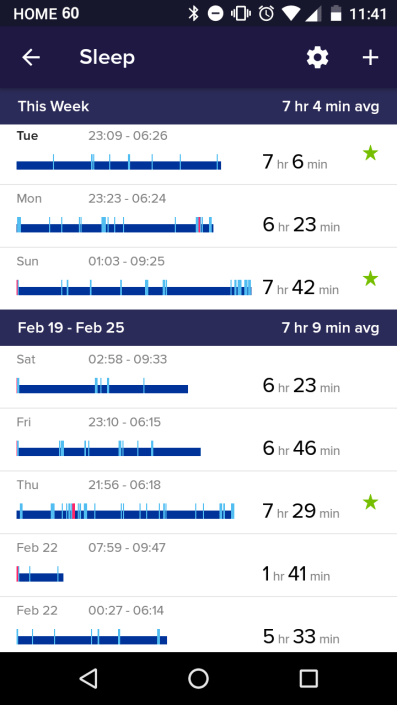
I track the results in my notebook as binary entries – either I sleep 7 hours according to my Fitbit or I do not. Here’s a snapshot of what some of these nights looked like last week:
February 22nd was a day I called in sick and went back to sleep (I was legitimately ill, not just sleepy).
As you can see, I’m often just barely missing my deadlines because I’m a restless sleeper. Nevertheless, I know of some various steps to explore to see if I can claim a few more nights of sleep, such as a more strict bedtime routine and possibly kicking the dog out of the bedroom at night (we spoil him rotten).
Subjectively, this is the best I’ve felt in a while. Rising before 6:30am is getting easier, I feel less groggy in the morning, I’m more motivated and active, I feel like I need less coffee to function, and most importantly my mood has lifted a bit. The morning exercise is probably also helping with my affect.
I’m looking forward to March’s numbers. I’ll keep you posted.
As luck would have it, the day after that post went live, I came down with a cold. Normally colds don’t bother me, but it was enough for me to cancel all of my Wednesday engagements to recover, then spend the next two days at work a tired, drippy, stuffy mess. Apparently, something is going around the Region (and our office) because many people have been off ill or discussing it online.
I had an interesting moment last week as I decided to call in sick. Normally, I’d try to push through and save my sick days for when I was genuinely incapacitated or in need of a mental health day. I always feel guilty conceding to being sick. But I realized that a.) much like with sleep, it’s important that I listen to my body’s cues, because in general I feel better when I respect my body’s natural rhythms; and b.) I have a big boy job that not only pays me to stay home when I’m sick, but also expects that I respect the office and not bring sickness to it.
So, rather than pushing it, I decided to take the week and weekend off from trying to be productive. This morning, I resumed my rowing and reading, even if I wasn’t yet up to 100%.

 A Paramedic's Notebook