Hot Yoga Kicked My Ass – Some Thoughts

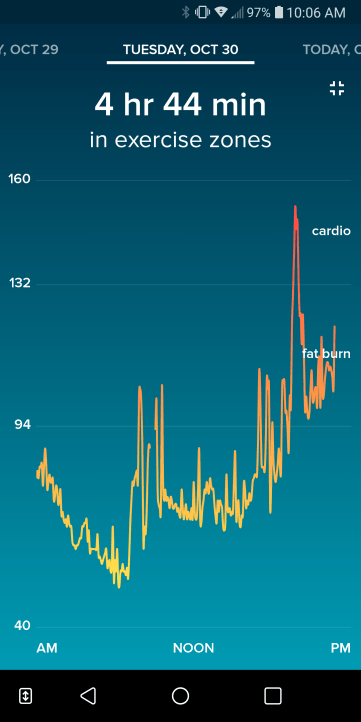
Last week, a group of friends and I attended a hot yoga session.  We, as a group, meet once per month to do an activity, and the October leader chose to have us join him for hot yoga.  I had some prior experience attending yoga classes, but this was my first time in a “hot yoga” session.  By the end of the hour, I looked like I had jumped in a lake.  My Fitbit tracked my heart rate and it had looked like I was running sprints.
Screenshot_2018-10-31-10-06-17.png
My max heart rate was 153bpm, during the hour-long session.

It was challenging, uncomfortable, and brutal.  In other words, it was awesome!

I’m not saying that I’m going to sign-up with my local studio or start buying into the lifestyle; I’m still paying for a gym membership that I don’t use, so I don’t need another cost to my monthly budget.  However, I found the experience interesting and invigorating, and I’d gladly go again in the future.

Cultural appropriation concerns aside, I’m fully on-board with the physical practice of yoga for health and fitness.  Western yoga tends to have a lot of stereotypes and negative perceptions attached to it, but the act itself can be a legitimately hard, physical activity that raises your heart rate, requires a lot of strength for the body-weight movements, and provides the same calming effect you get when you focus on process movements.

I’ve attended a handful of classes and tried routines at home a few times, so I’m not qualified to offer any opinions on yoga.  However, I’ll offer a few observations and thoughts on my experiences as a beginner:

  1. While I’ve never had a bad instructor, I was incredibly thankful that the two people I’ve had leading classes were super friendly, approachable, and accessible.  You feel incredibly awkward walking into your first class, and you assume that everyone is silently judging how bad you are at it.  Having a good instructor in front of you really helps you get into things, and their ability to break down the poses and movements with verbal cues really aids in immersing yourself in the experience.
  2. At the recommendation of a friend, I’ve attempted doing yoga at home by following along with an instructor’s video on YouTube (my go-to channel is Sarah Beth Yoga).  While doing yoga at home is more convenient, cheaper, and less awkward, I still find value in doing yoga in a group setting.  It feels more rewarding in the end to share the experience with others, and having a dedicated time to show up makes you more accountable.
  3. If you are going to buy anything, I recommend buying your own mat.  I’ve used it for yoga as well as doing tabatas at home.  I also recommend buying a thicker mat (the standard mat is really thin) because being a heavy guy, it helps cushion my wrists and knees in the various poses.  Bring a towel because the thicker mat doesn’t appear to have the same grip when you’re sweaty.
  4. BRING WATER!  STAY HYDRATED!  This applies to non-hot yoga as well.
  5. I found the act of yoga to help clear my mind.  Again, cultural appropriation questions aside, going through the motions intentionally and being mindful of what your body is doing or “saying” to you helps with the mind-body connection.  There is something about focusing on your breathing and your movements that creates a singular focus that pushes extraneous thoughts out of your mind.  The added layer of music and sanskrit words pulls your attention away from the past or future considerations and instead into the present.
  6. Speaking of sanskrit, I don’t get too bogged down in the culture.  When in the yoga studio space, I try to be mindful of others and the practice, but because I don’t know too much about the history or origins of yoga, I remain agnostic but open towards the cultural or spiritual side.  It’s not my place to judge, and smarter people than I can weigh-in on the validity of different kinds of yoga practices.  I find value in the physical movement and the slower pace of the activity.
  7. Having said that, I know that as a white dude participating in an appropriated practice from Hinduism, India, and the Desi people, it is loaded with problems (see the link above).  My participation adds to the watering down of a rich culture from which the original practitioners were forced to suppress their ways at the hands of their colonial occupiers.  I can’t square that circle and have to acknowledge it for what it is.


Stay Awesome,

Ryan
What I’ve Been Reading (As of October 29th)

While it’s only been a month since my last reading update, I’ve turned-over a fair number of books in that time.  Here’s what’s on my nightstand or playing from my speakers this month.

If You’re In My Office, It’s Already Too Late by James J. Sexton

No, I didn’t get this book because my relationship is in trouble.  In fact, it’s the exact opposite.  My relationship with my wife is great, and I want to keep it that way.  I first came across Sexton in a Lifehacker podcast along side Esther Perel and I thought he had some interesting perspectives on relationships as a divorce lawyer.  This book distills his 20-years of law experience and covers a gamut of reasons why relationships fail.  The thinking is that while he doesn’t know what makes a good relationship, he knows all sorts of reasons why they don’t work, and the reader of his book can learn from the mistakes of his clients.

The Laws of Human Nature by Robert Greene

I pre-ordered this a few weeks back and it just came in the mail, so I haven’t had a chance to get very far into it.  I first encountered Greene through a book recommendation from a friend of mine for his book, Mastery.  I was intrigued with the material in Mastery, so I’ve kept an eye on Greene since.  I listened to a the audiobook for the 48 Laws of Power, and I listened to a bit of his Art of Seduction (though I never finished it).  Greene, like his protege Ryan Holiday, is a master of research synthesis.  While his books are a bit of an animated bibliography, I think it’s the best representation of the genre.  He digs into history to learn lessons from key figures to articulate his thesis.  Instead of reporting on the achievements of others, Greene feels like a chronicler of insights.  I’m looking forward to what this book has to offer.

To Kill A Mockingbird by Harper Lee

I’m a bit embarrassed to admit that I’ve never read this one until now.  I’m familiar with the well-known courtroom scenes from the movie, but I was never assigned this while I was in school.  Since I’ve been reading a steady diet of non-fiction, I thought I should dig into some quality fiction.  I’m less than an hour into the audiobook, but already I find Scout to be an intriguing character (narrated by Sissy Spacek).

Harry Potter and the Deathly Hallows by JK Rowling

While my wife and I were heading off on our mini-honeymoon after the wedding last month, we found it difficult to talk about anything that wasn’t about the wedding.  The planning and lead-up to our nuptials was over a year in the making, so in the afterglow of the party, we didn’t have much to talk about.  Instead of riding in complete silence, we bought a copy of the Deathly Hallows on audiobook for the drive.  I’ve only read the book once, and that was way back in 2007 when it was released (I bought it during a layover in Heathrow Airport on my way home from Kenya).  We only listen to the book while together in the car during long(ish) drives between cities, and it’s funny how often we shut it off to talk about the story, or how stupid Harry (the character) is when you really think about it.  It’s honestly among my favourite times spent with my wife.

Ikigai: The Japanese Secret to a Long and Happy Life by Héctor García and Francesc Miralles

I bought this book with high hopes, but sadly I’m finding it a bit of a let down.  The Ikigai concept has floated around the interwebs and on my radar for a little over a year now.  It got picked up in the blogosphere (mostly on Medium for me), so when I saw the book I thought I should check it out.  This particular book is a hard animated bibliography.  I think its greatest sin is that it talks about Ikigai by first covering other well-known philosophical ideas, such as Frankl’s work in Man’s Search for Meaning.  I had hoped the concepts would stand on their own, or at least be situated with the original Japanese contexts that they were born out of.  Instead, it cobbles together a bunch of summaries of other publications and presents them in digest format.  Because the book is short with big font, I’ll slog through it, but it’s not what I had hoped it would be.

Stay Awesome,

Ryan

Principled Thinking

cropped20181018_130815

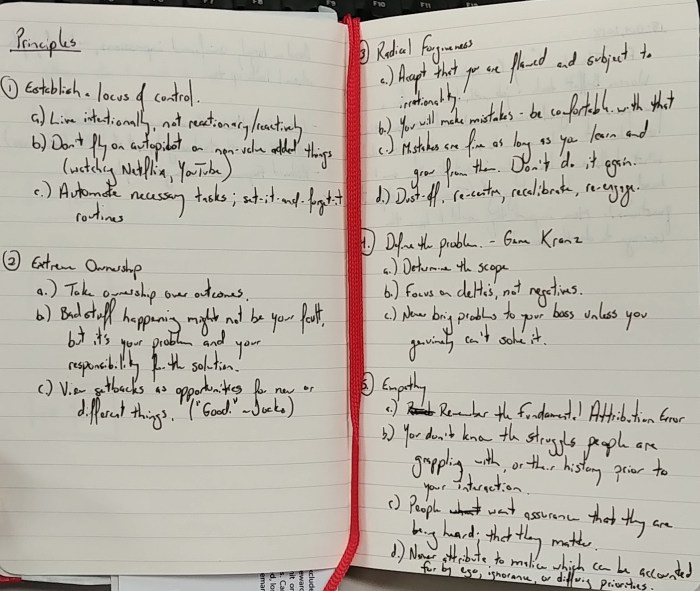
While I haven’t finished reading it, I have been thinking about the book Principles by Ray Dalio.  As the title of the book suggests, Dalio has published his comprehensive list of principles that Bridgewater Associates uses as part of its decision-making framework.  He encourages others to adopt this method for refining processes and capturing on paper a person’s or organization’s core beliefs  through carefully considered principles.  The thinking is that these principles create a process for filtering information so that decisions remain within scope by removing extraneous considerations.

I have a notebook that I use to jot down thoughts about myself and my personal development.  I needed a place to collect my thoughts in one place about where I am, what direction I am heading, and where I want to go in both life and career.

Recently, I started sketching out some ideas for what my own list of Principles would look like.  I suppose “principles” might be the wrong word.  “Beliefs” might be a better word; “aspirations” also fits in there because I know that I don’t always do the things that I believe I should do (for instance, 5a and 5b below are things I conveniently forget when I’m mad at someone).

This is an incomplete, work-in-progress list.  I’m not even sure that I’m heading in the right direction, but these were the five things that came to mind when I first sat down to start collecting these thoughts.  Below, I have transcribed the notes seen in the photo above.

Many of these ideas have been taken from the various books I’ve read over the last few years.  I suppose it’s a bit of a distillation of all the ideas that were strong enough to make an impression with me.  I expect that this list will need many more additions and revisions, but keeping it a living document would be beneficial to capture how I grow as a person over time.

Principles

1.) Establish a locus of control
a.) Live intentionally, not reactionary/re-actively
b.) Don’t fly on autopilot on non-value added things (watching Netflix, YouTube)
c.) Automate necessary tasks; set-it-and-forget-it routines

2.) Extreme Ownership
a.) Take ownership over outcomes
b.) Bad stuff happening might not be your fault, but it’s your problem and your responsibility for the solution
c. View setbacks as opportunities for new or different things (“Good” ~Jocko)

3.) Radical Forgiveness
a.) Accept that you are flawed and subject to irrationality
b.) You will make mistakes (and have bad judgement)* – be comfortable with that
c.) Mistakes are fine as long as you learn and grow from them.  Don’t do it again
d.) Dust-off, re-centre, recalibrate, re-engage

4.) Define the problem – Gene Kranz
a.) Determine the scope
b.) Focus on delta’s, not negatives
c.) Never bring problems to your boss unless you genuinely can’t solve them

5.) Empathy
a.) Remember the Fundamental Attribution Error
b.) You don’t know the struggles people are grappling with, or their history prior to your interaction
c.) People want assurance that they are being heard;  that they matter
d.) Never attribute to malice which can be accounted for by ego, ignorance, or differing priorities

*Note added after I photographed the page from my notebook

Stay Awesome,

Ryan

My Best Blog Post (to date)

I set up  this blog as a way to force myself to write.  With a few minor exceptions, I’ve managed to put out a post every Monday morning for the last few years.  While the tone and theme of the blog shifts around a bit, it’s been a pretty consistent thing.

One thing that is surprising to me is the top blog post on the site.  There is one post that consistently gets more traffic than any of the others (almost daily, in fact).  If I didn’t have access to the metrics, I would have never guessed which one it is.

My best blog post, to date is ……. (*drum roll*)….

Zombies, Run! 5K Training App Review

Yeah, no kidding.

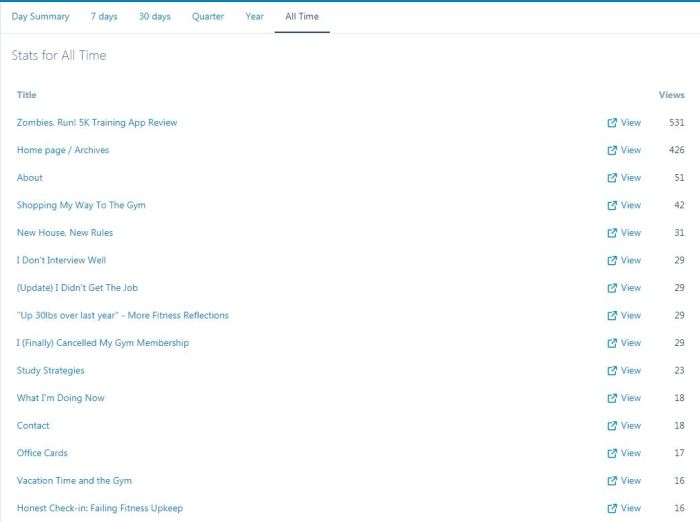
It’s far and away the most popular post.  It’s more popular than my landing page, which means that people often find my blog through a Google search before clicking through to the rest of the site.  Below is my top 15 pages according to views.

Top 15

I suppose there are a few good takeaways I could make use of if I were looking to optimize this blog for hits or monetization.  First, writing reviews of popular apps gets a lot of clicks.  As does talking about health and fitness (or, more specifically, failing at health and fitness).  And finally, people like reading about life/career developments – and posting your content to Facebook for your friends and family to read will get you a good number of hits each time.

I suppose now I have a goal to write something that will drive more traffic than Zombie, Run!  Good luck to me.

Stay Awesome,

Ryan

Office Cards

Until I started working in an office, I had never experienced the “office cards” thing myself.  I actually didn’t realize it was a thing until recently, either.  This is likely to be attributed to the gendered roles of emotional labour – I, as a man, don’t really think about these sorts of things because they aren’t expected of me.  But, in our office, cards are reliably circulated and initiated by the women of our office.  I’m not saying this is right or fair.  The truth is, I should take a more proactive role in these sorts of community-building activities because of my membership to the group.   In my personal life, I’ve taken the habit with a few friends to regularly send letters or thank-you cards for things that happen, but within a work context, I’ve yet to take the initiative.

Before I left the office for my wedding, my colleagues and bosses gathered around my cubicle to give me a card and wish me well for my upcoming nuptials.  The gave me a card with a gift inside.  The gift was thoughtful, but truthfully I appreciate the card more.  Everyone in the office had signed it without me knowing (as is protocol).  A part of me knows that taking a moment to sign a card (especially when everyone is doing it) is a fairly low-effort discharge of obligation; you sign it because someone puts it in front of you and you’d be rude to refuse.

Nevertheless, when I read over the card, and saw everyone’s signatures and well-wishes, it made me happy to be included.  I felt a surge of warmth that my colleagues took the time to do this for me.  I felt the same way when some of the faculty also signed a card to my wife and I.

And this morning, a card was circulated to celebrate one of our faculty members becoming a grandmother.  I felt joy to sign the card, to wish my colleague well and celebrate the birth of her grandchild.  It’s such a small but powerful gesture.

But it’s something I felt like I’ve lost until only recently.  I don’t know if it’s because it wasn’t as common with my family to give cards when I was growing up, or (the more likely case) that as a child I didn’t understand its significance.  That lack of understanding and awareness then was transformed during my transition to adulthood by my lack of care for these sorts of emotional efforts in general.  As I mentioned at the top of the post, men aren’t socialized or expected to perform these sorts of tasks, and I’m no exception to this.  It isn’t asked of me, nor am I expected to think of these things.  Further, no one would blame me for not thinking of this, and I would likely receive a lot of praise if I did.

Truthfully, I’m a lazy person, and I like that this kind of expectation isn’t placed on me.  It gives me a free pass to coast and disengage.  But, I also acknowledge two things: first, it’s not fair that I get a pass for being a guy while these tasks are expected of women; and second, that receiving signed cards brings me joy, which should motivate me to do the same for others in similar circumstances.

Card that express joy for others fortunes, or cards that acknowledge pain and grief in others are worth sending, because it’s a small, uncommon way to stay connected to others in personal ways.  It’s something I should do more often.

Stay Awesome,

Ryan

What I’ve Been Reading (As of September 24th)

I haven’t posted a reading update since the summer, so now seems like a good time to check in on what’s playing out of my speakers or sitting on my nightstand.

Carpe Jugulum by Terry Pratchett

This list must have the mandatory update on where I am in Pratchett’s Discworld books.  I’m only a little ways in, so not a huge update here.  Thus far, it’s a Witches story, sans Granny Weatherwax and involves vampires appearing to try and usurp a kingdom.  In other words, awesome.

What Happened by Hillary Rodham Clinton

I’ve drifted more towards memoirs as of late, choosing to distance myself a bit from the animated bibliography and instead listen to the stories by people reflecting on their life and either providing insight in retrospect or attempting to provide an explanation for why things unfolded (also see Catmull’s book below and my recent completion of Knight’s Shoe Dog).  As with many of us here in North America, I watched the US elections in 2016 with interest, and was disappointed in the results.  I was interested to hear Hillary’s story of what happened and am not disappointment by what I’ve heard so far.

Creativity Inc. by Ed Catmull

Another memoir, this book is from one of the founders and heads of Pixar.  What I love most about this book is that he’s discussing the behind-the-scenes decisions and goings-on of creating the films that I grew up on, which adds a new layer of awesome to my childhood memories.  The values and lessons he learned from their failures and successes are incredibly interesting, and I find the book captivating.

Tribe: On Homecoming and Belonging by Sebastian Junger

Junger starts with an interesting observation from the American Frontier: if “advanced civilization” is so wonderful, why did so many white American settlers abandon their communities to join and live among the indigenous peoples that were so backwards and savage to them?  Junger’s speculation is that it comes down to how people feel accepted within their communities.  To Junger, this is an example of how “civilization” and technology can be so alienating to a person, which diminishes their sense of worth and place.  I’m not very far into the book, but it’s quite a good read so far.

Outlander by Diana Gabaldon

I’ve been watching the Outlander series on Netflix with my wife and have been loving the story so far.  It didn’t hurt that the first season took place in Scotland, which reminded me of my trip there in 2016.  Fun fact, the scenes of Inverness in the series were actually filmed in a small town called Falkland, which I visited on my travels, long before we had started watching the show.  The book is huge (over a 800 pages!) so it’ll be a long read.


Image may contain: sky, tree and outdoor
If you watch the first episode, this is the town square of “Inverness” where Frank encounters the ghostly Scotsman.

No automatic alt text available.


Stay Awesome,

Ryan

Student Coaching

Lately, I’ve noticed that in addition to my roles of administration and teaching, I’ve been spending more time coaching students.  It tends to come up in small ways, such as offering suggestions on how to word emails or how a student should approach talking to their professor about something in their class.  At first I was a little uncomfortable with taking on a coaching role when it wasn’t really part of my job.  That’s not to say I’m uncomfortable with doing tasks that are not explicitly written into my job description.  Instead, I was uncomfortable because I wasn’t sure if it was my place to offer guidance.  Sure, I might be a decade older than most of the students, but I sometimes struggle with the impostor syndrome: what do I know?  I’m just a lowly administrative assistant.

Having said that, I recognized a fundamental truth that I think many people take for granted – students are young.  I don’t just mean young in age, but also young in experience.  Most students haven’t had the same experiences I’ve had, whether that is my post-secondary schooling, grad school, or work.  Things that I take for granted that come second nature to me are wildly new for students just coming into school.  It’s even worse for students who are first-generation college/university students (like I was).  For some, they haven’t had a lot of experience navigating systems on their own.

We bemoan the helicopter parents and make snide remarks that students don’t know anything (i.e. “life skills”), but I think we should have more empathy.  Post-secondary is a big, scary place to navigate.  If it’s your first time living away from home, having to manage your own schedule, finances, and life, would you not also feel overwhelmed?

Instead of starting with the assumption that students are lazy, or wanting everything fed to them on a silver spoon, I try to take the approach that students don’t know how to narrow down their options or choose a path.  They are the modern Buridan’s ass stuck between competing options with no practical way of making decisions or selecting priorities.  Instead they focus on what’s immediate and take the path of least resistance (for them at the time).  Without a longer view and a chain of successes, their choices may seem short-sighted, but in their context it makes sense to them.  If you couple that kind of decision framework with the complex, convoluted machinery that is “real life,” you can hardly be surprised when students make sub-optimal decisions.

In light of this, my response is not to infantilize them, nor chide them for what one would judge to be their bad decisions.  Instead, I offer my perspective and anecdotes to provide teachable moments.  I provide insight into byzantine rule structures and explain my reasoning.  And I ultimately leave decisions or action up to them.  They must take ownership of the process because they have to be accountable for the outcomes.  The point of education is to create a safe space to fail and learn.  Therefore, our goal should be to set students up for success but also provide them with the opportunity to learn through their mistakes, not by punishing them into doing the right thing.  Rote learning works in some contexts, but in order to make deeper connections between ideas and develop ones ability to reason, students need to be coached on how to shift their perspective and see new connections.

And so, I sometimes coach students.  It’s pretty interesting so far.

Stay Awesome,

Ryan


Public Speaking Bomb

Happy Labour Day!  Things have been busy here at work while we gear up for the new academic year.  Students are around, schedules are messed up, and people are scrambling to get back into the right mindset to kick off the new term.  Things are bustling and busy.

I don’t intent to keep a post trend going, but I wanted to ride some of the wave from last week’s psych-out post and talk about another recent failure I experienced at work.

Last week, I had to give a short presentation to college faculty about the research ethics board I’m on.  The purpose of the presentation was to remind faculty that the board exists, and to have them consider whether an ethics review is needed for their or their student’s projects.  I had a 15-minute block of time and a slide-deck provided by our board coordinator.

After the presentation, I sat down and wrote out all the ways the presentation sucked.  In fairness, two of my colleagues went out of their way to complement my presentation,  and that they took away the two main deliverables (that student research projects should be run by the board, and that I’m available on campus to answer questions).  I checked in with my boss and she, too, agreed that the presentation was not a failure as I saw it.  I know that my perception of how things went will be dramatically different than how others perceive me.  Nevertheless, I know that I am capable of doing much better and the main culprit of my failure was because I didn’t practice out loud before the talk.

Here is the list I generated:

Everything that went wrong (and why):

  • Didn’t practice the slides
  • Didn’t build the deck (it was pre-made and sent to me; building the deck would have made me more familiar with the content by necessity)
  • Too rushed
  • Unstable speaking patterns (rambling ticks)
  • Poor intro
  • Poor conclusion
  • Didn’t plan my transitions
  • Didn’t know how the transitions were set in the slide (i.e. need to click to reveal text)
  • Missed content from the page.
  • Had to look at screen to figure out where I was
  • Didn’t know I’d have to hold a microphone (I knew this from past All Faculty meetings, but I should have anticipated it)
  • I was holding the mic and the presentation remote – my hands were full
  • Didn’t pause to calm down or collect my thoughts
  • Bad presentation but saved with good will from prior relationships with faculty + my position (junior to the faculty)
  • finished in 8min or 15min.
  • Didn’t have a firm point in mind that I wanted them to take away from talk.
  • Didn’t edit slides to remove non-essential content

You can’t win them all, but it’s important to know where you go wrong so you don’t make the same mistakes again.

Stay Awesome,

Ryan