Honest Gym Update

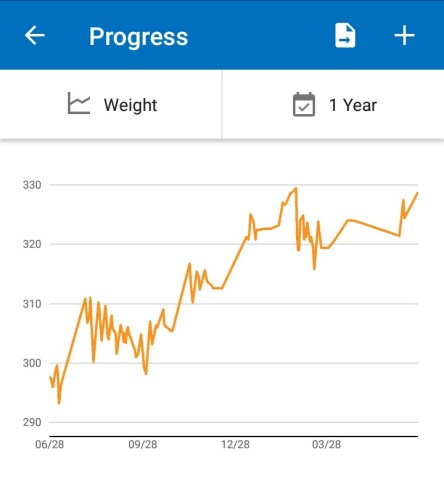
Earlier in July, I joined a new gym.  It had been some time since I went to a gym, and indeed I had cancelled my last gym membership due to not attending in months.  I researched some of my local options, and I settled on a non-chain gym to join.

My first workout was July 5th.  The gym has 24-hour access for members, and I wanted to blow off some steam, so I went out to run on the elliptical and do some light weight lifting.

All in all, I like the gym so far.  The layout is different than what I’m used to, but I like the aesthetic and vibe.  You have a decent mix of people using it, from muscle-heads to grandmas, and everyone seems welcome.

However, since July 5th I have not been back to the gym.  Despite wanting to get back into the routine of exercising, I have yet to make any progress towards forming a new habit of going to the gym.

Granted, things have been hectic as we dealt with the fallout from the move, the renovations, wedding planning, etc.  Still, this is not a good excuse and I should be doing better.

I figured this accountability post would be a good thing to share, because it’s going to take some work before I change my behaviour.

Stay Awesome,

Ryan

I (Finally) Cancelled My Gym Membership

I finally got around to cancelling my membership to my gym.

My last visit to the gym was at the end of November last year (I thought it was October, initially, so I wasn’t doing *that* bad…).

I have been away from the gym for so long that the branding and colour scheme has all changed to Crunch Fitness in my absence.  It was strange to walk in and see all the same equipment, but with new branding stickers adorning the equipment and different paint on the walls.  The vibrant reds and blacks have given way to more muted blues and greys – a shadowy ghost of the former company.

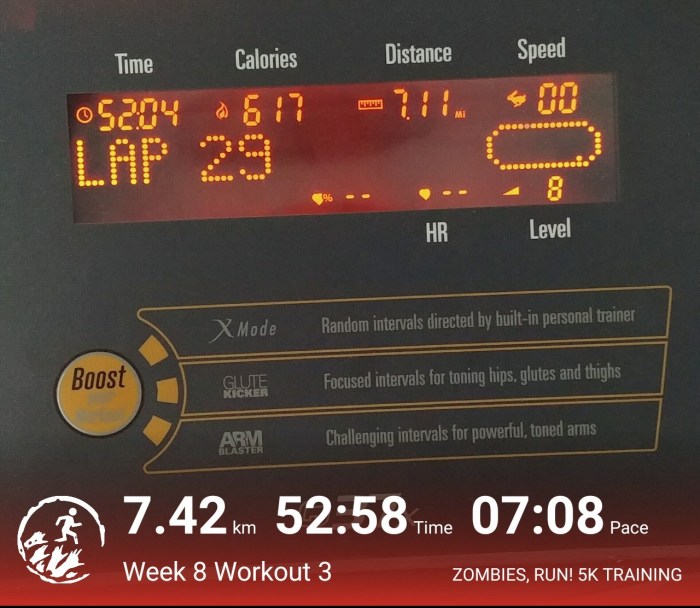
I’ve written before about my poor habits with going to the gym, and how much it costs me when I fail to go for months at a time.  I’ve had some successes, but mostly I tend to fall off the wagon.  The longest string of success I’ve had with exercise is using the elliptical at home with the Zombies, Run! app.

The decision to cancel my membership is motivated by three reasons.  First, since we are moving in May, I will be too far away to reasonably commute to the gym (and if I was inconsistent before while living close to the gym, there is almost no chance that anything would change in my habits after the move).

Second, I reviewed my finances and wanted to clean up some unnecessary recurring charges to my credit card.  Things like the gym and my subscription to Crave TV were cancelled since I rarely use them.

Third, with the move to the new house, I’d like to take a crack at exercising more from home.  I’m fairly regular with the elliptical running, and I would like to purchase a few more items to create a bit of a home gym.  While I doubt I’ll have a home gym like Jujimufu on YouTube anytime soon, I can add a few pieces that will allow me to get a reasonably comprehensive workout from home, such as a barbell, bench, and maybe a squat rack.  Stretch goals would include battle ropes, a heavy bag, and kettlebells.

If the home gym fails, there is a commercial gym and a more specialized gym in the town I’m moving to, so I could always sign back up when things settle down.

In the meantime, here’s a salute to World Gym (and Cruch Fitness who took over all the World Gym locations here in town).  I very much liked my experiences at World Gym, and I don’t regret our time together.

Stay Awesome,

Ryan

Zombies, Run! 5K Training App Review

img_20180129_121511.jpg

This blog post is not a paid sponsorship.

On Friday, I completed my last training mission for the Android version of the Zombies, Run!  5K Training app by Six to Start.  While this is supposed to be an 8-week training program, I’ve been at it since mid-October.  Having completed the program, I wanted to give some of my thoughts on the experience.

Overall, I loved it!

Imagine taking an audiobook about a zombie outbreak, and attaching a step-counter/GPS tracker to it.  That’s what the app is at its core.

Story

You play the silent hero, Runner 5.  The adventure opens with you in a helicopter bound for the Town of Able.  While en route, your helicopter is shot out of the sky, and you are forced to make your way to the settlement with the help of Able’s radio operator, Sam.  Once you make it to town, you meet a diverse cast of characters who you “interact” with throughout the 8-week plan.

The bulk of your interactions take place with Sam and Maxine, the town’s doctor, who also serves as your training coach while you build stamina and prepare to take your place as one of the town’s Runners.  The Runners are a group of people who are sent out on missions outside the guarded walls of town to run messages, look for survivors, gather supplies, and occasionally serve as decoy bait to lure zombies away.

While managing a zombie outbreak is bad enough, you still have the lingering question of who would shoot down a helicopter from the middle of the zombie-infested countryside, and more urgently, who is stealing supplies from the town’s quartermaster.

I found the story very immersive.  It brought me back to my old radio drama days from high school, with well-acted characters and sound effects to help you believe that you are being chased by zombies.  The creators took time to ensure the voice acting was well-done as you rely on the characters to help you experience the story.  There is no narrator telling you a story, but instead the story unfolds around you while you run.

Despite the fact that this is a training app, there is a surprising amount of story given to you.  You learn a bit of the backstory of the main players, and there is a lot of world building going on about life and the history of the zombie outbreak.  You learn a little bit about the politics of the various surrounding towns, and you get swept up in the human drama.  Indeed, your final mission is not just a 5k run, but a race against the clock to make a critical delivery to someone you’ll never meet but means the world to a close companion of yours.

The App

I found the app easy to use and well-designed.  As I mentioned above, the app is basically an audiobook and a step-counter.  There is a bit more to it, but those are just extras that help with customization.  The app tracks your progress in one of three ways – a GPS tracker that lays out your run via a Google Maps integration, a step-counter if you want to use a treadmill, and an estimated distance tracker for use on rowing machines and ellipticals (how many minutes it takes you to go 1-kilometre).  I chose to use the step-counter feature despite using an elliptical, which meant my in-app distances were skewed, however I corrected the distances with the tracking done by the elliptical itself.  I also used my Fitbit to track caloric expenditure and heart rate, since they were calibrated to my height and weight.

The best part about the app is that you can choose to use an external audio player when the app isn’t talking to you.  I used both Stitcher and Spotify and found that the integrations were smooth.  This allows you to listen to music on the run.  When the training app needs to deliver information to you, it pauses what you are listening to and continues the story, before switching back to your preferred audio.  Even taking phone calls mid-app worked well.  There was only one time where my music didn’t start back up after I took a phone call.

One note of caution is that the first 3 or so weeks of the app are free to use, but you need to pay a nominal fee ($5.49) to unlock the rest of the missions.  While this might be annoying, or a bit of a barrier for people, I liked it because a.) I’m in favour of companies making money off of users to keep creating good content; and b.) letting you use the app for free lets you test it out.  By the time I was ready for week 4, I wanted to find out what happens next, and I thought a buy-in of around $5 was worth it to continue on the adventure.  The full (non-training) app uses a subscription model, but still allows you to trying things out before you need to unlock the full app.

Training

I found the 8-week program to be a little easy for me, but using an elliptical meant that there was only so much crossover I would experience.  If I were to have tried running, I suspect the app’s difficulty would have been scaled more appropriately to me (and my knees would have taken a beating).  But the main purpose of the training is similar to most other “couch to 5K” training programs – get you moving a couple days per week while the difficulty is slowly ramped up.  I appreciate this approach, as it is enough to challenge you, but easy enough to keep you coming back for more.

To keep the difficulty scaled for me, I would often run through rest breaks, and I ensured that I kept the resistance level at a good place to maintain a heart rate of around 140bpm.  To ensure I was running fast enough, I monitored the elliptical’s RPMs, and used the following markers:

  • 40-50rpm: slow walk/rest
  • 50-60rpm: brisk walk/warm up
  • 60-70rpm: steady running pace
  • 70+: hard exertion/sprint

Before each mission, you can review what the day’s exercise routine will look like.  The training sessions involve a combination of walking and running periods, and some sort of ancillary movement to develop your leg muscles, such as knee-ups, skipping, and body-weight squats.  Some days are straight training, where you get little story development, but learn more about the people you are interacting with.  However, some training days morph into mini missions where you need to divert due to zombies or pick up critical supplies nearby.  One time, you even risk you life to help a downed runner in the field.  This is probably what kept me so engaged.  If it were just a disembodied voice telling me when to walk and run, I doubt I would find it very engaging and would have likely lost interest quickly.  However, because the training prompts are integrated into a narrative, and the characters are cheering your development on (because you are expected to take you place as a member of the community), it breaks the monotony of running up into more interesting chunks.

I’m not entirely sure to what degree I improved my cardiovascular health.  Because I didn’t feel like I struggled with the difficulty, it’s hard to measure my progress.  The best I can estimate is that my running distances did increase over time, even if you were to control for the duration of walking in the training cycles and the differences in run duration from week to week.  Despite having not measured with any amount of accuracy what my abilities were pre-Zombies, I’m fairly confident that I am in a better state of cardiovascular health having completed the training program.

Final Thoughts

If I have one complaint, it’s that the narrative move from the training app to the full app ends up restarting the story a bit.  The first mission in both the training app and the full app is  the same, meaning your story doesn’t really continue after the training app.  I suspect that once you start running the story missions, things will feel more integrated, but I was a little sad to have to “meet” Sam and Maxine for the first time again after having “developed” a relationship with them while I trained.  This is a relatively small nitpick on my part because narrative and story are important to me, but it’s not something that takes away from the experience.

I have already recommended the app to friends of mine, and I officially recommend it here.  I got well more than $5 in value from the app’s minor cost.  This is a well-made app that is easy to use, and integrates well into my exercise routine.  It makes exercise fun and engaging and the story is compelling enough to keep me coming back for more punishment.  If you are looking for a way to help you commit to a cardio routine, but you are starting off from scratch, this is a great option if you don’t mind running from zombies.

Stay Awesome,

Ryan
2017 Sleep Check-In

This is it!  I’ve finally hit the end of the sleep challenge and I can finally look back at a year of data and see if I can spot anything interesting from the data.  This post will give the quarterly update from October through December, and then I will look at the results from the entire year.

For those just coming on-board with this post, in 2017 I set out to track my sleep each month with the target of sleeping for at least 7-hours.  I used a Fitbit Charge HR to track my sleep and I gave monthly updates on my progress.  I also used a few quarterly updates that looked at data over longer periods of time to see what sorts of trends and patterns I could extract from the results.  While I wanted to try and maximize my sleep, in truth I am terrible at keeping a nightly routine, so at the mid-point of the experiment, I set the goal of trying to get at least 10 nights in each month where I hit my target of 7-hours.

To see a recap, you can go to the individual posts below:

You can also see my quarterly updates:

First, let us look at the fourth quarter’s results.

Fourth Quarter – October through December

Q4 sleep
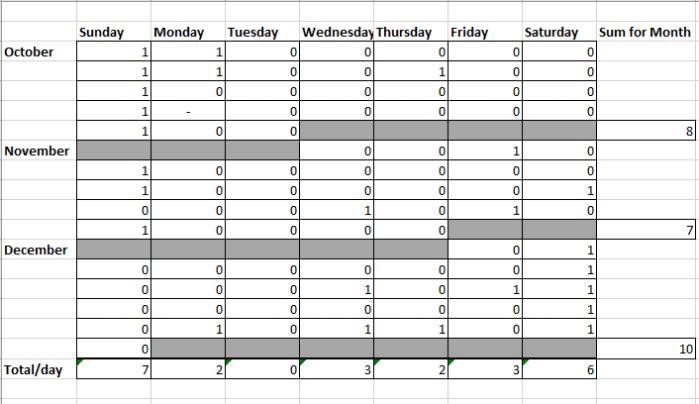
Note: 1’s denote nights where I hit my target.

The fourth quarter results fall in line with what I’ve been seeing over the course of the year.  Sundays prove to be the most consistent night of 7+ hours of sleep, followed by Saturday.  Monday usually gets a high number of hits, but this time around it appears that I’m not sleeping as well when I transition from weekend to work week.  I don’t have an explanation for this, other than I probably am going to bed too late (as opposed to lost sleep due to anxiety of going to work the next day).

And now, time for the final reveal!

Sleep Results for 2017

The grand total for the year are:

January – 4
February – 8
March – 6
April – 7
May – 4
June – 7
July – 11
August – 11
September – 9
October – 8
November – 7
December – 10
Total: 92

Out of the 365 nights of sleep for 2017, I hit my target 92 times, for a 25% success rate.  This is a very strict number, which reflects poorly on the overall experiment, but one bit comfort I take from this is that, as I have pointed out a few times over the course of this challenge, the data is skewed when we look at the time I spent asleep, versus the amount of time the Fitbit tracker tracked me as asleep.  Any amount of sleep disturbance or restlessness meant that the device wasn’t counting it as sleep time.  So, while I might have been asleep for over seven hours if I had any kind of restless sleep, the quality sleep tracked came in under 7-hours.

Is there another way of seeing the data to determine if the 25% rate is overly skewed?

Time spent Sleeping

We can adjudicate this by looking at the actual time I was asleep, versus the target sleep.  This way, any nights where I slept more than 7-hours would pull my averages up and cancel out some of the nights where I slept less than 7-hours.

Screenshot_2018-01-21-20-36-37


sleep
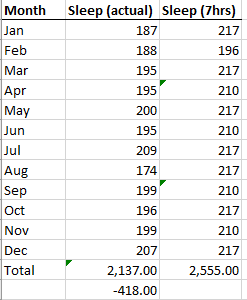
*Note: for simplicity, I rounded the sleep values to the nearest hour.

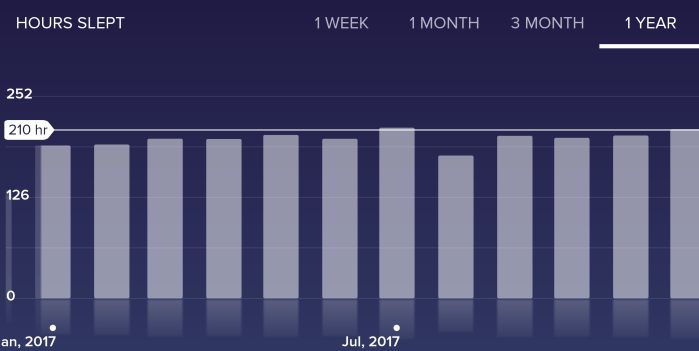
For 2017, the Fitbit tracked me as sleeping 2,137-hours.  If I assume 7-hours for all 365 days, this would give us 2,555 hours of sleep.  Viewed from this perspective, I hit 84% of my target sleep, with only a 418-hour deficit of sleep spread over the 12 months.

The problem with tracking only the successes throughout the year is that it ignored any sleep that falls under 7-hours.  Month over month, my progress tended to looked bad and reflected poorly on my ability to set goals and maintain progress.  While it’s true that I was failing in hitting absolute targets of sleep, the presentation almost suggested that if I didn’t hit my sleep target it was because I wasn’t sleeping at all.

So, while I was only 25% successful in hitting targets, I was able to get 84% of the sleep the target would imply.

One note of caution – if I’ve learned anything these last two years, it’s that I’ve learned and reflected on what it feels like to be sleep deprived.  Running a theoretical sleep deficit of 418-hours for a year might not seem bad, but in practice is something to be concerned about.  Sleep deprivation has consequences that affect me in many ways, such as my ability to resist temptation, my productivity at work, the likelihood that I will exercise, and my interpersonal interactions with friends and family.  There was one time where in my sleep-deprived state, I let a door swing shut before my dog was fully through the threshold, and it caught him in the rear paw.  Despite a yelp of pain from him, there was thankfully no physical damage to his paw.  Still, I felt terrible about my carelessness and it was a reminder that my ability to focus and pay attention is compromised when I don’t sleep.

Moving Forward

Tracking my sleep for this blog was an interesting experience.  I do not plan to continue giving regular updates as I progress through 2018, though I will still be monitoring my progress in my personal notebooks.  I found a lot of value in seeing the aggregate results.  The monthly updates were mostly in line with my intuition, but it was still good to objectively see how poorly I am with sleep.

It will be an ongoing work of progress to do better.  The main takeaways from this experiment are that,

1.) I’m terrible at maintaining a disciplined nightly routines to go to bed at a reasonable time;

2.) working at the bar, even 2-nights per week, dramatically impacts my sleep during the week; and

3.) I need to pay more attention to the things in and out of the bedroom that cause disturbances in my sleep (such a the dog jumping on the bed, evening alcohol consumption, and potential sleep apnea due to my weight).

There are many avenues I can explore to improve the quality and quantity of sleep I get each night.  Perhaps, I will explore them in time.  However, it’s time to put down the measuring devices and enjoy a bit on unquantified time.

Thanks for following this journey of sleep.

Stay Awesome,

Ryan

What I’ve Been Reading (As of November 20th)

I haven’t updated this series since August, so I thought it would be a good time to check-in on what I’ve been reading as of late.

Becoming a Supple Leopard by Kelly Starrett

This book came as a recommendation from Jujimufu (aka. Jon Call) on YouTube.  In addition to putting a greater focus on fitness and health, I’ve been trying to be more mindful of the physical state of my body.  I know that carrying around a lot of extra weight is hard on the joints, but I do a lot of stuff that is also bad for my body, such as poor lifting mechanics, sitting and slouching in my chair at work all day, poor mobility and stretching habits, and not addressing niggling pains in my knees.  I picked this book up to help me be more mindful of good body mechanics, improve both my flexibility and mobility, and to address common pain I feel in my joints.

Mating in Captivity by Esther Perel

I first stumbled across Esther Perel through a TedTalk she gave a few years back, and again through the Audible Original mini-series released about her couples therapy experience.  I heard she recently released a book on infidelity, which got me looking at her other books.  I decided to pick up Mating in Captivity since I am getting married next year and it seemed relevant to future-me (the idea of sustaining passion in a relationship over the long term).  Are there problems with my love life?  No, but that doesn’t mean I can’t learn something from an expert to ensure I’m mindful of my relationship moving forward.  If I want to be the best partner that I can be, then it means I should pick up good practices and insights wherever I go.  Long-term relationships are subjected to a lot of life changes (career, family, children, age, economy, etc.), and I’d rather be aware and exposed to things that threaten to cool the passion over time to better handle them down the road.

The Bookshop on the Corner (A Novel) by Jenny Colgan

This was a splurge purchase through the Bookbub mailing list I joined (they send daily lists of discounted Kindle ebooks on Amazon’s website).  The story is about an ex-librarian who decides to take a chance and buy a large cargo-truck to turn into a mobile bookshop.  I’m about a third of the way through the book and am enjoying the story so far.  It partially takes place in Scotland, which was a happy coincidence for me (I traveled to Scotland in July of 2016).  Truthfully, one fantasy I have is to retire and own a bookstore.  While this might not be an accurate picture of my future, I can still dream, can’t I?

Find Your Why by Simon Sinek, David Mead, and Peter Docker

A burning question for me concerns itself with purpose.  In a broad sense, I’ve been reflecting on purposeful living and articulating my values, but in a narrow sense, I’ve been exploring what gives me a sense of purpose and accomplishment at work.  Because I lack that definitive feeling of purpose at work (that I’m working on what I’m meant to do, whatever that means), I’ve been doing some soul searching, working with a career adviser, and reading this book.  I’m not very far into the book, so I can’t provide a lot of comments from it, but I liked Simon Sinek’s previous books, and so I’m looking forward to working may way through this one.

Reaper Man by Terry Pratchett

This list wouldn’t be complete with an update on which Pratchett Discworld book I’m on.  I just finished Moving Pictures last week, so I’ve just now moved on to Reaper Man.  Death has been a favourite character of mine, so it was nice to return to a Death-centred story.

These aren’t all the books I’ve got on the go (shamefully, there are books on my previous lists that I’m still plugging away at), but it does give a good snapshot of what you’d likely see in my hands.

Stay Awesome,

Ryan


Ellipticals and Zombies!

In my search to find exercise routines that I can make stick around long enough to build habits from, I am experimenting with a running app and a new piece of home equipment.  My fiancee and I have recently purchased an elliptical machine for our home.  While I was initially hesitant about the cost when I was already paying for my gym membership, I have since come around to the convenience of using the machine at home.

One issue I’ve had with fully embracing exercising at home is my limitations.  Monday, Wednesday, and Friday, I drop our dog off for daytime boarding, since both my fiancee and I work during the day (it gives our dog some socializing time and exercise).  This means that I have to be out the door a bit earlier than I otherwise would need to be, which cuts into time I could be at the gym.

I have been going to the gym Tuesday mornings for the last month and a half, but Thursdays are a write-off because I work at the bar Wednesday nights and don’t get to bed until 1am at the earliest.  Outside of weekend, this means that my morning exercises are limited to body-weight work, or the rowing machine that currently serves as a clothes rack.

Enter: the Elliptical

The elliptical, on the other hand, allows me to jump on for 30-45 minutes in the morning, then I can immediately shower and get ready for work and still get out the door in time.

(Note: I realize that these are not good excuses for why a more disciplined approach to my morning wouldn’t fix my problems.  While this is true, I’m trying to address these shortcomings with solutions, rather than relying on a fantasy alternative reality where I am a morning person.)

The elliptical is also good because it’s low impact on my knees.  I’ve recently discovered that 330lbs is the magical number where my knees are starting to hurt by the end of the day.  Ideally, I want to get  back into running, like I had done in undergrad, but I know that my knees and shins wouldn’t hold up to the abuse of trodding at my current weight.  The elliptical provides a good middle-ground to improve my cardio in the interim.

ACK! Zombies! RUN!

The last hurdle is that cardio is pretty boring.  This is where the zombies come in.  I’ve downloaded the Zombies, Run! 5k Training app (this is not a paid sponsorship; I just like the app).  It’s a fun spin on the Couch to 5k (C25K) training systems that gradually build a person’s endurance over a multi-week period to get them from complete novice to a 5km run through weekly drills and timed runs.

I’ve used it for a couple of weeks as of writing, and I’ve been enjoying the experience and sharing my “runs.”

My experience with the app have been good so far.  I like that it allows for external audio to play while the app is running.  I run Spotify in the background for music, then the running app interjects periodically to give me instructions, such as when to run and when to walk.  The app makes these instructions fun by forming them in terms of a story about a town fighting for survival during a zombie outbreak, so when you are running, it is from zombies that you can “hear” behind you.  The training is framed as you learning to be a better runner for the town (runner scavenge for supplies out of town, hence why they need to learn to run faster from zombies).  It adds a sense of purpose to the training, and provides a fun context to help you progress the story along.  At its core, it’s an audiobook laid over a GPS/step tracker.

Because I can complete a mission in under an hour without leaving the house, it fits well with my time restrictions in the morning.  I’m enjoying the experience and I hope to keep this going beyond the 8-week training module.  Combining this with lifting weights at the gym a few days a week (or the occasional YouTube lead yoga session), it provides a sense of novelty to keep me engaged in the process.

Stay Awesome,

Ryan

Vacation Time and the Gym

While on vacation, I had lots of free moments to address an issue I’ve discussed many times before – my poor track record with going to the gym to exercise.  While on vacation, I set the goal to attend the gym twice per week for the two-weeks I was home.  I didn’t set a specific time or day to go, only that I would make the effort.  Using the excuse log idea, I noted that when I didn’t feel like lifting heavy weights, I would commit myself to going and riding the bike for an hour.  As you can see below, I was successful in my goals.

Capture1Capture2

I noted a few observations that seemed to help spur me on to success.

  • I always strove to exercise while my fiancee was away at work.  That meant I would have more time with her when she was home since I had so much free time during the day to do anything else I wanted.  With this in mind, I knew that the closer I got to 5pm, the more likely I was to miss the window for the day to go to the gym.
  • Going during the day time, when everyone else was at work, was an amazing breath of relief.  While I may be passed the point of feeling super self-conscious about going to the gym, it was still refreshing to have a relatively empty gym to do whatever I wanted.
  • As noted above, my trips to the gym included both lifting weights and cardio-only sessions.  As part of my commitment, I knew that if I didn’t want to go, then I had to commit to just “30-min on the bike,” which I could turn into a full hour after I was already at the gym and sweating.
  • Getting dressed in my gym clothes at home also made it easier to go.  Maybe it’s because it cuts down on the overall time commitment, or because it primed me, or even because I always shower at home anyway (so why dirty street clothes?); whatever the reason, it helped.
  • I still couldn’t bring myself to go first thing in the morning.  I considered trying this during my vacation to see if I could potentially carry it over to when I returned to work.  This strategy would be the easiest to implement if I wanted to dedicate three days a week to the gym without sacrificing other obligations.
  • Likewise, I wanted to try swimming at an indoor pool once during my vacation as a form of exercise.  I was not able to make this happen.  I did, however, get time in the lake, so that should count for something.
  • I found the gym a good source of “therapy” when I was in a foul mood.

Overall, I’m happy with how things went and am looking to try and carry the 2-days/week practice into my normal routine.

Stay Awesome,

Ryan

Shopping My Way To The Gym

Back in January, I bought a new pair of running shoes for the gym.  I had owned my old ones for a *long* time – I remember using those shoes more than a decade ago when I was exercising before my trip to Kenya.  Those shoes were… well beyond worn.

I elected to get some Converse shoes as I hear that they are good for things like deadlifts, where you want solid contact with the ground (some of the pros deadlift barefoot).  Since I like deadlifts, I thought I’d listen to people who seem to know what they are doing, and so I bought new shoes.  I remember the feeling I had when I exited the store.  I immediately wanted to hit the gym and try them out.  There is something about new clothes that gives you a bit of a motivational kick.

Fast-forward to the present, I’ve been struggling a bit with maintaining a consistent schedule with going to the gym.  Last week, I was checking out some blog posts from a fitness YouTuber that I’ve recently started following – Jon Call, aka Jujimufu.  Seriously, the guy is freaking inspiring to me; I love his attitude and personality on camera.  I’m not ashamed to admit I also may have a bit of a man-crush on him.

View this post on Instagram

I'M HOLDING A LOG! IT MAKES ME HAPPY! 😃

A post shared by Jon Call (@jujimufu) on

In his blog archive, he talks about strategies for killing training boredom:

Try training in new outfits.  When you feel like a bad ass because you think you look cool, you perform better.  Owning the idea that you look great motivates you.  Beef up your training wardrobe and suddenly you’ll want to train sometimes exclusively as an excuse to wear cool training outfits.  Cool outfits kill training boredom.

Jujimufu zubaz tricking pants, tricking pants, zubaz pants


Crimson Zubaz pants + wrist bands + face paint = Just another Jujimufu outfit.

I remembered back to when I bought the shoes, and how jazzed I felt to hit the gym, so I took this advice and hit up a local sporting goods store.  To aid with my training, I bought three Under Armour tee-shirts, a pair of shorts, and some wrist-bands for wiping brow sweat.  I like the design of UA shirts, and I find their fabric blend helps keep me cool in the gym.

With my new shirt in hand, I drove straight from the store to the gym to try it out.  As expected, I felt really good wearing the shirt and I had a good workout.

While I can’t use this strategy all the time to find motivation, I’ll have to keep it in mind that shaking up the wardrobe could be just the trick I need in the future.

For more suggestions on how to kill training boredom, I suggest reading the full article or searching out Jujimufu online.

Stay Awesome,

Ryan

“Up 30lbs over last year” – More Fitness Reflections

Happy Canada Day weekend for those who are observing it!

In preparation for the holiday, I’m writing this post a little early as I will be sans networked connection at the lake.  As of writing, I don’t yet have all of my sleep data recorded for June, so the typical sleep update will be delayed one week.

Instead, I want to briefly give some further health and fitness thoughts that I’ve been mulling over recently, in no particular order.


1. “I’ve put on some weight…”

Exercise was a bigger part of my life last year, but I’ve recently recalled that my gym habit waned in the days before heading off to Scotland in July 2016.  Prompted by the realization that July starts next week, I looked up my weight stats for this time last year.  Ugly truth time!

IMG_20170627_120843
Starting Weight for June 27th, 2016 – 297.8lbs.  Starting Weight for June 27th, 2017 – 328.6lbs (+30.8lbs).


Needless to say, that’s a little disappointing.  Finding a system that I can stick to has been a challenge for a number of reasons that aren’t particularly compelling, and I’m disappointed in my progress so far.


2. Goal Setting with a Deadline

I realized that last Saturday was exactly 63 weeks away from our wedding day.  I’m hoping to leverage the not so far off wedding date as a concrete goal in my mind to spur action.  Every week that I do nothing in regards to exercise or fitness brings me one week closer to the wedding where I didn’t prepare.  With lots of lead-in, I have plenty of time to exercise safely to look good for my future-wife.


3. Tracking Excuses

I found a nifty idea on Reddit that I’m implementing in my notebook called the Excuse Log.   This will have the dual purpose of aiding purposeful reflection on why I don’t exercise when I plan to, and what I can do about it in the future.  In my notebook, I’ve penned in the table below:

Excuse Legitimate? Reality/Solution
 *What is the reason why I’m not going to the gym?  *Is this a legitimate reason?  I.e. would a good friend or professional excuse my absence based on this reason?  *If the excuse is not legitimate, reframe the problem to better reflect reality for next time. If the excuse is legitimate, what solutions can you implement to help you in the future.

This will help me be more mindful of those times when I didn’t exercise as I planned because I let my baser monkey brain trick me (you’re too tired, YouTube is more pleasant, you ate too big of a lunch, etc.).


4. Enjoy What You Do

I stopped rowing, ultimately, because I don’t enjoy cardio exercises all that much.  While it might be true that I like rowing over running, I truthfully don’t like rowing or running that much as compared to lifting weights, especially when it’s the only exercise I’m doing.

Going to the gym to lift weights comes with a whole host of mental barriers that I’ve thus far proven to be weak against.  I give in to temptation when I’m tired, I don’t have the discipline yet to hit the gym in the morning, I’m still self-conscious around others, and I seem to have an aversion to sweating.  Stacked together, I’ve got a lot of friction to fight against just to do the right thing.

A trick I’ve seen consistently in the exercise literature and the self-help sphere is to pick activities you like to do, because you’ll be more likely to stick to them.  I genuinely enjoyed going to the gym when life was simpler a year ago.  Now, having been away for so long, it’s hard for me to build up to the same level where I can coast on the routine.  I need a catalyst to help push me forward.  I need something I enjoy to be the keystone habit/activity that will force me to exercise.  John Green talked about it recently after completing his first half-marathon on his 100 Days YouTube channel.  In the video, he takes the advice that sticking to your fitness habits can be aided by signing up for competitions that you need to train for.

Recently, I participated in a crash course introduction to Brazilian Jiu Jitsu with some friends.  To say that it kicked my ass is a bit of an understatement; I was a hot, sweaty mess afterwards.  As of writing I still have bruises and broken blood vessels marking my upper arms and chest, and in the days afterwards I felt as though I had been run over by a mid-sized American pick-up truck.

And yet, I thoroughly enjoyed the experience.  In the past, I had also participated in a similar session for Krav Maga, and while I enjoyed it, too, the BJJ session was a lot more fun for me.  Despite what you may think about me moonlighting as a security guard, I’m not a big fan of striking combat.  I prefer grappling and restraint over throwing punches, so BJJ spoke to me on some level.

I’ve since looked up the fees and schedule offered by the recreation centre and I’ve been pondering whether I would want to join in on some of the drop-in classes.  To keep up and learn BJJ (or any martial art) would require me to improve my flexibility, mobility, and cardiovascular endurance; I’d also be more inclined to hit the weights to gain strength as well.  I haven’t made any decisions or commitments yet, but it’s something that’s been on my mind.

—–

Of course, this is all talk.  My problem is that I don’t translate talk into action.  All the best laid plans come unraveled when you can’t put the rubber to the pavement (worn cliched metaphors and all).  Or, as Mike Tyson has quipped, everyone has a plan until they get punched in the face.   In this case, lacking a solid fitness plan opens me up to the punches of day-to-day life, where every available excuse becomes a valid reason to not commit to exercise.

As I review this post, I realize the order I laid things out in creates a pretty good reflection of 1.) identifying the problem, 2.) setting a realistic timeline, 3.) anticipating roadblocks, and 4.) setting good plans of action.

I don’t know where this will go, but I’m curious to see what comes of it.

Stay Awesome,

Ryan