A few months back, I updated that I hadn’t been selected for a job I was in the running for (again). Well, turns out that I was a tad premature in my announcement. A few weeks after the post went live, my boss came to my desk, smiling, and let me know that the candidate they had moved forward on originally had accepted a job elsewhere, which moved me from the second slot to the top. I was advanced to two more informal interviews, and on March 4th I started my new job as the Graduate Attributes Quality Assurance Coordinator for our degree programs. And finally, my replacement for my old position started today, which will begin the formal hand-off of all of my old job tasks.
This is a different phase of work for me. I’ve trained people on tasks before, but I’ve never trained my replacement. Until now, I’ve been trying to balance both job portfolios, but now I begin the process of uncoupling myself from my old tasks and handing them off to the new Program Assistant.
I feel a little bad for her. The Program Assistant position didn’t exist in our office when I first started at the college. It is the result of four years of expanding the role to take on tasks that didn’t really fit under other people’s roles. It’s wholly unique in the college as far as I know, and it interacts with almost all major stakeholders: students, faculty, administration, alumni, and industry partners. I have to condense the four key areas of my job – Advisory Committees, Program Development, Continuous Improvement, and Student Advising – into a meaningful set of processes and best practices. At each phase of my old job’s development, my boss would give me a mandate, and I would figure out how to operationalize it over the next year. It’s a lot of stuff to summarize and cleanly hand off, and I’m only now realizing that I didn’t spend enough time reflecting on how to make the work accessible to someone else.
Granted, this is a place of business, and she’s an employee. She’s competent and is expected to actively learn her role, so it’s not up to me to hold her hand or treat her as if she needs special guidance. The benefit of this transition is that I’m still in the office and available to answer questions as she learns her new role.
And in this transition, not only do I have a new job, but I’m occupying a brand new position at the college, which means I get a chance to take the objectives set by my boss and figure out what it means all over again, which is an exciting prospect to me. Similar to my experience working in the gambling lab, I like situations where I’m given an objective and carte blanche to set up processes and procedures myself.
It is a steep learning curve, but I’m liking the work so far. It’s just outside of my comfort zone, which is a good place for me to be.
At the start of 2019, I wanted to conduct an experiment. I had grown irritated with the volume of email in my personal account. Each day, I would wake up to 10 or so new emails from various retailers with information on promotions, offers, and deals. I had tolerated these emails for sometime because I liked to keep abreast of potential deals that I could take advantage of.
However, the emails weren’t just morning updates. I would keep my personal email open at work and clear emails throughout the day, which forced me to continuously switch back and forth. I wanted a better way of managing the inflow of messages without unsubscribing to emails that genuinely were bringing me information I would want when planning upcoming purchases.
I took some time and set up around 60 filters to automatically route messages from my inbox to a separate Promotions folder (I know Gmail can handle this, but I wanted to be intentional with the process). I also unsubscribed to a bunch of lists where I never opened the messages. It was a lot of front end work that took a few days to complete, but slowly my inbox got quieter.
As of March 18th, 2019
Now, after 3 months of progress, I have seen between 1,500-2,000 messages get routed away from my inbox. 2,000 messages that I never read, and didn’t have to make a decision whether to open it or automatically delete.
I don’t think of this as some sort of productivity hack. At most, I’ve saved maybe an hour of time in 3 months, so it’s not like it’s a quality of life adjustment. Instead, the value I find is in the mental bandwidth saved from not having to constantly switch back and forth through email.
It’s a signal and noise ratio issue. So much of my time is spent wading through a lot of noise that is distracting me from focusing my attention on what’s important. On the best of days, I do my best to fight off my inability to focus on work and maybe carve out some meaningful time by avoiding things that have been designed to draw me towards them (I’m looking at you, social media and YouTube). Sometimes I succeed, and sometimes my monkey brain gets the best of me.
There are two strategies to deal with this. You can either intentionally focus the signal, or you can do what I’ve done in this instance and try to turn down the noise a bit. Too much noise can interfere with the signals you are trying to pick up. While email is hardly a signal-killing thing in my life, it’s a steady trickle of distractions that I’ve started intentionally cutting to make room in my attention for more important things.
Last week, I discussed how I felt really good after a particularly productive day. Just as I was drafting the post, I shared my thoughts with my wife. She was happy for my sense of accomplishment and expressed encouraging words about the value of feeling fulfilled, productive, and useful. But, I didn’t just marry her to build me up; my wife is also my best sounding board to check my intuitions.
In her wisdom, she asked if that kind of feeling of satisfaction is a healthy one. I knew what she was getting at right away. She wasn’t expressing skepticism about this one instance, but instead she was gesturing at a longer trend of mine.
I have a mindset and set of expectations on myself that are dangerously close to being unhealthy, to the point where I know I would never try and convince a person to adopt it themselves.
You see, I hate feeling like I’m wasting my time. I don’t mean this in a hustle/grind sort of way, nor does this mean that I don’t waste loads of my time (hello YouTube; you are my true weakness).
I hate napping because I feel like it’s a waste of my time.
I should qualify that a little bit. When I say a waste of my time, I don’t mean that napping isn’t good for me. I know that sleep is good. Sleep will rejuvenate you, help your brain work better, help you feel better, etc.
A friend conveniently shared this meme on Facebook while I was brainstorming this post.
When I say that napping is a waste of my time, I mean it in an existential sense. When I sleep, I am unconscious, and when I’m unconscious, time slips past me faster. It’s almost like time travel. I go to sleep and wake up in the future. All the time in the middle is gone, and I can never get it back. I have done nothing, and made no memories.
This line of thinking extends to downtime. I don’t handle downtime very well, often feeling guilty to take time to myself to mindlessly indulge in “non-productive” things (the aforementioned YouTube, movies/tv, videogames, etc). When I give myself permission to focus on fun things, it’s always clouded with the knowledge that by taking time to do a fun thing, it’s time not spent on something productive, and no matter how much fun I have, I know that those tasks and projects I need to work on will still have to be done. I’m not trading off tasks; I’m delaying progress because time runs linearly.
My wife (rhetorically) asked if this line of thinking is sustainable, and it is obviously not. Indeed, she rightfully labelled it as a stupid worldview to hold.
The real problem is that while I would never advocate for anyone else to frame their worldview in these terms, I want to (and choose to) do it for myself. I think this is largely because I’m so disordered in my productivity and I’m always battling against my akrasia (a fancy Greek term for making bad decisions due to weakness of the will). It’s my way of punishing myself for not focusing when I want to focus.
The reason why I mentioned that this is an existential problem for me is because when I think about my mortality, I know that every moment that passes is bringing me closer to death. Every moment that I spend watching YouTube videos instead of getting stuff done is non-renewable time that I can’t get back and exchange for time on more important things like my wife, my dog, family, friends, or leisurely pursuits. Realistically, I have finite time, a finite number of heartbeats, and no way of buying more. Instead, decisions like not going to the gym, not sleeping, or eating unhealthily have the opposite effect and are likely shortening my life.
I know this is stupid. I know this is unhealthy. And I don’t have a good solution to address it. This isn’t a case of believing that hustling for the sake of hustling is inherently virtuous. Quite the opposite, I think grinding away should be in service of something higher than itself. This is, plainly, a different flavour of a fear of missing out. I’m worried about missing out on things by not being productive.
I don’t have an adequate response to the charge that my worldview is not good. At least I have some semblance of self-awareness and a great partner in my wife that calls me out on my shenanigans.
I was reflecting on a day I had last week that I would classify as a “really good” day. I’m not saying it was perfect, but when I think about it from a personal level, I was very happy with it.
And by a really good day, I mean it was a really good professional day. It was a day where I went to bed, and I felt professionally and creatively satisfied. Most days, I feel like I’ve wasted my day with either pointless tasks or active procrastination. I look back over the day and think that I’ve let it slip away, never to be recovered, and I have nothing to show for it – no movement on any projects, I haven’t grown in any significant way, and I’ve let my base instincts drag me away from what’s important.
I’ve had many good days with friends and family, but I find good professional days to be rare – possibly because I spend so much time at work relatively to anything else in my life.
When thinking about this really good day, I suppose this is what Simon Sinek gets at when he talks about finding your “why,” or your purpose. I still can’t articulate my “why,” but I feel like the elements that made up my good day somehow speak to what fulfills me.
Anyway, I’ve talked around the topic enough. What was this day?
Here is a list of things I did that I felt fulfilled by:
I took a phone call to consult with a client about some ethics questions related to their project.
I secured some consent from industry partners on a development project I’m working on to create a new engineering degree.
I had a meta-discussion about working at the college with a boss.
I went home and got exercise by shoveling the driveway.
My normally scheduled board meeting was cancelled due to the weather, and I took the night off from working at the bar, which meant I had a free night that I’d normally not have in the week.
I watched some videos from a Udemy course I’m taking on how to record videos better (I enrolled to help me make better vlogs and possibly future courses).
I spent an hour or so reading 40-50 pages of a book on professional/career development while listening to ambient white noise.
I spend 30-45 minutes reading book about literary structure for fun.
I think what made these events so meaningful is I felt like I was either learning/developing through the process, or I was able to get good, positive reinforcement on tasks I was initiating. It’s not about “winning” or succeeding, but in this case, it’s about drawing a line that connects an intentional effort to find a certain outcome, and reaching that outcome precisely how you intended to do it.
In other word, I think the day felt so great because it felt intentional. I felt those elements that lead to professional satisfaction – I felt autonomous, a sense of control, and I was working towards mastery.
First off, I didn’t realize it, but last week was my 150th post! It snuck up on me, unlike my 100th post in March of last year. If all goes well, I should hit my 200th post in February of next year.
I was listening to a recent podcast episode from the Tim Ferriss Show where he interviewed author Jim Collins. In the latter half of the episode, they discuss Collins’s latest publication, a monograph that expands on his flywheel concept that he introduced in an earlier publication, Good to Great.
What I found most interesting was his reason for releasing a monograph (which comes to a total of around 45-pages). He stated that one option was to release it as an appendix to a future edition of Good to Great since it was material that has been expanded since the original publication. However, he decided against this idea since it would force anyone who already purchased Good to Great to buy a second copy of it, which seemed unnecessary.
A second option would be to release it as an article, either in a magazine publication or online. His reasoning against this, however, is that articles and blog posts are too ephemeral, and would likely not get the traction he was seeking. He wanted something that wouldn’t be forgotten immediately in the wash of news and opinions that are put out there for consumption multiple times per day.
Instead, he opted for a somewhat outdated option of releasing a monograph.
What struck me most was his comments concerning idea mediums, which reminded me of a few of my rants on animated bibliographies. His reason to avoid writing a separate book to expand on the flywheel idea is that he doesn’t see value in taking a relatively small idea and working to inflate it to 300 pages.
[Collins] “A piece of writing has a natural length. A symphony has a length. “Gimme Shelter” by the Stones has a length. You wouldn’t say, “Well we should make ‘Gimme Shelter’ a 72-minute piece.” It’s the wrong length for “Gimme Shelter,” and writing is like music. It has an appropriate length for what the music is trying to do, to be. What I realized back in 2005 was sometimes you could have something that is a powerful extension idea or an ideal, it really shouldn’t be a book. It’s not enough to be a book.”
This is a good comment on the self-help book publishing industry’s trend to push out books that have a few novel insights and a huge amount of commonly-cited research studies that fit the narrative (and confirmation bias). In fact, it reminds me of a video essay I watched recently which articulates (better than I) the problems with the self-help genre overall.
This certainly won’t stop me from reading self-help books, and I’m still knee-deep in many other animated bibliographies – I’m a bit of a glutton for punishment.
However, I think this insight is fantastic and expresses why some ideas don’t deserve to be turned into books (unless it’s a book of essays). It makes sense that some ideas have a natural size, and the size should be commensurate with the number of pages devoted to explaining it. While the industry does not incentivize these examples of smaller publications, I think it’s a great solution to the need to pad out books with the same sources and the same studies.
And now for something lighter. The last few weeks, I’ve been discussing some pretty heavy topics, so I thought for Family Day, I’d share something a little on the lighter side that makes me happy.
Killswitch Engage (KSE) is a band that I really like. I think since 2012 I’ve seen them play every time they’ve swung through Ontario on tour with the exception of once, tallying around 7 or 8 shows. A friend who accompanies me to the shows joked that it’s getting to the point where we buy tickets to KSE shows for an excuse to see the other bands they are touring with.
Six years ago this month, they released their lead track and video from 2013’s Disarm the Descent, In Due Time.
The video kicks off with some behind the scenes footage of the band and crew, interspersed with footage of the band playing their instruments. While this is going on, the camera follows behind the band’s vocalist, Jesse, as he enters the space, walks up to grab the microphone, and launches into the song’s vocals.
If you know nothing about the band, you might not connect the visuals with the band’s history, but let me show you why this is such a cool visual metaphor. I’m not entirely sure that it was intentional (I haven’t read anything to support my idea), but even if it was deliberate it’s a really cool way of visualizing the band’s history up until that moment.
The band, while going through a few member changes in its early days since forming in 1999, was made up of guitarists Adam and Joel, bassist Mike, drummer Justin (who joined in 2003), and vocalist Jesse. In 2002, just as they released their sophmore album Alive or Just Breathing, Jesse announced abruptly that he had to quit the band for personal reasons. It was a sudden departure that left the band hanging. The band added Howard Jones to the lineup, and they broke it big with 2004’s The End of Heartache, which launched them into the charts and cemented them as one of the biggest bands in the genre.
Fastforward to 2012, and Howard announces his departure for the band. There was some uncertainty at the time as to whether the band would continue and under what conditions, but it was quickly announced that Jesse would return to the mic. Jesse was not a stranger to making music at the time, having worked on a side project with some of the members of KSE called Times of Grace in 2011. KSE toured and completed their album through the end of the year and released Disarm the Descent in early 2013.
Now, if you take the history of the band into account, go back and watch the video from the start through around the 34 second mark, and what you see is a visual representation of the band up until that point. You see the band playing, making music but without a vocalist to sing their lyrics. Then, from outside, you watch Jesse walk up to the group, rejoining them in time to begin the first verse. The band was an entity that was already out there, working hard, and Jesse gets welcomed back, fitting in naturally with the group. The group had continued on without him, and Jesse returned to help give voice to their music.
It’s a beautiful representation, and something of an easter egg for the fans.
As an update to last week’s post, my boss confirmed with me that I wasn’t being offered the position. While technically I’m in the running since HR hasn’t sent me the official email to say they have selected another candidate, my boss gave me the courtesy of not making me wait for HR to seal the deal. And so, here I am, posting again about how I didn’t get the job.
Reflections and Learnings
One benefit of this round of interviews is that I was interviewed by my direct boss and one of the managers I support. This means that I have access to much better feedback than what HR can give me. Both bosses have offered to sit down with me and go over their notes from the interview, with specific feedback on how I could do better. They are both invested in my improvement.
My boss mentioned when she told me I wasn’t getting the job that there is still room to redefine my current job. Since then, I’ve been doing a comprehensive deepdive into my job and mapping it out. I pulled my last performance appraisal and am looking over what I do well (my strengths) and identify where I need to improve. This will give me a good lens to look for courses or opportunities to grow and better demonstrate my experinece.
Both bosses commented that I delivered a good presentation. This is good to note, because I can take stock of how I chose to research and present the information. HR sent me links to resources, and one of my bosses said I was the only one to name drop them during my presentatiton and interview, showing I did the work.
The more indepth feedback will help me address one of my interviewing weaknesses – I tend to ramble because I haven’t adequately prepared canned stories that showcase my abilities. With their specific feedback I can reflect and collect stories of how I problem-soved issues, which will help me articulate my value.
While it might be the case that I lost out on the job because I was in competition with a better qualified candidate, I need to remember to always express my value to the employer. I need to answer important questions like “What can I do for the employer? What problems will I address? What money will I save? What opportunities will I exploit?” etc. I will need to reflect more intentionally on what I bring and give it a narrative that tells a story.
Most importantly, I need to prepare so I can have more self-confidence. You can’t sell a product if you don’t believe in it 100%, and I sadly still lack confidence in my value.
As one of the managers and I were chatting afterwards, he said there is a saying in his home country of Romania, which roughly translates to “a swift kick in the butt is still a step forward.” I think this is a good perspective to take.
Last week I interviewed for a new position in the office. As I’ve mentioned before, I’m not very good in interviews. As of writing, I have not heard back whether I’m moving to the next round of interviews (successful candidates will have a further interview with the manager and an interview with the College President), however I’m not overly optimistic that I’ll be selected.
When I say that I don’t do well in interviews, I have to own the fact that not doing well in interviews is wholly my fault. For last week’s interview, I spent time studying for the position and about engineering educational accreditation processes, and constructing a presentation about the key domains of the accreditation process, but I spent next to no time preparing my answers to the interview questions themselves. My preparation was largely to watch two mini-courses on Lynda.com on interview prep, and to take notes on some case examples I could bring up for achievement or behaviour questions. Only the night before, for about twenty minutes, did I have my wife run some sample questions past me. My lack of preparation and practice on answering questions is entirely on me.
I did have one insight, though, that gives me some solace. In thinking about how poorly I thought my interview went, I reflected on how many interviews I’ve done in my career to date. This was my 5th interview, and only my third interview for a non-entry level position. I realized that one of the reasons why I was so unprepared, and why I didn’t spend more time prepping my answers is that I don’t know how to prepare for a mid-career interview. The phrase “what got me here won’t get me there,” comes to mind in this scenario. I don’t yet have a clear picture of what I should be aiming at in interview questions.
I know the mechanics of the interviews – I should be demonstrating value to the employer and painting a picture of what I can do for them. I should consider what their questions are trying to elicit from me and tailor the response accordingly. When giving a behavioural- or achievement-based answer, make sure to ground the example using the STAR method (situation, task, action, results). Link strengths back to the job competencies, and identify weaknesses from the job competencies that I’m actively addressing. I know these facts, but because I lack confidence in myself I have a hard time selling it to others because I don’t believe it for myself. No amount of resentment towards the dog-and-pony show process will elevate me above other candidates.
If I want to succeed, I need to get better at playing their game.
I have carried some form of notebook for the last seven years or so. It started back at the tail end of grad school where I felt I needed a way to help me remember important appointments, meetings, and to capture to-do items. I started off by purchasing a Moleskine weekly calendar, which was great, but my cheap student mind didn’t like the added cost of the specialty book, whereas I could make the same book from a regular, ruled Moleskine. For the next two years, I would measure out the spacing and draw in the lines for the year. I appreciated the simplicity of the task and found it almost meditative, however I grew tired of having to do this at the start of each year.
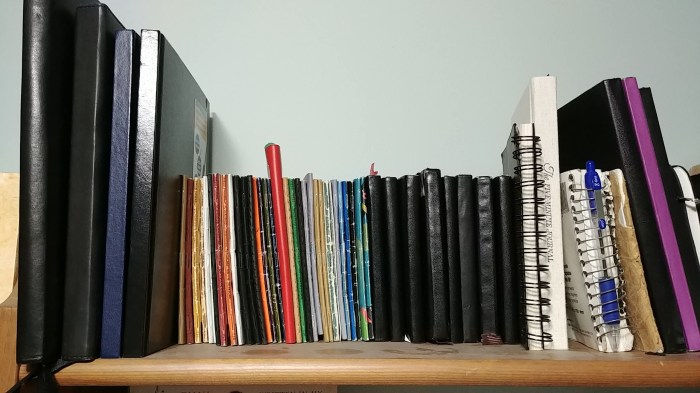
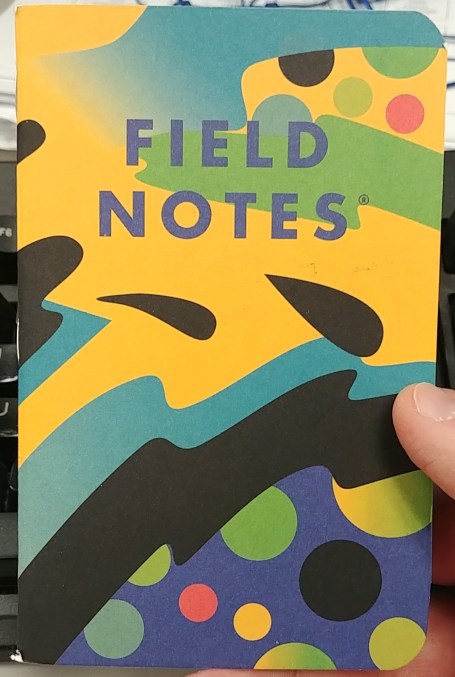
Later, I switched from larger Moleskine notebooks to smaller, pocket books. Over time, I adopted the Field Notes brand of pocket notebooks as my go-to medium to capture thoughts, though I do keep an assortment of notebooks on hand (or on my shelf) for specialty purposes. The early days of Field Notes had me using a notebook until it was full, whether this was notes from a single month or from multiple months.
Eventually I settled on using one book per month, and started a fresh book every month, regardless of whether I fill the book or not. In this post, I’ll show you how I set up a notebook for the month of January, and provide some commentary on my choices.
The first step is to get a fresh notebook. You don’t have to use Field Notes, but I like the brand and the quality of the product. My only criteria when selecting a book is I prefer at least 48-pages that uses good paper and a grid pattern (either solid lines or dots). The paper is important because I use a specific kind of pen (I’ve settled on the Uniball Deluxe Micro as my preferred pen) that can easily bleed or smudge on poor quality paper as I write leftie.
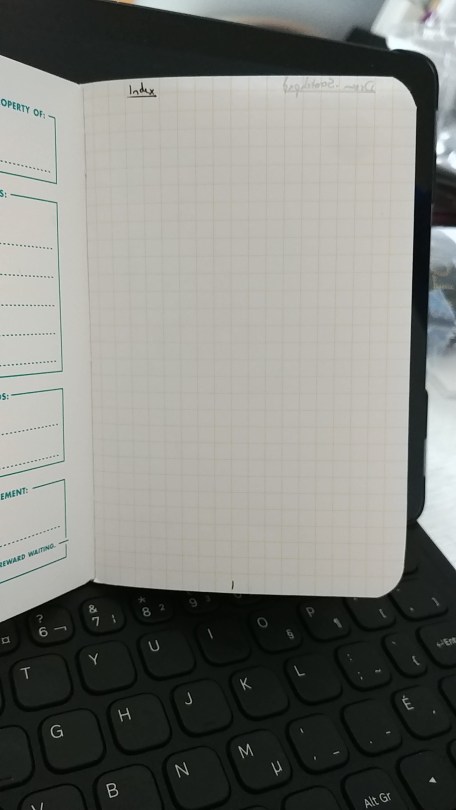
The next step is to go through and number all of my pages. This is important because after I’m done with a book, I use an index (see below) to capture important pages that I want to reference in the future. The index does not capture any of the standard pages I set up at the start of the month, nor does it capture my individual days. Instead, it captures main to-do lists, important notes, or other things that I’ll need to find later. For instance, I use these physical books to remember passwords I rarely need to type. If I update a password, I note the date in my online calendar with a book reference (month, year, and page), so that I can go back and see what I set the password to. This doesn’t work when I’m out of the house, but I find this helps with keeping my rarely used passwords secure (instead of constantly answering security questions to reset the password).
After the index, I titled the second page my dream scratch pad. This is where I can do pie-in-the-sky thinking about things I want to do, accomplish, strive towards, covet, etc. To be honest, I rarely use this page, but I like to keep it on hand in the same place.
Next, any major to-do items get carried over. A lot of these have been on my carried-over to-do’s for some time, but I don’t want to forget about them (things like rolling over my passwords regularly, or little things I want to do around the house. If to-do items can be grouped under a specific theme (say, specific home repairs), they get their own lists later in the book. This page carries over everything else.
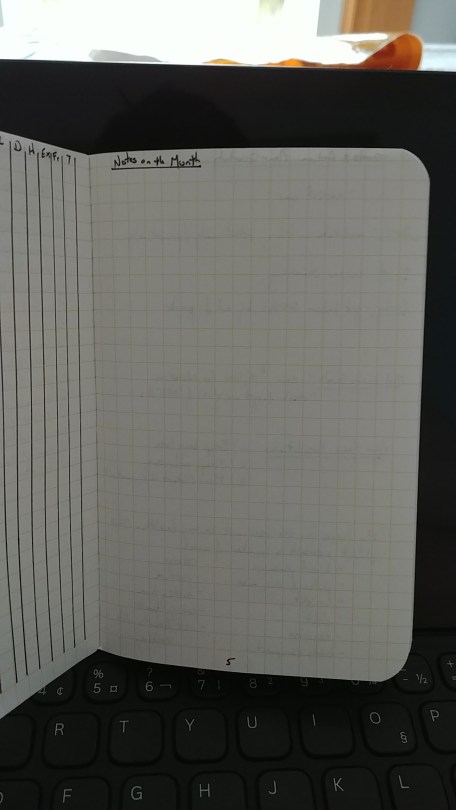
Tracked items, left to right – (Gr – German lessons on Duolingo), (L – when I’m late for something), (D – when I’m having a down or depressed day), (H – when I have a headache; at the bottom of the page I have a scoring system for how bad they are), (Ex – days I intentionally exercise), (Fr – time intentionally spent with friends or family), (7 – nights I track seven or more hours of sleep on my Fitbit).
Next is my tracker page. This is where I track habits and other regularly occurring items so I can see them at glance. I list the dates along the left side (weekends get doubled-up so I can fit the entire month in), and each category of things to be tracked gets its own column. Some metrics are good things to track, while some of them I want to use to monitor my general health and well-being.
Since the entries per day are pretty short (not a lot of space), I keep this facing-page blank for additional notes on the month, if I need it.
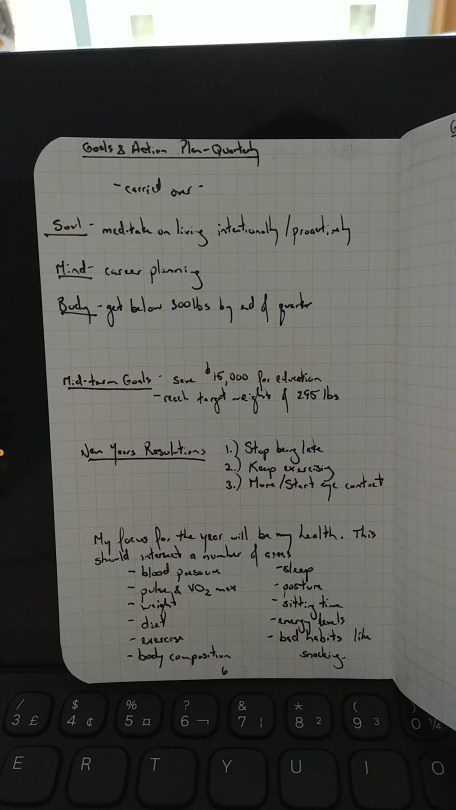
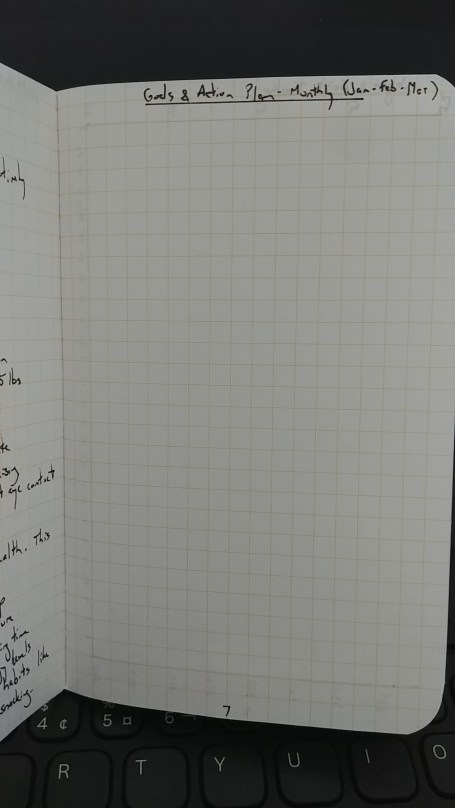
On page 6, I capture my intentions and goals. I track goals and intentions a few ways. First, I have a “soul,” “mind,” “body” theme which allows me to focus on specific areas of my life (soul – social, philosophical, spiritual, etc.), (mind – learning, planning, etc.), and (body – physical health and wellness). I realize you can’t try and change too many habits at once and be successful, so these are just ways of helping me to prioritize things into themes, short-term and longer-term goals, and things I want to change. If page 6 is my capture page, page 7 would be where I would focus myself to a limited number of things. I would pick something from the previous page and devote more time or attention to it with specific plans and actions.
On page 8, I track some specific health indicators – my weight on the scale (left side), and my waist measurements (on the right axis) over time (the x-axis). Static views of single health metrics aren’t very helpful, so I’ve chosen to track weight and my waist as a better indicator of my overall progress in fitness. I’ve also started tracking blood pressure, which I input results for the day the data is collected as the systolic/diastolic reading.
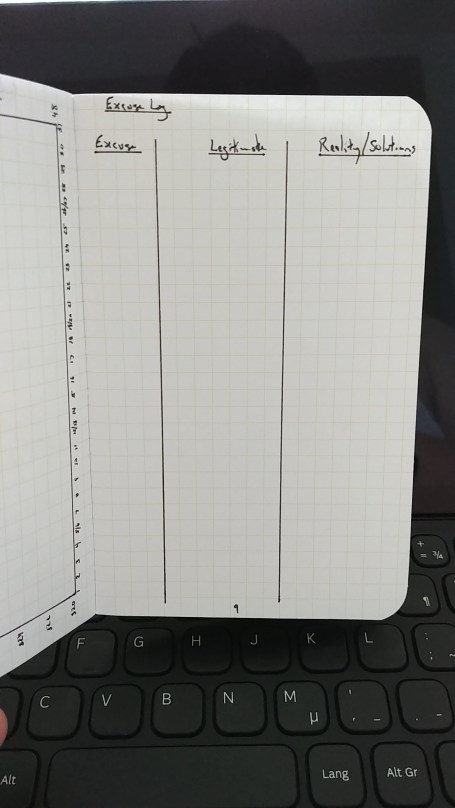
Then, on page 9, I borrow a system I found on Reddit to track excuses. This is where I can measure intentions against action. For instance, if I set an intention to exercise and I skip it, I can capture what my excuse is for skipping it, assess whether it is legitimate (yes/no), and make notes on any ways I can mitigate the reality or implement solutions to keep my intentions.
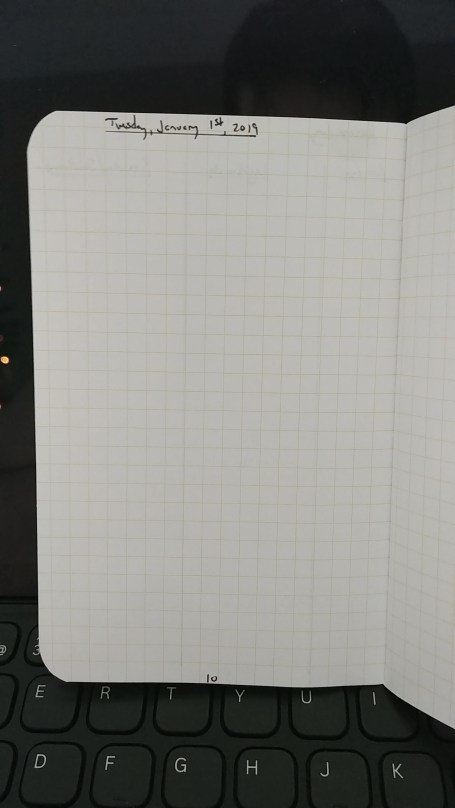
Finally, on page 10, I start my first entry. Every day that I record in my notebook will receive a new page. I put the date across the top, then fill in tasks for the day, ideas, interesting quotes, or things to remember. Sometimes I’ll migrate thematic lists into this section, such as tasks I need to complete as Board Chair or for things around the house to repair.
This is the system I currently use. It borrows from a couple different sources, such as the original Moleskine planner I began with, elements from the Bullet Journal method, and good ideas I’ve found rambling through sites like Reddit. The notebook set-up iterates over time. I add and remove things depending on how useful I find them. Some of the items discussed above might get removed soon since I haven’t done a good job of keeping up with them, and therefore are no longer useful to me.
It is a little tedious to set up a new notebook every 30 or so days, but on the whole I like the systems I’ve developed and have found it immensely useful in my day-to-day life.
Share with me down below what kind of systems you use to help keep yourself on top of things. I’m always looking to borrow good ideas! I hope you found something here that was useful.







 A Paramedic's Notebook