Principled Thinking

cropped20181018_130815

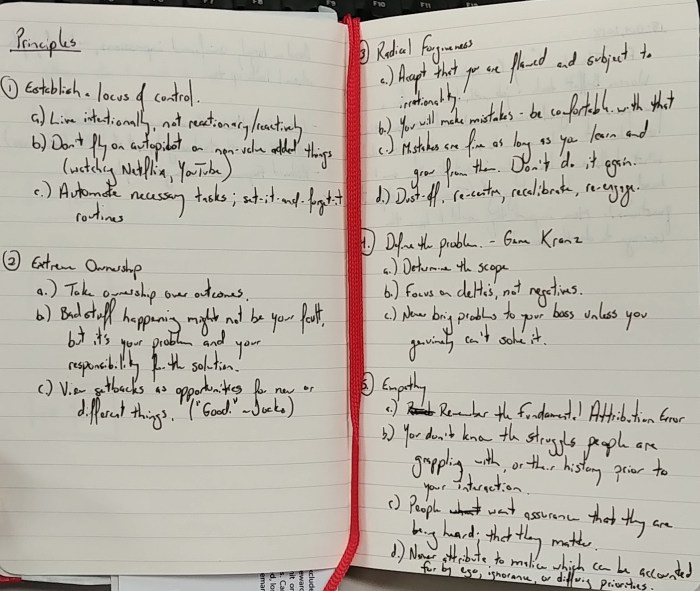
While I haven’t finished reading it, I have been thinking about the book Principles by Ray Dalio.  As the title of the book suggests, Dalio has published his comprehensive list of principles that Bridgewater Associates uses as part of its decision-making framework.  He encourages others to adopt this method for refining processes and capturing on paper a person’s or organization’s core beliefs  through carefully considered principles.  The thinking is that these principles create a process for filtering information so that decisions remain within scope by removing extraneous considerations.

I have a notebook that I use to jot down thoughts about myself and my personal development.  I needed a place to collect my thoughts in one place about where I am, what direction I am heading, and where I want to go in both life and career.

Recently, I started sketching out some ideas for what my own list of Principles would look like.  I suppose “principles” might be the wrong word.  “Beliefs” might be a better word; “aspirations” also fits in there because I know that I don’t always do the things that I believe I should do (for instance, 5a and 5b below are things I conveniently forget when I’m mad at someone).

This is an incomplete, work-in-progress list.  I’m not even sure that I’m heading in the right direction, but these were the five things that came to mind when I first sat down to start collecting these thoughts.  Below, I have transcribed the notes seen in the photo above.

Many of these ideas have been taken from the various books I’ve read over the last few years.  I suppose it’s a bit of a distillation of all the ideas that were strong enough to make an impression with me.  I expect that this list will need many more additions and revisions, but keeping it a living document would be beneficial to capture how I grow as a person over time.

Principles

1.) Establish a locus of control
a.) Live intentionally, not reactionary/re-actively
b.) Don’t fly on autopilot on non-value added things (watching Netflix, YouTube)
c.) Automate necessary tasks; set-it-and-forget-it routines

2.) Extreme Ownership
a.) Take ownership over outcomes
b.) Bad stuff happening might not be your fault, but it’s your problem and your responsibility for the solution
c. View setbacks as opportunities for new or different things (“Good” ~Jocko)

3.) Radical Forgiveness
a.) Accept that you are flawed and subject to irrationality
b.) You will make mistakes (and have bad judgement)* – be comfortable with that
c.) Mistakes are fine as long as you learn and grow from them.  Don’t do it again
d.) Dust-off, re-centre, recalibrate, re-engage

4.) Define the problem – Gene Kranz
a.) Determine the scope
b.) Focus on delta’s, not negatives
c.) Never bring problems to your boss unless you genuinely can’t solve them

5.) Empathy
a.) Remember the Fundamental Attribution Error
b.) You don’t know the struggles people are grappling with, or their history prior to your interaction
c.) People want assurance that they are being heard;  that they matter
d.) Never attribute to malice which can be accounted for by ego, ignorance, or differing priorities

*Note added after I photographed the page from my notebook

Stay Awesome,

Ryan
My Best Blog Post (to date)

I set up  this blog as a way to force myself to write.  With a few minor exceptions, I’ve managed to put out a post every Monday morning for the last few years.  While the tone and theme of the blog shifts around a bit, it’s been a pretty consistent thing.

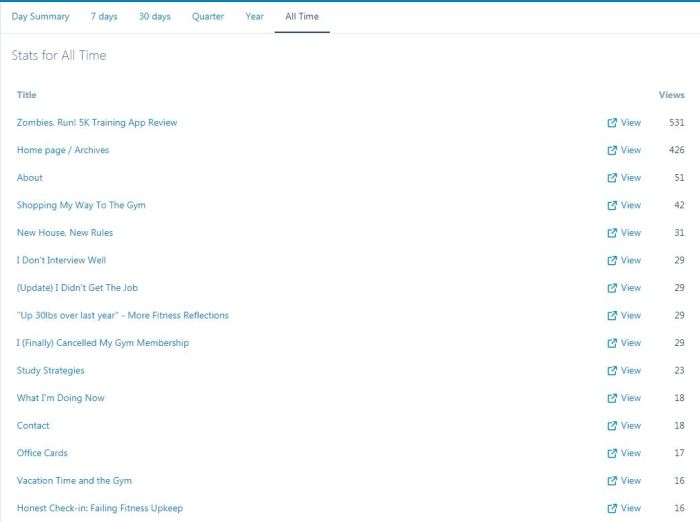
One thing that is surprising to me is the top blog post on the site.  There is one post that consistently gets more traffic than any of the others (almost daily, in fact).  If I didn’t have access to the metrics, I would have never guessed which one it is.

My best blog post, to date is ……. (*drum roll*)….

Zombies, Run! 5K Training App Review

Yeah, no kidding.

It’s far and away the most popular post.  It’s more popular than my landing page, which means that people often find my blog through a Google search before clicking through to the rest of the site.  Below is my top 15 pages according to views.

Top 15

I suppose there are a few good takeaways I could make use of if I were looking to optimize this blog for hits or monetization.  First, writing reviews of popular apps gets a lot of clicks.  As does talking about health and fitness (or, more specifically, failing at health and fitness).  And finally, people like reading about life/career developments – and posting your content to Facebook for your friends and family to read will get you a good number of hits each time.

I suppose now I have a goal to write something that will drive more traffic than Zombie, Run!  Good luck to me.

Stay Awesome,

Ryan

What I’ve Been Reading (As of September 24th)

I haven’t posted a reading update since the summer, so now seems like a good time to check in on what’s playing out of my speakers or sitting on my nightstand.

Carpe Jugulum by Terry Pratchett

This list must have the mandatory update on where I am in Pratchett’s Discworld books.  I’m only a little ways in, so not a huge update here.  Thus far, it’s a Witches story, sans Granny Weatherwax and involves vampires appearing to try and usurp a kingdom.  In other words, awesome.

What Happened by Hillary Rodham Clinton

I’ve drifted more towards memoirs as of late, choosing to distance myself a bit from the animated bibliography and instead listen to the stories by people reflecting on their life and either providing insight in retrospect or attempting to provide an explanation for why things unfolded (also see Catmull’s book below and my recent completion of Knight’s Shoe Dog).  As with many of us here in North America, I watched the US elections in 2016 with interest, and was disappointed in the results.  I was interested to hear Hillary’s story of what happened and am not disappointment by what I’ve heard so far.

Creativity Inc. by Ed Catmull

Another memoir, this book is from one of the founders and heads of Pixar.  What I love most about this book is that he’s discussing the behind-the-scenes decisions and goings-on of creating the films that I grew up on, which adds a new layer of awesome to my childhood memories.  The values and lessons he learned from their failures and successes are incredibly interesting, and I find the book captivating.

Tribe: On Homecoming and Belonging by Sebastian Junger

Junger starts with an interesting observation from the American Frontier: if “advanced civilization” is so wonderful, why did so many white American settlers abandon their communities to join and live among the indigenous peoples that were so backwards and savage to them?  Junger’s speculation is that it comes down to how people feel accepted within their communities.  To Junger, this is an example of how “civilization” and technology can be so alienating to a person, which diminishes their sense of worth and place.  I’m not very far into the book, but it’s quite a good read so far.

Outlander by Diana Gabaldon

I’ve been watching the Outlander series on Netflix with my wife and have been loving the story so far.  It didn’t hurt that the first season took place in Scotland, which reminded me of my trip there in 2016.  Fun fact, the scenes of Inverness in the series were actually filmed in a small town called Falkland, which I visited on my travels, long before we had started watching the show.  The book is huge (over a 800 pages!) so it’ll be a long read.


Image may contain: sky, tree and outdoor
If you watch the first episode, this is the town square of “Inverness” where Frank encounters the ghostly Scotsman.

No automatic alt text available.


Stay Awesome,

Ryan

Public Speaking Bomb

Happy Labour Day!  Things have been busy here at work while we gear up for the new academic year.  Students are around, schedules are messed up, and people are scrambling to get back into the right mindset to kick off the new term.  Things are bustling and busy.

I don’t intent to keep a post trend going, but I wanted to ride some of the wave from last week’s psych-out post and talk about another recent failure I experienced at work.

Last week, I had to give a short presentation to college faculty about the research ethics board I’m on.  The purpose of the presentation was to remind faculty that the board exists, and to have them consider whether an ethics review is needed for their or their student’s projects.  I had a 15-minute block of time and a slide-deck provided by our board coordinator.

After the presentation, I sat down and wrote out all the ways the presentation sucked.  In fairness, two of my colleagues went out of their way to complement my presentation,  and that they took away the two main deliverables (that student research projects should be run by the board, and that I’m available on campus to answer questions).  I checked in with my boss and she, too, agreed that the presentation was not a failure as I saw it.  I know that my perception of how things went will be dramatically different than how others perceive me.  Nevertheless, I know that I am capable of doing much better and the main culprit of my failure was because I didn’t practice out loud before the talk.

Here is the list I generated:

Everything that went wrong (and why):

  • Didn’t practice the slides
  • Didn’t build the deck (it was pre-made and sent to me; building the deck would have made me more familiar with the content by necessity)
  • Too rushed
  • Unstable speaking patterns (rambling ticks)
  • Poor intro
  • Poor conclusion
  • Didn’t plan my transitions
  • Didn’t know how the transitions were set in the slide (i.e. need to click to reveal text)
  • Missed content from the page.
  • Had to look at screen to figure out where I was
  • Didn’t know I’d have to hold a microphone (I knew this from past All Faculty meetings, but I should have anticipated it)
  • I was holding the mic and the presentation remote – my hands were full
  • Didn’t pause to calm down or collect my thoughts
  • Bad presentation but saved with good will from prior relationships with faculty + my position (junior to the faculty)
  • finished in 8min or 15min.
  • Didn’t have a firm point in mind that I wanted them to take away from talk.
  • Didn’t edit slides to remove non-essential content

You can’t win them all, but it’s important to know where you go wrong so you don’t make the same mistakes again.

Stay Awesome,

Ryan


Failure by Psych-Out

Yesterday I went to a climbing gym with my co-workers for our summer staff party.  It’s been at least five years since the last time I tried rock climbing, and over a decade since the last time I actually climbed a rockface.

The experience was interesting.  On the one hand, the venue is great, and the staff were awesome.  My co-workers were all super supportive, and in no way did I feel like I didn’t belong because of other people.  I did, however, felt like I didn’t belong because I’m a 325lbs mass of meat that doesn’t have the greatest cardiovascular system and a nervous suspicion of gravity.

I made two attempts to climb a fairly easy 5.5 wall.  The first attempt, I chickened out about a quarter of the way up.  A little while later, I made a second attempt and got around 80% of the way up before I stopped, thought about things, and promptly started climbing back down.  In other words, I psyched myself out before I reached the top.

I was really bummed out about it afterward, because I knew that if I pushed through the mental barrier and went up the last 5-10 feet, I could have made it.  Instead, I saw that I still had a bit to go and felt that I didn’t trust the auto-belay device to support my weight, and the hand-holds near the top would have been tricky to climb back down on.  So, instead I decided to turn back and climb down until I was a safe height up from the ground where I could let go and still not injure myself if the auto-belay device didn’t arrest me.

It’s really stupid to let myself succumb to this kind of thinking.  I know that the equipment is safe, and I know that I won’t injure myself if I slip.  Nevertheless, I let my fear get the best of me, and I turned back before the end.

We can’t win them all.  I’ll try to do better next time.

Stay Awesome,

Ryan

The Animated Bibliography

*Update: I’ve added bullet points to the bottom since the time of original publication.  New points are identified as “New.”

I’ve made references to the concept of the “animated bibliography” in a few recent instagram posts.  I first started conceiving of the idea when I wrote a short self-reflective critique of my habit of reading self-help books.

I doubt I’m the first person to notice this trend in publishing, and I’m not entirely confident that this is a new trend at all.  The more likely explanation is that this is something that has gone on for a while and I’m just too stuck in reading the same books listed on every “must read” list to see the broader context.  Were I to read books that were published earlier than the last decade, perhaps I would see that book have always used this strategy to convey information.

Nevertheless, it would be fun to take on a bit of a research project to see whether this trend has proliferated from a certain point in time, who the early adopters were, and how quickly it’s accelerating.

For the moment, here are my early observations:

  • The animated bibliography is a style of nonfiction where the author uses a micro expression of some authority to explain or contextualize some broader universal “truth.”
  • The authority is either scientific studies or biographical case studies.  Biographical case studies are not always literal examples, but can also be mythical or metaphorical examples.
  • The material is rarely discussed from the negative; that is, the material is presented as a causal relationship to explain a phenomenon, but less commonly are counter-examples, counterfactuals, or false-positives discussed.
  • The author is usually repackaging the work of someone else, rather than the original author of the micro expression.  For example, there is a difference between Daniel Kahneman writing a book reflecting on behavioural economics and his original studies, and someone invoking a study published by Daniel Kahneman to explain an phenomenon.  The animated bibliography would be the latter, but not the former.  The animated bibliography is a presentation of the things the author has learned.
  • The animated bibliography has parallels to how research papers are written at the undergraduate level.
  • The animated bibliography can be thought of as a narrative stitched together.  A series of vignettes (chapters) that bring stories together under a broader meta-narrative that provides a unified theory.
  • The animated bibliography is a method of delivering nonfiction, but it is not necessarily meant to be a moral lesson.  It is protreptic in aim – it attempts to be explanatory, if not educative.
  • The animated bibliography typically falls under a few key genres of nonfiction: business, productivity, leadership, personal development or self-improvement.
  • In isolation, the animated bibliography is merely a geneology of ideas, but taken as a genre it becomes self-referential.  The same studies and case studies start popping up over and over.  These, in turn, get meta-referenced by popular authors who write about them.  For instance, a reference could take the form of a book referencing another author’s book about a series of published studies.
  • Hypothesis: this phenomenon (if it is a new phenomenon) is an emergence from the overlapping worlds of start-ups and founder idolization, social media-fed ennui, high technology, scientism, and people’s inability to move from idea to action.  The books are proliferated as instructionals and how-to’s to solve a behavioural problems.  They paint an ideal way forward, but the fact that they keep getting published, and that a market still exists, means that no one book can actually be held up as the definitive voice.  The plurality exists because they singly do not provide broad answers.
  • The market creates a series of urtexts that spawn and inspire secondary and tertiary levels of reference.
  • *New* The author takes on an authoritative tone in the books, but uses the references to others as the source of their authority.
  • *New* Rarely is the book the result of a lengthy period of research or work in the field as a practitioner.  Instead, the book is the product of some period of immersion or research in the topic at hand (e.g. the author spent a year working on the topic and is writing a book about it).

I’ve deliberately kept things vague in terms of which authors and books I have in mind when I make the observations above.  Perhaps in time, I’ll have more courage and name names of those I find to be the biggest offenders of the genre.  For now, though, I choose to remain silent.

Stay Awesome,

Ryan


Honesty and Trust

The weekend after the last wedding experience I wrote about, I was fortunate to attend a second wedding.  Much like my last post on the topic, I want to reflect a bit on something the officiant said during the ceremony.

Warning: philosophical thoughts ahead!

Midway through the service, the officiant was offering some words of advice and wisdom for the couple.  He was discussing values that make for a strong, lasting relationship, and he commented that honesty is an important value to hold.  However, he speculated that beyond honesty, trust is something worth considering as a higher value.

His message was a little tongue in cheek, alluding to the impossible questions a partner is faced with, such as “does this make me look x,” but he also meant it in a more sincere way.  He was driving home the idea that the partnership can’t rely on honesty and transparency alone, but it also requires both partners to recognize the union of their lives, and that they must trust their partner in the journey.

While I won’t say I fully endorse the idea that trust must always be placed above honesty, it nevertheless gave me food for thought.  I mulled over what trust means to me in a relationship, and whether you can have deserved trust paired with deliberate dishonesty.  I donned my philosopher’s cap and thought about it.

For instance, (hearkening back to Kantian ethics), should we always tell the truth?  Certainly, I’d prefer to live in a world where I’m never (maliciously) deceived, but I can imagine cases where deception can be useful.  If my partner deceives me in order to seek to surprise me in a way that would bring me pleasure, then I think that kind of dishonesty can be permissible (Christmas and surprise birthday parties hinge on this being permissible).  Setting aside considerations about the differences between deception and omission, so long as the deception is for the benefit of the deceived, and that revealing  the nature of the deception results in increased happiness, then I think in most instances this can be thought of as a good thing.  On the other hand, deception that is used to maximize the pleasure of one person while building harm at the expense of the other person (especially if the deception is revealed) is likely to be uniformly wrong in all cases.  Feel free to check my thinking in the comments down below.

The implication I realized during the ceremony is that it is possible to knowingly be deceived by your partner and be fine with it if you trust your partner explicitly.  That is to say, if my partner chooses to be dishonest with me (or, to a lesser degree, if my partner is not fully transparent with me), and I suspect them to be as much, then the only instance where I would be fine with this is if fully trust my partner.

This is not to say that I think this gives license to one’s partner to be deliberately deceitful if a full trusting relationship is present.  I still believe that honesty and transparency ought to be the norm in a relationship; that the relationship is built upon its foundation.

But, if my partner judges that deceiving me is in my best interest (however temporary that might be) and it is indeed in my best interest, then full trust is the only way that it could be managed.  Of course, there would need to be some sort of resolution to the deception.  I don’t think a state of perpetual deception or ignorance is possible while being in a person’s best overall interest – the two run contrary in my mind.

Then, if it is the case that the thought of my partner deceiving me causes me discomfort or some other negative associative feeling, then it cannot be said that I fully trust them (or, that honesty and transparency are not things I care about – but how would a relationship work in that case…?).  A breach of trust and a breach of honesty would both transgress the relationship.

It’s an odd sort of thought experiment to run, especially during a wedding.  I had a lot of fun at that wedding, and I’m glad to have gotten some interesting philosophical thoughts to mull over while I celebrated more friends starting a new chapter in their lives.

Stay Awesome,

Ryan


Locus of Control – I Re-Assembled the Elliptical!

While I have recently joined a new gym in our new city after the move, I have used it once as of writing.  I have yet to work out a schedule that allows me to easily pick up the habit of exercising.  This is, of course, a terrible excuse to not exercise.

Exercising at the gym will either be something I do before work, or something done after work.  Each of these options have complications that provide just enough friction that implementing them is stopped by my slothful lizard brain.

In order to exercise at the gym before work, I’d have to wake up earlier.  This is hard for me for a few reasons:

  • Because I work at the bar a few nights per week, my sleep schedule is variable, so keeping a consistent bed and wake-up time is challenging.
  • I’m a heavy sleeper, so finding a way to wake me up without disturbing my partner is difficult.
  • I’ve developed a habit of snoozing when my alarm goes off.
  • Being late to work is bad, so if I’m late to get to the gym, it throws things off for me.
  • I’m lazy.

In order to exercise at the gym after work, I have a few barriers that I’d need to overcome.  Ideally, I’d go straight from work, but:

  • On days when the dog is at daycare, I’m usually the only one who can pick him up before they close since my work is closer.
  • On days when the dog is at home, I need to go home first to take him out to relieve himself.
  • Because I’m the first one home, it makes more sense for me to start dinner.
  • I have the habit that once my “pants come off,” or if I sit on the couch, it’s hard for me to get up and go again.
  • Exercising after work is challenging if I’m tired from work.
  • I wouldn’t be able to workout on days after work when I also work at the bar or have board meetings (mornings are more likely to be clear of other scheduled activities).
  • I value spending time with my significant other over going to the gym.

These are all excuses.  They are in no way real impediments to going to the gym.  Instead, they provide just enough friction to stop me from making a change.

Another option would be for me to workout at home.  Until recently, we’ve been limited in what we could unpack while the renovations were ongoing.  However, now that the renos are done, we are in a position to reclaim more space in the basement.  The disassembled elliptical was buried behind boxes of stuff, and there was little extra floor space that could be used to set up the machine.

Last week, I decided that I wanted to finally set up the elliptical so that I had no excuses for skipping some form of exercise.  I wanted to take back some locus of control for my fitness.  Everything listed above is coded in language that suggests I have no control over my situation.  There’s always a reason outside of myself that prevents me from committing to exercise – “if only things were different, I’d exercise.”

But this is wrong.

In truth, there is nothing stopping me from exercising.  I’m making excuses on why I’m not modifying my behaviour.  Instead of whining and whinging about why I can’t exercise, I need to address the nagging feeling that I am drifting about in my day to day life.  I don’t feel in control of things, but this is false.  I tend to react, without intention.  I act as if I don’t have an active agency in how I spend my time.  By not making decisions about how to fix my behaviour, I’m still making a decision – only now I’m pretending to be a victim of circumstance and pushing off ownership of that decision to do nothing.

And so, last week I decided to take back some locus of control and re-assemble the elliptical and go for a run.  This is not a behaviour change, but merely a first step.  (Or several steps according to my FitBit…)

Now, I must be responsible for continuing to take those steps.

Stay Awesome,

Ryan