Management and Teaching My Replacement

Over the last two weeks, I’ve been onboarding my replacement at work.  On the one hand, it’s great to finally offload the extra tasks that I’ve been juggling since assuming my new position.  On the other hand, I’m having to experience a new world at work in the form of management and performance coaching.  It’s one thing to do the tasks yourself, but it’s an entirely different thing to anticipate another person’s tasks, teach those tasks to the person, the follow-up on the progress with feedback.

While I am not the direct manager for the new program assistant, I share some of the responsibilities for ensuring she’s successful in her new role by virtue of me being the last person who occupied the role.  I suppose I’m over-thinking this a bit, since employees move on all the time and are not accountable for the new person’s performance.  Nevertheless, between me still working in the same office and me being a team player, I feel that it is my duty to help the new employee succeed until she can run under her own steam.  Afterall, the program assistant position is a job that was developed over the course of four years, so it’s a lot to take in all at once.

I knew prior to her starting that I would need to reflect intentionally on how I could teach someone to do the job that I have built over time, and figure out how to deconstruct the tasks and portfolios so that it makes sense to a fresh set of eyes.  Since this is my first time doing this, I took a stab at it and realized that there was a lot more I could have done to prepare for onboarding her.

One example is at the end of her first day.  I met with her to do a mini-debrief on how she felt her first day went.  She admitted it was a bit overwhelming, but was confident that she would learn more as she did the tasks.  She then asked for my input on what she should do the next day.  I hadn’t anticipated this question, so I floundered a bit, suggesting that she should take some time to read through the relevant policies and procedures I’ve got stashed away in a binder, as well as reviewing the committee minutes from the past year for an upcoming meeting she will need to plan.

After work, I reflected on this and realized that I didn’t do a good job of setting her up with concrete tasks for her to fill her day meaningfully.  Don’t get me wrong – at some point she will need to read over all of that stuff as it will be important to her job.  However, I realized there are better ways she could be utilizing her time.  Instead of reading over abstract documents, I need to get her working on tasks that are directly related to what she will be doing over time.

The next day, I jotted some ideas down and met with her in the afternoon to discuss how things are going and give her concrete tasks to start figuring out, such as responding to program-based email inquiries, learning where to find reports, typing up committee minutes so I could critique them, etc.  I also coached her on setting up meetings with the program Chairs to 1.) introduce herself more formally, and b.) to learn from them what their needs and wishes are.  I seeded some questions with her on topics she ought to cover, and left it to her to arrange the meetings.  In the background, I also spoke informally with some of the Chairs to let them know she was doing this, and to suggest ways they could help onboard her to their program areas.

This was a much better way to onboard her, and she was busy over the rest of the week learning various systems.  She would stop by my office a few times a day to ask clarifying questions or ask advice on how she should approach a certain task.  She was learning by doing, and seems to be adjusting well to her new role.  I’ll leave it for her actual boss to determine whether she is meeting targets, but at least I know she’s able to work with us as a team behind her.

Stay Awesome,

Ryan
Values-based Decision Making

In a recent accreditation visit at work, a comment was made in the visiting team’s report that the college and engineering program need to better demonstrate the rationale behind program changes that are tied to something called “graduate attributes.”  I won’t bore you here with the details of how an engineering degree gets accredited since it’s a bit more complex than a short blog post would allow.  The main point is that the visiting team wanted to understand the motives we had when making updates to the courses in our continuous improvement process.

This reminded me of my KWCF experiences, specifically the Engage!KW program.  One of the activities we did was to reflect critically on our values.  We were asked to come up with a list of our values, and compare our espoused values with how we choose to spend our time in a week.  The point of the exercise is to a.) see whether you are living according to your values, and b.) to reinforce that you should make decisions based on your values – and if a decision does not align with your core values, it’s probably not something worth pursuing.

The visiting team’s comment didn’t sit well with the faculty and administration, largely because we felt that all of our decisions were made in the spirit of making graduates from the program better prepared for their careers.  The idea that we need to somehow demonstrate or explain better what we are already doing was hard to understand.

My best explanation for how this would work goes like this:

Suppose you receive feedback from your industry partners that in order for graduates to  be successful, the college needs to buy every student a pink hat.  The students must wear the pink hats at all times, and they must bring them with them into their careers after graduation.

Now, it might be the case that these pink hats are a good idea.  The idea originated from our industry partners, whom will be the very people hiring our grads.  However, buying the pink hats is an expensive endeavor.  The money we spend on pink hats means we can’t allocate those resources elsewhere to improve the program.

When the team evaluates the idea, they should look to the core values of the program and see whether the pink hats falls in line with those values.  In our engineering programs, we have twelve graduate attributes that we seek to instill in our students.  Every student who graduates from an engineering program will possess these attributes if the program is designed well.  If we look at the attributes (our values) we won’t see a connection of how pink hats are essential to making a better graduate or a better engineer, even though industry is telling us this is the case.  And so, we would make a decision to ignore industry’s suggestion, and instead allocate our money elsewhere.

Pinks hats might seem like a silly example, but the situation is the same for any piece of technology that industry wants us to teach, such as 3D printers and proprietary programming languages for manufacturing robots.  It costs a lot of money to adopt these technologies, and it takes a lot of time to teach and reinforce the skills in our students.  At each point, we have to ask ourselves whether this investment materially improves the students, or whether there is a better way we can allocate our time (such as teaching good computer modelling for 3D printers, or teaching good programming foundations so that our students can easily teach themselves any programming language used in industry).

The key lesson is that these decisions should not be made on a whim, but nor should they be made because a stakeholder tells you they are important.  Input from industry is only one point of data in a sea of information.  In order to tease out the signal from the noise, it’s important to use your values to help determine what’s worth pursuing, and what’s worth leaving behind.

Stay Awesome,

Ryan


My Backfill Starts Today (Job Update)

A few months back, I updated that I hadn’t been selected for a job I was in the running for (again).  Well, turns out that I was a tad premature in my announcement.  A few weeks after the post went live, my boss came to my desk, smiling, and let me know that the candidate they had moved forward on originally had accepted a job elsewhere, which moved me from the second slot to the top.  I was advanced to two more informal interviews, and on March 4th I started my new job as the Graduate Attributes Quality Assurance Coordinator for our degree programs.  And finally, my replacement for my old position started today, which will begin the formal hand-off of all of my old job tasks.

This is a different phase of work for me.  I’ve trained people on tasks before, but I’ve never trained my replacement.  Until now, I’ve been trying to balance both job portfolios, but now I begin the process of uncoupling myself from my old tasks and handing them off to the new Program Assistant.

I feel a little bad for her.  The Program Assistant position didn’t exist in our office when I first started at the college.  It is the result of four years of expanding the role to take on tasks that didn’t really fit under other people’s roles.  It’s wholly unique in the college as far as I know, and it interacts with almost all major stakeholders: students, faculty, administration, alumni, and industry partners.  I have to condense the four key areas of my job – Advisory Committees, Program Development, Continuous Improvement, and Student Advising – into a meaningful set of processes and best practices.  At each phase of my old job’s development, my boss would give me a mandate, and I would figure out how to operationalize it over the next year.  It’s a lot of stuff to summarize and cleanly hand off, and I’m only now realizing that I didn’t spend enough time reflecting on how to make the work accessible to someone else.

Granted, this is a place of business, and she’s an employee.  She’s competent and is expected to actively learn her role, so it’s not up to me to hold her hand or treat her as if she needs special guidance.  The benefit of this transition is that I’m still in the office and available to answer questions as she learns her new role.

And in this transition, not only do I have a new job, but I’m occupying a brand new position at the college, which means I get a chance to take the objectives set by my boss and figure out what it means all over again, which is an exciting prospect to me.  Similar to my experience working in the gambling lab, I like situations where I’m given an objective and carte blanche to set up processes and procedures myself.

It is a steep learning curve, but I’m liking the work so far.  It’s just outside of my comfort zone, which is a good place for me to be.

Stay Awesome,

Ryan


The Role of Good Media (On Liberty)

While I didn’t dive too deeply into political philosophy while in school, I do muse on it from time to time.  I grant that my knowledge about political philosophy can be charitably labelled as “naive,” so please forgive some of the silliness I’m about to wade around in.

On the whole, I tend towards the idea that the protection of liberty is good, even at the cost of bad actors.  I think the State should limit as few liberties as they can to ensure social cohesion and social protection.  This will come with a few hard to manage examples where people’s liberties can come into conflict (e.g. the right to free speech and the right for people to not give platforms to people they disagree with).

I won’t attempt to give a comprehensive exploration here.  I just want to comment on why good media is important for moral education.

Last week, I was rolling around with an idea I was tentatively calling “dynamic homeostatic liberty.”  I don’t know if this concept has been expressed by anyone else, but the term refers to the idea that the rights respected by the State are dynamically recognized and abide by the principle of homeostasis according to the social and economic conditions at play at any given time.  During times of war or disaster, rights are constricted to maximize good while also achieving some sort of political aim (think curfews and forced redistribution of material goods, for example).  There would have to be some mechanism that says the State owes more responsibility of care to the people in proportion to the amount the State restricts the freedoms of its people.  And this would also recognize that when the strife is over, liberties are relaxed and the State removes itself from meddling in people’s lives.

This is a fantasy, of course, because it assumes the government would always keep the best interests of the people in mind and not lead to tyranny.  It also assumes people would freely give up their rights for better protection and better outcomes.

I was wondering how well a system like this would work, then I watched the season 4 episode from Star Trek: The Next Generation “The Drumhead.”  The episode covers a situation aboard the Enterprise which leads to a series of conspiratorial speculations about members of the crew.  A set of minor accusations ends up leading to wild allegations and a full-blown future version of a witch hunt.

The voice of reason on the ship is Captain Picard, who pauses throughout the ordeal to question whether things are spinning out of control, and people are letting their passions and righteousness get the best of them.

https://youtu.be/ADEDLoLY3AY

Watching the two speeches above made me realize how silly my idea of “dynamic homeostatic liberty” is.  The truth is, there is no way to ensure that the restriction of liberties would be in the best interests of the people who need their liberties protected the most.  The powerful have a tendency to allow themselves to be corrupted by their righteous fury and perceived moral authority.  It was a fantastic example of why we need good media that makes us think and reflect.

Good media helps to elevate us and educate us morally.  It helps us to empathize, and see ourselves from outside our perspectives and lived experiences.

I often think about what kind of media I will want to promote to my children.  I think about what stories I want to tell them to give them a good, moral education.  I think Star Trek will definitely be on that list.

Stay Awesome,

Ryan


What I Read in 2018

Here it is, my yearly update on what I read over the last 12-months.  Overall, I far exceeded my 2016 and 2017 lists in terms of the number of books (42 in 2016, 44 in 2017, and now 57 in 2018) and even the number of pages (4,600 pages more over 2017’s total).

Title Author Date Completed Pages
1 Saga, Volume One Brian K Vaughan and Fiona Staples 12-Feb 160
2 Witches Abroad Terry Pratchett 23-Feb 288
3 12 Rules for Life Jordan Peterson 5-Mar 448
4 Skin in the Game Nassim Nicholas Taleb 10-Mar 304
5 Proust and the Squid Maryanne Wolf 11-Mar 336
6 Small Gods Terry Pratchett 16-Mar 384
7 Conspiracy Ryan Holiday 21-Mar 336
8 Lords and Ladies Terry Pratchett 7-Apr 384
9 Thinking in Bets Annie Duke 7-Apr 288
10 Sapiens Yuval Noah Harari 13-May 464
11 Career Manifesto Mike Steib 4-Jun 288
12 This Is The Year I Put My Financial Life in Order John Schwartz 5-Jun 320
13 Men at Arms Terry Pratchett 12-Jun 384
14 Soul Music Terry Pratchett 24-Jun 384
15 Interesting Times Terry Pratchett 8-Jul 352
16 The Achievement Habit Bernard Roth 21-Jul 288
17 Discover Your Inner Economist Tyler Cowen 26-Jul 256
18 Maskerade Terry Pratchett 30-Jul 384
19 The Five Love Languages: Men’s Edition Gary Chapman 31-Jul 208
20 David and Goliath Malcolm Gladwell 3-Aug 320
21 Feet of Clay Terry Pratchett 10-Aug 416
22 Originals Adam Grant 13-Aug 336
23 Own the Day, Own your Life Aubrey Marcus 17-Aug 448
24 Hogfather Terry Pratchett 17-Aug 352
25 Tribe of Mentors Timothy Ferriss 20-Aug 624
26 Better than Before Gretchen Rubin 21-Aug 320
27 Jingo Terry Pratchett 25-Aug 416
28 Books for Living Will Schwalbe 27-Aug 288
29 The Last Continent Terry Pratchett 6-Sep 416
30 Unshakeable Tony Robbins 17-Sep 256
31 Shoe Dog Phil Knight 17-Sep 400
32 What Happened Hillary Rodham Clinton 26-Sep 512
33 When Daniel H. Pink 28-Sep 272
34 A Higher Loyalty James Comey 30-Sep 312
35 Creativity, Inc. Ed Catmull 2-Oct 368
36 Why Buddhism is True Robert Wright 15-Oct 336
37 The Element Ken Robinson 19-Oct 320
38 Elon Musk (Biography) Ashlee Vance 24-Oct 400
39 Reinventing You Dorie Clark 26-Oct 240
40 What the Dog Saw Malcolm Gladwell 4-Nov 448
41 The Daily Show: An Oral History Chris Smith 12-Nov 480
42 Waking Up Sam Harris 15-Nov 256
43 If You’re In My Office, It’s Already Too Late James J. Sexton 24-Nov 288
44 A Life in Parts Bryan Cranston 24-Nov 288
45 5 Love Languages Gary Chapman 27-Nov 208
46 The Perfectionists Simon Winchester 1-Dec 416
47 Entrepreneurial You Dorie Clark 3-Dec 272
48 The Dip Seth Godin 3-Dec 96
49 The Last Man Who Knew Everything David N. Schwartz 7-Dec 480
50 Ikigai Hector Garcia and Francesc Mirales 20-Dec 208
51 The One Thing Gary Keller and Jay Papasan 20-Dec 240
52 This Is Marketing Seth Godin 21-Dec 288
53 The Souls of Black Folk W.E.B. Du Bois 23-Dec 272
54 The Artist’s Journey Steven Pressfield 27-Dec 192
55 Running Down a Dream Tim Grahl 28-Dec 198
56 Zen to Done Leo Babauta 28-Dec 114
57 What I Talk About When I Talk About Running Haruki Murakami 31-Dec/1-Jan 192
Total: 18544

As I mentioned last week, I have some thoughts and reflections while reviewing the list.  First, when I was selecting my best 5 for the year, I noticed that the books in the latter part of the year were ones I felt resonate with me the most.  I think this is for two, related reasons.  First, this was a huge year for my wife and I.  We renovated our old house, sold it, bought a new house, renovated the new one, moved cities, got married, and got me a new car.  We had so much packed into one year on top of work and family, that the year seemed to have flown by without me realizing it.  Someone pointed out to me that there was a Winter Olympics at the start of last year – I couldn’t believe it and had forgotten all about it.

The second, somewhat related reason is because of the sheer volume of books finished, I don’t think I gave the material time to properly settle in my mind.  Fifty-seven books is a huge amount, and I think that by the end of the year, I couldn’t really remember what I had read during the first half of the year.  Instead, most of the impact was felt in the readings from the latter half of the year.  That’s not to say that the books from the start of the year are forgotten, because I feel that lessons taken from Skin in the Game and from Sapeins, for example, are prominent in my mind.  It’s just that they didn’t really stick out in my mind at the end of the year when I was picking my top reads of the year.

Another reason why I think I have a hard time remembering what I read from the start of the year is because the vast majority of the books finished this year were audiobooks.  Thanks to Audible and the Libby app, I was flushed with books to go through.  And because I listen to books at a minimum of 1.5x speed, I can get through the books at a far faster rate than if I were carving out time to read physical books.  This has its advantages, such as being exposed more rapidly to new ideas.  However, this advantage comes at the cost of little overall integration of the information and general lowered retention of information over time. The speed at which I’m listening to books is more like skimming than true reading.

Nevertheless, I’m very satisfied with my accomplishment for the year.  I’m not really interested in trying to top this list intentionally next year.  I will keep reading/listening/consuming books at whatever rate I happen to finish them, but I will go with whatever pace I happen to settle in, rather than trying to hit weekly or monthly targets.

For the upcoming year, I’d like to try and move away from the self-help, business, and animated bibliography genres of books, and instead tackle more books on history, biographies, and fiction that’s not just Terry Pratchett (though I will still keep ploughing through the Discworld series – that’s not changing any time soon).  If you have any book recommendations, feel free to let me know!  I’ve already got “Educated” by Tara Westover and “When They Call You A Terrorist” by Patrisse Khan-Cullors and Asha Bandele on my bookshelf as recommended by friends.  I’m always on the lookout for the next book to read.

Have a great new year and happy reading!

Stay Awesome,

Ryan

Institutional Systems and Game Theory

One of the hardest lessons I grapple with is treating systems (especially bureaucracies) as a series of “games.”  By games, I’m treating it in the academic sense as a series of interactions between parties that has rules, outcomes/payoffs, and strategies.  Being the meek person that I am, I tend to default to the assumption that the stated rules are all that there is, and you are expected to follow the prescribed process if you are seeking an outcome.  The truth is, in most cases there are multiple strategies that you can use to seek out advantageous outcomes for yourself.  Depending on how the rules are set up, you can avail yourself of several options, both sanctioned and unsanctioned.

For instance, in the case of students, you need to achieve a certain grade to pass a course (say, a 55%).  There are a number of strategies you can use depending on what outcome you are seeking:

  • If you are seeking the highest grade possible – you study the textbook, attend lectures, attend office hours, learn the rubric, do well on assessments, and challenge grades to bump your marks up.
  • If you are seeking mastery of the content – you study the textbook, attend lectures, attend office hours to resolve unclear topics, research the topic, create good study notes, take practice tests, and learn from mistakes.
  • If you are seeking a moderate pass – you prioritize the work and tackle the highest value graded units to achieve at least a minimal passing grade, and you disregard low-return work that requires lots of effort for little ROI, you attend only the lectures required to get information you need, and likely get notes from peers.
  • If you are seeking a pass regardless of content mastery – you can cheat and hope you are not discovered by your professor, then deny any wrong-doing if caught or present excuses to justify your behaviour.  If that doesn’t work, you appeal using the institutions mechanism.

Something to keep in mind is that cheating is still considered at “legitimate” strategy as long as you don’t get caught, because the goal is to secure your desired outcome.  If you aren’t caught, it’s because your strategy beat out your opponent, and you won your outcome.  It might be that cheating goes against the system or the intended processes put in place, but if an adequate system to police the rules isn’t in place, you can exploit that strategy to your advantage.

I hope it’s obvious that I’m not advocating for academic cheating.  I do my best to guard against cheating because I think it runs counter to my goals as a teacher.  I want my students to learn to play the game as I see it should  be played, because the skills and strategies used for my class are both useful and valuable outside of my class – the ability to read a variety of perspectives with an open-mind, the ability to articulate your position with evidence, the ability to connect ideas across different knowledge domains, etc.

I exploit the same rules when I help students navigate their way through the institution’s byzantine labyrinths and silo’d departments when they come to me with problems in their program.  I want them to get through their education with the least institutional friction and cost possible – school is hard enough and I don’t want them wasting time jumping through frivolous hoops because the systems aren’t set up optimally.

I sometimes feel irked or offended when I catch a student cheating, or catch someone lying to me.  I try to check myself in those instances because I know it’s not meant as a personal slight against me when these things happen; it’s because of the incentive structures in place.  A legitimate strategy is not available to the person, so they seek an alternative strategy to get what they want.  They are playing a game and their strategy is competing against mine when they submit plagiarized work, or hand me a fake ID at the bar I work at.  If my strategy is sufficiently robust, I can catch and counter their strategy.  But if I’m also using a sub-optimal strategy, then it’s more likely the case that their strategy will exploit my complacency.

It’s nothing personal.  It’s just how the institutional games work.

Stay Awesome,

Ryan

Self-Education Resources

Post-secondary education has never been more accessible to the average person.  We may have a long ways to go in terms of making courses more accessible for learners and reducing the financial barriers that keep students from being successful in school, but it is nevertheless an undeniable fact that there are more people who have been to post-secondary schooling than the entire history of people attending higher learning.

One issue with the proliferation of access is that it’s getting harder to stand-out in the workforce.  With so many people carrying credentials, the golden ticket that a diploma or degree used to confer has lost some of its value.  Your choices are to either go to industries where they are starving for workers (if you are looking for a solid career with good prospects, you should become a welder NOW), or figure out a way to become a better problem-solver to stand out amongst the crowd.

Another issue that complicates matters is that industry and technology is changing at such a rapid rate that you can no longer rest on your laurels that your program of study will adequately prepare you for work in your industry.  The techniques, technologies, and skills you learn in your first year may be obsolete by the end of your final year.

Therefore, it’s important to develop your ability to self-educate.  Knowing where you can find free or cheap resources can be a huge advantage when developing yourself in your career.  Here are some of the resources I use to teach myself.

Top Spot: your Public Library

In my humble opinion, the public library is one of the greatest inventions of all time.  Whether you are taking classes they offer, using resources in their catalog, or availing yourself of the free access to materials like online journals and portals, there is almost no limit to  the access your library card can provide.  When my HVAC system went on the fritz, I was able to check out an HVAC manual to help me learn just what the heck an HVAC system does so that I could understand what repairs were needed, and how to better care for the system in the future.

YouTube

YouTube changed the game when it comes to sharing knowledge.  Don’t get me wrong, books are great (the necessary precursor to the greatest invention of all time; see: public library entry), but unless your book has incredibly detailed diagrams, the video format will always be the superior resource for teaching hands-on skills.  When I had to fix my roof, I turned to videos to learn how to remove individual shingles and replace them myself.

Coursera

Coursera is all the benefits of attending lectures without the associated costs.  Granted, if you want formal recognition of completing Coursera courses, you’ll need to pay for the access.  However, nearly every Coursera course has the option for you to audit the course for free, which gives you access to the lecture content and some of the supplementary material.

Reddit (and other specialty discussion forums)

I suppose I should have used “Google” as the category here since I often will search for solutions through Google’s indexed results.  However, dedicated online communities are some of the best resources to learn from.  They often post comprehensive resources and how-to manuals, and are usually great about providing solutions when you are stuck on specific problems.  If you can find a good community that isn’t locked behind a paywall, you can lose yourself for hours in it’s wealth of information.

Lynda.com

While not a free resource, this is something that my employer has provided to its employees at no cost.  You should check to see if your employer offers any services for employees to self-develop because you might be missing out on a ton of non-financial benefits.  Lynda is a great resource for comprehensive courses on a wide variety of tech and business topics.  It’s a bit restrictive if you are looking for non-business courses, but it’s worth checking out for learning the basics you’ll need to navigate your early career development.

Udemy

Another paid service, I find Udemy great for high tech courses where I want to develop specific skills, such as in Python or in using Adobe software.  I wait for courses to go on sale, and I snap up courses up to 90% off their full price.

Ask friends

My final suggestion is to tap your friends to see if anyone can help you learn new skills.  Obviously, you don’t want to exploit your friends – you should pay for their services where appropriate.  However, in some cases your friends can be great resources to tackle projects.  Not only do you get to leverage their unique skills or experience, but you also get quality time together.  My entire podcast and music run for Woot Suit Riot has been some of the most formative experiences I’ve had, all because I was making stuff with friends.

All of this is framed as advice to help you in your career, however the truth is that you should be seeking to educate yourself for any project your’re interested in, regardless of whether you can get paid for the skills or not.  I took painting classes earlier this year at my local art store because I wanted to learn how to paint.  This isn’t a skillset that directly will get me promoted, but it rounds me out and allows me to explore my creative side.

The point of self-education or self-development is for you to become more of the person you want to be.  It’s often hard work, but the experiences are well-worth the effort.

Stay Awesome,

Ryan

Principled Thinking (part two)

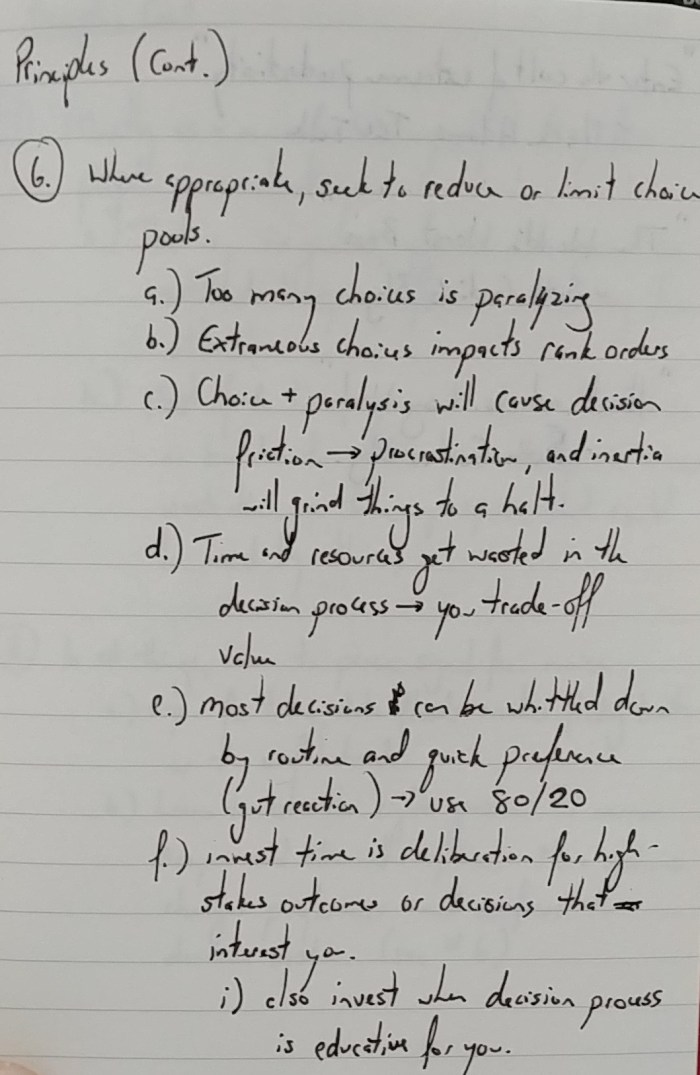
Since my last post on principles, I’ve jotted down a few more ideas in my notebook.  I’ve transcribed my thoughts under the photo below.

20181118_131600~2

6. Where appropriate, seek to reduce or limit choice pools.
a.) Too many choices is paralyzing.
b.) Extraneous choices impacts rank(ing) orders.
c.) Choice + paralysis  will cause decision friction –> procrastination, and inertia will  grind things to a halt.
d.) Time and resources get wasted in the decision process –> you trade off value.
e.) Most decisions can be whittled down by routine and quick preference (gut reaction) –> use 80/20.
f.) Invest time in deliberation for high stakes outcomes or decisions that interest you.
i.) Also invest when decision process is educative for you.

This entry largely captures what my behaviours are like when it comes to making decisions versus where I want them to be.  By nature, I’m a risk averse and indecisive person.  I tend to sit on decisions far too long, to the point where they can cause anxiety when it’s finally time for me to make the call.

I also tend to lack preferences in a lot of things.  For instance, I usually don’t have a strong preference when it comes to picking a place to eat, so I’m terrible at deciding where to go but I’m perfectly happy to go along with choices made by others.  There are many things I’m starkly black-and-white about (which is really annoying to my wife), but most of the time I sit in a middle state like Buridan’s ass.

Therefore, this set of principled notes captures where I want to be – to quickly narrow down extraneous choices (because too many options usually leads to diminished outcomes), and to automate where I can.  Then, I can focus on the really important decisions or use the deliberation process as a teaching tool for myself.

Stay Awesome,

Ryan


The Value of a Myers-Briggs Test

There seems to be a publishing cycle, where every year a new slew of articles are released to damn personality tests, such as the Myers-Briggs.  Lifehacker published one recently, and a book was released at the end of summer about the mother-daughter duo who created the assessment tool, which can be paired with a book released a decade ago discussing personality tests more broadly.

A few years back, I was thinking about my career, and I happened to take the test.  According to it, I’m a INTP, the Logician, an introverted big-thinker who is logical but adaptive.  A year later, I took the test again and I drifted into ENTJ territory; apparently in that time I became more extroverted and more rigid in my planning.

This, of course, is the biggest issue with these personality tests.  They tend to overly rely on generalizations of fluid behaviours and attitudes.  People rarely have stable traits over time, and the test tends to loosely clump these together in attempt to create a meaningful picture.  In this, the Myers-Briggs is nether reliable nor valid from a scientific point of view.  As the Lifehacker article points out, along with many others, it’s dangerous when you base decisions on the conclusions drawn from these tests for things like dealing with others or hiring employees.  The best thing you can do, the article claims, is to use it as a fun conversation starter and nothing more.

But I find value in the tests for another reason.

Humans are drawn to stories.  We like crafting narratives to explain events and give meaning to our lives.  While we would want our stories to align with true accounts of history or phenomena (a book I recently bought argues that it’s not possible), we can still find value in stories that are not, strictly speaking, true (I’m appealing to a coherence-model of truth, rather than a correspondence-model of truth; I never thought I’d drag that grad course back up in conversation again…).  We can find value in a story even if we are agnostic towards it being literally true or corresponding to a fact “out there” in the world.

When it comes to my career, one problem I have is that I have a hard time knowing how to sell myself.  When you are crafting your resume or CV, or when you are interviewing for a position, you are trying to create an appealing story of yourself.  You are painting a picture of the kind of person you are that aligns with the demands of the job or the needs of the employer.  Sometimes, it’s hard to create a compelling story for yourself.  You don’t know what to include, what to leave out, and what needs some mild spin.  You have to decide how to play-up key points and downplay unsavory details.  How you choose to connect the dots can make a large impact on what others will think of you as a candidate.  You don’t want to be dishonest, but sometimes the “truth” is very compelling.

One critical area that the Myers-Briggs can offer value is providing inspiration for how to tell that story.  It creates neat little packages that arranges details in interesting ways.  It allows you to take the generalizations and apply them to your own experiences.  It’s the same trick astrology uses – if you make a statement sufficiently ambiguous, you can find confirming evidence to support it.  Using this to your advantage, you can create a compelling backstory for yourself while also prompting you to fill in the details with good stories.

And if something does fit?  Leave it out and move on.

As long as you don’t pigeonhole yourself, you can tell a story about you that shows how valuable, interesting, and desirable you are to others.  The Myers-Briggs can offer some themes and typologies to help sell the best version of you.  Just don’t believe everything you read.

Stay Awesome,

Ryan

Post-Script: After I drafted this post last week, Seth Godin posted some thoughts about changing your story.  If I’m randomly coming up with ideas that coheres with advice from Seth, I count myself in good company.

~R