Friday Round-up – July 17, 2020

I missed posting last week again! I’m not perfect, and so I keep moving forward and try to do better.

Here is my round-up list for the week ending on July 17th:

🎧 Listen – “This Is What Living Through History Looks Like” | Daily Stoic Podcast

This is a short and sweet observation that hit me just at the right time. I’ve been feeling low recently and lamenting some of the stuff I have on my plate that’s causing me minor stress. Were it not for the pandemic, I mused, I wouldn’t be having problems coping – if only things were easier. Then a line popped from this podcast to give me perspective: “What did you think that living through history was going to be like?” I can pine for the fabled good ol’ days, but we should be honest that between the periods of calm, there will be periods punctuated with strife. And as observed in the podcast, only time will turn the turmoil of the present into a passage in a history book.

🎧 Listen – “#444: Hugh Jackman on Best Decisions, Daily Routines, The 85% Rule, Favourite Exercises, Mind Training, and Much More” | Tim Ferriss Show Podcast

Hugh Jackman has a bit of a reputation for being a good guy, and this podcast did not disappoint. He’s sweet, thoughtful, humble, and genuinely a person you’d want to aspire towards. He’s an example worth following.

🎧 Listen – “JRE #1504 – Alan Levinovitz” | The Joe Rogan Experience Podcast

I’m a bit of a casual listener to the JRE podcast. I’ll usually check things out depending on who the guest is. In this case, Rogan sent out an image on Instagram with the author, Alan Levinovitz, holding up his book. The caption referenced how quick and enjoyable the 3.5hr show zipped by. Then I caught the book’s subtitle: How faith in nature’s goodness leads to harmful fads, unjust laws, and flawed science. Colour me interested, but I’m a sucker for discussions about the appeal to nature fallacy, so I check it out.

How cool is it that the author tweeted back!?!

To be honest, I couldn’t tell you what the book’s about after listening to the episode. I have a vague sense that Levinovitz is looking to push back against those who believe things that are natural are automatically good/valuable as well as its opposite that things that are artificial or manipulated are automatically bad. I’m not saying that the episode was bad. Just the opposite – the episode was so good. I’m glad that Rogen doesn’t bring on guests to discuss well-rehearsed talking points to promote the book. Instead, they have a free-wheeling conversation that follows their curiosities. And based on some of the ideas that Levinovitz has, and how he calls for a kinder form of discourse, I was made an instant fan and grabbed the audiobook.

Stay Awesome,

Ryan

Friday Round-up – July 3, 2020

As I noted in my post earlier this week, I missed my last Friday roundup post. This is my first effort in doing better.

Here is my round-up list for the week ending on June 26th July 3rd, 2020.

📽 Video: The Toxic World of Self Help: Hustle Culture, Toxic Positivity, Addiction, and Fake Gurus. | James Jani (YouTube)

I am guilty of buying into the world of self-help. The vast majority of my reading over the last five years has been variations on the self-help genre (to the point that I’ve coined the term animated bibliography to describe its form). I know that the returns on investing in self-help diminishes quickly, and I am aware of how dubious the promise that self-help sells is, but I constantly find myself getting sucked into it. This video doesn’t necessarily say anything new that I haven’t realized myself, but it pulls it together nicely with many examples of how dark this world can be for the copycat authorities that use the same tactics in different domains. This video is a good summary and reminder to myself the next time I’m sold the promise of a better life through tactics and strategies for sale.

Listen: A Recipe for Caesar | Common Sense Podcast by Dan Carlin AND Jon Stewart | Joe Rogan Experience Podcast

I covered a different interview with Jon Stewart in my last published Friday roundup, but I wanted to link these two different podcast episodes along a similar theme, despite the shows being wildly different. I noticed that both Dan Carlin and Jon Stewart remarked on the difficulty that comes with being a voice that people turn to when making sense of the world. Stewart noted that towards the end of his time on the Daily Show, he sometimes struggled to be the person to go on television and say something smart or comforting after a tragedy struck (it might have been part of the reason why he burned-out and needed to retire). Similarly, Dan Carlin has not put out an episode of his podcast Common Sense in a few years, but he released this episode earlier this year. In it, he notes that he’s tried recording an episode multiple times but felt he was adding nothing of substance to the conversation. He struggled to, like Stewart, be a voice for people (like me) who turn to him to help understand the world we find ourselves in. I listened to both of these episodes in the same week, and gained a new appreciation for those like Carlin and Stewart who make livings giving me monologues to pre-digest current events. It must be tough to strike a balance by being both insightful and non-inflammatory, where you avoid stoking the audience against “the other side” (whatever side that happens to be at the time). A YouTuber I follow recently commented on folks like Tim Poole whose sole purpose is to inflame the left/right hostility, rather than adding anything of substance to the discourse. It’s causing me to slowly evaluate what voices I allow in and whether they’ve earned their place in my attention.

Read: Why I’m Leaving Academia | Ozan Varol

I have some deeper reflections that this article prompted, but I wanted to capture this here first. Varol has been a law professor for 10 years now, and with the success of his recent book, he’s decided to move on from his teaching duties to pursue other endeavors. This reminds me of Nassim Taleb’s idea of via negativa. Varol specifically invokes this idea (though not by name) by reflecting that decisions he’s made in his life that had the greatest positive impact were often decisions that “subtracted” from his life. It’s a reflection I applied to my own circumstances and still need a bit more time to process.

Watch: Every Race in Middle-Earth Explained | WIRED (YouTube)

Because we all need to have some fun once in a while, here is an informative half-hour from a Tolkein scholar who covers the history of Middle-Earth through its inhabitants.

Stay Awesome,

Ryan

Aristotle and Moral Education in Art

silhouette of three performers on stage
Photo by Kyle Head on Unsplash

I spent a large chunk of my weekend grading essays from my students. Their task was to watch the movie The Road, adapted from the novel by Cormac McCarthy and write a paper based on themes and ideas presented in the course. Based on the course content presented so far, I encourage students to examine the story’s protagonist and argue whether he is a good candidate to be considered a tragic hero as defined by Aristotle.

While grading papers, I mused about Aristotle’s strict criteria for what makes for a tragic hero. The tragic hero must be noble and good (though not a paragon of virtue), but possesses a minor flaw of character or error in judgment (hamartia), which when applied to circumstances brings about some sort of downfall or negative consequence (an inevitable reversal of circumstances, or peripeteia). It’s not that the character is vicious, but merely that their minor flaw is the cause of the negative outcome. However, the negative outcome must be caused by the character (and not, for instance, by the gods), and the consequences of outcome must be in excess of the original cause. The character must also see that they are the reason for their suffering (anagnorisis – the move from ignorance to knowledge). In the context of a narrative or telling of the story, this would elicit pity and fear, a purification of emotions (catharsis) for the audience.

On the one hand, Aristotle is spelling this all out as a way of formalizing and categorizing types of art (Aristotle was a philosopher and biologist by vocation). He might have even considered writing this down as a way of formalizing a set of guidelines to critique plays, finding a way to point out what makes some plays good and others not.

But I had another thought. Aristotle’s teacher, Plato, took a dim view of the arts. In his Republic, Plato was comfortable with banishing the poets from his ideal city, and only allow art that held up the moral authority. I’m wondering if Aristotle had something like this in mind – that art could be used as a moral education tool.

Maybe, the best examples of art are ones that teach the audience lessons, albeit in a less direct route (than, say, fables). If this were true, then we could interpret Aristotle’s criteria the following way. A piece of art is valuable as a moral training tool when the audience can build an emotional connection with the suffering of others. Rather than it being a spectacle for them to lose themselves in, the art gives the audience a moral framework to judge themselves against. The tragic figure is like them: not a god or immortal, but an example of a good person trying to do good things. The tragic figure might even be a little aspirational, something the audience can work towards. They aren’t depraved in the soul, but they are responsible for their actions, even if those actions have negative consequences.

Instead of blaming their suffering on an external cause, the tragic figure realizes that they are the cause of their own suffering. The audience sees this, sees that they could be this person, and through their emotional connection, learns to empathize with the tragic figure. In a sense, they could be the same person, were the circumstances be different. The audience feels the pain, takes pity upon the otherwise good person, and maybe even fears this happening to them.

Given that Aristotle’s ethics was predicated on relative moral excellence, it’s possible that he intended art to be educative, though I don’t have the scholarship background to confirm whether this is true (or plausible). To be clear, I don’t think art must function in this capacity. I think it’s perfectly reasonable to have art for its own sake, or for the creative expression of what’s inside the artist.

Still, the thought of morally educative art is interesting. I’ve often thought of what kinds of art I’d want to expose my own children to in the development of their moral character. What kinds of lesson would I want them to absorb and learn from as they develop an internal sense of ethics and morality?

Stay Awesome,

Ryan

Reflection: T1J – On Riots

My Monday post this week is late. Instead of trying to cobble something together, I will share this video from T1J’s YouTube channel published last week. It gave me a lot to think about.

“Now these stories are very complex and nuanced, and American schools generally do a bad job of teaching Black history. But the point I’m making is, it’s not true that Martin Luther King Jr. did some peaceful protests and gave some speeches and then single-handedly changed everyone’s minds. The progress we’ve seen is due to the combined efforts of Black leaders and activists throughout history, some of whom disagreed on the best path forward, but all of whom contributed towards shaping the world and making the world a little better for people of color. Another thing people fail to realize is that Martin Luther King Jr. was very unpopular during his time. So, whether or not something is palatable to the white masses is not a good measure of whether it is the right thing to do.”

“On Riots” 7:24-8:07

Stay Awesome,

Ryan

Friday Round-up – June 5, 2020

My attention this week has largely focused on what’s happening in the United States with the protests and marches. As such, the vast majority of this week’s round-up are a collection of posts from social media that I want to help amplify.

Here is my round-up for the week ending on June 5th, 2020:

📖Article – James Mattis Denounces President Trump, Describes Him as a Threat to the Constitution | The Atlantic

I read Mattis’s memoir a few months back, and in it he specifically states that he does not intend to publically comment or speak out against a sitting President. He notes that it’s inappropriate as a former military member (he feels that there should be a separation between executive politics and the military) and as a former Cabinet member. The implication is that while he resigned his post in protest over the policy decisions being made by the White House, there will come a time when he feels it would be appropriate to finally criticize the President he served under. That is what made this post all the more surprising (thought not surprising when you read it) – things have gotten to the point that he feels his silence is counter-productive to upholding the American Constitution. Based on his memoir, I hold Mattis in high regard, both as a leader and as a thinker, so this is something I took note of.

💭 Reflection – What can I do as a white ally?

When this week started, I could find no words that would be appropriate. This is, of course, a huge privilege – that I can choose to remain silent while people are out fighting for their lives and a better world.

It would be inappropriate for me to wax on about my thoughts because that would mean centering my voice (even if this is my blog). My voice, my thoughts, and my opinions are not important in this social conversation. Instead, I want to share and amplify some of the great ideas that I bookmarked in my feed.

View this post on Instagram

Volume I of Creative Ecosystems and Funds that are doing the work to support Black people, especially Black queer, trans, and nonbinary folks, and Black women. ⁣⁣⁣⁣⁣⁣I’ll be making an updated version of this graphic every 2 weeks through July to show new adds.⁣⁣⁣⁣⁣⁣⁣⁣ Donate directly to the funds! ⁣⁣⁣⁣⁣⁣⁣⁣⁣⁣⁣⁣⁣⁣ What this moment cannot be is a momentary surge of white guilt translating to temporary care and funds to Black people. White people, how will you use your wealth and power to create strategic plans for societal reparations for Black folks? ⁣⁣⁣⁣⁣⁣⁣⁣⁣⁣⁣⁣ How can you put pressure on your workplaces, governments, etc, to pay reparations to Black folks? How can you make this your own person practice? How will you support not only organizations, but also local Black folks?⁣⁣ ⁣⁣⁣⁣⁣⁣⁣⁣⁣⁣⁣⁣⁣⁣ Do reparations make you feel a type of way? Go to google. Do not ask a Black queer woman to explain a concept that has been well researched by Black people across time.⁣⁣ ⁣⁣⁣⁣⁣⁣⁣⁣⁣⁣⁣⁣⁣⁣ SUPPORT AND FOLLOW THESE ORGS AND FUNDS. They have been doing the WORK long before I made this graphic. ⁣⁣⁣ ⁣⁣⁣ You can view the full list of ecosystems & funds by clicking my bio link.⁣⁣⁣⁣⁣⁣⁣⁣ ⁣⁣⁣⁣⁣⁣⁣⁣⁣⁣⁣⁣⁣⁣ If you’d like to submit your Creative Ecosystem or Fund, please hit my bio link and fill out the form. This list in no way encompasses all creative ecosystems, it needs to grow & it needs your help to do that work.⁣⁣⁣⁣⁣ ⁣⁣⁣⁣⁣⁣⁣⁣⁣⁣⁣⁣ ⁣ ⁣⁣Note 1. While I focused this post on reparations for Black folks, Indigenous folks also need to be included in conversations on land & monetary reparations. This is all a part of the larger convo on white people redistributing their power and wealth to the people they’ve stolen from. ⁣⁣ ⁣⁣ Note 2. My repost guidelines are in my “repost” story highlight. ⁣⁣ ⁣⁣⁣⁣ Note 3. I could only tag 20 max in this post, I’ve tagged all of orgs in my “blk ecosystems” highlight! ⁣⁣⁣⁣⁣⁣⁣⁣⁣⁣⁣⁣⁣⁣ ⁣⁣ Note 4. Every listed org/fund is not solely run by or only supports Black people. Some of these organizations support NonBlack people as well, but they (1.) Show dedicated support to Black people, and also (2.) Have Black leaders on their core teams/boards.

A post shared by Annika Hansteen-Izora (@annika.izora) on

View this post on Instagram

Sending love and hugs to you all everyday. ❤️ Just wanted to take a moment to say and address this again in a post on my feed so this is embedded here. That I will continue to share important information in my stories always at the start of each day, along with swipe up links to things I’ve found helpful in educating myself. I also have a highlight on my page and link in my bio, along with important petitions, donation pages and any further information for books to read, movies to watch, podcasts to listen to that are all really helpful in educating and learning more. I’ll also be sharing any movements and protests we can take part in around the world. . And of course I will continue these conversations offline not just in this online space always. This isn’t a trend, I stand with each and every one of you. Today, tomorrow and always. Change needs to happen and this broken system needs to be fixed. I think, it’s so important we all make sure we really are taking a stand together and help create conversations within our day to day lives always. . I also want to say it’s important right now, we do what we feel works for us in terms of educating, learning and supporting in ways we can. Whether it’s finding and educating online or educating offline. TO make change, we need to continue to speak up, embed conversations in everyday life, help one another carry this throughout all our lives. I’ve attached @nataliesoutlet guide to how to use our voices for change and empowerment in this post as a carousel, which are ways offline we can also show our support and use our voice to fight for what is right. Let’s all continue to positively encourage each other to work together to fight for the change that is needed. If any of you also have anything you’d like me to share, please send them my way ❤️ I also have listed below some incredible, inspiring, amazing and wonderful WOC and MOC creators who I absolutely adore!!! ❤️❤️❤️ @stylebyaysh @laurennicolefk @nimiblackwell @sarahjoholder @basicstouch @styleidealist @iansangala @nicoleocran @_marisamartins_ @eniswardrobe @freshlengths @perpetualplaces @sulsworld @daisyboateng @brenna_anastasia @emmanuellek_

A post shared by India Moon (@indiaamoon) on

View this post on Instagram

ok it took forever (there are so many great books!!) but thanks to all your recommendations here’s a stack for kids, from babies up to about 12, I’d say (YA/teens set coming soon). it does include books about racism and how to be antiracist, but also about what it’s like to be made to feel different and other or to be welcomed and included with love, and about how to love everything about yourself ❤️. (also to be clear, it does include books about some experiences other than being Black and dealing with systemic racism in the US; I went a little more broad for this one!) 📚 let me just say up front that there are way more I could have added, but already it’s hard to read the tiny titles even zoomed in. so please comment below with everything I left out! also, I don’t have kids, so I could be a bit wrong about what age a book suits, please correct me on that below too. (for instance, I’ve learned the young readers’ adaptation of Born a Crime and Stamped might be better for older kids!) 📚 also, if you can, as always, please buy books from your local bookstore (and even better if it is Black- or minority- or woman-owned!) instead of from a giant online retailer ☺️. 📚 yes you can repost, just please don’t crop or alter the image, and tag @jane_mount and @idealbookshelf in the image and the caption, thank you! 📚 https://www.idealbookshelf.com/pages/ideal-bookshelf-1163-antiracist-kids-booklist

A post shared by Ideal Bookshelf (@idealbookshelf) on

View this post on Instagram

THIS POST IS FOR WHITE ACTIVISTS! Please read all of the slides and the caption before commenting or sliding into my DMs on this one because I anticipate some push back. I will ask that you read this post more than once before you challenge me and I’ll be happy to engage. Over the past week I’ve watched as white activists call one another out, publicly shame one another, and cancel each other. It astounds me that folx cannot see how they’re using the very tools of white supremacy and the prison-industrial complex under the guise of social justice and activism. Shame is the tool of the oppressor. We must stop using it. We must stop weaponizing social justice. White folx are being told “you should have known better” (maybe they should have) and that their allyship is “performative” (and maybe it is). But there are just so many assumptions being made. It’s like we forget that everyone started somewhere when they began their activism work. As white folx, it is our job to call those white folx in, not shut them out. It is our job to call them in, so that they can learn and do better next time. What also blows my mind is the complete lack of engagement with disability justice within activism. I’m really just over white folx telling other white folx to “google it.” Do you not see the ableism and classism there? If you’re so much further ahead in your activism, why not share resources? Why not have a conversation? My social justice knowledge is a privilege that I gained through a critical education. Not everyone has that. So here are my thoughts on this particular form of white activism. I’m not here for it. I want y’all to know that wherever you are in your activism, I see you. I’m always here to answer any questions you have and will share resources or point you in the direction of the answer if I don’t. I will never shame you, belittle you, or call you out. I’m committed to meeting you where you’re at if you’re willing to do the work. Image IDs are in the comments! Apologies to folks that are having to dig for them. Full body pain flare + brain fog meant that I spaced out on adding them right away and so there are some other comments in the way!

A post shared by Margeaux (they/them) (@margeaux.feldman) on

Friday Round-up – May 29, 2020

This was a pretty bad week for me consuming content. Between some big stuff happening at work, and a general feeling of blah-ness, I don’t have a lot to share this week.

Here is a round-up list for the week ending on May 29th:

📽 Video – Comedy News: Is It Deep or Dumb? | Wisecrack

I think this video does a good job to interrogate my love of certain kinds of comedic news. I was a late-convert to Jon Stewart, and felt crushed when he announced his (much deserved) retirement. While I’ll admit I haven’t given Trevor Noah a fair shake, I pretty much stopped watching the Daily Show after the change-over. Similarly, I’ve watched other shows that riff on the format, whether on cable (such as Samantha Bee), subscription services (like Hasan Minhaj), or online content (I get John Oliver through YouTube). It’s not lost on me that all of the names listed above are Daily Show alumni. My consumption also includes shows that are inspired by the presentation format, like Some More News on YouTube. Still, it’s rare that I consistently follow any one show because I tend to find the material or subjects to be somewhat hollow. The only exceptions to this, as noted by Wisecrack, are Oliver’s and Minhaj’s shows, which I feel to be both smart and wise in the material they present. Rather than trying to punch for the sake of cracking jokes, their shows punch at topics that are meant to help people that aren’t in on the joke. That is, their shows aren’t just speaking to the in-crowd as a private way of mocking the out-group. This was a great video essay that made me think.

📽 Video/Reading Group – Hannah Ardent Reading Group on “The Origins of Totalitarianism” | YouTube & Hannah Ardent Centre for Politics and Humanities at Bard College

I purchased Hannah Ardent’s The Origins of Totalitarianism as a birthday present for myself a few years ago (I know, I’m weird). I still haven’t cracked into it as of writing, but last week I received an email update from my alma mater, and in it they discussed how one of the faculty members had recently returned from time spent doing research at the Hannah Ardent Centre for Politics and Humanities at Bard College. The email also described the regular reading group that occurs, and how it recently moved online to promote physical distancing. I checked out their YouTube page and found this series that I hope to carve out some time to follow along with. Origins is a pretty hefty book, and Ardent is a pretty powerful thinker, so I’m glad to have a resource to help me understand the nuances of her work better.

Stay Awesome,

Ryan

Lost in Translation – Sophrosune

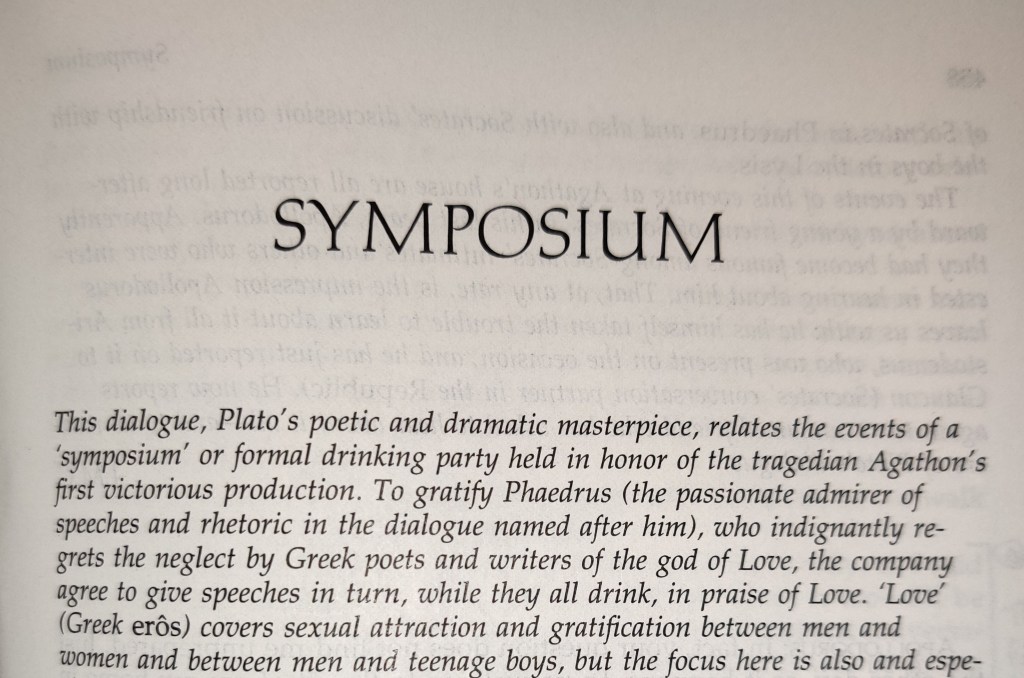
In preparation for my upcoming book club meeting, I’ve been reading through our current selection, Plato’s Symposium. While on Friday I chuckled at a little dialogue I’ve started with myself as a reader over time, I stumbled across a very interesting footnote that I wanted to share.

23. The word can be translated also as “temperance” and, most literally, “sound-mindedness.” (Plato and Aristotle generally contrast sophrosune as a virtue with self-control: the person with sophrosune is naturally well-tempered in every way and so does not need to control himself, or hold himself back.) From: Plato: Complete Works, edited by John M. Cooper (Hackett) p479.

I love learning about words in foreign languages that don’t have an exact translation into English. The great thing about these words is that is serves as a worldview expanding device that adds to the filters we use to engage with the world. Sophrosune (or sophrosyne as I later learned from Wikipedia) is often translated to mean temperance or self-control. But as this footnote discusses, the world has an added element that sets it apart from self-control.

It carries an added moral character dimension that describes a certain kind of disposition. Implied in the idea of self-control is an element of instability – the self-control is needed to push against some felt desire or want. Were the desire absent, there would be no need for self-control. We don’t think of a person who is not thirsty as exercising self-control because they are not drinking water. Self-control would instead apply to the person who is actively thirsty but must resist imbibing for some reason. There is a force of will that is being applied against a desire to tamp it down.

Thirst for water might be a poor example here since water is necessary for life. Instead, we can think of the addict who is fighting an impulse to consume something they seek to abstain from. When they fight against the impulse, they can be said to be exercising self-control.

By contrast, sophrosune describes a moral quality of a person who is, in some sense, harmonious in their inner life. They don’t have the cravings that create impulses that require self-control. Instead of fighting cravings, as in the case of the addict, they may choose to engage or not engage in an activity without any internal pull towards it.

Whether this is a quality that is possible to attain, I cannot say. But it was an interesting word to learn about as separate from what one typically thinks about when pondering self-control and temperance.

Stay Awesome,

Ryan

Masterclass in Storytelling – Hamilton

This past weekend, I had the privilege of seeing Hamilton the musical on stage. As I noted in my Instagram post, I was blown away by the experience, and was moved to tears by the performance. My emotional reaction was due, in part, to my having completed the audiobook a few weeks back. Had I not already been familiar with the story of Alexander Hamilton, I think I would have struggled a bit with the fast paced delivery of the lyrics.

In my mind, the musical is perfect – it is a shining example of why art exists and what it is capable of. Hamilton the musical takes a 35-hour book, of which spans the nearly 50-year life of Hamilton, and distills it down into a powerful 2-hour performance.

There are so many fantastic elements of the play. I don’t want to spoil the experience, but I can’t not list some of my favourite parts.

For instance, in the second song, a throughline is set-up that spans Hamilton’s life where he ambitiously declares that he won’t throw his shot (waste an opportunity to advance himself). But, at the end of his life, when he is dueling Aaron Burr over a matter of honour, he chooses to “throw his shot” (raise one’s weapon in the air to waste your shot, signalling that you are not participating in the duel) as he becomes morally opposed to dueling. It was haunting to hear this theme get set up so early.

I loved the use of space on stage. The floor was set up with two circular discs that could rotate in different directions, which meant that the actors could allow the stage to carry them around the space to give the illusion of traversing great distances.

Speaking of those discs, there were a few moments in the play where things could freeze in time or rewind. The actors could halt in tableau, but the discs would rotate them around, giving the appearance that they were reversing in time. This was so cool to see – we were able to watch a scene play out twice: once from Hamilton’s perspective, and one from the narration of a side character who was singing her motivations while guiding the scene along.

I’m not normally a great fan of dancing, but even the bodily movements of the performers had me transfixed. The ways they moved around to evoke things like battlefield war, or Hamilton feeling at the centre of a hurricane made me forget I was watching a play on stage.

So many other elements came together in amazing ways – how they used space on the stage to signal travelling over vast distances, how costumes took on symbolic meanings, the politics of ceding from England through the Kings’ songs, and the incredible attention to detail of every word spoken, rapped, and sung by the cast. The last straw was Eliza getting the final word. So. Good!

The experience was so wonderful and memorable, I can’t put into words what it meant for me to see it. I simply don’t have the vocabulary developed to articulate how smart and charming the musical was. It was a pure masterclass of how to put together a modern piece of art to tell the story of one of the United State’s founding fathers – a man whose impact lasts through to today, but whose legacy is unknown to most everyday persons.

I’ll end with one final note. In the premiere week of the show in Toronto, the CBC news company ran a short piece about the show. Within the segment, they showed a clip of an interview with the musical’s writer and original-run star, Lin Manuel Miranda, where he gives advice to up and coming playwrites. Now, granted, his words are meant to speak to marginalized voices who fall outside of what is deemed normal or popular art. However, his words, more generally applied, can speak to the creative urge in all of us.

“Well, I’ll tell you the only advice I can give is: write what’s missing. Write what you don’t see on stage. I started writing in the Heights because I really wanted a life in musical theatre and so I wanted to write the kind of show I wasn’t seeing. So, don’t write the next Hamilton. Write what isn’t Hamilton. Write the story that only you can write.”

Stay Awesome,

Ryan

A Modern Cartesian Demon

grey and brown concrete building close-up photography
Photo by Marius on Unsplash

During a throwaway thought experiment in his 1641 treatise, Meditations on First Philosophy in which the existence of God and the immortality of the soul are demonstrated, René Descartes posited the idea of an evil genius or demon that systematically deceives us to distort our understanding of the world. Contrary to first year philosophy students everywhere (a younger version of myself included), Descartes did not actually believe in the existence of an evil manipulator that was holding us back from understanding the nature of the real world. Instead, he was using it as part of a larger project to radically re-conceive epistemology in an era of rapid advancements in science that was threatening to overturn centuries of our understanding of the world. He felt that knowledge was built upon shaky ground thanks to an over-adherence on the received authorities from Greek antiquity and the Church’s use of Aristotelian scholasticism. Similar to Francis Bacon twenty years earlier, Descartes set out to focus on knowledge that stood independent of received authority.

Through Meditations one and two of his book, Descartes considers the sources of our beliefs and considers how we come to know what we think we know. He wants to find an unshakable truth to build all knowledge from, and through an exercise of radical doubt he calls into question many of the core facts we hold – first that knowledge gained from the senses are often in error, that we often can’t distinguish the real from fantasy, and through the use of the evil genius, that perhaps even our abstract knowledge like mathematics could be an illusion.

André Hatala [e.a.] (1997) De eeuw van Rembrandt, Bruxelles: Crédit communal de Belgique, ISBN 2-908388-32-4.

When I teach this to first year students, they either don’t take his concerns seriously because of the force of the impressions the real world gives us in providing sense data for knowledge (a stubbed toe in the dark seems to forcefully prove to us that the external world to our senses is very real), or they take Descartes too seriously and think Descartes really thought that a demon was actively deceiving him. Regardless of which side the student falls on, they will then conclude that Descartes’ concerns are not worth worrying about; that this mode of thinking is the product of an earlier, less sophisticated age.

Unless you are a scholar delving into Descartes’ work, the real purpose of teaching the Meditations is to provide students with a framework to understand how one can go about thinking through complex philosophical problems. Descartes starts from a position of epistemic doubt, and decided to run with it in a thought experiment to see where it took him. The thought experiment is a useful exercise to run your students through to get them to think through their received opinions and held-dogmas.

However, in light of my rant a few weeks back about informed consent and vaccines, I’ve discovered a new contemporary use for thinking about Descartes’ evil genius. In some sense, the evil genius is *real* and takes the form of fear that shortcuts our abilities to learn about the world and revise our held beliefs. Descartes posited that the evil demon was able to put ideas into our heads that made us believe things that were completely against logic. The demon was able to strip away the world beyond the senses and even cast doubt on abstract concepts like mathematics.

Much in the same way Descartes’ demon was able to “deceive” him into believing things that were contrary to the nature of reality, our fear of the unknown and of future harm can cause us to hold beliefs that do not map onto facts about the world. Worse yet, the story we tell about those facts can get warped, and new explanations can be given to account for what we are seeing. This becomes the breeding ground for conspiracy thinking, the backfire effect, and entrenched adherence to one’s beliefs. We hate to be wrong, and so we bend over backwards to contort our understanding of the facts to hold-fast to our worldview.

In truth, we are all susceptible to Descartes’ demon, especially those whom believe themselves to be above these kinds of faults of logic. In psychology, it’s called the Dunning-Kruger effect, of which there are all sorts of reasons given why people overestimate their competence. But in the context of an entrenched worldview that is susceptible to fear of the unknown lurks Descartes’ Demon, ready to pounce upon us with false beliefs about the world. Its call is strong, its grip is tight, and the demon is there to lull us into tribalism. We fight against those we see as merchants of un-truth and in a twisted sense of irony, the weapons of truth we yield only affect those already on our side, while those we seek to attack are left unaffected. It becomes a dog-whistle that calls on those who already think and believe as we do.

If we hope to combat this modern Cartesian demon, we’ll need to find a new way of reaching those we see on the other side.

Stay Awesome,

Ryan