Hey folks!
It’s Family Day here in Ontario, so I’m taking the day off to spend time with my significant other. I’ll be back next week with a new post.
Stay Awesome!
Ryan
Hey folks!
It’s Family Day here in Ontario, so I’m taking the day off to spend time with my significant other. I’ll be back next week with a new post.
Stay Awesome!
Ryan
Last week SpaceX successfully launched the Falcon Heavy rocket into space. The mission put one of Elon Musk’s Tesla Roadsters on a trip to the sun, and verified that a private corporation could fund the launching of rockets that brings us one step closer to making space travel a possibility for the average person.
The last time NASA put a shuttle into space was 2011. Since then, the shuttle program has gone quiet, as NASA has cooperated with other international space agencies to send astronauts and supplies to the International Space Station.
To be honest, I almost missed the launch. I was vaguely aware that SpaceX was set to test another launch (after a previous attempt failed in explosion), and only joined in on waiting for the launch with about 24-hours to go. But something about the launch spoke to me. It was exciting on a level I haven’t felt in a long time.
I suppose I was too young to appreciate the shuttle program when it was in full swing. I have been to the Kennedy Space Center in Florida, and I have see a shuttle up close. I’ve even met former astronauts, but I never felt the same excitement that I felt last week as I (while in a meeting taking minutes) watched the rocket’s launch sequence ignited the jets and sent the tube of fuel skyward. I felt emotional, and somehow connected to the quest to illuminate the cosmos to uncover its mysteries.
While it’s too early to say that SpaceX has achieved something unique or set humanity on a course towards space travel, I can say that for a brief moment last week, a lot more things seemed possible.
If you have a chance, I highly recommend watching the launch and learning more about the program. The final minute of the launch sequence starts at the 21 minute mark.
Stay Awesome,
Ryan
The job I have at the college is my first full time job after I finished university. Prior to the position I’m in, I have worked only full-time hours on contracts and a smattering of part time jobs. I thought, like many others, coming out of university that I knew what it would mean to have a job, be an employee, and work responsibly. I wouldn’t say I was unprepared to enter the workforce, but it would be charitable to say that I had a lot to learn, and many beliefs to update.
This is, in part, why I decided to occasionally write thoughts in a series of posts loosely connected with the theme “Skills Worth Developing.” There are many hard skills that employees should pick up over time to help them do their jobs better and advance in their careers. Organizations like Coursera, Udemy, Lynda, etc. are excellent resources to help one pick up those kinds of skills. But many other skills (usually dubbed “soft skills”) are usually picked up through experience and self reflection. This blog serves both to force me to write, but also to force me to make permanent any self-reflections I’ve had, and these reflections might be valuable to others.
The last time I discussed Skills Worth Developing, I discussed the merits of storytelling as a communication tool. This time, I want to reflect on a phrase I heard a lot when I first started working – “That’s not my problem” or “That’s not my job.”
You might be wondering why I lump this in with the notion of skills, instead of some other attribute, such as attitude. True, something like this will overlap with one’s “attitude” while on the job, but I view this as a skill because it’s a habit and ability that can be modified over time, practiced, and strategies can be employed to use it in the workplace. Therefore, I loosely connect it under the skills area that should be developed and practiced over time.
One other observation I want to make is that this skill – avoiding falling into the “That’s not my problem” mentality – is something I exercised as a beginner. I think this is a fantastic skill to develop early in your career, but I’m not entirely sure of it’s value when you are well-established in your role. The value of this skill is that it increases your value to the company when you are still differentiating yourself. The same can not be said for someone who is either well-established in their company or field, where their value is tied directly to their ability to focus on problems that they can uniquely solve. In those instances, it’s probably a better strategy to limit distractions from your primary role and duties.
And so, we come to the problem of “That’s not my problem.” I found early on that many employees in a work environment can take on the “not my problem” mentality for a variety of reasons. Perhaps they were burned in the past and now refuse to extend themselves. Some feel overworked and overstretched. Some are lazy. For whatever reason, they resist helping others in their duties.
I find two issues with this kind of mentality. First, it goes against the spirit of cooperation, collaboration, and teamwork. The workplace is a team of employees who are working towards common goals to advance the interests of the organization (while hopefully advancing their own personal interests in parallel). Any time someone says to a coworker “that’s not my problem,” what they are in fact saying is “your problems aren’t important enough for me to take an interest.” They end up placing themselves above the interests of their coworkers and the organization. I’m not saying that this is wrong per se – I am sympathetic to the ideas that this mentality is easy for organizations to exploit, and that there is no moral imperative to place the company’s interests above your own, so you should guard against it taking advantage of you. What I am saying is that taking this as a default position undermines the team. Everyone is supposed to work together to solve problems and strive to the company’s mission. If you don’t want to do that, what’s the point of working at that company? I would hardly think that it’s just in service of the paycheque.
The second issue I have with this attitude is it closes you off to development. I directly attribute my success so far to my willingness to learn outside of my prescribed job. By helping others with their tasks (so long as it does not prevent me from taking care of my own job area), I am able to develop new hard skills and learn about areas laterally and vertically from my position. I am better able to see how my role fits within the larger context of our department, which continuously exposes you to new opportunities for growth and development. You become more valuable to the team and you strengthen your ties with your coworkers. When you are just starting out, this is a valuable way of integrating yourself and setting yourself up for advancement.
When you ignore the impulse to say “that’s not my problem,” you acknowledge that your coworkers are people with their own problems, concerns, hangups and worries, while also setting yourself up as a person of value for the team. It is a perfect opportunity to step up and be noticed in your workplace.
That is why I think resisting the impulse to say “that’s not my problem” is a skill worth developing.
Stay Awesome,
Ryan
This is it! I’ve finally hit the end of the sleep challenge and I can finally look back at a year of data and see if I can spot anything interesting from the data. This post will give the quarterly update from October through December, and then I will look at the results from the entire year.
For those just coming on-board with this post, in 2017 I set out to track my sleep each month with the target of sleeping for at least 7-hours. I used a Fitbit Charge HR to track my sleep and I gave monthly updates on my progress. I also used a few quarterly updates that looked at data over longer periods of time to see what sorts of trends and patterns I could extract from the results. While I wanted to try and maximize my sleep, in truth I am terrible at keeping a nightly routine, so at the mid-point of the experiment, I set the goal of trying to get at least 10 nights in each month where I hit my target of 7-hours.
To see a recap, you can go to the individual posts below:
You can also see my quarterly updates:
First, let us look at the fourth quarter’s results.
Fourth Quarter – October through December
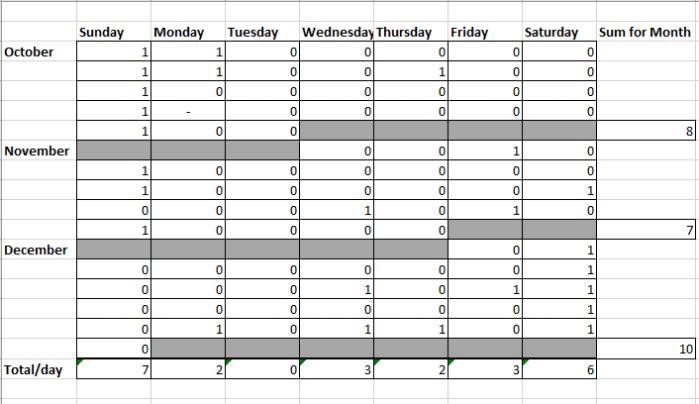
The fourth quarter results fall in line with what I’ve been seeing over the course of the year. Sundays prove to be the most consistent night of 7+ hours of sleep, followed by Saturday. Monday usually gets a high number of hits, but this time around it appears that I’m not sleeping as well when I transition from weekend to work week. I don’t have an explanation for this, other than I probably am going to bed too late (as opposed to lost sleep due to anxiety of going to work the next day).
And now, time for the final reveal!
Sleep Results for 2017
The grand total for the year are:
January – 4
February – 8
March – 6
April – 7
May – 4
June – 7
July – 11
August – 11
September – 9
October – 8
November – 7
December – 10
Total: 92
Out of the 365 nights of sleep for 2017, I hit my target 92 times, for a 25% success rate. This is a very strict number, which reflects poorly on the overall experiment, but one bit comfort I take from this is that, as I have pointed out a few times over the course of this challenge, the data is skewed when we look at the time I spent asleep, versus the amount of time the Fitbit tracker tracked me as asleep. Any amount of sleep disturbance or restlessness meant that the device wasn’t counting it as sleep time. So, while I might have been asleep for over seven hours if I had any kind of restless sleep, the quality sleep tracked came in under 7-hours.
Is there another way of seeing the data to determine if the 25% rate is overly skewed?
Time spent Sleeping
We can adjudicate this by looking at the actual time I was asleep, versus the target sleep. This way, any nights where I slept more than 7-hours would pull my averages up and cancel out some of the nights where I slept less than 7-hours.
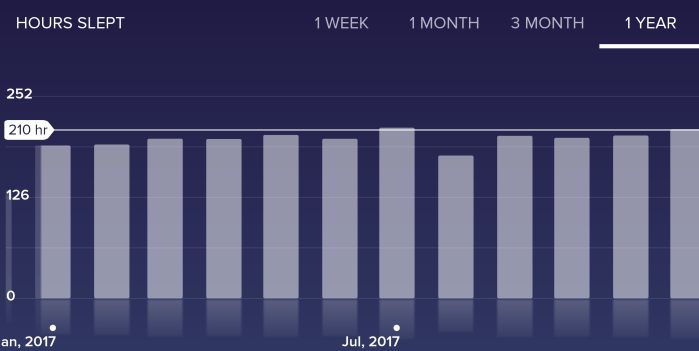
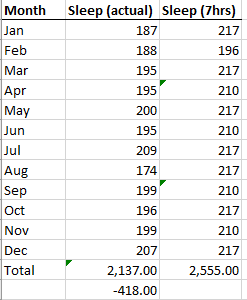
For 2017, the Fitbit tracked me as sleeping 2,137-hours. If I assume 7-hours for all 365 days, this would give us 2,555 hours of sleep. Viewed from this perspective, I hit 84% of my target sleep, with only a 418-hour deficit of sleep spread over the 12 months.
The problem with tracking only the successes throughout the year is that it ignored any sleep that falls under 7-hours. Month over month, my progress tended to looked bad and reflected poorly on my ability to set goals and maintain progress. While it’s true that I was failing in hitting absolute targets of sleep, the presentation almost suggested that if I didn’t hit my sleep target it was because I wasn’t sleeping at all.
So, while I was only 25% successful in hitting targets, I was able to get 84% of the sleep the target would imply.
One note of caution – if I’ve learned anything these last two years, it’s that I’ve learned and reflected on what it feels like to be sleep deprived. Running a theoretical sleep deficit of 418-hours for a year might not seem bad, but in practice is something to be concerned about. Sleep deprivation has consequences that affect me in many ways, such as my ability to resist temptation, my productivity at work, the likelihood that I will exercise, and my interpersonal interactions with friends and family. There was one time where in my sleep-deprived state, I let a door swing shut before my dog was fully through the threshold, and it caught him in the rear paw. Despite a yelp of pain from him, there was thankfully no physical damage to his paw. Still, I felt terrible about my carelessness and it was a reminder that my ability to focus and pay attention is compromised when I don’t sleep.
Moving Forward
Tracking my sleep for this blog was an interesting experience. I do not plan to continue giving regular updates as I progress through 2018, though I will still be monitoring my progress in my personal notebooks. I found a lot of value in seeing the aggregate results. The monthly updates were mostly in line with my intuition, but it was still good to objectively see how poorly I am with sleep.
It will be an ongoing work of progress to do better. The main takeaways from this experiment are that,
1.) I’m terrible at maintaining a disciplined nightly routines to go to bed at a reasonable time;
2.) working at the bar, even 2-nights per week, dramatically impacts my sleep during the week; and
3.) I need to pay more attention to the things in and out of the bedroom that cause disturbances in my sleep (such a the dog jumping on the bed, evening alcohol consumption, and potential sleep apnea due to my weight).
There are many avenues I can explore to improve the quality and quantity of sleep I get each night. Perhaps, I will explore them in time. However, it’s time to put down the measuring devices and enjoy a bit on unquantified time.
Thanks for following this journey of sleep.
Stay Awesome,
Ryan
Another year of reading has finished, so it’s time to take stock of how I did for 2017. While I’m not an advocate of reading purely for the sake of speed or volume, I do challenge myself to see how many books I can get through during the year, if for nothing else than to ensure I’m carving out time to read. For my 2016 results, check back to my post on What I read in 2016.
This year, I managed to get through 44 books and almost 14,000 pages, which is on par with my results from last year. I posted my top list of books I read this year a few posts back, if you want to check it out.
I would say a little more than half of these books are audio books, as I decided to get an Audible subscription, and a friend has been kind enough to supply me with Terry Prachett books. I have significantly picked up on the amount of fiction I’m reading, which was a deliberate choice since I noticed I consumed a lot of business and self-help books last year.
| Title | Author | Pages | |
| 1 | Essentialism: The Disciplined Pursuit of Less | Greg McKeown | 272 |
| 2 | The Subtle Art of Not Giving a Fuck | Mark Manson | 224 |
| 3 | Leaders Eat Last | Simon Sinek | 368 |
| 4 | Awaken the Giant Within | Tony Robbins | 544 |
| 5 | $100 Startup | Chris Guillebeau | 304 |
| 6 | Tools of Titans | Tim Ferriss | 736 |
| 7 | American Gods | Neil Gaiman | 558 |
| 8 | The View from the Cheap Seats | Neil Gaiman | 544 |
| 9 | The Consolations of Philosophy | Alain de Botton | 272 |
| 10 | Catching the Big Fish | David Lynch | 208 |
| 11 | The Colour of Magic | Terry Pratchett | 288 |
| 12 | The Path to Purpose | William Damon | 240 |
| 13 | The Light Fantastic | Terry Pratchett | 288 |
| 14 | The 80/20 Pinciple | Richard Koch | 288 |
| 15 | The Complacent Class | Tyler Cowen | 256 |
| 16 | How Proust Can Change Your Life | Alain de Botton | 208 |
| 17 | Equal Rites | Terry Pratchett | 282 |
| 18 | No Fears, No Excuses | Larry Smith | 272 |
| 19 | Mort | Terry Pratchett | 272 |
| 20 | The Death of Expertise | Tom Nichols | 240 |
| 21 | Never Split the Difference | Chris Voss | 288 |
| 22 | Sourcery | Terry Pratchett | 336 |
| 23 | On Writing | Stephen King | 288 |
| 24 | The Happiness Project | Gretchen Rubin | 368 |
| 25 | Reading the Humanities | John Greenwood | 156 |
| 26 | Spark | John J. Ratey | 304 |
| 27 | Wyrd Sisters | Terry Pratchett | 336 |
| 28 | Managing Oneself | Peter F. Drucker | 72 |
| 29 | Pyramids | Terry Pratchett | 308 |
| 30 | The Checklist Manifesto | Atul Gawande | 240 |
| 31 | Total Recall | Arnold Schwarzenegger | 656 |
| 32 | Discipline Equals Freedom Field Manual | Jocko Willink | 208 |
| 33 | I’d Like to Apologize to Every Teacher I Ever Had | Tony Danza | 272 |
| 34 | Guards! Guards! | Terry Pratchett | 416 |
| 35 | Eric | Terry Pratchett | 160 |
| 36 | Side Hustle | Chris Guillebeau | 272 |
| 37 | The Productivity Project | Chris Bailey | 304 |
| 38 | Moving Pictures | Terry Pratchett | 400 |
| 39 | Mating in Captivity | Esther Perel | 272 |
| 40 | Finding Ultra | Rich Roll | 400 |
| 41 | Reaper Man | Terry Pratchett | 288 |
| 42 | The Art of Learning | Josh Waitzkin | 288 |
| 43 | Machine Man | Max Barry | 288 |
| 44 | The Road to Character | David Brooks | 320 |
| Total: | 13904 |
All in all, I am very happy with the results, and I am looking forward to tackling the growing stack of books I have in my office for 2018.
Stay Awesome,
Ryan
Things have been hectic on my end. With the normal travel, family, holiday cheer and good eats (on top of grading, lack of exercise, strike recovery, etc), I wasn’t able to get a post up yesterday. Apologies if you were looking forward to reading something pithy in your pjays for Christmas.
I’ll have a new post up on January 8th. Until then, have a great rest of the holiday season and I’ll see you in the new year.
Stay Awesome,
Ryan
On the internet, December marks the time of year where everyone releases lists of their top favourite things from the past year. It’s my turn to add to that mighty tradition and announce my top books that I read in 2017. I will post my total list of books read in 2017 in January. For those curious, here are the 44 books I read in 2016.
Here are my top books that I read in 2017.
List Criteria:
For this post, I have three criteria notes.
Honourable Mention
The Art of Learning – Josh Waitzkin
This book goes on the honourable mention list because I haven’t finished reading it as of posting. It’s really good, though, and would have made the list had I finished it in time. Waitzkin is a bit of a wunderkind, having won chess championships as a child, then becoming a national push-hands championship, and now (post-book publication) has become a black belt in Brazilian Jiu-Jitsu. I mention this because it gives credit to the idea that he’s given a lot of thought to the learning process, and his book provides many insights that I will use both as a student and as a teacher.
Top 5 Books (in no particular order)
I read relatively few works of fiction this year, but American Gods stuck out for me. It’s been a while since I felt engrossed in a work of fiction the way I was for American Gods. It was my first introduction to Neil Gaiman’s work, and it certainly won’t be my last. I’m looking forward to checking out the television series.
The 80/20 Principle – Richard Koch
This is a book that I implemented at work with my role in program updating and renewals. I took the 80/20 principle and started thinking about the relatively few problems that lead to massive delays in the program review process in order to find solutions to the workflow. I didn’t get a chance to implement many changes before the Ontario College Strike put things on hold, but I’m looking forward to continuing the process when things even out a bit.
Never Split the Difference – Chris Voss
I wish I could say that I implemented the lessons from this book, but truthfully, I found it hard to absorb all the fine details from my first pass in the audiobook. This book will be a prime candidate for a re-read in the near future, as I will be able to take my time and work through the material to assimilate the useful information in my work.
Discipline Equals Freedom – Jocko Willink
I think this one will end up being one of those books I pick up and thumb to a random page for an aspirational kick in the pants. Jocko’s main lesson is that, paradoxically, if you want more freedom, you must get more disciplined. That means doing what you need to do when you need to do it. As he says, if you want more money, you need more financial discipline. If you want a body that doesn’t let you down, you need to have discipline in diet and exercise. As a former US Navy Seal, having this guy telling you to get on it, and why I have no excuses to stop is pretty powerful, even from the written word.
Tie: Mort and Pyramids – Terry Pratchett
This might be a cheat, but I simply couldn’t pick a favourite between these two. Both have compelling stories, both have memorable characters, and both are awesome. Mort is a story where Death looks for an apprentice, and Pyramids tells the story of a prince-turned-assassin who is recalled to rule when his father dies in a land resembling ancient Egypt. Fantastical stories full of charm, and I laughed out loud while listening to them both. Therefore, they make the list in a shared spot.
Keep an eye out for my complete 2017 list in January. In the meantime, I really need to get on my Christmas shopping!
Stay Awesome,
Ryan
My stats from the October sleep check-in were below my target, so I was hoping to get things back on track for the month of November. Let’s see how I did.
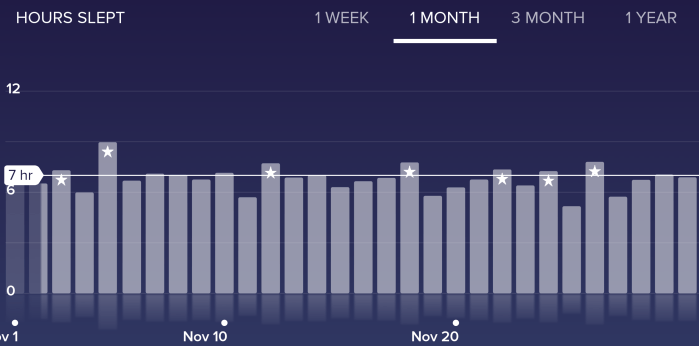
Double-ouch!
Not only did I miss my target again, but I did poorer overall than October (8 of 31). Sadly, this is less an issue of poor quality sleep (you can still see a fair number of nights where I was really close to the target line, suggesting I was in bed for at least 7-hours, but I had disturbed sleep), and more a problem of me not having a solid night-time routine. This time last year, my problem was that I couldn’t tear myself away from the internet at a reasonable time (remember when I used to shut-off my internet via timer?), whereas this year my problem is that my partner and I don’t get ready for bed at a decent time, and then stay up chatting passed 11pm.
I know that I will be doing better in December since I’ll have time off from work before and after Christmas, which will make up the bulk of the time I hit my sleep target. Still, I should strive to hit more nights during the work-week, rather than leaving it up to the weekends to catch up on sleep.
Stay Awesome,
Ryan
In my search to find exercise routines that I can make stick around long enough to build habits from, I am experimenting with a running app and a new piece of home equipment. My fiancee and I have recently purchased an elliptical machine for our home. While I was initially hesitant about the cost when I was already paying for my gym membership, I have since come around to the convenience of using the machine at home.
One issue I’ve had with fully embracing exercising at home is my limitations. Monday, Wednesday, and Friday, I drop our dog off for daytime boarding, since both my fiancee and I work during the day (it gives our dog some socializing time and exercise). This means that I have to be out the door a bit earlier than I otherwise would need to be, which cuts into time I could be at the gym.
I have been going to the gym Tuesday mornings for the last month and a half, but Thursdays are a write-off because I work at the bar Wednesday nights and don’t get to bed until 1am at the earliest. Outside of weekend, this means that my morning exercises are limited to body-weight work, or the rowing machine that currently serves as a clothes rack.
The elliptical, on the other hand, allows me to jump on for 30-45 minutes in the morning, then I can immediately shower and get ready for work and still get out the door in time.
(Note: I realize that these are not good excuses for why a more disciplined approach to my morning wouldn’t fix my problems. While this is true, I’m trying to address these shortcomings with solutions, rather than relying on a fantasy alternative reality where I am a morning person.)
The elliptical is also good because it’s low impact on my knees. I’ve recently discovered that 330lbs is the magical number where my knees are starting to hurt by the end of the day. Ideally, I want to get back into running, like I had done in undergrad, but I know that my knees and shins wouldn’t hold up to the abuse of trodding at my current weight. The elliptical provides a good middle-ground to improve my cardio in the interim.
The last hurdle is that cardio is pretty boring. This is where the zombies come in. I’ve downloaded the Zombies, Run! 5k Training app (this is not a paid sponsorship; I just like the app). It’s a fun spin on the Couch to 5k (C25K) training systems that gradually build a person’s endurance over a multi-week period to get them from complete novice to a 5km run through weekly drills and timed runs.
I’ve used it for a couple of weeks as of writing, and I’ve been enjoying the experience and sharing my “runs.”
My experience with the app have been good so far. I like that it allows for external audio to play while the app is running. I run Spotify in the background for music, then the running app interjects periodically to give me instructions, such as when to run and when to walk. The app makes these instructions fun by forming them in terms of a story about a town fighting for survival during a zombie outbreak, so when you are running, it is from zombies that you can “hear” behind you. The training is framed as you learning to be a better runner for the town (runner scavenge for supplies out of town, hence why they need to learn to run faster from zombies). It adds a sense of purpose to the training, and provides a fun context to help you progress the story along. At its core, it’s an audiobook laid over a GPS/step tracker.
Because I can complete a mission in under an hour without leaving the house, it fits well with my time restrictions in the morning. I’m enjoying the experience and I hope to keep this going beyond the 8-week training module. Combining this with lifting weights at the gym a few days a week (or the occasional YouTube lead yoga session), it provides a sense of novelty to keep me engaged in the process.
Stay Awesome,
Ryan
 A Paramedic's Notebook