Space: Revisiting the Final Frontier

Last week SpaceX successfully launched the Falcon Heavy rocket into space.  The mission put one of Elon Musk’s Tesla Roadsters on a trip to the sun, and verified that a private corporation could fund the launching of rockets that brings us one step closer to making space travel a possibility for the average person.

The last time NASA put a shuttle into space was 2011.  Since then, the shuttle program has gone quiet, as NASA has cooperated with other international space agencies to send astronauts and supplies to the International Space Station.

To be honest, I almost missed the launch.  I was vaguely aware that SpaceX was set to test another launch (after a previous attempt failed in explosion), and only joined in on waiting for the launch with about 24-hours to go.  But something about the launch spoke to me.  It was exciting on a level I haven’t felt in a long time.

I suppose I was too young to appreciate the shuttle program when it was in full swing.  I have been to the Kennedy Space Center in Florida, and I have see a shuttle up close.  I’ve even met former astronauts, but I never felt the same excitement that I felt last week as I (while in a meeting taking minutes) watched the rocket’s launch sequence ignited the jets and sent the tube of fuel skyward.  I felt emotional, and somehow connected to the quest to illuminate the cosmos to uncover its mysteries.

While it’s too early to say that SpaceX has achieved something unique or set humanity on a course towards space travel, I can say that for a brief moment last week, a lot more things seemed possible.

If you have a chance, I highly recommend watching the launch and learning more about the program.  The final minute of the launch sequence starts at the 21 minute mark.


Stay Awesome,

Ryan

Skills Worth Developing – Resisting “That’s Not My Problem”

The job I have at the college is my first full time job after I finished university.  Prior to the position I’m in, I have worked only full-time hours on contracts and a smattering of part time jobs.  I thought, like many others, coming out of university that I knew what it would mean to have a job, be an employee, and work responsibly.  I wouldn’t say I was unprepared to enter the workforce, but it would be charitable to say that I had a lot to learn, and many beliefs to update.

This is, in part, why I decided to occasionally write thoughts in a series of posts loosely connected with the theme “Skills Worth Developing.”  There are many hard skills that employees should pick up over time to help them do their jobs better and advance in their careers.  Organizations like Coursera, Udemy, Lynda, etc. are excellent resources to help one pick up those kinds of skills.  But many other skills (usually dubbed “soft skills”) are usually picked up through experience and self reflection.  This blog serves both to force me to write, but also to force me to make permanent any self-reflections I’ve had, and these reflections might be valuable to others.

The last time I discussed Skills Worth Developing, I discussed the merits of storytelling as a communication tool.  This time, I want to reflect on a phrase I heard a lot when I first started working – “That’s not my problem” or “That’s not my job.”

You might be wondering why I lump this in with the notion of skills, instead of some other attribute, such as attitude.  True, something like this will overlap with one’s “attitude” while on the job, but I view this as a skill because it’s a habit and ability that can be modified over time, practiced, and strategies can be employed to use it in the workplace.  Therefore, I loosely connect it under the skills area that should be developed and practiced over time.

One other observation I want to make is that this skill – avoiding falling into the “That’s not my problem” mentality – is something I exercised as a beginner.  I think this is a fantastic skill to develop early in your career, but I’m not entirely sure of it’s value when you are well-established in your role.  The value of this skill is that it increases your value to the company when you are still differentiating yourself.  The same can not be said for someone who is either well-established in their company or field, where their value is tied directly to their ability to focus on problems that they can uniquely solve.  In those instances, it’s probably a better strategy to limit distractions from your primary role and duties.

And so, we come to the problem of “That’s not my problem.”  I found early on that many employees in a work environment can take on the “not my problem” mentality for a variety of reasons.  Perhaps they were burned in the past and now refuse to extend themselves.  Some feel overworked and overstretched.  Some are lazy.  For whatever reason, they resist helping others in their duties.

I find two issues with this kind of mentality.  First, it goes against the spirit of cooperation, collaboration, and teamwork.  The workplace is a team of employees who are working towards common goals to advance the interests of the organization (while hopefully advancing their own personal interests in parallel).  Any time someone says to a coworker “that’s not my problem,” what they are in fact saying is “your problems aren’t important enough for me to take an interest.”  They end up placing themselves above the interests of their coworkers and the organization.  I’m not saying that this is wrong per se – I am sympathetic to the ideas that this mentality is easy for organizations to exploit, and that there is no moral imperative to place the company’s interests above your own, so you should guard against it taking advantage of you.  What I am saying is that taking this as a default position undermines the team.  Everyone is supposed to work together to solve problems and strive to the company’s mission.  If you don’t want to do that, what’s the point of working at that company?  I would hardly think that it’s just in service of the paycheque.

The second issue I have with this attitude is it closes you off to development.  I directly attribute my success so far to my willingness to learn outside of my prescribed job.  By helping others with their tasks (so long as it does not prevent me from taking care of my own job area), I am able to develop new hard skills and learn about areas laterally and vertically from my position.  I am better able to see how my role fits within the larger context of our department, which continuously exposes you to new opportunities for growth and development.  You become more valuable to the team and you strengthen your ties with your coworkers.  When you are just starting out, this is a valuable way of integrating yourself and setting yourself up for advancement.

When you ignore the impulse to say “that’s not my problem,” you acknowledge that your coworkers are people with their own problems, concerns, hangups and worries, while also setting yourself up as a person of value for the team.  It is a perfect opportunity to step up and be noticed in your workplace.

That is why I think resisting the impulse to say “that’s not my problem” is a skill worth developing.

Stay Awesome,

Ryan

Zombies, Run! 5K Training App Review

img_20180129_121511.jpg

This blog post is not a paid sponsorship.

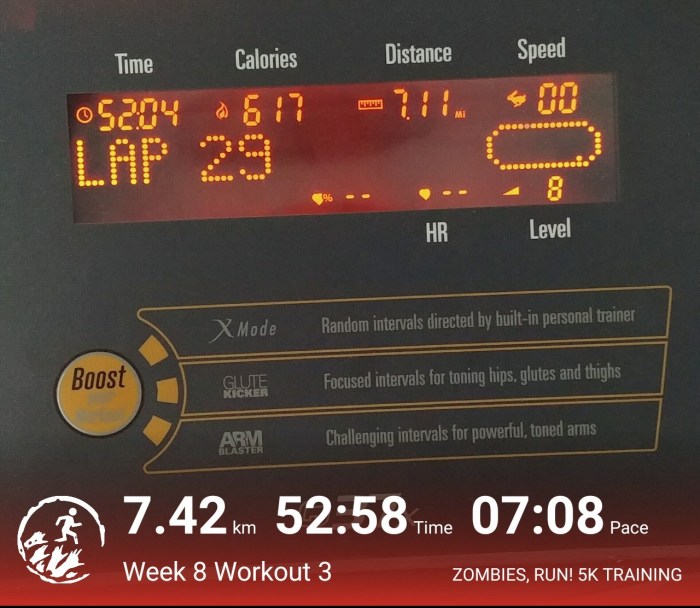
On Friday, I completed my last training mission for the Android version of the Zombies, Run!  5K Training app by Six to Start.  While this is supposed to be an 8-week training program, I’ve been at it since mid-October.  Having completed the program, I wanted to give some of my thoughts on the experience.

Overall, I loved it!

Imagine taking an audiobook about a zombie outbreak, and attaching a step-counter/GPS tracker to it.  That’s what the app is at its core.

Story

You play the silent hero, Runner 5.  The adventure opens with you in a helicopter bound for the Town of Able.  While en route, your helicopter is shot out of the sky, and you are forced to make your way to the settlement with the help of Able’s radio operator, Sam.  Once you make it to town, you meet a diverse cast of characters who you “interact” with throughout the 8-week plan.

The bulk of your interactions take place with Sam and Maxine, the town’s doctor, who also serves as your training coach while you build stamina and prepare to take your place as one of the town’s Runners.  The Runners are a group of people who are sent out on missions outside the guarded walls of town to run messages, look for survivors, gather supplies, and occasionally serve as decoy bait to lure zombies away.

While managing a zombie outbreak is bad enough, you still have the lingering question of who would shoot down a helicopter from the middle of the zombie-infested countryside, and more urgently, who is stealing supplies from the town’s quartermaster.

I found the story very immersive.  It brought me back to my old radio drama days from high school, with well-acted characters and sound effects to help you believe that you are being chased by zombies.  The creators took time to ensure the voice acting was well-done as you rely on the characters to help you experience the story.  There is no narrator telling you a story, but instead the story unfolds around you while you run.

Despite the fact that this is a training app, there is a surprising amount of story given to you.  You learn a bit of the backstory of the main players, and there is a lot of world building going on about life and the history of the zombie outbreak.  You learn a little bit about the politics of the various surrounding towns, and you get swept up in the human drama.  Indeed, your final mission is not just a 5k run, but a race against the clock to make a critical delivery to someone you’ll never meet but means the world to a close companion of yours.

The App

I found the app easy to use and well-designed.  As I mentioned above, the app is basically an audiobook and a step-counter.  There is a bit more to it, but those are just extras that help with customization.  The app tracks your progress in one of three ways – a GPS tracker that lays out your run via a Google Maps integration, a step-counter if you want to use a treadmill, and an estimated distance tracker for use on rowing machines and ellipticals (how many minutes it takes you to go 1-kilometre).  I chose to use the step-counter feature despite using an elliptical, which meant my in-app distances were skewed, however I corrected the distances with the tracking done by the elliptical itself.  I also used my Fitbit to track caloric expenditure and heart rate, since they were calibrated to my height and weight.

The best part about the app is that you can choose to use an external audio player when the app isn’t talking to you.  I used both Stitcher and Spotify and found that the integrations were smooth.  This allows you to listen to music on the run.  When the training app needs to deliver information to you, it pauses what you are listening to and continues the story, before switching back to your preferred audio.  Even taking phone calls mid-app worked well.  There was only one time where my music didn’t start back up after I took a phone call.

One note of caution is that the first 3 or so weeks of the app are free to use, but you need to pay a nominal fee ($5.49) to unlock the rest of the missions.  While this might be annoying, or a bit of a barrier for people, I liked it because a.) I’m in favour of companies making money off of users to keep creating good content; and b.) letting you use the app for free lets you test it out.  By the time I was ready for week 4, I wanted to find out what happens next, and I thought a buy-in of around $5 was worth it to continue on the adventure.  The full (non-training) app uses a subscription model, but still allows you to trying things out before you need to unlock the full app.

Training

I found the 8-week program to be a little easy for me, but using an elliptical meant that there was only so much crossover I would experience.  If I were to have tried running, I suspect the app’s difficulty would have been scaled more appropriately to me (and my knees would have taken a beating).  But the main purpose of the training is similar to most other “couch to 5K” training programs – get you moving a couple days per week while the difficulty is slowly ramped up.  I appreciate this approach, as it is enough to challenge you, but easy enough to keep you coming back for more.

To keep the difficulty scaled for me, I would often run through rest breaks, and I ensured that I kept the resistance level at a good place to maintain a heart rate of around 140bpm.  To ensure I was running fast enough, I monitored the elliptical’s RPMs, and used the following markers:

  • 40-50rpm: slow walk/rest
  • 50-60rpm: brisk walk/warm up
  • 60-70rpm: steady running pace
  • 70+: hard exertion/sprint

Before each mission, you can review what the day’s exercise routine will look like.  The training sessions involve a combination of walking and running periods, and some sort of ancillary movement to develop your leg muscles, such as knee-ups, skipping, and body-weight squats.  Some days are straight training, where you get little story development, but learn more about the people you are interacting with.  However, some training days morph into mini missions where you need to divert due to zombies or pick up critical supplies nearby.  One time, you even risk you life to help a downed runner in the field.  This is probably what kept me so engaged.  If it were just a disembodied voice telling me when to walk and run, I doubt I would find it very engaging and would have likely lost interest quickly.  However, because the training prompts are integrated into a narrative, and the characters are cheering your development on (because you are expected to take you place as a member of the community), it breaks the monotony of running up into more interesting chunks.

I’m not entirely sure to what degree I improved my cardiovascular health.  Because I didn’t feel like I struggled with the difficulty, it’s hard to measure my progress.  The best I can estimate is that my running distances did increase over time, even if you were to control for the duration of walking in the training cycles and the differences in run duration from week to week.  Despite having not measured with any amount of accuracy what my abilities were pre-Zombies, I’m fairly confident that I am in a better state of cardiovascular health having completed the training program.

Final Thoughts

If I have one complaint, it’s that the narrative move from the training app to the full app ends up restarting the story a bit.  The first mission in both the training app and the full app is  the same, meaning your story doesn’t really continue after the training app.  I suspect that once you start running the story missions, things will feel more integrated, but I was a little sad to have to “meet” Sam and Maxine for the first time again after having “developed” a relationship with them while I trained.  This is a relatively small nitpick on my part because narrative and story are important to me, but it’s not something that takes away from the experience.

I have already recommended the app to friends of mine, and I officially recommend it here.  I got well more than $5 in value from the app’s minor cost.  This is a well-made app that is easy to use, and integrates well into my exercise routine.  It makes exercise fun and engaging and the story is compelling enough to keep me coming back for more punishment.  If you are looking for a way to help you commit to a cardio routine, but you are starting off from scratch, this is a great option if you don’t mind running from zombies.

Stay Awesome,

Ryan
2017 Sleep Check-In

This is it!  I’ve finally hit the end of the sleep challenge and I can finally look back at a year of data and see if I can spot anything interesting from the data.  This post will give the quarterly update from October through December, and then I will look at the results from the entire year.

For those just coming on-board with this post, in 2017 I set out to track my sleep each month with the target of sleeping for at least 7-hours.  I used a Fitbit Charge HR to track my sleep and I gave monthly updates on my progress.  I also used a few quarterly updates that looked at data over longer periods of time to see what sorts of trends and patterns I could extract from the results.  While I wanted to try and maximize my sleep, in truth I am terrible at keeping a nightly routine, so at the mid-point of the experiment, I set the goal of trying to get at least 10 nights in each month where I hit my target of 7-hours.

To see a recap, you can go to the individual posts below:

You can also see my quarterly updates:

First, let us look at the fourth quarter’s results.

Fourth Quarter – October through December

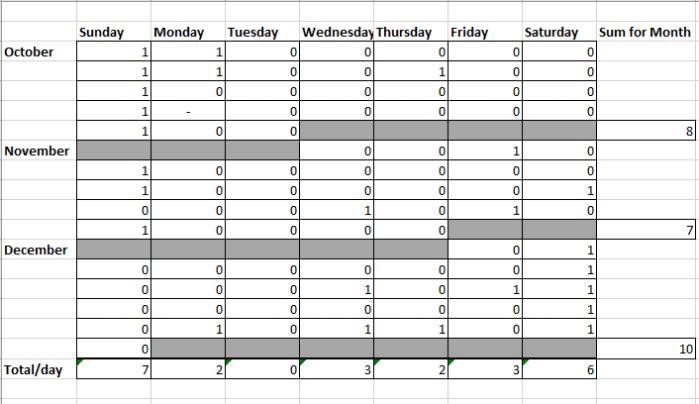
Q4 sleep
Note: 1’s denote nights where I hit my target.

The fourth quarter results fall in line with what I’ve been seeing over the course of the year.  Sundays prove to be the most consistent night of 7+ hours of sleep, followed by Saturday.  Monday usually gets a high number of hits, but this time around it appears that I’m not sleeping as well when I transition from weekend to work week.  I don’t have an explanation for this, other than I probably am going to bed too late (as opposed to lost sleep due to anxiety of going to work the next day).

And now, time for the final reveal!

Sleep Results for 2017

The grand total for the year are:

January – 4
February – 8
March – 6
April – 7
May – 4
June – 7
July – 11
August – 11
September – 9
October – 8
November – 7
December – 10
Total: 92

Out of the 365 nights of sleep for 2017, I hit my target 92 times, for a 25% success rate.  This is a very strict number, which reflects poorly on the overall experiment, but one bit comfort I take from this is that, as I have pointed out a few times over the course of this challenge, the data is skewed when we look at the time I spent asleep, versus the amount of time the Fitbit tracker tracked me as asleep.  Any amount of sleep disturbance or restlessness meant that the device wasn’t counting it as sleep time.  So, while I might have been asleep for over seven hours if I had any kind of restless sleep, the quality sleep tracked came in under 7-hours.

Is there another way of seeing the data to determine if the 25% rate is overly skewed?

Time spent Sleeping

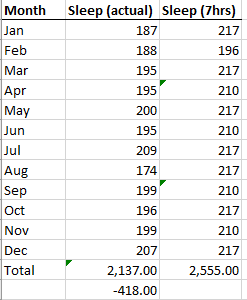
We can adjudicate this by looking at the actual time I was asleep, versus the target sleep.  This way, any nights where I slept more than 7-hours would pull my averages up and cancel out some of the nights where I slept less than 7-hours.

Screenshot_2018-01-21-20-36-37


sleep
*Note: for simplicity, I rounded the sleep values to the nearest hour.

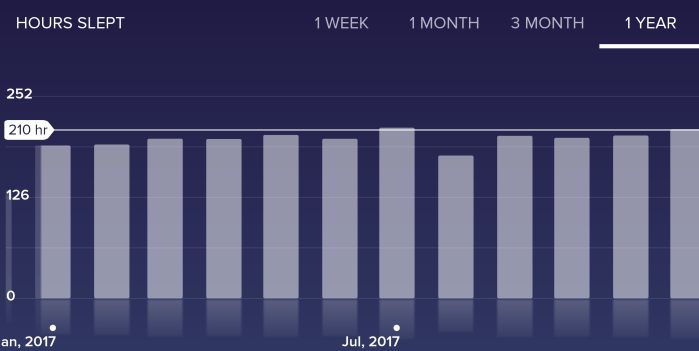
For 2017, the Fitbit tracked me as sleeping 2,137-hours.  If I assume 7-hours for all 365 days, this would give us 2,555 hours of sleep.  Viewed from this perspective, I hit 84% of my target sleep, with only a 418-hour deficit of sleep spread over the 12 months.

The problem with tracking only the successes throughout the year is that it ignored any sleep that falls under 7-hours.  Month over month, my progress tended to looked bad and reflected poorly on my ability to set goals and maintain progress.  While it’s true that I was failing in hitting absolute targets of sleep, the presentation almost suggested that if I didn’t hit my sleep target it was because I wasn’t sleeping at all.

So, while I was only 25% successful in hitting targets, I was able to get 84% of the sleep the target would imply.

One note of caution – if I’ve learned anything these last two years, it’s that I’ve learned and reflected on what it feels like to be sleep deprived.  Running a theoretical sleep deficit of 418-hours for a year might not seem bad, but in practice is something to be concerned about.  Sleep deprivation has consequences that affect me in many ways, such as my ability to resist temptation, my productivity at work, the likelihood that I will exercise, and my interpersonal interactions with friends and family.  There was one time where in my sleep-deprived state, I let a door swing shut before my dog was fully through the threshold, and it caught him in the rear paw.  Despite a yelp of pain from him, there was thankfully no physical damage to his paw.  Still, I felt terrible about my carelessness and it was a reminder that my ability to focus and pay attention is compromised when I don’t sleep.

Moving Forward

Tracking my sleep for this blog was an interesting experience.  I do not plan to continue giving regular updates as I progress through 2018, though I will still be monitoring my progress in my personal notebooks.  I found a lot of value in seeing the aggregate results.  The monthly updates were mostly in line with my intuition, but it was still good to objectively see how poorly I am with sleep.

It will be an ongoing work of progress to do better.  The main takeaways from this experiment are that,

1.) I’m terrible at maintaining a disciplined nightly routines to go to bed at a reasonable time;

2.) working at the bar, even 2-nights per week, dramatically impacts my sleep during the week; and

3.) I need to pay more attention to the things in and out of the bedroom that cause disturbances in my sleep (such a the dog jumping on the bed, evening alcohol consumption, and potential sleep apnea due to my weight).

There are many avenues I can explore to improve the quality and quantity of sleep I get each night.  Perhaps, I will explore them in time.  However, it’s time to put down the measuring devices and enjoy a bit on unquantified time.

Thanks for following this journey of sleep.

Stay Awesome,

Ryan

What I Read in 2017

Another year of reading has finished, so it’s time to take stock of how I did for 2017.  While I’m not an advocate of reading purely for the sake of speed or volume, I do challenge myself to see how many books I can get through during the year, if for nothing else than to ensure I’m carving out time to read.  For my 2016 results, check back to my post on What I read in 2016.

This year, I managed to get through 44 books and almost 14,000 pages, which is on par with my results from last year.  I posted my top list of books I read this year a few posts back, if you want to check it out.

I would say a little more than half of these books are audio books, as I decided to get an Audible subscription, and a friend has been kind enough to supply me with Terry Prachett books.  I have significantly picked up on the amount of fiction I’m reading, which was a deliberate choice since I noticed I consumed a lot of business and self-help books last year.

Title Author Pages
1 Essentialism: The Disciplined Pursuit of Less Greg McKeown 272
2 The Subtle Art of Not Giving a Fuck Mark Manson 224
3 Leaders Eat Last Simon Sinek 368
4 Awaken the Giant Within Tony Robbins 544
5 $100 Startup Chris Guillebeau 304
6 Tools of Titans Tim Ferriss 736
7 American Gods Neil Gaiman 558
8 The View from the Cheap Seats Neil Gaiman 544
9 The Consolations of Philosophy Alain de Botton 272
10 Catching the Big Fish David Lynch 208
11 The Colour of Magic Terry Pratchett 288
12 The Path to Purpose William Damon 240
13 The Light Fantastic Terry Pratchett 288
14 The 80/20 Pinciple Richard Koch 288
15 The Complacent Class Tyler Cowen 256
16 How Proust Can Change Your Life Alain de Botton 208
17 Equal Rites Terry Pratchett 282
18 No Fears, No Excuses Larry Smith 272
19 Mort Terry Pratchett 272
20 The Death of Expertise Tom Nichols 240
21 Never Split the Difference Chris Voss 288
22 Sourcery Terry Pratchett 336
23 On Writing Stephen King 288
24 The Happiness Project Gretchen Rubin 368
25 Reading the Humanities John Greenwood 156
26 Spark John J. Ratey 304
27 Wyrd Sisters Terry Pratchett 336
28 Managing Oneself Peter F. Drucker 72
29 Pyramids Terry Pratchett 308
30 The Checklist Manifesto Atul Gawande 240
31 Total Recall Arnold Schwarzenegger 656
32 Discipline Equals Freedom Field Manual Jocko Willink 208
33 I’d Like to Apologize to Every Teacher I Ever Had Tony Danza 272
34 Guards! Guards! Terry Pratchett 416
35 Eric Terry Pratchett 160
36 Side Hustle Chris Guillebeau 272
37 The Productivity Project Chris Bailey 304
38 Moving Pictures Terry Pratchett 400
39 Mating in Captivity Esther Perel 272
40 Finding Ultra Rich Roll 400
41 Reaper Man Terry Pratchett 288
42 The Art of Learning Josh Waitzkin 288
43 Machine Man Max Barry 288
44 The Road to Character David Brooks 320
Total: 13904

All in all, I am very happy with the results, and I am looking forward to tackling the growing stack of books I have in my office for 2018.

Stay Awesome,

Ryan

December 2017 Sleep Check-in

My November sleep check-in fell short of my target of 7-hours, so I was hoping to rally stronger in December to close out the year-long experiment.  Let’s see how I did for December.

Screenshot_2018-01-03-19-12-33
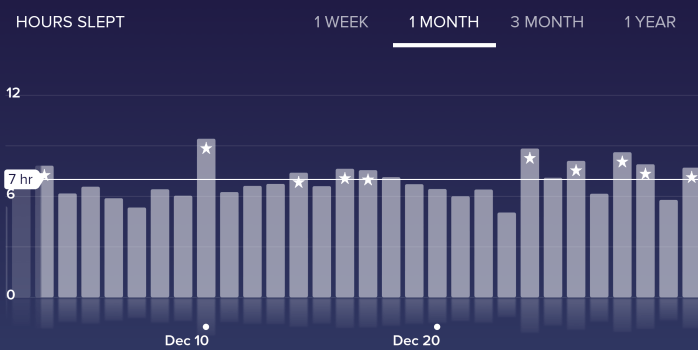
10/31 times (December 1st was cut-off on the far left of the image)

Success!

I managed to hit my target of 10 nights, but only just barely.  This is thanks in large part to my time off from work from December 23rd through the end of the year (5/9 nights).  One item of note is that I also managed to get 3 nights on the 14th, 16th, and 17th (Thursday, Saturday and Sunday), which is unusual for me.

On the other hand, I still had long stretches of time where poor bed-time habits and a lack of routine caused me to fall short of my target.  My lack of intentionality nearly lost me the challenge for another month.  This has been a persistent problem with the sleep challenge all through 2017, which suggests a lack of priority in sleep overall (though I’ll leave that reflection for the 2017 Sleep Review).

At the very least, it feels good to close 2017 and kick off 2018 on a positive note.

Happy New Year!

Ryan

Top books of 2017

On the internet, December marks the time of year where everyone releases lists of their top favourite things from the past year.  It’s my turn to add to that mighty tradition and announce my top books that I read in 2017.  I will post my total list of books read in 2017 in January.  For those curious, here are the 44 books I read in 2016.

Here are my top books that I read in 2017.

List Criteria:

For this post, I have three criteria notes.

  1. The book didn’t need to be published in 2017.  I’m nowhere near able to keep up with the new material getting pumped out every year, so for my list, I will include anything that I happened to read and complete in 2017.
  2. Having said that, I will only count books that I read for the first time in 2017.  You’ll see in my overall list of books for the year, there were a few books I revisited that I read in 2016.
  3. Finally, the biggest criteria for “best” is books that stuck with me – they gave me knowledge or wisdom that I use, or that has lasting mental/emotional impact.  This is admittedly a wishy-washy criteria, so to summarize, these are books that I found valuable to have read and I will likely re-read in the future.


Honourable Mention

The Art of Learning – Josh Waitzkin

This book goes on the honourable mention list because I haven’t finished reading it as of posting.  It’s really good, though, and would have made the list had I finished it in time.  Waitzkin is a bit of a wunderkind, having won chess championships as a child, then becoming a national push-hands championship, and now (post-book publication) has become a black belt in Brazilian Jiu-Jitsu.  I mention this because it gives credit to the idea that he’s given a lot of thought to the learning process, and his book provides many insights that I will use both as a student and as a teacher.


Top 5 Books (in no particular order)

American Gods – Neil Gaiman

I read relatively few works of fiction this year, but American Gods stuck out for me.  It’s been a while since I felt engrossed in a work of fiction the way I was for American Gods.  It was my first introduction to Neil Gaiman’s work, and it certainly won’t be my last.  I’m looking forward to checking out the television series.

The 80/20 Principle – Richard Koch

This is a book that I implemented at work with my role in program updating and renewals.  I took the 80/20 principle and started thinking about the relatively few problems that lead to massive delays in the program review process in order to find solutions to the workflow.  I didn’t get a chance to implement many changes before the Ontario College Strike put things on hold, but I’m looking forward to continuing the process when things even out a bit.

Never Split the Difference – Chris Voss

I wish I could say that I implemented the lessons from this book, but truthfully, I found it hard to absorb all the fine details from my first pass in the audiobook.  This book will be a prime candidate for a re-read in the near future, as I will be able to take my time and work through the material to assimilate the useful information in my work.

Discipline Equals Freedom – Jocko Willink

I think this one will end up being one of those books I pick up and thumb to a random page for an aspirational kick in the pants.  Jocko’s main lesson is that, paradoxically, if you want more freedom, you must get more disciplined.  That means doing what you need to do when you need to do it.  As he says, if you want more money, you need more financial discipline.  If you want a body that doesn’t let you down, you need to have discipline in diet and exercise.  As a former US Navy Seal, having this guy telling you to get on it, and why I have no excuses to stop is pretty powerful, even from the written word.

Tie: Mort and Pyramids – Terry Pratchett

This might be a cheat, but I simply couldn’t pick a favourite between these two.  Both have compelling stories, both have memorable characters, and both are awesome.  Mort is a story where Death looks for an apprentice, and Pyramids tells the story of a prince-turned-assassin who is recalled to rule when his father dies in a land resembling ancient Egypt.  Fantastical stories full of charm, and I laughed out loud while listening to them both.  Therefore, they make the list in a shared spot.

Keep an eye out for my complete 2017 list in January.  In the meantime, I really need to get on my Christmas shopping!

Stay Awesome,

Ryan

November 2017 Sleep Check-in

My stats from the October sleep check-in were below my target, so I was hoping to get things back on track for the month of November.  Let’s see how I did.

Screenshot_2017-12-03-21-40-56
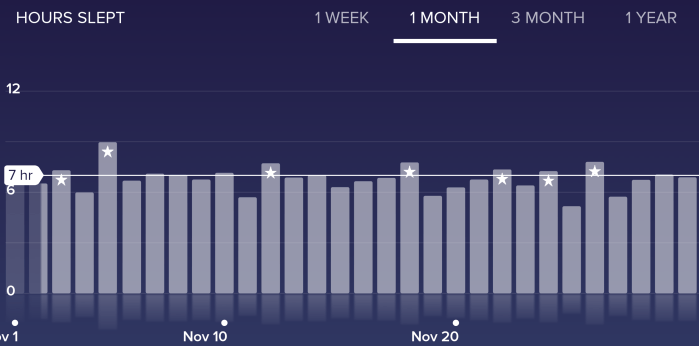
7/30…

Double-ouch!

Not only did I miss my target again, but I did poorer overall than October (8 of 31).  Sadly, this is less an issue of poor quality sleep (you can still see a fair number of nights where I was really close to the target line, suggesting I was in bed for at least 7-hours, but I had disturbed sleep), and more a problem of me not having a solid night-time routine.  This time last year, my problem was that I couldn’t tear myself away from the internet at a reasonable time (remember when I used to shut-off my internet via timer?), whereas this year my problem is that my partner and I don’t get ready for bed at a decent time, and then stay up chatting passed 11pm.

I know that I will be doing better in December since I’ll have time off from work before and after Christmas, which will make up the bulk of the time I hit my sleep target.  Still, I should strive to hit more nights during the work-week, rather than leaving it up to the weekends to catch up on sleep.

Stay Awesome,

Ryan

Ongoing Education and Solving Problems

There is a general perception that going through the formal education process is sufficient for career success.  If you follow the standard formula of secondary school, followed by some form of post-secondary education, whether through trades, college, or through the university, you should have the necessary tools in order to enter the workforce and perform well in most situations.  While this might be true to some degree, I’m willing to bet that if you were to ask people of their thoughts on this process, you’d be met with a certain level of skepticism.  Yes, there are some critical problems with how we view and use higher education, but on the whole, I think the missing piece is this: the role of higher education should be to give students the ability to think and learn for themselves (often concurrent with learning some kind of job-market skill).

The value of higher education is the exposure to ideas and of ways of thinking about things.  By exposing students to ideas and problems they’ve never encountered, you are giving them experience that they can use to navigate life after the classroom.  I think most people get too hung up on the job-market skills and end up de-emphasizing the other stuff referred to as “the humanities” or “breadth electives.”  What is important is for students to be able to cross over the threshold of their vocational training and learn to navigate in systems of knowledge that they aren’t comfortable with so that they can learn to gather information, define problems, and test solutions for things that are applicable to them.

I have a small example of this in action for myself.  Recently, the provincial college system was brought to a halt during a labour dispute.  Once the teachers came back to work, everyone set to work on figuring out how to carry-on and salvage the remainder of the semester.  One of my tasks was to track student requests for accommodation once it was determined that the holiday break was being scaled back to allow students to complete the fall semester.  If students had made previous plans for travel, asking them to cancel their plans (which often was at a huge financial loss to the students) was something the college did not wish to do.  So, the goal is to see where we can find solutions for students missing class in the revised schedule.  My job is to track the requests from students and track the faculties responses.

I wanted a simple way of tracking the information electronically on spreadsheets, and avoid copying huge numbers of cells worth of information into emails.  My solution was to set up a database.  I’ve never created a database before (only used existing ones), so I turned to resources available for employees at my work to teach myself the skills.  I set up a simple database, laid a form over it to allow for a cleaner user experience, and created standardized Word documents with placeholder values that would automatically call information from the database into the document for me to email out streamlined messages to faculty and students.

I shared this database tool across the college, and have been receiving very positive feedback from people who are using it.  I even recorded a 30-minute tutorial video on how to use the database and manage the information, then hosted the video online for other employees to use at their discretion.

My educational background is in philosophy, which is quite different from data process management.  However, through philosophy I learned skills such as how to self-direct my learning, how to define problems, and how to test solutions.  These skills are what has allowed me to come up with a way of managing all the information coming at me, and how to teach that system to others for their own use.  Being able to help others, and sharing something that they value, makes me feel really good and engaged at work, and I’m happy to be able to help others do their jobs more easily.

I understand that students often don’t have the luxury to think broadly about how their skills fit in with a larger view of pedagogy, but I think it’s important to remember that the specific processes, tools, and systems we learn at school are the micro expressions of overall deeper ways that we live, understand, and view our lives.  Taking a narrow view of the value of education tends to miss the proverbial forest for the trees.  The point of higher education is not just about vocational training and preparing people to enter the economy, but instead it’s main purpose should be viewed as a way of preparing people to become better problem solvers.

Stay Awesome,

Ryan