I’ve hit a couple of milestones recently. For instance, last week I hit a nice big milestone in Duolingo when I hit 600 consistent days of doing lessons.
I wouldn’t say I’m particularly fluent in German, but during my trip in October of last year, I was able to follow some of the conversation going on around me and put into practice the lessons given by the app. I was able to manage thanks to small, consistent daily micro-lessons that expanded my vocabulary a bit at a time.
Something similar happened for this blog as well. From time to time I check-in on the site’s stats and analytics. I don’t have any plans or intentions to seek monetization, so I only check in on things out of a sense of curiosity rather than seeking optimization. I originally set up this blog as an exercise to see if I could keep a consistent weekly writing schedule. At the time, I had the aspirations to go back to school to become a paramedic, and so I also had intended to use this blog to apply the concepts I was learning to help me reinforce my learning. I’ve sinceabandoned that path, and so the blog largely remains a project to force me to come up with something to post on a weekly schedule.
I was looking at the stats last week and felt a sense of satisfaction for hitting a couple of milestones. First, it appears that I have not missed a weekly post in the last three years (I might be late posting, but I still get something up). Also, I’m happy to see that overall my words per post are trending upwards, though I hope this means I’m providing more meaningful, nuanced posts rather than just being verbose.
Then, I decided to check on how many words I had written for this blog.
Year
Total Posts
Total Words
Avg Words per Post
2016
37
17,660
477
2017
54
28,625
530
2018
52
26,545
511
2019
52
32,210
619
2020
3
3,075
1,025
Sum
108,115
As it turns out, I had written the rough equivalent of a book in the four years I’ve been at this. Beyond the urge to create something and a desire to force myself to “write more,” the steady drip of a weekly schedule has now pooled into a large body of words.
I take a lot of inspiration from Seth Godin, and I learned from him the value of consistently showing up and putting in the work. It’s not about creating high quality giant pieces of work from fiat, but instead the slow, plodding, steady work of creating a little bit at a time. When you look back, you see the vast distance you’ve covered by forcing yourself to focus on putting one foot in front of the other. Not everything is going to be good – in fact, most of it will suck. But, over time you get better at the work, and sometimes you can find the good stuff emerging from the mediocre.
Last week, I gave a highlight of the best books I read in 2019. Below, I present what I read in 2019. By comparison to 2016, 2017, and 2018, last year was a paltry year in reading for me.
Title
Author
Date Completed
Pages
1
Harry Potter and the Deathly Hallows
J.K. Rowling
6-Jan
640
2
The Bullet Journal Method
Ryder Carroll
31-Jan
320
3
Daring Greatly
Brene Brown
4-Feb
320
4
Trumpocracy – The Corruption of the American Republic
David Frum
25-Feb
320
5
Drive
Daniel H. Pink
4-Mar
288
6
Twilight
Stephenie Meyer
10-Mar
544
7
The Gift of Failure
Jessica Lahey
12-Mar
304
8
Better – A Surgeon’s Notes on Performance
Atul Gawande
27-Mar
288
9
The Graveyard Book
Neil Gaiman
11-Apr
368
10
Bad Blood
John Carreyrou
9-May
352
11
Atomic Habits
James Clear
23-May
320
12
Built to Last
Jim Collins
25-May
368
13
Digital Minimalism
Cal Newport
30-May
304
14
Right Here Right Now
Stephen J. Harper
14-Jun
240
15
Mastery
Robert Greene
20-Jun
352
16
Complications – A Surgeon’s Notes on an Imperfect Science
Atul Gawande
25-Jun
288
17
Vagabonding
Rolf Potts
29-Jul
240
18
Becoming Superman
J. Michael Straczynski
4-Aug
480
19
A Game of Thrones
George R.R. Martin
11-Aug
864
20
Ultralearning
Scott H. Young
31-Aug
304
21
Reader Come Home
Maryanne Wolf
11-Sep
272
22
The Threat
Andrew G. McCabe
14-Sep
288
23
Indistractable
Nir Eyal
19-Sep
300
24
Permanent Record
Edward Snowden
22-Sep
352
25
The Path Made Clear
Oprah Winfrey
19-Nov
208
Total:
8924
I have a few thoughts as to why my reading rate dropped off significantly last year and what I can do about it in the year to come.
Life Pressures
Last year had a few significant pressures on my life that might have affected my desire to read. We started basement renovations early in the year, only to discover our basement’s foundation was cracked, requiring us to source quotes and opinions for repairs. This delayed our basement renovation, which didn’t finish until the summer. The protracted project weighed heavily on our minds throughout the year as we questioned whether we were making the right decisions for our home repairs, or whether we would need to make additional fixes later down the line.
Another big change for me was a change of my job at work. While I wouldn’t say it affected me as strongly as the basement renos, it disrupted my routine enough to impact my desire to focus on reading when I came home from work. Couple that with another full year as Board Chair for the non-profit I head up, and it left me with less cognitive bandwidth for self-improvement.
Podcasts and Music
If 2016 was my year of purchasing books, 2017 saw me start to utilize Libby to access the library, and 2018 was an all-out race for me to go through as many audiobooks as my brain could absorb, I felt a greater push away from books in 2019. Instead of working my way through 8-15 hours of content for one piece of work, I found the shorter format of podcasts more satisfying on my commutes. I enjoyed the variety in topics, shows, and voices.
However I also found I was drawn back to listening to music instead of information. With the sheer volume of books I’ve consumed in the last three years, it was nice to go long stretches without a goal of getting through books (or trying to learn new things) and instead allow the melodies, riffs, percussion, and lyrics sweep me away.
Book Burnout?
Overall, my rate for the year was a bit varied. I started slow in January and February, then picked back up in March. April only saw one book completed, then I found my footing again through May onward. However, October is when my wife and I traveled abroad for our honeymoon, and I never recovered my reading habit for the rest of the year.
Given that I spent most of the last three years focusing on business, personal development, and productivity books, I didn’t feel a strong desire to read those books in 2019. Even among the books I did read from that area, I found looking back that I don’t remember anything of note from those books. Neither the book’s theses nor the examples they offered have stuck with me as I enter the new year.
I’ve mentioned a few time the concept of the animated bibliography on this blog, and I think I’ve hit peak saturation for the genre. I’ve read the canon, and find that reading new books in the genre is resulting in diminishing returns; that is, I’m not really seeing a lot of new insights being offered that leaves me wanting more.
In my list last week, I commented that the books that I’m drawn to now is starting to shift away from business and productivity and more towards moral lessons found in fiction, biography/memoir, and journalistic explorations of current events. That’s not to say I won’t continue to be tempted to pick up the latest book that promises to fix my life, but it does mean that I’m intending to be more selective in what I choose to prioritize.
Assuming I continue to live a somewhat healthy life that is free from accidents, I figure that I have around 45-50 more years of life left. If I read around 3 books consistently per month, I will get another 1,650 books in my lifetime (4 per month is 2,208 books, and 5 books per month is 2,760 more books before I die). While that sounds like a lot, it’s a drop in the bucket compared to the number of books that come out each year and the books that have already been written. There is more to life and learning than being more productive or seeking more meaning in one’s life. I’ve grown to appreciate the value of storytelling this past year, and there are a lot of stories out there to sink into. If I only get access to a few thousand more stories, I should make sure they count.
In the waning days of 2018, I gave a preview of the books I read for the year by listing my top five books. I doubt my current list of books will grow before the new year chimes in tomorrow night, but I will save the 2019 list for next week, and instead present you with my top books I read this year.
My overall volume of reading this year was less than half of what I read last year. Since 2016, I’ve intentionally set about to increase my reading and I was able to keep the pace for three years. However, for some reason my reading slowed down a bit. I’ll reflect on this over the coming week and share some thoughts with my 2019 reading list post. Given the relatively short list this year, I will instead highlight all of my favourite books since it seems that these were the books that stuck with me.
In chronological order of when I finished them, here are my top books I read in 2019.
The Graveyard Book – Neil Gaiman
A delightful fictional story about a boy who grows up in a graveyard among ghosts and other creatures of the night. Rather than a horror story as you might expect from the premise, instead this is a charming and whimsical coming of age story that gripped me from start to finish. Like all good stories, I was sad when the book was over and missed the characters dearly.
The story of the rise and fall of Elizabeth Holmes and the Theranos company. Not only is this book a journalistic account of the deceptive “science” and events surrounding the failed tech venture, but it also explores the toxic achievement culture at the company’s top and the lengths the journalists and ex-employees had to go to in order to bring the company down. It’s a riveting story to experience, and I was happy to hear of the Ethics in Entrepreneurship initiative founded by two of the whistle blowers.
This memoir took me to the highest highs and the lowest lows. While Straczynski is known for his ability to craft human stories in the most magical and alien of settings, none of his work of fiction can come close to matching his own personal story of growing up in an abusive home and how that shadow followed him throughout his life. Running in parallel with his own story, he also tells a mystery story about his family’s origins that spans three generations. I mostly started this book to learn about his craft and the origins of some of my favourite projects he’s worked on, but in the end I witnessed a masterclass in writing and reflection.
With the end of the show this year, I felt like it was time for me to crack into the books that kicked-off the phenomenon. I am grateful that I watched the series first as it really helped me keep track of all of the characters in this massive tale. Also, reading a large fictional story was a welcomed relief. Over the last three years, my primary genre to read is at the intersections of business, productivity, and personal development. I think one thing that has lead to me reading less is feeling burnt out of that kind of content, so it was great to read something for pleasure. I am still proud of going through 500-pages while up at the cottage; there is nothing quite like reading by the lake.
Thanks to the Libby app and the library, I was able to check out books I otherwise wouldn’t have encountered if I had to purchase them. I wasn’t sure what to expect, but this memoir was fascinating. I’m drawn to books where people look over their life and career to draw lessons when connecting their experiences. Whatever the political climate we find ourselves in, I find it somewhat reassuring to know there are people in the deep state who work to put the mission above party, though as more evidence comes to light, that faith is beginning to crumble.
Despite the subject matter, there is no other word I can think of to describe this book than “awesome.” And I mean “awesome” in both senses of the word. The book inspires “awe” at the sheer scope of things, but also a riveting tale of Snowden’s life to date, full of creativity, ingenuity, and technological espionage. I marveled at the fact that he is only a few years older than me, but what he has gone through is likely to dwarf any contributions I’ll ever make. I hope he can come home one day, but for the present I hope he remains safe while the effects of his actions continue to simmer in the current political climate.
In looking over my top books for the year, we see three genres stand out – fantasy, current events journalism, and memoirs. I would have also included biography in this list, however one book is missing that I unfortunately couldn’t finish before it was checked back in to the library: Hamilton by Ron Chernow. It’ll get added to my 2020 list when the library finally releases it back to me.
As I said above, I think I’m starting to burn out of the business and productivity genres of books. When I reviewed the list for the year, I had almost no recollection of the content for nearly all of the books. It would seem I’ve hit a bit of a block, where I’ve consumed so much content in a short amount of time that I’m failing to hold on to it (or, as a corollary, the content is so superficial that it doesn’t stick…).
I still have a number of books on the go that I hope to finish early next year (such as the first Witcher book that the game and Netflix series was based on, Robert Greene’s Laws of Human Nature, and Working by Robert A. Caro, to name a few). Once I clear some of the current backlog, I plan to start selecting my reading a bit more intentionally so that I can reflect on the lessons the books have to offer. Overall, the main themes that stick out in the books that speak to me personally are good moral stories, cautionary tales, and the reflections of/about people over a long period of time to draw connections and lessons from their life and work.
As the year is winding down, I (like many others) am beginning the process of looking over the year that was and weighing in on how things went. While I ideally would have set goals for myself for 2019, truthfully I am terrible on the follow-through and I ended up setting something more akin to an “intention.” For instance, over the last two years, I had set as a New Year’s resolution to 1.) stop being late for things, 2.) keep exercising, and 3.) start making better eye contact when talking to people.
In reality, I’m still late for everything (but at least I track it), I stopped exercising a while ago (I’m disheartened no one called me out about it on social media), and I still feel my eye contact at work is spotty at best.
Last year though, instead of creating a quarterly goal for myself, I set a grand focus or theme for the year. I had tried setting quarterly themes for myself a few years ago, but I found that I wasn’t making progress during the quarter through poor goal management on my part, so I simplified and decided to work on one thing for the year.
At the start of 2019, I decided I would place greater emphasis on my health. I kept it fairly broad in its application, but I did brainstorm a number of concrete areas I could work on, such as weight loss, lowering my blood pressure, regularly attending the gym, better nutrition.
I think the fact that I kept things open-ended was a main reason why I feel like I didn’t accomplish this focus as well as I had wanted to. Had I set specific goals with realistic action items, I might have made better progress.
That’s not to say I haven’t “lived healthier.” For instance, I have:
experimented with intermittent fasting all throughout the year which did help to keep my overall weight regulated.
finally got a family doctor after having been dropped from my doctor when she closed her practice a decade ago.
went in for my first physical in a long time and had blood work done to check-in on how my body is doing.
been weighing myself and measuring blood pressure more frequently, though still haphazardly.
experimented with app-based meditation; I found the experience interesting and meriting further exploration, but I haven’t carved out the time to dedicate to it.
while on my honeymoon I hiked up Mt. Vesuvio and did a roundtrip on the Path of the God hike (nearly 20km and 200 flights of stairs registered on my Fitbit for the day).
began tracking things like my down/depressed days, headaches, and time with family and friends in addition to my sleep tracker.
visited my optometrist for a check-up.
two regular visits to the dentist.
cut down on the amount of junk food I take in my lunches at work to essentially zero.
While these aren’t quantified victories, there are worthwhile achievements to celebrate. As I look to the new year, one lesson I can draw is that limiting my one thing for the year is a good way to focus my attention, but if I want to make any tangible progress (e.g. weight loss on the scale), I would still need to set proper SMART goals and create an action plan that requires me to carve out time intentionally.
I’ve been thinking about endurance recently, specifically in two areas of my life. First, I’ve been experimenting with intermittent fasting since January of this year and I’ll be sharing some reflections on it soon. By fasting each day, it requires a certain amount of endurance to push through on cognitively and physically demanding tasks while your body deals with the exertion in a fasted state.
Second, as the winter weather hits us, I have to endure colder temperatures while working at the bar. I’ve managed to push myself over the last two years and use a sufficient number of clothing layers to eschew wearing a coat while on the door position. I have the coat on hand, but I like the challenge of working without it and standing outdoors for long stretches of time exposed to the elements.
It might seem silly or pointless to put myself in these positions when I don’t have to – I make enough money so that I never need to worry about food scarcity or not owning enough proper clothing to protect myself. On some level, it’s stupid machismo to willfully deprive myself in this way. Yet, I like the challenge and the sense of satisfaction that I can achieve some level of control or mastery over myself and my situation.
While recently listening to Oprah’s book The Path Made Clear, I came across a really interesting way of framing this tendency I have. The specific section runs from 4:53-5:52 of the clip below, where Oprah is chatting with Alanis Morissette about the yearning to seek out a time in the future where all your present problems are solved and you are finally happy. They discuss that this forward-orientated hope for the future never manifests itself as peace; that money and fame doesn’t bring you happiness or contentment. Instead, you are always chasing that future where you are free from whatever pain you feel in the present.
“One of the big lessons I’ve learned over the last little while has been that if I can be comfortable with pain, which is different than suffering, if I can be comfortable with pain, as just an indication, and it’s potentially a daily thing (in my case it often is) then there won’t be my living in the future all the time; that one day if and when I will be happy.
“And even if I’m not comfortable doing that, I’m very uncomfortable in pain – I hate it – we run from it with all kinds of addictive, fun things (temporarily fun things). But at least knowing it’s a portal, and that on the other side is this great sense of peace that goes beyond this ego development.”
~Alanis Morissette (lightly edited for readability)
This sentiment spoke to me. I have an affinity towards stoicism and the idea that one should re-frame their relationship with the external. To me, I like knowing that I can endure, even when I don’t have to. It becomes practice for those moments when I need to dig in deep to perform, because life isn’t always easy. Through this practice, I can also appreciate my comforts all the more. And, it also doesn’t need to run in opposition of my goal to remove discomfort from my life so long as I remember that I’m not entitled to a life of comfort and ease and instead have to intentionally earn it.
I acknowledge that I’m fortunate not to live with serious pain or suffering. I have a comfortable life and I wouldn’t exchange it for machismo points. I don’t think the point of life is to suffer, but instead my goal is to learn to suffer well when life brings me pain.
Back in January, I discussed how I set up my monthly notebook. I’ve since updated the system and added a new process that I thought I should share.
Previously, at the start of the notebook I would collect a running series of to-do items. Most of the items at the top of the list would be things that had been carried-over for multiple months, with a few small items at the bottom that likely were first jotted-down in the previous month. I found that I was continuously copying out the same items month-over-month and the list was growing. On the one hand, if the thing isn’t important enough for me to complete in a reasonable amount of time, it could be the case that it’s not important enough for me to carry-forward and that I should just drop the task all together.
Yet, I felt that some of the tasks were things I’d want to complete “one day” in the undefined future, but that I had lots of other pressing things that needed my attention first. Or, some tasks would require a fair amount of planning or coordination, and so I would tackle it after an adequate amount of lead time.
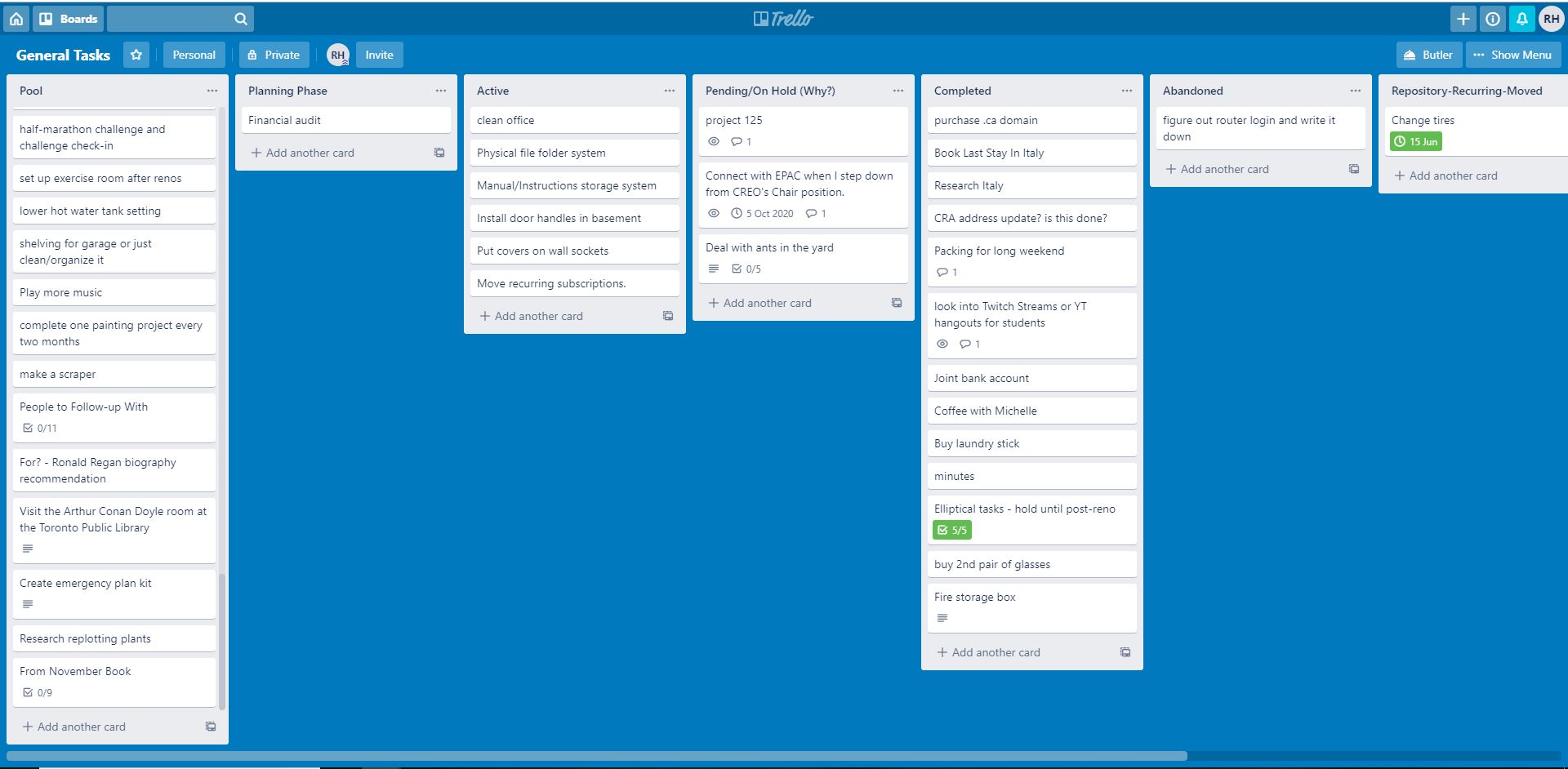
Some time ago, I created an account on Trello, but it was sitting unused as I didn’t know what kind of boards I would find useful. This seemed like the perfect experiment to help me remain flexible.
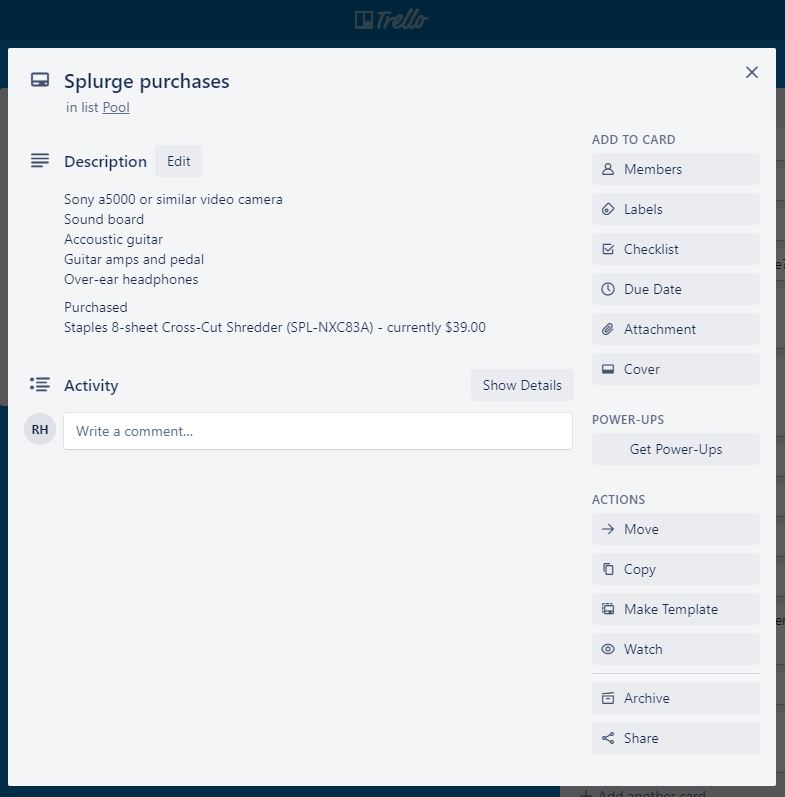
I set up several columns (buckets) of items. In the far left, I labelled the list “Pool” and dump in all to do items. Within each of the cards I can make notes or sub-lists to help keep me on track of things. At the start of each month, if there is something I don’t want to carry forward into the new book, I put the item into the bucket.
An example where I grouped a bunch of items under a single heading – in this case, splurge purchases I want to make but at a time when I have the discretionary funds.
Next, is the “Planning Phase” bucket. The beauty of Trello is I can drag cards from one column to the next, so when I’m ready to move stuff from the Pool to another phase of activity, I can easy drag-and-drop. Items in the Planning Phase might require me to do research or make purchases in preparation to work on the project.
If no further planning is required, I move it into the “Active” column. When a task is active, it’s something that I’m placing priority on and is meant to remind me to carve out space in my schedule to address.
An example of something that requires research and ongoing monitoring, I had ants in my yard last year and I wanted to deal with them without harming the grass or affecting my dog. Now that it’s Winter, I can’t deal with this again until Spring.
Sometimes, a project needs to be put on hold. I created a bucket to put tasks that are underway but I’m not making active progress on. Items in this bucket might require someone to get back to me on some action of detail, or maybe I need to wait until a future date to complete the tasks. Whatever it is, if I don’t want to move a task back into the pool column, I place it here and make a note of why the tasks is in limbo.
“Completed” is my win column – it gives me a chance to see what I’ve crossed of my list and as the column grows, I can take satisfaction in my accomplishments.
I created an “Abandoned” column because sometimes I will choose not to complete a task but I don’t want to delete it outright. Maybe it’s something that’s still important, or maybe I missed a window but I want to be reminded of it.
Finally, for tasks that occur regularly but infrequently, I have a column so that I can see when the last time was that I finished a task, and remind myself that it will need to go back into the active column (e.g. changing my tires, changing the furnace filter, etc.).
I’ve been using this revised system for a few months and it seems to be satisfying my immediate needs. It both cuts down on the number of items I need to manually copy from book to book while allowing me to indefinitely store things in a user-friendly format – effectively marrying my love of analogue with the convenience of digital.
Recently, a lot of things circulating through social media and my podcast feeds have been enraging me. I try to mitigate these things through a number of strategies – limiting my time on social media, intentionally targeting positive messages, not reading comments, not engaging, reminding myself that it is ok to disagree about things, etc. The hardest things for me to let go are cases where my thought-processes seem to wildly diverge from others about the framing of the same set of facts.
Initially, I wanted this blog post to be my master rebuttal. I wanted to lay out my case for why the conclusions others are drawing from this or that event are wrong and why. I wanted to emphasize what the important, salient points are that we should keep in mind.
But I know in my heart that would be an exercise in futility. A blog post is easy to skip; easy to ignore. I won’t change hearts and minds by arguing against a strawman average of the viewpoints expressed in my network of known-people. It would be antagonistic, hostile, and unproductive towards my goals. In all likelihood, it would backfire and entrench or alienate friends.
Instead, I will offer a different approach that I want to continuously remind myself of. When I feel compelled to dig in my heels for an argument, I should remind myself of the following.
First, remember what Aristotle (via Will Durant) tells us about virtue and excellence. It doesn’t matter what others say or share/post online; we are what we repeatedly do. Excellence, then, is not an act, but a habit.
Second, turning to fiction, remember why The Doctor helps people.
“Winning; is that what you think it’s about? I’m not trying to win. I’m not doing this because I want to beat someone or ‘cause I hate someone, or because I want to blame someone. It’s not because it’s fun. God knows it’s not because it’s easy. It’s not even because it works because it hardly ever does. I do what I do because it’s right! Because it’s decent. And above all, it’s kind. It’s just that. Just kind.”
Series 10, Episode 12: “The Doctor Falls”
Ultimately, it’s not about what I will say, or argue. Arguing with other people doesn’t make me a decent person; picking fights online doesn’t put me on the high road. If I want to bring about change in people I care about, it’s important to remember to be kind. Always be kind and help people, because it’s the right thing to do.
I recognize that being kind doesn’t give a lot of direction and can seem cowardly when meeting the systems that do real harm to the vulnerable and oppressed. In fact, espousing kindness can easily slip into inaction or forced neutrality. It’s hard to be prescriptive in this case at a granular level.
However, if I start with the core values of kindness and action, that what is important is doing things that are kind to others, then you can use your values as a filter for determining what you will choose to do.
Instead of arguing online, I choose to try and lead by being kind.
While reading a post from A Learning A Day, I thought I’d keep the irony train rolling by linking to Rohan’s linked post from Derek Sivers about the perceived need to quote an idea’s source. Specifically, I wanted to respond to this point:
2. School teaches us to reference. But we’re not trying to impress a teacher anymore. And every unnecessary fact dilutes our point.
I often reflect on the learning objectives I expect to achieve in a course lesson while teaching. I try to parse out the meaningful things I want students to learn from rote procedural tasks that don’t serve a purpose. The last thing I want to do is to reinforce the wrong lesson or derive the wrong conclusion from a student’s performance (e.g. did a student do well on a test because they understood the material, or because they are good at taking tests?).
Derek’s point above about references is well-taken and got me thinking: why do I want students to cite their sources? I brainstormed a few reasons and listed them below with comments.
Reason
Thoughts
I want a student to be mindful of their research process (procedure).
Having gone through writing my master’s thesis, it’s easy to lose track of references and citations if you don’t stay on top of it. This isn’t super relevant to most assignment learning objectives, but it’s a good practice to have before launching into a bigger endeavor or capstone project.
2.
I want a student to critically examine their own knowledge (what do they believe to be true facts, where did that fact come from, and why do they think it’s true).
I’m not sure if making students cite their sources achieves this aim on its own, but I suppose I could use citation requirements to help guide them through this process.
3.
I want a student to be mindful of idea ownership and give credit to people who have done work.
I’ve used this mostly in plagiarism cases where students copied work and submitted it as their own. I try to distinguish between sloppy citing and outright theft, and I remind students that they shouldn’t get marks for work they didn’t do. I’m still undecided if this is a rule of the academy or a legitimate thing to prevent fraudulently passing work off as your own in the future. This point, though, is mostly relevant in academic contexts as opposed to Derek’s notes about doing this during conversations.
4.
I want an easy way to see if the student did the work.
This is a trick I’ve developed to see whether a student giving me their opinion is right by chance, or if they have informed their opinion by doing the course reading. The same result could be gained if students inserted relevant information without citations, but the citations help to highlight this when I’m reading through their submission. In other words, it makes my job easier.
5.
I want to reinforce good academic writing habits.
Using references is part of what it means to write academically, and is used as part of the integrity process. This is only a good reason if my objective is to teach/reinforce academic writing for students.
6.
This is the way it has always been done.
More cynically, requiring citations is part of the tradition, and who am I to question it? It’s not a good reason to require it, but it is what it is. I won’t included in the list to the left, but a more sadistic version of this is “I had to do it, so you have to (go through this rite of passage) too!”
7.
I want to remain consistent with departmental policies and culture.
Whether written or unstated, most departments adhere to some level of standards. This was less the case for me in undergrad and it depended largely on the preferences of the prof. By the time of my thesis, I ended up developing a hybrid referencing system that did not strictly follow any of the major citation methods. I received no comments from anyone who reviewed my thesis on my citation practices.
8.
It’s important to trace an idea’s lineage as much as possible to spot fabrication.
If you are going to insert facts or conclusions into your work, it’s important to point to where you found them. Without a citation or an adequate way of accounting for how you know what you purport to know, it’s possible that the information is made up. Being able to trace these things helps, albeit this is more useful from a scholarship point of view, as I suspect a lay-reader isn’t concerned with checking a text for factual accuracy and instead takes it on authorial authority.
9.
Related – to see if a student is able to either properly reference work, or at the very least charitably restate ideas without dropping important content from the idea.
This perhaps falls under sloppy citation practices, but on occasion students will misunderstand a piece of text and paraphrase or summarize information incorrectly. Knowing where the student is drawing their source from can have pedagogical merit if you take the time to compare the student’s work with the source and discuss the divergence.
10.
Related – when an author cites their sources, a reader can use the bibliography of sources for further reading.
This is perhaps more for book nerds, but I love having references to be able to learn more for things that pique my interest. This is, however, not the context Derek is referencing when he discusses giving citations during a normal conversation. If Derek’s conversation partner was interested and want to know more, I’m sure they would ask Derek for more information.
11.
More abstractly, knowledge and academics is a web of mutually reinforcing facts, so academic writing is an extension of that reality.
This one is a bit of a stretch as to why a student who is not adding to a body of knowledge is required to rigorously cite their sources in a pedagogical exercise, but I include this more epistemological point to try and be exhaustive.
12.
It’s a symbolic representation that the student (in most contexts) is not generating new or novel work/insights that creates new knowledge, but instead is remixing ideas from other sources.
I think this is a good reminder of what the goal of the assignment should be (students are often far too ambitious in what they think they can reasonably achieve in x-number of pages), but I wouldn’t consider this to be an adequate reason to insist on proper citations.
13.
Like other skills, the act of referencing needs to be practiced.
I’m sympathetic to this, but as Derek is implying, you should be practicing skills that transfer into other domains or that you will need. In most instances, outside of school you don’t need to cite sources.
14.
Citing references is part of the argumentation process. In order to build a successful argument, you must clearly express and state your premises, which includes any premises taken from the work of others (either their premises or their conclusions).
I’m also sympathetic to this as I think everyone should keep in mind that arguments need to be made to help convey ideas. It shows the logical chain from premise to conclusion and seeks to make the implicit explicit, and the unstated stated.
Other than a subset of the reasons above, a strict requirement for citations is often unnecessarily enforced in the classroom, and is almost never required outside of the academic setting. I think there are some good pedagogical reasons to have students go through the effort to cite their sources, but you should be intentional when teaching as to when those cases apply. For instance, I am less strict about my students citing sources and instead I look for them to directly apply material from the course in their assignments (instead of giving me their opinions).
I enjoyed Derek’s point about how citing sources is a common trope in pop non-fiction, which sounds like a convergence on my ideas concerning animated bibliographies, or Ryan Holiday’s “15 academic studies” comment from a few weeks back. Maybe Derek’s right – we should have more courage to integrate knowledge into our existing schema and be prepared to state things as facts instead of citing our sources. I’m not sure I’m prepared to abandon the practice wholesale, but it has given me something to chew on.
Despite my rant a few weeks back on the podcast-book marketing relationship, there are a few authors I will check out when they appear on podcasts I’m subscribed to. For instance, Ryan Holiday just released his new book and is out promoting it to various podcast audiences.
He appeared on Rolf Pott’s podcast, Deviate, and had a conversation about what it’s like to write a big idea book. Towards the end of the episode, he makes an off-hand remark on getting ideas from recently published books, and how he chooses not to do this because it tends to result in recycling the same academic studies. Given how much I rant about animated bibliographies and short term content bias, I was happy to see some convergence in our ideas – that my amateur attempt on commenting on culture is shared by people I admire and hold in regard.
I’ve transcribed his remarks below, but you can go here to listen to the episode yourself. Holiday’s comments begin at the 50:37 mark:
Potts: And that’s why you should feel blessed not to be an academic, right, because that’s such a useful model from which to write a book. The academic world has these different hoops to jump through that often aren’t as useful. And I would think that, sometimes, there’s types of research, like, do you do much Google or Wikipedia research, or is it mostly books?
Holiday: Yeah, I mean, you have to be careful, obviously, relying on Wikipedia, but yeah you do wanna go get facts here and there, and you gotta check stuff out. I like to use obituaries. Let’s say I’m writing about a modern person and they’ve died. New York Times obituaries, Washington Post obituaries often have lots of really interesting stuff. Then you can be really confident that dates and places and names are all correct because they’ve been properly fact-checked. So I like to do stuff like that. I watch documentaries from time to time. In this book, there wasn’t really a great book about Marina Abramović, but there was some really great New York Times reporting about her Artist is Present exhibit, and there’s also a documentary with the same name. So I’m willing to get stuff from anywhere provided I believe it’s verified or accurate, but you can’t be choosy about where your stuff comes from. And in fact, if you’re only drawing from the best selling books of the last couple of years, just as an aside, an example, I find when I read a lot of big idea business books, it feels like they’re all relying on the same fifteen academic studies. It’s “the will power” experiment, and “the paradox of choice” experiment, and the “Stanford Prison” experiment! They think it’s new because it’s new to them, but if they’d read a little bit more widely in their own space, they’d realize that they’d be better off going a bit deeper or treading on some newer ground.
*****
(Note: I’ve lightly edited the transcript to remove filler words and some idiolects).



 A Paramedic's Notebook