What I’ve Been Reading (As of April 12th, 2020)

person holding opened book
Photo by João Silas on Unsplash

It’s been a while since I’ve written one of these posts (last one was October 2018!). Since many people find themselves with some extra reading time, here is what I’m working through while staying safe at home.

Salt, Fat, Acid, Heat by Samin Nosrat

With some extra time at home and wanting to ensure I’m using my perishable foods wisely to cut down on waste, I decided to finally crack this book that I bought for myself at Christmas. When it originally arrived, I was slightly disappointed to see it was less of a recipe book and more of a primer on cooking (which I stuffily thought I had already a good grasp on). However, I recently checked out Nosrat’s latest podcast miniseries, which endeared me to her instantly (she’s so bubbly and full of passion, it was infectious!). Then I checked out the Netflix series that was created based on this book. Then I set to work cooking a minestrone soup from scratch (taking some cues from Jamie Oliver’s YouTube channel) and channeled Nosrat’s thoughts on what makes food taste good. The soup was a hit here at home, and it’s given me the confidence to keep practicing.

Gulliver’s Travels by Jonathan Swift

Some friends and I started a book club just before the government started shutting things down in the province. Our first book was Jim Mattis’ military memoir, and I chose Gulliver’s Travels as our second read. I had first encountered the story as a child, then again in first year of undergrad when I had to read excerpts for a class. However I don’t think I’ve read the unabridged book in its entirety, so I’m trying to approach this read fresh and wrap it up before we meet later this week.

Gates of Fire by Steven Pressfield

I’ve been experimenting with reading fiction in bed before I go to sleep. I found the practice worked well reading The Alchemist, so I decided to continue the practice by grabbing a copy of Pressfield’s Gates of Fire, a fictional telling of the Battle of Thermopylae. I chose this book because I learned in Mattis’s memoir that it’s one of the books on the US Marine Corps mandatory reading list for all enlisted soldiers, and it sounded interesting.

Every Tool’s a Hammer by Adam Savage

I mentioned while reflecting on my 2019 reading list that I’m gravitating more towards biographies and memoirs as of late, and when I was reminded that Savage released a book recently, I grabbed it on audiobook to listen to. I love Savage’s worldview when it comes to making, and I would jump at an opportunity to spend a day with him. I’ll have to settle for this book instead.

Coders by Clive Thompson

I was flirting with learning coding a little while back (also seems like a good skill to pick up now), so I had ordered this one since it had some good reviews. I didn’t buy it to learn coding itself, but because it was presented as a good primer for learning about the world/community of coding. It provides a quick overview of the history of coding and dives into a bit of the lives and psychology of people who devote themselves to coding. I also was interested by the section at the end where the author reflects on learning to code during the writing of the book. I’m only around 100 pages in, so I still have a bit more to go.


Ramble: Professionalism by the Inch

white measuring tape on white surface
Photo by Annie Spratt on Unsplash

When it comes to posting for this blog, my goal is to have content ready to go live by Monday mornings at 9am. It’s largely an arbitrary objective, but I like to try and keep it so that the post is live by the time I get to work for the week and I can kick off work feeling a sense of accomplishment. As of writing these words, it’s 11:46am on a Monday – clearly I’ve missed my target.

Like many people, I’m finding it challenging to maintain productivity while working from home. I can try to claim that I’m in an adjustment period. Afterall, Wednesday will mark two full weeks of me being home from work. But I know in the back of my mind that while it might be true that I’m still adjusting to working from home (now that the novelty has worn off a bit), I also am keenly aware that my productivity habits are spotty at best.

Thanks to my wife, I’ve been able to keep a structured schedule for my days. I’ve also increased my excersising and have used the time at home to practice time-restricted feeding. I’ve brainstormed what I’d like to work on during this period of instability, and my relationship with my wife has grown closer as we’ve been forced to spend more time together at home.

But when it comes to actually doing the things on my list, I’m struggling with tipping over from plan to action. I’ve known for a week that a blog post needed to get done. I’ve even drafted a few ideas with some rough thoughts and structure. Yet, here I am, almost three-hours past my deadline, and I’m writing a vaguely stream-of-consciousness post. I recognize in me the same level of performance I see when students leave their assignments to the last moment to start (note: stream-of-consciousness is a typical strategy to fill space and sound smart).

Meta-blogging aside, the problem is that I’m still not a professional when it comes to many things in my life. I don’t mean ‘professional’ in the sense of being paid for my work, nor do I mean professional in the sense of being recognized as such.

In this case, I mean professional in the sense that Seth Godin invoked in a podcast episode I listened to recently (Seth Godin [Empathy] on the Creative Elements podcast). A professional is someone who shows up (often because they are being paid, though not necessarily) because that is what they do; it’s what’s expected of them. It doesn’t matter how they feel – they show up. Seth Godin notes that this can be hugely inauthentic. Sometimes, like this morning, you have a hard time feeling like you want to show up. You want to show up, and at a second order you want to want to show up, but no matter how much you desire to show up, you struggle with moving from thought to action.

There are tricks to motivating yourself. If I may be allowed to tap Seth Godin again, a recent blog post of his resonated strongly with me last week (React, Respond or Initiate on Seth’s Blog). Reacting is often the easiest route to overcome the motivation barrier – it’s visceral and immediate. It’s also unfocused and sloppy. Responding is more thoughtful and directed, but like this post is still intimately tied to someone else putting work into the field. But Initiate? That gives you maximum freedom of direction, but the hardest to push yourself through. The Resistance (hat-tip to Mr. Pressfield) is felt in direct proportion to how much ownership you have over the initial starting move. To React is to cede the initiative because you are unaware and flat-footed. To Respond is to acknowledge that you are going second, but you are at least aware and ready to make a move. But, to Initiate means you pick the time and place to move things into action, which can have all sorts mental barriers in the way.

I’m of two minds on the matter. On the one hand, I feel like not moving towards a goal is to waste an opportunity that has presented itself to me. Like with compound interest, the more small progress I can put in, the more it will pay off down the line. And if you fail to put in the work, you’ll struggle to rise to new challenges; you’ll end up hurting your future-self because you failed to practice and prepare. Or as Ryan Holiday notes, “you can lie to yourself, saying that you put in the time, or pretend that you’re working, but eventually someone will show up. You’ll be tested. And quite possibly, found out.”

But at the same time, I know I have to be kind to myself. These aren’t expectations that I need to follow, nor do I have to choose them. These are one version of a vision of success, but it’s not the only path or formula to follow.

Being afforded the opportunity to work from home is giving me space to be able to think and reflect. Within the opportunity, it’s important that I take the time to pause and listen to what my preferences are telling me – what do I find important and how do I leverage the tools I have to go where I want to go. Being a professional towards goals you don’t want strikes me as pyrrhic. Sure, you might gain measures of success as someone might define it, but at what cost? If we know that lunches are truly never free, then what is it we give up when we go with defaults?

Showing up doesn’t have to be a grand gesture. Being a professional means being consistent and accountable, even if you are fighting to create progress by the inch. Chain enough inches together over time will still create progress forward.

Stay Awesome,

Ryan

Reflection: Self-Isolation and Routines

person holding black game controller
Photo by Hardik Sharma on Unsplash

My wife and I are fortunate to be able to work from home. I started working from home Wednesday of last week, and initially found the transition to be manageable. Thanks to my wife’s discipline, we were keeping our normal sleep schedules, and we are able to maintain our normal working routine from the safety of home.

One thing that really threw me this weekend was when I allowed myself the permission to completely relax my schedule. Because of the pandemic, a lot of my pressing obligations and scheduled social time have been put on hold, meaning I have more free time than is typical. During the work week last week, I kept up with work and tending to things around the house, but by the weekend I decided to jump into playing video games, reading, and podcast listening. I also enjoyed a few beers Friday and Saturday nights while exploring the Borderlands, so going to bed before midnight was quickly forgotten.

This had two interesting consequences. First, by Sunday I physically felt bad. Not sick, but my body felt sluggish, I was tired, I had a headache, and my motivation was sapped. While I didn’t drink to excess, I did wonder aloud to my wife if what I was feeling was a low-grade hangover from my general poor choices over the weekend.

The (amusing) second consequence was that my wife remarked that she now sees why I impose schedules and routines on my daily life. She normally encourages me to relax and play games, but this is the first time in a long time that she has seen me proactively partake in games. It was a little like a crash-and-burn by Sunday night – I don’t do moderation very well and her mock-horror was a good reminder of that.

In reflecting on the last few days of the self-isolation, I have learned that it’s important for me to keep regular routines and impose discipline on my otherwise chaotic whims. I’ve known this about myself for some time, but this weekend helped to reinforce why I prefer keeping routines and habits active. Like a child, I crave structure.

Stay Awesome and Safe,

Ryan

Enough Blog Words to Fill A Book!

fountain pen on black lined paper
Photo by Aaron Burden on Unsplash

I’ve hit a couple of milestones recently. For instance, last week I hit a nice big milestone in Duolingo when I hit 600 consistent days of doing lessons.

I wouldn’t say I’m particularly fluent in German, but during my trip in October of last year, I was able to follow some of the conversation going on around me and put into practice the lessons given by the app. I was able to manage thanks to small, consistent daily micro-lessons that expanded my vocabulary a bit at a time.

Something similar happened for this blog as well. From time to time I check-in on the site’s stats and analytics. I don’t have any plans or intentions to seek monetization, so I only check in on things out of a sense of curiosity rather than seeking optimization. I originally set up this blog as an exercise to see if I could keep a consistent weekly writing schedule. At the time, I had the aspirations to go back to school to become a paramedic, and so I also had intended to use this blog to apply the concepts I was learning to help me reinforce my learning. I’ve since abandoned that path, and so the blog largely remains a project to force me to come up with something to post on a weekly schedule.

I was looking at the stats last week and felt a sense of satisfaction for hitting a couple of milestones. First, it appears that I have not missed a weekly post in the last three years (I might be late posting, but I still get something up). Also, I’m happy to see that overall my words per post are trending upwards, though I hope this means I’m providing more meaningful, nuanced posts rather than just being verbose.

Then, I decided to check on how many words I had written for this blog.

YearTotal PostsTotal WordsAvg Words per Post
20163717,660477
20175428,625530
20185226,545511
20195232,210619
202033,0751,025
Sum108,115

As it turns out, I had written the rough equivalent of a book in the four years I’ve been at this. Beyond the urge to create something and a desire to force myself to “write more,” the steady drip of a weekly schedule has now pooled into a large body of words.

I take a lot of inspiration from Seth Godin, and I learned from him the value of consistently showing up and putting in the work. It’s not about creating high quality giant pieces of work from fiat, but instead the slow, plodding, steady work of creating a little bit at a time. When you look back, you see the vast distance you’ve covered by forcing yourself to focus on putting one foot in front of the other. Not everything is going to be good – in fact, most of it will suck. But, over time you get better at the work, and sometimes you can find the good stuff emerging from the mediocre.

Stay Awesome,

Ryan

What I Read in 2019

macro photo of five assorted books
Photo by Syd Wachs on Unsplash

Last week, I gave a highlight of the best books I read in 2019. Below, I present what I read in 2019. By comparison to 2016, 2017, and 2018, last year was a paltry year in reading for me.

TitleAuthorDate CompletedPages
1Harry Potter and the Deathly HallowsJ.K. Rowling6-Jan640
2The Bullet Journal MethodRyder Carroll31-Jan320
3Daring GreatlyBrene Brown4-Feb320
4Trumpocracy – The Corruption of the American RepublicDavid Frum25-Feb320
5DriveDaniel H. Pink4-Mar288
6TwilightStephenie Meyer10-Mar544
7The Gift of FailureJessica Lahey12-Mar304
8Better – A Surgeon’s Notes on PerformanceAtul Gawande27-Mar288
9The Graveyard BookNeil Gaiman11-Apr368
10Bad BloodJohn Carreyrou9-May352
11Atomic HabitsJames Clear23-May320
12Built to LastJim Collins25-May368
13Digital MinimalismCal Newport30-May304
14Right Here Right NowStephen J. Harper14-Jun240
15MasteryRobert Greene20-Jun352
16Complications – A Surgeon’s Notes on an Imperfect ScienceAtul Gawande25-Jun288
17VagabondingRolf Potts29-Jul240
18Becoming SupermanJ. Michael Straczynski4-Aug480
19A Game of ThronesGeorge R.R. Martin11-Aug864
20UltralearningScott H. Young31-Aug304
21Reader Come HomeMaryanne Wolf11-Sep272
22The ThreatAndrew G. McCabe14-Sep288
23IndistractableNir Eyal19-Sep300
24Permanent RecordEdward Snowden22-Sep352
25The Path Made ClearOprah Winfrey19-Nov208
Total:8924

I have a few thoughts as to why my reading rate dropped off significantly last year and what I can do about it in the year to come.

Life Pressures

Last year had a few significant pressures on my life that might have affected my desire to read. We started basement renovations early in the year, only to discover our basement’s foundation was cracked, requiring us to source quotes and opinions for repairs. This delayed our basement renovation, which didn’t finish until the summer. The protracted project weighed heavily on our minds throughout the year as we questioned whether we were making the right decisions for our home repairs, or whether we would need to make additional fixes later down the line.

Another big change for me was a change of my job at work. While I wouldn’t say it affected me as strongly as the basement renos, it disrupted my routine enough to impact my desire to focus on reading when I came home from work. Couple that with another full year as Board Chair for the non-profit I head up, and it left me with less cognitive bandwidth for self-improvement.

Podcasts and Music

If 2016 was my year of purchasing books, 2017 saw me start to utilize Libby to access the library, and 2018 was an all-out race for me to go through as many audiobooks as my brain could absorb, I felt a greater push away from books in 2019. Instead of working my way through 8-15 hours of content for one piece of work, I found the shorter format of podcasts more satisfying on my commutes. I enjoyed the variety in topics, shows, and voices.

However I also found I was drawn back to listening to music instead of information. With the sheer volume of books I’ve consumed in the last three years, it was nice to go long stretches without a goal of getting through books (or trying to learn new things) and instead allow the melodies, riffs, percussion, and lyrics sweep me away.

Book Burnout?

Overall, my rate for the year was a bit varied. I started slow in January and February, then picked back up in March. April only saw one book completed, then I found my footing again through May onward. However, October is when my wife and I traveled abroad for our honeymoon, and I never recovered my reading habit for the rest of the year.

Given that I spent most of the last three years focusing on business, personal development, and productivity books, I didn’t feel a strong desire to read those books in 2019. Even among the books I did read from that area, I found looking back that I don’t remember anything of note from those books. Neither the book’s theses nor the examples they offered have stuck with me as I enter the new year.

I’ve mentioned a few time the concept of the animated bibliography on this blog, and I think I’ve hit peak saturation for the genre. I’ve read the canon, and find that reading new books in the genre is resulting in diminishing returns; that is, I’m not really seeing a lot of new insights being offered that leaves me wanting more.

In my list last week, I commented that the books that I’m drawn to now is starting to shift away from business and productivity and more towards moral lessons found in fiction, biography/memoir, and journalistic explorations of current events. That’s not to say I won’t continue to be tempted to pick up the latest book that promises to fix my life, but it does mean that I’m intending to be more selective in what I choose to prioritize.

Assuming I continue to live a somewhat healthy life that is free from accidents, I figure that I have around 45-50 more years of life left. If I read around 3 books consistently per month, I will get another 1,650 books in my lifetime (4 per month is 2,208 books, and 5 books per month is 2,760 more books before I die). While that sounds like a lot, it’s a drop in the bucket compared to the number of books that come out each year and the books that have already been written. There is more to life and learning than being more productive or seeking more meaning in one’s life. I’ve grown to appreciate the value of storytelling this past year, and there are a lot of stories out there to sink into. If I only get access to a few thousand more stories, I should make sure they count.

Happy New Year and Stay Awesome,

Ryan

Top *6* Books Read in 2019

pile of books beside white printer paper and black ballpoint pen
Photo by Debby Hudson on Unsplash

In the waning days of 2018, I gave a preview of the books I read for the year by listing my top five books.  I doubt my current list of books will grow before the new year chimes in tomorrow night, but I will save the 2019 list for next week, and instead present you with my top books I read this year.

My overall volume of reading this year was less than half of what I read last year.  Since 2016, I’ve intentionally set about to increase my reading and I was able to keep the pace for three years.  However, for some reason my reading slowed down a bit.  I’ll reflect on this over the coming week and share some thoughts with my 2019 reading list post.  Given the relatively short list this year, I will instead highlight all of my favourite books since it seems that these were the books that stuck with me.

In chronological order of when I finished them, here are my top books I read in 2019.


The Graveyard Book – Neil Gaiman

A delightful fictional story about a boy who grows up in a graveyard among ghosts and other creatures of the night.  Rather than a horror story as you might expect from the premise, instead this is a charming and whimsical coming of age story that gripped me from start to finish.  Like all good stories, I was sad when the book was over and missed the characters dearly.


Bad Blood – John Carreyrou

The story of the rise and fall of Elizabeth Holmes and the Theranos company.  Not only is this book a journalistic account of the deceptive “science” and events surrounding the failed tech venture, but it also explores the toxic achievement culture at the company’s top and the lengths the journalists and ex-employees had to go to in order to bring the company down.  It’s a riveting story to experience, and I was happy to hear of the Ethics in Entrepreneurship initiative founded by two of the whistle blowers.


Becoming Superman – J. Michael Straczynski

This memoir took me to the highest highs and the lowest lows.  While Straczynski is known for his ability to craft human stories in the most magical and alien of settings, none of his work of fiction can come close to matching his own personal story of growing up in an abusive home and how that shadow followed him throughout his life.  Running in parallel with his own story, he also tells a mystery story about his family’s origins that spans three generations.  I mostly started this book to learn about his craft and the origins of some of my favourite projects he’s worked on, but in the end I witnessed a masterclass in writing and reflection.


A Game of Thrones – George R.R. Martin

With the end of the show this year, I felt like it was time for me to crack into the books that kicked-off the phenomenon.  I am grateful that I watched the series first as it really helped me keep track of all of the characters in this massive tale.  Also, reading a large fictional story was a welcomed relief.  Over the last three years, my primary genre to read is at the intersections of business, productivity, and personal development.  I think one thing that has lead to me reading less is feeling burnt out of that kind of content, so it was great to read something for pleasure.  I am still proud of going through 500-pages while up at the cottage; there is nothing quite like reading by the lake.


The Threat – Andrew G. McCabe

Thanks to the Libby app and the library, I was able to check out books I otherwise wouldn’t have encountered if I had to purchase them.  I wasn’t sure what to expect, but this memoir was fascinating.  I’m drawn to books where people look over their life and career to draw lessons when connecting their experiences.  Whatever the political climate we find ourselves in, I find it somewhat reassuring to know there are people in the deep state who work to put the mission above party, though as more evidence comes to light, that faith is beginning to crumble.


Permanent Record – Edward Snowden

Despite the subject matter, there is no other word I can think of to describe this book than “awesome.”  And I mean “awesome” in both senses of the word.  The book inspires “awe” at the sheer scope of things, but also a riveting tale of Snowden’s life to date, full of creativity, ingenuity, and technological espionage.  I marveled at the fact that he is only a few years older than me, but what he has gone through is likely to dwarf any contributions I’ll ever make.  I hope he can come home one day, but for the present I hope he remains safe while the effects of his actions continue to simmer in the current political climate.

In looking over my top books for the year, we see three genres stand out – fantasy, current events journalism, and memoirs.  I would have also included biography in this list, however one book is missing that I unfortunately couldn’t finish before it was checked back in to the library: Hamilton by Ron Chernow.  It’ll get added to my 2020 list when the library finally releases it back to me.

As I said above, I think I’m starting to burn out of the business and productivity genres of books.  When I reviewed the list for the year, I had almost no recollection of the content for nearly all of the books.  It would seem I’ve hit a bit of a block, where I’ve consumed so much content in a short amount of time that I’m failing to hold on to it (or, as a corollary, the content is so superficial that it doesn’t stick…).

I still have a number of books on the go that I hope to finish early next year (such as the first Witcher book that the game and Netflix series was based on, Robert Greene’s Laws of Human Nature, and Working by Robert A. Caro, to name a few).  Once I clear some of the current backlog, I plan to start selecting my reading a bit more intentionally so that I can reflect on the lessons the books have to offer.  Overall, the main themes that stick out in the books that speak to me personally are good moral stories, cautionary tales, and the reflections of/about people over a long period of time to draw connections and lessons from their life and work.

Stay Awesome,

Ryan


To-Do Kanban

Kanban

Back in January, I discussed how I set up my monthly notebook.  I’ve since updated the system and added a new process that I thought I should share.

Previously, at the start of the notebook I would collect a running series of to-do items.  Most of the items at the top of the list would be things that had been carried-over for multiple months, with a few small items at the bottom that likely were first jotted-down in the previous month.  I found that I was continuously copying out the same items month-over-month and the list was growing.  On the one hand, if the thing isn’t important enough for me to complete in a reasonable amount of time, it could be the case that it’s not important enough for me to carry-forward and that I should just drop the task all together.

Yet, I felt that some of the tasks were things I’d want to complete “one day” in the undefined future, but that I had lots of other pressing things that needed my attention first.  Or, some tasks would require a fair amount of planning or coordination, and so I would tackle it after an adequate amount of lead time.

Some time ago, I created an account on Trello, but it was sitting unused as I didn’t know what kind of boards I would find useful.  This seemed like the perfect experiment to help me remain flexible.

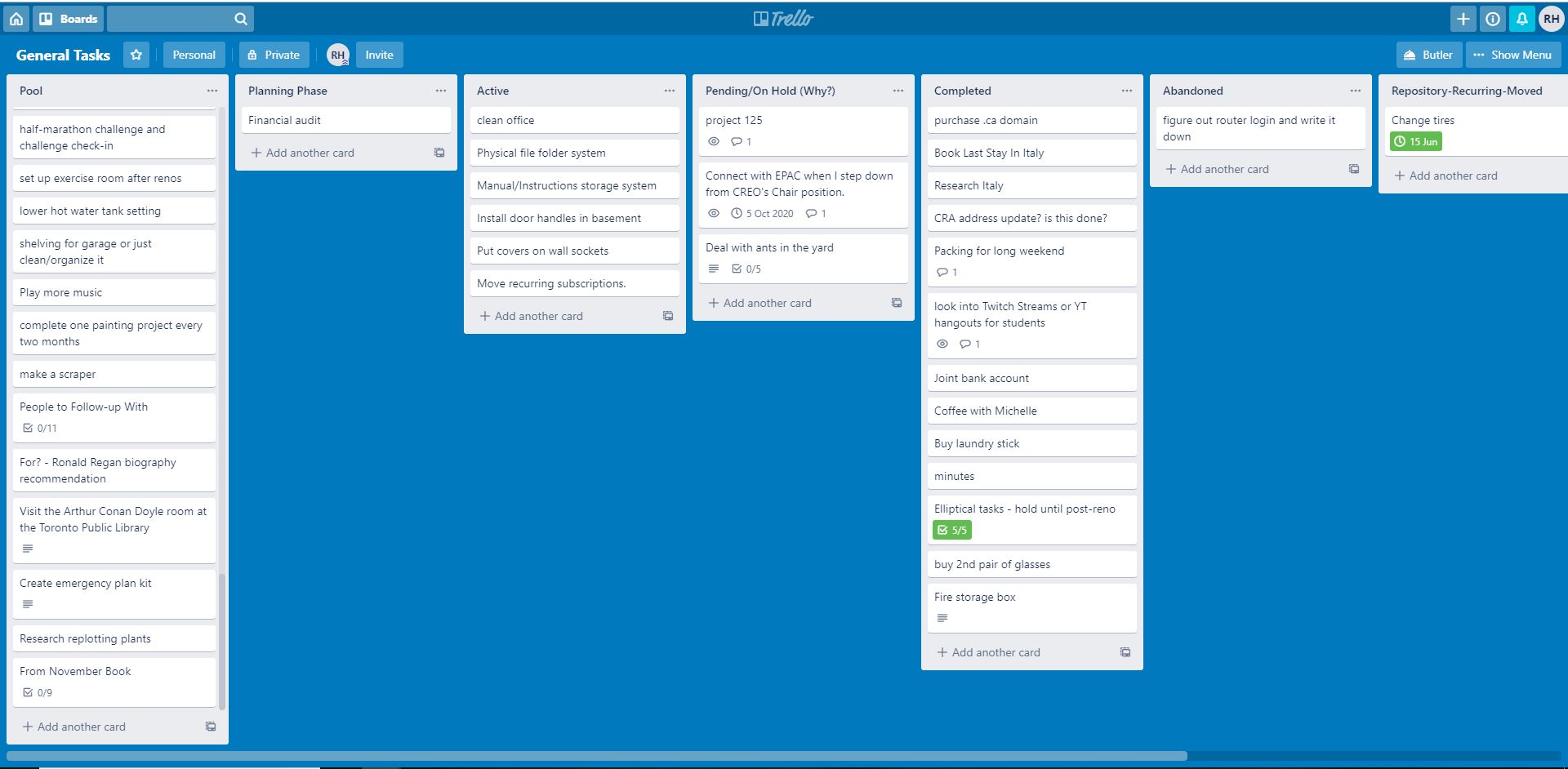
I set up several columns (buckets) of items.  In the far left, I labelled the list “Pool” and dump in all to do items.  Within each of the cards I can make notes or sub-lists to help keep me on track of things.  At the start of each month, if there is something I don’t want to carry forward into the new book, I put the item into the bucket.

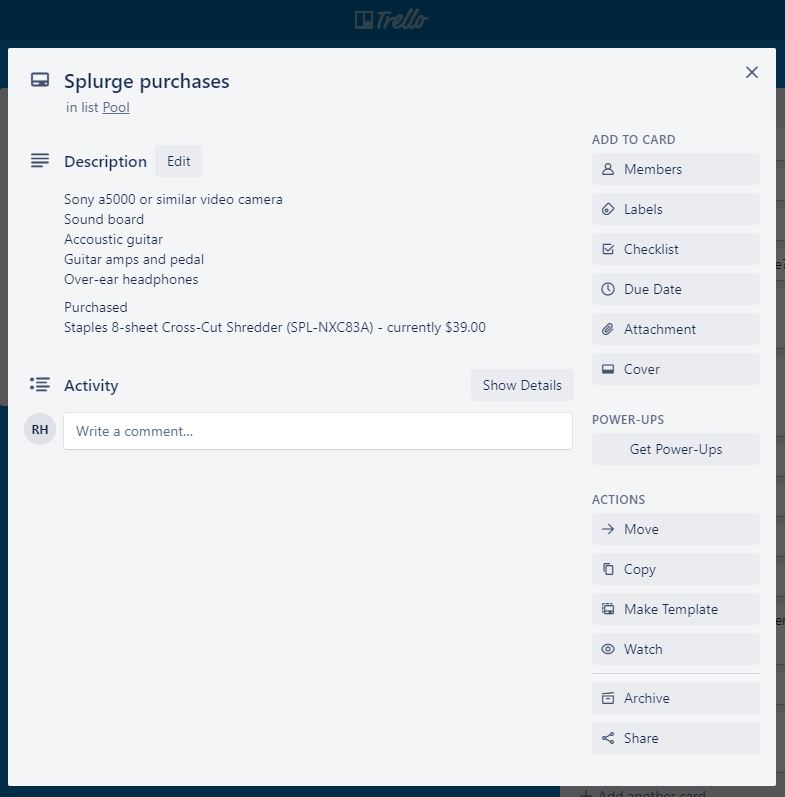
example
An example where I grouped a bunch of items under a single heading – in this case, splurge purchases I want to make but at a time when I have the discretionary funds.

Next, is the “Planning Phase” bucket.  The beauty of Trello is I can drag cards from one column to the next, so when I’m ready to move stuff from the Pool to another phase of activity, I can easy drag-and-drop.  Items in the Planning Phase might require me to do research or make purchases in preparation to work on the project.

If no further planning is required, I move it into the “Active” column.  When a task is active, it’s something that I’m placing priority on and is meant to remind me to carve out space in my schedule to address.

ants
An example of something that requires research and ongoing monitoring, I had ants in my yard last year and I wanted to deal with them without harming the grass or affecting my dog.  Now that it’s Winter, I can’t deal with this again until Spring.

Sometimes, a project needs to be put on hold.  I created a bucket to put tasks that are underway but I’m not making active progress on.  Items in this bucket might require someone to get back to me on some action of detail, or maybe I need to wait until a future date to complete the tasks.  Whatever it is, if I don’t want to move a task back into the pool column, I place it here and make a note of why the tasks is in limbo.

“Completed” is my win column – it gives me a chance to see what I’ve crossed of my list and as the column grows, I can take satisfaction in my accomplishments.

I created an “Abandoned” column because sometimes I will choose not to complete a task but I don’t want to delete it outright.  Maybe it’s something that’s still important, or maybe I missed a window but I want to be reminded of it.

Finally, for tasks that occur regularly but infrequently, I have a column so that I can see when the last time was that I finished a task, and remind myself that it will need to go back into the active column (e.g. changing my tires, changing the furnace filter, etc.).

I’ve been using this revised system for a few months and it seems to be satisfying my immediate needs.  It both cuts down on the number of items I need to manually copy from book to book while allowing me to indefinitely store things in a user-friendly format – effectively marrying my love of analogue with the convenience of digital.

Stay Awesome,

Ryan


“The Same Fifteen Academic Studies”

Despite my rant a few weeks back on the podcast-book marketing relationship, there are a few authors I will check out when they appear on podcasts I’m subscribed to.  For instance, Ryan Holiday just released his new book and is out promoting it to various podcast audiences.

He appeared on Rolf Pott’s podcast, Deviate, and had a conversation about what it’s like to write a big idea book.  Towards the end of the episode, he makes an off-hand remark on getting ideas from recently published books, and how he chooses not to do this because it tends to result in recycling the same academic studies.  Given how much I rant about animated bibliographies and short term content bias, I was happy to see some convergence in our ideas – that my amateur attempt on commenting on culture is shared by people I admire and hold in regard.

I’ve transcribed his remarks below, but you can go here to listen to the episode yourself.  Holiday’s comments begin at the 50:37 mark:

Potts: And that’s why you should feel blessed not to be an academic, right, because that’s such a useful model from which to write a book.  The academic world has these different hoops to jump through that often aren’t as useful.  And I would think that, sometimes, there’s types of research, like, do you do much Google or Wikipedia research, or is it mostly books?

Holiday: Yeah, I mean, you have to be careful, obviously, relying on Wikipedia, but yeah you do wanna go get facts here and there, and you gotta check stuff out.  I like to use obituaries.  Let’s say I’m writing about a modern person and they’ve died.  New York Times obituaries, Washington Post obituaries often have lots of really interesting stuff.   Then you can be really confident that dates and places and names are all correct because they’ve been properly fact-checked.  So I like to do stuff like that.  I watch documentaries from time to time.  In this book, there wasn’t really a great book about Marina Abramović, but there was some really great New York Times reporting about her Artist is Present exhibit, and there’s also a documentary with the same name.  So I’m willing to get stuff from anywhere provided I believe it’s verified or accurate, but you can’t be choosy about where your stuff comes from.  And in fact, if you’re only drawing from the best selling books of the last couple of years, just as an aside, an example, I find when I read a lot of big idea business books, it feels like they’re all relying on the same fifteen academic studies.  It’s “the will power” experiment, and “the paradox of choice” experiment, and the “Stanford Prison” experiment!  They think it’s new because it’s new to them, but if they’d read a little bit more widely in their own space, they’d realize that they’d be better off going a bit deeper or treading on some newer ground.

*****
(Note: I’ve lightly edited the transcript to remove filler words and some idiolects).

Stay Awesome,

Ryan

Five* Digital Tools I Use

Last week I shouted from the rooftops about reaching zero unread messages in my inbox.  This feels like a good opportunity to geek out a bit on some cool digital tools I use for my process flow.  Below are a handful of applications and services I use to keep on top of things, which supplement any physical systems I use to stay organized (like my notebook, for example).  None of the referenced products below are sponsors and I have no business ties with them.

Boomerang (Paid)

I was introduced to Boomerang for Gmail a few years back and made use of their free tier for quite some time.  However, last year I made the jump to unlock some additional functionality and allow me to boomerang more messages per month.

Seamlessly integrated into Gmail, Boomerang allows me to kick messages out of my inbox and set to return at a predetermined time.  You may have noted in a caption that I mentioned “boomeranged messages;” this is what I was referencing.  If I have messages that I want to come back to, but I don’t want them to clutter my inbox, I use Boomerang to remove them temporarily without me forgetting about it.  Boomerang has other features, such as being able to append notes to myself or asking a message to return if no one responds within a certain time frame.  All in all, a great little service that doesn’t cost much for the year.

Evernote/OneNote

I use both Evernote (free) and OneNote (Enterprise).  I don’t really have a preference one way or the other at the moment, but I tend to use Evernote for personal items (saving notes, planning blog posts, etc.) where I use OneNote for Board work and my main job.  I was urged to go paperless by my boss, so I slowly adopted the services and moved away from extra notebooks and loose papers on my desk.  Especially within OneNote, I can use the attach document feature to put “print outs” of documents within a notebook page, then use my tablet’s stylus to annotate the document with handwritten notes.

Scanbot

Speaking of embedding print outs, I started using Scanbot for Android to capture paper documents and port them into my digital notes.  I like Scanbot over the regular camera because the AI recognizes the page and will use algorithms to digitally morph distortions of the page.  Instead of requiring perfect lighting and standing perfectly over the page, I can capture documents on camera and Scanbot flattens out and crops the image for me.  I’ve also found it handy for taking pictures of overhead presentation slides, and whiteboard writing.

Pushbullet

Pushbullet has a lot of features for pushing documents across devices, but I mostly use it as a way of preventing myself from always looking at my phone.  Instead, I can avoid temptation and quickly reply to text messages from my wife before jumping back into my task.  I know myself well enough that picking up my phone is inviting a trip down the rabbit hole of distraction, so Pushbullet really helps keep my monkey brain in check.  (Note: if you’re wondering about how I avoid distractions on my computer, I use the StayFocusd extension to block website during certain hours of the day)

Trello

Month over month, I will have lots of To Do items that are left incomplete.  I used to copy them over manually to the next notebook, but over time the list grew.  Out of laziness, I started porting those tasks over to Trello for longer term storage.  Yes, I should either discard those items I’m not doing or clearing my plate by completing the tasks.  However, there are items that are not urgent and not important enough to do at the time.  Instead, I’ve set up a kanban board that allows me to move tasks from a pool to an active list, then to a complete, abandon, or hold list, depending on the status of the task.  It’s a handy way of keeping on top of tasks that are not immediately pressing and allows me to use my notebook for day-to-day pressing concerns.

There are a few other tools I’m trying out, such as Toggl, RescueTime, Microsoft Teams, and Notion, but I’ll save those for a future post.

The five-ish tools above are a few things that makes it easy for me to keep on top of several process flows for work, my personal projects, and my volunteer work.  Without them, I would be drowning in trying to keep everything fresh in my mind.  Let me know what kind of tools you use (digital or analogue) in the comments below.  I’m always interested in learning what different people have set up for themselves.

Stay Awesome,

Ryan