The Importance of Making Space

I’ve been thinking a lot about space recently.  Not in the outer space sense, but headspace.  I’ve got a lot of stuff on the go and I’m finding downtime at a bit of a premium.  Between the wedding and our upcoming move (we bought a house last week!), a lot of very important things need to be done in relatively short time.  This requires me to stay on top of a lot of little moving pieces to ensure stuff doesn’t slip through the cracks.

The one thing, however, that I’m finding huge importance in is making space for more important things, like relationships.  Two weeks ago, my fiancee and I were running ourselves ragged as we worked to close a deal on the purchase of the house.  In short order, our week involved scheduling a viewing of a house that had been on the market for about 12-hours, setting up meetings with the bank, a home inspector, a basement expert, and our realtor to set up and fulfill conditions on our offer.  This required three separate trips out of town, which takes us away from our normal routine.

Last week, my fiancee suggested we take a pause from the “work” required at home, and instead for us to enjoy some downtime together.  It amounted to little more than dinner and couch time in front of Netflix, but it was exactly what we needed.  We needed to make space for us to be a couple (rather than domestic partners).  In one evening, I felt closer to my fiancee than I had in the better part of two weeks.

It reminded me why it’s important to ensure quality time together.  We might live together, eat together, and sleep in the same bed, but that doesn’t mean we are taking time to be together, present in the moment.  There is a time and place for work, but it’s important to make time and space for more important things, too.

Stay Awesome,

Ryan

Trying Something New – Painting

A few years back, I stumbled across Bob Ross videos on YouTube.  His Joy of Painting series made painting seem accessible and fun, and it stoked in me a desire to try it out.  My experience in creating art mostly was concerned with drawing and sketching.  Only once (in high school) did I attempt to paint a picture (a large Spider-man poster, which was meant for us to experiment with painting along one side of the colour wheel).  Painting has largely been intimidating for me to try until I watched Bob Ross.

A friend who paints suggested I try starting off with an easy medium, like acrylic paint, since oil painting can be both challenging and dangerous if you don’t take the right precautions.  I made a New Year’s resolution to try out painting before the end of the first quarter, and in February I found a local art store that runs beginner acrylics classes.  For four weeks, you learn lessons from a local artist and complete a painting each week to take home.

This week will be the last class.  I’m sad that it’s over already and I’ve really enjoyed the experiences so far.  I’m hoping the store sets up the intermediate class soon, as I will gladly pay to attend that class as well.  When you sign up for the beginner class, you are given the option to purchase a starter kit with some paints, brushes, and canvasses.  I’ve already started buying additional supplies, such as more paint colours, a medium to extend the acrylic drying time, a new kneadable eraser, and more canvasses.  Below are the paintings I made from the first three weeks of the course.

I’ve even started experimenting with paining at home – last week I attempted my first run at mixing flesh tones to paint people (I hope to attempt a self-portrait in the near future).

I’m glad I invested the money in this experience and am looking forward to practicing this new set of skills.

Stay Awesome,

Ryan

100th Post!

EXPEDITION

This post marks my 100th entry on this site!

My first post went live on April 21st, 2016 and, if memory serves, I have managed to post at least once every week since then.

The original motivation to start this site was three-fold.  First, I vainly wanted to snag up the domain name in the off-chance that I wanted to use it in the future.  Second, I wanted an excuse to force myself to write regularly.  It had been a few years since I finished my master’s degree, and I found that my writing skills had softened over time, so I wanted a reason to regularly practice those skills to keep them sharp.

The third, and primary reason, was to chronicle and reinforce my path towards becoming a paramedic.  I had intended to document the application process of returning to school, the time spent as a student, and eventually the transition into a career.  I also wanted to use the website to discuss and teach the concepts I was learning because I believe it is a good mode of reinforcing the material I would have learned in class (an effective way of learning is being forced to teach it to others).

While the first two reasons have been honoured, I have since shelved the idea of becoming a paramedic.

The unfortunate result is that I’ve been maintaining this site up to 100 posts without a clear purpose or direction of where I want to go.  This is amusingly also the case with what I want to do career-wise.

I had my performance appraisal at work last week, and my boss said she was “super happy” with my work and contribution (there are a few areas of growth we identified, but otherwise it was a great appraisal).  When we discussed my future avenues of growth, I was hard-pressed to come up with the next steps of where to go next beyond wanting to take on more responsibility in general.  I have a few concrete skill sets that I want to work on, but nothing that lends itself to an obvious career choice.

I suppose this blog is an accurate reflection of my career trajectory.  On the one hand, the status quo looks good, clean, and polished.  On the other hand, it lacks direction and purpose.  However, the blog also affords me the space to stop, reflect, and document things as I go.

I don’t have an answer as to where I’m intending on going next, but at least I can share my muses along the way.

He’s to another 100 posts!

Stay Awesome,

Ryan


Skills Worth Developing – Resisting “That’s Not My Problem”

The job I have at the college is my first full time job after I finished university.  Prior to the position I’m in, I have worked only full-time hours on contracts and a smattering of part time jobs.  I thought, like many others, coming out of university that I knew what it would mean to have a job, be an employee, and work responsibly.  I wouldn’t say I was unprepared to enter the workforce, but it would be charitable to say that I had a lot to learn, and many beliefs to update.

This is, in part, why I decided to occasionally write thoughts in a series of posts loosely connected with the theme “Skills Worth Developing.”  There are many hard skills that employees should pick up over time to help them do their jobs better and advance in their careers.  Organizations like Coursera, Udemy, Lynda, etc. are excellent resources to help one pick up those kinds of skills.  But many other skills (usually dubbed “soft skills”) are usually picked up through experience and self reflection.  This blog serves both to force me to write, but also to force me to make permanent any self-reflections I’ve had, and these reflections might be valuable to others.

The last time I discussed Skills Worth Developing, I discussed the merits of storytelling as a communication tool.  This time, I want to reflect on a phrase I heard a lot when I first started working – “That’s not my problem” or “That’s not my job.”

You might be wondering why I lump this in with the notion of skills, instead of some other attribute, such as attitude.  True, something like this will overlap with one’s “attitude” while on the job, but I view this as a skill because it’s a habit and ability that can be modified over time, practiced, and strategies can be employed to use it in the workplace.  Therefore, I loosely connect it under the skills area that should be developed and practiced over time.

One other observation I want to make is that this skill – avoiding falling into the “That’s not my problem” mentality – is something I exercised as a beginner.  I think this is a fantastic skill to develop early in your career, but I’m not entirely sure of it’s value when you are well-established in your role.  The value of this skill is that it increases your value to the company when you are still differentiating yourself.  The same can not be said for someone who is either well-established in their company or field, where their value is tied directly to their ability to focus on problems that they can uniquely solve.  In those instances, it’s probably a better strategy to limit distractions from your primary role and duties.

And so, we come to the problem of “That’s not my problem.”  I found early on that many employees in a work environment can take on the “not my problem” mentality for a variety of reasons.  Perhaps they were burned in the past and now refuse to extend themselves.  Some feel overworked and overstretched.  Some are lazy.  For whatever reason, they resist helping others in their duties.

I find two issues with this kind of mentality.  First, it goes against the spirit of cooperation, collaboration, and teamwork.  The workplace is a team of employees who are working towards common goals to advance the interests of the organization (while hopefully advancing their own personal interests in parallel).  Any time someone says to a coworker “that’s not my problem,” what they are in fact saying is “your problems aren’t important enough for me to take an interest.”  They end up placing themselves above the interests of their coworkers and the organization.  I’m not saying that this is wrong per se – I am sympathetic to the ideas that this mentality is easy for organizations to exploit, and that there is no moral imperative to place the company’s interests above your own, so you should guard against it taking advantage of you.  What I am saying is that taking this as a default position undermines the team.  Everyone is supposed to work together to solve problems and strive to the company’s mission.  If you don’t want to do that, what’s the point of working at that company?  I would hardly think that it’s just in service of the paycheque.

The second issue I have with this attitude is it closes you off to development.  I directly attribute my success so far to my willingness to learn outside of my prescribed job.  By helping others with their tasks (so long as it does not prevent me from taking care of my own job area), I am able to develop new hard skills and learn about areas laterally and vertically from my position.  I am better able to see how my role fits within the larger context of our department, which continuously exposes you to new opportunities for growth and development.  You become more valuable to the team and you strengthen your ties with your coworkers.  When you are just starting out, this is a valuable way of integrating yourself and setting yourself up for advancement.

When you ignore the impulse to say “that’s not my problem,” you acknowledge that your coworkers are people with their own problems, concerns, hangups and worries, while also setting yourself up as a person of value for the team.  It is a perfect opportunity to step up and be noticed in your workplace.

That is why I think resisting the impulse to say “that’s not my problem” is a skill worth developing.

Stay Awesome,

Ryan

Zombies, Run! 5K Training App Review

img_20180129_121511.jpg

This blog post is not a paid sponsorship.

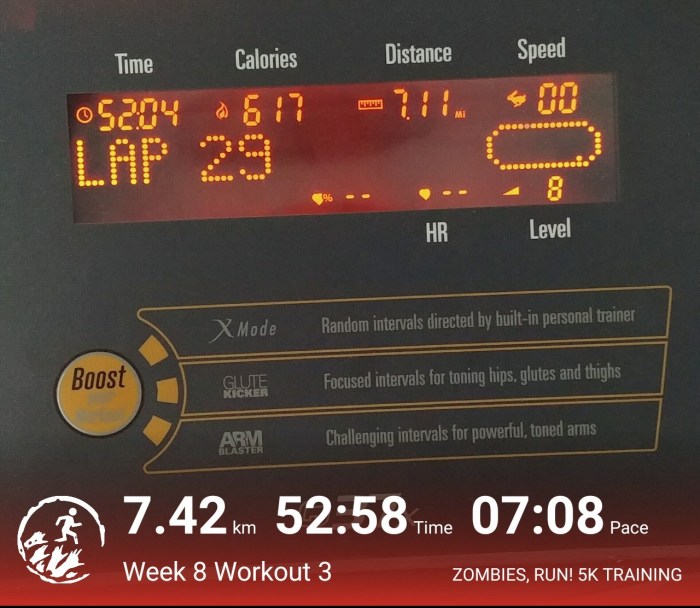
On Friday, I completed my last training mission for the Android version of the Zombies, Run!  5K Training app by Six to Start.  While this is supposed to be an 8-week training program, I’ve been at it since mid-October.  Having completed the program, I wanted to give some of my thoughts on the experience.

Overall, I loved it!

Imagine taking an audiobook about a zombie outbreak, and attaching a step-counter/GPS tracker to it.  That’s what the app is at its core.

Story

You play the silent hero, Runner 5.  The adventure opens with you in a helicopter bound for the Town of Able.  While en route, your helicopter is shot out of the sky, and you are forced to make your way to the settlement with the help of Able’s radio operator, Sam.  Once you make it to town, you meet a diverse cast of characters who you “interact” with throughout the 8-week plan.

The bulk of your interactions take place with Sam and Maxine, the town’s doctor, who also serves as your training coach while you build stamina and prepare to take your place as one of the town’s Runners.  The Runners are a group of people who are sent out on missions outside the guarded walls of town to run messages, look for survivors, gather supplies, and occasionally serve as decoy bait to lure zombies away.

While managing a zombie outbreak is bad enough, you still have the lingering question of who would shoot down a helicopter from the middle of the zombie-infested countryside, and more urgently, who is stealing supplies from the town’s quartermaster.

I found the story very immersive.  It brought me back to my old radio drama days from high school, with well-acted characters and sound effects to help you believe that you are being chased by zombies.  The creators took time to ensure the voice acting was well-done as you rely on the characters to help you experience the story.  There is no narrator telling you a story, but instead the story unfolds around you while you run.

Despite the fact that this is a training app, there is a surprising amount of story given to you.  You learn a bit of the backstory of the main players, and there is a lot of world building going on about life and the history of the zombie outbreak.  You learn a little bit about the politics of the various surrounding towns, and you get swept up in the human drama.  Indeed, your final mission is not just a 5k run, but a race against the clock to make a critical delivery to someone you’ll never meet but means the world to a close companion of yours.

The App

I found the app easy to use and well-designed.  As I mentioned above, the app is basically an audiobook and a step-counter.  There is a bit more to it, but those are just extras that help with customization.  The app tracks your progress in one of three ways – a GPS tracker that lays out your run via a Google Maps integration, a step-counter if you want to use a treadmill, and an estimated distance tracker for use on rowing machines and ellipticals (how many minutes it takes you to go 1-kilometre).  I chose to use the step-counter feature despite using an elliptical, which meant my in-app distances were skewed, however I corrected the distances with the tracking done by the elliptical itself.  I also used my Fitbit to track caloric expenditure and heart rate, since they were calibrated to my height and weight.

The best part about the app is that you can choose to use an external audio player when the app isn’t talking to you.  I used both Stitcher and Spotify and found that the integrations were smooth.  This allows you to listen to music on the run.  When the training app needs to deliver information to you, it pauses what you are listening to and continues the story, before switching back to your preferred audio.  Even taking phone calls mid-app worked well.  There was only one time where my music didn’t start back up after I took a phone call.

One note of caution is that the first 3 or so weeks of the app are free to use, but you need to pay a nominal fee ($5.49) to unlock the rest of the missions.  While this might be annoying, or a bit of a barrier for people, I liked it because a.) I’m in favour of companies making money off of users to keep creating good content; and b.) letting you use the app for free lets you test it out.  By the time I was ready for week 4, I wanted to find out what happens next, and I thought a buy-in of around $5 was worth it to continue on the adventure.  The full (non-training) app uses a subscription model, but still allows you to trying things out before you need to unlock the full app.

Training

I found the 8-week program to be a little easy for me, but using an elliptical meant that there was only so much crossover I would experience.  If I were to have tried running, I suspect the app’s difficulty would have been scaled more appropriately to me (and my knees would have taken a beating).  But the main purpose of the training is similar to most other “couch to 5K” training programs – get you moving a couple days per week while the difficulty is slowly ramped up.  I appreciate this approach, as it is enough to challenge you, but easy enough to keep you coming back for more.

To keep the difficulty scaled for me, I would often run through rest breaks, and I ensured that I kept the resistance level at a good place to maintain a heart rate of around 140bpm.  To ensure I was running fast enough, I monitored the elliptical’s RPMs, and used the following markers:

  • 40-50rpm: slow walk/rest
  • 50-60rpm: brisk walk/warm up
  • 60-70rpm: steady running pace
  • 70+: hard exertion/sprint

Before each mission, you can review what the day’s exercise routine will look like.  The training sessions involve a combination of walking and running periods, and some sort of ancillary movement to develop your leg muscles, such as knee-ups, skipping, and body-weight squats.  Some days are straight training, where you get little story development, but learn more about the people you are interacting with.  However, some training days morph into mini missions where you need to divert due to zombies or pick up critical supplies nearby.  One time, you even risk you life to help a downed runner in the field.  This is probably what kept me so engaged.  If it were just a disembodied voice telling me when to walk and run, I doubt I would find it very engaging and would have likely lost interest quickly.  However, because the training prompts are integrated into a narrative, and the characters are cheering your development on (because you are expected to take you place as a member of the community), it breaks the monotony of running up into more interesting chunks.

I’m not entirely sure to what degree I improved my cardiovascular health.  Because I didn’t feel like I struggled with the difficulty, it’s hard to measure my progress.  The best I can estimate is that my running distances did increase over time, even if you were to control for the duration of walking in the training cycles and the differences in run duration from week to week.  Despite having not measured with any amount of accuracy what my abilities were pre-Zombies, I’m fairly confident that I am in a better state of cardiovascular health having completed the training program.

Final Thoughts

If I have one complaint, it’s that the narrative move from the training app to the full app ends up restarting the story a bit.  The first mission in both the training app and the full app is  the same, meaning your story doesn’t really continue after the training app.  I suspect that once you start running the story missions, things will feel more integrated, but I was a little sad to have to “meet” Sam and Maxine for the first time again after having “developed” a relationship with them while I trained.  This is a relatively small nitpick on my part because narrative and story are important to me, but it’s not something that takes away from the experience.

I have already recommended the app to friends of mine, and I officially recommend it here.  I got well more than $5 in value from the app’s minor cost.  This is a well-made app that is easy to use, and integrates well into my exercise routine.  It makes exercise fun and engaging and the story is compelling enough to keep me coming back for more punishment.  If you are looking for a way to help you commit to a cardio routine, but you are starting off from scratch, this is a great option if you don’t mind running from zombies.

Stay Awesome,

Ryan

2017 Sleep Check-In

This is it!  I’ve finally hit the end of the sleep challenge and I can finally look back at a year of data and see if I can spot anything interesting from the data.  This post will give the quarterly update from October through December, and then I will look at the results from the entire year.

For those just coming on-board with this post, in 2017 I set out to track my sleep each month with the target of sleeping for at least 7-hours.  I used a Fitbit Charge HR to track my sleep and I gave monthly updates on my progress.  I also used a few quarterly updates that looked at data over longer periods of time to see what sorts of trends and patterns I could extract from the results.  While I wanted to try and maximize my sleep, in truth I am terrible at keeping a nightly routine, so at the mid-point of the experiment, I set the goal of trying to get at least 10 nights in each month where I hit my target of 7-hours.

To see a recap, you can go to the individual posts below:

You can also see my quarterly updates:

First, let us look at the fourth quarter’s results.

Fourth Quarter – October through December

Q4 sleep
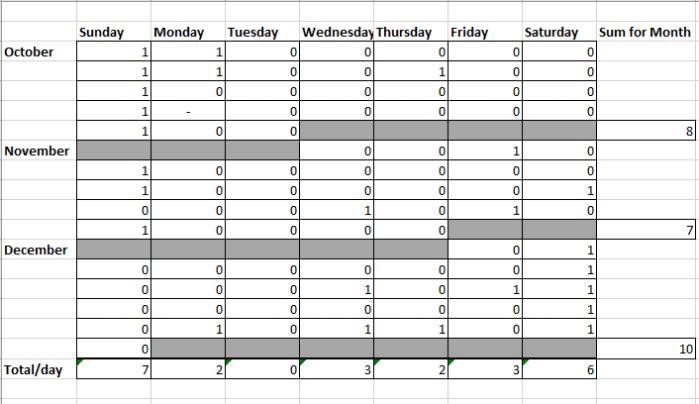
Note: 1’s denote nights where I hit my target.

The fourth quarter results fall in line with what I’ve been seeing over the course of the year.  Sundays prove to be the most consistent night of 7+ hours of sleep, followed by Saturday.  Monday usually gets a high number of hits, but this time around it appears that I’m not sleeping as well when I transition from weekend to work week.  I don’t have an explanation for this, other than I probably am going to bed too late (as opposed to lost sleep due to anxiety of going to work the next day).

And now, time for the final reveal!

Sleep Results for 2017

The grand total for the year are:

January – 4
February – 8
March – 6
April – 7
May – 4
June – 7
July – 11
August – 11
September – 9
October – 8
November – 7
December – 10
Total: 92

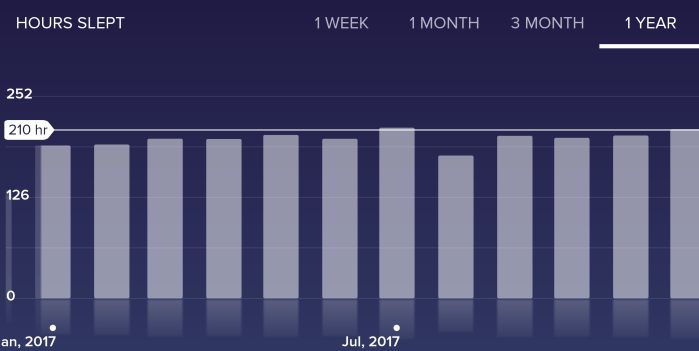
Out of the 365 nights of sleep for 2017, I hit my target 92 times, for a 25% success rate.  This is a very strict number, which reflects poorly on the overall experiment, but one bit comfort I take from this is that, as I have pointed out a few times over the course of this challenge, the data is skewed when we look at the time I spent asleep, versus the amount of time the Fitbit tracker tracked me as asleep.  Any amount of sleep disturbance or restlessness meant that the device wasn’t counting it as sleep time.  So, while I might have been asleep for over seven hours if I had any kind of restless sleep, the quality sleep tracked came in under 7-hours.

Is there another way of seeing the data to determine if the 25% rate is overly skewed?

Time spent Sleeping

We can adjudicate this by looking at the actual time I was asleep, versus the target sleep.  This way, any nights where I slept more than 7-hours would pull my averages up and cancel out some of the nights where I slept less than 7-hours.

Screenshot_2018-01-21-20-36-37


sleep
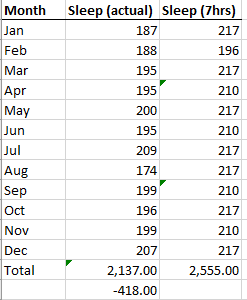
*Note: for simplicity, I rounded the sleep values to the nearest hour.

For 2017, the Fitbit tracked me as sleeping 2,137-hours.  If I assume 7-hours for all 365 days, this would give us 2,555 hours of sleep.  Viewed from this perspective, I hit 84% of my target sleep, with only a 418-hour deficit of sleep spread over the 12 months.

The problem with tracking only the successes throughout the year is that it ignored any sleep that falls under 7-hours.  Month over month, my progress tended to looked bad and reflected poorly on my ability to set goals and maintain progress.  While it’s true that I was failing in hitting absolute targets of sleep, the presentation almost suggested that if I didn’t hit my sleep target it was because I wasn’t sleeping at all.

So, while I was only 25% successful in hitting targets, I was able to get 84% of the sleep the target would imply.

One note of caution – if I’ve learned anything these last two years, it’s that I’ve learned and reflected on what it feels like to be sleep deprived.  Running a theoretical sleep deficit of 418-hours for a year might not seem bad, but in practice is something to be concerned about.  Sleep deprivation has consequences that affect me in many ways, such as my ability to resist temptation, my productivity at work, the likelihood that I will exercise, and my interpersonal interactions with friends and family.  There was one time where in my sleep-deprived state, I let a door swing shut before my dog was fully through the threshold, and it caught him in the rear paw.  Despite a yelp of pain from him, there was thankfully no physical damage to his paw.  Still, I felt terrible about my carelessness and it was a reminder that my ability to focus and pay attention is compromised when I don’t sleep.

Moving Forward

Tracking my sleep for this blog was an interesting experience.  I do not plan to continue giving regular updates as I progress through 2018, though I will still be monitoring my progress in my personal notebooks.  I found a lot of value in seeing the aggregate results.  The monthly updates were mostly in line with my intuition, but it was still good to objectively see how poorly I am with sleep.

It will be an ongoing work of progress to do better.  The main takeaways from this experiment are that,

1.) I’m terrible at maintaining a disciplined nightly routines to go to bed at a reasonable time;

2.) working at the bar, even 2-nights per week, dramatically impacts my sleep during the week; and

3.) I need to pay more attention to the things in and out of the bedroom that cause disturbances in my sleep (such a the dog jumping on the bed, evening alcohol consumption, and potential sleep apnea due to my weight).

There are many avenues I can explore to improve the quality and quantity of sleep I get each night.  Perhaps, I will explore them in time.  However, it’s time to put down the measuring devices and enjoy a bit on unquantified time.

Thanks for following this journey of sleep.

Stay Awesome,

Ryan

The Arts of Learning & Teaching

I’ve been in the apprenticeship phase of teaching for the last year, so I’ve largely been gaining experience in how information is conveyed and how to give feedback to students.  While I have given some consideration to course design and what kinds of courses I’d be interested in teaching, my primary focus has been on ensuring the students receive good content and (more importantly) good feedback on performance. Good performance management involves timely and specific feedback to either reinforce good behavioural outcomes, or quickly identifying and redirecting bad performance outcomes. It’s a challenge to ensure that feedback is both timely and useful, but it’s an important step of the process. 

I’m currently working my way through the Art of Learning by Josh Waitzkin, and I’ve started thinking about the process of learning.  While learning and teaching are separate domains, they are interconnected since they share similar goals.  However, being able to translate learning (whether being taught by a teacher or through self-teaching) into teaching to others is something that I have a lot of gaps in my knowledge about.

The first time I taught in-class in the college setting, I quickly became aware that my experiences with formal education (the university style lecture) was not a good mode of delivery to copy. While I am comfortable in the lecture setting, I saw that my students did not excel in that environment. I wish I could say that I had fixed my delivery before the end of the semester, but the reality is that I didn’t fully appreciate the situation until after the course was over and I reflected on the term. An environment where I stood at the front and spoke at length for two-hours was not one which the students could effectively absorb the material.

The problem I found is that how I think and absorb content is different from my students. Rather than teaching them to my style, I need to be more mindful of their talents and experiences. Waitzkin discusses this in his book, where he contrasts two kinds of teachers he’s had. One is the kind that teaches his own strengths and relies on rote memorization of strategies and techniques. In chess, this teacher has you studying opening moves to take early advantage of the board.  The other kind of teacher allows the student to play to their inner style, and teaches by building up concepts atomistically. In chess, this kind of teacher strip the board of all the pieces and focuses on the relationships between pieces at the end of the game. By showing how individual pieces play off each other, the student becomes comfortable across the game and learns not only how pieces fit together, but how to set yourself up for control at the end of the game.

I think my teaching style should embrace this second kind of teacher. Instead of dictating knowledge, I should focus on breaking the knowledge down and building up understanding in ways that make sense to the student. I can’t assume my students will have the prerequisite knowledge to compile the facts together on their own. It’s also the case that if I can’t break ideas down simply, the students might not get it, nor may I truly know what I’m talking about.  Afterall, Einstein and Feynman believed that if you couldn’t explain something simply, you probably don’t understand it very well yourself.

Stay awesome, 

Ryan

Ongoing Education and Solving Problems

There is a general perception that going through the formal education process is sufficient for career success.  If you follow the standard formula of secondary school, followed by some form of post-secondary education, whether through trades, college, or through the university, you should have the necessary tools in order to enter the workforce and perform well in most situations.  While this might be true to some degree, I’m willing to bet that if you were to ask people of their thoughts on this process, you’d be met with a certain level of skepticism.  Yes, there are some critical problems with how we view and use higher education, but on the whole, I think the missing piece is this: the role of higher education should be to give students the ability to think and learn for themselves (often concurrent with learning some kind of job-market skill).

The value of higher education is the exposure to ideas and of ways of thinking about things.  By exposing students to ideas and problems they’ve never encountered, you are giving them experience that they can use to navigate life after the classroom.  I think most people get too hung up on the job-market skills and end up de-emphasizing the other stuff referred to as “the humanities” or “breadth electives.”  What is important is for students to be able to cross over the threshold of their vocational training and learn to navigate in systems of knowledge that they aren’t comfortable with so that they can learn to gather information, define problems, and test solutions for things that are applicable to them.

I have a small example of this in action for myself.  Recently, the provincial college system was brought to a halt during a labour dispute.  Once the teachers came back to work, everyone set to work on figuring out how to carry-on and salvage the remainder of the semester.  One of my tasks was to track student requests for accommodation once it was determined that the holiday break was being scaled back to allow students to complete the fall semester.  If students had made previous plans for travel, asking them to cancel their plans (which often was at a huge financial loss to the students) was something the college did not wish to do.  So, the goal is to see where we can find solutions for students missing class in the revised schedule.  My job is to track the requests from students and track the faculties responses.

I wanted a simple way of tracking the information electronically on spreadsheets, and avoid copying huge numbers of cells worth of information into emails.  My solution was to set up a database.  I’ve never created a database before (only used existing ones), so I turned to resources available for employees at my work to teach myself the skills.  I set up a simple database, laid a form over it to allow for a cleaner user experience, and created standardized Word documents with placeholder values that would automatically call information from the database into the document for me to email out streamlined messages to faculty and students.

I shared this database tool across the college, and have been receiving very positive feedback from people who are using it.  I even recorded a 30-minute tutorial video on how to use the database and manage the information, then hosted the video online for other employees to use at their discretion.

My educational background is in philosophy, which is quite different from data process management.  However, through philosophy I learned skills such as how to self-direct my learning, how to define problems, and how to test solutions.  These skills are what has allowed me to come up with a way of managing all the information coming at me, and how to teach that system to others for their own use.  Being able to help others, and sharing something that they value, makes me feel really good and engaged at work, and I’m happy to be able to help others do their jobs more easily.

I understand that students often don’t have the luxury to think broadly about how their skills fit in with a larger view of pedagogy, but I think it’s important to remember that the specific processes, tools, and systems we learn at school are the micro expressions of overall deeper ways that we live, understand, and view our lives.  Taking a narrow view of the value of education tends to miss the proverbial forest for the trees.  The point of higher education is not just about vocational training and preparing people to enter the economy, but instead it’s main purpose should be viewed as a way of preparing people to become better problem solvers.

Stay Awesome,

Ryan

What I’ve Been Reading (As of November 20th)

I haven’t updated this series since August, so I thought it would be a good time to check-in on what I’ve been reading as of late.

Becoming a Supple Leopard by Kelly Starrett

This book came as a recommendation from Jujimufu (aka. Jon Call) on YouTube.  In addition to putting a greater focus on fitness and health, I’ve been trying to be more mindful of the physical state of my body.  I know that carrying around a lot of extra weight is hard on the joints, but I do a lot of stuff that is also bad for my body, such as poor lifting mechanics, sitting and slouching in my chair at work all day, poor mobility and stretching habits, and not addressing niggling pains in my knees.  I picked this book up to help me be more mindful of good body mechanics, improve both my flexibility and mobility, and to address common pain I feel in my joints.

Mating in Captivity by Esther Perel

I first stumbled across Esther Perel through a TedTalk she gave a few years back, and again through the Audible Original mini-series released about her couples therapy experience.  I heard she recently released a book on infidelity, which got me looking at her other books.  I decided to pick up Mating in Captivity since I am getting married next year and it seemed relevant to future-me (the idea of sustaining passion in a relationship over the long term).  Are there problems with my love life?  No, but that doesn’t mean I can’t learn something from an expert to ensure I’m mindful of my relationship moving forward.  If I want to be the best partner that I can be, then it means I should pick up good practices and insights wherever I go.  Long-term relationships are subjected to a lot of life changes (career, family, children, age, economy, etc.), and I’d rather be aware and exposed to things that threaten to cool the passion over time to better handle them down the road.

The Bookshop on the Corner (A Novel) by Jenny Colgan

This was a splurge purchase through the Bookbub mailing list I joined (they send daily lists of discounted Kindle ebooks on Amazon’s website).  The story is about an ex-librarian who decides to take a chance and buy a large cargo-truck to turn into a mobile bookshop.  I’m about a third of the way through the book and am enjoying the story so far.  It partially takes place in Scotland, which was a happy coincidence for me (I traveled to Scotland in July of 2016).  Truthfully, one fantasy I have is to retire and own a bookstore.  While this might not be an accurate picture of my future, I can still dream, can’t I?

Find Your Why by Simon Sinek, David Mead, and Peter Docker

A burning question for me concerns itself with purpose.  In a broad sense, I’ve been reflecting on purposeful living and articulating my values, but in a narrow sense, I’ve been exploring what gives me a sense of purpose and accomplishment at work.  Because I lack that definitive feeling of purpose at work (that I’m working on what I’m meant to do, whatever that means), I’ve been doing some soul searching, working with a career adviser, and reading this book.  I’m not very far into the book, so I can’t provide a lot of comments from it, but I liked Simon Sinek’s previous books, and so I’m looking forward to working may way through this one.

Reaper Man by Terry Pratchett

This list wouldn’t be complete with an update on which Pratchett Discworld book I’m on.  I just finished Moving Pictures last week, so I’ve just now moved on to Reaper Man.  Death has been a favourite character of mine, so it was nice to return to a Death-centred story.

These aren’t all the books I’ve got on the go (shamefully, there are books on my previous lists that I’m still plugging away at), but it does give a good snapshot of what you’d likely see in my hands.

Stay Awesome,

Ryan