Study Strategies #5 – Application

One of the hardest things I find my students struggling with is not grappling with deep philosophical thoughts, or technical jargon (to be fair, they do struggle with these as well), but it’s in the application of course material.  Most often, when my students submit work for me to evaluate, they submit work that is either:

  • straight opinion (read: a submission that is not structured as an argument with evidence and connecting ideas through logic); or
  • an attempt to solve or provide a definitive response for all the problems of this philosophical issue in about a page.

The thing my students don’t realize is that I don’t care whether they “solve” the philosophical problem.  Granted, I don’t expect them to be able to solve the problem in a page, but that’s not the point.

The purpose of the exercise is for me to check the thought-process of whether they are able to understand the material and work with it.

I was recently chatting with a Program Chair about her time teaching engineering courses.  She noted that often she’d give problem sets that lacked defined measurements, and her students would pause to ask what the length or value of the unknowns are.  She was very frank that she didn’t care what number their calculator displayed because it was more important for her to see whether the students could think through the problem, manipulate the equations, and understand how to go about solving a problem.  For her, the solution was extraneous for the purposes of the class – it was a quick and convenient way to mark an answer right or wrong, but not entirely indicative of whether the student was understanding the concepts.

Now, you may say that this is all well and good for engineering, but how does that apply to philosophy (“But, philosophy has no right answers!!!) or any of the other soft sciences or humanities disciplines.

The truth is that the faster you try to apply the concepts, the easier it is to learn and make the concepts stick, and it’s not all that different across disciplines.  If you are trying to learn a concept, the best thing you can do is to try to take what you think you are learning, and apply it to a novel situation.  By focusing less on the details and working with the core concepts, you get a chance to see what makes sense to you and where your gaps in knowledge are.

For the course I teach, the students work their way through the online module materials, which includes extra readings, embedded videos, probing questions, links to additional sources, etc.  Then, after a round of discussion board posts, the students have a weekly essay prompt related to the week’s topic.

Early in the course, my students will often reply strictly to the essay question with what they think the right answer is.  Through my weekly rubric feedback and general emails to the class, I encourage them to go back to the module content and apply the concepts they are learning to the essay prompt.  What would so and so say about this concept?  How does this school of thought define this concept?  Do you agree with how this concept gets framed?

The point of undergraduate philosophy courses is not for students to generate original philosophical thought.  That is an aim, but it shouldn’t be the outcome.  Instead, the instructor should be guiding the students to think better and understand the concepts being covered so that they can then apply it in novel situations.

When studying, a good way to learn the concepts it to try and extract the ideas from how the author framed them and see how you can apply those ideas in new ways.  It reinforces the learning and helps to spot gaps in understanding in a way that straight memorization doesn’t provide.

Stay Awesome,

Ryan

Trying Something New – Painting

A few years back, I stumbled across Bob Ross videos on YouTube.  His Joy of Painting series made painting seem accessible and fun, and it stoked in me a desire to try it out.  My experience in creating art mostly was concerned with drawing and sketching.  Only once (in high school) did I attempt to paint a picture (a large Spider-man poster, which was meant for us to experiment with painting along one side of the colour wheel).  Painting has largely been intimidating for me to try until I watched Bob Ross.

A friend who paints suggested I try starting off with an easy medium, like acrylic paint, since oil painting can be both challenging and dangerous if you don’t take the right precautions.  I made a New Year’s resolution to try out painting before the end of the first quarter, and in February I found a local art store that runs beginner acrylics classes.  For four weeks, you learn lessons from a local artist and complete a painting each week to take home.

This week will be the last class.  I’m sad that it’s over already and I’ve really enjoyed the experiences so far.  I’m hoping the store sets up the intermediate class soon, as I will gladly pay to attend that class as well.  When you sign up for the beginner class, you are given the option to purchase a starter kit with some paints, brushes, and canvasses.  I’ve already started buying additional supplies, such as more paint colours, a medium to extend the acrylic drying time, a new kneadable eraser, and more canvasses.  Below are the paintings I made from the first three weeks of the course.

I’ve even started experimenting with paining at home – last week I attempted my first run at mixing flesh tones to paint people (I hope to attempt a self-portrait in the near future).

I’m glad I invested the money in this experience and am looking forward to practicing this new set of skills.

Stay Awesome,

Ryan

100th Post!

EXPEDITION

This post marks my 100th entry on this site!

My first post went live on April 21st, 2016 and, if memory serves, I have managed to post at least once every week since then.

The original motivation to start this site was three-fold.  First, I vainly wanted to snag up the domain name in the off-chance that I wanted to use it in the future.  Second, I wanted an excuse to force myself to write regularly.  It had been a few years since I finished my master’s degree, and I found that my writing skills had softened over time, so I wanted a reason to regularly practice those skills to keep them sharp.

The third, and primary reason, was to chronicle and reinforce my path towards becoming a paramedic.  I had intended to document the application process of returning to school, the time spent as a student, and eventually the transition into a career.  I also wanted to use the website to discuss and teach the concepts I was learning because I believe it is a good mode of reinforcing the material I would have learned in class (an effective way of learning is being forced to teach it to others).

While the first two reasons have been honoured, I have since shelved the idea of becoming a paramedic.

The unfortunate result is that I’ve been maintaining this site up to 100 posts without a clear purpose or direction of where I want to go.  This is amusingly also the case with what I want to do career-wise.

I had my performance appraisal at work last week, and my boss said she was “super happy” with my work and contribution (there are a few areas of growth we identified, but otherwise it was a great appraisal).  When we discussed my future avenues of growth, I was hard-pressed to come up with the next steps of where to go next beyond wanting to take on more responsibility in general.  I have a few concrete skill sets that I want to work on, but nothing that lends itself to an obvious career choice.

I suppose this blog is an accurate reflection of my career trajectory.  On the one hand, the status quo looks good, clean, and polished.  On the other hand, it lacks direction and purpose.  However, the blog also affords me the space to stop, reflect, and document things as I go.

I don’t have an answer as to where I’m intending on going next, but at least I can share my muses along the way.

He’s to another 100 posts!

Stay Awesome,

Ryan


Zombies, Run! 5K Training App Review

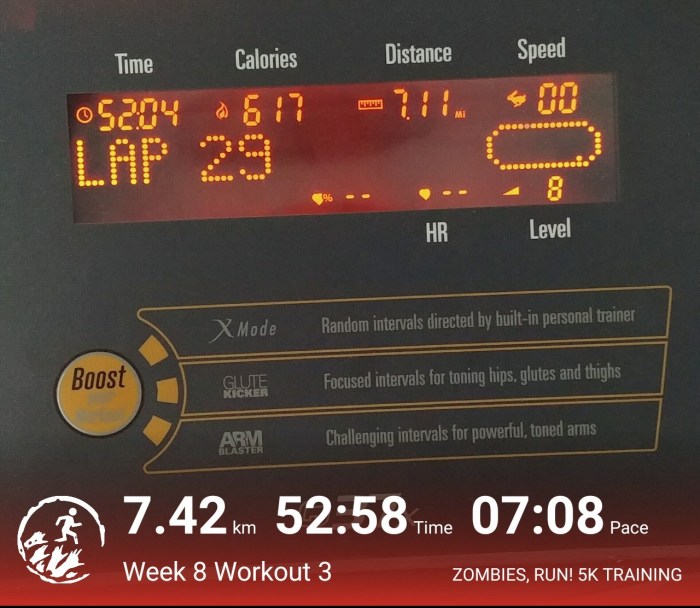
img_20180129_121511.jpg

This blog post is not a paid sponsorship.

On Friday, I completed my last training mission for the Android version of the Zombies, Run!  5K Training app by Six to Start.  While this is supposed to be an 8-week training program, I’ve been at it since mid-October.  Having completed the program, I wanted to give some of my thoughts on the experience.

Overall, I loved it!

Imagine taking an audiobook about a zombie outbreak, and attaching a step-counter/GPS tracker to it.  That’s what the app is at its core.

Story

You play the silent hero, Runner 5.  The adventure opens with you in a helicopter bound for the Town of Able.  While en route, your helicopter is shot out of the sky, and you are forced to make your way to the settlement with the help of Able’s radio operator, Sam.  Once you make it to town, you meet a diverse cast of characters who you “interact” with throughout the 8-week plan.

The bulk of your interactions take place with Sam and Maxine, the town’s doctor, who also serves as your training coach while you build stamina and prepare to take your place as one of the town’s Runners.  The Runners are a group of people who are sent out on missions outside the guarded walls of town to run messages, look for survivors, gather supplies, and occasionally serve as decoy bait to lure zombies away.

While managing a zombie outbreak is bad enough, you still have the lingering question of who would shoot down a helicopter from the middle of the zombie-infested countryside, and more urgently, who is stealing supplies from the town’s quartermaster.

I found the story very immersive.  It brought me back to my old radio drama days from high school, with well-acted characters and sound effects to help you believe that you are being chased by zombies.  The creators took time to ensure the voice acting was well-done as you rely on the characters to help you experience the story.  There is no narrator telling you a story, but instead the story unfolds around you while you run.

Despite the fact that this is a training app, there is a surprising amount of story given to you.  You learn a bit of the backstory of the main players, and there is a lot of world building going on about life and the history of the zombie outbreak.  You learn a little bit about the politics of the various surrounding towns, and you get swept up in the human drama.  Indeed, your final mission is not just a 5k run, but a race against the clock to make a critical delivery to someone you’ll never meet but means the world to a close companion of yours.

The App

I found the app easy to use and well-designed.  As I mentioned above, the app is basically an audiobook and a step-counter.  There is a bit more to it, but those are just extras that help with customization.  The app tracks your progress in one of three ways – a GPS tracker that lays out your run via a Google Maps integration, a step-counter if you want to use a treadmill, and an estimated distance tracker for use on rowing machines and ellipticals (how many minutes it takes you to go 1-kilometre).  I chose to use the step-counter feature despite using an elliptical, which meant my in-app distances were skewed, however I corrected the distances with the tracking done by the elliptical itself.  I also used my Fitbit to track caloric expenditure and heart rate, since they were calibrated to my height and weight.

The best part about the app is that you can choose to use an external audio player when the app isn’t talking to you.  I used both Stitcher and Spotify and found that the integrations were smooth.  This allows you to listen to music on the run.  When the training app needs to deliver information to you, it pauses what you are listening to and continues the story, before switching back to your preferred audio.  Even taking phone calls mid-app worked well.  There was only one time where my music didn’t start back up after I took a phone call.

One note of caution is that the first 3 or so weeks of the app are free to use, but you need to pay a nominal fee ($5.49) to unlock the rest of the missions.  While this might be annoying, or a bit of a barrier for people, I liked it because a.) I’m in favour of companies making money off of users to keep creating good content; and b.) letting you use the app for free lets you test it out.  By the time I was ready for week 4, I wanted to find out what happens next, and I thought a buy-in of around $5 was worth it to continue on the adventure.  The full (non-training) app uses a subscription model, but still allows you to trying things out before you need to unlock the full app.

Training

I found the 8-week program to be a little easy for me, but using an elliptical meant that there was only so much crossover I would experience.  If I were to have tried running, I suspect the app’s difficulty would have been scaled more appropriately to me (and my knees would have taken a beating).  But the main purpose of the training is similar to most other “couch to 5K” training programs – get you moving a couple days per week while the difficulty is slowly ramped up.  I appreciate this approach, as it is enough to challenge you, but easy enough to keep you coming back for more.

To keep the difficulty scaled for me, I would often run through rest breaks, and I ensured that I kept the resistance level at a good place to maintain a heart rate of around 140bpm.  To ensure I was running fast enough, I monitored the elliptical’s RPMs, and used the following markers:

  • 40-50rpm: slow walk/rest
  • 50-60rpm: brisk walk/warm up
  • 60-70rpm: steady running pace
  • 70+: hard exertion/sprint

Before each mission, you can review what the day’s exercise routine will look like.  The training sessions involve a combination of walking and running periods, and some sort of ancillary movement to develop your leg muscles, such as knee-ups, skipping, and body-weight squats.  Some days are straight training, where you get little story development, but learn more about the people you are interacting with.  However, some training days morph into mini missions where you need to divert due to zombies or pick up critical supplies nearby.  One time, you even risk you life to help a downed runner in the field.  This is probably what kept me so engaged.  If it were just a disembodied voice telling me when to walk and run, I doubt I would find it very engaging and would have likely lost interest quickly.  However, because the training prompts are integrated into a narrative, and the characters are cheering your development on (because you are expected to take you place as a member of the community), it breaks the monotony of running up into more interesting chunks.

I’m not entirely sure to what degree I improved my cardiovascular health.  Because I didn’t feel like I struggled with the difficulty, it’s hard to measure my progress.  The best I can estimate is that my running distances did increase over time, even if you were to control for the duration of walking in the training cycles and the differences in run duration from week to week.  Despite having not measured with any amount of accuracy what my abilities were pre-Zombies, I’m fairly confident that I am in a better state of cardiovascular health having completed the training program.

Final Thoughts

If I have one complaint, it’s that the narrative move from the training app to the full app ends up restarting the story a bit.  The first mission in both the training app and the full app is  the same, meaning your story doesn’t really continue after the training app.  I suspect that once you start running the story missions, things will feel more integrated, but I was a little sad to have to “meet” Sam and Maxine for the first time again after having “developed” a relationship with them while I trained.  This is a relatively small nitpick on my part because narrative and story are important to me, but it’s not something that takes away from the experience.

I have already recommended the app to friends of mine, and I officially recommend it here.  I got well more than $5 in value from the app’s minor cost.  This is a well-made app that is easy to use, and integrates well into my exercise routine.  It makes exercise fun and engaging and the story is compelling enough to keep me coming back for more punishment.  If you are looking for a way to help you commit to a cardio routine, but you are starting off from scratch, this is a great option if you don’t mind running from zombies.

Stay Awesome,

Ryan

2017 Sleep Check-In

This is it!  I’ve finally hit the end of the sleep challenge and I can finally look back at a year of data and see if I can spot anything interesting from the data.  This post will give the quarterly update from October through December, and then I will look at the results from the entire year.

For those just coming on-board with this post, in 2017 I set out to track my sleep each month with the target of sleeping for at least 7-hours.  I used a Fitbit Charge HR to track my sleep and I gave monthly updates on my progress.  I also used a few quarterly updates that looked at data over longer periods of time to see what sorts of trends and patterns I could extract from the results.  While I wanted to try and maximize my sleep, in truth I am terrible at keeping a nightly routine, so at the mid-point of the experiment, I set the goal of trying to get at least 10 nights in each month where I hit my target of 7-hours.

To see a recap, you can go to the individual posts below:

You can also see my quarterly updates:

First, let us look at the fourth quarter’s results.

Fourth Quarter – October through December

Q4 sleep
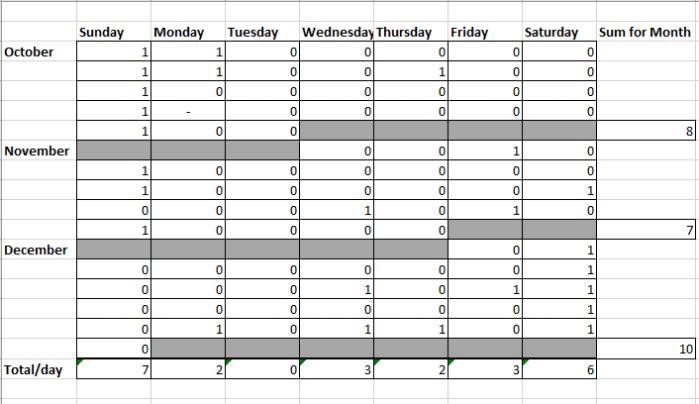
Note: 1’s denote nights where I hit my target.

The fourth quarter results fall in line with what I’ve been seeing over the course of the year.  Sundays prove to be the most consistent night of 7+ hours of sleep, followed by Saturday.  Monday usually gets a high number of hits, but this time around it appears that I’m not sleeping as well when I transition from weekend to work week.  I don’t have an explanation for this, other than I probably am going to bed too late (as opposed to lost sleep due to anxiety of going to work the next day).

And now, time for the final reveal!

Sleep Results for 2017

The grand total for the year are:

January – 4
February – 8
March – 6
April – 7
May – 4
June – 7
July – 11
August – 11
September – 9
October – 8
November – 7
December – 10
Total: 92

Out of the 365 nights of sleep for 2017, I hit my target 92 times, for a 25% success rate.  This is a very strict number, which reflects poorly on the overall experiment, but one bit comfort I take from this is that, as I have pointed out a few times over the course of this challenge, the data is skewed when we look at the time I spent asleep, versus the amount of time the Fitbit tracker tracked me as asleep.  Any amount of sleep disturbance or restlessness meant that the device wasn’t counting it as sleep time.  So, while I might have been asleep for over seven hours if I had any kind of restless sleep, the quality sleep tracked came in under 7-hours.

Is there another way of seeing the data to determine if the 25% rate is overly skewed?

Time spent Sleeping

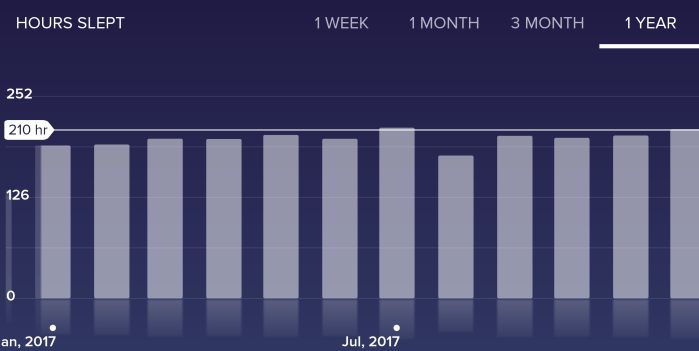
We can adjudicate this by looking at the actual time I was asleep, versus the target sleep.  This way, any nights where I slept more than 7-hours would pull my averages up and cancel out some of the nights where I slept less than 7-hours.

Screenshot_2018-01-21-20-36-37


sleep
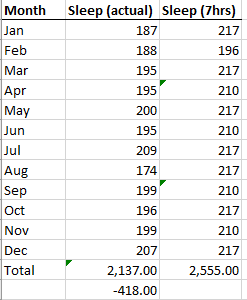
*Note: for simplicity, I rounded the sleep values to the nearest hour.

For 2017, the Fitbit tracked me as sleeping 2,137-hours.  If I assume 7-hours for all 365 days, this would give us 2,555 hours of sleep.  Viewed from this perspective, I hit 84% of my target sleep, with only a 418-hour deficit of sleep spread over the 12 months.

The problem with tracking only the successes throughout the year is that it ignored any sleep that falls under 7-hours.  Month over month, my progress tended to looked bad and reflected poorly on my ability to set goals and maintain progress.  While it’s true that I was failing in hitting absolute targets of sleep, the presentation almost suggested that if I didn’t hit my sleep target it was because I wasn’t sleeping at all.

So, while I was only 25% successful in hitting targets, I was able to get 84% of the sleep the target would imply.

One note of caution – if I’ve learned anything these last two years, it’s that I’ve learned and reflected on what it feels like to be sleep deprived.  Running a theoretical sleep deficit of 418-hours for a year might not seem bad, but in practice is something to be concerned about.  Sleep deprivation has consequences that affect me in many ways, such as my ability to resist temptation, my productivity at work, the likelihood that I will exercise, and my interpersonal interactions with friends and family.  There was one time where in my sleep-deprived state, I let a door swing shut before my dog was fully through the threshold, and it caught him in the rear paw.  Despite a yelp of pain from him, there was thankfully no physical damage to his paw.  Still, I felt terrible about my carelessness and it was a reminder that my ability to focus and pay attention is compromised when I don’t sleep.

Moving Forward

Tracking my sleep for this blog was an interesting experience.  I do not plan to continue giving regular updates as I progress through 2018, though I will still be monitoring my progress in my personal notebooks.  I found a lot of value in seeing the aggregate results.  The monthly updates were mostly in line with my intuition, but it was still good to objectively see how poorly I am with sleep.

It will be an ongoing work of progress to do better.  The main takeaways from this experiment are that,

1.) I’m terrible at maintaining a disciplined nightly routines to go to bed at a reasonable time;

2.) working at the bar, even 2-nights per week, dramatically impacts my sleep during the week; and

3.) I need to pay more attention to the things in and out of the bedroom that cause disturbances in my sleep (such a the dog jumping on the bed, evening alcohol consumption, and potential sleep apnea due to my weight).

There are many avenues I can explore to improve the quality and quantity of sleep I get each night.  Perhaps, I will explore them in time.  However, it’s time to put down the measuring devices and enjoy a bit on unquantified time.

Thanks for following this journey of sleep.

Stay Awesome,

Ryan

What I Read in 2017

Another year of reading has finished, so it’s time to take stock of how I did for 2017.  While I’m not an advocate of reading purely for the sake of speed or volume, I do challenge myself to see how many books I can get through during the year, if for nothing else than to ensure I’m carving out time to read.  For my 2016 results, check back to my post on What I read in 2016.

This year, I managed to get through 44 books and almost 14,000 pages, which is on par with my results from last year.  I posted my top list of books I read this year a few posts back, if you want to check it out.

I would say a little more than half of these books are audio books, as I decided to get an Audible subscription, and a friend has been kind enough to supply me with Terry Prachett books.  I have significantly picked up on the amount of fiction I’m reading, which was a deliberate choice since I noticed I consumed a lot of business and self-help books last year.

Title Author Pages
1 Essentialism: The Disciplined Pursuit of Less Greg McKeown 272
2 The Subtle Art of Not Giving a Fuck Mark Manson 224
3 Leaders Eat Last Simon Sinek 368
4 Awaken the Giant Within Tony Robbins 544
5 $100 Startup Chris Guillebeau 304
6 Tools of Titans Tim Ferriss 736
7 American Gods Neil Gaiman 558
8 The View from the Cheap Seats Neil Gaiman 544
9 The Consolations of Philosophy Alain de Botton 272
10 Catching the Big Fish David Lynch 208
11 The Colour of Magic Terry Pratchett 288
12 The Path to Purpose William Damon 240
13 The Light Fantastic Terry Pratchett 288
14 The 80/20 Pinciple Richard Koch 288
15 The Complacent Class Tyler Cowen 256
16 How Proust Can Change Your Life Alain de Botton 208
17 Equal Rites Terry Pratchett 282
18 No Fears, No Excuses Larry Smith 272
19 Mort Terry Pratchett 272
20 The Death of Expertise Tom Nichols 240
21 Never Split the Difference Chris Voss 288
22 Sourcery Terry Pratchett 336
23 On Writing Stephen King 288
24 The Happiness Project Gretchen Rubin 368
25 Reading the Humanities John Greenwood 156
26 Spark John J. Ratey 304
27 Wyrd Sisters Terry Pratchett 336
28 Managing Oneself Peter F. Drucker 72
29 Pyramids Terry Pratchett 308
30 The Checklist Manifesto Atul Gawande 240
31 Total Recall Arnold Schwarzenegger 656
32 Discipline Equals Freedom Field Manual Jocko Willink 208
33 I’d Like to Apologize to Every Teacher I Ever Had Tony Danza 272
34 Guards! Guards! Terry Pratchett 416
35 Eric Terry Pratchett 160
36 Side Hustle Chris Guillebeau 272
37 The Productivity Project Chris Bailey 304
38 Moving Pictures Terry Pratchett 400
39 Mating in Captivity Esther Perel 272
40 Finding Ultra Rich Roll 400
41 Reaper Man Terry Pratchett 288
42 The Art of Learning Josh Waitzkin 288
43 Machine Man Max Barry 288
44 The Road to Character David Brooks 320
Total: 13904

All in all, I am very happy with the results, and I am looking forward to tackling the growing stack of books I have in my office for 2018.

Stay Awesome,

Ryan

Ongoing Education and Solving Problems

There is a general perception that going through the formal education process is sufficient for career success.  If you follow the standard formula of secondary school, followed by some form of post-secondary education, whether through trades, college, or through the university, you should have the necessary tools in order to enter the workforce and perform well in most situations.  While this might be true to some degree, I’m willing to bet that if you were to ask people of their thoughts on this process, you’d be met with a certain level of skepticism.  Yes, there are some critical problems with how we view and use higher education, but on the whole, I think the missing piece is this: the role of higher education should be to give students the ability to think and learn for themselves (often concurrent with learning some kind of job-market skill).

The value of higher education is the exposure to ideas and of ways of thinking about things.  By exposing students to ideas and problems they’ve never encountered, you are giving them experience that they can use to navigate life after the classroom.  I think most people get too hung up on the job-market skills and end up de-emphasizing the other stuff referred to as “the humanities” or “breadth electives.”  What is important is for students to be able to cross over the threshold of their vocational training and learn to navigate in systems of knowledge that they aren’t comfortable with so that they can learn to gather information, define problems, and test solutions for things that are applicable to them.

I have a small example of this in action for myself.  Recently, the provincial college system was brought to a halt during a labour dispute.  Once the teachers came back to work, everyone set to work on figuring out how to carry-on and salvage the remainder of the semester.  One of my tasks was to track student requests for accommodation once it was determined that the holiday break was being scaled back to allow students to complete the fall semester.  If students had made previous plans for travel, asking them to cancel their plans (which often was at a huge financial loss to the students) was something the college did not wish to do.  So, the goal is to see where we can find solutions for students missing class in the revised schedule.  My job is to track the requests from students and track the faculties responses.

I wanted a simple way of tracking the information electronically on spreadsheets, and avoid copying huge numbers of cells worth of information into emails.  My solution was to set up a database.  I’ve never created a database before (only used existing ones), so I turned to resources available for employees at my work to teach myself the skills.  I set up a simple database, laid a form over it to allow for a cleaner user experience, and created standardized Word documents with placeholder values that would automatically call information from the database into the document for me to email out streamlined messages to faculty and students.

I shared this database tool across the college, and have been receiving very positive feedback from people who are using it.  I even recorded a 30-minute tutorial video on how to use the database and manage the information, then hosted the video online for other employees to use at their discretion.

My educational background is in philosophy, which is quite different from data process management.  However, through philosophy I learned skills such as how to self-direct my learning, how to define problems, and how to test solutions.  These skills are what has allowed me to come up with a way of managing all the information coming at me, and how to teach that system to others for their own use.  Being able to help others, and sharing something that they value, makes me feel really good and engaged at work, and I’m happy to be able to help others do their jobs more easily.

I understand that students often don’t have the luxury to think broadly about how their skills fit in with a larger view of pedagogy, but I think it’s important to remember that the specific processes, tools, and systems we learn at school are the micro expressions of overall deeper ways that we live, understand, and view our lives.  Taking a narrow view of the value of education tends to miss the proverbial forest for the trees.  The point of higher education is not just about vocational training and preparing people to enter the economy, but instead it’s main purpose should be viewed as a way of preparing people to become better problem solvers.

Stay Awesome,

Ryan

Ellipticals and Zombies!

In my search to find exercise routines that I can make stick around long enough to build habits from, I am experimenting with a running app and a new piece of home equipment.  My fiancee and I have recently purchased an elliptical machine for our home.  While I was initially hesitant about the cost when I was already paying for my gym membership, I have since come around to the convenience of using the machine at home.

One issue I’ve had with fully embracing exercising at home is my limitations.  Monday, Wednesday, and Friday, I drop our dog off for daytime boarding, since both my fiancee and I work during the day (it gives our dog some socializing time and exercise).  This means that I have to be out the door a bit earlier than I otherwise would need to be, which cuts into time I could be at the gym.

I have been going to the gym Tuesday mornings for the last month and a half, but Thursdays are a write-off because I work at the bar Wednesday nights and don’t get to bed until 1am at the earliest.  Outside of weekend, this means that my morning exercises are limited to body-weight work, or the rowing machine that currently serves as a clothes rack.

Enter: the Elliptical

The elliptical, on the other hand, allows me to jump on for 30-45 minutes in the morning, then I can immediately shower and get ready for work and still get out the door in time.

(Note: I realize that these are not good excuses for why a more disciplined approach to my morning wouldn’t fix my problems.  While this is true, I’m trying to address these shortcomings with solutions, rather than relying on a fantasy alternative reality where I am a morning person.)

The elliptical is also good because it’s low impact on my knees.  I’ve recently discovered that 330lbs is the magical number where my knees are starting to hurt by the end of the day.  Ideally, I want to get  back into running, like I had done in undergrad, but I know that my knees and shins wouldn’t hold up to the abuse of trodding at my current weight.  The elliptical provides a good middle-ground to improve my cardio in the interim.

ACK! Zombies! RUN!

The last hurdle is that cardio is pretty boring.  This is where the zombies come in.  I’ve downloaded the Zombies, Run! 5k Training app (this is not a paid sponsorship; I just like the app).  It’s a fun spin on the Couch to 5k (C25K) training systems that gradually build a person’s endurance over a multi-week period to get them from complete novice to a 5km run through weekly drills and timed runs.

I’ve used it for a couple of weeks as of writing, and I’ve been enjoying the experience and sharing my “runs.”

My experience with the app have been good so far.  I like that it allows for external audio to play while the app is running.  I run Spotify in the background for music, then the running app interjects periodically to give me instructions, such as when to run and when to walk.  The app makes these instructions fun by forming them in terms of a story about a town fighting for survival during a zombie outbreak, so when you are running, it is from zombies that you can “hear” behind you.  The training is framed as you learning to be a better runner for the town (runner scavenge for supplies out of town, hence why they need to learn to run faster from zombies).  It adds a sense of purpose to the training, and provides a fun context to help you progress the story along.  At its core, it’s an audiobook laid over a GPS/step tracker.

Because I can complete a mission in under an hour without leaving the house, it fits well with my time restrictions in the morning.  I’m enjoying the experience and I hope to keep this going beyond the 8-week training module.  Combining this with lifting weights at the gym a few days a week (or the occasional YouTube lead yoga session), it provides a sense of novelty to keep me engaged in the process.

Stay Awesome,

Ryan

Skills Worth Developing – A Primer

I have recently made visits to my alma mater’s Career Centre for some career counselling.  Now that I have established myself solidly at work, I want to start planning the next steps for mid-career moves in a few years.  While I can certainly do a lot of work on my own, I find value in speaking with a professional who can help me work through the process from an objective outsider view.

Part of the process involves reflecting on skills and values.  Not only should I look at the skills I currently have, but I should also start looking towards jobs I’m interested in and analyzing the skills I will need.  This process asks a number of important questions:

  • What skills are required to be successful/effective in my desired position?
  • What skills will I need to develop, and what kind of training/experience will that require?  Is there any lateral movement I can make with existing skills or domains?
  • On what timeline do I need to plan for skill development?
  • (And, critically) Of the skills required of a position I’m looking at, do I really care about the skill or acquiring it?

I’m still in the early stages of this work, but it has gotten me thinking about skills more broadly.  If you spend time around the career or personal development blogospheres, there is a lot of lip-service paid to skills that lead to high paying jobs, especially those concerning STEM.  Oftentimes, I find that these skills are specific bits of knowledge, such as programming and design, but you still see some of the generic skills like communication or critical thinking.

While reflecting on this, I was thinking about skills that I don’t see mentioned often that would still be worth developing as they are cross-domain and useful in many contexts.  And so, from time to time, I will reflect on some of these skills here.  Next week, I will share some reflections on the skill of storytelling.

One thing to note here is that I think these skills are important irrespective of whether they are tied to high-paying work.  Yes, it can be important to seek high compensation for work.  However, my introspection on the topic of career moves is motivated less by wanting more money, and more tied to personal fulfillment.

Yes, I want more money – I am hampered by student loans and I look forward to the day when my comfort margins widen sans debt.  The reason, though, that I went to the career adviser in the first place is because I generally don’t feel satisfied by my work.  I want to feel a sense of purpose and intrinsic achievement in my life, both professionally and personally.  There are many aspects of my life that I am happy with, especially at home.  Where I feel an absence of satisfaction is in the intersections of work, production, and craft.  It’s not about being busy or productive.  It’s about making, producing, and working on interesting problems.  That’s what I feel is missing.

It’s what I intend to explore through thinking about skills worth developing.

Stay Awesome,

Ryan