Last week, I reflected on competence, confidence, and parenting. Turns out Eleanor Roosevelt had a more inspiring insight:
“You gain strength, courage, and confidence by every experience in which you really stop to look fear in the face. You are able to say to yourself, ‘I have lived through this horror. I can take the next thing that comes along. … You must do the thing you think you cannot do.” (~You Learn By Living)
“Most of the time, we work in the system, not on it. […] If there’s a hole in the boat, it’s easy to spend all day bailing water with a bucket. Or we can take a moment to pull the boat onto the dock and fix the leak. When we work in the system, all we can do is bail. When we work on the system, we have a chance to make things better.”
“161. To Get to New York,” This Is Strategy, by Seth Godin.
I was not let go from my job at Conestoga due to issues of performance or competence. But even though the organizational restructure was not my fault, I am reflecting on the lessons learned from issues that I was responsible for.
Accreditation is hard work. I saw 5 successful program accreditations in four years. By that metric alone, I delivered value.
Seth’s words spoke to the side of me that struggled. In retrospect, I wasn’t quite ready for the role when I started. I did not have a lot of experience in project management, and that showed in the ways I became the bottleneck to the work of the Chairs, Faculty, and the Degree Consultants (who bailed me out many times). In the end, we delivered (sometimes a little after the deadline), but in my inexperience I failed to see that in project management, problems trickle in slowly then happen all at once.
When I let things pile up, or when my attention was flitting across many projects, tasks, and areas of concern, I was just doing my best to keep my head above water and keep the system going.
I now know what it means to periodically pause to step back and look at things from a higher perspective, or as Seth says put the boat into dock and fix the leaks.
The leaks? Those were the things that made the system less efficient, lowered quality, and required a lot of manual inspection and rework. I’d plug a hole by locking down cells in Excel instead of helping faculty see the meaning of what was in it. I’d discuss the value of creating a culture of quality, but I’m sure most faculty still saw it as yet more work on the overhead of teaching. And perhaps the greatest sin is to generate a list of actionable tasks that only dealt with operations instead of seeking to move the needle on important metrics like measuring against graduate attribute attainment or improving retention.
All of these things would have been fixed in time, I’m sure. For now, I’ll just ensure I carry that lesson forward.
You learn to handle things by handling things. Your kids learn to handle things by watching you handle things.
You might be scared or lack confidence, but life is a game of gaining confidence through incrementally building competence, one challenge at a time. Always be mindful how others, especially little eyes, see how you comport yourself through challenge. In adults, it affects trust; in children, it shapes who they will be.
During my period of unemployment, I reflected on my career and identified a few areas I could develop now that I had some spare time on my hands. One of those development areas is seeking an ASQ certification as a Six Sigma Green Belt (h/t to Andrea for the suggestion!). At first, I delayed starting because I was looking for a low-cost near-free course to guide my study, such as something on Coursera I could audit, learning paths on LinkedIn Learning, or a discounted Udemy class I’d already purchased. But as I started watching the video modules, I quickly realized I wasn’t truly engaging. I was watching lecture content without retaining much. While yes, watching at 2x speed is largely to blame for it, I couldn’t escape the fact that I was engaging in passive consumption.
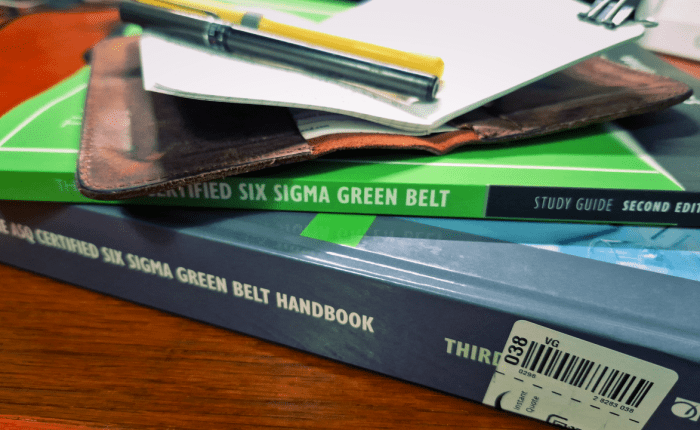
While I waited to figure out how to learn the material, I looked up the ASQ requirements and purchased used copies of the Six Sigma green belt handbook and a test prep study guide with practice questions.
Knowing that getting started is better than waiting around for a perfect plan, I started reading the handbook and planned to sort out my study strategy as I went. Almost immediately, I began connecting concepts to my past work and imagining how I could apply them now in my current role.
That’s when I realized: I’d done this before.
Paramedicine (2015–2016)
In 2015, I hit the transition point between early and mid-career phases and started questioning if I was on the right path (I found office work not very fulfilling). I thought it was a good opportunity to seek a career change and embark into paramedicine – I had a passion for first aid, I was a first responder on a few occasions in university (shoutout to University of Waterloo Campus Response Team!), dealt with emergencies while working as a bouncer, and I had written my masters thesis on the ethics of first aid. It aligned with my values of helping people and provided a fast-paced technical job that would give me fulfilment.
The first step was meeting the admissions requirements, which included needing a high school biology credit. I enrolled in a self-paced college prep biology course.
There was no active instructor; just a course outline, a textbook, weekly tests, and two major summative exams. Here’s how I approached it:
Used the course outline and test schedule as a learning roadmap – Matched unit outcomes in the course outline to textbook chapters covered on tests – Prioritized readings based on the self-paced testing schedule
Created active study tools – Flashcards for definitions and concepts – Hand-drawing diagrams (cells, organs, systems) labeled front-and-back for drill practice
Focused on comprehension-level mastery – Enough to explain, label, and connect systems without unnecessary complexity – The test was multiple choice, true/false, and labelling diagrams, so sticking to the first two levels in Bloom’s taxonomy was sufficient.
This gave me a clear plan and a feedback loop through frequent testing. I passed the course with an above 90% final grade.
Samples of my flash cards and hand-drawn diagrams.
The Present
For my Green Belt prep, I have:
A roadmap: The Body of Knowledge in the handbook’s appendix, which outlines each section, topics, and the number of exam questions per section.
Content: The handbook itself for deep reading and marginalia.
Practice: A test prep guide with exam-style questions.
By combining these, I can map my study plan to the exam structure. I also asked AI to use my weekly time constraints to suggest a manageable plan to break up the work and prepare to take the test by mid-Fall. Then, I can prioritize topics by weighting and test my knowledge incrementally as I go.
The Lesson
I realized I don’t always need a formal course, especially for a certification with a defined body of knowledge and predictable exam format. By having a clear syllabus, a learning map, a primary content source to learn from, and a way to test and reinforce learning, I can direct my learning effectively.
Courses have advantages: expert guidance, tailored examples, real-time feedback, and adaptive teaching. However, courses are not the only route for learning and self-development. By having a well-defined body of knowledge to study from, and using active learning methods like taking notes, journaling on my learning, short feedback cycles, and finding ways to apply the content to my work and experience, I have all that I need to be successful. All it will cost is some used textbooks, a registration fee, and remembering a lesson I learned a decade ago.
Here is a note I wrote to myself watching a training video:
“While a lot of these (insights) are basics that I already know, I am doing a terrible job at following them (to use my time effectively during the work day). Yes, I’m procrastinating by watching (the) video as if it will be the magical thing that fixes all my problems. Still, I also believe in the need to repeat messages, messages resonating at different times, and new ways to view old problems.”
There is something to be said for shiny new toys distracting us from just sitting down to get the work done. It’s not a knowledge problem, it’s an application problem. As Derek Sivers points out, if it were a matter of knowing, we’d all have six-pack abs and a million dollars in the bank. I fully acknowledge that I don’t need another video to teach me how to be more productive.
As it is said, there are many paths up the mountain. Some are harder, some are more direct. I have to allow myself some space and grace to realize that I don’t know everything, that I’m going to make mistakes, and that each day resets to zero to try again.
Exercise teaches us that to become stronger (read: more capable), you must grow through a process of exposure to controlled stress, recovery, then adaptation, so that you can handle the same stress loads with less conscious, intentional effort. This is a useful metaphor for handing other kinds of stress in our lives. Therefore, to overcome, you must develop your stress-capacity beyond whatever it is that is creating your fear, anxiety, or pain.
There are limitations to this simplification, such as bodily ailments and chronic systemic issues, but as a general idea, this shows an empowering approach that allows you to take responsibility over finding paths forward to good outcomes. You don’t have to resign yourself to passivity; it is possible to be active in redefining what you are capable of.
I had my latest performance appraisal last week. I found I had a much easier time identifying areas of growth this time over last year after having gone through an accreditation visit for one of our programs. In the past, I would look at my current skillset, look at the friction points I was experiencing, and project forward a better future based on picking up some new skills or experience. This process is fine, but I realize the flaw is that the path you choose to develop in is not based on experience. It’s a guess about what might be helpful.
Contrast this to going through the accreditation process. To prepare for the performance appraisal, I reviewed the last year’s worth of information (my calendar, my one-on-one meeting notes, and notes I’ve taken about my job) and saw patterns of missed opportunities and under-performance. In these areas, I can reflect and see how if I had more skills or experience in these particular areas, I would have had a better time navigating the issues we faced.
Based on this backwards reflection (rather than guessing or projecting forward), I could more clearly articulate what I’m weak in and where I would gain the highest value in focusing on.
I think this marks for me the formal transition from the “start of career” phase to a more mature “middle career phase.” I have enough work experience and self-knowledge to draw meaningfully from, and that allows me to make smarter choices moving forward.
I was reminded today of one thing I missed in the two years we worked from home. When carrying out your duties from home, in isolation, your interactions with your colleagues has two defining features: it’s mediated, and it’s pragmatic.
It’s mediated for the obvious reason that it’s done entirely remotely. You see your colleagues, but through a screen. You work hard to not talk over each other, because doing so makes the conversation stilted. The interactions are just more screen time you are seeking to limit, and it’s artificial in the conversational decorum that’s needed to make the medium work.
And it’s pragmatic in that your interactions are always deliberately chosen. Unless you intentionally sit on an open call, waiting for people to come in as they please, all interactions with colleagues are done by appointment and with a specific purpose in mind. The two of you “connect” virtually to discuss, then disengage to carry on with your day.
The office is different. There is something to be said for serendipitous conversations that pop up when passing each other in physical space; when you wander into someone’s office or cubicle and strike up a chat. The conversation has a tendency to float from topic to topic, because unless you booked a meeting into their calendar, your interaction doesn’t have the same constraints. Once the purpose of the chat is over (e.g. your question is answered, or the message is conveyed), you then move on to whatever adjacent topics are on your minds.
In the time I’ve worked here at the college, I’ve found a lot of opportunity for career development in the casual conversations I’ve had with people around the office. The conversations aren’t even about my career development explicitly, but instead are lessons learned through osmosis. Lessons learned when a manager is describing an issue they are dealing with, and you gleam from them insights into the skills you need to develop to meet similar challenges. Or where they share stories from earlier in their career that’s relevant to something being experienced in the present. It’s not a traditional mentorship, but if you listen closely, it can come close.
During the time I worked at home, my career development came through the projects I worked on, reflecting on skills I lacked, and seeking out ways to train into what I needed. It was always reactive and “just in time.” I didn’t realize how much I missed what happens when people are sharing a space together, and you as a colleague seeking wisdom get a chance to learn proactively with “just in case” wisdom that gets filed away for future use.
I miss the freedom of wearing shorts at home, but I’m glad to be back for the water cooler discussions.
The calendar has rolled over, meaning it’s time to provide an update on my reading over the last year. For my previous lists, you can see what I read in 2020, 2019, 2018, 2017, and 2016.
Title
Author
Date Completed
Pages
1
Clanlands
Sam Heughan & Graham McTavish
01-Jan
352
2
Lean Out
Tara Henley
03-Jan
336
3
Moon of the Crusted Snow
Waubgeshig Rice
05-Jan
224
4
Sovereignty
Ryan Michler
12-Jan
266
5
Eat a Peach: A Memoir
David Chang
14-Jan
304
6
Neverwhere
Neil Gaiman
19-Jan
480
7
The Office: The Untold Story…
Andy Greene
24-Jan
464
8
Angels & Demons
Dan Brown
30-Jan
736
9*
Meditations
Marcus Aurelius
07-Feb
256
10
The Practice
Seth Godin
23-Feb
272
11*
The Righteous Mind
Jonathan Haidt
12-Mar
528
12
A Clash of Kings
George R.R. Martin
29-Mar
1040
13
Hold Me Tight
Dr. Sue Johnson
26-Apr
320
14*
To Pixar and Beyond
Lawrence Levy
26-Apr
272
15
Cool Sex
Diana Richardson & Wendy Doeleman
30-Apr
128
16
Mindfuck
Christopher Wylie
10-May
288
17*
The Massey Murder
Charlotte Gray
24-May
336
18*
On Immunity
Eula Biss
21-Jun
224
19
At The Existentialist Café
Sarah Bakewell
30-Jul
448
20
Learn Like a Pro
Barbara Oakley & Olav Schewe
05-Aug
160
21
The Great Influenza
John M Barry
05-Aug
560
22
The New Father
Armin A. Brott
07-Aug
336
23
Effortless
Greg McKeown
07-Aug
272
24
Can’t Even
Anne Helen Petersen
13-Aug
304
25
The Happiness Hypothesis
Jonathan Haidt
13-Aug
320
26
Switch
Chip Heath and Dan Heath
16-Aug
320
27
The Bully Pulpit
Doris Kearns Goodwin
22-Aug
912
28
Saving Justice
James Comey
22-Aug
240
29
An Elegant Defense
Matt Richtel
27-Aug
448
30
Infinitely Full of Hope
Tom Whyman
06-Sep
218
31*
The Black Count
Tom Reiss
22-Sep
432
32
Think Again
Adam Grant
01-Oct
320
33
Lives of the Stoics
Ryan Holiday and Stephen Hanselman
03-Oct
352
34*
A Knock on the Door
Truth and Reconciliation Commission of Canada
06-Oct
296
35
Our Own Worst Enemy
Tom Nichols
07-Oct
256
36
A Storm of Swords
George R.R. Martin
11-Oct
1216
37
How Ike Led
Susan Eisenhower
17-Oct
400
38
Braiding Sweetgrass
Robin Wall Kimmerer
29-Oct
408
39*
Social Empathy
Elizabeth Segal
05-Nov
256
40
Noise
Daniel Kahneman, Olivier Sibony, Cass R. Sunstein
09-Nov
464
41
Finding Your Element
Ken Robinson with Lou Aronica
12-Nov
320
42
The Storyteller
Dave Grohl
14-Nov
384
43
Why We Make Things and Why It Matters
Peter Korn
16-Nov
176
44
For Small Creatures Such As We
Sasha Sagan
18-Nov
288
45
Courage is Calling
Ryan Holiday
24-Nov
304
46*
The Seven Principles for Making Marriage Work
John M Gottman and Nan Silver
06-Dec
288
47
Mr. Dickens and His Carol
Samantha Silva
08-Dec
288
48
The Ghost of Christmas Past
Rhys Bowen
14-Dec
272
49
Why We Sleep
Matthew Walker
19-Dec
368
50
In A Holidaze
Christina Lauren
20-Dec
336
51
Christmas Every Day
Beth Moran
24-Dec
408
52
A Christmas Carol
Charles Dickens
24-Dec
112
Total
19308
Entries whose number is asterisked was read for our bookclub.
This year was a huge step up in the number of books I got through. In 2020 I came in at 38 books, whereas I settled into a good groove and managed 52 books for 2021, or a book per week on average. The big months were January (8 books), August (10 books), and October through December (7 books each month). 2020 was a tough year on everyone as we made the pivot to pandemic life; I was also preoccupied with my wife’s pregnancy and later the birth of our son. For 2021, things settled and we found new normals to operate within. I still relied heavily on audiobooks, but I found that where I made the majority of my reading progress during my work commutes in the before-times, I now find time while walking the dog and doing chores around the house to squeeze in a listen.
I’m also happy to see I continued my trend started in 2020 to move away from predominantly reading self-help and business books. While they are still sprinkled throughout, I embraced more fiction, memoirs, books on history, and discussions of complex social issues.
My book club was down slightly over last year, coming in at 9 books for the year. We also celebrated a birth and added a new member which is exciting. In the table above, the asterisked numbers denote book club entries, but I have included them collected below:
Meditations by Marcus Aurelius
The Righteous Mind by Jonathan Haidt
To Pixar and Beyond by Lawrence Levy
The Massey Murder by Charlotte Gray
On Immunity by Eula Biss
The Black Count by Tom Reiss
A Knock on the Door by Truth and Reconciliation Commission of Canada
Social Empathy by Elizabeth Segal
The Seven Principles for Making Marriage Work by John M Gottman and Nan Silver
And to round out the post, here are my top five reads of the year in chronological order:
Moon of the Crusted Snow by Waubgeshig Rice (this book was so good, I bought two copies and mailed them to friends as gifts – one going all the way to Scotland!)
The Great Influenza by John M Barry (if history doesn’t repeat itself, then at the very least it rhymes, and so learning about the Influenza Pandemic of 1918-1919 helps to contextualize our experiences over the last two years)
How Ike Led by Susan Eisenhower (I took so many notes reading this book and will revisit the lessons of Dwight Eisenhower often)
Braiding Sweetgrass by Robin Wall Kimmerer (this was my first proper introduction to Indigenous ways of knowing, and my worldview has been made richer for it)
Why We Make Things and Why It Matters by Peter Korn (a beautiful memoir and reflection on the nature of making, craft, art, and finding your calling within a career)
2021 was a great year of reading for me. Despite feeling adrift in the monotony of the pandemic (or languishing, as Adam Grant claims it), I found exploring both ideas and fictional worlds to be immensely rewarding. My horizons have expanded and I’m looking forward to continuing this exploration into the new year. I’m intending on tackling more biographies, books on history, and works of fiction. I’ve also decided to explore another genre – comic books! With all the great media being adapted from comic books (and now that I have disposable income), I’m intending on diving into some of the celebrated collected volumes that I missed out back in my Wizard reading days.


 A Paramedic's Notebook