Friday Round-Up – June 19, 2020

After a poor performance last week left me with no Friday post, and even though today’s post is much later than I intended, here I am to make good on my promise to do better.

Here is my round-up list for the week ending on June 19th:

📖Article – Jon Stewart Is Back to Weigh In | The New York Times

Sorry if you hit a paywall on this article (I managed to read it fine from Pocket). I’ve lamented elsewhere that I genuinely miss Jon Stewart, not just from his tenure on the Daily Show, but also from other initiatives he’s thrown his weight behind (remember his masterclass in oration?). While this interview is part of Stewart’s media blitz for his upcoming movie release, it is also chocked-full of wonderful insights and observations about the world we find ourselves in. He’s ever poignant in his wit, but also speaks from a cautious place. The interview is so good, I quickly reached the limit of my free highlights in Pocket.

💭 Reflection Mega-Thread – How We Process Information

I want to turn this into a more formal blog post in the near future, but for now I’d like to lay out a few strands that have come together over the last two weeks about how we process, curate, and digest information.

🎧 Listen – You Must Avoid This Weakness | The Daily Stoic Podcast

First, a short listen from the Daily Stoic reflecting on how our minds are not reliable when it comes to processing truth. Instead, we are bound up in our own biases that we seek to confirm. If we want to be functioning, contributing members of society, we must actively exercise our critical faculties, including seeking out when we are wrong. Or as the closing lines state: “It’s the snowflakes who fly into a rage when someone challenges their views. It’s the snowflakes who can never admit they’re wrong or address deserved criticism or feedback.”

🎧 Listen – 479: Post-truth Expertise | CBC Spark Podcast

Next, a thought-provoking podcast episode from the CBC that tackles expertise in a seeming post-truth world. There is a lot of good information floating around in the ether, waiting for us to latch on to its wisdom. And yet, despite good information there for us to seize, we see many people in our peer groups turn away and distrust the experts. Shunning the norms of knowledge communities, they instead embrace their own norms of knowledge and assertion.

📣 Twitter – Carl T. Bergstrom (@CT_Bergstrom)

Speaking of experts, one of the voices I’ve turned to on Twitter to help me filter the signal from the noise is Mr. Bergstrom. He has provided both some levity :

As well as valuable information to help stop me from embracing each news article that flies out with clickbait titles:

I have a blog post percolating in my mind about curating news feeds, but I’ll leave that breadcrumb here for now.

🏳‍🌈🎧 Listen – I Don’t Want To Get Over You (Season 3 Mission 9) | Zombies, Run!🏳‍🌈

Finally, I want to give a huge shout-out to the writers and folks behind Zombies, Run! for this episode I listened to last week. The episode really stuck out for me. A large portion of the dialogue involves two lesbian characters discussing a mutual love interest (the love interest is the current partner of one of the characters, and a former lover of the other character in the conversation). The conversation between the characters touches on topics like “gold stars” and the fears that bisexual partners may have, even in committed relationships. I’ve heard my own queer friends discuss these topics, and while it felt noteworthy that the development team included “voices” from a wide range of folks, it was awesome to hear conversations that weren’t centered on the heterosexual experience that’s often given as the default in media. It gives the game a sense of realness and depth, despite it being about living in a post-apocalyptic zombie wasteland. It’s also important, as we reflect on this Pride month, to think about the kinds of voices we engage with that represents life, and whether we are seeking out sources that look to bring more diversity to the table. I’m happy to be supporting the app and the team.

Stay Awesome,

Ryan

Aristotle and Moral Education in Art

silhouette of three performers on stage
Photo by Kyle Head on Unsplash

I spent a large chunk of my weekend grading essays from my students. Their task was to watch the movie The Road, adapted from the novel by Cormac McCarthy and write a paper based on themes and ideas presented in the course. Based on the course content presented so far, I encourage students to examine the story’s protagonist and argue whether he is a good candidate to be considered a tragic hero as defined by Aristotle.

While grading papers, I mused about Aristotle’s strict criteria for what makes for a tragic hero. The tragic hero must be noble and good (though not a paragon of virtue), but possesses a minor flaw of character or error in judgment (hamartia), which when applied to circumstances brings about some sort of downfall or negative consequence (an inevitable reversal of circumstances, or peripeteia). It’s not that the character is vicious, but merely that their minor flaw is the cause of the negative outcome. However, the negative outcome must be caused by the character (and not, for instance, by the gods), and the consequences of outcome must be in excess of the original cause. The character must also see that they are the reason for their suffering (anagnorisis – the move from ignorance to knowledge). In the context of a narrative or telling of the story, this would elicit pity and fear, a purification of emotions (catharsis) for the audience.

On the one hand, Aristotle is spelling this all out as a way of formalizing and categorizing types of art (Aristotle was a philosopher and biologist by vocation). He might have even considered writing this down as a way of formalizing a set of guidelines to critique plays, finding a way to point out what makes some plays good and others not.

But I had another thought. Aristotle’s teacher, Plato, took a dim view of the arts. In his Republic, Plato was comfortable with banishing the poets from his ideal city, and only allow art that held up the moral authority. I’m wondering if Aristotle had something like this in mind – that art could be used as a moral education tool.

Maybe, the best examples of art are ones that teach the audience lessons, albeit in a less direct route (than, say, fables). If this were true, then we could interpret Aristotle’s criteria the following way. A piece of art is valuable as a moral training tool when the audience can build an emotional connection with the suffering of others. Rather than it being a spectacle for them to lose themselves in, the art gives the audience a moral framework to judge themselves against. The tragic figure is like them: not a god or immortal, but an example of a good person trying to do good things. The tragic figure might even be a little aspirational, something the audience can work towards. They aren’t depraved in the soul, but they are responsible for their actions, even if those actions have negative consequences.

Instead of blaming their suffering on an external cause, the tragic figure realizes that they are the cause of their own suffering. The audience sees this, sees that they could be this person, and through their emotional connection, learns to empathize with the tragic figure. In a sense, they could be the same person, were the circumstances be different. The audience feels the pain, takes pity upon the otherwise good person, and maybe even fears this happening to them.

Given that Aristotle’s ethics was predicated on relative moral excellence, it’s possible that he intended art to be educative, though I don’t have the scholarship background to confirm whether this is true (or plausible). To be clear, I don’t think art must function in this capacity. I think it’s perfectly reasonable to have art for its own sake, or for the creative expression of what’s inside the artist.

Still, the thought of morally educative art is interesting. I’ve often thought of what kinds of art I’d want to expose my own children to in the development of their moral character. What kinds of lesson would I want them to absorb and learn from as they develop an internal sense of ethics and morality?

Stay Awesome,

Ryan

Friday Round-up – June 5, 2020

My attention this week has largely focused on what’s happening in the United States with the protests and marches. As such, the vast majority of this week’s round-up are a collection of posts from social media that I want to help amplify.

Here is my round-up for the week ending on June 5th, 2020:

📖Article – James Mattis Denounces President Trump, Describes Him as a Threat to the Constitution | The Atlantic

I read Mattis’s memoir a few months back, and in it he specifically states that he does not intend to publically comment or speak out against a sitting President. He notes that it’s inappropriate as a former military member (he feels that there should be a separation between executive politics and the military) and as a former Cabinet member. The implication is that while he resigned his post in protest over the policy decisions being made by the White House, there will come a time when he feels it would be appropriate to finally criticize the President he served under. That is what made this post all the more surprising (thought not surprising when you read it) – things have gotten to the point that he feels his silence is counter-productive to upholding the American Constitution. Based on his memoir, I hold Mattis in high regard, both as a leader and as a thinker, so this is something I took note of.

💭 Reflection – What can I do as a white ally?

When this week started, I could find no words that would be appropriate. This is, of course, a huge privilege – that I can choose to remain silent while people are out fighting for their lives and a better world.

It would be inappropriate for me to wax on about my thoughts because that would mean centering my voice (even if this is my blog). My voice, my thoughts, and my opinions are not important in this social conversation. Instead, I want to share and amplify some of the great ideas that I bookmarked in my feed.

View this post on Instagram

Volume I of Creative Ecosystems and Funds that are doing the work to support Black people, especially Black queer, trans, and nonbinary folks, and Black women. ⁣⁣⁣⁣⁣⁣I’ll be making an updated version of this graphic every 2 weeks through July to show new adds.⁣⁣⁣⁣⁣⁣⁣⁣ Donate directly to the funds! ⁣⁣⁣⁣⁣⁣⁣⁣⁣⁣⁣⁣⁣⁣ What this moment cannot be is a momentary surge of white guilt translating to temporary care and funds to Black people. White people, how will you use your wealth and power to create strategic plans for societal reparations for Black folks? ⁣⁣⁣⁣⁣⁣⁣⁣⁣⁣⁣⁣ How can you put pressure on your workplaces, governments, etc, to pay reparations to Black folks? How can you make this your own person practice? How will you support not only organizations, but also local Black folks?⁣⁣ ⁣⁣⁣⁣⁣⁣⁣⁣⁣⁣⁣⁣⁣⁣ Do reparations make you feel a type of way? Go to google. Do not ask a Black queer woman to explain a concept that has been well researched by Black people across time.⁣⁣ ⁣⁣⁣⁣⁣⁣⁣⁣⁣⁣⁣⁣⁣⁣ SUPPORT AND FOLLOW THESE ORGS AND FUNDS. They have been doing the WORK long before I made this graphic. ⁣⁣⁣ ⁣⁣⁣ You can view the full list of ecosystems & funds by clicking my bio link.⁣⁣⁣⁣⁣⁣⁣⁣ ⁣⁣⁣⁣⁣⁣⁣⁣⁣⁣⁣⁣⁣⁣ If you’d like to submit your Creative Ecosystem or Fund, please hit my bio link and fill out the form. This list in no way encompasses all creative ecosystems, it needs to grow & it needs your help to do that work.⁣⁣⁣⁣⁣ ⁣⁣⁣⁣⁣⁣⁣⁣⁣⁣⁣⁣ ⁣ ⁣⁣Note 1. While I focused this post on reparations for Black folks, Indigenous folks also need to be included in conversations on land & monetary reparations. This is all a part of the larger convo on white people redistributing their power and wealth to the people they’ve stolen from. ⁣⁣ ⁣⁣ Note 2. My repost guidelines are in my “repost” story highlight. ⁣⁣ ⁣⁣⁣⁣ Note 3. I could only tag 20 max in this post, I’ve tagged all of orgs in my “blk ecosystems” highlight! ⁣⁣⁣⁣⁣⁣⁣⁣⁣⁣⁣⁣⁣⁣ ⁣⁣ Note 4. Every listed org/fund is not solely run by or only supports Black people. Some of these organizations support NonBlack people as well, but they (1.) Show dedicated support to Black people, and also (2.) Have Black leaders on their core teams/boards.

A post shared by Annika Hansteen-Izora (@annika.izora) on

View this post on Instagram

Sending love and hugs to you all everyday. ❤️ Just wanted to take a moment to say and address this again in a post on my feed so this is embedded here. That I will continue to share important information in my stories always at the start of each day, along with swipe up links to things I’ve found helpful in educating myself. I also have a highlight on my page and link in my bio, along with important petitions, donation pages and any further information for books to read, movies to watch, podcasts to listen to that are all really helpful in educating and learning more. I’ll also be sharing any movements and protests we can take part in around the world. . And of course I will continue these conversations offline not just in this online space always. This isn’t a trend, I stand with each and every one of you. Today, tomorrow and always. Change needs to happen and this broken system needs to be fixed. I think, it’s so important we all make sure we really are taking a stand together and help create conversations within our day to day lives always. . I also want to say it’s important right now, we do what we feel works for us in terms of educating, learning and supporting in ways we can. Whether it’s finding and educating online or educating offline. TO make change, we need to continue to speak up, embed conversations in everyday life, help one another carry this throughout all our lives. I’ve attached @nataliesoutlet guide to how to use our voices for change and empowerment in this post as a carousel, which are ways offline we can also show our support and use our voice to fight for what is right. Let’s all continue to positively encourage each other to work together to fight for the change that is needed. If any of you also have anything you’d like me to share, please send them my way ❤️ I also have listed below some incredible, inspiring, amazing and wonderful WOC and MOC creators who I absolutely adore!!! ❤️❤️❤️ @stylebyaysh @laurennicolefk @nimiblackwell @sarahjoholder @basicstouch @styleidealist @iansangala @nicoleocran @_marisamartins_ @eniswardrobe @freshlengths @perpetualplaces @sulsworld @daisyboateng @brenna_anastasia @emmanuellek_

A post shared by India Moon (@indiaamoon) on

View this post on Instagram

ok it took forever (there are so many great books!!) but thanks to all your recommendations here’s a stack for kids, from babies up to about 12, I’d say (YA/teens set coming soon). it does include books about racism and how to be antiracist, but also about what it’s like to be made to feel different and other or to be welcomed and included with love, and about how to love everything about yourself ❤️. (also to be clear, it does include books about some experiences other than being Black and dealing with systemic racism in the US; I went a little more broad for this one!) 📚 let me just say up front that there are way more I could have added, but already it’s hard to read the tiny titles even zoomed in. so please comment below with everything I left out! also, I don’t have kids, so I could be a bit wrong about what age a book suits, please correct me on that below too. (for instance, I’ve learned the young readers’ adaptation of Born a Crime and Stamped might be better for older kids!) 📚 also, if you can, as always, please buy books from your local bookstore (and even better if it is Black- or minority- or woman-owned!) instead of from a giant online retailer ☺️. 📚 yes you can repost, just please don’t crop or alter the image, and tag @jane_mount and @idealbookshelf in the image and the caption, thank you! 📚 https://www.idealbookshelf.com/pages/ideal-bookshelf-1163-antiracist-kids-booklist

A post shared by Ideal Bookshelf (@idealbookshelf) on

View this post on Instagram

THIS POST IS FOR WHITE ACTIVISTS! Please read all of the slides and the caption before commenting or sliding into my DMs on this one because I anticipate some push back. I will ask that you read this post more than once before you challenge me and I’ll be happy to engage. Over the past week I’ve watched as white activists call one another out, publicly shame one another, and cancel each other. It astounds me that folx cannot see how they’re using the very tools of white supremacy and the prison-industrial complex under the guise of social justice and activism. Shame is the tool of the oppressor. We must stop using it. We must stop weaponizing social justice. White folx are being told “you should have known better” (maybe they should have) and that their allyship is “performative” (and maybe it is). But there are just so many assumptions being made. It’s like we forget that everyone started somewhere when they began their activism work. As white folx, it is our job to call those white folx in, not shut them out. It is our job to call them in, so that they can learn and do better next time. What also blows my mind is the complete lack of engagement with disability justice within activism. I’m really just over white folx telling other white folx to “google it.” Do you not see the ableism and classism there? If you’re so much further ahead in your activism, why not share resources? Why not have a conversation? My social justice knowledge is a privilege that I gained through a critical education. Not everyone has that. So here are my thoughts on this particular form of white activism. I’m not here for it. I want y’all to know that wherever you are in your activism, I see you. I’m always here to answer any questions you have and will share resources or point you in the direction of the answer if I don’t. I will never shame you, belittle you, or call you out. I’m committed to meeting you where you’re at if you’re willing to do the work. Image IDs are in the comments! Apologies to folks that are having to dig for them. Full body pain flare + brain fog meant that I spaced out on adding them right away and so there are some other comments in the way!

A post shared by Margeaux (they/them) (@margeaux.feldman) on

Friday Round-up – May 29, 2020

This was a pretty bad week for me consuming content. Between some big stuff happening at work, and a general feeling of blah-ness, I don’t have a lot to share this week.

Here is a round-up list for the week ending on May 29th:

📽 Video – Comedy News: Is It Deep or Dumb? | Wisecrack

I think this video does a good job to interrogate my love of certain kinds of comedic news. I was a late-convert to Jon Stewart, and felt crushed when he announced his (much deserved) retirement. While I’ll admit I haven’t given Trevor Noah a fair shake, I pretty much stopped watching the Daily Show after the change-over. Similarly, I’ve watched other shows that riff on the format, whether on cable (such as Samantha Bee), subscription services (like Hasan Minhaj), or online content (I get John Oliver through YouTube). It’s not lost on me that all of the names listed above are Daily Show alumni. My consumption also includes shows that are inspired by the presentation format, like Some More News on YouTube. Still, it’s rare that I consistently follow any one show because I tend to find the material or subjects to be somewhat hollow. The only exceptions to this, as noted by Wisecrack, are Oliver’s and Minhaj’s shows, which I feel to be both smart and wise in the material they present. Rather than trying to punch for the sake of cracking jokes, their shows punch at topics that are meant to help people that aren’t in on the joke. That is, their shows aren’t just speaking to the in-crowd as a private way of mocking the out-group. This was a great video essay that made me think.

📽 Video/Reading Group – Hannah Ardent Reading Group on “The Origins of Totalitarianism” | YouTube & Hannah Ardent Centre for Politics and Humanities at Bard College

I purchased Hannah Ardent’s The Origins of Totalitarianism as a birthday present for myself a few years ago (I know, I’m weird). I still haven’t cracked into it as of writing, but last week I received an email update from my alma mater, and in it they discussed how one of the faculty members had recently returned from time spent doing research at the Hannah Ardent Centre for Politics and Humanities at Bard College. The email also described the regular reading group that occurs, and how it recently moved online to promote physical distancing. I checked out their YouTube page and found this series that I hope to carve out some time to follow along with. Origins is a pretty hefty book, and Ardent is a pretty powerful thinker, so I’m glad to have a resource to help me understand the nuances of her work better.

Stay Awesome,

Ryan

Friday Round-Up – May 22, 2020

Note – this is an experimental posting format. I’ve thought about increasing the number of posts I commit to per week, but I don’t want to add unnecessary work if I’m not willing to stick it out. Let’s be honest: sometimes it’s really hard to get a single post out each Monday that I’m satisfied with, so increasing my posting frequency just to for the sake of increasing my output is a terrible idea. I will run a short experiment to see how easy it is for me to get out a Friday Round-up for the next month. If the experiment goes well, I’ll consider making it a part of the regular rotation. You can find the first round-up post here from April 24ththe second on May 1st, the third here from May 8th, and last week’s on May 15th.

I’m enjoying this posting format so far, so I’ll continue for a few more weeks before making a decision whether it’ll stick around. This week, I stumbled across a lot of heartwarming videos and some cool, creative content.

Here is my round-up list for the week ending on May 22nd:

📷 Photography – This Joker Photo Was Shot with a Toy Figure and Household Items | Peta Pixel/Arjun Menon

View this post on Instagram

FREE FALL. This image is shot with action figures and household items only. . . I was listen to this song by 'Gorillaz: plastic beach' when this idea popped into my head. Joker falling down a sky scraper and yet showing no signs of fear or remorse! Afterall being a sociopath come with their own ups and downs. BTS (swipe for video): For this image I wanted to show a realistic city scape, something that wouldn't be too distracting. Realistic sets make bigger problems I realised. I began by choosing my skyscraper, needed a long grill that looked symmetrical and could pass light. Tada, found my rooms AC cover as the perfect candidate. I used it's filters and the other two surrounding buildings. Found a few more things like Keyboards, Bluetooth speakers, dumbbells as buildings. Then made a road map with rice lights. Added candle leds as building lights. Loved the way this shot came to life with practical effects! For the video my freind @shahidgire helped me out, thanks so much man, he's a kick-ass artist. Follow him! As always a lot of the effort and feedback from @hungryalisha and @sibyeduthafoto. Hey @joaquinlphoenix @hamillhimself @willsmith Hope you enjoyed this, a lot of effort goes into making these. Guys sharing goes a long way as support 🙂 . @hbo @hbomax . #actionfigures #joker @behindthescenegram #toyartphotography #toyartgallery #articulatedcomicbookart #acba #epictoyart @french_toy_love @epictoyart #toy #toyunion #endoskeleton @onlyfilmmaker #diyphotoshoot  #kaiexposeyourself #articulatedphotography #createathome @cinematogr #filmmakersworld @filmlights  #creativequarantine  #marvelactionfigures #op_h #batmanjoker #toysyndicate #dccomicsart  #breakfromboredom #toyaremydrug  #batmanart  #quarantineproject #dccomics @camera_setups

A post shared by ARJUN MENON (@artleavesamark) on

I stumbled across Arjun Menon’s work through a post on Peta Pixel, however I really encourage you to check out his Instagram page. Once you get past his recent project of filming figurines, you’ll also find many incredible photos from his portfolio. But his figurine photos are super creative and inspiring!

📽 (Wholesome) Video – broxh_| YouTube & Twitch

The link above takes you to broxh_’s Twitch page, but I learned about this sweet and wholesome dude on a compilation video elsewhere on the interwebs. Check out how awesome this guy is!

GAH! I just can’t get enough of how genuine and good he is. He’s so friendly and just wants to share his craft with people. I would gladly travel to New Zealand just to meet him in person.

📽 How To Videos – Dad, how do I? and Mom, how do I? | YouTube

The “Dad, how do I?” YouTube channel has blown-up recently, and I stumbled across a “Mom, how do I?” companion channel that was likely inspired by the Dad channel. The apparent story behind the Dad channel is the host, Rob, wanted to create videos to impart his wisdom now that his kids have grown. Rob’s father walked out on his family when he was in his early teens, so these videos also serve to help kids who were like him who don’t have someone they can turn to for how-to help. Like broxh_ above, the Dad and Mom channels show us that there are wonderful people out there who are spreading kindness in small, meaningful ways.

💭 Reflection – On Experimentation and the Unknown | Think Like a Rocket Scientist by Ozan Varol

This was an interesting observation that I stumbled across while reading Varol’s new book. While there are pedagogical reasons why we do experiments with known outcomes, I think sometimes we forget that the point of experiments is to test hypotheses because we don’t know the outcome with certainty. This pairs nicely with a quote Varol includes a few pages later from Richard Feynman: “Scientific knowledge is a body of statements of varying degrees of certainty – some most unsure, some nearly sure, none absolutely certain.” We tend to demand fixed answers from our experts and media, when instead we should be reminded repeatedly and often that our understanding of the universe is based on probabilities and not binary truth-conditions.

Stay Awesome,

Ryan

Lost in Translation – Sophrosune

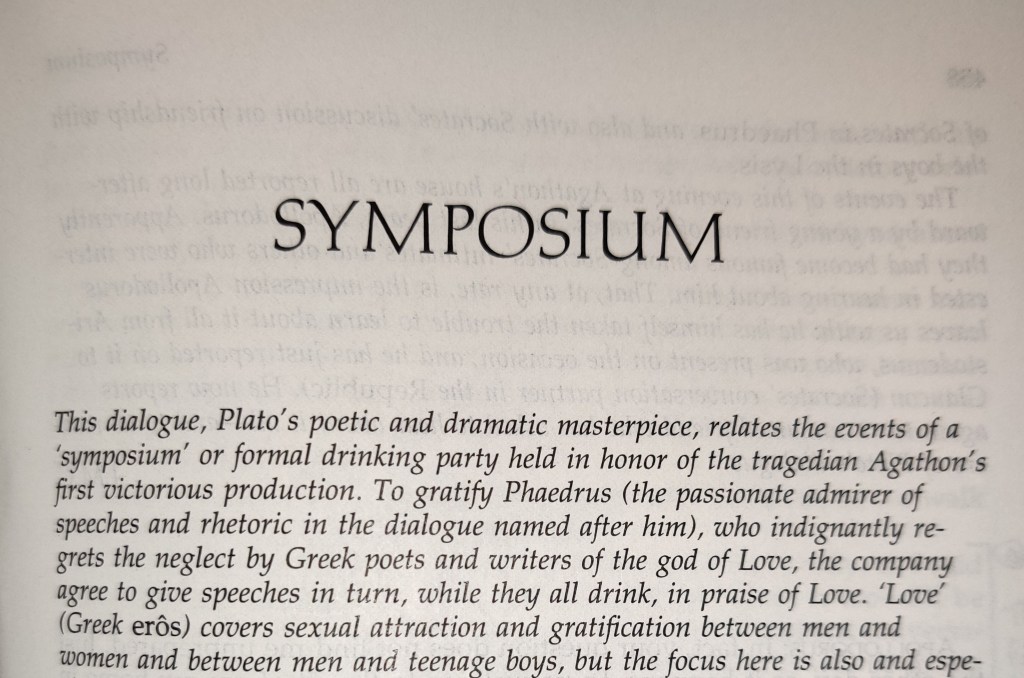
In preparation for my upcoming book club meeting, I’ve been reading through our current selection, Plato’s Symposium. While on Friday I chuckled at a little dialogue I’ve started with myself as a reader over time, I stumbled across a very interesting footnote that I wanted to share.

23. The word can be translated also as “temperance” and, most literally, “sound-mindedness.” (Plato and Aristotle generally contrast sophrosune as a virtue with self-control: the person with sophrosune is naturally well-tempered in every way and so does not need to control himself, or hold himself back.) From: Plato: Complete Works, edited by John M. Cooper (Hackett) p479.

I love learning about words in foreign languages that don’t have an exact translation into English. The great thing about these words is that is serves as a worldview expanding device that adds to the filters we use to engage with the world. Sophrosune (or sophrosyne as I later learned from Wikipedia) is often translated to mean temperance or self-control. But as this footnote discusses, the world has an added element that sets it apart from self-control.

It carries an added moral character dimension that describes a certain kind of disposition. Implied in the idea of self-control is an element of instability – the self-control is needed to push against some felt desire or want. Were the desire absent, there would be no need for self-control. We don’t think of a person who is not thirsty as exercising self-control because they are not drinking water. Self-control would instead apply to the person who is actively thirsty but must resist imbibing for some reason. There is a force of will that is being applied against a desire to tamp it down.

Thirst for water might be a poor example here since water is necessary for life. Instead, we can think of the addict who is fighting an impulse to consume something they seek to abstain from. When they fight against the impulse, they can be said to be exercising self-control.

By contrast, sophrosune describes a moral quality of a person who is, in some sense, harmonious in their inner life. They don’t have the cravings that create impulses that require self-control. Instead of fighting cravings, as in the case of the addict, they may choose to engage or not engage in an activity without any internal pull towards it.

Whether this is a quality that is possible to attain, I cannot say. But it was an interesting word to learn about as separate from what one typically thinks about when pondering self-control and temperance.

Stay Awesome,

Ryan

Why Is Reading So Hard Right Now?

Photo by João Silas on Unsplash

Right as the pandemic was shutting down work for us, some friends and I decided to start a book club. Last week, we met for our second session to discuss Gulliver’s Travels. I had chosen the book, largely because I was intending to read the book for myself and it seemed like a convenient way to pull double duty.

The book club’s initial pitch was largely for us to use audiobooks to read through non-fiction books since it was mostly what the three of us were doing in our personal lives. Yet I chose a fictional story because, as I mentioned in my overview of what I read in 2019, I feel largely burnt out of self-help, productivity, and business books and I want to broaden my reading a bit.

Not only did I choose a work of fiction, but I decided that since I owned a copy of the book I would try and read my physical copy. It seemed relatively straightforward, and I thought I would make my way through the book at a decent pace.

However, when we met last week to discuss the book, I had to admit in shame that I hadn’t finished the book. I barely made it out of the first of the four voyages Gulliver undertakes.

Truthfully, I’m finding reading (in all forms) difficult at the moment. I found it challenging to read the book since it was sometimes inconvenient to try and read it at night in bed, so I borrowed an ebook copy from the library to read on my phone or tablet. I didn’t elect to purchase an audio copy (but if my own audiobooks are any indication, I wouldn’t be making much progress there either).

So, why is it so hard to read right now? Three reasons have occured to me.

First, unlike when I used to travel to work, I don’t have 40-60 minutes each day where I’m stuck in my car. The lack of captive audiences is considered the biggest reason why podcast authors are noting a dip in listening time since the middle of March. Unlike a few months ago, it’s difficult to plow through a book when I’ve got nothing else going on during a commute.

Second, you’d think being at home all day means I would have plenty of opportunities to listen to podcasts and audiobook guilt-free. Turns out, this isn’t true for me. I feel guilty listening to books or podcasts during “working hours.” And aside from time when I’m running on the elliptical or out doing yard work, I feel guilty listening to my stuff when in shared spaces with others in the house.

But in this case, I had elected not to listen to the story but to read it. That posed a challenge because unlike time when I’m exercising, doing chores, or driving, you can’t multitask while reading. Instead, I have to carve out dedicated time away from my family, when there are no pressing chores, and when I’m not supposed to be working. I’m finding it challenging to eke out those quiet moments that I can set aside just for reading.

Finally, unlike when I was working from the college, my time is much more fluid now. Without context or code switching, the lack of liminality means I don’t mentally put myself in a head-space to read like I did a few months ago. But further than that, I find that I don’t hold fast to “normal working hours,” and instead I’ve noticed myself shifting later into the evening with my work. As work creeps later in the evening, I lose the demarcation of time, especially discretionary time for reading.

I don’t think this is a lost cause. I may be finding it challenging to read while working from home, but it’s merely something to be mindful of, and I have to be more intentional with my time if I want to give myself opportunities to read. The pandemic has forced us all to change how we live our lives, and it stands to reason that the habits I used before to find reading time during the day are not appropriate to expect to carry forward. Instead, if I want to succeed, I have to find a way to create new habits from our new circumstances.

Stay Awesome,

Ryan

Friday Round-up – May 1, 2020

Note – this is an experimental posting format. I’ve thought about increasing the number of posts I commit to per week, but I don’t want to add unnecessary work if I’m not willing to stick it out. Let’s be honest: sometimes it’s really hard to get a single post out each Monday that I’m satisfied with, so increasing my posting frequency just to for the sake of increasing my output is a terrible idea. I will run a short experiment to see how easy it is for me to get out a Friday Round-up for the next month. If the experiment goes well, I’ll consider making it a part of the regular rotation. You can find the first round-up post here from April 24th.

Have you ever noticed the tendency that when you’re thinking about a topic, you seem to notice it everywhere? I first became aware of its phenomenology back in my university days, where stuff that I was learning in my lectures seemingly popped up randomly in my non-class time. Turns out, there is a word for that feeling – the Baader-Meinhof phenomenon, also known as the frequency bias. It’s why you start to see your car’s model everywhere after buying one. I bring this up because today’s articles are all loosely connected with scientific literacy in the digital age (especially as it relates to COVID). The more I read about thoughts concerning how to understand research about the pandemic, the more content I noticed about the topic of scientific literacy in general. This might be the phenomenon/my bias at play, or maybe the algorithms that govern my feeds are really in tune with my concerns.

Here is my round-up list for the week ending on May 1st:

📖Article – What You Need to Know about Interpreting COVID-19 Research | The Toronto Star

My round-up for the week started with this short article that was open in one of my browser tabs since last week. There is a lot of information floating around in our respective feeds, and most of it can charitably be called inconclusive (and some of it is just bad or false). We’ve suddenly all become “experts” in epidemiology over the last month, and I want to remind myself that just because I think I’m smart, doesn’t mean I have the context or experience to understand what I’m reading. So, this article kicked off some light reflection on scientific and data literacy in our media landscape.

📖Article – Experts Demolish Studies Suggesting COVID-19 is No Worse Than Flu | Ars Technica

This next piece pairs nicely with our first link, and includes reporting and discussion of recent flair ups on Twitter criticizing recent studies. Absent of the pressure being applied by the pandemic, what this article describes is something that normally takes place within academic circles – experts putting out positions that are critiqued by their peers (sometimes respectfully, sometimes rudely). Because of the toll the pandemic is exacting on us, these disagreements are likely more heated as a result, which are taken to be more personally driven. I link this article not to cast doubt over the validity of the scientific and medical communities. Rather, I am linking to this article to highlight that our experts are having difficulty grappling with this issues, so it’s foolish to think us lay-people will fare any better in understanding the situation. Therefore, it’s incumbent on journalists to be extra-vigilant in how they report data, and to question the data they encounter.

📽Video – Claire Wardle: Why Do We Fall for Misinformation | NPR/TED

The Ars Technica piece raises a lot of complex things that we should be mindful of. There are questions such as:

  • Who should we count as authoritative sources of information?
  • How do we determine what an authoritative source of information should be?
  • What role does a platform like Twitter play in disseminating research beyond the scientific community?
  • How much legitimacy should we place on Twitter conversations vs. gated communities and publication arbiters?
  • How do we detangle policy decisions, economics, political motives, and egos?
  • How much editorial enforcement should we expect or demand from our news sources?

There are lots of really smart people who think about these things, and I’m lucky to study at their feet via social media and the internet. But even if we settle on answers to some of the above questions, we also have to engage with a fundamental truth about our human condition – we are really bad at sorting good information from bad when dealing at scale. Thankfully, there are people like Claire Wardle, and her organization FirstDraft that are working on this problem, because if we can’t fix the signal to noise ratio, having smart people fixing important problem won’t amount to much if we either don’t know about it, or can’t action on their findings. I was put onto Claire Wardle’s work through an email newsletter from the Centre for Humane Technology this week, where they highlighted a recent podcast episode with her (I haven’t had time to listen to it as of writing, but I have it queued up: Episode 14: Stranger Than Fiction).

📖 Essay – On Bullshit | Harry Frankfurt

All of this discussion about knowledge and our sources of it brought me back to grad school and a course I took on the philosophy of Harry Frankfurt, specifically his 1986 essay On Bullshit. Frankfurt, seemingly prescient of our times, distinguishes between liars and bullshitters. A liar knows a truth and seeks to hide the truth from the person they are trying to persuade. Bullshit as a speech act, on the other hand, only seeks to persuade, irrespective of truth. If you don’t want to read the essay linked above, here is the Wikipedia page.

I hope you find something of value in this week’s round-up and that you are keeping safe.

Stay Awesome,

Ryan

What I’ve Been Reading (As of April 12th, 2020)

person holding opened book
Photo by João Silas on Unsplash

It’s been a while since I’ve written one of these posts (last one was October 2018!). Since many people find themselves with some extra reading time, here is what I’m working through while staying safe at home.

Salt, Fat, Acid, Heat by Samin Nosrat

With some extra time at home and wanting to ensure I’m using my perishable foods wisely to cut down on waste, I decided to finally crack this book that I bought for myself at Christmas. When it originally arrived, I was slightly disappointed to see it was less of a recipe book and more of a primer on cooking (which I stuffily thought I had already a good grasp on). However, I recently checked out Nosrat’s latest podcast miniseries, which endeared me to her instantly (she’s so bubbly and full of passion, it was infectious!). Then I checked out the Netflix series that was created based on this book. Then I set to work cooking a minestrone soup from scratch (taking some cues from Jamie Oliver’s YouTube channel) and channeled Nosrat’s thoughts on what makes food taste good. The soup was a hit here at home, and it’s given me the confidence to keep practicing.

Gulliver’s Travels by Jonathan Swift

Some friends and I started a book club just before the government started shutting things down in the province. Our first book was Jim Mattis’ military memoir, and I chose Gulliver’s Travels as our second read. I had first encountered the story as a child, then again in first year of undergrad when I had to read excerpts for a class. However I don’t think I’ve read the unabridged book in its entirety, so I’m trying to approach this read fresh and wrap it up before we meet later this week.

Gates of Fire by Steven Pressfield

I’ve been experimenting with reading fiction in bed before I go to sleep. I found the practice worked well reading The Alchemist, so I decided to continue the practice by grabbing a copy of Pressfield’s Gates of Fire, a fictional telling of the Battle of Thermopylae. I chose this book because I learned in Mattis’s memoir that it’s one of the books on the US Marine Corps mandatory reading list for all enlisted soldiers, and it sounded interesting.

Every Tool’s a Hammer by Adam Savage

I mentioned while reflecting on my 2019 reading list that I’m gravitating more towards biographies and memoirs as of late, and when I was reminded that Savage released a book recently, I grabbed it on audiobook to listen to. I love Savage’s worldview when it comes to making, and I would jump at an opportunity to spend a day with him. I’ll have to settle for this book instead.

Coders by Clive Thompson

I was flirting with learning coding a little while back (also seems like a good skill to pick up now), so I had ordered this one since it had some good reviews. I didn’t buy it to learn coding itself, but because it was presented as a good primer for learning about the world/community of coding. It provides a quick overview of the history of coding and dives into a bit of the lives and psychology of people who devote themselves to coding. I also was interested by the section at the end where the author reflects on learning to code during the writing of the book. I’m only around 100 pages in, so I still have a bit more to go.