Last week, I finished reading As A Man Thinketh & From Poverty to Power by James Allen for the book club I am in. I noticed I hadn’t updated my reading tracker for the year, so I quickly updated my progress in 2020 to date.
195
The Kite Runner
Khaled Hosseini
363
2020
196
My Own Words
Ruth Bader Ginsburg
400
2020
197
Kitchen Confidential
Anthony Bourdain
384
2020
198
Stillness is the Key
Ryan Holiday
288
2020
199
The Oxford Inklings
Colin Duriez
276
2020
200
The Infinite Game
Simon Sinek
272
2020
201
The Ride of a Lifetime
Robert Iger
272
2020
202
As a Man Thinketh & From Poverty to Power
James Allen
182
2020
65981
pages
I have been maintaining my reading tracker since 2016 when I chose to make reading a priority in my life. I was pleasantly surprised to see that I had surpassed 200 books in the last 5 years, which amounts to around 65,000 pages (caveat – a lot of these books are in audiobook format, and the page counts are taken from Amazon’s book listings, so the amount is inflated to include front and back matter).
I’ll be posting my 2020 reading list in January, but I thought it would be fun to boast about this a little bit in the interim. I may not remember everything that I’ve read, but on the whole I find this time very much well spent. Through slow, incremental steps, I’ve made a lot of progress.
One thing I love about reading Seth Godin is how he tends to reframe how I think about things. Like many other people, I’ve been feeling in a bit of a rut with work. Without the context shift of going to work in an office, the days start to blur, and working from a distance keeps me detached from my colleagues. Instead, my work is largely done on documents and spreadsheets, and the tedium easily sets in. It feels monotonous and largely procedural.
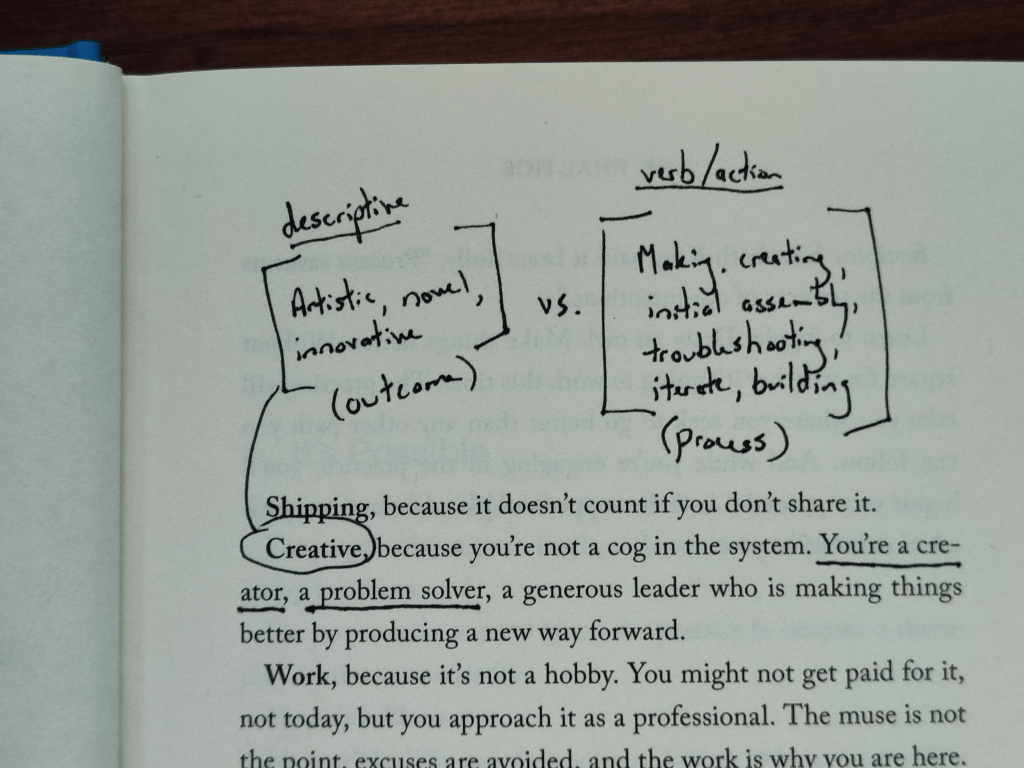
However, the first page of Seth’s new book forced me to reconsider how I view my work. When reflecting on my work, I realized that I was defining “creative” narrowly.
“The Practice” by Seth Godin (2020), page 3
Were you to ask me whether my job is creative, I would probably take a view that conforms to my notes on the left. My job has some elements that I have “artistic” control over, but largely “no” because it’s process driven. However, if I define “creative” more broadly, it’s easy to see how my job is creative. I create tools and process flows. I define problems and find creative solutions, then teach them to others.
We often bind our thinking about “creative” to notions like innovation and novelty (divinely given?), when instead we should think of “creative” as deriving from “create,” which is more process driven than outcomes driven.
This doesn’t solve my tedium with spreadsheets, but it helps me frame my work within a different context. I am not just a cog, but instead I have the ability to adapt the cogs I use to suit my needs.
According to Seth Godin, there is no such thing as writer’s block. He’s been on my mind recently, not just because I listen to his regular podcast, but also because he’s doing the book marketing circuit on the podcast shows I typically listen to. As of writing (November 3rd), his latest book was just delivered to my door.
From what I understand, Seth’s belief is that writer’s block is a function of our desire to not ship bad work. Instead, we hold out until a good idea arrives and we work on it. His advice to overcome “writer’s block” is to constantly write regardless of how bad you think it is. It’s a bit of a spaghetti approach – you throw as much at the wall and see what sticks. He maintains that buried under all the bad writing, there is bound to be some good stuff. The job of writing bad stuff is to eventually unearth the good stuff for you to work on and polish to completion.
Seth is known for having posted on his blog every day for over a decade, tallying over 7000 posts. He says that for every post we read, there are up to 8 that didn’t get published.
I recently finished Adam Savage’s maker’s memoir, Every Tool’s a Hammer. I always enjoyed watching MythBusters back in the day, though I wouldn’t say I was a diehard fan – I caught episodes as they aired, but didn’t follow the show. As an adult, I wish I had followed more closely, because I’m finding that I’m drifting towards the maker ethos, and it would have been good to have been mentored in real-time to the show’s airing. I guess that’s why we have reruns and syndication.
Anyway, the book has many great insights, one of which is concerned with giving praise and making sure the recipient of the praise is acknowledged.
Adam reflects that all of his growth came from feedback from his mentors. In the role of a boss, he questions why would he shy away from feedback if he wasn’t happy with something (e.g. someone’s performance or the product of their build). This moment of empathy is a valuable insight to me, because as a leader I often hedge my feedback, wanting to avoid hurt feelings or awkward interactions. But there is a difference between providing feedback for growth, and being cruel. I’ve had many great bosses that helped me grow through their feedback, even if that feedback made me feel less than great. But their feedback was never cruel or meant to belittle me – it held me accountable and showed me what to do for next time.
He also mentions praise – people want to be acknowledged and recognized by the ones signing the cheque. Even if it sounds corny, he says, it goes a long way towards building up your team both in terms of morale and skills.
The book has been circling my periphery for some time, coming up in recommended reads lists for at least a year. When it came time for me to suggest the next read, I chose this book without really knowing much about the subject. I was vaguely aware that Henrietta Lacks’s cells were instrumental to many scientific and medical advances, and I was aware that the obtaining of the cells was likely done unethically, as was the case for many Black Americans who found themselves under medical scrutiny in the middle of the last century. Since I review research ethics applications on two ethics boards I serve on, and because of the ongoing conversation around Black lives, I thought this would be a good book for us to read and learn from.
In short, the book is fantastic as a piece of writing.
But the story of Henrietta Lacks and her family is heartbreaking. The book paints a vivid portrait of who Henrietta was, and gives intimate glimpses into the life of her decedents. It also presents a comprehensive history of both the rise of research ethics since the end of World War Two and of the many advances made by science thanks to Henrietta’s cells. However, those advances were done with cells acquired neither with proper consent nor compensation. For many years after her early death, Henrietta’s name became lost to obscurity outside of her family, but everyone in the cellular biology community knew her cells because of how abundant they were. In a tragic twist, the very medical advances that gave way to better understandings of radiation, viruses, and vaccines, were often not available to the impoverished Lacks family. While the Lacks’s remained stuck in poverty, others profited.
I highly recommend everyone read this book.
As we discussed the book last week, I realized that this was an example of why it’s important to enlarge the domain of one’s ignorance. Learning about history shouldn’t be an exercise in theory; often we forget that history is presented as an abstraction away from the stories of individual people. If we forget about their individual lives, we can sometimes take the wrong lessons from history. As the saying goes, those who don’t learn from history are doomed to repeat it. In this case, we continue to exploit the voiceless, and profit on the backs of the disenfranchised – those who don’t have the power to speak back.
Reading books like this gives me a greater context for history, and it helps me understand the lived-history of people. I review research projects to understand the ethical consequences of our search for knowledge. If I lack a historical context – the history of how research was and is carried out – then I run the risk of perpetuating the same injustices on the people of today that the research is meant to help.
Research is supposed to be dispassionate, but we must understand and situate it within its proper historical context.
In an allusion to Picard, I close with this: constant vigilance is the price we must pay for progress.
This is a short and sweet observation that hit me just at the right time. I’ve been feeling low recently and lamenting some of the stuff I have on my plate that’s causing me minor stress. Were it not for the pandemic, I mused, I wouldn’t be having problems coping – if only things were easier. Then a line popped from this podcast to give me perspective: “What did you think that living through history was going to be like?” I can pine for the fabled good ol’ days, but we should be honest that between the periods of calm, there will be periods punctuated with strife. And as observed in the podcast, only time will turn the turmoil of the present into a passage in a history book.
Hugh Jackman has a bit of a reputation for being a good guy, and this podcast did not disappoint. He’s sweet, thoughtful, humble, and genuinely a person you’d want to aspire towards. He’s an example worth following.
I’m a bit of a casual listener to the JRE podcast. I’ll usually check things out depending on who the guest is. In this case, Rogan sent out an image on Instagram with the author, Alan Levinovitz, holding up his book. The caption referenced how quick and enjoyable the 3.5hr show zipped by. Then I caught the book’s subtitle: How faith in nature’s goodness leads to harmful fads, unjust laws, and flawed science. Colour me interested, but I’m a sucker for discussions about the appeal to nature fallacy, so I check it out.
To be honest, I couldn’t tell you what the book’s about after listening to the episode. I have a vague sense that Levinovitz is looking to push back against those who believe things that are natural are automatically good/valuable as well as its opposite that things that are artificial or manipulated are automatically bad. I’m not saying that the episode was bad. Just the opposite – the episode was so good. I’m glad that Rogen doesn’t bring on guests to discuss well-rehearsed talking points to promote the book. Instead, they have a free-wheeling conversation that follows their curiosities. And based on some of the ideas that Levinovitz has, and how he calls for a kinder form of discourse, I was made an instant fan and grabbed the audiobook.
This was a pretty bad week for me consuming content. Between some big stuff happening at work, and a general feeling of blah-ness, I don’t have a lot to share this week.
Here is a round-up list for the week ending on May 29th:
I think this video does a good job to interrogate my love of certain kinds of comedic news. I was a late-convert to Jon Stewart, and felt crushed when he announced his (much deserved) retirement. While I’ll admit I haven’t given Trevor Noah a fair shake, I pretty much stopped watching the Daily Show after the change-over. Similarly, I’ve watched other shows that riff on the format, whether on cable (such as Samantha Bee), subscription services (like Hasan Minhaj), or online content (I get John Oliver through YouTube). It’s not lost on me that all of the names listed above are Daily Show alumni. My consumption also includes shows that are inspired by the presentation format, like Some More News on YouTube. Still, it’s rare that I consistently follow any one show because I tend to find the material or subjects to be somewhat hollow. The only exceptions to this, as noted by Wisecrack, are Oliver’s and Minhaj’s shows, which I feel to be both smart and wise in the material they present. Rather than trying to punch for the sake of cracking jokes, their shows punch at topics that are meant to help people that aren’t in on the joke. That is, their shows aren’t just speaking to the in-crowd as a private way of mocking the out-group. This was a great video essay that made me think.
I purchased Hannah Ardent’s The Origins of Totalitarianism as a birthday present for myself a few years ago (I know, I’m weird). I still haven’t cracked into it as of writing, but last week I received an email update from my alma mater, and in it they discussed how one of the faculty members had recently returned from time spent doing research at the Hannah Ardent Centre for Politics and Humanities at Bard College. The email also described the regular reading group that occurs, and how it recently moved online to promote physical distancing. I checked out their YouTube page and found this series that I hope to carve out some time to follow along with. Origins is a pretty hefty book, and Ardent is a pretty powerful thinker, so I’m glad to have a resource to help me understand the nuances of her work better.
Right as the pandemic was shutting down work for us, some friends and I decided to start a book club. Last week, we met for our second session to discuss Gulliver’s Travels. I had chosen the book, largely because I was intending to read the book for myself and it seemed like a convenient way to pull double duty.
The book club’s initial pitch was largely for us to use audiobooks to read through non-fiction books since it was mostly what the three of us were doing in our personal lives. Yet I chose a fictional story because, as I mentioned in my overview of what I read in 2019, I feel largely burnt out of self-help, productivity, and business books and I want to broaden my reading a bit.
Not only did I choose a work of fiction, but I decided that since I owned a copy of the book I would try and read my physical copy. It seemed relatively straightforward, and I thought I would make my way through the book at a decent pace.
However, when we met last week to discuss the book, I had to admit in shame that I hadn’t finished the book. I barely made it out of the first of the four voyages Gulliver undertakes.
Truthfully, I’m finding reading (in all forms) difficult at the moment. I found it challenging to read the book since it was sometimes inconvenient to try and read it at night in bed, so I borrowed an ebook copy from the library to read on my phone or tablet. I didn’t elect to purchase an audio copy (but if my own audiobooks are any indication, I wouldn’t be making much progress there either).
So, why is it so hard to read right now? Three reasons have occured to me.
First, unlike when I used to travel to work, I don’t have 40-60 minutes each day where I’m stuck in my car. The lack of captive audiences is considered the biggest reason why podcast authors are noting a dip in listening time since the middle of March. Unlike a few months ago, it’s difficult to plow through a book when I’ve got nothing else going on during a commute.
Second, you’d think being at home all day means I would have plenty of opportunities to listen to podcasts and audiobook guilt-free. Turns out, this isn’t true for me. I feel guilty listening to books or podcasts during “working hours.” And aside from time when I’m running on the elliptical or out doing yard work, I feel guilty listening to my stuff when in shared spaces with others in the house.
But in this case, I had elected not to listen to the story but to read it. That posed a challenge because unlike time when I’m exercising, doing chores, or driving, you can’t multitask while reading. Instead, I have to carve out dedicated time away from my family, when there are no pressing chores, and when I’m not supposed to be working. I’m finding it challenging to eke out those quiet moments that I can set aside just for reading.
Finally, unlike when I was working from the college, my time is much more fluid now. Without context or code switching, the lack of liminality means I don’t mentally put myself in a head-space to read like I did a few months ago. But further than that, I find that I don’t hold fast to “normal working hours,” and instead I’ve noticed myself shifting later into the evening with my work. As work creeps later in the evening, I lose the demarcation of time, especially discretionary time for reading.
I don’t think this is a lost cause. I may be finding it challenging to read while working from home, but it’s merely something to be mindful of, and I have to be more intentional with my time if I want to give myself opportunities to read. The pandemic has forced us all to change how we live our lives, and it stands to reason that the habits I used before to find reading time during the day are not appropriate to expect to carry forward. Instead, if I want to succeed, I have to find a way to create new habits from our new circumstances.
It’s been a while since I’ve written one of these posts (last one was October 2018!). Since many people find themselves with some extra reading time, here is what I’m working through while staying safe at home.
With some extra time at home and wanting to ensure I’m using my perishable foods wisely to cut down on waste, I decided to finally crack this book that I bought for myself at Christmas. When it originally arrived, I was slightly disappointed to see it was less of a recipe book and more of a primer on cooking (which I stuffily thought I had already a good grasp on). However, I recently checked out Nosrat’s latest podcast miniseries, which endeared me to her instantly (she’s so bubbly and full of passion, it was infectious!). Then I checked out the Netflix series that was created based on this book. Then I set to work cooking a minestrone soup from scratch (taking some cues from Jamie Oliver’s YouTube channel) and channeled Nosrat’s thoughts on what makes food taste good. The soup was a hit here at home, and it’s given me the confidence to keep practicing.
Some friends and I started a book club just before the government started shutting things down in the province. Our first book was Jim Mattis’ military memoir, and I chose Gulliver’s Travels as our second read. I had first encountered the story as a child, then again in first year of undergrad when I had to read excerpts for a class. However I don’t think I’ve read the unabridged book in its entirety, so I’m trying to approach this read fresh and wrap it up before we meet later this week.
I’ve been experimenting with reading fiction in bed before I go to sleep. I found the practice worked well reading The Alchemist, so I decided to continue the practice by grabbing a copy of Pressfield’s Gates of Fire, a fictional telling of the Battle of Thermopylae. I chose this book because I learned in Mattis’s memoir that it’s one of the books on the US Marine Corps mandatory reading list for all enlisted soldiers, and it sounded interesting.
I mentioned while reflecting on my 2019 reading list that I’m gravitating more towards biographies and memoirs as of late, and when I was reminded that Savage released a book recently, I grabbed it on audiobook to listen to. I love Savage’s worldview when it comes to making, and I would jump at an opportunity to spend a day with him. I’ll have to settle for this book instead.
I was flirting with learning coding a little while back (also seems like a good skill to pick up now), so I had ordered this one since it had some good reviews. I didn’t buy it to learn coding itself, but because it was presented as a good primer for learning about the world/community of coding. It provides a quick overview of the history of coding and dives into a bit of the lives and psychology of people who devote themselves to coding. I also was interested by the section at the end where the author reflects on learning to code during the writing of the book. I’m only around 100 pages in, so I still have a bit more to go.


 A Paramedic's Notebook