Paying to Be Upsold

After a bit of a hiatus, it’s time I dust off my keyboard and get to work.

I attended a digital summit last week organized by a reputable platform. I’m going to deliberately keep this post’s detail vague because I’m not upset by being upsold to the point of it changing my opinion about the platform or the purpose of the summit. On the other hand, it clarified a few things about the nature of online business that I thankfully only paid a few bucks to learn.

The summit was meant to bring together content creators to discuss the business of making money online. I’ve flirted with this idea, and I have some project ideas for online content that I intend to provide for free for the ethics boards I serve, so I thought learning about some of the business and strategic best-practices would help me think through the project steps.

The three-day event brought together a few creators I’m familiar with, and I bought in at the early bird pricing, so I thought even if I attended the equivalent of one-day’s worth of sessions, I wouldn’t feel bad having put down some money for the access.

The first session was about creating an online course using the best practices used on the platform. Since I work in academia, I’m aware of some of the work that goes into creating a course. I would charitably say that I’m not the best fit for the target audience of the course, but I took notes and found some of their insights useful.

But just after halfway through the scheduled event, they switched from presenting about the tools and tactics of content creation to discussing some of the exclusive perks that could be available for a limited time to the summit attendees. As I sat watching, I was amazed that a lot of the various tactics they discussed in the previous 40-minutes were being applied to the session attendees in an effort to upsell a package. For a limited time, if you bought into a $100+ monthly subscription, you’d have access to a half-dozen pre-recorded courses, a half-dozen 2-month trial access to software, a more in-depth set of lessons about all the topics we just learned about, and a few other odds and ends (like unlimited replay of the summit sessions).

I don’t blame the platform for choosing to go this route, but I was shaking my head when I thought that I paid to be given a reduced-value presentation of a larger set of courses, and was being upsold on it. I paid to be sold to. I was even interested in one of the keynote Q&A’s and was disappointed that it was a twenty minute video call. The guest speaker has put out more value for free on his various social media channels than what I received at the summit.

Again, I’m not above this – I think there is some value in what I learned, and I’m not necessarily the target audience, so it’s wrong of me to complain about not liking the content. I just hate that I had to pay a small price to learn this lesson about the nature of online content creation. It’s a series of remixes of content (a cousin of the animated bibliography, it seems), trickled out slowly to optimize the conversion rate of your mailing list.

I understand that in order to make money online, you have to play the game. The problem is I hate that the game is mostly concerned with optimizing for views, rather than genuinely trying to help solve problems. Perhaps it’s a signal that I should heed. If I don’t want to play the game by the rules, I either have to get out of the game, or be so good that I invent a new category. Either way, my main takeaway: creating content online is going to remain a side initiative for me, rather than my main source of income for the foreseeable future.

Stay Awesome,

Ryan
Lost in Translation – Sophrosune

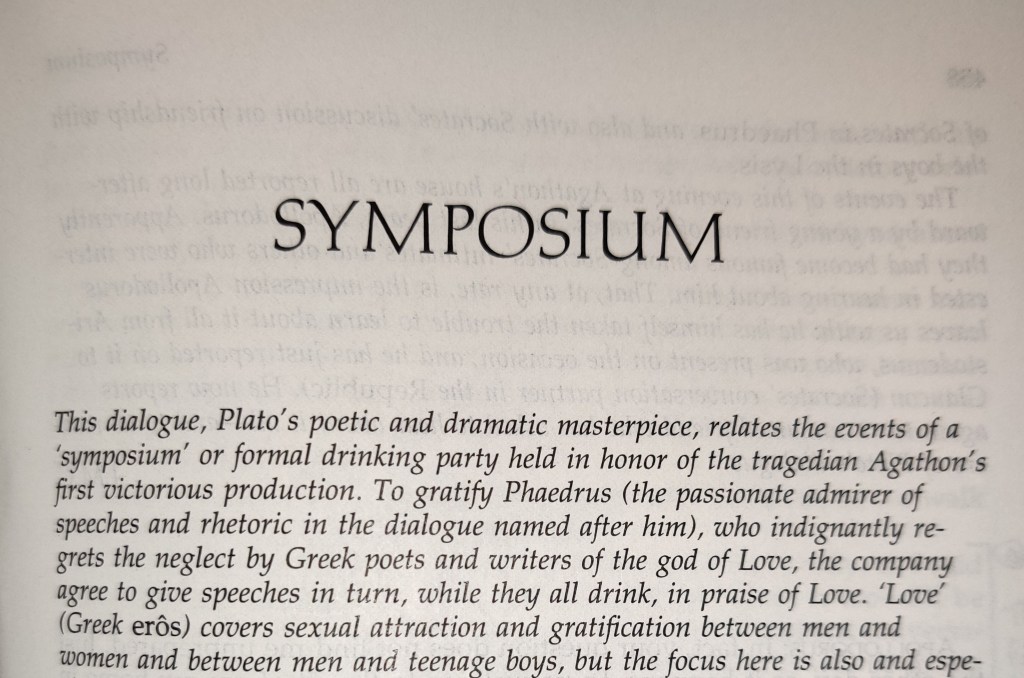
In preparation for my upcoming book club meeting, I’ve been reading through our current selection, Plato’s Symposium. While on Friday I chuckled at a little dialogue I’ve started with myself as a reader over time, I stumbled across a very interesting footnote that I wanted to share.

23. The word can be translated also as “temperance” and, most literally, “sound-mindedness.” (Plato and Aristotle generally contrast sophrosune as a virtue with self-control: the person with sophrosune is naturally well-tempered in every way and so does not need to control himself, or hold himself back.) From: Plato: Complete Works, edited by John M. Cooper (Hackett) p479.

I love learning about words in foreign languages that don’t have an exact translation into English. The great thing about these words is that is serves as a worldview expanding device that adds to the filters we use to engage with the world. Sophrosune (or sophrosyne as I later learned from Wikipedia) is often translated to mean temperance or self-control. But as this footnote discusses, the world has an added element that sets it apart from self-control.

It carries an added moral character dimension that describes a certain kind of disposition. Implied in the idea of self-control is an element of instability – the self-control is needed to push against some felt desire or want. Were the desire absent, there would be no need for self-control. We don’t think of a person who is not thirsty as exercising self-control because they are not drinking water. Self-control would instead apply to the person who is actively thirsty but must resist imbibing for some reason. There is a force of will that is being applied against a desire to tamp it down.

Thirst for water might be a poor example here since water is necessary for life. Instead, we can think of the addict who is fighting an impulse to consume something they seek to abstain from. When they fight against the impulse, they can be said to be exercising self-control.

By contrast, sophrosune describes a moral quality of a person who is, in some sense, harmonious in their inner life. They don’t have the cravings that create impulses that require self-control. Instead of fighting cravings, as in the case of the addict, they may choose to engage or not engage in an activity without any internal pull towards it.

Whether this is a quality that is possible to attain, I cannot say. But it was an interesting word to learn about as separate from what one typically thinks about when pondering self-control and temperance.

Stay Awesome,

Ryan

Openness to Learn

mirror photography of trees on hill
Photo by Steve Halama on Unsplash

Unrelated to the post below, but this is my 200th blog post! I hit post number 100 in March of 2018, which feels like forever at this point. Here’s to another 200 more!

***

On a long(ish) car ride with my mother-in-law over the holidays, we got chatting on the subject of learning from experience. She reminded me of something I’ve known for some time, yet keep forgetting: if you keep an open mind, you can learn something from everyone.

I don’t think this is a trite piece of advice, though often it comes from an experience we would otherwise hope to forget. In my case, I tend to forget this bit of wisdom as I have developed a bad habit of being somewhat dismissive or condescending. There really is no excuse for it – nothing in my experience explains why I’ve adopted this mindset. I just developed the attitude gradually over time.

But it’s good to be reminded that with the right mindset, every encounter you have with others can be an opportunity to learn something, whether that is a piece of knowledge that is exchanged, or if through your interaction with them you learn something about yourself. Rather than seeing things through the lens of whether the person adding or subtracting value (e.g. “this was a waste of my time”) we should look at it from a growth perspective – “what did I learn or discover about myself that I can carry forward and do things better in the future?” This also dovetails nicely with a vlog post I put up recently about finding your tools along the way.

By reframing things this way, you open yourself to serendipitous opportunities to grow and develop. Or, at the very least, you take yourself (and your time) a little less seriously.

Stay Awesome,

Ryan
