Defaults

I’ve been thinking about habits lately. It mostly started when I would reflect or review on my weekly productivity output – or more specifically the lack of output – and realized that I tended to procrastinate a lot in fairly predictable ways. My behaviour of choice to avoid work is to allow myself just a small indulgence on YouTube in the morning before I get started on tasks for the day, and then I look up and it’s been hours.

It’s not that I’m unaware of the time passing me by. I fully accept that it’s a choice I’m making. It just so happens to also be a choice that is hard to make to stop yourself from continuing when the cost to switch to work is so high (objectively less enjoyable than watching a video).

Somewhat coincidentally, I just read BJ Fogg’s book Tiny Habits. I didn’t choose it with the explicit purpose of fixing my work productivity; it just happened to be a happy coincidence. I have read a fair number of the self-help books centering around habits. In 2016, I read Duhigg’s book The Power of Habit, Deep Work from Newport, and 7-Habits from Covey; in 2019 I read Atomic Habits from Clear, Mastery from Greene; and in 2021 was The Practice by Godin. At this point, I think I have a pretty good grasp on the common understanding of how behaviour works in the mind, at least as distilled by pop-psychology.

Having said that, I thought Fogg’s book was pretty good. It’s been a while since I read Duhigg and Clear’s books, but while I finished those books feeling like they laid out a decent explanation of a process for changing habits. I felt that Fogg covered the topics in greater depth with more actionable steps. On top of that, Duhigg is a journalist and Clear is a motivational/productivity writer, whereas Fogg is a behavioural scientist. It was super refreshing to have a book entirely based on his work. He avoided having an animated bibliography of summarizing all the work of other people and rehashing old ideas. The anecdotes he included were samples from his own students, which helped give context to the topics he covered.

Finishing this book (especially his section on replacing habits you want to discontinue) made me think of something Ali Abdaal discussed in a recent video on intentional defaults. A lot of my bad habits seem to stem from poor default choices. For instance, when I don’t want to start work, I’ll indulge procrastination by seeing what’s on my YouTube feed. Or when I have a night off, I’ll default to watching television.

Despite these not feeling like a choice, I am still making a choice to do these activities because they are the defaults I have set in those instances. ~When I feel the anxiety associated with work, I default to soothing myself with YouTube.~ Same with downtime at home. Rather than doing something productive, I passively consume because it feels better.

I don’t mean to say that we should maximize productivity at all times. That is a toxic attitude to take.

What I am suggesting is that I should question the process by which I choose to fill my time. When I want to do something productive, say knock off small tasks on my to do list, I approach it as something that needs to be scheduled. That is, I have to think about my time as something I’m earmarking to get stuff done. For instance, my Saturday is free, so I’ll do the laundry, bake some banana bread, etc. I fill that time intentionally.

But it doesn’t have to be this way. I can flip it around and think “I have free time until the next planned thing to do, so what small thing could I do that will help me out?” It might be the case that sometimes I just want to zone out and not think about anything. However, when I do this every time I have free time, it suggests that I’m not choosing how to fill my time but instead am just falling into whatever action will make me feel good in the moment.

I should take the time to reflect meaningfully on my defaults and see if there are better, more fulfilling ways I can occupy my empty time.

Stay Awesome,

Ryan
On Tardiness

For all the lip-service paid on this blog about doing the work, I have been posting late recently. My target is supposed to be going live by 9am on Monday mornings, yet I can’t remember the last time I had a post scheduled to go live on time in a while. I think the last time I was ahead was heading out for my honeymoon in 2019, where I had three weeks lead time while I was away.

Part of why I’m behind continues to be working from home – in the before times, I would procrastinate in the office from real work by writing. But since working from home over the last twenty or so months, all time feels like procrastination time. With no one looking over my shoulder, it doesn’t matter what I am doing on my screen so long as I continue to deliver on the goods.

And as with most procrastination, the longer I go past my deadline (e.g. today), the harder it gets to get to work on the task. It usually results in taking a mulligan for the week, or cobbling together a half-thought into a semi-stream of consciousness post just to have something shipped. You’re welcome.

It feels good to publish, but I shouldn’t consider it a win to get something up for the week for the sake of hitting the metric. At the same time, I should extend myself some measure of kindness and acknowledge that I still did the work.

I still show up to do the work, just not according to what was expected of a professional.

Stay Awesome,

Ryan

Work Focus While Home Alone

Working from home poses challenges for most folks when it comes to being able to focus. Many of my colleagues noted how difficult the summer months could be while children were home from school. For me, with an infant at home, the distractions were fairly minimal, especially because my wife handled 99% of the care during the working day during her leave from work.

But now she’s gone back to work and our child is at daycare during the day. While you’d think this means my productivity output has jumped by leaps and bounds, it’s actually done the opposite. With no one in the house to bother me, with no one to look over my shoulder, or for me to quickly hide the fact that I’m goofing off watching irrelevant videos on YouTube instead of looking at spreadsheets, the seeming unlimited time means I have a hard time getting started.

This almost seems like a cousin of Parkinson’s law, but instead of work filling the allotted time, the strength of the impulse to get started is negatively correlated with the amount of free (unsupervised) time I find myself with. Quite the opposite, there seems to be more inertia to overcome.

Stay Awesome,

Ryan

PS – as a note to my future-self: there is a connection here with what Mel Robbins says about procrastination, that it’s not a function of laziness but instead a coping mechanism for the anxiety felt by the task. I should look into this more.

Visualizing Time

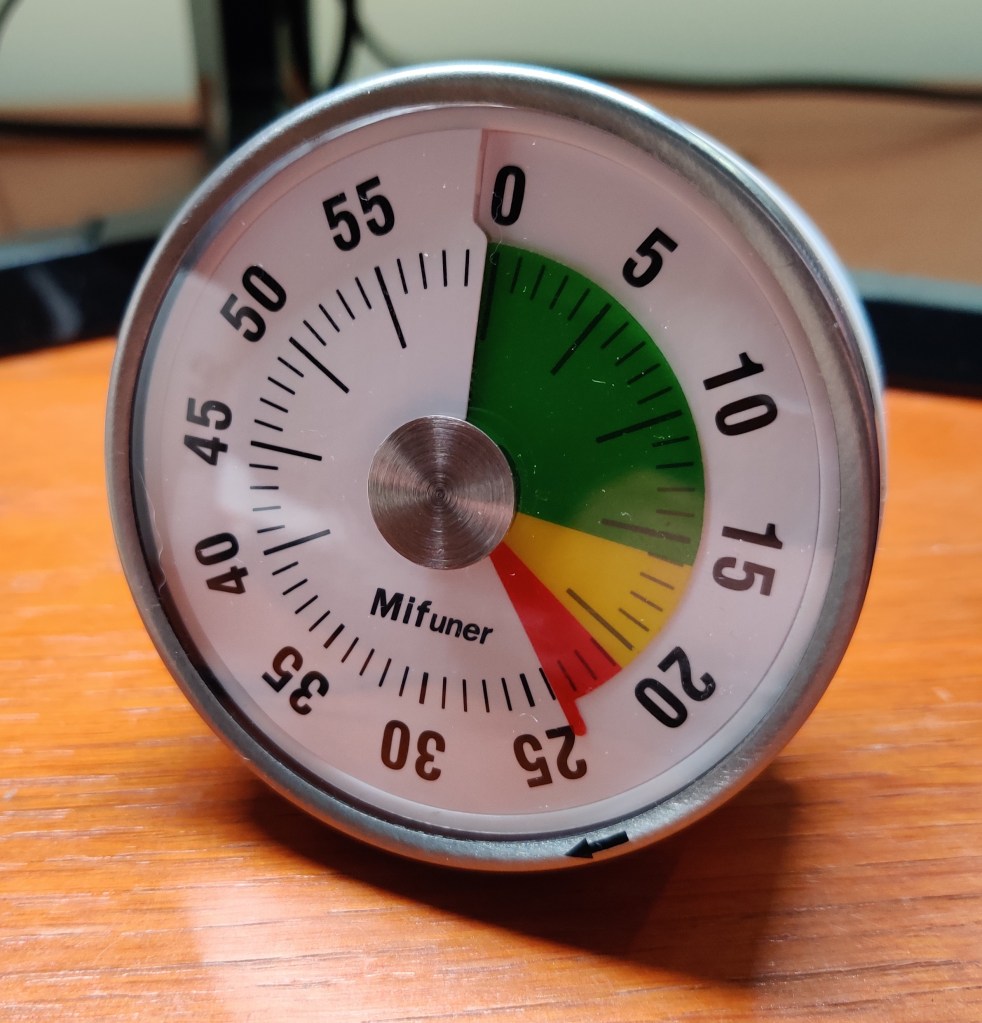
In an effort to tamp down on my procrastinating and get back on a Pomodoro system, I bought a desk timer.

I elected to go with a physical device rather than using my computer or phone to track time because I’m trying to remove the temptation to get distracted if I’m curious about the time left in the period. But I also had some other criteria.

In addition to wanting to avoid distractions, I wanted: a.) a visual representation of time, b.) something that made audible ticking, and c.) I wanted to avoid batteries if possible. The device above fit all three requirements. You wind-up the dial, set the desired duration, and the timer ticks away until the bell rings.

I’m still struggling with getting started (I usually give in and watch YouTube videos in lieu of starting my work), but once I get going, I find it easy to work through 25-minute sprints.

Let’s see how long this lasts.

Stay Awesome,

Ryan

Two Approaches to Intro Phil

By the time this is published, I will have finished my grading for the Winter semester, however as of drafting, I am procrastinating from finishing.  That means it’s time to let my mind wander and to blog about it.

The course I’ve been teaching since Fall 2016 is a light, multidisciplinary romp through philosophy that examines various topics in human experience through multiple lenses.  Often, this is one of the first general education courses the students encounter, and for many it is the first time they are getting into something approximating formalized philosophy.  It’s an online course, so the students work their way through the module material, post to discussion boards, and submit weekly asignments.  The modules are a mix of text, graphics, and embedded videos, and all things considered is a pretty marked departure from my first course in philosophy.

My introduction to philosophy was significantly more old school.  We all had copies of Cahn’s Classics in Western Philosophy (the sixth edition), and we started the semester on Plato.  It was my first class in university, and my first introduction to academic philosophy.  In a small way, that course has dictated how, in my mind, philosophy gets taught.  It is my default template for teaching – the professor stands at the front and pontificates in fifty minute blocks of time.  I never questioned it; I just tried to take notes, not really knowing how one takes notes about the lecture material.

Since then, I’ve seen a few different pedagogical approaches to teaching an intro phil course.  You can teach the material chronologically, topically, using ancient sources, using modern case studies, you can approach the different branches of philosophy thematically, or you could teach the material historically.

But there is another axiom I’ve been thinking about when teaching philosophy (or any topic for that matter):

Should I require the students to read the text before or after the lecture?

On first glance, this seems like a silly question.  Afterall, the lecture is about exploring ideas, clarifying thought, and demonstrating how to extend the ideas.  Students should grapple with the text and work to come to an understanding.  If there are problems with the text, they can bring their questions to class for rich discussions.  After reading the text, the students can teach the concepts to each other and have fruitful conversations about the ideas.  Why would you want to let the students not read the text?

On the other hand, it depends on what your goals are.  You see, the problem with requiring the students to read the text prior to the lecture, at least at an introductory level, is that the students often don’t possess the vocabulary or the historical schema’s to truly understand the work in front of them.  In an introductory philosophy course, I’m not looking for students to master the material.  Often times, I’m not even looking for them to be right in their arguments.  Instead, I’m looking for other skills, like close reading, comprehension, and (most importantly) the ability to read text charitably.  The hardest thing for students to grapple with in intro phil is that they are seeking to be right and rarely allow themselves to explore ideas.

Plato wrote more than 2000 years ago – what could he possibly have to say in his silly dialogues that helps me today?  Given the current political climate, I’d say his Republic has a lot to say (I’m looking at you, Thrasymachus).

If I give students a text, they don’t have the benefit of a historical view.  They don’t understand the context in which the author is writing.  They don’t understand the conventions of language and allusions.  They don’t see the historical dialogue that is unfolding on the page, where the author is addressing thinkers who came before them.  For instance, in my experience, the vast majority of students who read Descartes for the first time end up thinking Descartes literally believes an evil genius is out to deceive him.  They get so fixated on trying to keep up with what Descartes is doing that they lose sight of the argument being laid out before their eyes.

Reading the text before class is a great way to have students develop critical thinking skills, but if you want the students to understand what they are reading, it might be worth your time to consider helping them to explore the text together.  At least for an intro phil course.

Stay Awesome,

Ryan