Last week, I reflected on competence, confidence, and parenting. Turns out Eleanor Roosevelt had a more inspiring insight:
“You gain strength, courage, and confidence by every experience in which you really stop to look fear in the face. You are able to say to yourself, ‘I have lived through this horror. I can take the next thing that comes along. … You must do the thing you think you cannot do.” (~You Learn By Living)
“Most of the time, we work in the system, not on it. […] If there’s a hole in the boat, it’s easy to spend all day bailing water with a bucket. Or we can take a moment to pull the boat onto the dock and fix the leak. When we work in the system, all we can do is bail. When we work on the system, we have a chance to make things better.”
“161. To Get to New York,” This Is Strategy, by Seth Godin.
I was not let go from my job at Conestoga due to issues of performance or competence. But even though the organizational restructure was not my fault, I am reflecting on the lessons learned from issues that I was responsible for.
Accreditation is hard work. I saw 5 successful program accreditations in four years. By that metric alone, I delivered value.
Seth’s words spoke to the side of me that struggled. In retrospect, I wasn’t quite ready for the role when I started. I did not have a lot of experience in project management, and that showed in the ways I became the bottleneck to the work of the Chairs, Faculty, and the Degree Consultants (who bailed me out many times). In the end, we delivered (sometimes a little after the deadline), but in my inexperience I failed to see that in project management, problems trickle in slowly then happen all at once.
When I let things pile up, or when my attention was flitting across many projects, tasks, and areas of concern, I was just doing my best to keep my head above water and keep the system going.
I now know what it means to periodically pause to step back and look at things from a higher perspective, or as Seth says put the boat into dock and fix the leaks.
The leaks? Those were the things that made the system less efficient, lowered quality, and required a lot of manual inspection and rework. I’d plug a hole by locking down cells in Excel instead of helping faculty see the meaning of what was in it. I’d discuss the value of creating a culture of quality, but I’m sure most faculty still saw it as yet more work on the overhead of teaching. And perhaps the greatest sin is to generate a list of actionable tasks that only dealt with operations instead of seeking to move the needle on important metrics like measuring against graduate attribute attainment or improving retention.
All of these things would have been fixed in time, I’m sure. For now, I’ll just ensure I carry that lesson forward.
During my period of unemployment, I reflected on my career and identified a few areas I could develop now that I had some spare time on my hands. One of those development areas is seeking an ASQ certification as a Six Sigma Green Belt (h/t to Andrea for the suggestion!). At first, I delayed starting because I was looking for a low-cost near-free course to guide my study, such as something on Coursera I could audit, learning paths on LinkedIn Learning, or a discounted Udemy class I’d already purchased. But as I started watching the video modules, I quickly realized I wasn’t truly engaging. I was watching lecture content without retaining much. While yes, watching at 2x speed is largely to blame for it, I couldn’t escape the fact that I was engaging in passive consumption.
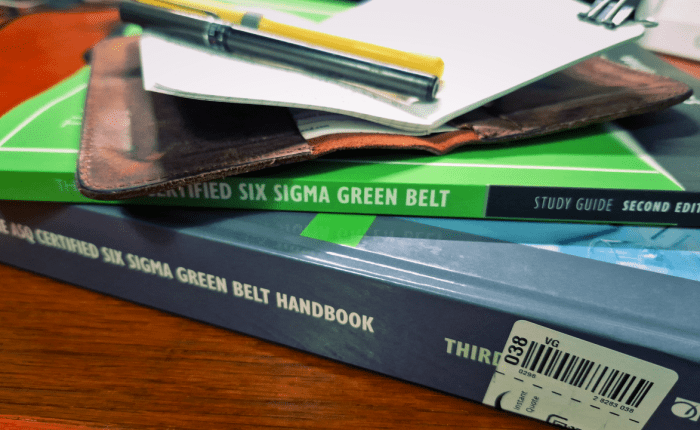
While I waited to figure out how to learn the material, I looked up the ASQ requirements and purchased used copies of the Six Sigma green belt handbook and a test prep study guide with practice questions.
Knowing that getting started is better than waiting around for a perfect plan, I started reading the handbook and planned to sort out my study strategy as I went. Almost immediately, I began connecting concepts to my past work and imagining how I could apply them now in my current role.
That’s when I realized: I’d done this before.
Paramedicine (2015–2016)
In 2015, I hit the transition point between early and mid-career phases and started questioning if I was on the right path (I found office work not very fulfilling). I thought it was a good opportunity to seek a career change and embark into paramedicine – I had a passion for first aid, I was a first responder on a few occasions in university (shoutout to University of Waterloo Campus Response Team!), dealt with emergencies while working as a bouncer, and I had written my masters thesis on the ethics of first aid. It aligned with my values of helping people and provided a fast-paced technical job that would give me fulfilment.
The first step was meeting the admissions requirements, which included needing a high school biology credit. I enrolled in a self-paced college prep biology course.
There was no active instructor; just a course outline, a textbook, weekly tests, and two major summative exams. Here’s how I approached it:
Used the course outline and test schedule as a learning roadmap – Matched unit outcomes in the course outline to textbook chapters covered on tests – Prioritized readings based on the self-paced testing schedule
Created active study tools – Flashcards for definitions and concepts – Hand-drawing diagrams (cells, organs, systems) labeled front-and-back for drill practice
Focused on comprehension-level mastery – Enough to explain, label, and connect systems without unnecessary complexity – The test was multiple choice, true/false, and labelling diagrams, so sticking to the first two levels in Bloom’s taxonomy was sufficient.
This gave me a clear plan and a feedback loop through frequent testing. I passed the course with an above 90% final grade.
Samples of my flash cards and hand-drawn diagrams.
The Present
For my Green Belt prep, I have:
A roadmap: The Body of Knowledge in the handbook’s appendix, which outlines each section, topics, and the number of exam questions per section.
Content: The handbook itself for deep reading and marginalia.
Practice: A test prep guide with exam-style questions.
By combining these, I can map my study plan to the exam structure. I also asked AI to use my weekly time constraints to suggest a manageable plan to break up the work and prepare to take the test by mid-Fall. Then, I can prioritize topics by weighting and test my knowledge incrementally as I go.
The Lesson
I realized I don’t always need a formal course, especially for a certification with a defined body of knowledge and predictable exam format. By having a clear syllabus, a learning map, a primary content source to learn from, and a way to test and reinforce learning, I can direct my learning effectively.
Courses have advantages: expert guidance, tailored examples, real-time feedback, and adaptive teaching. However, courses are not the only route for learning and self-development. By having a well-defined body of knowledge to study from, and using active learning methods like taking notes, journaling on my learning, short feedback cycles, and finding ways to apply the content to my work and experience, I have all that I need to be successful. All it will cost is some used textbooks, a registration fee, and remembering a lesson I learned a decade ago.
A lot has changed since then. Aside from not writing here regularly, I’ve moved, married, changed job roles and have expanded the family with kids. It’s a good opportunity to take time and reflect on how far I’ve come and where I’d like to go next.
Anniversaries are only arbitrary if you don’t put in the work to make them significant.
Here is a note I wrote to myself watching a training video:
“While a lot of these (insights) are basics that I already know, I am doing a terrible job at following them (to use my time effectively during the work day). Yes, I’m procrastinating by watching (the) video as if it will be the magical thing that fixes all my problems. Still, I also believe in the need to repeat messages, messages resonating at different times, and new ways to view old problems.”
There is something to be said for shiny new toys distracting us from just sitting down to get the work done. It’s not a knowledge problem, it’s an application problem. As Derek Sivers points out, if it were a matter of knowing, we’d all have six-pack abs and a million dollars in the bank. I fully acknowledge that I don’t need another video to teach me how to be more productive.
As it is said, there are many paths up the mountain. Some are harder, some are more direct. I have to allow myself some space and grace to realize that I don’t know everything, that I’m going to make mistakes, and that each day resets to zero to try again.
I’ve recently been turned onto Van Neistat’s YouTube channel. Van, the older brother of Casey Neistat, is a true pleasure to watch – he’s the DIYer’s DIYer and his style is untainted by modern social media. He’s the best of the Gen X cohort without the pretension or cynicism.
In his video meditating on the nature of burnout, he described slow burnout in terms of a motor with the cylinders breaking down one at a time. I’ve never thought about burnout in this way, but the image struck me hard. I find it to be a very apt description, where a motor can lose a cylinder and still operate, but there will be consequences to continuing to run, such as damage to the motor, inefficiencies of fuel consumption, increased wear on other components in the chain, and vibration in the ride. From a mechanical perspective, if you choose not to fix the issue, so long as you reduce the load on the engine and cut the fuel going to the cylinder, you can get away with running down a cylinder. For a time.
Of course, this probably will be harder and costlier to fix later.
It’s better to fix the issue up front, but that usually is expensive as well – the time, cost to diagnose, and cost to repair.
Work and life burnout seems to function the same way – if you choose to ignore the problem, you can still operate, but you have to accept the knock-on consequences of operating out of balance. At some point, the engine will stop running. Or, you can pause and try to identify the problem up front and fix it then, which can be expensive and uncomfortable.
I had my latest performance appraisal last week. I found I had a much easier time identifying areas of growth this time over last year after having gone through an accreditation visit for one of our programs. In the past, I would look at my current skillset, look at the friction points I was experiencing, and project forward a better future based on picking up some new skills or experience. This process is fine, but I realize the flaw is that the path you choose to develop in is not based on experience. It’s a guess about what might be helpful.
Contrast this to going through the accreditation process. To prepare for the performance appraisal, I reviewed the last year’s worth of information (my calendar, my one-on-one meeting notes, and notes I’ve taken about my job) and saw patterns of missed opportunities and under-performance. In these areas, I can reflect and see how if I had more skills or experience in these particular areas, I would have had a better time navigating the issues we faced.
Based on this backwards reflection (rather than guessing or projecting forward), I could more clearly articulate what I’m weak in and where I would gain the highest value in focusing on.
I think this marks for me the formal transition from the “start of career” phase to a more mature “middle career phase.” I have enough work experience and self-knowledge to draw meaningfully from, and that allows me to make smarter choices moving forward.
At my college, there is a yearly multi-day event for employees to deliver PD workshops to each others to teach skills and share experiences. The college invites thought-leaders to delivery keynote addresses to kick-off and close-out the event.
This year, the closing address was delivered by Canadian astronaut Col. Chris Hadfield. After his inspiring talk, he fielded a few questions. I was one of the lucky ones whose question was posed to him. Here is a summary of his key lessons to my question:
“How do you and fellow astronauts handle coming back to Earth? That is, the depression that comes after the high of achieving your goal/mission. “I just did that… now what?””
There is a misperception about going to space. It’s not just a random good thing that happens to you out of the blue – the mission has been an endeavor that is decades in the making (26-years for him from the time he decided to become an astronaut to his first mission). Even if he wasn’t chosen to go to space, he still enjoyed his job. Going to space afforded him unique experiences that honed his skills. He was gathering experiences and capabilities, then after coming back from space he could take those skills to support others and apply them in other areas of his life. He sees it as a tremendous set of gifts, tools, and new abilities to tackle the rest of his life. If you try to measure your life by one or two shiny peaks, then by definition you’ll make your life dismal. (As a side note, I read his book “An Astronaut’s Guide To Life on Earth” after his speech, and in it he goes into greater detail of what happens to astronauts after they come back. The experience doesn’t end; the job of being an astronaut has succession plans built into it that keeps astronauts useful. They spend months debriefing the mission to identify best practices that will keep future astronauts safe. They help train others, and handle mission control duties. They also help support the families of other astronauts when their loved ones are away on mission. The impression I got is that the job is designed to be a.) in service of others, and b.) purpose-driven).
Don’t spend a lot of time looking backwards. “If you spend a lot of your life looking backwards, you’re going to bump into your future. That’s not where things are coming from; they’re not coming from the past.”
The most important decision you’ll ever make is “What am I going to do next?” Some of your opportunities and skills will diminish as you age, but that doesn’t mean it can’t be vital, important, interesting, or challenging to you.
There are cool things happening to you everyday. Allow yourself to succeed everyday, it doesn’t have to matter to anyone else. Celebrate it. Recognize that yeah, there is crappy stuff happening, but there are cool things happening to you too, so try and choose to focus on them. There are compulsory things you have to do, but like in figure skating there are freestyle points. Try to revel in the freestyle. That leads to a life well-lived.
I’m so glad I got a chance to hear him speak and that my question was selected for response. I devoured his book and dropped many bookmarks in to return to so that I can absorb his experiences. It really drove home the problem with many self-help books that are released today – the books are written by people who are telling the stories of others. The purpose of the book (aside from sales) is to collect stories from the deeds of others in order to fit a narrative or thesis. There is an assumption that because someone else made things work that the author has the borrowed authority to provide advice to others.
I’ve learned that it’s much more instructive to turn to the primary sources and read the undiluted message from those who’ve actually been “in the arena.”
As the saying goes from Heraclitus, you can’t step in the same river twice. There are two ways we can interpret this metaphor. The most common interpretation is that you cannot step in the same river twice because the river is constantly changing. The water is flowing past, the flux of the water is changing the boundaries and composition of the river, and so it’s impossible to step into the exact same river twice. But another way to interpret the metaphor is to place more emphasis on the you – You can’t step in the same river twice – whereby the you stepping into the river changes and is not the same over time. This can be taken as literally as when describing the flux of the river – your cells are changing, etc. But I like the more poetic version of the metaphor that speaks to us changing with our experiences through our lives.
When you return to a river (the river being a stand-in for any number of things), you are a different person, and your past experiences make the phenomenological event that you experience different. The first time I encountered this was retaking a course in high school. I was the kid that took a course called Writer’s Craft, loved it and the instructor so much that in the following year I enrolled in it again with the same teacher. However, the materials selected for the class by the teacher, and indeed my fellow students, were all different. It was different, less enjoyable this time around. I still enjoyed studying under my teacher, Mr. Steffler, but with it being a different cohort of students (students from the grade below me), I realized that the experience lacked the magic of when I took it with my original cohort. I tried to step in the same river twice and was surprised when it was different; that I was different.
There is also the case where you revisit a book you read previously and it speaks to you on a different level. Maybe your experiences help you connect with the characters on a different level, or you empathize with the characters differently. Your values might have changed. Or just that you are older and more knowledgeable, you understand more of the text and draw different connections.
This happened to me recently. My job promotion at work was approved, and I’m taking on management tasks as part of my portfolio. Maybe because I have mild imposter syndrome (I sometimes believe I am continuing to fail upwards), or maybe because I’m trying to be proactive, I decided to pull my copies of books by Peter Drucker off the shelf to learn what it means to be in management and how to do it well. I started with a short text of his called Managing Oneself, which I read back in 2017.
Something in the book landed differently this time, which I think breaks down to two differences about me now versus who I was five years ago. The first is I am busier now than I was then. This isn’t to say I was idle then – I was working three jobs, heading up a non-profit, in a relationship, etc. However now my life feels fuller with things that feel more critical – a higher stakes position at work with more responsibility, co-managing a household with my wife, the responsibilities of family and childcare, dealing with a pandemic, etc. I might have fewer work domains on my radar than I did in the past, but things have higher stakes now, and the idea of more effectively managing myself speaks to who I am as a person, where I’m trying to be mindful of others, plan for the future, and lay down a good foundation to support our family as we go.
The second thing that landed differently was the section about learning more about yourself and how you operate as you manage yourself/your life. I don’t remember this sticking in quite the same way (and based on my blurb from Instagram, it seems I was slightly underwhelmed by the text). For as much as I feel like I’m an imposter sometimes, I also know myself more now, am more confident in my skills, and have cultivated experience and expertise as I travelled along my career path from then until now. And so to revisit this section about managing yourself (that is, identifying what you should prioritize your focus on nurturing and developing) speaks to me. Rather than being frenetic and jumping on every opportunity while you are early in your career, it is better to slow down, be mindful, and think through what will add value to your life.
I don’t need to worry about losing out on opportunities by not acting fast. Instead, I can think about enhancing quality, enriching life, and paring down the things that no longer serve me.
I thought I was going to read the book a second time to remind myself of its content. Instead, I realized I was coming at the book afresh, for the first time, ready to learn.

 A Paramedic's Notebook