Back In The Office

Last week I stepped in the office for full-day work for the first time since the start of the pandemic. I have visited the office twice in the last two years to pick up items and personal effects, but have otherwise acted as an employee from the comfort of my home. I have been extremely fortunate to have been able to work remotely, and now things at work have been deemed safe to return.

This is not to say that everything is back to “normal.” We are obviously still following public health protocols by conducting screens on entry, displaying our vaccine QR codes, wearing masks, maintaining physical distancing, and staggering our time in the office to cut down on the number of people on site at any given point. But it’s the first step back towards “normalcy” I’ve experienced in two year – I had to put on pants to “go to work.” In my time at home, I have whole-heartedly embraced what I call the Zoom mullet – business up top (in camera view) and party down below (always shorts; even I have a sense of propriety).

What I found most jarring about my return is the paradoxical strangeness of being on campus. It’s paradoxical because intellectually, I know I have been away from the office for two-years, however on an emotional, visceral level, it doesn’t feel like I’ve been gone at all. I have a few guesses why it doesn’t feel strange being on campus. First, I have continued working my job during my time at home, so I’m not stepping back into an unfamiliar context. I’ve also been in regular contact with many of my collegues (though some I literally have not interacted with them since we’ve been away), and I’ve seen many of them on video, so there is a sense that we’ve not been apart too long. Third, the pandemic has created a distorted time dilation, where large swaths of time pass quickly, even if day to day existence is (sometimes) painfully long. This tricks our minds with a kind of time travel into the future; perhaps we’ve all been more zoned-out on auto-pilot than we realized. And finally, I think the reason why it feels like I’ve been gone for a short time is that the office hasn’t changed. I mean almost literally, the office is the same as when I left. Because we have all more or less worked from home during this time, and everyone has been out of the office, no changes have happened to the physical space – the furnature is all where we left it, the decorations are the same, the same names appear on the walls, etc. Other than the desks being decluttered, you wouldn’t know that people have been gone for two years. Props to the custodial staff for keeping the space clean.

I came to work with some mixed emotions. I’m a little sad that our time at home is over and we have to move on to the next phase of things. The pandemic might drag on, but I am entering a new phase of interacting with the phenomenon. And of course, I’ll miss the flexibility that came with always being home. However I was looking forward to my return as well. I looked forward to the separation of work and home, the commute to function as a liminal space. I embrace the structure imposed on my time by virtue of changing phyical locations. I look forward to the serendipitous interactions with my colleagues, around the proverbial water cooler.

All things change, and now so must I. I will look back with some fondness on the last 23 months, despite all the negatives it brought. However, now it’s time to get back to work.

Stay Awesome,

Ryan
Post #302

I uploaded my post last week without much thought. When I went back to draft some ideas for a future post, I saw that Beachhead was my 301st post. I missed the opportunity to both celebrate the milestone and reflect on its significance.

Earlier this year, I missed the 5-year anniversary of this blog. I let the milestone pass by, unlike years past. I think part of the lack of enthusiasm for these significant milestones is due to general pandemic-induced apathy (we’re all feeling it). But the optimistic side of me also thinks that these milestones are less important than the work itself. I used to be more metrics-driven with my blog, excitedly noting the passing of the first year or the first 100-posts. However now I’m not concerned with reaching a future target but instead focus more on ensuring I’m keeping up with the weekly schedule and trying to come up with decent thoughts worth publishing.

That’s not to say that all of my posts are worth reading. I wouldn’t say I take a lot of pride in the final product of what goes up weekly; I’m not ashamed either. It’s just that the quality of the final draft isn’t as important as sitting down to do the work. Of taking an idea from brainstorm to coherent narrative. I find more satisfaction in putting in the work than the bragging rights of the final product. I try to think of it as more of a craft-mentality rather than creating a masterpiece corpus of writing.

Each post is an exercise that stretches the muscles, practices the movements, and gives me an opportunity to learn and develop slowly over time. At present, this blog operates at a loss (no income is generated to offset the nominal fees I pay for the site and URL). And I’m completely fine with that. At one time I thought about turning this into a brand and trying to monetize it. I’m not opposed to scraping money out of the endeavor, but it’s not the primary focus of this blog.

When I shifted away from the blog being an exercise in becoming a paramedic, it merely became a place to publicly share my practice of writing to meet a deadline. That’s good enough for me. It doesn’t have to seek to achieve anything grand – not everything has to be epic or monetizable. It’s still fun and I feel good shipping the work. As the mass of posts grow, I can look at the incremental progress and take satisfaction in what it represents – time well spent.

Stay Awesome,

Ryan

Parenting Lessons One Year On

We recently celebrated our son’s first birthday, so naturally I’ve been reflecting on the last year of being a first-time parent. If I were to summarize the most important lesson (beyond any of the technical skills you need to keep your kid alive), it’s that parenting is the largely an illusion of control. Your child is a chaos engine that you will try to wrangle, understand, and predict, but from moment to moment, day to day, week to week, things change wildly without discernable reason. Things that worked suddenly stop working.

The tighter you try to hold onto control, the more frustrated you’ll be.

As a corollorary, in accepting that your child is pure id, you must also come to terms that your child (at least for the first year) carries little intentionality behind what they do, and so you must not attribute your frustration to them. Instead, recognize that your frustration is a product of your own unrealistic expectations. If you align your expectations to this reality, I find it’s much easier to weather the physically and mentally taxing moments.

This isn’t to say that you won’t feel anger or frustrations directed toward your child. I’ve accepted that I will feel these feelings and there isn’t anything wrong with them so long as you don’t act on those impulses (physically or verbally). As the adult, you are expected to have learned to understand your physiological signals and adjust accordingly. As your child grows, and as they experience new feelings in themselves – feelings that they won’t have the context to understand – it’s your job to guide them through the experience so that they can learn as well.

In sum:

  • You are not in control of anything.
  • The frustration you feel is usually a product of having misaligned expectations for how you think your child ought to act.
  • Your child doesn’t understand the signals their body is giving them. You, having learned to understand your body, will be key to guiding your child through this period of discovery.

Stay Awesome,

Ryan

Nicola McDermott’s Notebook

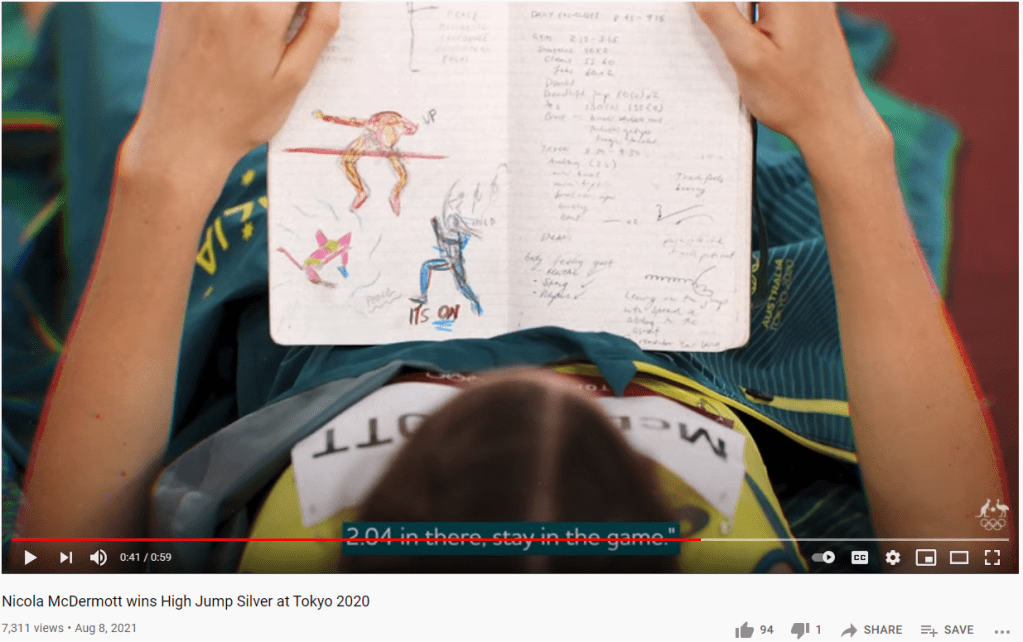
As my wife and I were watching some of the Olympic coverage, we caught a recap of the finals for the women’s high jump event. I was always terrible at high jump as a child, but I stand at around 191cm (over 6-feet tall), so watching the athletes jumping heights that would clear my head instils a lot of awe in me. One jumper in particular caught my eye – silver-medalist Nicola McDermott from Australia. After each of her jumps, the camera would catch her diligently writing in a notebook.

Screencap from video: https://youtu.be/tYFV02xldbE

I have heard of athletes who meticulously journal to help with performance psychology, but this was the first time I caught it live. You can learn a bit more about what she records after each jump in this Guardian piece. One quote from the piece caught my eye:

“The 2.04m – I gave myself a 10/10 for that jump, the execution,” McDermott explained. “I felt the clearance in the air. But the lack of experience with the timing meant that it just didn’t happen today.”

I like that she framed it not as a failure of her abilities, but instead a lack of experience with the execution. Instead of seeing it as “I can’t do this,” it’s “I haven’t done this yet.” The productivity sphere labels this as an example of growth mindset, and given the stakes of the Olympics it’s inspiring to see an athlete have such an upbeat, positive attitude that would likely cause me to beat myself down in defeat.

While mere mortals like myself typically go through the motions of any given action, Nicola’s journaling habit and mindset is worth modelling as a method of providing yourself with immediate feedback and a view from without – one that gets you out of your own head. It also takes ownership over the process, because it forces you to break the activity down into discrete parts that you can focus on and improve.

Congratulations to Nicola on her personal best, and the example she sets in performance excellence.

Stay Awesome,

Ryan

For the First Time, Since

Last week was a wonderful week of “first time, since” events for me. It was the first time, since the pandemic started, that I played board games with friends in their home. It was the first time, since probably the start of the pandemic, that I ate inside at a restaurant. It was the first time, since the bar closed, I got to see my colleagues and have a drink. And for the first time, since the birth of our son, I got my hair cut.

I’m under no illusions that this is over. The cynical side of me is expecting another lockdown (or at least a retraction of re-opening plans) in the fall. I know we are still a ways to go from where we ought to be if everyone bought into the plan by masking-up and getting double-dosed.

But for a brief moment, I got a chance to flex my extraverted side and give him some fresh air, while looking slight less like a caveman.

It’s the small things I get to relish for the first time, since.

Stay Awesome,

Ryan

Parenting and the Return to “Normal”

I’ve been very fortunate to work from home since the start of the pandemic. I have only stepped foot in the office once in the last year, and have otherwise been plugging away at tasks from home. I was also fortunate that this time overlapped with the birth of our son, so I have been home for his first year of life. My wife returns to work in September, and our son will head off to daycare, signaling our first steps towards a return to “normal.” At present, I will likely continue working from home until January, assuming public health doesn’t pull back on restrictions to limit the virus spread.

Two recent podcasts had me reflecting on the kinds of things that changed about life both as a result of the pandemic as well as experiencing parenthood while at home. The first was a musing from The Daily Dad on the slow life of the pandemic, and the second was from Scott Young on how parenting changed his views on productivity.

The pandemic hit a hard stop to the busy lifestyle I had adopted. This isn’t to say I embraced “busyness” as a mark of distinction, but rather I was the kind of person who said yes to a lot of things and wanted to be involved in cool stuff. My calendar was filled with lots of obligations, work and social alike. I juggled three jobs while running a non-profit, a social club, and podcasting and vlogging projects. I enjoyed being busy and helping others.

But as a parent, I carry a different set of responsibilities that conflict with this kind of lifestyle. I was never faced with the choices to prune back my (mostly) optional obligations in order to fulfill my parental duties – the pandemic largely did that for me.

And as we think about returning to “normal,” I will obviously have to think carefully about what sorts of things I add back into my life (the pandemic will end, but being a parent won’t). Some of the effects from the pandemic and being at home to take a greater prominence in co-parenting our child makes me reflect on what kind of home life I wish to cultivate, and ask which elements of the pandemic do I want to carry forward into the new normal. For instance, in thinking about the slow life, things like bedtime routines, long blocks of time with kid(s), weekends set aside for family time, are all things I want to hold sacred.

The pandemic was referred to as The Great Pause. I should get some more of this thinking done before we un-pause and move on with life.

Stay Awesome,

Ryan

Return to Normal

Well, I certainly was optimistic in my last post about when I’d return to normal. The move proved to be a bit more onerous, so I missed last week’s post, as well as this week’s deadline. C’est la vie. We press on.

As we start getting our vaccines rolled out to younger folks in my part of the country, we are beginning to have virtual watercooler chats about what the return to normal will be. The gut-reaction is that our higher education institutions will kowtow to pressure to return to face-to-face delivery as soon as possible – whether it’s students looking for the ol’ college experience, administrators looking to address gaps in the bottom line, or employees desperate to escape working from home.

It’s tempting to think things will return to normal, back to the pre-pandemic status quo. We, as creatures of habit, like to slide back into what’s comfortable and expend the least amount of energy that we need to.

But knowing what I know about people, a “return to normal” is going to smack straight into the loss aversion wall – people don’t like to lose benefits once they have them. It switches to an entitlement mentality. I don’t mean this in a negative sense. Entitlements are good! When we talk about entitlements, it carries a negative connotation of something not earned. But to the contrary, I think “unearned” entitlements are the point of society, culture, and government. Rather than everyone being forced to create everything for themselves, we can leverage divisions in labour, experience, technology, and collective action to ensure that benefits get spread around. The metaphorical tide should raise all ships.

So, what does it mean when we are rushing back to return to normal – what do we think we are missing, and what would a return to normal cost us?

A return to normal means hours of commuting per week, instead of going upstairs to work.

A return to normal means rigid schedules and limited campus space, instead of blending the flexibility of synchronous and asynchronous delivery.

A return to normal means bringing back flu seasons at work.

A return to normal brings back all the issues around inclusion and accessibility for those who don’t fit the “normal” not built for them.

Here at home, a return to normal means less time with our infant son. It would also mean less quality time with my wife.

I haven’t packed a lunch in a year. My office dress clothes have been hanging untouched in my closet. I’ve fueled up as many times as maybe months we’ve been working from home.

Not everyone is as fortunate as I am to still be working from home. Many employees at my institution still have to go on campus to work because they’re essential, so their current normal differs from mine. However, we must question whether we want the consequences of having the rest of us join the essential few. I sincerely doubt it is automatically a return to something better.

Stay Awesome,

Ryan

A Well-Designed Vaccination Process

I was fortunate to receive my first vaccine dose yesterday. While I initially thought I would have to wait until a later phase, I recently found out that I qualified based on my BMI. It bummed me out to learn that I’m perhaps not as “healthy” as I thought and I had felt a sense of pride being among those who would have to wait until the end. It’s irrational, I know. However, I felt it was my duty to get my vaccine as soon as I was eligible in order to do my part and help with public health measures.

The vaccination process I participated in was very smooth and efficient. A friend asked me how the experience went – here were the notes I sent:

My appointment was scheduled for 4:45pm, and I arrived at 4:40 (a 30min commute from home to the site).  They had a sign outside saying they were now taking the 4:45 appointments.  I went through several layers of people asking me questions, but it was super smooth and efficient:

  • Security Guard at the door ask the standard screeners (I don’t have symptoms, no one in my house has symptoms, I haven’t travelled in the last 14 days), and to check I had an appointment confirmation email/text.
  • Queue person to direct me to the check-in.  They also directed me to sanitize my hands and handed me a mask with tongs, saying I could either replace the one I was wearing or use it to double-up.  I chose to just double-up.
  • Check-in to confirm my appointment.
  • Nurse to take my health card info.
  • Queue person to direct me to which chair to sit in.
  • Doctor who asked screeners and gained consent. (we chatted for a little bit)  My receipt notes I received my shot at 4:43.
  • After the shot, the doctor wrote a time on the top of my information form and directed me through a door to a gymnasium for observation.
  • Queue person to explain the chairs (basically, wait until my time was up, and whatever chair I chose, flip the sign to indicate I sat in it so it could be sanitized when I left).
  • Get up from the chair at 5:04 and go in one direction around the seating area to another nurse (observed by security guard).
  • Final nurse confirmed who I was, ask for family physician to notify them, confirmed my email, then printed and emailed me my receipt.

I texted my wife at 5:11 that I was done and heading back.  Well oiled, well directed, very relaxed. 

I am incredibly grateful for the care and thought the local Public Health Unit put into this process. I never felt lost or unsure about how to proceed, and all the staff were friendly and professional.

So far, almost 20-hours post-shot, I feel great. The soreness in my arm is similar to vaccines I received previously, so time will tell if I feel any of the other side effects (aches, fever, etc.).

We’re all in this together.

Stay Awesome,

Ryan

Editing with Rapt Attention

Last week I discussed how I created a video training series for one of the ethics boards I serve on. All told, I’d estimate it took me around twenty hours to sketch, film, edit, and publish the series (this is an ad hoc estimate; sadly I didn’t do any time tracking to appreciate the effort). While I’m comfortable with the filming, I noticed a particular period of the work that created a bit of a flow state for me.

On the last day of editing, I was up against a bit of a deadline to finish the videos and push them out to the trainees. I admit that the deadline helped me to focus more (or at least resist the temptation to get distracted), but I noticed that when I was editing the videos, I hit a bit of a flow state. It’s not that I found the tasks particularly challenging, but there was something about the rote, somewhat monotonous task of watching and cutting footage that helped me move through the videos fairly quickly. It was almost 4-hours of editing before I felt like I should take a break to stretch and shift my mind to something else – the time seemed to go quickly. Then, after my break, I returned for another multi-hour stretch to finish off the last of the videos for the rendering queue.

It’s not often that I feel myself working in this state, where time gets away from me for hours at a time. In fact, most of the time I feel somewhat disengaged with my work, and I have to apply discipline in order to work on tasks. This was a rare example of working on something that felt right.

I joked with my wife that I wish I found a job as an editor, but I was only half joking. The lesson I take from this is to be mindful with how I engage with activities that trigger flow, and find a way to go back to that state in other areas of my work.

Stay Awesome,

Ryan