One thing I love about reading Seth Godin is how he tends to reframe how I think about things. Like many other people, I’ve been feeling in a bit of a rut with work. Without the context shift of going to work in an office, the days start to blur, and working from a distance keeps me detached from my colleagues. Instead, my work is largely done on documents and spreadsheets, and the tedium easily sets in. It feels monotonous and largely procedural.
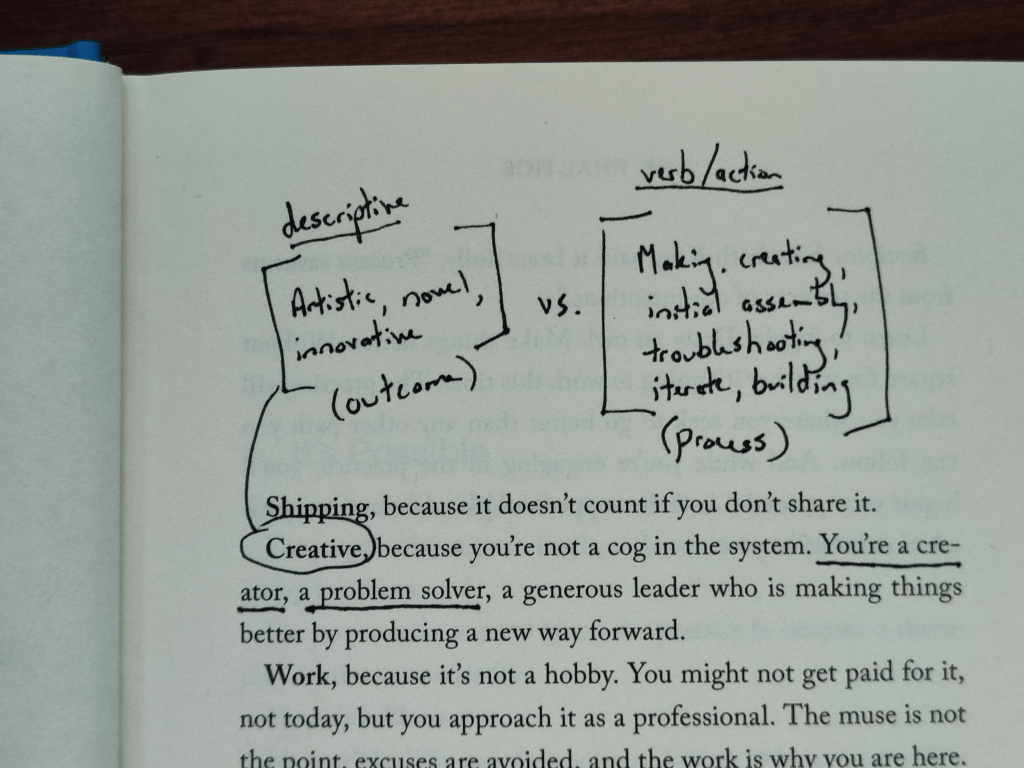
However, the first page of Seth’s new book forced me to reconsider how I view my work. When reflecting on my work, I realized that I was defining “creative” narrowly.
“The Practice” by Seth Godin (2020), page 3
Were you to ask me whether my job is creative, I would probably take a view that conforms to my notes on the left. My job has some elements that I have “artistic” control over, but largely “no” because it’s process driven. However, if I define “creative” more broadly, it’s easy to see how my job is creative. I create tools and process flows. I define problems and find creative solutions, then teach them to others.
We often bind our thinking about “creative” to notions like innovation and novelty (divinely given?), when instead we should think of “creative” as deriving from “create,” which is more process driven than outcomes driven.
This doesn’t solve my tedium with spreadsheets, but it helps me frame my work within a different context. I am not just a cog, but instead I have the ability to adapt the cogs I use to suit my needs.
Almost a decade ago, I co-started a semi-formal group with some friends. It was intended as a bit of a mutual-beneficial group – we were all just starting out in our careers and felt that getting together monthly to practice public speaking would help us in our jobs. The nature of the group has evolved somewhat now that we are having kids and have grown comfortable in our jobs. Instead, we treat the monthly meetup as both social time and a chance for us to share experiences with each other.
This month, we’ve been challenged to try out the Tech Shabbat as discussed in Tiffany Shlain’s book 24/6: The Power of Unplugging One Day a Week (note: I haven’t read the book). In essence, we pick one day a week to abstain from screens – no smartphones, no computers, no television. It’s not a complete removal from all technology (for instance, I use my smart speaker to stream podcast episodes and listen to live radio), but instead we seek to disconnect from an increasingly interconnected existence.
I have completed three of the Shabbats, with the final one this weekend. Overall, this has been a very positive experience for me. There are some challenges and moments where I have to play fast and loose with the rules (like this weekend when I got lost on a hike…).
It’s also not clear if I should abstain from using our smart speaker at home; I’ve been using it to listen to podcast episodes and radio over the internet. I’ll even admit that there are moments of boredom or tedium where I feel a strong pull to give up the challenge and open a social media app. But despite any of these missteps or moments of weakness, I can say without any qualification that I’ve enjoyed the experience. I may look forward to the close of the 24-hours, but I do so with a sense of mental calm. The break gives me a bit of a reset, a chance to journal and bring order to my life. Instead of mindlessly consuming content, I’ve chosen activities that create memories and allow me to be more present in the now.
I’m not sure if I’ll keep the Tech Shabbat once the group activity is over, but it has given me a lot to reflect on. Cal Newport has discussed taking a more hardline stance on cutting unnecessary tech out of our lives. I’m sympathetic to the idea, though in practice I have to balance my quirky experiments with my wife’s needs, and I doubt she would entertain any drastic measures like what Newport suggests. Regardless, just taking the opportunity to pause and reflect is a worthwhile activity, which the Tech Shabbat has afforded me over the month.
I had a realization recently: I don’t think I’ve gone camping in the last thirteen years. That might not seem like much, but when I reflect on my childhood, it was full of camping. I was in Beavers, Cubs, Scouts, Army Cadets, and the Duke of Edinburgh program. My mom also used to take my sister and I camping during the summers. If I entered Beavers at 5, and my last outdoor adventure was my trip to Kenya in 2007, then I had an almost uninterrupted period of camping that spanned 16 years. At 33 now, I have only recently crossed the threshold for more years of my life not camping than all the years I spent in youth programs.
Camping was easy when I was in youth programs – so long as you participated, it was almost a default activity. But once I left for post-secondary schooling, it fell by the wayside. Camping didn’t seem very accessible to me – I didn’t have money to spend on equipment or transportation, and I chose to spend my leisure time occupied with other things. Soon, a year became two, then five, and now more than a decade has passed.
It’s not that I haven’t thought about this. A few years back, I decided to become a paying member of the Bruce Trail with the aim to avail myself of the various sections of trail nearby (admittedly, I haven’t done it yet…) My hike along the Path of the Gods route in Italy back in October was my most recent attempt to embrace activity in nature. It was a hard route for me and finishing it left me with an amazing sense of accomplishment.
Since then, I’ve been mulling it over in the back of my mind. The pandemic has both prevented me from attempting camping this year and gave me additional time to think about being more intentional with reconnecting with the outdoors.
One of the problems, I realized, is that my idea of camping is a little skewed. Since camping in my childhood was bound up in intensive adventures, hiking and camping has been intertwined in my mind with multiple days away in the woods – several night-stays while travelling a few dozen kilometres a day, sometimes while hiking in mountainous terrain far from civilization. In this way, camping requires planning, specialized equipment, and lots of experience or paid guides. In other words, camping and hiking requires a lot of time and money.
But recently, I’ve been rethinking of camping in a new light. Thanks to the magic of YouTube’s algorithm, I stumbled across Steve Wallis’s channel through his video Highway Rest Area Stealth Camping. I’ve since gone down a deep rabbit hole of his content. In short, he’s a guy out of Alberta who likes to stealth camp (short term, low impact camping, sometimes in areas where you aren’t allowed to camp). He will go out for a night, set up a hammock somewhere, and vlog the experience. He buys cost-effective gear from Canadian Tire and insists that camping shouldn’t be complicated or about expensive gear. I realized in watching his vlogs that he’s right: camping and hiking isn’t about long, expensive trips, and it doesn’t have to be an onerous undertaking.
I’ve since started looking at what kinds of opportunities I can avail myself nearby. I’ve dug out my old camping gear to see what I’ve got in storage. I ordered an inexpensive hammock online (since I don’t own a tent) and plan to try camping in my backyard for the fun of it. I’ve also started looking at the trails nearby and got out this weekend with the dog. It was a quick jaunt near a river that took an hour and was a short drive from my house. It was a lot of fun, and I felt great afterwards.
All of this has taught me three things: first, if I want to find the time to have adventures, I have to make the time. Second, camping and hiking aren’t the purview of the elite outdoors people, but should be enjoyed by anyone who wants it. Third, I should have the courage to try things out solo. It was easy when I was young and under the guidance of adults. Now that I’m an adult myself, I can’t wait around for someone to take my hand. I have to learn to rely on myself, and trust that I can do it.
Stay Awesome,
Ryan
Post-script – I wanted to title this post The Accessible Outdoors, but I didn’t want to confuse the topic. I’m not talking about accessibility in the sense of barriers to people’s ability to physically enjoy the outdoors. Sadly, as I write this, I remember reading a piece online about efforts of people to make camping and hiking more accessible to persons with disabilities and persons of colour, but I can’t find the article at this time.
This is a short and sweet observation that hit me just at the right time. I’ve been feeling low recently and lamenting some of the stuff I have on my plate that’s causing me minor stress. Were it not for the pandemic, I mused, I wouldn’t be having problems coping – if only things were easier. Then a line popped from this podcast to give me perspective: “What did you think that living through history was going to be like?” I can pine for the fabled good ol’ days, but we should be honest that between the periods of calm, there will be periods punctuated with strife. And as observed in the podcast, only time will turn the turmoil of the present into a passage in a history book.
Hugh Jackman has a bit of a reputation for being a good guy, and this podcast did not disappoint. He’s sweet, thoughtful, humble, and genuinely a person you’d want to aspire towards. He’s an example worth following.
I’m a bit of a casual listener to the JRE podcast. I’ll usually check things out depending on who the guest is. In this case, Rogan sent out an image on Instagram with the author, Alan Levinovitz, holding up his book. The caption referenced how quick and enjoyable the 3.5hr show zipped by. Then I caught the book’s subtitle: How faith in nature’s goodness leads to harmful fads, unjust laws, and flawed science. Colour me interested, but I’m a sucker for discussions about the appeal to nature fallacy, so I check it out.
To be honest, I couldn’t tell you what the book’s about after listening to the episode. I have a vague sense that Levinovitz is looking to push back against those who believe things that are natural are automatically good/valuable as well as its opposite that things that are artificial or manipulated are automatically bad. I’m not saying that the episode was bad. Just the opposite – the episode was so good. I’m glad that Rogen doesn’t bring on guests to discuss well-rehearsed talking points to promote the book. Instead, they have a free-wheeling conversation that follows their curiosities. And based on some of the ideas that Levinovitz has, and how he calls for a kinder form of discourse, I was made an instant fan and grabbed the audiobook.
I am guilty of buying into the world of self-help. The vast majority of my reading over the last five years has been variations on the self-help genre (to the point that I’ve coined the term animated bibliography to describe its form). I know that the returns on investing in self-help diminishes quickly, and I am aware of how dubious the promise that self-help sells is, but I constantly find myself getting sucked into it. This video doesn’t necessarily say anything new that I haven’t realized myself, but it pulls it together nicely with many examples of how dark this world can be for the copycat authorities that use the same tactics in different domains. This video is a good summary and reminder to myself the next time I’m sold the promise of a better life through tactics and strategies for sale.
I covered a different interview with Jon Stewart in my last published Friday roundup, but I wanted to link these two different podcast episodes along a similar theme, despite the shows being wildly different. I noticed that both Dan Carlin and Jon Stewart remarked on the difficulty that comes with being a voice that people turn to when making sense of the world. Stewart noted that towards the end of his time on the Daily Show, he sometimes struggled to be the person to go on television and say something smart or comforting after a tragedy struck (it might have been part of the reason why he burned-out and needed to retire). Similarly, Dan Carlin has not put out an episode of his podcast Common Sense in a few years, but he released this episode earlier this year. In it, he notes that he’s tried recording an episode multiple times but felt he was adding nothing of substance to the conversation. He struggled to, like Stewart, be a voice for people (like me) who turn to him to help understand the world we find ourselves in. I listened to both of these episodes in the same week, and gained a new appreciation for those like Carlin and Stewart who make livings giving me monologues to pre-digest current events. It must be tough to strike a balance by being both insightful and non-inflammatory, where you avoid stoking the audience against “the other side” (whatever side that happens to be at the time). A YouTuber I follow recently commented on folks like Tim Poole whose sole purpose is to inflame the left/right hostility, rather than adding anything of substance to the discourse. It’s causing me to slowly evaluate what voices I allow in and whether they’ve earned their place in my attention.
I have some deeper reflections that this article prompted, but I wanted to capture this here first. Varol has been a law professor for 10 years now, and with the success of his recent book, he’s decided to move on from his teaching duties to pursue other endeavors. This reminds me of Nassim Taleb’s idea of via negativa. Varol specifically invokes this idea (though not by name) by reflecting that decisions he’s made in his life that had the greatest positive impact were often decisions that “subtracted” from his life. It’s a reflection I applied to my own circumstances and still need a bit more time to process.
Watch: Every Race in Middle-Earth Explained | WIRED (YouTube)
Because we all need to have some fun once in a while, here is an informative half-hour from a Tolkein scholar who covers the history of Middle-Earth through its inhabitants.
I’ve been mulling over a quote I wrote down in my notebook back in March, especially as it relates to my productive output at both work and for my personal projects:
“Every system is perfectly designed to get the results it gets.” ~Paul Batalden
At the end of the day, I’ll look back at my lists of tasks and feel frustrated that another day has slipped by thanks to my monkey brain’s inability to focus. Of course, this is placing the blame on the wrong focus because it’s ignoring two important facts: it assumes I’m not in control of my behaviours when I blame it on my “monkey brain,” and it assumes that I’m setting myself up for success merely by sitting at my computer. Both of these are patently untrue. I have control over my environment and (to borrow a phrase from Jocko Willink) I should be taking extreme ownership over my work situation.
If I find myself frustrated with my lack of output, I have to look at the system that my productivity is set against. If I spend my day getting lost down YouTube video and blog holes, then it’s because my system is optimized for it.
If I’m allowing myself to give in to temptation or distraction, it’s because it’s easier to fall back on things that are psychologically comforting and there is too much friction to get started on the real work.
Motivation is a flywheel – I have to overcome inertia to get the wheel turning, and it takes time before inertia helps the wheel turn freely. If the system is optimized to prevent me turning the flywheel, then it’s important to look at the system for fixes, rather than bemoaning the outcomes.
It’s not a quick fix. It will take time, effort, and a direction to push towards that will start the flywheel. I shouldn’t be so hard on myself. If the flywheel grounds to a halt, then it’s my job to stop, reset, appraise, and re-engage.
Last week, I hit a new milestone in my ongoing fitness journey. Since the start of the year, I’ve been following an exercise regiment that is having me progressively adding distance to weekly targets that I run on our elliptical at home. I plan to post a more in-depth explanation of how and why I set the system up in the future, but the main gist is that for each week of the new year, I add one mile on the distance I have to cover for the week. As of writing, I’m in week 22 of the year, which means I will be running 22 miles this week.
On Friday, I still had just over 10 miles that I needed to cover to hit my target for the week. I had initially planned on running half on Friday and half on Saturday. As I started my run, I felt that I was in a good groove, and decided to run more than half the distance for the session. Five miles turned to six, then seven. Around the eighth mile, I figured I could easily go the full ten to close off the week.
Then I had another thought. When we first purchased the elliptical, I thought it might be a good goal to try and run a half-marathon. The furthest I ran on the machine was 10 miles, so it wouldn’t be much to go the extra three. With me being so close to the target, why not?
The hardest mile was probably going from mile ten to mile eleven. The display on the machine only shows three digits, so 9.99 miles became 10.0, meaning it took longer to see progress getting counted.
A mantra started to form at the top of each mile – “just one more mile; you can do it.” This was something I learned from my army cadet days. During a particularly hard summer, I felt extremely dispirited with having to last six-weeks on a challenging leadership course. I learned to focus less on the whole six-weeks and instead focus on just getting through to the next day. It’s a lesson I’ve carried with me and try to apply anytime I’m faced with a seemingly insurmountable task.
Instead of running 13.1 miles, I focused myself to just completing the next mile. And when I finished that mile, I focused on the next; then the next.
Ten miles gave way to eleven, then twelve, and finally thirteen.
Running a half-marathon on an elliptical isn’t the greatest of achievements. However, it was an excellent application of focus and drive that affirmed to me that a.) I’ve come a long way since January; and b.) progress is made by focusing on the next goal, not the end goal.
Note – this is an experimental posting format. I’ve thought about increasing the number of posts I commit to per week, but I don’t want to add unnecessary work if I’m not willing to stick it out. Let’s be honest: sometimes it’s really hard to get a single post out each Monday that I’m satisfied with, so increasing my posting frequency just to for the sake of increasing my output is a terrible idea. I will run a short experiment to see how easy it is for me to get out a Friday Round-up for the next month. If the experiment goes well, I’ll consider making it a part of the regular rotation. You can find the first round-up post here from April 24th, the second on May 1st, the third here from May 8th, and last week’s on May 15th.
I’m enjoying this posting format so far, so I’ll continue for a few more weeks before making a decision whether it’ll stick around. This week, I stumbled across a lot of heartwarming videos and some cool, creative content.
Here is my round-up list for the week ending on May 22nd:
I stumbled across Arjun Menon’s work through a post on Peta Pixel, however I really encourage you to check out his Instagram page. Once you get past his recent project of filming figurines, you’ll also find many incredible photos from his portfolio. But his figurine photos are super creative and inspiring!
The link above takes you to broxh_’s Twitch page, but I learned about this sweet and wholesome dude on a compilation video elsewhere on the interwebs. Check out how awesome this guy is!
GAH! I just can’t get enough of how genuine and good he is. He’s so friendly and just wants to share his craft with people. I would gladly travel to New Zealand just to meet him in person.
The “Dad, how do I?” YouTube channel has blown-up recently, and I stumbled across a “Mom, how do I?” companion channel that was likely inspired by the Dad channel. The apparent story behind the Dad channel is the host, Rob, wanted to create videos to impart his wisdom now that his kids have grown. Rob’s father walked out on his family when he was in his early teens, so these videos also serve to help kids who were like him who don’t have someone they can turn to for how-to help. Like broxh_ above, the Dad and Mom channels show us that there are wonderful people out there who are spreading kindness in small, meaningful ways.
💭 Reflection – On Experimentation and the Unknown | Think Like a Rocket Scientist by Ozan Varol
This was an interesting observation that I stumbled across while reading Varol’s new book. While there are pedagogical reasons why we do experiments with known outcomes, I think sometimes we forget that the point of experiments is to test hypotheses because we don’t know the outcome with certainty. This pairs nicely with a quote Varol includes a few pages later from Richard Feynman: “Scientific knowledge is a body of statements of varying degrees of certainty – some most unsure, some nearly sure, none absolutely certain.” We tend to demand fixed answers from our experts and media, when instead we should be reminded repeatedly and often that our understanding of the universe is based on probabilities and not binary truth-conditions.
Note – this is an experimental posting format. I’ve thought about increasing the number of posts I commit to per week, but I don’t want to add unnecessary work if I’m not willing to stick it out. Let’s be honest: sometimes it’s really hard to get a single post out each Monday that I’m satisfied with, so increasing my posting frequency just to for the sake of increasing my output is a terrible idea. I will run a short experiment to see how easy it is for me to get out a Friday Round-up for the next month. If the experiment goes well, I’ll consider making it a part of the regular rotation. You can find the first round-up post here from April 24th, the second here from May 1st, and the third here from May 8th.
Sadly, I don’t have a proper post for today. Maybe the reading I engaged with was relatively poor this week. I’ve also been feeling down recently, which probably had something to do with it.
So, instead of an article round-up, how about two fun things:
I’ve never made cinnamon buns from scratch before, and I had some live yeast that needs to be used before it expires, so I decided to make a sweet treat for the household. I’m quite happy with how they turned out. For the recipe, I just used the first search result in Google for “cinnamon bun recipe.”
A few weeks back, while on a grocery trip with my grandmother, she commented to one of the shop’s proprietors that I am a good cook. I quickly corrected any misunderstandings he might have had about my abilities, and that as a grandson everything I do is wonderful to a grandmother’s eyes. Instead, the secret to my success, I told him, is that I have the courage to make mistakes along the way. Overall, that’s how I see my activities in the kitchen: I like to experiment and have the courage to try new things out. They don’t all succeed, but I find value in the striving.
💭 Reflection – On “Deep Philosophical Thoughts” | Plato’s Symposium
Ugh…
As I mentioned in this week’s post about my recent difficulties with reading, I recently joined a book club, and we are currently reading through Plato’s Symposium. Since I have a physical copy, I decided to crack it open to read the dialogue on love. The last time I was reading the massive tomb, I had already started developing the practice of marginalia and notes to myself about the reading. I spotted the gem above.
In 2011, I felt a strong affinity with the narrator’s passion for thinking big thoughts. Now, almost a decade later, I felt myself groaning at the sentiment. As I noted in the margins, internet smart guys ruined the passage for me as it sounds so pretentious. It probably read that way in 2011, but I’m more attuned to the snobbery. I don’t blame Plato, I blame the trolls.




 A Paramedic's Notebook