Stepping Back Into The River

As the saying goes from Heraclitus, you can’t step in the same river twice. There are two ways we can interpret this metaphor. The most common interpretation is that you cannot step in the same river twice because the river is constantly changing. The water is flowing past, the flux of the water is changing the boundaries and composition of the river, and so it’s impossible to step into the exact same river twice. But another way to interpret the metaphor is to place more emphasis on the youYou can’t step in the same river twice – whereby the you stepping into the river changes and is not the same over time. This can be taken as literally as when describing the flux of the river – your cells are changing, etc. But I like the more poetic version of the metaphor that speaks to us changing with our experiences through our lives.

When you return to a river (the river being a stand-in for any number of things), you are a different person, and your past experiences make the phenomenological event that you experience different. The first time I encountered this was retaking a course in high school. I was the kid that took a course called Writer’s Craft, loved it and the instructor so much that in the following year I enrolled in it again with the same teacher. However, the materials selected for the class by the teacher, and indeed my fellow students, were all different. It was different, less enjoyable this time around. I still enjoyed studying under my teacher, Mr. Steffler, but with it being a different cohort of students (students from the grade below me), I realized that the experience lacked the magic of when I took it with my original cohort. I tried to step in the same river twice and was surprised when it was different; that I was different.

There is also the case where you revisit a book you read previously and it speaks to you on a different level. Maybe your experiences help you connect with the characters on a different level, or you empathize with the characters differently. Your values might have changed. Or just that you are older and more knowledgeable, you understand more of the text and draw different connections.

This happened to me recently. My job promotion at work was approved, and I’m taking on management tasks as part of my portfolio. Maybe because I have mild imposter syndrome (I sometimes believe I am continuing to fail upwards), or maybe because I’m trying to be proactive, I decided to pull my copies of books by Peter Drucker off the shelf to learn what it means to be in management and how to do it well. I started with a short text of his called Managing Oneself, which I read back in 2017.

Something in the book landed differently this time, which I think breaks down to two differences about me now versus who I was five years ago. The first is I am busier now than I was then. This isn’t to say I was idle then – I was working three jobs, heading up a non-profit, in a relationship, etc. However now my life feels fuller with things that feel more critical – a higher stakes position at work with more responsibility, co-managing a household with my wife, the responsibilities of family and childcare, dealing with a pandemic, etc. I might have fewer work domains on my radar than I did in the past, but things have higher stakes now, and the idea of more effectively managing myself speaks to who I am as a person, where I’m trying to be mindful of others, plan for the future, and lay down a good foundation to support our family as we go.

The second thing that landed differently was the section about learning more about yourself and how you operate as you manage yourself/your life. I don’t remember this sticking in quite the same way (and based on my blurb from Instagram, it seems I was slightly underwhelmed by the text). For as much as I feel like I’m an imposter sometimes, I also know myself more now, am more confident in my skills, and have cultivated experience and expertise as I travelled along my career path from then until now. And so to revisit this section about managing yourself (that is, identifying what you should prioritize your focus on nurturing and developing) speaks to me. Rather than being frenetic and jumping on every opportunity while you are early in your career, it is better to slow down, be mindful, and think through what will add value to your life.

I don’t need to worry about losing out on opportunities by not acting fast. Instead, I can think about enhancing quality, enriching life, and paring down the things that no longer serve me.

I thought I was going to read the book a second time to remind myself of its content. Instead, I realized I was coming at the book afresh, for the first time, ready to learn.

Stay Awesome,

Ryan
Blocking Distraction

For as much as think I am in control of my impulses, the reality is I am buffeted around by my whims far more than I wish were true. The biggest bane to my daily work is the mighty well of distraction that is YouTube. I’ve lost hours of time in a day allowing my subscriptions to serve me fresh content. I try to justify it to myself – “I’m just going over for a quick mental break,” or “I just need to see a tutorial on how to do x-action in Excel.”

Then, I look up and hours might have passed without me consciously knowing it.

Some time ago, I used a browser blocker to prevent me from accessing the worst offenders for distraction (all social media, YouTube, and Reddit specifically). I’m no stranger to signing an Odysseus contract, which I’ve written about before. However during the pandemic, I relaxed it a bit since, hey, we are all going through a rough time.

As of late, I’m forced to conclude that enough is enough, it’s time to hold myself to a higher standard. I went back in, and toggled StayFocusd back on, and so far have done a better job of accounting for my time. Between blocking distractions, using pomodoro sprints, and writing down what I do in my time blocks (quick estimates, nothing too detailed), I’ve done a pretty good job of limiting distracted time.

It’s not perfect, but it’s more than a 1% improvement, which will hopefully compound over time.

Stay Awesome,

Ryan

Leverage

I’ve been reading ‘self-improvement’ books for the last five years. Some of those books dealt with financial and life management, where you leverage the money you earn to create more value for yourself. But until you reach that point in your life, it’s only a theoretical exercise to engage with – there is no point in thinking deeply into investing options or buying your way into freedom until you have money to buy options. I’m sure there are self-improvement adherents who will vehemently disagree with this, but the reality is you aren’t going to gain access to the game by saving money not buying lattes or avocado toast unless you are playing a really long game with a lot of good luck.

I’ve now hit a point in my life where options have opened up for my family, and we can make choices and trade-offs to build out a lifestyle that works best for our goals. This is not to say that all options are available to us – we have to carefully look at the tradeoffs and determine whether the downsides of any option are something we are comfortable living with (e.g. to pay for a given option, should we, say, reduce from two cars to one).

Part of this exercise is critically examining each of our assumptions and systems to determine if they are moving us towards what we want, or if they need to change to better align with what we want. This is where the concept of leverage has entered my mind, because when evaluating costs or expenses, it’s important to note that not all expenses are net negative. Some expenditures end up buying more value than what we spend on them.

This is the game in a nutshell – you trade your time for money. Money represents quantified time and effort that can be exchanged in markets with mixed goods. I spend time at work and my employer gives me money in return. I then take that money to purchases goods or services.

Until now, most of the way I thought about the game was surface-level transactions of 1:1 value transfer – I work x-hours for y-dollars. I then trade y-dollars for a good or service with a transactional value of y-dollars. I haven’t really given much thought to the value (that is, how much I value it subjectively) of the good or service provided back to me, and whether that value is higher than what I’m spending. I suppose I’ve thought about it in an abstract way, such as I receive more enjoyment from the thing than the money I spent on it; the opportunity cost is not higher than the value I’m getting from it.

By focusing on the surface-level transactions, the only metric that was critical was to ensure the revenue was not exceeded by the expenses, that I wasn’t spending more money to buy value than I was getting in exchange for my labour. It’s worked up until now, but the direction my family wants to head requires me to think more deeply about what those expenses are buying us.

Ideally, I should be seeking to engage leverage – I trade time for money, then use the money to buy time in greater quantities. What might this look like?

  • With my wages, I can lease or own a car. The money I spend on the car frees me up to commute to work on my own terms. I could get to work more cheaply, such as public transportation or cycling (ignoring environmental costs in this calculation), but then I’m trading cost for time. Having my own vehicle is more convenient, more comfortable, and faster, allowing me to maximize time at work and time at home.
  • With my wages, I can pay for cleaners to clean my house. This frees up more leisure time and cuts down on bickering in the house. It is cheaper for me to buy the supplies and do it myself, but I value the leisure and time with my family more than the cost.
  • With my wages, I can pay for daycare for our child. My spouse or I could quit our job to care for our child at home full time and save the money. However, the money we spend on childcare frees us up to earn multiples of what we spend for the childcare – e.g. at $1,000/month, we would spend $12,000/year for daycare so that we can make north of 5x of that in our jobs.

This is not an easy exercise as many of our expenses feel necessary on the one hand, or scary large in context. However at this point in our lives, we have to accept that our raw effort will only diminish (I can’t work all-nighters like I used to without significant physical cost), and there are no more hours in a day we can squeeze out through discipline and efficiency. We must now turn to leverage and force multipliers to translate what we have into higher value.

Stay Awesome,

Ryan

Planning and Preparation

Last week, Seth Godin wrote a poignant observation about the wisdom of refilling your gas tank at the right time. This of course was a metaphor; it’s not about literally filling your gas tank (except when it is). Instead, the observation is about recognizing that you are better able to weather uncertainty when you are mindful about resources, whether that’s financial, physical, human, or even your own attention.

Yes, sometimes we are so strapped for time that it’s hard to remember to prioritize fil1ing before empty, but if you pay attention to your resources, then as he says you can “have your emergency on your own schedule.”

His post was well-timed, because I’ve found myself falling behind this week on some critical tasks. When I reflected on it in my journal, it’s easy to say I was busy. It’s true, I was busy – I was in a lot of long meetings, I had appointments, and obligations at home. But I’m always busy, so this week wasn’t necessarily out of the ordinary.

Instead, my lack of progress is due less in part to other people’s demands on my time, and instead it’s largely due to my own poor planning and preparation. Without an appropriate plan for the time that was all my own, I was left to flit carelessly to this whim and that urgent thing.

As a reminder to myself, open blocks of time in my calendar are not default downtime. I have more control over my time than I realize (or behave).

Stay Awesome,

Ryan

The Art of Self-Discipline

On the days when I’m languishing and finding it difficult to be productive, where procrastination and anxiety keep me in rabbit holes of distraction, and at the end of the day I look at the clock and realize how much time I’ve wasted, it’s easy to write myself off as a lazy, slovenly person. It’s easy to think of myself as the kind of person who does not have discipline, that I wasn’t born with that trait – fatalism has kicked in; I should accept who I am.

But that’s not what self-discipline is. It’s easy to see self-discipline as some sort of binary state when you are comparing yourself against others further along their own paths than where you want to go.

The Romans had a saying that “we can’t all be Cato’s,” referring to the stoic politician who served the State with self-sacrifice. But that saying is wrong. It should be “we aren’t all Cato’s, yet.”

In virtue ethics, your moral character is judged against an abstract ideal – the Stoic Sage. But possessing virtue is not a trait or character state. Possessing virtue is a process of becoming, of doing the right thing at the right time.

Having self-discpline doesn’t mean you are a paragon of discpline. It means you are exercising discpline in the moment. If you fail, it just means you are still working on becoming who you want to be.

The Japanese refer to this as ““, the Way. You never reach perfection, but your life is one long project of incremental progress towards what you are meant to be.

That is the way of self-discipline.

Stay Awesome,

Ryan

Work Focus While Home Alone

Working from home poses challenges for most folks when it comes to being able to focus. Many of my colleagues noted how difficult the summer months could be while children were home from school. For me, with an infant at home, the distractions were fairly minimal, especially because my wife handled 99% of the care during the working day during her leave from work.

But now she’s gone back to work and our child is at daycare during the day. While you’d think this means my productivity output has jumped by leaps and bounds, it’s actually done the opposite. With no one in the house to bother me, with no one to look over my shoulder, or for me to quickly hide the fact that I’m goofing off watching irrelevant videos on YouTube instead of looking at spreadsheets, the seeming unlimited time means I have a hard time getting started.

This almost seems like a cousin of Parkinson’s law, but instead of work filling the allotted time, the strength of the impulse to get started is negatively correlated with the amount of free (unsupervised) time I find myself with. Quite the opposite, there seems to be more inertia to overcome.

Stay Awesome,

Ryan

PS – as a note to my future-self: there is a connection here with what Mel Robbins says about procrastination, that it’s not a function of laziness but instead a coping mechanism for the anxiety felt by the task. I should look into this more.

Shrinking the Change

In recent weeks, I’ve built reading time intentionally into my work day. I’ve had it “in my calendar” for quite a while as an intention, but I haven’t meaningfully engaged with that blocked-off time since I first put it into my calendar. The intention was to recognize that my skills and career path would require me to commit time to learning and personal development, but I quickly got lazy and found other less productive things to occupy that time with.

I was annoyed with how I’d allow the whole day to slip by without getting a good start to my tasks (my vice being YouTube’s algorithm), so I thought I’d redirect my attention a bit. I reasoned that if my brain wanted to fight engaging with work (because it’s hard), then I could use that time to read. I set the timer and once I finish the sprint, I would start on some task for the day.

Surprisingly, I’m having some success with the process. It’s not perfect, but on the days I start with reading, I’m more likely to resist temptation and tackle items on my to do list.

Coincidentally I’m reading the book Switch by Chip and Dan Heath. One of the chapters discusses the concept of shrinking the change, which is just a fancy way of expressing the idea that we should break big scary tasks into smaller, more manageable bites. Committing to something that is long and ill-defined is hard for my lazy brain to comply with, but it will comply with an easy edict, like “read for the next 25-minutes,” or “spend the next 25-minutes downloading course information files to be processed.”

These tips and hacks are not new – everyone has some flavour of it as part of their productivity system. But like losing weight, it’s not a knowledge problem. Learning and reading about how to lose weight won’t make you shed the fat, nor will it help you amp up productivity.

The challenge for me is tricking myself into not being lazy. If the only way I can do that is making an Odysseus pact, or treating myself like a child, setting a timer, and promising to do a little bit before I get a reward, then so be it.

Stay Awesome,

Ryan

Visualizing Time

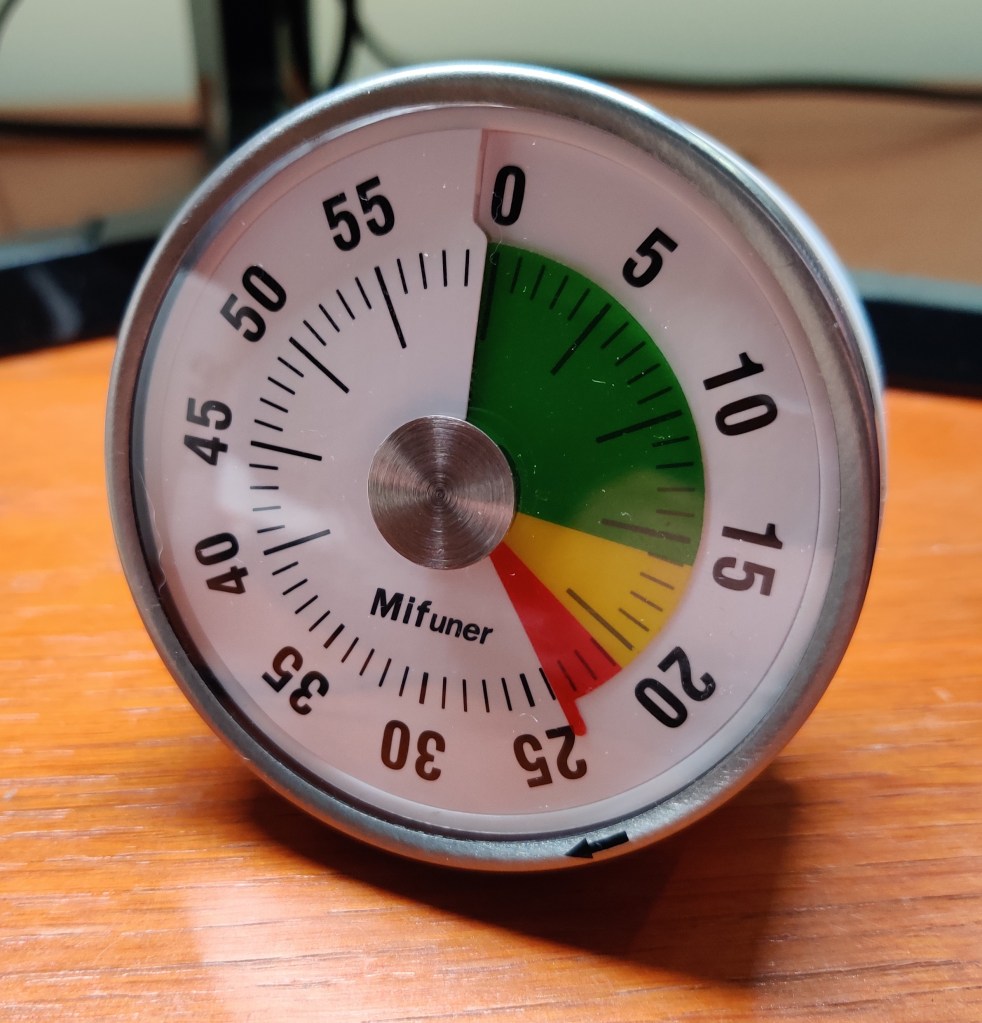
In an effort to tamp down on my procrastinating and get back on a Pomodoro system, I bought a desk timer.

I elected to go with a physical device rather than using my computer or phone to track time because I’m trying to remove the temptation to get distracted if I’m curious about the time left in the period. But I also had some other criteria.

In addition to wanting to avoid distractions, I wanted: a.) a visual representation of time, b.) something that made audible ticking, and c.) I wanted to avoid batteries if possible. The device above fit all three requirements. You wind-up the dial, set the desired duration, and the timer ticks away until the bell rings.

I’m still struggling with getting started (I usually give in and watch YouTube videos in lieu of starting my work), but once I get going, I find it easy to work through 25-minute sprints.

Let’s see how long this lasts.

Stay Awesome,

Ryan

Falling Through My Systems

This late post is a nice springboard into something I’ve been thinking about throughout the pandemic. Pre-pandemic, when I was still commuting to work, I had a fair number of systems to help me get stuff done. My commute to work helped me film daily vlogs, listen to books, and think about big ideas for blog posts and Stay Awesome vlogs. When we started working from home, those outputs began fading. Now, I feel behind on my blog posts, I *maybe* film a personal vlog once every two weeks, and Stay Awesome has been put on an indefinite hiatus until Jim and I get some extra headspace bandwidth to devote attention to it.

I was also known for my notebook. I carried a Field Notes notebook everywhere with me, and was constantly scribbling notes into it. Then, around 4 months into working from home, I found myself abandoning the monthly notebook and appropriating a disused larger notebook to jot down tasks, lists, and random thoughts. The Field Notes book was small, portable, convenient, and had many systems to track things I found important, such as exercise, health, habits, etc. Now, my notebook is largely devoted to task management, because when every day feels the same, you can quickly find yourself several weeks down the line having nothing to show for your time.

In a sense, I’ve fallen through my systems. The various “systems” I implemented succumbed to inertia when I both lost the cues that triggered them and lost the will to keep putting effort in the system to power the flywheel, and friction has ground them to a halt.

James Clear has a pithy phrase, that “you do not rise to the level of your goals. You fall to the level of your systems.” This is a riff on an older Greek observation from Archilochus: “We don’t rise to the level of our expectations, we fall to the level of our training.”

Regardless, the question I have is whether I truly had a system if it was a fair-weather operation that wasn’t robust enough to adapt to these kinds of radical changes. When I lost the external liminal cues that came from commuting to work, or from even leaving the house on a regular basis, the things I called systems disappeared as well. Is it charitable to call these things “systems”? In virtue ethics, you aren’t said to possess a virtue if you only exercise it some of the time – you aren’t considered courageous if you don’t act courageously in a moment that requires it. Does this apply to systems as well?

Part of me says yes, but that’s not very helpful. Perhaps I should reframe my thinking and consider the quality and attributes of the system. Borrowing from Taleb, some systems are fragile, some are robust, and I suppose some are antifragile. I understand antifragile systems in the context of biology (e.g. stressing muscles can allow them to get stronger over time), though as of writing I can’t think of any productivity system that get stronger under pressure.

Regardless, it’s clear that much of my productivity was built upon what can now be labelled as fragile systems. They worked under certain conditions, but outside of that narrower band they are less able to withstand fluctuations or variance. In my reflections over the last few months, I’ve been seeing the value in understanding the causes of system failures so that I can create new processes to help me in work and life. For now, the first step is to acknowledge that I’ve fallen through my systems, and having acknowledged this, I can stop spinning my wheels and start seeking traction.

Stay Awesome,

Ryan