Visualizing Time

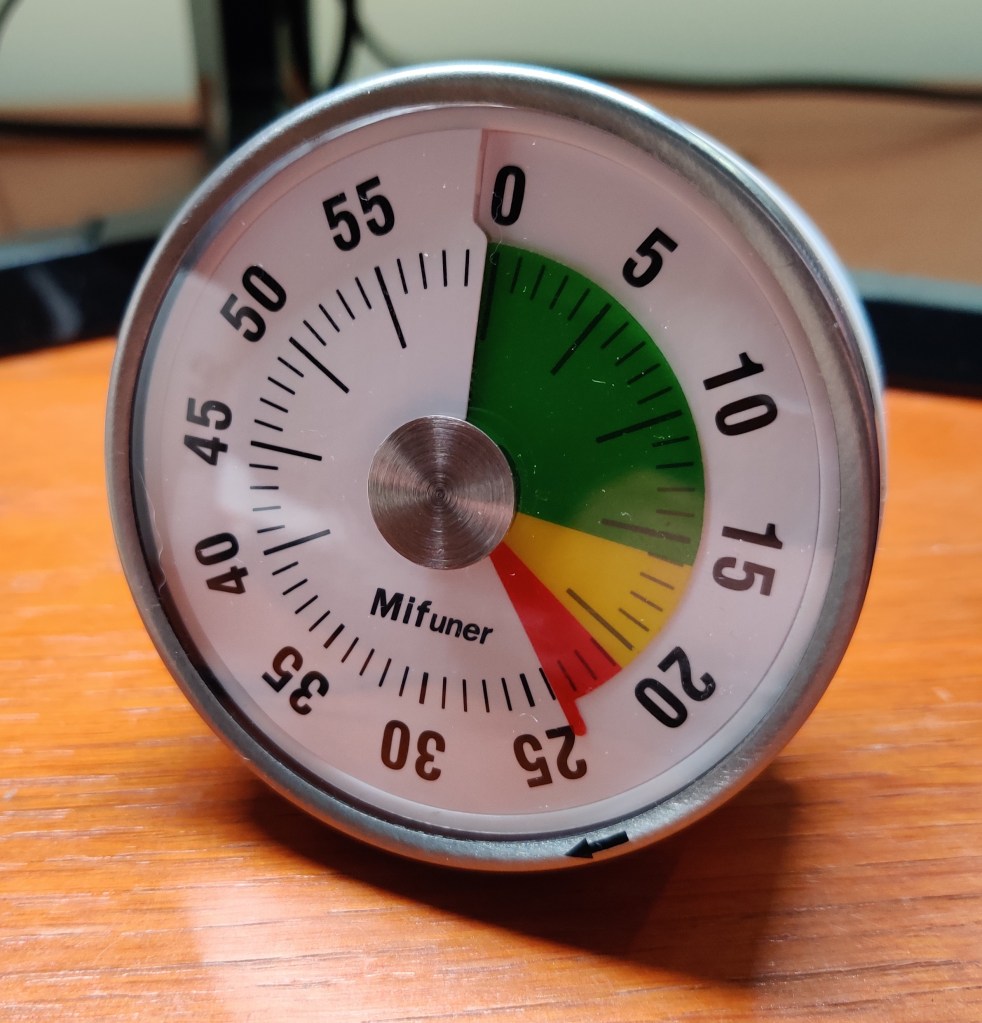
In an effort to tamp down on my procrastinating and get back on a Pomodoro system, I bought a desk timer.

I elected to go with a physical device rather than using my computer or phone to track time because I’m trying to remove the temptation to get distracted if I’m curious about the time left in the period. But I also had some other criteria.

In addition to wanting to avoid distractions, I wanted: a.) a visual representation of time, b.) something that made audible ticking, and c.) I wanted to avoid batteries if possible. The device above fit all three requirements. You wind-up the dial, set the desired duration, and the timer ticks away until the bell rings.

I’m still struggling with getting started (I usually give in and watch YouTube videos in lieu of starting my work), but once I get going, I find it easy to work through 25-minute sprints.

Let’s see how long this lasts.

Stay Awesome,

Ryan

Beyond the European Default Follow-up (7/4 time)

Last week I shared some thoughts on appreciating musical languages developed beyond the European music theory standard, and how it can be inappropriate to judge musical modalities using the vocabulary and standards of your cultural (musical) heritage. This isn’t to say that viewing art through different lenses can’t bring about interesting discoveries of the artform, but rather using one standard to pass a value-judgement of the merits of an artform can be fraught with problems.

Thanks to YouTube’s algorithm, the recommended videos feed provided some great gems appreciating the original. Through a drum cover, I learned the original was in 7/4 time (whereas I thought it might have been alternating 2/4-2/8 measures; sounds like I missed a 1/8 beat).

And here was another drum cover with some artistic interpretations on the beat.

I was able to learn a bit more about Konnakkol, and how it builds increasing complexity to the music.

And here was a great beatbox cover that got a shoutout from the male performer in the original video, Somashekar Jois.

Finally, I found that Somashekar Jois has a YouTube channel where he teaches lessons in Konnakkol. I was a little nervous about posting this since one of his past videos was an artist’s endorsement for Prime Minister Modi of India, but I still felt it important to provide the link here to learn more about the artform. If possible, I’m trying to focus on the art, rather than the artist (or his whatever his politics happens to be).

Oh, and a recent video from Adam Neely again touched on the problems with passing judgement on musical performance when you don’t critically engage with the sources of your musical taste. At best, you are falsely applying a single standard as a universal judge of taste, and at worst you are using music theory to justify sexist bullying of people just trying to have fun creating.

Stay Awesome,

Ryan

Beyond the European Default

Tim Ferriss recently shared the following video in his newsletter. From the video’s description, we are treated to a short but wonderful performance “on the most traditional, classical and ancient vocal percussive art form of India; the mother of all percussive languages – Konnakkol.”

I found as I was watching the video, I was trying to discern the time signature being used (I suppose in the hope of finding the cadence to bob my head along with the rhythm). Most of the song sounds like it switches between some sort of 2/4 and 2/8 back to back rhythm, alternating one bar of each. For a brief moment, I was going to push this out to my network to see what my music theory friends would say, since I consider myself an amateur at best.

But then I realized that the folks who I thought would be better equipped to give me an answer were likely trained in classic music theory; that is to say, European music theory. But applying a European music theory framework would be wholly inappropriate for classical Indian music. I don’t mean inappropriate in a politically correct sense (quite the contrary, it would be a fun exercise to apply European music theory as an exercise to see where the similarities and differences are between the two music styles), but instead it would be inappropriate from a practical sense. The two musical styles share the common thread of using percussion and pitches to “tell a story” but the similarities end there. They are two styles with differing underlying grammar and syntax. Applying a different musical theory lens would be inadequate to capture the nuances of the performance, and possibly miss a richer historical context to give the performance more meaning.

It reminds me of a video Adam Neely put out almost a year ago that’s well worth a revisit because he raises important points about what we choose as our defaults – what “counts” as music. If we judge everything based on what’s been given primacy over the last few hundred years, we at best have an impoverished understanding of music and culture, and at worst continue to perpetuate a systemic bias (read: racist) in favour of some kinds of music to the exclusion of others that we deem inferior (coded as foreign, exotic, world, or worse).

This isn’t to say you have to like any one kind of music – let your tastes take you wherever and drink in the art of whomever speaks to you. It’s just important to remember that art extends far beyond the preferences we think of as universal, and that our taste should not be placed at the centre of culture.

Stay Awesome,

Ryan

Return to Normal

Well, I certainly was optimistic in my last post about when I’d return to normal. The move proved to be a bit more onerous, so I missed last week’s post, as well as this week’s deadline. C’est la vie. We press on.

As we start getting our vaccines rolled out to younger folks in my part of the country, we are beginning to have virtual watercooler chats about what the return to normal will be. The gut-reaction is that our higher education institutions will kowtow to pressure to return to face-to-face delivery as soon as possible – whether it’s students looking for the ol’ college experience, administrators looking to address gaps in the bottom line, or employees desperate to escape working from home.

It’s tempting to think things will return to normal, back to the pre-pandemic status quo. We, as creatures of habit, like to slide back into what’s comfortable and expend the least amount of energy that we need to.

But knowing what I know about people, a “return to normal” is going to smack straight into the loss aversion wall – people don’t like to lose benefits once they have them. It switches to an entitlement mentality. I don’t mean this in a negative sense. Entitlements are good! When we talk about entitlements, it carries a negative connotation of something not earned. But to the contrary, I think “unearned” entitlements are the point of society, culture, and government. Rather than everyone being forced to create everything for themselves, we can leverage divisions in labour, experience, technology, and collective action to ensure that benefits get spread around. The metaphorical tide should raise all ships.

So, what does it mean when we are rushing back to return to normal – what do we think we are missing, and what would a return to normal cost us?

A return to normal means hours of commuting per week, instead of going upstairs to work.

A return to normal means rigid schedules and limited campus space, instead of blending the flexibility of synchronous and asynchronous delivery.

A return to normal means bringing back flu seasons at work.

A return to normal brings back all the issues around inclusion and accessibility for those who don’t fit the “normal” not built for them.

Here at home, a return to normal means less time with our infant son. It would also mean less quality time with my wife.

I haven’t packed a lunch in a year. My office dress clothes have been hanging untouched in my closet. I’ve fueled up as many times as maybe months we’ve been working from home.

Not everyone is as fortunate as I am to still be working from home. Many employees at my institution still have to go on campus to work because they’re essential, so their current normal differs from mine. However, we must question whether we want the consequences of having the rest of us join the essential few. I sincerely doubt it is automatically a return to something better.

Stay Awesome,

Ryan

Initial Assumptions

I was reflecting on Seth Godin’s musings about the number of moons in our solar system. The initial assumptions we use to make predictions about our world can sometimes be orders of magnitude off from truth.

We as humans don’t like to be wrong, but we shouldn’t be overly concerned with our initial assumptions being off the mark. After all, if we knew the truth (whatever “truth” happens to be in this case), there would be no need to start from initial assumptions. It is because we are starting from a place of ignorance that we have to start from an assumption (or hypothesis) in order to move forward.

The problem lies with whether we realize we are making assumptions, and how committed we are to holding on to them. Assumptions made about the physical world can often be value-neutral, but assumptions that intersect with the lived experiences of people always come pre-packaged with history that’s value-loaded. It’s fine to make an assumption that your experiences are shared with others, but that assumption can only be carried so far. At some point, you have to acknowledge that there will be a lot missing in your initial assumptions that need to be accounted for.

The lesson then is this: when working from an estimation or prediction, be careful with your initial assumptions. It’s fine to begin with your own experiences, but always put an asterisks beside it because your experience is likely not universal. We must guess, then check. Test, verify, then revise.

Aiming at truth is a noble goal, but we should settle for asymptotically moving closer towards it as it more likely reflects reality.

Stay Awesome,

Ryan

A Well-Designed Vaccination Process

I was fortunate to receive my first vaccine dose yesterday. While I initially thought I would have to wait until a later phase, I recently found out that I qualified based on my BMI. It bummed me out to learn that I’m perhaps not as “healthy” as I thought and I had felt a sense of pride being among those who would have to wait until the end. It’s irrational, I know. However, I felt it was my duty to get my vaccine as soon as I was eligible in order to do my part and help with public health measures.

The vaccination process I participated in was very smooth and efficient. A friend asked me how the experience went – here were the notes I sent:

My appointment was scheduled for 4:45pm, and I arrived at 4:40 (a 30min commute from home to the site).  They had a sign outside saying they were now taking the 4:45 appointments.  I went through several layers of people asking me questions, but it was super smooth and efficient:

  • Security Guard at the door ask the standard screeners (I don’t have symptoms, no one in my house has symptoms, I haven’t travelled in the last 14 days), and to check I had an appointment confirmation email/text.
  • Queue person to direct me to the check-in.  They also directed me to sanitize my hands and handed me a mask with tongs, saying I could either replace the one I was wearing or use it to double-up.  I chose to just double-up.
  • Check-in to confirm my appointment.
  • Nurse to take my health card info.
  • Queue person to direct me to which chair to sit in.
  • Doctor who asked screeners and gained consent. (we chatted for a little bit)  My receipt notes I received my shot at 4:43.
  • After the shot, the doctor wrote a time on the top of my information form and directed me through a door to a gymnasium for observation.
  • Queue person to explain the chairs (basically, wait until my time was up, and whatever chair I chose, flip the sign to indicate I sat in it so it could be sanitized when I left).
  • Get up from the chair at 5:04 and go in one direction around the seating area to another nurse (observed by security guard).
  • Final nurse confirmed who I was, ask for family physician to notify them, confirmed my email, then printed and emailed me my receipt.

I texted my wife at 5:11 that I was done and heading back.  Well oiled, well directed, very relaxed. 

I am incredibly grateful for the care and thought the local Public Health Unit put into this process. I never felt lost or unsure about how to proceed, and all the staff were friendly and professional.

So far, almost 20-hours post-shot, I feel great. The soreness in my arm is similar to vaccines I received previously, so time will tell if I feel any of the other side effects (aches, fever, etc.).

We’re all in this together.

Stay Awesome,

Ryan

The Duke of Edinburgh’s Impact on My Life

With the passing of Prince Philip last week, I reflected on his impact on my life. Normally, the goings-on of the Royal family impacts me little directly, albeit I am a commonwealth subject as a Canadian. However, Prince Philip was also the creator of the Duke of Edinburgh Award Program, which I participated in as a youth. I was fortunate to be introduced to the program during my Army Cadet days, and I progressed through each of the three levels before I aged out of the program, completing my Gold Level in late 2011.

I recently participated in a survey of Gold Level holders asking about the program’s impact on my life. At the time, I answered that the program had little lasting impact on me. I said this in relation to each of the four core areas of the program – physical fitness, skill development, community service, and the adventure component. For each of these areas, I felt like little had directly carried over all these years later. I’m not a particularly fit person, I don’t remember any of the skills I had developed, and I haven’t gone camping in about a decade. The only domain that I am still highly active in concerns volunteering.

So, on the surface, I feel somewhat disconnected from my achievements in the DofE program. Yet, as I reflected over the weekend, I was struck by a realization: had it not been for my gold level trip to Kenya (I joined a group who travelled to Kenya in 2007 to perform a service project and climb Mt. Kenya), I would not be where I am today.

My trip overseas came at the midpoint of my undergraduate experience. As I returned home and went back to school in September 2007 for my third year, I had a profound change in outlook. Prior to my trip, I was a residence-body. I rarely ventured out beyond the dorms and was too shy to join on-campus clubs and groups. But after returning from the trip, when I was faced with an opportunity that I was nervous to attempt, I would remind myself that I had just climbed a mountain, and now anything seemed possible. It gave me the confidence to step outside of my shyness and embrace new challenges.

I joined the campus first aid team and the departmental undergraduate society. In time, I took over both groups and lead my peers through successful tenures as Operations Coordinator and Society President respectively. I committed more fully to my studies, and continued my education into graduate school. The friends I made on the first aid team lead me to a job in the gambling lab as a field researcher. It also lead me through the same connections to volunteering for a local non-profit board and working with the local Community Foundation. Those experiences then helped me get my first full time job at Conestoga College, where I currently am employed.

I’m not saying that I wouldn’t be where I am had I not been in the DofE program. However, I can draw a strong link through each of these personal developments that traces back to a decision I made one day to join in when a friend told me about this fun opportunity to travel abroad. And while I don’t often remind myself anymore that I climbed a mountain when I’m trying to convince myself to be brave, I feel a deep sense of gratitude for being a part of something that pushed me to grow beyond what I thought I was capable.

Kurt Hahn was a mentor of Prince Philip who provide inspiration for what would become the DofE program. He is known for saying that “there is more in us than we know if we could be made to see it; perhaps, for the rest of our lives we will be unwilling to settle for less.” Without realizing it, these words infused themselves into who I am as a person, and I didn’t understand what it meant or its impact until the passing of Prince Philip.

Rest in Peace, His Royal Highness, The Prince Philip, Duke of Edinburgh.

Stay Awesome,

Ryan
WFH Observation – Novel Environments

I’ve been working from home for a year now, and I’m still surprised when I discover something about how I work that I had overlooked previously. You’d think I’d have stuff sorted out by now, but alas here I find myself.

Over the last week, we’ve been away from our house as we prepare to sell it. With COVID ramping up in the province, we thought it would be easier with a baby and a dog to be out of the house full time while prospective buyers came by to look at the listing. We stayed with family, which has required me to adapt my working conditions.

Typically I work in the home office at my desktop. For the last week, I’ve been working off a laptop and a borrowed computer monitor that functions as my second screen. For comfort, I’m using my peripheral wireless mouse and keyboard, along with my wireless headphones to block out noise. While working out of various bedrooms this past week, I’ve noticed an increase in my focus.

Granted, the increased focus coincided with a series of long meetings I’ve been attending, so perhaps I’ve been tricking myself into thinking I’m more productive. However, as I reflect on the situation, I also feel it’s worth mentioning that working in a new location helps to provide a sense of novelty for me.

This isn’t a new insight in the world of remote work – early in the pandemic, I used my company’s access to LinkedIn Learning to complete a few micro-courses on the topic of remote work to help me adjust. Many of the instructors noted that traditional remote work is done in many locations, both inside the home (dedicated workspace) as well as at favourite places out of the house (e.g. the local cafe). Because of COVID, I haven’t placed much stock in this piece of advice because we are dissuaded from working out of the house for long stretches of time (that is, sitting indoors at a coffee shop) if we are not required to do so.

This mini-experiment in remote work has given me some insight into my working style – I am not immune to the novelty that comes from environmental changes. When things relax a bit more, and if I continue to work remotely in my position, this will be something I’ll give consideration to.

Stay Awesome,

Ryan

Editing with Rapt Attention

Last week I discussed how I created a video training series for one of the ethics boards I serve on. All told, I’d estimate it took me around twenty hours to sketch, film, edit, and publish the series (this is an ad hoc estimate; sadly I didn’t do any time tracking to appreciate the effort). While I’m comfortable with the filming, I noticed a particular period of the work that created a bit of a flow state for me.

On the last day of editing, I was up against a bit of a deadline to finish the videos and push them out to the trainees. I admit that the deadline helped me to focus more (or at least resist the temptation to get distracted), but I noticed that when I was editing the videos, I hit a bit of a flow state. It’s not that I found the tasks particularly challenging, but there was something about the rote, somewhat monotonous task of watching and cutting footage that helped me move through the videos fairly quickly. It was almost 4-hours of editing before I felt like I should take a break to stretch and shift my mind to something else – the time seemed to go quickly. Then, after my break, I returned for another multi-hour stretch to finish off the last of the videos for the rendering queue.

It’s not often that I feel myself working in this state, where time gets away from me for hours at a time. In fact, most of the time I feel somewhat disengaged with my work, and I have to apply discipline in order to work on tasks. This was a rare example of working on something that felt right.

I joked with my wife that I wish I found a job as an editor, but I was only half joking. The lesson I take from this is to be mindful with how I engage with activities that trigger flow, and find a way to go back to that state in other areas of my work.

Stay Awesome,

Ryan