The Last Person to Know Everything

On a recent CBC podcast episode about Leibniz and Voltaire’s thoughts about evil and God, one of the interviewees referred to Leibniz as “the last man to know everything.” I find this notion utterly fascinating. Upon hearing that title, I jumped online to search for the “best biography on Leibniz” and found a highly acclaimed book detailing an intellectual biography of the 17th-century thinker. Once I clear some books on my current reading list, I’ll dive into this hefty book.

“Leibniz: An Intellectual Biography” by Maria Rosa Antognazz

This isn’t the first time I’ve encountered the moniker of “the last person who knew everything.” In fact, that was the title of a biography I read back in late 2018 on Enrico Fermi.

I’ve been drawn to this idea for a long time, probably originating with the first time I saw the 1994 film Renaissance Man starring Danny DeVito. That was where I first learned of the term renaissance man, or more commonly known as a polymath – a person with considerable knowledge and expertise across a wide variety of domains. While I wouldn’t quite call it a goal, this is an aspiration of mine since I was a child.

I suppose as the sciences progress, it becomes increasingly difficult to lay claim to being “the last person who knew everything.” Each field grows increasingly complex as we push the boundaries of the known world, which raises the threshold higher of what counts as expertise.

It would seem we need to seriously consider the observation recently made by Professor Adam Grant on the differences between experience and expertise:

Instead of seeking to always have depth of knowledge, perhaps we should give equal consideration to wisdom and how we can apply our experiences and expertise to solve interesting problems. While more nebulous as a goal, I think it steers us in the right direction. At the very least, it’s a good vision to aspire towards.

Stay Awesome,

Ryan

PS – an unexhaustive list of the traits that distinguishes a “last person who knew everything:”

  • Intellectual curiosity
  • Intellectual humility
  • Interests spanning a variety of domains, both sciences and arts
  • A grasp of the methods and tools of science
  • Generating novel insights
  • The ability to see problems in terms of first principles
  • Engaging in idea arbitrage
  • Focus and flow in work – liking what you do
Work Focus While Home Alone

Working from home poses challenges for most folks when it comes to being able to focus. Many of my colleagues noted how difficult the summer months could be while children were home from school. For me, with an infant at home, the distractions were fairly minimal, especially because my wife handled 99% of the care during the working day during her leave from work.

But now she’s gone back to work and our child is at daycare during the day. While you’d think this means my productivity output has jumped by leaps and bounds, it’s actually done the opposite. With no one in the house to bother me, with no one to look over my shoulder, or for me to quickly hide the fact that I’m goofing off watching irrelevant videos on YouTube instead of looking at spreadsheets, the seeming unlimited time means I have a hard time getting started.

This almost seems like a cousin of Parkinson’s law, but instead of work filling the allotted time, the strength of the impulse to get started is negatively correlated with the amount of free (unsupervised) time I find myself with. Quite the opposite, there seems to be more inertia to overcome.

Stay Awesome,

Ryan

PS – as a note to my future-self: there is a connection here with what Mel Robbins says about procrastination, that it’s not a function of laziness but instead a coping mechanism for the anxiety felt by the task. I should look into this more.

Shrinking the Change

In recent weeks, I’ve built reading time intentionally into my work day. I’ve had it “in my calendar” for quite a while as an intention, but I haven’t meaningfully engaged with that blocked-off time since I first put it into my calendar. The intention was to recognize that my skills and career path would require me to commit time to learning and personal development, but I quickly got lazy and found other less productive things to occupy that time with.

I was annoyed with how I’d allow the whole day to slip by without getting a good start to my tasks (my vice being YouTube’s algorithm), so I thought I’d redirect my attention a bit. I reasoned that if my brain wanted to fight engaging with work (because it’s hard), then I could use that time to read. I set the timer and once I finish the sprint, I would start on some task for the day.

Surprisingly, I’m having some success with the process. It’s not perfect, but on the days I start with reading, I’m more likely to resist temptation and tackle items on my to do list.

Coincidentally I’m reading the book Switch by Chip and Dan Heath. One of the chapters discusses the concept of shrinking the change, which is just a fancy way of expressing the idea that we should break big scary tasks into smaller, more manageable bites. Committing to something that is long and ill-defined is hard for my lazy brain to comply with, but it will comply with an easy edict, like “read for the next 25-minutes,” or “spend the next 25-minutes downloading course information files to be processed.”

These tips and hacks are not new – everyone has some flavour of it as part of their productivity system. But like losing weight, it’s not a knowledge problem. Learning and reading about how to lose weight won’t make you shed the fat, nor will it help you amp up productivity.

The challenge for me is tricking myself into not being lazy. If the only way I can do that is making an Odysseus pact, or treating myself like a child, setting a timer, and promising to do a little bit before I get a reward, then so be it.

Stay Awesome,

Ryan

A Decent Day

My productivity has been garbage recently. Maybe the lingering effects of working from home during the pandemic has finally ground me down, but I’ve been struggling with staying on task. I’m failing to prioritize my work, I’m failing to follow-through on intentions, and while I’m keeping up with some deliverables, it’s a real slog to turn stuff around. Even this blog consistently goes up days late.

I try to not take this to heart, because it genuinely wears me down. On a good day, I cross items off my list and stick to the pomodoro timer, letting its ticking provide a meditative soundtrack to my flow. On bad days, it feels like the whole days gets past me with nothing of substance to show; time that’s gobbled up by the Past forever.

On the days when I catch myself heading towards an abysmal performance by 5pm, I tell myself to just get one thing done. It doesn’t have to be huge or complicated, but get at least one important thing done and shipped, and you’ll have had a decent day.

It’s not the best day, it’s not a great day, but a decent day is better than nothing. And it’s easier to chain decent days together to push forward in your work.

Aim for decent days, when you get at least one thing done, then give yourself permission to be satisfied with that.

If you aim for perfection, you stall yourself out. If you aim for decent, you get at least this blog post out.

Stay Awesome,

Ryan

Parenting and the Return to “Normal”

I’ve been very fortunate to work from home since the start of the pandemic. I have only stepped foot in the office once in the last year, and have otherwise been plugging away at tasks from home. I was also fortunate that this time overlapped with the birth of our son, so I have been home for his first year of life. My wife returns to work in September, and our son will head off to daycare, signaling our first steps towards a return to “normal.” At present, I will likely continue working from home until January, assuming public health doesn’t pull back on restrictions to limit the virus spread.

Two recent podcasts had me reflecting on the kinds of things that changed about life both as a result of the pandemic as well as experiencing parenthood while at home. The first was a musing from The Daily Dad on the slow life of the pandemic, and the second was from Scott Young on how parenting changed his views on productivity.

The pandemic hit a hard stop to the busy lifestyle I had adopted. This isn’t to say I embraced “busyness” as a mark of distinction, but rather I was the kind of person who said yes to a lot of things and wanted to be involved in cool stuff. My calendar was filled with lots of obligations, work and social alike. I juggled three jobs while running a non-profit, a social club, and podcasting and vlogging projects. I enjoyed being busy and helping others.

But as a parent, I carry a different set of responsibilities that conflict with this kind of lifestyle. I was never faced with the choices to prune back my (mostly) optional obligations in order to fulfill my parental duties – the pandemic largely did that for me.

And as we think about returning to “normal,” I will obviously have to think carefully about what sorts of things I add back into my life (the pandemic will end, but being a parent won’t). Some of the effects from the pandemic and being at home to take a greater prominence in co-parenting our child makes me reflect on what kind of home life I wish to cultivate, and ask which elements of the pandemic do I want to carry forward into the new normal. For instance, in thinking about the slow life, things like bedtime routines, long blocks of time with kid(s), weekends set aside for family time, are all things I want to hold sacred.

The pandemic was referred to as The Great Pause. I should get some more of this thinking done before we un-pause and move on with life.

Stay Awesome,

Ryan

Visualizing Time

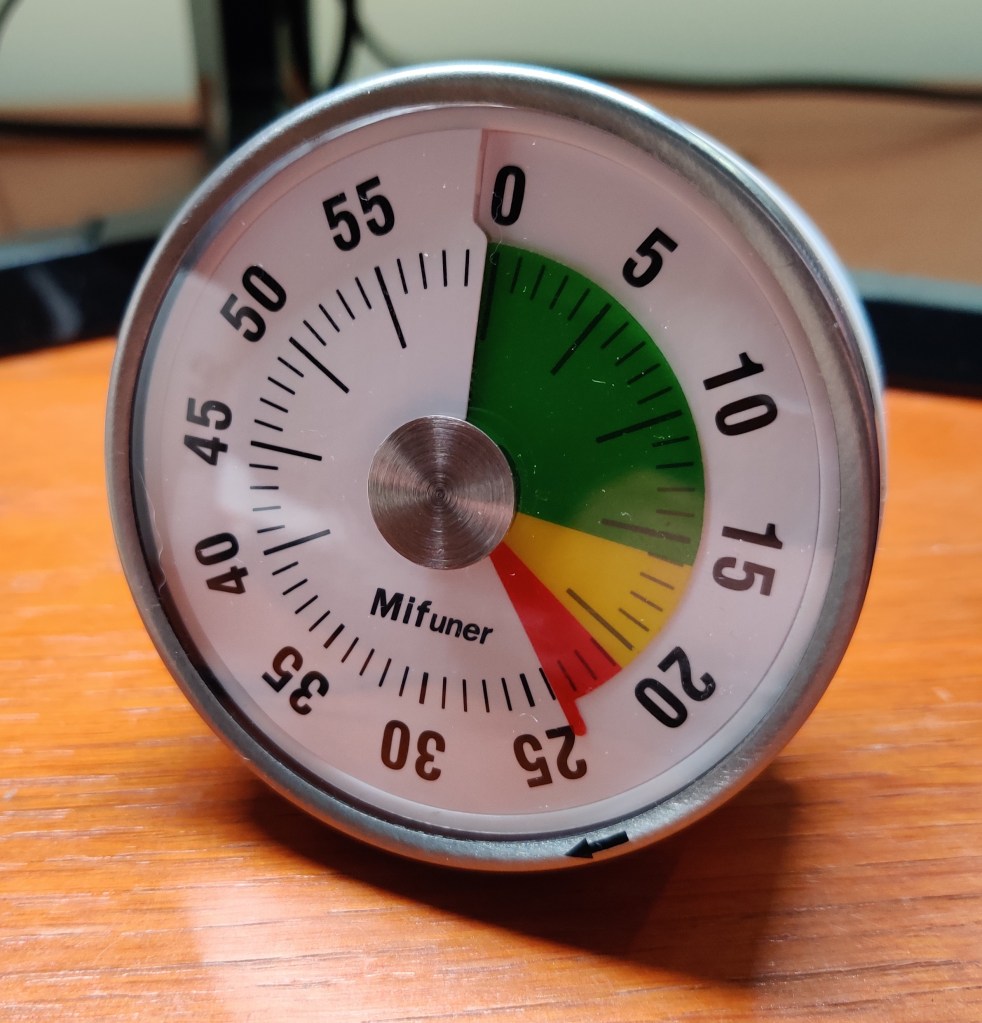
In an effort to tamp down on my procrastinating and get back on a Pomodoro system, I bought a desk timer.

I elected to go with a physical device rather than using my computer or phone to track time because I’m trying to remove the temptation to get distracted if I’m curious about the time left in the period. But I also had some other criteria.

In addition to wanting to avoid distractions, I wanted: a.) a visual representation of time, b.) something that made audible ticking, and c.) I wanted to avoid batteries if possible. The device above fit all three requirements. You wind-up the dial, set the desired duration, and the timer ticks away until the bell rings.

I’m still struggling with getting started (I usually give in and watch YouTube videos in lieu of starting my work), but once I get going, I find it easy to work through 25-minute sprints.

Let’s see how long this lasts.

Stay Awesome,

Ryan

Return to Normal

Well, I certainly was optimistic in my last post about when I’d return to normal. The move proved to be a bit more onerous, so I missed last week’s post, as well as this week’s deadline. C’est la vie. We press on.

As we start getting our vaccines rolled out to younger folks in my part of the country, we are beginning to have virtual watercooler chats about what the return to normal will be. The gut-reaction is that our higher education institutions will kowtow to pressure to return to face-to-face delivery as soon as possible – whether it’s students looking for the ol’ college experience, administrators looking to address gaps in the bottom line, or employees desperate to escape working from home.

It’s tempting to think things will return to normal, back to the pre-pandemic status quo. We, as creatures of habit, like to slide back into what’s comfortable and expend the least amount of energy that we need to.

But knowing what I know about people, a “return to normal” is going to smack straight into the loss aversion wall – people don’t like to lose benefits once they have them. It switches to an entitlement mentality. I don’t mean this in a negative sense. Entitlements are good! When we talk about entitlements, it carries a negative connotation of something not earned. But to the contrary, I think “unearned” entitlements are the point of society, culture, and government. Rather than everyone being forced to create everything for themselves, we can leverage divisions in labour, experience, technology, and collective action to ensure that benefits get spread around. The metaphorical tide should raise all ships.

So, what does it mean when we are rushing back to return to normal – what do we think we are missing, and what would a return to normal cost us?

A return to normal means hours of commuting per week, instead of going upstairs to work.

A return to normal means rigid schedules and limited campus space, instead of blending the flexibility of synchronous and asynchronous delivery.

A return to normal means bringing back flu seasons at work.

A return to normal brings back all the issues around inclusion and accessibility for those who don’t fit the “normal” not built for them.

Here at home, a return to normal means less time with our infant son. It would also mean less quality time with my wife.

I haven’t packed a lunch in a year. My office dress clothes have been hanging untouched in my closet. I’ve fueled up as many times as maybe months we’ve been working from home.

Not everyone is as fortunate as I am to still be working from home. Many employees at my institution still have to go on campus to work because they’re essential, so their current normal differs from mine. However, we must question whether we want the consequences of having the rest of us join the essential few. I sincerely doubt it is automatically a return to something better.

Stay Awesome,

Ryan

The Duke of Edinburgh’s Impact on My Life

With the passing of Prince Philip last week, I reflected on his impact on my life. Normally, the goings-on of the Royal family impacts me little directly, albeit I am a commonwealth subject as a Canadian. However, Prince Philip was also the creator of the Duke of Edinburgh Award Program, which I participated in as a youth. I was fortunate to be introduced to the program during my Army Cadet days, and I progressed through each of the three levels before I aged out of the program, completing my Gold Level in late 2011.

I recently participated in a survey of Gold Level holders asking about the program’s impact on my life. At the time, I answered that the program had little lasting impact on me. I said this in relation to each of the four core areas of the program – physical fitness, skill development, community service, and the adventure component. For each of these areas, I felt like little had directly carried over all these years later. I’m not a particularly fit person, I don’t remember any of the skills I had developed, and I haven’t gone camping in about a decade. The only domain that I am still highly active in concerns volunteering.

So, on the surface, I feel somewhat disconnected from my achievements in the DofE program. Yet, as I reflected over the weekend, I was struck by a realization: had it not been for my gold level trip to Kenya (I joined a group who travelled to Kenya in 2007 to perform a service project and climb Mt. Kenya), I would not be where I am today.

My trip overseas came at the midpoint of my undergraduate experience. As I returned home and went back to school in September 2007 for my third year, I had a profound change in outlook. Prior to my trip, I was a residence-body. I rarely ventured out beyond the dorms and was too shy to join on-campus clubs and groups. But after returning from the trip, when I was faced with an opportunity that I was nervous to attempt, I would remind myself that I had just climbed a mountain, and now anything seemed possible. It gave me the confidence to step outside of my shyness and embrace new challenges.

I joined the campus first aid team and the departmental undergraduate society. In time, I took over both groups and lead my peers through successful tenures as Operations Coordinator and Society President respectively. I committed more fully to my studies, and continued my education into graduate school. The friends I made on the first aid team lead me to a job in the gambling lab as a field researcher. It also lead me through the same connections to volunteering for a local non-profit board and working with the local Community Foundation. Those experiences then helped me get my first full time job at Conestoga College, where I currently am employed.

I’m not saying that I wouldn’t be where I am had I not been in the DofE program. However, I can draw a strong link through each of these personal developments that traces back to a decision I made one day to join in when a friend told me about this fun opportunity to travel abroad. And while I don’t often remind myself anymore that I climbed a mountain when I’m trying to convince myself to be brave, I feel a deep sense of gratitude for being a part of something that pushed me to grow beyond what I thought I was capable.

Kurt Hahn was a mentor of Prince Philip who provide inspiration for what would become the DofE program. He is known for saying that “there is more in us than we know if we could be made to see it; perhaps, for the rest of our lives we will be unwilling to settle for less.” Without realizing it, these words infused themselves into who I am as a person, and I didn’t understand what it meant or its impact until the passing of Prince Philip.

Rest in Peace, His Royal Highness, The Prince Philip, Duke of Edinburgh.

Stay Awesome,

Ryan

WFH Observation – Novel Environments

I’ve been working from home for a year now, and I’m still surprised when I discover something about how I work that I had overlooked previously. You’d think I’d have stuff sorted out by now, but alas here I find myself.

Over the last week, we’ve been away from our house as we prepare to sell it. With COVID ramping up in the province, we thought it would be easier with a baby and a dog to be out of the house full time while prospective buyers came by to look at the listing. We stayed with family, which has required me to adapt my working conditions.

Typically I work in the home office at my desktop. For the last week, I’ve been working off a laptop and a borrowed computer monitor that functions as my second screen. For comfort, I’m using my peripheral wireless mouse and keyboard, along with my wireless headphones to block out noise. While working out of various bedrooms this past week, I’ve noticed an increase in my focus.

Granted, the increased focus coincided with a series of long meetings I’ve been attending, so perhaps I’ve been tricking myself into thinking I’m more productive. However, as I reflect on the situation, I also feel it’s worth mentioning that working in a new location helps to provide a sense of novelty for me.

This isn’t a new insight in the world of remote work – early in the pandemic, I used my company’s access to LinkedIn Learning to complete a few micro-courses on the topic of remote work to help me adjust. Many of the instructors noted that traditional remote work is done in many locations, both inside the home (dedicated workspace) as well as at favourite places out of the house (e.g. the local cafe). Because of COVID, I haven’t placed much stock in this piece of advice because we are dissuaded from working out of the house for long stretches of time (that is, sitting indoors at a coffee shop) if we are not required to do so.

This mini-experiment in remote work has given me some insight into my working style – I am not immune to the novelty that comes from environmental changes. When things relax a bit more, and if I continue to work remotely in my position, this will be something I’ll give consideration to.

Stay Awesome,

Ryan