Relearning an Old Lesson About Self-Directed Learning

Relearning an Old Lesson About Self-Directed Learning

Originally published on LinkedIn.

During my period of unemployment, I reflected on my career and identified a few areas I could develop now that I had some spare time on my hands.  One of those development areas is seeking an ASQ certification as a Six Sigma Green Belt (h/t to Andrea for the suggestion!). At first, I delayed starting because I was looking for a low-cost near-free course to guide my study, such as something on Coursera I could audit, learning paths on LinkedIn Learning, or a discounted Udemy class I’d already purchased. But as I started watching the video modules, I quickly realized I wasn’t truly engaging. I was watching lecture content without retaining much.  While yes, watching at 2x speed is largely to blame for it, I couldn’t escape the fact that I was engaging in passive consumption.

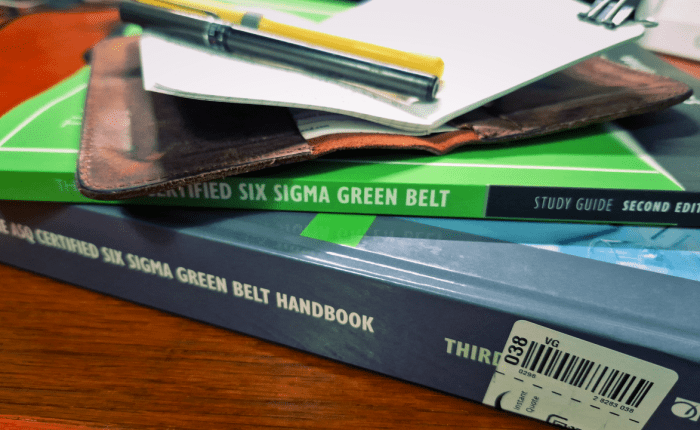
While I waited to figure out how to learn the material, I looked up the ASQ requirements and purchased used copies of the Six Sigma green belt handbook and a test prep study guide with practice questions.

Knowing that getting started is better than waiting around for a perfect plan, I started reading the handbook and planned to sort out my study strategy as I went. Almost immediately, I began connecting concepts to my past work and imagining how I could apply them now in my current role.

That’s when I realized: I’d done this before.

Paramedicine (2015–2016)

In 2015, I hit the transition point between early and mid-career phases and started questioning if I was on the right path (I found office work not very fulfilling). I thought it was a good opportunity to seek a career change and embark into paramedicine – I had a passion for first aid, I was a first responder on a few occasions in university (shoutout to University of Waterloo Campus Response Team!), dealt with emergencies while working as a bouncer, and I had written my masters thesis on the ethics of first aid.  It aligned with my values of helping people and provided a fast-paced technical job that would give me fulfilment.

The first step was meeting the admissions requirements, which included needing a high school biology credit. I enrolled in a self-paced college prep biology course.

There was no active instructor; just a course outline, a textbook, weekly tests, and two major summative exams. Here’s how I approached it:

  1. Used the course outline and test schedule as a learning roadmap – Matched unit outcomes in the course outline to textbook chapters covered on tests – Prioritized readings based on the self-paced testing schedule
  2. Created active study tools – Flashcards for definitions and concepts – Hand-drawing diagrams (cells, organs, systems) labeled front-and-back for drill practice
  3. Focused on comprehension-level mastery – Enough to explain, label, and connect systems without unnecessary complexity – The test was multiple choice, true/false, and labelling diagrams, so sticking to the first two levels in Bloom’s taxonomy was sufficient.

This gave me a clear plan and a feedback loop through frequent testing.  I passed the course with an above 90% final grade.

Article content
Samples of my flash cards and hand-drawn diagrams.

The Present

For my Green Belt prep, I have:

  • A roadmap: The Body of Knowledge in the handbook’s appendix, which outlines each section, topics, and the number of exam questions per section.
  • Content: The handbook itself for deep reading and marginalia.
  • Practice: A test prep guide with exam-style questions.

By combining these, I can map my study plan to the exam structure.  I also asked AI to use my weekly time constraints to suggest a manageable plan to break up the work and prepare to take the test by mid-Fall.  Then, I can prioritize topics by weighting and test my knowledge incrementally as I go.

The Lesson

I realized I don’t always need a formal course, especially for a certification with a defined body of knowledge and predictable exam format.  By having a clear syllabus, a learning map, a primary content source to learn from, and a way to test and reinforce learning, I can direct my learning effectively.

Courses have advantages: expert guidance, tailored examples, real-time feedback, and adaptive teaching.  However, courses are not the only route for learning and self-development. By having a well-defined body of knowledge to study from, and using active learning methods like taking notes, journaling on my learning, short feedback cycles, and finding ways to apply the content to my work and experience, I have all that I need to be successful.  All it will cost is some used textbooks, a registration fee, and remembering a lesson I learned a decade ago.
Pandemic Career Development

I was reminded today of one thing I missed in the two years we worked from home. When carrying out your duties from home, in isolation, your interactions with your colleagues has two defining features: it’s mediated, and it’s pragmatic.

It’s mediated for the obvious reason that it’s done entirely remotely. You see your colleagues, but through a screen. You work hard to not talk over each other, because doing so makes the conversation stilted. The interactions are just more screen time you are seeking to limit, and it’s artificial in the conversational decorum that’s needed to make the medium work.

And it’s pragmatic in that your interactions are always deliberately chosen. Unless you intentionally sit on an open call, waiting for people to come in as they please, all interactions with colleagues are done by appointment and with a specific purpose in mind. The two of you “connect” virtually to discuss, then disengage to carry on with your day.

The office is different. There is something to be said for serendipitous conversations that pop up when passing each other in physical space; when you wander into someone’s office or cubicle and strike up a chat. The conversation has a tendency to float from topic to topic, because unless you booked a meeting into their calendar, your interaction doesn’t have the same constraints. Once the purpose of the chat is over (e.g. your question is answered, or the message is conveyed), you then move on to whatever adjacent topics are on your minds.

In the time I’ve worked here at the college, I’ve found a lot of opportunity for career development in the casual conversations I’ve had with people around the office. The conversations aren’t even about my career development explicitly, but instead are lessons learned through osmosis. Lessons learned when a manager is describing an issue they are dealing with, and you gleam from them insights into the skills you need to develop to meet similar challenges. Or where they share stories from earlier in their career that’s relevant to something being experienced in the present. It’s not a traditional mentorship, but if you listen closely, it can come close.

During the time I worked at home, my career development came through the projects I worked on, reflecting on skills I lacked, and seeking out ways to train into what I needed. It was always reactive and “just in time.” I didn’t realize how much I missed what happens when people are sharing a space together, and you as a colleague seeking wisdom get a chance to learn proactively with “just in case” wisdom that gets filed away for future use.

I miss the freedom of wearing shorts at home, but I’m glad to be back for the water cooler discussions.

Stay Awesome,

Ryan

Stepping Back Into The River

As the saying goes from Heraclitus, you can’t step in the same river twice. There are two ways we can interpret this metaphor. The most common interpretation is that you cannot step in the same river twice because the river is constantly changing. The water is flowing past, the flux of the water is changing the boundaries and composition of the river, and so it’s impossible to step into the exact same river twice. But another way to interpret the metaphor is to place more emphasis on the youYou can’t step in the same river twice – whereby the you stepping into the river changes and is not the same over time. This can be taken as literally as when describing the flux of the river – your cells are changing, etc. But I like the more poetic version of the metaphor that speaks to us changing with our experiences through our lives.

When you return to a river (the river being a stand-in for any number of things), you are a different person, and your past experiences make the phenomenological event that you experience different. The first time I encountered this was retaking a course in high school. I was the kid that took a course called Writer’s Craft, loved it and the instructor so much that in the following year I enrolled in it again with the same teacher. However, the materials selected for the class by the teacher, and indeed my fellow students, were all different. It was different, less enjoyable this time around. I still enjoyed studying under my teacher, Mr. Steffler, but with it being a different cohort of students (students from the grade below me), I realized that the experience lacked the magic of when I took it with my original cohort. I tried to step in the same river twice and was surprised when it was different; that I was different.

There is also the case where you revisit a book you read previously and it speaks to you on a different level. Maybe your experiences help you connect with the characters on a different level, or you empathize with the characters differently. Your values might have changed. Or just that you are older and more knowledgeable, you understand more of the text and draw different connections.

This happened to me recently. My job promotion at work was approved, and I’m taking on management tasks as part of my portfolio. Maybe because I have mild imposter syndrome (I sometimes believe I am continuing to fail upwards), or maybe because I’m trying to be proactive, I decided to pull my copies of books by Peter Drucker off the shelf to learn what it means to be in management and how to do it well. I started with a short text of his called Managing Oneself, which I read back in 2017.

Something in the book landed differently this time, which I think breaks down to two differences about me now versus who I was five years ago. The first is I am busier now than I was then. This isn’t to say I was idle then – I was working three jobs, heading up a non-profit, in a relationship, etc. However now my life feels fuller with things that feel more critical – a higher stakes position at work with more responsibility, co-managing a household with my wife, the responsibilities of family and childcare, dealing with a pandemic, etc. I might have fewer work domains on my radar than I did in the past, but things have higher stakes now, and the idea of more effectively managing myself speaks to who I am as a person, where I’m trying to be mindful of others, plan for the future, and lay down a good foundation to support our family as we go.

The second thing that landed differently was the section about learning more about yourself and how you operate as you manage yourself/your life. I don’t remember this sticking in quite the same way (and based on my blurb from Instagram, it seems I was slightly underwhelmed by the text). For as much as I feel like I’m an imposter sometimes, I also know myself more now, am more confident in my skills, and have cultivated experience and expertise as I travelled along my career path from then until now. And so to revisit this section about managing yourself (that is, identifying what you should prioritize your focus on nurturing and developing) speaks to me. Rather than being frenetic and jumping on every opportunity while you are early in your career, it is better to slow down, be mindful, and think through what will add value to your life.

I don’t need to worry about losing out on opportunities by not acting fast. Instead, I can think about enhancing quality, enriching life, and paring down the things that no longer serve me.

I thought I was going to read the book a second time to remind myself of its content. Instead, I realized I was coming at the book afresh, for the first time, ready to learn.

Stay Awesome,

Ryan

World Limits

I’ve been thinking about the limits of my world, specifically as it relates to my ability to understand it. Much of the time, I operate as if I have access to capital-T Truth, that I have some connection with facts about the world. It’s easy to fall into this kind of thinking – when I can predict and explain events, it gives me feedback that I know things about the world in a meaningful sense.

But I also know that this confidence in my knowledge is not as strong as I assume it to be. I have to remind myself to adjudicate the claims I encounter, or to remind myself of the difference between history and the past. It’s also good to listen to others who have learned about issues from multiple vantage points (see this amazing conversation on the Tim Ferriss podcast with Noah Feldman, and his experiences with constitution building in the Middle East).

Generally speaking, all of our experience in life has presented us with a mostly successful set of interactions with the world, but those interactions are subjective and limited. Taking the long view of world events, learning new languages, and empathy provide the Archimedean point beyond ourselves to attempt to stand on some point of objectivity (if this is even possible).

As Wittgenstein says, “the limits of my language are the limits of my world.” This shouldn’t be literally taken to mean language (though I’m assuming that’s what Wittgenstein meant), but we should apply this to our understanding vis a vis experience. The limits of my world are constrained by the limits of my experience and the mental framework I use to make sense of it. If I want to seek to expand my worldview, it’s important to both prune out the dead branches of knowledge while cultivating new seeds of wisdom.

Stay Awesome,

Ryan

1,111 Days of Practice

I hit a new milestone on Sunday with learning German on Duolingo. I hit 1,111 consecutive days of practice.

I’ve discussed before how I’m a little skeptical of the learning process, especially with how easy it is for me to mindlessly snap off a quick lesson by repeating modules so that I preserve my momentum. Still, I am pleased to hit this milestone after 3 years of consistency. While we can question whether I’m gaining true fluency in the language, we should at least acknowledge when we stick with learning habits.

Stay Awesome,

Ryan

WFH: Struggles in Focus

In March, I will have been working from home (WFH) for a full year. You’d think that with my experience being employed pre-pandemic, I’d know how to manage my time and motivate myself. But, I have to be honest that working from home has had its challenges. Every time I think I’ve got it figured out, I somehow end up reverting back to a less productive mode of work.

You’d also think that after working from home for a year that I’d have a handle on the situation, yet there, too, I’m finding it difficult. I could attribute it to having a child and the challenges that come with that level of life adjustment, but I feel that would be a disingenuous excuse for my poor integrity.

I know I’m not alone; many people are feeling this. In the beginning, the articles were about learning to draw boundaries in work/life balance. Then came the articles urging us to dress for the office, trying to capture the liminality inherent in a structured schedule. Then came the posts lamenting the late nights with alcohol and doom-scrolling. We all are feeling the anxiety of trying to remain in the present while our focus is pulled towards thoughts about a dimly lit uncertain future.

The best I can do is continue to experiment and see what sticks for me. At the moment I’m trying to be more intentional with my work calendar. I set up to three priorities for the week, block off time in my calendar to work, and spend the first moments at the beginning and the last moments at the end of the day to plan, reflect, plan, and review.

One thing I’m enjoying with this approach is that I’m having an ongoing dialogue with myself in my work calendar. At a high level, I’m leaving a paper-trail of my thoughts, and with that trail I can autopsy where I’m successful and why I fail. But in the day-to-day moments, voices from the past come to help my present understand itself, then I leave little notes for the future to pick things up after rest.

I’ll keep practicing this approach and write some comments in the future, if it sticks.

Stay Awesome,

Ryan

The Discomfort of Learning

Here’s a reminder to myself: learning is always uncomfortable.

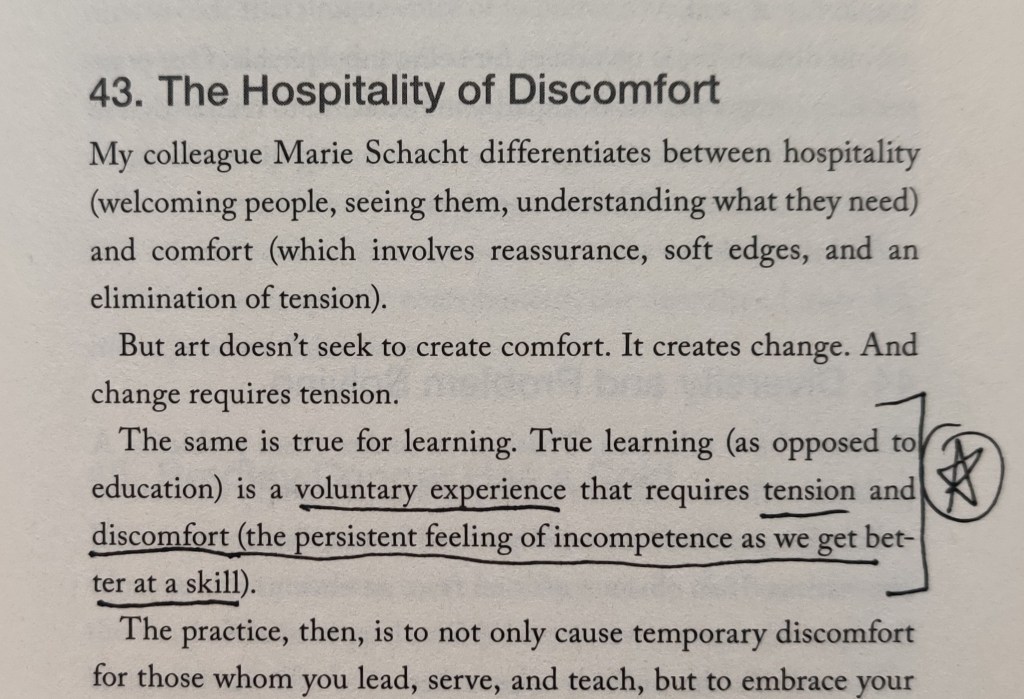
As I was reading through Seth Godin’s latest book, The Practice, I came across this gem of insight.

“The Practice” by Seth Godin (2020), pg. 53

It is often the discomfort and tension that causes me to avoid learning new things and settling into my work. When I feel the anxiety rise, I’ll switch gears to something more comfortable or distracting. Instead, I need to embrace the suck.

Learning is voluntary – I must want to engage with it.

Learning creates tension – personal discovery in unfamiliar territory creates questions of tension, and each answer I find resolves the tension. Tension and release.

Learning is uncomfortable – it’s hard to willingly feel incompetent when our careers are geared towards increasing competence and confidence.

I need to learn that when I feel uncomfortable in the learning process, this means I’m on the right track and should embrace the feeling.

Stay Awesome,

Ryan

900 Days of Deutsch

This weekend, I hit a new milestone – 900 consecutive days of practicing German using Duolingo.

Upon sharing the news with a friend, he asked how fluent I feel. Truthfully, I still feel like I’m pattern-matching. I’m fairly decent at decoding messages and generating approximately correct statements, but I don’t feel that I could carry on a conversation.

That’s not to say there is no value in what I’ve invested so much time in. Last year, my wife and I spent a few days visiting her family in Germany, and I knew enough from practicing on Duolingo to utter a few sentences and follow along on some simple conversations. However, it was a valuable lesson that just because I unlock levels, it doesn’t mean I’m gaining competence. Sometimes, what you think you are learning doesn’t match what you are actually practicing. It’s good to keep this distinction in mind.

Stay Awesome

Ryan

The Right Season To Learn

Something that I’ve started taking more seriously as of late is the idea that there is a seasonality to learning some things in life. In this case, I mean “seasonality” not in the calendar sense that we experience during the year (Spring, Summer, etc.), but more in a broad metaphorical sense, such as seasons of life. I think there are seasons of our lives where certain lessons are easier to learn than others. This is not to say that you can’t learn them outside of the “right” season, but that some lessons are easier to learn at certain points in your life.

For instance, I’ve heard complaints about the secondary school system’s curriculum not teaching useful skills. Where the modern high school student is wasting their time learning about Shakespeare, the argument goes, they should instead be focusing their attention on more practical matters such as learning how to budget.

I’ve long been skeptical of this criticism for two reasons. First, I don’t think it should be the job of the school to teach every skill that’s deemed important. When people complain that they didn’t learn useful things in school like how to do laundry, how to eat properly, how to do taxes, etc., I place the blame of the lack of skills on them and their parents. Those bits of know-how are readily searchable online now, and short of an accessibility issue with being able to use technology, I see no reason for being ignorant. No, instead, I see school as the domain of more specialized knowledge that would be challenging to teach in the home environment by your parents who otherwise might not be skilled in teaching subjects like the maths, sciences, and humanities.

However, the second reason why I don’t find those arguments persuasive is that there are some concepts that are not easily absorbed at that time of your life. I can only speak from my experience, but when I was a teen, I wasn’t earning an income to support myself, nor was I carrying the bills and debts that would require me to keep a budget. I didn’t have the frame of reference, experience, or need to learn those kinds of skills. Instead, I understood what it meant to set up a budget, but not how to actually keep it.

I’m finding the same for home repair during this season of my life. Prior to owning my own home (where I am directly responsible for its upkeep and my family’s comfort and security), I didn’t feel an incentive to invest time and energy into learning how to maintain the home. Growing up, I would help with the chores and some light maintenance, but otherwise my parents largely were the ones who did the important stuff with troubleshooting problems. Now, those responsibilities fall squarely on my shoulders, and I’ve had a number of instances where I’ve had to pay costly invoices to tradespeople for repairs and work that largely could have been handled by me had I possessed a better understanding of how my home worked.

This is not to say that people don’t learn these skills when they are young. Whether it is through personal interested, a keen disposition, or a patient and knowledgeable parent/mentor, plenty of people know how to do amazing things by hand that puts my simple repairs to shame. Nevertheless, I have now reached a season where I’m more receptive to these lessons, and I’m embracing them with an open mind and a willingness to try.

Stay Awesome,

Ryan