On Tardiness

For all the lip-service paid on this blog about doing the work, I have been posting late recently. My target is supposed to be going live by 9am on Monday mornings, yet I can’t remember the last time I had a post scheduled to go live on time in a while. I think the last time I was ahead was heading out for my honeymoon in 2019, where I had three weeks lead time while I was away.

Part of why I’m behind continues to be working from home – in the before times, I would procrastinate in the office from real work by writing. But since working from home over the last twenty or so months, all time feels like procrastination time. With no one looking over my shoulder, it doesn’t matter what I am doing on my screen so long as I continue to deliver on the goods.

And as with most procrastination, the longer I go past my deadline (e.g. today), the harder it gets to get to work on the task. It usually results in taking a mulligan for the week, or cobbling together a half-thought into a semi-stream of consciousness post just to have something shipped. You’re welcome.

It feels good to publish, but I shouldn’t consider it a win to get something up for the week for the sake of hitting the metric. At the same time, I should extend myself some measure of kindness and acknowledge that I still did the work.

I still show up to do the work, just not according to what was expected of a professional.

Stay Awesome,

Ryan

Leverage

I’ve been reading ‘self-improvement’ books for the last five years. Some of those books dealt with financial and life management, where you leverage the money you earn to create more value for yourself. But until you reach that point in your life, it’s only a theoretical exercise to engage with – there is no point in thinking deeply into investing options or buying your way into freedom until you have money to buy options. I’m sure there are self-improvement adherents who will vehemently disagree with this, but the reality is you aren’t going to gain access to the game by saving money not buying lattes or avocado toast unless you are playing a really long game with a lot of good luck.

I’ve now hit a point in my life where options have opened up for my family, and we can make choices and trade-offs to build out a lifestyle that works best for our goals. This is not to say that all options are available to us – we have to carefully look at the tradeoffs and determine whether the downsides of any option are something we are comfortable living with (e.g. to pay for a given option, should we, say, reduce from two cars to one).

Part of this exercise is critically examining each of our assumptions and systems to determine if they are moving us towards what we want, or if they need to change to better align with what we want. This is where the concept of leverage has entered my mind, because when evaluating costs or expenses, it’s important to note that not all expenses are net negative. Some expenditures end up buying more value than what we spend on them.

This is the game in a nutshell – you trade your time for money. Money represents quantified time and effort that can be exchanged in markets with mixed goods. I spend time at work and my employer gives me money in return. I then take that money to purchases goods or services.

Until now, most of the way I thought about the game was surface-level transactions of 1:1 value transfer – I work x-hours for y-dollars. I then trade y-dollars for a good or service with a transactional value of y-dollars. I haven’t really given much thought to the value (that is, how much I value it subjectively) of the good or service provided back to me, and whether that value is higher than what I’m spending. I suppose I’ve thought about it in an abstract way, such as I receive more enjoyment from the thing than the money I spent on it; the opportunity cost is not higher than the value I’m getting from it.

By focusing on the surface-level transactions, the only metric that was critical was to ensure the revenue was not exceeded by the expenses, that I wasn’t spending more money to buy value than I was getting in exchange for my labour. It’s worked up until now, but the direction my family wants to head requires me to think more deeply about what those expenses are buying us.

Ideally, I should be seeking to engage leverage – I trade time for money, then use the money to buy time in greater quantities. What might this look like?

  • With my wages, I can lease or own a car. The money I spend on the car frees me up to commute to work on my own terms. I could get to work more cheaply, such as public transportation or cycling (ignoring environmental costs in this calculation), but then I’m trading cost for time. Having my own vehicle is more convenient, more comfortable, and faster, allowing me to maximize time at work and time at home.
  • With my wages, I can pay for cleaners to clean my house. This frees up more leisure time and cuts down on bickering in the house. It is cheaper for me to buy the supplies and do it myself, but I value the leisure and time with my family more than the cost.
  • With my wages, I can pay for daycare for our child. My spouse or I could quit our job to care for our child at home full time and save the money. However, the money we spend on childcare frees us up to earn multiples of what we spend for the childcare – e.g. at $1,000/month, we would spend $12,000/year for daycare so that we can make north of 5x of that in our jobs.

This is not an easy exercise as many of our expenses feel necessary on the one hand, or scary large in context. However at this point in our lives, we have to accept that our raw effort will only diminish (I can’t work all-nighters like I used to without significant physical cost), and there are no more hours in a day we can squeeze out through discipline and efficiency. We must now turn to leverage and force multipliers to translate what we have into higher value.

Stay Awesome,

Ryan
The Beachhead

A friend who recently was appointed CEO of a company called me this week looking for a soundboard to sort out ideas he had in his head about how to proceed with company operations and strategic direction. The company is looking to shift strategic priorities, and he was looking for an outside voice to make sense of the new direction in relation to the legacy systems he’d need to grapple with.

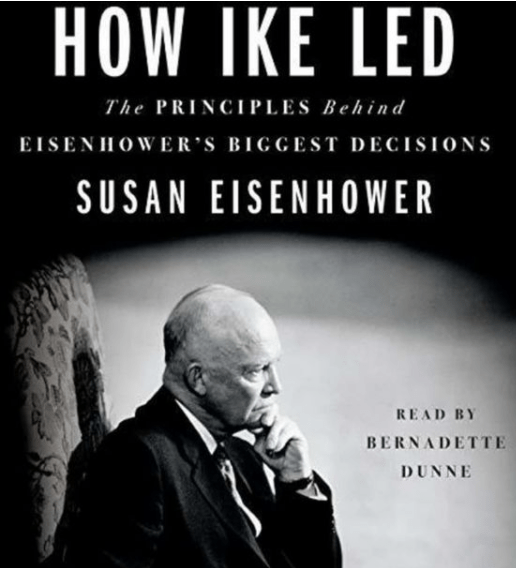
One of the topics that came up reminded me of a concept I learned about while reading Susan Eisenhower’s book about her grandfather’s time during World War 2 and his subsequent Presidential years.

At two times during Dwight Eisenhower’s tenure in significant leadership roles, he had to create a beachhead to establish his forces (literal and metaphorical) to push towards his objectives. During the war, Operation Overlord’s first phase was to establish a beachhead in Normandy to create a defensible position to allow Allied Forces to work their way into Europe to push back Germany’s army. Establishing a beachhead is critical to success, but is often difficult for offensive forces to complete as the defending force usually has the upper hand in terms of resources and strategic positioning. While the offensive forces need to both set up a foothold and protect its lines to allow more troops to arrive, the defending forces merely have to reinforce it’s occupying positions to clamp down on fresh troops from joining the beachhead. Once the effects of first-mover advantage wears off, the offensive force must contend with protecting supply lines, fighting active defense from the opponent, and pushing past inertia to avoid grinding to a halt in order to win. Once established, a successful beachhead serves as a ratchet for the offensive force – the location of which all future offensives are launched from, and from which the troops need not backslide past. Traction is gained, and the army moves forward.

Similarly, during Eisenhower’s presidency, he saw the importance of passing civil rights legislation, but saw the difficult uphill battle that would needed to both move the country towards accepting civil rights AND enshrining those rights in law (turning both hearts and minds of the nation). While he would have aspired to complete civil rights equality in his time, he knew that if poorly planned, then history, culture, and opposing interests would ensure that forward progress towards equality would halt. Instead, he sought to establish a kind of metaphorical beachhead for civil rights, working on government programs and legislation that would lay the foundation for future leaders to take up and ratchet their work – allowing the movement to progress forward without worrying about losing traction and backsliding.

In listening to my friend, I noted that he also needed to take this lesson from history and focus on his own beachhead. While we think that a CEO is all-powerful in terms of exerting their will over the company, we must also face the reality that comes with working with legacy systems and people. Change is difficult and slow, and when poorly executed either stalls from inertia or alienates your workforce. And so I suggested he take a leaf from Eisenhower’s example and focus on what his core objective is that is reasonable within the timeline he’s being given, and focus on establishing a beachhead to deliver value back to the company president.

Since reading about Eisenhower, I’ve thought about my own beachheads – what are the areas of my life that I must focus on to ensure I’m moving forward with my goals, whether they are family, work, health, or passions. It is still very much a work in progress, but I want to find those areas that I can carve out and secure so that when it’s time to take risks towards my goals, I have a safe space to launch from.

Stay Awesome,

Ryan

Planning and Preparation

Last week, Seth Godin wrote a poignant observation about the wisdom of refilling your gas tank at the right time. This of course was a metaphor; it’s not about literally filling your gas tank (except when it is). Instead, the observation is about recognizing that you are better able to weather uncertainty when you are mindful about resources, whether that’s financial, physical, human, or even your own attention.

Yes, sometimes we are so strapped for time that it’s hard to remember to prioritize fil1ing before empty, but if you pay attention to your resources, then as he says you can “have your emergency on your own schedule.”

His post was well-timed, because I’ve found myself falling behind this week on some critical tasks. When I reflected on it in my journal, it’s easy to say I was busy. It’s true, I was busy – I was in a lot of long meetings, I had appointments, and obligations at home. But I’m always busy, so this week wasn’t necessarily out of the ordinary.

Instead, my lack of progress is due less in part to other people’s demands on my time, and instead it’s largely due to my own poor planning and preparation. Without an appropriate plan for the time that was all my own, I was left to flit carelessly to this whim and that urgent thing.

As a reminder to myself, open blocks of time in my calendar are not default downtime. I have more control over my time than I realize (or behave).

Stay Awesome,

Ryan

The Art of Self-Discipline

On the days when I’m languishing and finding it difficult to be productive, where procrastination and anxiety keep me in rabbit holes of distraction, and at the end of the day I look at the clock and realize how much time I’ve wasted, it’s easy to write myself off as a lazy, slovenly person. It’s easy to think of myself as the kind of person who does not have discipline, that I wasn’t born with that trait – fatalism has kicked in; I should accept who I am.

But that’s not what self-discipline is. It’s easy to see self-discipline as some sort of binary state when you are comparing yourself against others further along their own paths than where you want to go.

The Romans had a saying that “we can’t all be Cato’s,” referring to the stoic politician who served the State with self-sacrifice. But that saying is wrong. It should be “we aren’t all Cato’s, yet.”

In virtue ethics, your moral character is judged against an abstract ideal – the Stoic Sage. But possessing virtue is not a trait or character state. Possessing virtue is a process of becoming, of doing the right thing at the right time.

Having self-discpline doesn’t mean you are a paragon of discpline. It means you are exercising discpline in the moment. If you fail, it just means you are still working on becoming who you want to be.

The Japanese refer to this as ““, the Way. You never reach perfection, but your life is one long project of incremental progress towards what you are meant to be.

That is the way of self-discipline.

Stay Awesome,

Ryan

The Last Person to Know Everything

On a recent CBC podcast episode about Leibniz and Voltaire’s thoughts about evil and God, one of the interviewees referred to Leibniz as “the last man to know everything.” I find this notion utterly fascinating. Upon hearing that title, I jumped online to search for the “best biography on Leibniz” and found a highly acclaimed book detailing an intellectual biography of the 17th-century thinker. Once I clear some books on my current reading list, I’ll dive into this hefty book.

“Leibniz: An Intellectual Biography” by Maria Rosa Antognazz

This isn’t the first time I’ve encountered the moniker of “the last person who knew everything.” In fact, that was the title of a biography I read back in late 2018 on Enrico Fermi.

I’ve been drawn to this idea for a long time, probably originating with the first time I saw the 1994 film Renaissance Man starring Danny DeVito. That was where I first learned of the term renaissance man, or more commonly known as a polymath – a person with considerable knowledge and expertise across a wide variety of domains. While I wouldn’t quite call it a goal, this is an aspiration of mine since I was a child.

I suppose as the sciences progress, it becomes increasingly difficult to lay claim to being “the last person who knew everything.” Each field grows increasingly complex as we push the boundaries of the known world, which raises the threshold higher of what counts as expertise.

It would seem we need to seriously consider the observation recently made by Professor Adam Grant on the differences between experience and expertise:

Instead of seeking to always have depth of knowledge, perhaps we should give equal consideration to wisdom and how we can apply our experiences and expertise to solve interesting problems. While more nebulous as a goal, I think it steers us in the right direction. At the very least, it’s a good vision to aspire towards.

Stay Awesome,

Ryan

PS – an unexhaustive list of the traits that distinguishes a “last person who knew everything:”

  • Intellectual curiosity
  • Intellectual humility
  • Interests spanning a variety of domains, both sciences and arts
  • A grasp of the methods and tools of science
  • Generating novel insights
  • The ability to see problems in terms of first principles
  • Engaging in idea arbitrage
  • Focus and flow in work – liking what you do

Work Focus While Home Alone

Working from home poses challenges for most folks when it comes to being able to focus. Many of my colleagues noted how difficult the summer months could be while children were home from school. For me, with an infant at home, the distractions were fairly minimal, especially because my wife handled 99% of the care during the working day during her leave from work.

But now she’s gone back to work and our child is at daycare during the day. While you’d think this means my productivity output has jumped by leaps and bounds, it’s actually done the opposite. With no one in the house to bother me, with no one to look over my shoulder, or for me to quickly hide the fact that I’m goofing off watching irrelevant videos on YouTube instead of looking at spreadsheets, the seeming unlimited time means I have a hard time getting started.

This almost seems like a cousin of Parkinson’s law, but instead of work filling the allotted time, the strength of the impulse to get started is negatively correlated with the amount of free (unsupervised) time I find myself with. Quite the opposite, there seems to be more inertia to overcome.

Stay Awesome,

Ryan

PS – as a note to my future-self: there is a connection here with what Mel Robbins says about procrastination, that it’s not a function of laziness but instead a coping mechanism for the anxiety felt by the task. I should look into this more.

Parenting and the Return to “Normal”

I’ve been very fortunate to work from home since the start of the pandemic. I have only stepped foot in the office once in the last year, and have otherwise been plugging away at tasks from home. I was also fortunate that this time overlapped with the birth of our son, so I have been home for his first year of life. My wife returns to work in September, and our son will head off to daycare, signaling our first steps towards a return to “normal.” At present, I will likely continue working from home until January, assuming public health doesn’t pull back on restrictions to limit the virus spread.

Two recent podcasts had me reflecting on the kinds of things that changed about life both as a result of the pandemic as well as experiencing parenthood while at home. The first was a musing from The Daily Dad on the slow life of the pandemic, and the second was from Scott Young on how parenting changed his views on productivity.

The pandemic hit a hard stop to the busy lifestyle I had adopted. This isn’t to say I embraced “busyness” as a mark of distinction, but rather I was the kind of person who said yes to a lot of things and wanted to be involved in cool stuff. My calendar was filled with lots of obligations, work and social alike. I juggled three jobs while running a non-profit, a social club, and podcasting and vlogging projects. I enjoyed being busy and helping others.

But as a parent, I carry a different set of responsibilities that conflict with this kind of lifestyle. I was never faced with the choices to prune back my (mostly) optional obligations in order to fulfill my parental duties – the pandemic largely did that for me.

And as we think about returning to “normal,” I will obviously have to think carefully about what sorts of things I add back into my life (the pandemic will end, but being a parent won’t). Some of the effects from the pandemic and being at home to take a greater prominence in co-parenting our child makes me reflect on what kind of home life I wish to cultivate, and ask which elements of the pandemic do I want to carry forward into the new normal. For instance, in thinking about the slow life, things like bedtime routines, long blocks of time with kid(s), weekends set aside for family time, are all things I want to hold sacred.

The pandemic was referred to as The Great Pause. I should get some more of this thinking done before we un-pause and move on with life.

Stay Awesome,

Ryan

Visualizing Time

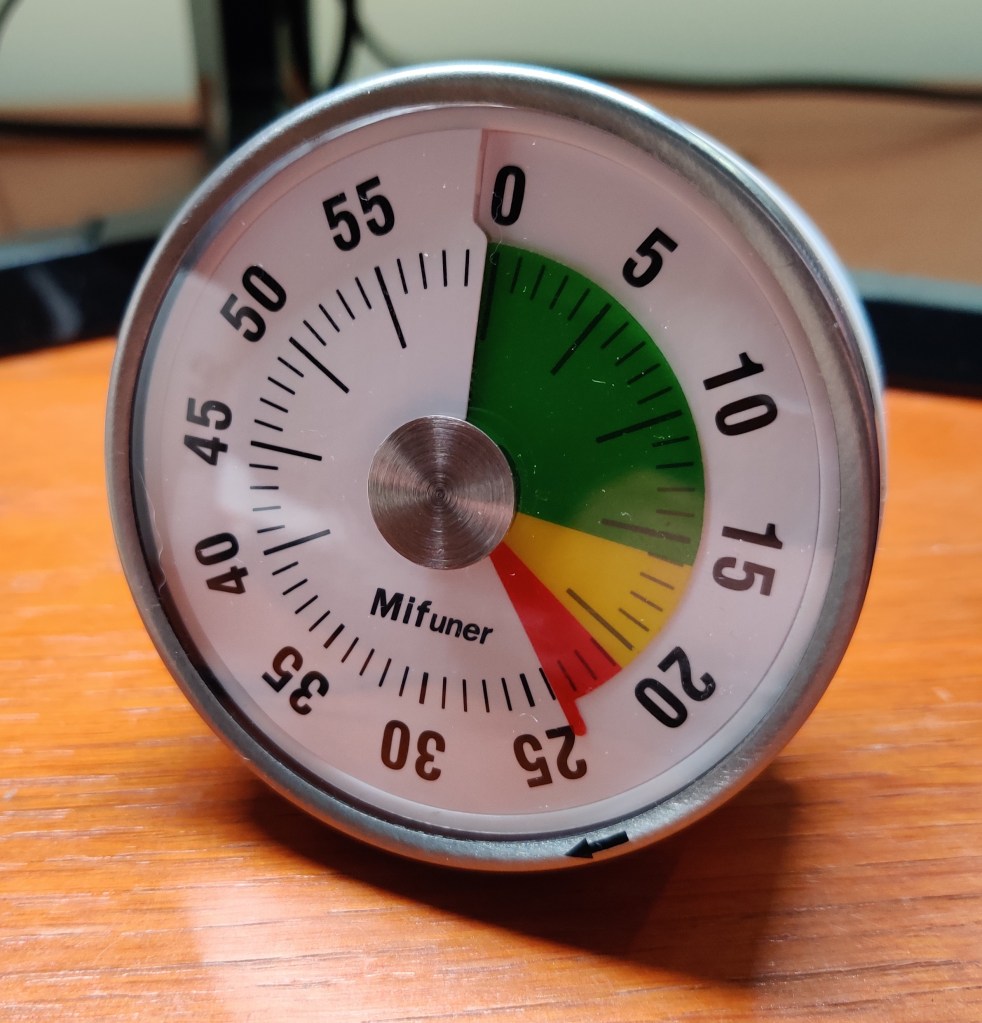
In an effort to tamp down on my procrastinating and get back on a Pomodoro system, I bought a desk timer.

I elected to go with a physical device rather than using my computer or phone to track time because I’m trying to remove the temptation to get distracted if I’m curious about the time left in the period. But I also had some other criteria.

In addition to wanting to avoid distractions, I wanted: a.) a visual representation of time, b.) something that made audible ticking, and c.) I wanted to avoid batteries if possible. The device above fit all three requirements. You wind-up the dial, set the desired duration, and the timer ticks away until the bell rings.

I’m still struggling with getting started (I usually give in and watch YouTube videos in lieu of starting my work), but once I get going, I find it easy to work through 25-minute sprints.

Let’s see how long this lasts.

Stay Awesome,

Ryan