My attention this week has largely focused on what’s happening in the United States with the protests and marches. As such, the vast majority of this week’s round-up are a collection of posts from social media that I want to help amplify.
Here is my round-up for the week ending on June 5th, 2020:
I read Mattis’s memoir a few months back, and in it he specifically states that he does not intend to publically comment or speak out against a sitting President. He notes that it’s inappropriate as a former military member (he feels that there should be a separation between executive politics and the military) and as a former Cabinet member. The implication is that while he resigned his post in protest over the policy decisions being made by the White House, there will come a time when he feels it would be appropriate to finally criticize the President he served under. That is what made this post all the more surprising (thought not surprising when you read it) – things have gotten to the point that he feels his silence is counter-productive to upholding the American Constitution. Based on his memoir, I hold Mattis in high regard, both as a leader and as a thinker, so this is something I took note of.
💭 Reflection – What can I do as a white ally?
When this week started, I could find no words that would be appropriate. This is, of course, a huge privilege – that I can choose to remain silent while people are out fighting for their lives and a better world.
It would be inappropriate for me to wax on about my thoughts because that would mean centering my voice (even if this is my blog). My voice, my thoughts, and my opinions are not important in this social conversation. Instead, I want to share and amplify some of the great ideas that I bookmarked in my feed.
Star Trek: The Next Generation – Season 3 Episode 7 “The Enemy”
As with many other people right now, I have chosen to go back and re-watch favourite television shows. I decided that with Star Trek: Picard’s recent release, it would be a great time to go back to the beginning (of the modern era, anyway) and revisit Star Trek: The Next Generation. I had probably watched every episode in my teen years, but I had always watched it in syndication, so this is my first time going through the show in order.
Approaching the series in my 30’s has been a real treat. I have more life and cultural experience to draw upon as I watch these incredibly written episodes play out. I knew the show was amazing, but I never appreciated how well it engages with moral issues.
I want to highlight one excellent episode from the third season – episode 7, “The Enemy.” The characters provide us with a moral issue about autonomy, and a good lesson in leadership.
The story centres on the conflict that arises when the protagonists rescue an enemy officer from an out of bounds planet. The officer, from a race of people called Romulans, is gravely wounded and requires a blood transfusion. There is only one member of the crew whose blood could be usable, but that crew member, Worf, has a history with the enemy’s peoples – Worf’s parents had been killed during a Romulan attack when he was a child. Worf, still carrying his anger for their death all these years, refuses to give his blood.
Meanwhile, a Romulan ship is en route to recover the officer. There is a tenuous peace treaty that prevents an all out war, but the Romulans have a history of subterfuge and deceit. It is believed they will cross the border and assume an antagonistic stance to provoke a war. Worf’s Captain, Jean Luc Picard, is seeking any means that would avoid an armed encounter, and decides to plead with Worf to reconsider his decision.
In this moment, it would be expedient to Picard and his crew to order Worf to donate his blood. He is about to contend with an adversary whom has no issue with breaking a peace treaty by provoking an attack (whether or not his side is initially in the wrong). Picard is seeking to recover a still-stranded crew member on the planet below, keep his ship safe, maintain the territorial sovereignty of the Federation, and maintain tenuous diplomatic relations with a rival group. This is all threatened because the one solution to his problem, keeping the enemy officer alive, is being blocked by a crew member whose personal history and honour motivate him to not help the enemy.
There is a beautiful scene where Picard appeals to Worf for him to reconsider:
Picard: So, there is no question that the Romulan officer is more valuable to us alive than dead. Worf: I understand. Picard: Lieutenant, sometimes the moral obligations of command are less than clear. I have to weigh the good of the many against the needs of the individual and try to balance them as realistically as possible. God knows, I don’t always succeed. Worf: I have not had cause to complain, Captain. Picard: Oh, Lieutenant, you wouldn’t complain even if you had cause. Worf: If you order me to agree to the transfusion, I will obey of course. Picard: I don’t want to order you. But I ask you, I beg you, to volunteer. Worf: I cannot.
In silence, Picard slowly walks back around his desk and sits in his chair.
Picard: Lieutenant. Worf: Sir? Picard: That will be all.
We then learn from the ship’s Chief Medical Officer that the Romulan has died. Picard has lost the only bargaining chip he had to keep things peaceful with the approaching enemy ship.
Picard could have chosen to order Worf to allow the blood transfusion. Instead, he chooses to respect his crew member’s personal wish, and as a leader deal with the hand he’s given. He also knows that making an order against the personal rights of a crew member under his command sets a dangerous precedence – that anyone is disposable if the captain judges it. Instead, he accepts that this closes off options. He knows that this places him not just on the back-foot, but also with his arms tied behind his back as he prepares for the possibility that his ship will be destroyed. However, the burden of command requires him to take these realities as they come and make the best decisions that he can. Events are being shaped around him that are beyond his control, but he strives to make the best decision that he can. He’s not perfect, but he becomes a role model in striving to do the right thing.
Even if the right thing might mean the death of he and his crew.
It’s a wonder piece of science fiction that I’m glad to be discovering anew.
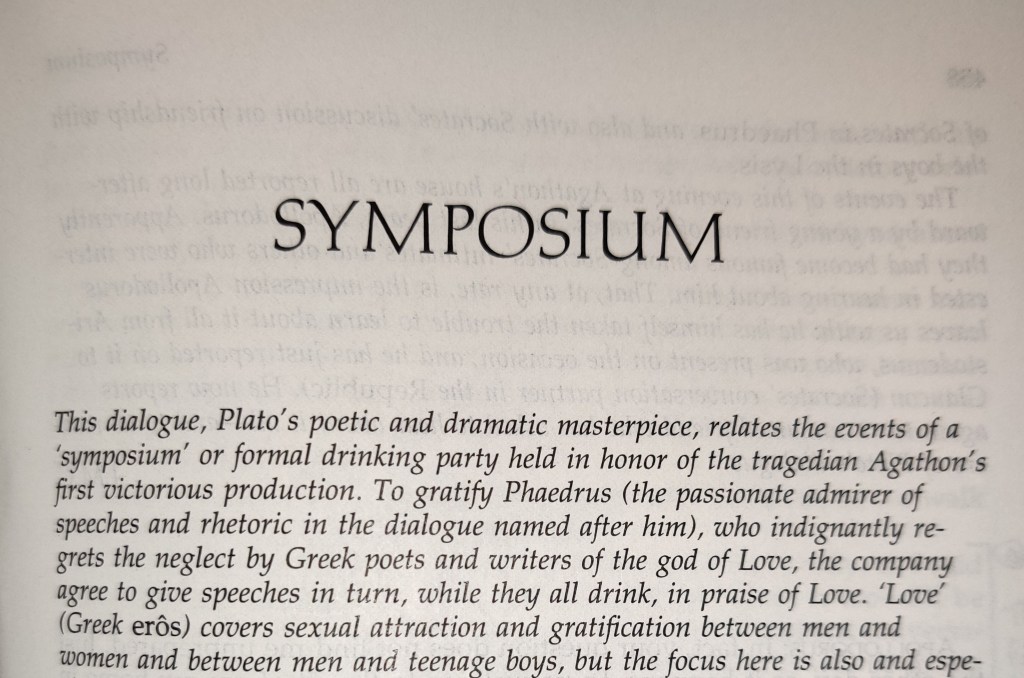
In preparation for my upcoming book club meeting, I’ve been reading through our current selection, Plato’s Symposium. While on Friday I chuckled at a little dialogue I’ve started with myself as a reader over time, I stumbled across a very interesting footnote that I wanted to share.
23. The word can be translated also as “temperance” and, most literally, “sound-mindedness.” (Plato and Aristotle generally contrast sophrosune as a virtue with self-control: the person with sophrosune is naturally well-tempered in every way and so does not need to control himself, or hold himself back.) From: Plato: Complete Works, edited by John M. Cooper (Hackett) p479.
I love learning about words in foreign languages that don’t have an exact translation into English. The great thing about these words is that is serves as a worldview expanding device that adds to the filters we use to engage with the world. Sophrosune (or sophrosyne as I later learned from Wikipedia) is often translated to mean temperance or self-control. But as this footnote discusses, the world has an added element that sets it apart from self-control.
It carries an added moral character dimension that describes a certain kind of disposition. Implied in the idea of self-control is an element of instability – the self-control is needed to push against some felt desire or want. Were the desire absent, there would be no need for self-control. We don’t think of a person who is not thirsty as exercising self-control because they are not drinking water. Self-control would instead apply to the person who is actively thirsty but must resist imbibing for some reason. There is a force of will that is being applied against a desire to tamp it down.
Thirst for water might be a poor example here since water is necessary for life. Instead, we can think of the addict who is fighting an impulse to consume something they seek to abstain from. When they fight against the impulse, they can be said to be exercising self-control.
By contrast, sophrosune describes a moral quality of a person who is, in some sense, harmonious in their inner life. They don’t have the cravings that create impulses that require self-control. Instead of fighting cravings, as in the case of the addict, they may choose to engage or not engage in an activity without any internal pull towards it.
Whether this is a quality that is possible to attain, I cannot say. But it was an interesting word to learn about as separate from what one typically thinks about when pondering self-control and temperance.
I normally post on Monday’s, but today is the 4 year anniversary of my first post on this site (tomorrow if the 4 year anniversary of my substantive first post, but let’s batch them into this post for funsies).
With everything that’s going on, I wanted to pause for a moment to commemorate my “Hello World” moment on this blog. Even though I still don’t have any concrete plans for this site, I’m still going strong by committing myself to consistently putting in the work. If I’ve learned anything in 4 years, it’s less about the business plan and more about putting in the work. In this case, it’s better to focus on quantity, rather than waiting for the quality to start.
When it comes to posting for this blog, my goal is to have content ready to go live by Monday mornings at 9am. It’s largely an arbitrary objective, but I like to try and keep it so that the post is live by the time I get to work for the week and I can kick off work feeling a sense of accomplishment. As of writing these words, it’s 11:46am on a Monday – clearly I’ve missed my target.
Like many people, I’m finding it challenging to maintain productivity while working from home. I can try to claim that I’m in an adjustment period. Afterall, Wednesday will mark two full weeks of me being home from work. But I know in the back of my mind that while it might be true that I’m still adjusting to working from home (now that the novelty has worn off a bit), I also am keenly aware that my productivity habits are spotty at best.
Thanks to my wife, I’ve been able to keep a structured schedule for my days. I’ve also increased my excersising and have used the time at home to practice time-restricted feeding. I’ve brainstormed what I’d like to work on during this period of instability, and my relationship with my wife has grown closer as we’ve been forced to spend more time together at home.
But when it comes to actually doing the things on my list, I’m struggling with tipping over from plan to action. I’ve known for a week that a blog post needed to get done. I’ve even drafted a few ideas with some rough thoughts and structure. Yet, here I am, almost three-hours past my deadline, and I’m writing a vaguely stream-of-consciousness post. I recognize in me the same level of performance I see when students leave their assignments to the last moment to start (note: stream-of-consciousness is a typical strategy to fill space and sound smart).
Meta-blogging aside, the problem is that I’m still not a professional when it comes to many things in my life. I don’t mean ‘professional’ in the sense of being paid for my work, nor do I mean professional in the sense of being recognized as such.
In this case, I mean professional in the sense that Seth Godin invoked in a podcast episode I listened to recently (Seth Godin [Empathy] on the Creative Elements podcast). A professional is someone who shows up (often because they are being paid, though not necessarily) because that is what they do; it’s what’s expected of them. It doesn’t matter how they feel – they show up. Seth Godin notes that this can be hugely inauthentic. Sometimes, like this morning, you have a hard time feeling like you want to show up. You want to show up, and at a second order you want to want to show up, but no matter how much you desire to show up, you struggle with moving from thought to action.
There are tricks to motivating yourself. If I may be allowed to tap Seth Godin again, a recent blog post of his resonated strongly with me last week (React, Respond or Initiate on Seth’s Blog). Reacting is often the easiest route to overcome the motivation barrier – it’s visceral and immediate. It’s also unfocused and sloppy. Responding is more thoughtful and directed, but like this post is still intimately tied to someone else putting work into the field. But Initiate? That gives you maximum freedom of direction, but the hardest to push yourself through. The Resistance (hat-tip to Mr. Pressfield) is felt in direct proportion to how much ownership you have over the initial starting move. To React is to cede the initiative because you are unaware and flat-footed. To Respond is to acknowledge that you are going second, but you are at least aware and ready to make a move. But, to Initiate means you pick the time and place to move things into action, which can have all sorts mental barriers in the way.
I’m of two minds on the matter. On the one hand, I feel like not moving towards a goal is to waste an opportunity that has presented itself to me. Like with compound interest, the more small progress I can put in, the more it will pay off down the line. And if you fail to put in the work, you’ll struggle to rise to new challenges; you’ll end up hurting your future-self because you failed to practice and prepare. Or as Ryan Holiday notes, “you can lie to yourself, saying that you put in the time, or pretend that you’re working, but eventually someone will show up. You’ll be tested. And quite possibly, found out.”
But at the same time, I know I have to be kind to myself. These aren’t expectations that I need to follow, nor do I have to choose them. These are one version of a vision of success, but it’s not the only path or formula to follow.
Being afforded the opportunity to work from home is giving me space to be able to think and reflect. Within the opportunity, it’s important that I take the time to pause and listen to what my preferences are telling me – what do I find important and how do I leverage the tools I have to go where I want to go. Being a professional towards goals you don’t want strikes me as pyrrhic. Sure, you might gain measures of success as someone might define it, but at what cost? If we know that lunches are truly never free, then what is it we give up when we go with defaults?
Showing up doesn’t have to be a grand gesture. Being a professional means being consistent and accountable, even if you are fighting to create progress by the inch. Chain enough inches together over time will still create progress forward.
During a throwaway thought experiment in his 1641 treatise, Meditations on First Philosophy in which the existence of God and the immortality of the soul are demonstrated, René Descartes posited the idea of an evil genius or demon that systematically deceives us to distort our understanding of the world. Contrary to first year philosophy students everywhere (a younger version of myself included), Descartes did not actually believe in the existence of an evil manipulator that was holding us back from understanding the nature of the real world. Instead, he was using it as part of a larger project to radically re-conceive epistemology in an era of rapid advancements in science that was threatening to overturn centuries of our understanding of the world. He felt that knowledge was built upon shaky ground thanks to an over-adherence on the received authorities from Greek antiquity and the Church’s use of Aristotelian scholasticism. Similar to Francis Bacon twenty years earlier, Descartes set out to focus on knowledge that stood independent of received authority.
Through Meditations one and two of his book, Descartes considers the sources of our beliefs and considers how we come to know what we think we know. He wants to find an unshakable truth to build all knowledge from, and through an exercise of radical doubt he calls into question many of the core facts we hold – first that knowledge gained from the senses are often in error, that we often can’t distinguish the real from fantasy, and through the use of the evil genius, that perhaps even our abstract knowledge like mathematics could be an illusion.
André Hatala [e.a.] (1997) De eeuw van Rembrandt, Bruxelles: Crédit communal de Belgique, ISBN 2-908388-32-4.
When I teach this to first year students, they either don’t take his concerns seriously because of the force of the impressions the real world gives us in providing sense data for knowledge (a stubbed toe in the dark seems to forcefully prove to us that the external world to our senses is very real), or they take Descartes too seriously and think Descartes really thought that a demon was actively deceiving him. Regardless of which side the student falls on, they will then conclude that Descartes’ concerns are not worth worrying about; that this mode of thinking is the product of an earlier, less sophisticated age.
Unless you are a scholar delving into Descartes’ work, the real purpose of teaching the Meditations is to provide students with a framework to understand how one can go about thinking through complex philosophical problems. Descartes starts from a position of epistemic doubt, and decided to run with it in a thought experiment to see where it took him. The thought experiment is a useful exercise to run your students through to get them to think through their received opinions and held-dogmas.
However, in light of my rant a few weeks back about informed consent and vaccines, I’ve discovered a new contemporary use for thinking about Descartes’ evil genius. In some sense, the evil genius is *real* and takes the form of fear that shortcuts our abilities to learn about the world and revise our held beliefs. Descartes posited that the evil demon was able to put ideas into our heads that made us believe things that were completely against logic. The demon was able to strip away the world beyond the senses and even cast doubt on abstract concepts like mathematics.
Much in the same way Descartes’ demon was able to “deceive” him into believing things that were contrary to the nature of reality, our fear of the unknown and of future harm can cause us to hold beliefs that do not map onto facts about the world. Worse yet, the story we tell about those facts can get warped, and new explanations can be given to account for what we are seeing. This becomes the breeding ground for conspiracy thinking, the backfire effect, and entrenched adherence to one’s beliefs. We hate to be wrong, and so we bend over backwards to contort our understanding of the facts to hold-fast to our worldview.
In truth, we are all susceptible to Descartes’ demon, especially those whom believe themselves to be above these kinds of faults of logic. In psychology, it’s called the Dunning-Kruger effect, of which there are all sorts of reasons given why people overestimate their competence. But in the context of an entrenched worldview that is susceptible to fear of the unknown lurks Descartes’ Demon, ready to pounce upon us with false beliefs about the world. Its call is strong, its grip is tight, and the demon is there to lull us into tribalism. We fight against those we see as merchants of un-truth and in a twisted sense of irony, the weapons of truth we yield only affect those already on our side, while those we seek to attack are left unaffected. It becomes a dog-whistle that calls on those who already think and believe as we do.
If we hope to combat this modern Cartesian demon, we’ll need to find a new way of reaching those we see on the other side.
In the ethics of conducting research with human participants, there is the concept of “informed consent.” At its foundation, informed consent is the process of communicating a sufficient amount of information about a research project to a prospective participant so that the prospect is able to decide whether they want to consent to being a participant in a study. There is a lot of nuance that can go into selecting what gets communicated because you have a lot of necessary information that needs be shared but you don’t want to share so much information that the participant is overwhelmed by the volume of information.
When I review research ethics applications, I am privy to a lot of information about the project. In the course of reviewing the project, I have to make judgement calls about what should be included in the informed consent letters that participants read. It would be counter-productive if the participant had to read all the documentation I am required to read when reviewing an application, so we use certain best practices and principles to decide what information gets communicated as a standard, and what is left in the application.
There is, of course, some challenges that we must confront in this process. As I said, when reviewing a research project, you have to balance the needs of the project with the needs of a participant. All research, by virtue of exploring the unknown, carries with it an element of risk. When you involve humans in a research project, you are asking them to shoulder some of the risk in the name of progress. Our job as researchers and reviewers is to anticpate risk and mitigate it where possible. We are stewards of the well-being of the participants, and we use our experience and expertise to protect the particpants.
This means that one challenge is communicating risk to participants and helping them understand the implications of the risks of the research. In many instances, the participants are well aware of risks posed to their normal, every-day lived experiences and how the research intersects with it. The patient living with a medical condition is aware of their pain or suffering, and can appreciate risks associated with medical interventions. A person living in poverty is acutely aware of what it means to live in poverty, and understands that discussing their experiences can be psychologically and emotionally difficult. Our jobs (as reviewers and researchers) is to ensure that the participant is made aware of the risk, mitigate it as much as we can without compromising the integrity of the research program, and to contextualize the risk so that the participant can make choices for themselves without coercion.
The concept of informed consent is hugely important, arguably the most important component of research projects involving humans as participants. It is an acknowledgement that people are ends in themselves, not a means to furthering knowledge or the researcher’s private or professional goals. Indeed, without a respect for the autonomy of the participant, research projects are likely to not be moved into action even when research funds are available.
All of this is a preamble to discuss the anger I felt when I read a recent CBC report on how anti-vaxxer advocates are using the concept of informed consent as a dog-whistle to their adherents, and are using informed consent as a way of both furthering their awareness and raising money with well-meaning politicians and the public.
In fairness, I can see the chain of reasoning at play that tries to connect informed consent with concerns about vaccines. For instance, in the article there is a photo of supporters of a vaccine choice group with a banner that reads “If there is a risk there must be a choice.” This sentiment is entirely consistent with the principles of informed consent. The problem with this application is that the risk is not being communicated and understood properly within context, and instead fear, misinformation, and conspiracies that lead to paternalistic paranoia are short-cutting the conversation. Further, the incentive structures that are borne out of the economics of our medical system are doing little to address these fears. Because so little money is flowing from the government to the medical system, doctors are forced to maximize the number of patients they see in a day just to ensure enough money is coming into the practice to pay for space, equipment, staff, insurance, and supplies. Rather than seeking quality face-to-face time with a patient, doctors have to make a choice to limit patient time to just focus on a chief complaint and address questions as efficiently as they can.
I don’t think it’s all the doctor’s fault either. I think we as patients, or more specifically we as a society, have a terrible grasp of medical and scientific literacy. I don’t have a strong opinion about what the root cause of this is, but some combination of underfunded schooling, rapid technological innovation, growing income disparities, entertainment pacification, a lack of mental health support, increasingly complex life systems, and precarious economic living in the average household are all influencing the poor grasp people have about what makes the world around us work. Rather than being the case that we are hyper-specialized in our worldviews, I think it’s the case that “life” is too complex for the average person to invest time into understanding. Let’s be clear, it is not the case that the average person isn’t smart enough to grasp it (even if sometimes my frustration with people leads me to this conclusion). Instead, I think that people are pulled in so many directions that they don’t have the time or economic freedom to deal with things that don’t immediately pay off for them. People are so fixated on just making it day-to-day and trying not to fall behind that it becomes a luxury to have the leisure time to devote to these kinds of activities.
What this results in, then, is the perfect storm of ignorance and fear that congeals into a tribal call to rebel against the paternalism of a system that is ironically also too cash-strapped to allow the flexibility to educate people on the nature of risk. People don’t have the time and ability to educate themselves, and doctors don’t have the time to share their experiences and knowledge with their patients.
Within this gap, opportunistic charlatans and sophists thrive to capitalize on people’s fears to push their own agendas. This is why bad actors like the disgraced former doctor Andrew Wakefield and movement leader Del Bigtree are able to charge fees to profit from speaking at anti-vaccination events. I’m not saying a person who spreads a message should do it for free. What I am saying is that they are able to turn a personal profit by preying on people’s fears while doing little to investigate the thing they claim to worry about.
We must find a way to communicate two simultaneous truths:
There is an inherent risk in everything; bad stuff happens to good people, and you can do everything right and still lose. Nevertheless, the risks involved when it comes to vaccines are worth shouldering because of the net good that comes from it and the risks themselves are vanishingly small.
In the 22 years since Wakefield published his study and the 16 years since its retraction, there has not been any peer-reviewed credible evidence that supports many of the claims given by the anti-vaxx movement. The movement is predicated on fears people have of the probability of something bad happening to them or their loved ones. The motivation behind the fear is legitimate, but the object of the fear is a bogeyman that hides behind whatever shadows it can find as more and more light is cast on this area.
The anti-vaxx ideology knows it cannot address head-on the mounting scientific evidence that discredits its premise, and so it instead focuses on a different avenue of attack.
This bears repeating: the anti-vaxx ideology cannot debate or refute the scientific evidence about vaccination. We know vaccines work. We know how they work; we know why they work. We understand the probabilities of the risk; we know the type and magnitudes of the risks. These things are known to us. Anti-vaxx belief is a deliberate falsehood when it denies any of what we know.
Because of this, the anti-vaxx ideology is shifting to speak to those deep fears we have of the unknown, and instead of dealing with the facts of medicine, it is sinking its claws into the deep desire we have for freedom and autonomy. It shortcuts our rational experience and appeals to the fears evolution has given us to grapples with the unknown – the knee-jerk rejection of things we don’t understand.
Informed consent as a concept is the latest victim of anti-vaxx’s contagion. It’s seeping in and corrupting it from the inside, turning the very principle of self-directed autonomy against a person’s self-interest. It doesn’t cast doubt by calling the science into question. Instead, it casts doubt precisely because the average person doesn’t understand the science, and so that unknown becomes scary to us and we reject or avoid what brings us fear.
Anti-vaxx ideology is a memetic virus. In our society’s wealth, luxury, and tech-enabled friction-free lives, we have allowed this dangerous idea to gain strength. By ignoring it and ridiculing it until now, we have come to a point where it threatens to disrupt social homeostasis. Unless we do something to change the conditions we find ourselves in – unless we are willing to do the hard work – I fear that this ideology is going to replicate at a rate that we can’t stop. It will reach a critical mass, infect enough people, and threaten to undo all the hard work achieved in the past. We have already seen the evidence of this as once-eradicated diseases are popping up in our communities. The immunity and innoculations have weakened. Let’s hope those walls don’t break.
Last week, I gave a highlight of the best books I read in 2019. Below, I present what I read in 2019. By comparison to 2016, 2017, and 2018, last year was a paltry year in reading for me.
Title
Author
Date Completed
Pages
1
Harry Potter and the Deathly Hallows
J.K. Rowling
6-Jan
640
2
The Bullet Journal Method
Ryder Carroll
31-Jan
320
3
Daring Greatly
Brene Brown
4-Feb
320
4
Trumpocracy – The Corruption of the American Republic
David Frum
25-Feb
320
5
Drive
Daniel H. Pink
4-Mar
288
6
Twilight
Stephenie Meyer
10-Mar
544
7
The Gift of Failure
Jessica Lahey
12-Mar
304
8
Better – A Surgeon’s Notes on Performance
Atul Gawande
27-Mar
288
9
The Graveyard Book
Neil Gaiman
11-Apr
368
10
Bad Blood
John Carreyrou
9-May
352
11
Atomic Habits
James Clear
23-May
320
12
Built to Last
Jim Collins
25-May
368
13
Digital Minimalism
Cal Newport
30-May
304
14
Right Here Right Now
Stephen J. Harper
14-Jun
240
15
Mastery
Robert Greene
20-Jun
352
16
Complications – A Surgeon’s Notes on an Imperfect Science
Atul Gawande
25-Jun
288
17
Vagabonding
Rolf Potts
29-Jul
240
18
Becoming Superman
J. Michael Straczynski
4-Aug
480
19
A Game of Thrones
George R.R. Martin
11-Aug
864
20
Ultralearning
Scott H. Young
31-Aug
304
21
Reader Come Home
Maryanne Wolf
11-Sep
272
22
The Threat
Andrew G. McCabe
14-Sep
288
23
Indistractable
Nir Eyal
19-Sep
300
24
Permanent Record
Edward Snowden
22-Sep
352
25
The Path Made Clear
Oprah Winfrey
19-Nov
208
Total:
8924
I have a few thoughts as to why my reading rate dropped off significantly last year and what I can do about it in the year to come.
Life Pressures
Last year had a few significant pressures on my life that might have affected my desire to read. We started basement renovations early in the year, only to discover our basement’s foundation was cracked, requiring us to source quotes and opinions for repairs. This delayed our basement renovation, which didn’t finish until the summer. The protracted project weighed heavily on our minds throughout the year as we questioned whether we were making the right decisions for our home repairs, or whether we would need to make additional fixes later down the line.
Another big change for me was a change of my job at work. While I wouldn’t say it affected me as strongly as the basement renos, it disrupted my routine enough to impact my desire to focus on reading when I came home from work. Couple that with another full year as Board Chair for the non-profit I head up, and it left me with less cognitive bandwidth for self-improvement.
Podcasts and Music
If 2016 was my year of purchasing books, 2017 saw me start to utilize Libby to access the library, and 2018 was an all-out race for me to go through as many audiobooks as my brain could absorb, I felt a greater push away from books in 2019. Instead of working my way through 8-15 hours of content for one piece of work, I found the shorter format of podcasts more satisfying on my commutes. I enjoyed the variety in topics, shows, and voices.
However I also found I was drawn back to listening to music instead of information. With the sheer volume of books I’ve consumed in the last three years, it was nice to go long stretches without a goal of getting through books (or trying to learn new things) and instead allow the melodies, riffs, percussion, and lyrics sweep me away.
Book Burnout?
Overall, my rate for the year was a bit varied. I started slow in January and February, then picked back up in March. April only saw one book completed, then I found my footing again through May onward. However, October is when my wife and I traveled abroad for our honeymoon, and I never recovered my reading habit for the rest of the year.
Given that I spent most of the last three years focusing on business, personal development, and productivity books, I didn’t feel a strong desire to read those books in 2019. Even among the books I did read from that area, I found looking back that I don’t remember anything of note from those books. Neither the book’s theses nor the examples they offered have stuck with me as I enter the new year.
I’ve mentioned a few time the concept of the animated bibliography on this blog, and I think I’ve hit peak saturation for the genre. I’ve read the canon, and find that reading new books in the genre is resulting in diminishing returns; that is, I’m not really seeing a lot of new insights being offered that leaves me wanting more.
In my list last week, I commented that the books that I’m drawn to now is starting to shift away from business and productivity and more towards moral lessons found in fiction, biography/memoir, and journalistic explorations of current events. That’s not to say I won’t continue to be tempted to pick up the latest book that promises to fix my life, but it does mean that I’m intending to be more selective in what I choose to prioritize.
Assuming I continue to live a somewhat healthy life that is free from accidents, I figure that I have around 45-50 more years of life left. If I read around 3 books consistently per month, I will get another 1,650 books in my lifetime (4 per month is 2,208 books, and 5 books per month is 2,760 more books before I die). While that sounds like a lot, it’s a drop in the bucket compared to the number of books that come out each year and the books that have already been written. There is more to life and learning than being more productive or seeking more meaning in one’s life. I’ve grown to appreciate the value of storytelling this past year, and there are a lot of stories out there to sink into. If I only get access to a few thousand more stories, I should make sure they count.
Recently, a lot of things circulating through social media and my podcast feeds have been enraging me. I try to mitigate these things through a number of strategies – limiting my time on social media, intentionally targeting positive messages, not reading comments, not engaging, reminding myself that it is ok to disagree about things, etc. The hardest things for me to let go are cases where my thought-processes seem to wildly diverge from others about the framing of the same set of facts.
Initially, I wanted this blog post to be my master rebuttal. I wanted to lay out my case for why the conclusions others are drawing from this or that event are wrong and why. I wanted to emphasize what the important, salient points are that we should keep in mind.
But I know in my heart that would be an exercise in futility. A blog post is easy to skip; easy to ignore. I won’t change hearts and minds by arguing against a strawman average of the viewpoints expressed in my network of known-people. It would be antagonistic, hostile, and unproductive towards my goals. In all likelihood, it would backfire and entrench or alienate friends.
Instead, I will offer a different approach that I want to continuously remind myself of. When I feel compelled to dig in my heels for an argument, I should remind myself of the following.
First, remember what Aristotle (via Will Durant) tells us about virtue and excellence. It doesn’t matter what others say or share/post online; we are what we repeatedly do. Excellence, then, is not an act, but a habit.
Second, turning to fiction, remember why The Doctor helps people.
“Winning; is that what you think it’s about? I’m not trying to win. I’m not doing this because I want to beat someone or ‘cause I hate someone, or because I want to blame someone. It’s not because it’s fun. God knows it’s not because it’s easy. It’s not even because it works because it hardly ever does. I do what I do because it’s right! Because it’s decent. And above all, it’s kind. It’s just that. Just kind.”
Series 10, Episode 12: “The Doctor Falls”
Ultimately, it’s not about what I will say, or argue. Arguing with other people doesn’t make me a decent person; picking fights online doesn’t put me on the high road. If I want to bring about change in people I care about, it’s important to remember to be kind. Always be kind and help people, because it’s the right thing to do.
I recognize that being kind doesn’t give a lot of direction and can seem cowardly when meeting the systems that do real harm to the vulnerable and oppressed. In fact, espousing kindness can easily slip into inaction or forced neutrality. It’s hard to be prescriptive in this case at a granular level.
However, if I start with the core values of kindness and action, that what is important is doing things that are kind to others, then you can use your values as a filter for determining what you will choose to do.
Instead of arguing online, I choose to try and lead by being kind.








 A Paramedic's Notebook