World Limits

I’ve been thinking about the limits of my world, specifically as it relates to my ability to understand it. Much of the time, I operate as if I have access to capital-T Truth, that I have some connection with facts about the world. It’s easy to fall into this kind of thinking – when I can predict and explain events, it gives me feedback that I know things about the world in a meaningful sense.

But I also know that this confidence in my knowledge is not as strong as I assume it to be. I have to remind myself to adjudicate the claims I encounter, or to remind myself of the difference between history and the past. It’s also good to listen to others who have learned about issues from multiple vantage points (see this amazing conversation on the Tim Ferriss podcast with Noah Feldman, and his experiences with constitution building in the Middle East).

Generally speaking, all of our experience in life has presented us with a mostly successful set of interactions with the world, but those interactions are subjective and limited. Taking the long view of world events, learning new languages, and empathy provide the Archimedean point beyond ourselves to attempt to stand on some point of objectivity (if this is even possible).

As Wittgenstein says, “the limits of my language are the limits of my world.” This shouldn’t be literally taken to mean language (though I’m assuming that’s what Wittgenstein meant), but we should apply this to our understanding vis a vis experience. The limits of my world are constrained by the limits of my experience and the mental framework I use to make sense of it. If I want to seek to expand my worldview, it’s important to both prune out the dead branches of knowledge while cultivating new seeds of wisdom.

Stay Awesome,

Ryan
The Art of Self-Discipline

On the days when I’m languishing and finding it difficult to be productive, where procrastination and anxiety keep me in rabbit holes of distraction, and at the end of the day I look at the clock and realize how much time I’ve wasted, it’s easy to write myself off as a lazy, slovenly person. It’s easy to think of myself as the kind of person who does not have discipline, that I wasn’t born with that trait – fatalism has kicked in; I should accept who I am.

But that’s not what self-discipline is. It’s easy to see self-discipline as some sort of binary state when you are comparing yourself against others further along their own paths than where you want to go.

The Romans had a saying that “we can’t all be Cato’s,” referring to the stoic politician who served the State with self-sacrifice. But that saying is wrong. It should be “we aren’t all Cato’s, yet.”

In virtue ethics, your moral character is judged against an abstract ideal – the Stoic Sage. But possessing virtue is not a trait or character state. Possessing virtue is a process of becoming, of doing the right thing at the right time.

Having self-discpline doesn’t mean you are a paragon of discpline. It means you are exercising discpline in the moment. If you fail, it just means you are still working on becoming who you want to be.

The Japanese refer to this as ““, the Way. You never reach perfection, but your life is one long project of incremental progress towards what you are meant to be.

That is the way of self-discipline.

Stay Awesome,

Ryan

The Last Person to Know Everything

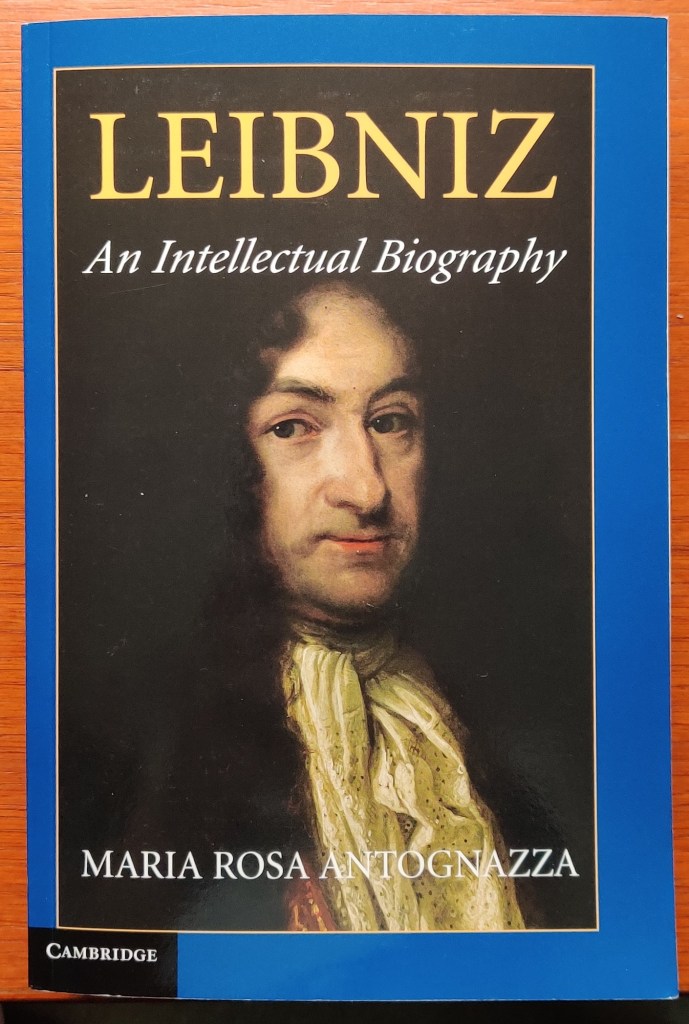
On a recent CBC podcast episode about Leibniz and Voltaire’s thoughts about evil and God, one of the interviewees referred to Leibniz as “the last man to know everything.” I find this notion utterly fascinating. Upon hearing that title, I jumped online to search for the “best biography on Leibniz” and found a highly acclaimed book detailing an intellectual biography of the 17th-century thinker. Once I clear some books on my current reading list, I’ll dive into this hefty book.

“Leibniz: An Intellectual Biography” by Maria Rosa Antognazz

This isn’t the first time I’ve encountered the moniker of “the last person who knew everything.” In fact, that was the title of a biography I read back in late 2018 on Enrico Fermi.

I’ve been drawn to this idea for a long time, probably originating with the first time I saw the 1994 film Renaissance Man starring Danny DeVito. That was where I first learned of the term renaissance man, or more commonly known as a polymath – a person with considerable knowledge and expertise across a wide variety of domains. While I wouldn’t quite call it a goal, this is an aspiration of mine since I was a child.

I suppose as the sciences progress, it becomes increasingly difficult to lay claim to being “the last person who knew everything.” Each field grows increasingly complex as we push the boundaries of the known world, which raises the threshold higher of what counts as expertise.

It would seem we need to seriously consider the observation recently made by Professor Adam Grant on the differences between experience and expertise:

Instead of seeking to always have depth of knowledge, perhaps we should give equal consideration to wisdom and how we can apply our experiences and expertise to solve interesting problems. While more nebulous as a goal, I think it steers us in the right direction. At the very least, it’s a good vision to aspire towards.

Stay Awesome,

Ryan

PS – an unexhaustive list of the traits that distinguishes a “last person who knew everything:”

  • Intellectual curiosity
  • Intellectual humility
  • Interests spanning a variety of domains, both sciences and arts
  • A grasp of the methods and tools of science
  • Generating novel insights
  • The ability to see problems in terms of first principles
  • Engaging in idea arbitrage
  • Focus and flow in work – liking what you do

Shrinking the Change

In recent weeks, I’ve built reading time intentionally into my work day. I’ve had it “in my calendar” for quite a while as an intention, but I haven’t meaningfully engaged with that blocked-off time since I first put it into my calendar. The intention was to recognize that my skills and career path would require me to commit time to learning and personal development, but I quickly got lazy and found other less productive things to occupy that time with.

I was annoyed with how I’d allow the whole day to slip by without getting a good start to my tasks (my vice being YouTube’s algorithm), so I thought I’d redirect my attention a bit. I reasoned that if my brain wanted to fight engaging with work (because it’s hard), then I could use that time to read. I set the timer and once I finish the sprint, I would start on some task for the day.

Surprisingly, I’m having some success with the process. It’s not perfect, but on the days I start with reading, I’m more likely to resist temptation and tackle items on my to do list.

Coincidentally I’m reading the book Switch by Chip and Dan Heath. One of the chapters discusses the concept of shrinking the change, which is just a fancy way of expressing the idea that we should break big scary tasks into smaller, more manageable bites. Committing to something that is long and ill-defined is hard for my lazy brain to comply with, but it will comply with an easy edict, like “read for the next 25-minutes,” or “spend the next 25-minutes downloading course information files to be processed.”

These tips and hacks are not new – everyone has some flavour of it as part of their productivity system. But like losing weight, it’s not a knowledge problem. Learning and reading about how to lose weight won’t make you shed the fat, nor will it help you amp up productivity.

The challenge for me is tricking myself into not being lazy. If the only way I can do that is making an Odysseus pact, or treating myself like a child, setting a timer, and promising to do a little bit before I get a reward, then so be it.

Stay Awesome,

Ryan

Initial Assumptions

I was reflecting on Seth Godin’s musings about the number of moons in our solar system. The initial assumptions we use to make predictions about our world can sometimes be orders of magnitude off from truth.

We as humans don’t like to be wrong, but we shouldn’t be overly concerned with our initial assumptions being off the mark. After all, if we knew the truth (whatever “truth” happens to be in this case), there would be no need to start from initial assumptions. It is because we are starting from a place of ignorance that we have to start from an assumption (or hypothesis) in order to move forward.

The problem lies with whether we realize we are making assumptions, and how committed we are to holding on to them. Assumptions made about the physical world can often be value-neutral, but assumptions that intersect with the lived experiences of people always come pre-packaged with history that’s value-loaded. It’s fine to make an assumption that your experiences are shared with others, but that assumption can only be carried so far. At some point, you have to acknowledge that there will be a lot missing in your initial assumptions that need to be accounted for.

The lesson then is this: when working from an estimation or prediction, be careful with your initial assumptions. It’s fine to begin with your own experiences, but always put an asterisks beside it because your experience is likely not universal. We must guess, then check. Test, verify, then revise.

Aiming at truth is a noble goal, but we should settle for asymptotically moving closer towards it as it more likely reflects reality.

Stay Awesome,

Ryan

Gifting Books

I’ve longed for the day when I would be in a position in my life to gift people books. I don’t mean gifting people books for Christmas or their birthday, or even as a congratulatory token for their accomplishments. Instead, I mean an unprompted, unsolicited book to people I think would value the read. Where I can give a book because of how much I enjoyed the experience, and by giving it to others I hope to share that feeling.

I’ve finally found such a book. Last week, I finished Waubgeshig Rice’s novel, Moon of the Crusted Snow, a dystopian novel about an Indigenous community in Northern Ontario that gets cut-off from the rest of the Province. It’s dark, but also life-affirming; it felt like the perfect pandemic read, even though it was published two years ago.

Despite its themes and content, it was a wonderful book to read. As I noted in my Instagram post, the characters feel real and the narrative helped me feel as though I was walking among the community while the story unfolds. A commenter on the book noted that the story is very accessible for folks who are unfamiliar with reservation life of Indigenous peoples in Canada. Yet, the book doesn’t talk down to the reader – it’s infused with cultural references, history, and language that makes you work to understand it in places.

I have already gifted this book in audiobook format to one friend, and I have ordered two more copies for other friends. I am also excited to give this book as gifts because I feel it’s important to support Indigenous and other minority voices, and help amplify them so that we can enjoy more great art from these creators.

Stay Awesome,

Ryan

What I Read in 2020

Here we are at the dawning of a new year, which for me means it’s time to post an update on my reading over the last year. For my previous lists, you can see them here: 2019, 2018, 2017, and 2016. It’s hard to believe this is my fifth reading list!

TitleAuthorDate CompletedPages
1Creative CallingChase Jarvis22-Jan304
2The Age of Surveillance CapitalismShoshana Zuboff25-Jan704
3Animal FarmGeorge Orwell27-Jan112
4Alexander HamiltonRon Chernow02-Feb818
5RangeDavid Epstein12-Feb352
6The Bookshop on the CornerJenny Colgan29-Feb384
7Call Sign ChaosJim Mattis12-Mar320
8The Hitchhiker’s Guide to the GalaxyDouglas Adams19-Mar208
9The AlchemistPaulo Coelho22-Mar208
10Guns, Germs, and SteelJared Diamond06-Apr496
11UpstreamDan Heath16-May320
12SymposiumPlato18-May144
13Gulliver’s TravelsJonathan Swift25-May432
14Anything You WantDerek Sivers11-Jun96
15Extreme OwnershipJocko Willink & Leif Babin18-Jun384
16The Code. The Evaluation. The ProtocolsJocko Willink 23-Jun93
17How Will You Measure Your LifeClayton M. Christensen28-Jun236
18The Last WishAndrzej Sapkowski05-Jul384
19The Expectant FatherArmin A. Brott & Jennifer Ash06-Jul336
20The Coaching HabitMichael Bungay Stanier14-Jul234
21The Immortal Life of Henrietta LacksRebecca Skloot23-Jul400
22WorkingRobert A. Caro08-Sep240
23Crime and PunishmentFyodor Dostoyevsky15-Sep544
24Every Tool’s A HammerAdam Savage18-Sep320
25Love SenseDr. Sue Johnson20-Sep352
26NaturalAlan Levinovitz22-Sep264
27The Kite RunnerKhaled Hosseini06-Oct363
28My Own WordsRuth Bader Ginsburg10-Oct400
29Kitchen ConfidentialAnthony Bourdain20-Oct384
30Stillness is the KeyRyan Holiday06-Nov288
31The Oxford InklingsColin Duriez07-Nov276
32The Infinite GameSimon Sinek14-Nov272
33The Ride of a LifetimeRobert Iger21-Nov272
34As a Man Thinketh & From Poverty to PowerJames Allen26-Nov182
35Medium RawAnthony Bourdain06-Dec320
36A Christmas CarolCharles Dickens06-Dec112
37The Little Book of HyggeMeik Wiking12-Dec288
38Nicomachean EthicsAristotle30-Dec400
Total12242

Overall, I’m happy with how the year went for reading. In reviewing the list, a few things stood out to me. First is that I surpassed my total books read for the year over 2019 by 13 entries. While we can certainly have a discussion about the merits issues of using the number of books read as an accurate key performance indicator of comprehension or progress, it was nice to see that I stepped things up a bit. I was fairly consistent in making my way through the books, with only a dip in April (likely because of the life-adjustment that came from working from home) and the silence seen from mid-July to the start of September thanks to the birth of our son in early-August.

I’m also happy to see that I read fewer self-help and business books last year and instead dove into more fiction, memoirs, and books about history. In my previous roundup, I had commented about wanting to be more intentional with my reading after feeling burnt out on certain genres of books.

One significant change in my reading habits this past year was that I joined a reading group/book club. A friend organized it just as things went into lockdown in March. We meet online every few weeks to discuss books selected in a rotation by the group. I commented earlier that I read 13 more books this year than last, and I’d attribute the book club to being the single biggest reason for the boost in completions (we cleared 12 by year’s end). Here are the books that we read:

  1. Call Sign Chaos by Jim Mattis
  2. Symposium by Plato
  3. Gulliver’s Travels by Jonathan Swift
  4. How Will You Measure Your Life by Clayton M. Christensen
  5. The Immortal Life of Henrietta Lacks by Rebecca Skloot
  6. Crime and Punishment by Fyodor Dostoyevsky
  7. The Kite Runner by Khaled Hosseini
  8. Kitchen Confidential by Anthony Bourdain
  9. The Oxford Inklings by Colin Duriez
  10. As a Man Thinketh & From Poverty to Power by James Allen
  11. A Christmas Carol by Charles Dickens
  12. Nicomachean Ethics by Aristotle (finished in the final days, though we haven’t met to discuss it yet.

I’d normally create a separate post about my top reads for the year, but I’ll include it here for simplicity. In chronological order of when I finished, my top 5 reads of the year are:

  1. Alexander Hamilton by Ron Chernow (among my top reads ever; I was fortunate to see the stage play before the shutdown in March)
  2. Call Sign Chaos by Jim Mattis (the first book I chose for the book club; I was struck by how Mattis talks about self-education and reflection)
  3. The Expectant Father by Armin A. Brott & Jennifer Ash (since we were expecting this year, this book was a nice roadmap to know what to expect, and it provided some comfort along the way)
  4. The Immortal Life of Henrietta Lacks by Rebecca Skloot (I recommend everyone read this book; it reminds me of the important work we do on the research ethics boards I sit on, and why we must be critical of research)
  5. My Own Words by Ruth Bader Ginsberg (I started this collection of writings and speeches before RBG died, and was sadly reminded after finishing of what we lost in her death).

This was a pretty good year for reading. It felt good to get lost in more fiction, and I’ll have things to say in the future about the value I’m finding in reading as part of a group. In the meantime, Happy New Year, and it’s time to keep tackling my reading backlog.

Stay Awesome,

Ryan

Observations on “A Christmas Carol”

Our bookclub tackled A Christmas Carol as one of the last reads for the year. It was a wonderful chat about what the holidays means to us, how things have changed over time, and what the moral lessons are from the short story.

This was my second time reading the story, so in addition to my knowledge of it from cinema (thanks largely to the Muppets), I was able to pay closer attention to the themes threaded through the story.

I noticed, for instance, that while the story is largely about redeeming one’s soul and the spirit of giving during the holidays, knowledge kept popping in. For instance, when Scrooge is haunted by Jacob Marley, Marley notes that he walks the earth as a result of not letting his spirit roam while alive. This unfinished business suggests that experiencing the world (cultivating awareness of those beyond yourself) was an important element of living a fulfilling live (after all, why would a spirit need to roam if they had a fulfilling life?).

The chains worn by Marley were a symbolic reminder of the knowledge he now possessed of his life’s actions. Each link forged by his life’s misdeeds are discrete representations of his lack of personal knowledge of his actions while alive.

Scrooge is unable to be receptive to the ghosts’ messages of redemption until he gains personal knowledge of himself by traveling to the past and understanding the choices that lead him to this point.

The Ghost of Christmas Present beckons Scrooge with “Come in man, and know me better!” Becoming acquainted with the present requires one to be present in the moment.

Scrooge’s redemption is only realized because he confronts the Spirit of Christmas-Yet-To-Come, pleading to know whether the shadows he sees are set. Why would you show these images to me if my knowledge of them won’t change what’s to come! he cries to the ghost.

I couldn’t help but draw a connection to our own problems with empathy in our charged political moment. We often lament our failures to connect with folks “on the other side.” We lack the empathy to understand their position to see how our similarities vastly outweigh our differences.

Dickens’s solution to the problem of empathy is rooted in knowledge. Yes, Scrooge is motivated initially by the desire to redeem his immortal soul and to avoid the fate of Marley. But his change of heart comes by letting his soul out to walk around and to know others. He connects with them, which in turn creates empathy and a desire to help.

It’s a delightful story that I was more than happy to revisit at this time of year.

Stay Awesome,

Ryan

The Discomfort of Learning

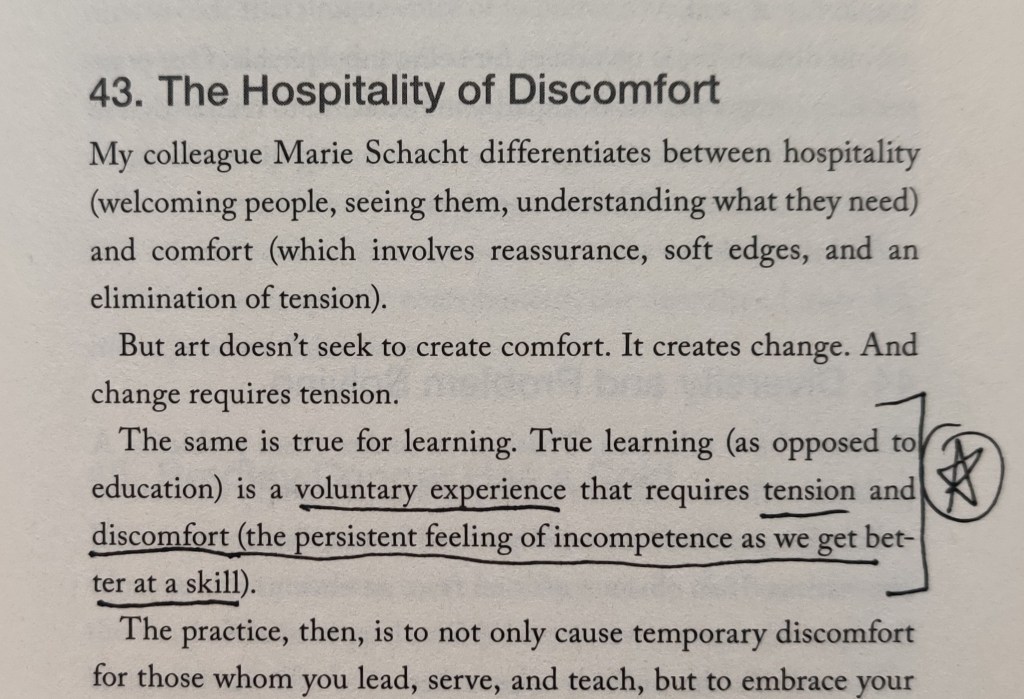
Here’s a reminder to myself: learning is always uncomfortable.

As I was reading through Seth Godin’s latest book, The Practice, I came across this gem of insight.

“The Practice” by Seth Godin (2020), pg. 53

It is often the discomfort and tension that causes me to avoid learning new things and settling into my work. When I feel the anxiety rise, I’ll switch gears to something more comfortable or distracting. Instead, I need to embrace the suck.

Learning is voluntary – I must want to engage with it.

Learning creates tension – personal discovery in unfamiliar territory creates questions of tension, and each answer I find resolves the tension. Tension and release.

Learning is uncomfortable – it’s hard to willingly feel incompetent when our careers are geared towards increasing competence and confidence.

I need to learn that when I feel uncomfortable in the learning process, this means I’m on the right track and should embrace the feeling.

Stay Awesome,

Ryan