200+ and Counting

Last week, I finished reading As A Man Thinketh & From Poverty to Power by James Allen for the book club I am in. I noticed I hadn’t updated my reading tracker for the year, so I quickly updated my progress in 2020 to date.

195The Kite RunnerKhaled Hosseini3632020
196My Own WordsRuth Bader Ginsburg4002020
197Kitchen ConfidentialAnthony Bourdain3842020
198Stillness is the KeyRyan Holiday2882020
199The Oxford InklingsColin Duriez2762020
200The Infinite GameSimon Sinek2722020
201The Ride of a LifetimeRobert Iger2722020
202As a Man Thinketh & From Poverty to PowerJames Allen1822020
65981pages

I have been maintaining my reading tracker since 2016 when I chose to make reading a priority in my life. I was pleasantly surprised to see that I had surpassed 200 books in the last 5 years, which amounts to around 65,000 pages (caveat – a lot of these books are in audiobook format, and the page counts are taken from Amazon’s book listings, so the amount is inflated to include front and back matter).

I’ll be posting my 2020 reading list in January, but I thought it would be fun to boast about this a little bit in the interim. I may not remember everything that I’ve read, but on the whole I find this time very much well spent. Through slow, incremental steps, I’ve made a lot of progress.

Stay Awesome,

Ryan

What Is “Creative” Work?

One thing I love about reading Seth Godin is how he tends to reframe how I think about things. Like many other people, I’ve been feeling in a bit of a rut with work. Without the context shift of going to work in an office, the days start to blur, and working from a distance keeps me detached from my colleagues. Instead, my work is largely done on documents and spreadsheets, and the tedium easily sets in. It feels monotonous and largely procedural.

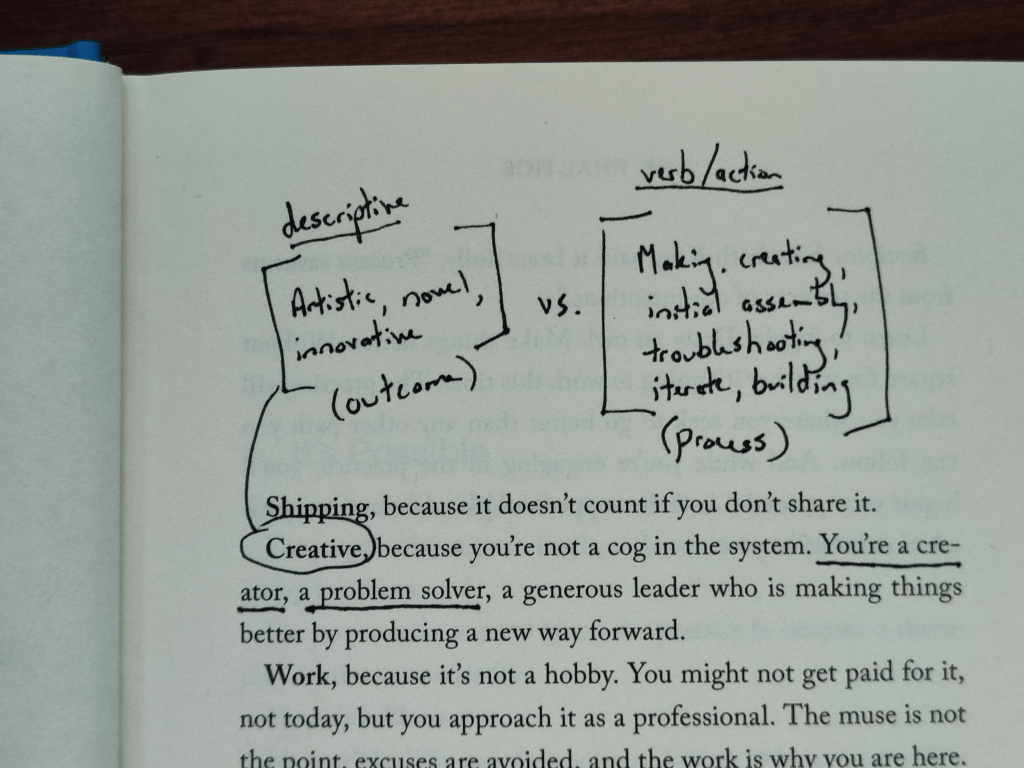
However, the first page of Seth’s new book forced me to reconsider how I view my work. When reflecting on my work, I realized that I was defining “creative” narrowly.

“The Practice” by Seth Godin (2020), page 3

Were you to ask me whether my job is creative, I would probably take a view that conforms to my notes on the left. My job has some elements that I have “artistic” control over, but largely “no” because it’s process driven. However, if I define “creative” more broadly, it’s easy to see how my job is creative. I create tools and process flows. I define problems and find creative solutions, then teach them to others.

We often bind our thinking about “creative” to notions like innovation and novelty (divinely given?), when instead we should think of “creative” as deriving from “create,” which is more process driven than outcomes driven.

This doesn’t solve my tedium with spreadsheets, but it helps me frame my work within a different context. I am not just a cog, but instead I have the ability to adapt the cogs I use to suit my needs.

Stay Awesome,

Ryan

Writer’s Block and Bad Writing

According to Seth Godin, there is no such thing as writer’s block. He’s been on my mind recently, not just because I listen to his regular podcast, but also because he’s doing the book marketing circuit on the podcast shows I typically listen to. As of writing (November 3rd), his latest book was just delivered to my door.

From what I understand, Seth’s belief is that writer’s block is a function of our desire to not ship bad work. Instead, we hold out until a good idea arrives and we work on it. His advice to overcome “writer’s block” is to constantly write regardless of how bad you think it is. It’s a bit of a spaghetti approach – you throw as much at the wall and see what sticks. He maintains that buried under all the bad writing, there is bound to be some good stuff. The job of writing bad stuff is to eventually unearth the good stuff for you to work on and polish to completion.

Seth is known for having posted on his blog every day for over a decade, tallying over 7000 posts. He says that for every post we read, there are up to 8 that didn’t get published.

I’ve been talking recently about how I’ve missed deadlines on this blog due to poor planning. If what Seth says is true, it would also be the result of a bad ratio of published to unpublished ideas.

2:1

I guess that means I need to get to work pumping those numbers up.

Stay Awesome,

Ryan

Adam Savage on Giving Praise

I recently finished Adam Savage’s maker’s memoir, Every Tool’s a Hammer. I always enjoyed watching MythBusters back in the day, though I wouldn’t say I was a diehard fan – I caught episodes as they aired, but didn’t follow the show. As an adult, I wish I had followed more closely, because I’m finding that I’m drifting towards the maker ethos, and it would have been good to have been mentored in real-time to the show’s airing. I guess that’s why we have reruns and syndication.

Anyway, the book has many great insights, one of which is concerned with giving praise and making sure the recipient of the praise is acknowledged.

Adam reflects that all of his growth came from feedback from his mentors. In the role of a boss, he questions why would he shy away from feedback if he wasn’t happy with something (e.g. someone’s performance or the product of their build). This moment of empathy is a valuable insight to me, because as a leader I often hedge my feedback, wanting to avoid hurt feelings or awkward interactions. But there is a difference between providing feedback for growth, and being cruel. I’ve had many great bosses that helped me grow through their feedback, even if that feedback made me feel less than great. But their feedback was never cruel or meant to belittle me – it held me accountable and showed me what to do for next time.

He also mentions praise – people want to be acknowledged and recognized by the ones signing the cheque. Even if it sounds corny, he says, it goes a long way towards building up your team both in terms of morale and skills.

Stay Awesome,

Ryan 

Friday Round-up – August 7, 2020

This was a light week for consuming content that stuck with me, so here is the sole round-up list for the week ending on August 7th:

💭Reflection – Citing our sources – How to Think for Yourself | Ozan Varol blog post and Don’t Quote. Make it Yours and Say it Yourself | Derek Sivers blog post

The Varol piece was new, and as I read it, it reminded me of the Sivers piece, so I’m pairing them together. I’m a little conflicted with the message. On the one hand, I agree with both writers about the sentiments they are expressing. In Varol’s case, often citation becomes a short-hand for original thinking. Rather than expression your own unique ideas, you regurgitate what you’ve consumed from others (whether you are citing it or not, as is on display in the Good Will Hunting example). Likewise, Sivers is on to something when he suggests that integrating facts into our mental apparatus should not require us to cite our sources when it’s no longer the appropriate context. It makes sense to cite sources when writing something that will be graded in school, but it is stilted while in informal settings.

Where I feel conflicted is when there is a need to trace ideas back to verify the content. I don’t think it’s a new phenomenon, but it has certainly accelerated in recent years that misinformation is being thrown out into the void at a rapid pace. The internet has optimized itself on three facts of human nature – we like sensation, we like things that are familiar (that accords with what we already believe), and we are less critical of our in-group. Therefore, information bubbles get set up online, which creates a digital environment that’s conducive to rapid spreading of memetic viruses. When you think about it, it’s a marvelous analogy: the online information bubble is a closed environment where people are like-minded, which amounts to a roughly analogical immune system. A memetic virus then latches hold on one person, who spreads it to people in their network. Since the folks in the network share similar belief structures, the homogeneous group quickly spreads the meme throughout the information bubble. The meme is then incorporated into the belief network of the individuals through repetition and confirmation bias exposure. It writes itself into the belief web, in the same way viruses incorporate themselves into DNA.

I’m using the example of a memetic virus, but I think this framework is equally applied to more benign examples. Scientists release findings in the form of pre-peer reviewed news releases, which gets amplified and distorted through the media, which is then amplified and distorted through information bubbles. See here for an example:

At each phase, part of the signal is lost or transformed, like a social media game of telephone. When one person in the chain misunderstands the data, that impacts how the idea gets replicated. Over time, it becomes the digital version of a cancerous mutation of the base information.

This is why it’s important that we take care of how information is communicated, because as soon as you print something like “the majority of people believe x,” or “studies showed a y% decrease in the effect,” without a proper context of what the data is saying (or its limitations), that gets incorporated into people’s webs of belief. If you are a part of the population that believes something and you read that information, it reinforces your prior beliefs and you continue on in replicating the idea.

And so I’m torn. On the one hand, I shouldn’t need to cite my sources when having a casual conversation (a la Sivers), and I shouldn’t be substituting original thoughts with the ideas of others (a la Varol), but at the same time, I want it to be the case that when I encounter something that it should be verifiable and scruitable. I don’t know what the solution to this is, other than to flag it and remind myself to be wary of absolutist language.

Stay Awesome,

Ryan
Friday Round-up – July 31, 2020

Here is my round-up list for the week ending on July 31st:

💭Reflection – Writing Daily, But Posting When Ready | Derek Sivers

I started this blog for two reasons – because I wanted a public way of practicing what I was learning at the time, and to force myself to write consistently. I decided posting once per week was a manageable target, and I’ve been relatively successful for the last few years. Recently, I’ve added the Friday Round-up as a way to force myself to write more and to share interesting content I stumble upon. When I added the Friday posts, I questioned whether it was worth putting in the effort – was I adding value to any part of the process? On some level, I feel it’s worth it, if for nothing else than to force myself to be a bit more reflective on what I consume. However, Derek Sivers’s point about forcing one’s self to post rapidly comes with some trade-offs. I imagine Seth Godin (another prolific blog poster) sometimes feels the same way by posting daily – that most of his posts aren’t what he would consider good. The mentalities are a bit different; Godin posts as part of his process, whereby you have to make a lot of crap to find the good stuff. Sivers would rather keep the crap more private to give him time to polish up the gems. I’m not sure which style is better. Both admit to keeping the daily writing practice, which is probably the more important lesson to draw from their examples, but it’s still worth considering.

*Addendum*

After drafting the above, I kept reading some bookmarked posts from Sivers’s page and found this one written in 2013 after a friend of his died. It’s a heartbreaking reflection on how one spends their time, which included this:

For me, writing is about the most worthy thing I can do with my time. I love how the distributed word is eternal — that every day I get emails from strangers thanking me for things I wrote years ago that helped them today. I love how those things will continue to help people long after I’m gone.

I’m not saying my writing is helping anyone, but the thought that my words will live beyond me touched something within.

📽Video – The Biggest Bluff: Poker as Life | Book Review from ThePoptimist

I’ve known the author of this YouTube channel for a few years, and I follow him on ye ol’ Instagrams (I love his scotch and cigar posts). But I didn’t know until last month that he also reviews books as part of the BookTube community. I wanted to share this link to show him some love, and because it reminds me of one of my roomies in undergrad who introduced me to the world (and language) of poker. While I’m a terrible player, I have fond memories of watching my roomie play online, if for nothing else than the humor of him yelling at the screen.

Oh, and I like Maria Konnikova’s writing, so I think I’ll check out her book. Another good book by a poker player about thinking better – Annie Duke’s Thinking in Bets.

🎧Listen – “Your mask questions answered” | The Dose podcast by CBC

With all the anti-mask beliefs floating around, I wanted to do my part to share good information about the benefits of masks and to help dispel some of the dis/misinformation out there.

Wear your masks and stay awesome,

Ryan

Vigilance and the Price of Progress

I recently joined a book club, and last week we met virtually to discuss The Immortal Life of Henrietta Lacks by Rebecca Skloot.

The book has been circling my periphery for some time, coming up in recommended reads lists for at least a year. When it came time for me to suggest the next read, I chose this book without really knowing much about the subject. I was vaguely aware that Henrietta Lacks’s cells were instrumental to many scientific and medical advances, and I was aware that the obtaining of the cells was likely done unethically, as was the case for many Black Americans who found themselves under medical scrutiny in the middle of the last century. Since I review research ethics applications on two ethics boards I serve on, and because of the ongoing conversation around Black lives, I thought this would be a good book for us to read and learn from.

In short, the book is fantastic as a piece of writing.

But the story of Henrietta Lacks and her family is heartbreaking. The book paints a vivid portrait of who Henrietta was, and gives intimate glimpses into the life of her decedents. It also presents a comprehensive history of both the rise of research ethics since the end of World War Two and of the many advances made by science thanks to Henrietta’s cells. However, those advances were done with cells acquired neither with proper consent nor compensation. For many years after her early death, Henrietta’s name became lost to obscurity outside of her family, but everyone in the cellular biology community knew her cells because of how abundant they were. In a tragic twist, the very medical advances that gave way to better understandings of radiation, viruses, and vaccines, were often not available to the impoverished Lacks family. While the Lacks’s remained stuck in poverty, others profited.

I highly recommend everyone read this book.

As we discussed the book last week, I realized that this was an example of why it’s important to enlarge the domain of one’s ignorance. Learning about history shouldn’t be an exercise in theory; often we forget that history is presented as an abstraction away from the stories of individual people. If we forget about their individual lives, we can sometimes take the wrong lessons from history. As the saying goes, those who don’t learn from history are doomed to repeat it. In this case, we continue to exploit the voiceless, and profit on the backs of the disenfranchised – those who don’t have the power to speak back.

Reading books like this gives me a greater context for history, and it helps me understand the lived-history of people. I review research projects to understand the ethical consequences of our search for knowledge. If I lack a historical context – the history of how research was and is carried out – then I run the risk of perpetuating the same injustices on the people of today that the research is meant to help.

Research is supposed to be dispassionate, but we must understand and situate it within its proper historical context.

In an allusion to Picard, I close with this: constant vigilance is the price we must pay for progress.

Stay Awesome,

Ryan

Friday Round-up – July 24, 2020

Let’s keep the momentum going from last week!

Here is my round-up list for the week ending on July 24th:

💭Reflection – Books as Monuments – Ryan Holiday (Instagram)

Last week Ryan shared the following post:

I have a vague recollection of when Madison Holleran died by suicide in 2014, though less about her as a person and more because of the conversation it sparked around mental health and how social media can portray a perfect life despite the hidden struggles of the person. I’ve yet to read this book, however as I was reflecting on this post I realized that this isn’t a book about a famous person, but it still stands as a monument to a life. That felt like a weird mental juxtaposition against the conversation going on about monuments in general and what we choose to remember. During a recent conversation with my grandmother, she was showing me photos of friends from her past that have since passed away. For nearly every person on the planet, your legacy extends only as far as your genes and the living memories of those who knew you. And yet, sometimes we pulp trees into paper and create a monument that will be read in the future. Monuments are not accidental – it’s a reflection of what we choose to remember. Madison’s life was tragically cut short, but at least she remains more than a fragile memory.

🎧Listen – What You Need To Know About Protective Face Masks – NPR Life Kit

There is a lot of misinformation around the effects of wearing a mask. Here is a good quick summary. tldr: it prevents the wearer from spreading germs and it does not prevent one from breathing adequately. I’ve demonstrated this for myself by donning a non-surgical mask for the last two weeks of running on the elliptical. To date, in the 30 masked-miles I’ve run (roughly 3.5-hours of exertion), I have yet to have any symptoms related to hypoxia.

📖Read – Graduating during a downturn | A Learning a Day blog

Two paragraphs stood out in this post that resonated with me:

By all accounts, COVID-19 is a ridiculously bad time to graduate. It isn’t just a bizarre year from the perspective of the job market. Graduates who have a job will face an unusual first year as part of the workforce. With organizations and the people generally unprepared and dealing with multiple stressors, they’re unlikely to get the training that they need on the job.

These are moments when you realize how big a role dumb luck plays in any professional success we enjoy. It is so easy to attribute things that are going well to our smarts and hard work. But, there’s so much more to any success than that.

Reading this made me reflect on my own career to this point. I finished my undergrad in 2009, the year after the 2008 economic downturn. I was fortunate to be accepted into grad school, where I stretched a 1-year program into a 3-year experience by the time I finished writing my thesis. That put me into the formal job market at the tail end of 2012, four full years after the markets took a dive. I was lucky to enter the working world while the economy was rebounding, and I didn’t have to face the same setbacks and struggles that many of my cohort felt (that is, had I not did my 5th year “victory lap” in high school, I would have finished undergrad a year earlier with my secondary school classmates). In this, I was very fortunate that my choices became opportunities of timing, and something worth keeping in mind as context.

Stay Awesome,

Ryan

Friday Round-up – July 3, 2020

As I noted in my post earlier this week, I missed my last Friday roundup post. This is my first effort in doing better.

Here is my round-up list for the week ending on June 26th July 3rd, 2020.

📽 Video: The Toxic World of Self Help: Hustle Culture, Toxic Positivity, Addiction, and Fake Gurus. | James Jani (YouTube)

I am guilty of buying into the world of self-help. The vast majority of my reading over the last five years has been variations on the self-help genre (to the point that I’ve coined the term animated bibliography to describe its form). I know that the returns on investing in self-help diminishes quickly, and I am aware of how dubious the promise that self-help sells is, but I constantly find myself getting sucked into it. This video doesn’t necessarily say anything new that I haven’t realized myself, but it pulls it together nicely with many examples of how dark this world can be for the copycat authorities that use the same tactics in different domains. This video is a good summary and reminder to myself the next time I’m sold the promise of a better life through tactics and strategies for sale.

Listen: A Recipe for Caesar | Common Sense Podcast by Dan Carlin AND Jon Stewart | Joe Rogan Experience Podcast

I covered a different interview with Jon Stewart in my last published Friday roundup, but I wanted to link these two different podcast episodes along a similar theme, despite the shows being wildly different. I noticed that both Dan Carlin and Jon Stewart remarked on the difficulty that comes with being a voice that people turn to when making sense of the world. Stewart noted that towards the end of his time on the Daily Show, he sometimes struggled to be the person to go on television and say something smart or comforting after a tragedy struck (it might have been part of the reason why he burned-out and needed to retire). Similarly, Dan Carlin has not put out an episode of his podcast Common Sense in a few years, but he released this episode earlier this year. In it, he notes that he’s tried recording an episode multiple times but felt he was adding nothing of substance to the conversation. He struggled to, like Stewart, be a voice for people (like me) who turn to him to help understand the world we find ourselves in. I listened to both of these episodes in the same week, and gained a new appreciation for those like Carlin and Stewart who make livings giving me monologues to pre-digest current events. It must be tough to strike a balance by being both insightful and non-inflammatory, where you avoid stoking the audience against “the other side” (whatever side that happens to be at the time). A YouTuber I follow recently commented on folks like Tim Poole whose sole purpose is to inflame the left/right hostility, rather than adding anything of substance to the discourse. It’s causing me to slowly evaluate what voices I allow in and whether they’ve earned their place in my attention.

Read: Why I’m Leaving Academia | Ozan Varol

I have some deeper reflections that this article prompted, but I wanted to capture this here first. Varol has been a law professor for 10 years now, and with the success of his recent book, he’s decided to move on from his teaching duties to pursue other endeavors. This reminds me of Nassim Taleb’s idea of via negativa. Varol specifically invokes this idea (though not by name) by reflecting that decisions he’s made in his life that had the greatest positive impact were often decisions that “subtracted” from his life. It’s a reflection I applied to my own circumstances and still need a bit more time to process.

Watch: Every Race in Middle-Earth Explained | WIRED (YouTube)

Because we all need to have some fun once in a while, here is an informative half-hour from a Tolkein scholar who covers the history of Middle-Earth through its inhabitants.

Stay Awesome,

Ryan