Leverage

I’ve been reading ‘self-improvement’ books for the last five years. Some of those books dealt with financial and life management, where you leverage the money you earn to create more value for yourself. But until you reach that point in your life, it’s only a theoretical exercise to engage with – there is no point in thinking deeply into investing options or buying your way into freedom until you have money to buy options. I’m sure there are self-improvement adherents who will vehemently disagree with this, but the reality is you aren’t going to gain access to the game by saving money not buying lattes or avocado toast unless you are playing a really long game with a lot of good luck.

I’ve now hit a point in my life where options have opened up for my family, and we can make choices and trade-offs to build out a lifestyle that works best for our goals. This is not to say that all options are available to us – we have to carefully look at the tradeoffs and determine whether the downsides of any option are something we are comfortable living with (e.g. to pay for a given option, should we, say, reduce from two cars to one).

Part of this exercise is critically examining each of our assumptions and systems to determine if they are moving us towards what we want, or if they need to change to better align with what we want. This is where the concept of leverage has entered my mind, because when evaluating costs or expenses, it’s important to note that not all expenses are net negative. Some expenditures end up buying more value than what we spend on them.

This is the game in a nutshell – you trade your time for money. Money represents quantified time and effort that can be exchanged in markets with mixed goods. I spend time at work and my employer gives me money in return. I then take that money to purchases goods or services.

Until now, most of the way I thought about the game was surface-level transactions of 1:1 value transfer – I work x-hours for y-dollars. I then trade y-dollars for a good or service with a transactional value of y-dollars. I haven’t really given much thought to the value (that is, how much I value it subjectively) of the good or service provided back to me, and whether that value is higher than what I’m spending. I suppose I’ve thought about it in an abstract way, such as I receive more enjoyment from the thing than the money I spent on it; the opportunity cost is not higher than the value I’m getting from it.

By focusing on the surface-level transactions, the only metric that was critical was to ensure the revenue was not exceeded by the expenses, that I wasn’t spending more money to buy value than I was getting in exchange for my labour. It’s worked up until now, but the direction my family wants to head requires me to think more deeply about what those expenses are buying us.

Ideally, I should be seeking to engage leverage – I trade time for money, then use the money to buy time in greater quantities. What might this look like?

  • With my wages, I can lease or own a car. The money I spend on the car frees me up to commute to work on my own terms. I could get to work more cheaply, such as public transportation or cycling (ignoring environmental costs in this calculation), but then I’m trading cost for time. Having my own vehicle is more convenient, more comfortable, and faster, allowing me to maximize time at work and time at home.
  • With my wages, I can pay for cleaners to clean my house. This frees up more leisure time and cuts down on bickering in the house. It is cheaper for me to buy the supplies and do it myself, but I value the leisure and time with my family more than the cost.
  • With my wages, I can pay for daycare for our child. My spouse or I could quit our job to care for our child at home full time and save the money. However, the money we spend on childcare frees us up to earn multiples of what we spend for the childcare – e.g. at $1,000/month, we would spend $12,000/year for daycare so that we can make north of 5x of that in our jobs.

This is not an easy exercise as many of our expenses feel necessary on the one hand, or scary large in context. However at this point in our lives, we have to accept that our raw effort will only diminish (I can’t work all-nighters like I used to without significant physical cost), and there are no more hours in a day we can squeeze out through discipline and efficiency. We must now turn to leverage and force multipliers to translate what we have into higher value.

Stay Awesome,

Ryan
The Beachhead

A friend who recently was appointed CEO of a company called me this week looking for a soundboard to sort out ideas he had in his head about how to proceed with company operations and strategic direction. The company is looking to shift strategic priorities, and he was looking for an outside voice to make sense of the new direction in relation to the legacy systems he’d need to grapple with.

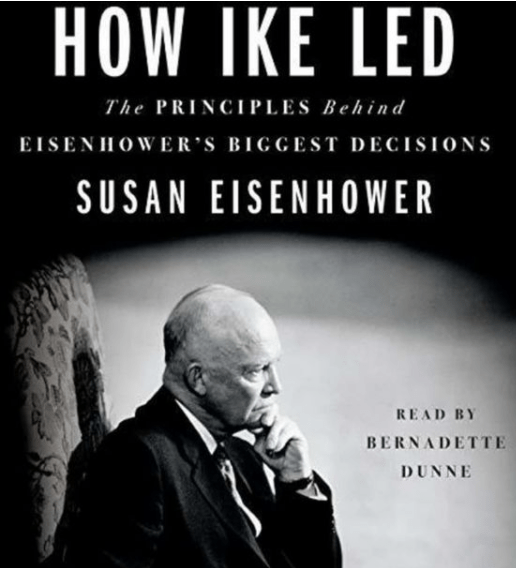
One of the topics that came up reminded me of a concept I learned about while reading Susan Eisenhower’s book about her grandfather’s time during World War 2 and his subsequent Presidential years.

At two times during Dwight Eisenhower’s tenure in significant leadership roles, he had to create a beachhead to establish his forces (literal and metaphorical) to push towards his objectives. During the war, Operation Overlord’s first phase was to establish a beachhead in Normandy to create a defensible position to allow Allied Forces to work their way into Europe to push back Germany’s army. Establishing a beachhead is critical to success, but is often difficult for offensive forces to complete as the defending force usually has the upper hand in terms of resources and strategic positioning. While the offensive forces need to both set up a foothold and protect its lines to allow more troops to arrive, the defending forces merely have to reinforce it’s occupying positions to clamp down on fresh troops from joining the beachhead. Once the effects of first-mover advantage wears off, the offensive force must contend with protecting supply lines, fighting active defense from the opponent, and pushing past inertia to avoid grinding to a halt in order to win. Once established, a successful beachhead serves as a ratchet for the offensive force – the location of which all future offensives are launched from, and from which the troops need not backslide past. Traction is gained, and the army moves forward.

Similarly, during Eisenhower’s presidency, he saw the importance of passing civil rights legislation, but saw the difficult uphill battle that would needed to both move the country towards accepting civil rights AND enshrining those rights in law (turning both hearts and minds of the nation). While he would have aspired to complete civil rights equality in his time, he knew that if poorly planned, then history, culture, and opposing interests would ensure that forward progress towards equality would halt. Instead, he sought to establish a kind of metaphorical beachhead for civil rights, working on government programs and legislation that would lay the foundation for future leaders to take up and ratchet their work – allowing the movement to progress forward without worrying about losing traction and backsliding.

In listening to my friend, I noted that he also needed to take this lesson from history and focus on his own beachhead. While we think that a CEO is all-powerful in terms of exerting their will over the company, we must also face the reality that comes with working with legacy systems and people. Change is difficult and slow, and when poorly executed either stalls from inertia or alienates your workforce. And so I suggested he take a leaf from Eisenhower’s example and focus on what his core objective is that is reasonable within the timeline he’s being given, and focus on establishing a beachhead to deliver value back to the company president.

Since reading about Eisenhower, I’ve thought about my own beachheads – what are the areas of my life that I must focus on to ensure I’m moving forward with my goals, whether they are family, work, health, or passions. It is still very much a work in progress, but I want to find those areas that I can carve out and secure so that when it’s time to take risks towards my goals, I have a safe space to launch from.

Stay Awesome,

Ryan

Evidence, Credibility, and the Homunculus Courtroom

We should think of our beliefs and the evidence we engage with as if we had a little homunculus tv courtroom in our brain adjudicating whether to admit evidence into the record. Obviously, this is incredibly difficult to pull off in real time, but it’s a nice thought experiment to pause and consider the weight of a claim being made.

This idea came to me while watching a YouTube video covering the recent downfall of a famous hustle influencer, where the presenter made an observation that she (the presenter) would normally not take people’s personal lives into consideration when judging their professional work, but the case that the influencer sold conferences and products marketed as relationship coaching courses under the pretenses of having a great marriage was swiftly undermined by her (the influencer) getting a divorce approximately two years later.

I was impressed with this statement by the presenter – she was right! Under normal circumstances, the personal life of a person shouldn’t bear weight on something like this, but given the fact that the evidence under consideration was whether someone was misleading about their personal life and getting others to pay for her “expertise,” it would be grounds to consider this piece of evidence as relevant or bearing weight. My homunculus courtroom judge ruled that the testimony was admissible.

This is a silly thought experiment to anthropomorphize cognitive thought-processes that are otherwise just a black box to me. I suppose it’s a little farfetched to think that we have this much control over our beliefs, but maybe the next time I listen to a claim (or gossip, or something that doesn’t jive with my experience… or claims that I want to be true…), I will remember my homunculus courtroom and think twice about the claim’s believability.

Stay Awesome,

Ryan

Visualizing Time

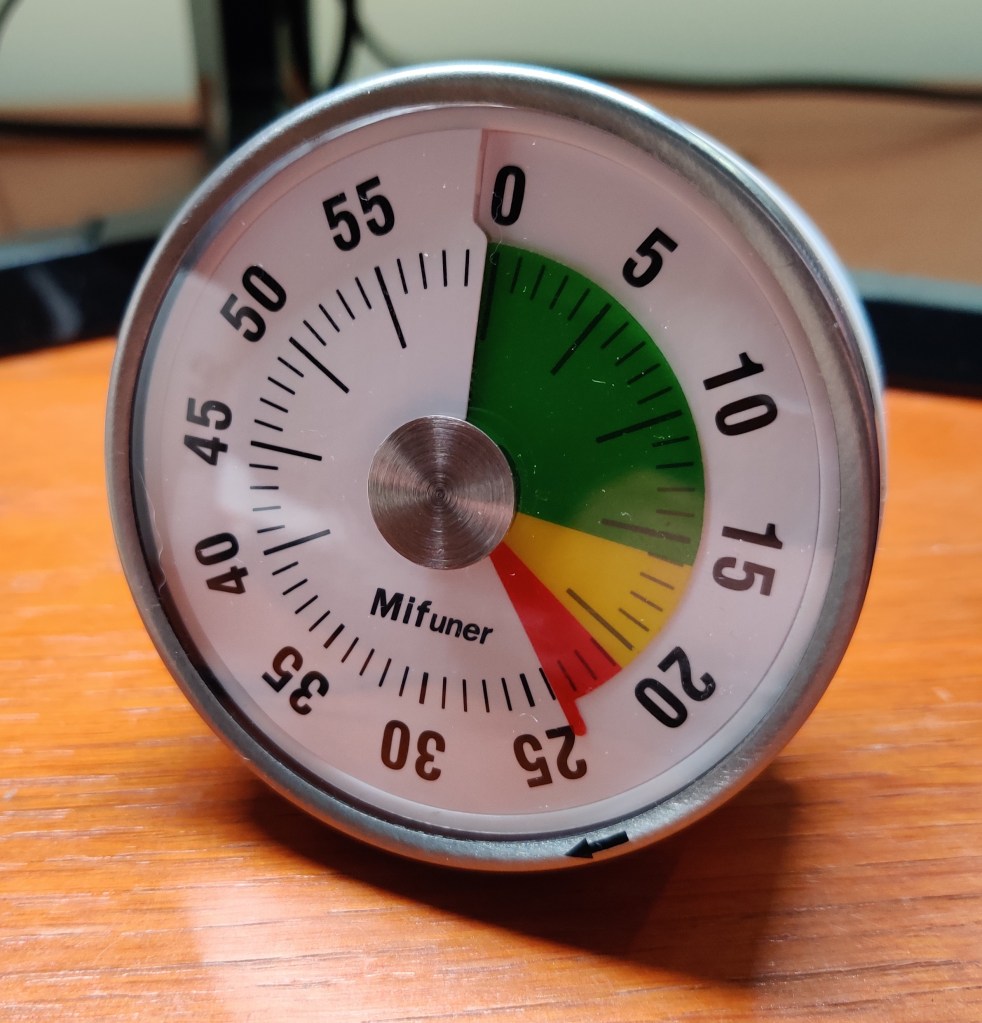
In an effort to tamp down on my procrastinating and get back on a Pomodoro system, I bought a desk timer.

I elected to go with a physical device rather than using my computer or phone to track time because I’m trying to remove the temptation to get distracted if I’m curious about the time left in the period. But I also had some other criteria.

In addition to wanting to avoid distractions, I wanted: a.) a visual representation of time, b.) something that made audible ticking, and c.) I wanted to avoid batteries if possible. The device above fit all three requirements. You wind-up the dial, set the desired duration, and the timer ticks away until the bell rings.

I’m still struggling with getting started (I usually give in and watch YouTube videos in lieu of starting my work), but once I get going, I find it easy to work through 25-minute sprints.

Let’s see how long this lasts.

Stay Awesome,

Ryan

Return to Normal

Well, I certainly was optimistic in my last post about when I’d return to normal. The move proved to be a bit more onerous, so I missed last week’s post, as well as this week’s deadline. C’est la vie. We press on.

As we start getting our vaccines rolled out to younger folks in my part of the country, we are beginning to have virtual watercooler chats about what the return to normal will be. The gut-reaction is that our higher education institutions will kowtow to pressure to return to face-to-face delivery as soon as possible – whether it’s students looking for the ol’ college experience, administrators looking to address gaps in the bottom line, or employees desperate to escape working from home.

It’s tempting to think things will return to normal, back to the pre-pandemic status quo. We, as creatures of habit, like to slide back into what’s comfortable and expend the least amount of energy that we need to.

But knowing what I know about people, a “return to normal” is going to smack straight into the loss aversion wall – people don’t like to lose benefits once they have them. It switches to an entitlement mentality. I don’t mean this in a negative sense. Entitlements are good! When we talk about entitlements, it carries a negative connotation of something not earned. But to the contrary, I think “unearned” entitlements are the point of society, culture, and government. Rather than everyone being forced to create everything for themselves, we can leverage divisions in labour, experience, technology, and collective action to ensure that benefits get spread around. The metaphorical tide should raise all ships.

So, what does it mean when we are rushing back to return to normal – what do we think we are missing, and what would a return to normal cost us?

A return to normal means hours of commuting per week, instead of going upstairs to work.

A return to normal means rigid schedules and limited campus space, instead of blending the flexibility of synchronous and asynchronous delivery.

A return to normal means bringing back flu seasons at work.

A return to normal brings back all the issues around inclusion and accessibility for those who don’t fit the “normal” not built for them.

Here at home, a return to normal means less time with our infant son. It would also mean less quality time with my wife.

I haven’t packed a lunch in a year. My office dress clothes have been hanging untouched in my closet. I’ve fueled up as many times as maybe months we’ve been working from home.

Not everyone is as fortunate as I am to still be working from home. Many employees at my institution still have to go on campus to work because they’re essential, so their current normal differs from mine. However, we must question whether we want the consequences of having the rest of us join the essential few. I sincerely doubt it is automatically a return to something better.

Stay Awesome,

Ryan

Banded Work-out

I’ve been neglecting to care for my body these last few months of the pandemic. Last year I was progressing well with exercising on the elliptical, however I had to pause my challenge when my son was born. I didn’t have a good contingency plan in place, and so the whole running challenge fell by the wayside. Other than walks with the dog, I haven’t been intentionally setting out to move my body in some time.

One thing I’ve learned about myself and exercising is that injecting novelty into the process can be enough to spur on some change in my behaviours, such as the time I shopped my way to the gym. As a similar approach, I purchased an exercise program from the creators of a YouTube channel I follow – Buff Dudes. Brothers Brandon and Hudson put out great content and the idea of doing exercises at home with minimal equipment like exercise bands seemed like an interesting way to attempt exercise (without facing the humiliation of not being able to do proper pushups). I purchased some inexpensive bands online and ordered a copy of the workout plan.

I tried the first workout Thursday of last week, and attempted to stay humble by going through the routine with the lightest resistance band in the package. Somehow even the lightest band proved too much for my sedentary body and I suffered from D.O.M.S all weekend. I cursed my inactivity and reflected fondly on my days of regularly going to the gym and lifting waaaaay more weight without the same soreness nagging me days later.

Having recovered, I’ll be trying day 2 tomorrow, and hoping to suffer a little less in my recovery.

Stay Awesome,

Ryan

WFH Observation – Novel Environments

I’ve been working from home for a year now, and I’m still surprised when I discover something about how I work that I had overlooked previously. You’d think I’d have stuff sorted out by now, but alas here I find myself.

Over the last week, we’ve been away from our house as we prepare to sell it. With COVID ramping up in the province, we thought it would be easier with a baby and a dog to be out of the house full time while prospective buyers came by to look at the listing. We stayed with family, which has required me to adapt my working conditions.

Typically I work in the home office at my desktop. For the last week, I’ve been working off a laptop and a borrowed computer monitor that functions as my second screen. For comfort, I’m using my peripheral wireless mouse and keyboard, along with my wireless headphones to block out noise. While working out of various bedrooms this past week, I’ve noticed an increase in my focus.

Granted, the increased focus coincided with a series of long meetings I’ve been attending, so perhaps I’ve been tricking myself into thinking I’m more productive. However, as I reflect on the situation, I also feel it’s worth mentioning that working in a new location helps to provide a sense of novelty for me.

This isn’t a new insight in the world of remote work – early in the pandemic, I used my company’s access to LinkedIn Learning to complete a few micro-courses on the topic of remote work to help me adjust. Many of the instructors noted that traditional remote work is done in many locations, both inside the home (dedicated workspace) as well as at favourite places out of the house (e.g. the local cafe). Because of COVID, I haven’t placed much stock in this piece of advice because we are dissuaded from working out of the house for long stretches of time (that is, sitting indoors at a coffee shop) if we are not required to do so.

This mini-experiment in remote work has given me some insight into my working style – I am not immune to the novelty that comes from environmental changes. When things relax a bit more, and if I continue to work remotely in my position, this will be something I’ll give consideration to.

Stay Awesome,

Ryan

Meaningful Actions

Over the weekend, I attended a virtual board meeting for engineering education. One of the reports pertained to a working-group’s findings and recommended actions to support the aims the 30 by 30 Campaign to address low representation of women in the engineering profession. This is a great initiative and I’m looking at ways we can improve our own processes to support women in STEM in our programs at the college. There was a comment that made me think, and it’s worth considering.

One of the board members expressed support for the report, but also commented that she had provided input as early as the 1990’s on this very initiative. Her comment was not meant to cast doubt over the process, but instead highlighted two important things – that this is not a new issue, and that many people have tried to make sweeping changes for the profession, which clearly hasn’t been entirely successful. Her advice was to be cautious about taking on too much scope with the recommendations, and instead to support a “divide and conquer” strategy for making targeted, meaningful actions to promote change.

I don’t hold any illusions that we will solve systemic issues overnight. If I’ve learned anything this past year, it’s that my hopes for reform are likely to fail and that instead of refinement, we should be aiming at transformative changes.

There is also another tension – on some level, this line of thinking suggests a teleological progression of progress for society and culture. I want to think that our culture is aiming at progress (“the arc of the moral universe is long, but it bends towards justice” is a powerful vision to work towards), but a skeptical voice reminds me that, like our misunderstanding of Darwinian evolution, there is nothing inherent in the progress of change that aims towards a higher, final form. A kind of defeatism can creep in when one thinks that meaningful actions do not contribute towards progress, but instead are just the spinning of our collective wheels.

I reject this defeatist view and want to aim towards a higher vision. I grant that the universe is largely amoral and unconcerned with our progress. So, instead, we must clearly define our values and principles, and take actions towards achieving these ends. The actions are neither good nor bad in an absolute sense. Rather, we mark progress with how close we come to realizing the values we want to see manifested in our lives. Meaningful actions are measured not against morality, but instead on efficacy for the outcomes. There are trade-offs and consequences along the way, and so we must be prudent. Both history and mythology have given us plenty of examples of why hubris should be avoided.

I don’t have a good answer on what meaningful actions we ought to settle on as part of our agenda. As noted, this issue has been discussed far longer than my tenure in the employment game. I’ll defer to folks much smarter than I, and try to learn from their efforts to do my part.

Stay Awesome,

Ryan

Falling Through My Systems

This late post is a nice springboard into something I’ve been thinking about throughout the pandemic. Pre-pandemic, when I was still commuting to work, I had a fair number of systems to help me get stuff done. My commute to work helped me film daily vlogs, listen to books, and think about big ideas for blog posts and Stay Awesome vlogs. When we started working from home, those outputs began fading. Now, I feel behind on my blog posts, I *maybe* film a personal vlog once every two weeks, and Stay Awesome has been put on an indefinite hiatus until Jim and I get some extra headspace bandwidth to devote attention to it.

I was also known for my notebook. I carried a Field Notes notebook everywhere with me, and was constantly scribbling notes into it. Then, around 4 months into working from home, I found myself abandoning the monthly notebook and appropriating a disused larger notebook to jot down tasks, lists, and random thoughts. The Field Notes book was small, portable, convenient, and had many systems to track things I found important, such as exercise, health, habits, etc. Now, my notebook is largely devoted to task management, because when every day feels the same, you can quickly find yourself several weeks down the line having nothing to show for your time.

In a sense, I’ve fallen through my systems. The various “systems” I implemented succumbed to inertia when I both lost the cues that triggered them and lost the will to keep putting effort in the system to power the flywheel, and friction has ground them to a halt.

James Clear has a pithy phrase, that “you do not rise to the level of your goals. You fall to the level of your systems.” This is a riff on an older Greek observation from Archilochus: “We don’t rise to the level of our expectations, we fall to the level of our training.”

Regardless, the question I have is whether I truly had a system if it was a fair-weather operation that wasn’t robust enough to adapt to these kinds of radical changes. When I lost the external liminal cues that came from commuting to work, or from even leaving the house on a regular basis, the things I called systems disappeared as well. Is it charitable to call these things “systems”? In virtue ethics, you aren’t said to possess a virtue if you only exercise it some of the time – you aren’t considered courageous if you don’t act courageously in a moment that requires it. Does this apply to systems as well?

Part of me says yes, but that’s not very helpful. Perhaps I should reframe my thinking and consider the quality and attributes of the system. Borrowing from Taleb, some systems are fragile, some are robust, and I suppose some are antifragile. I understand antifragile systems in the context of biology (e.g. stressing muscles can allow them to get stronger over time), though as of writing I can’t think of any productivity system that get stronger under pressure.

Regardless, it’s clear that much of my productivity was built upon what can now be labelled as fragile systems. They worked under certain conditions, but outside of that narrower band they are less able to withstand fluctuations or variance. In my reflections over the last few months, I’ve been seeing the value in understanding the causes of system failures so that I can create new processes to help me in work and life. For now, the first step is to acknowledge that I’ve fallen through my systems, and having acknowledged this, I can stop spinning my wheels and start seeking traction.

Stay Awesome,

Ryan