Last week, I reflected on competence, confidence, and parenting. Turns out Eleanor Roosevelt had a more inspiring insight:
“You gain strength, courage, and confidence by every experience in which you really stop to look fear in the face. You are able to say to yourself, ‘I have lived through this horror. I can take the next thing that comes along. … You must do the thing you think you cannot do.” (~You Learn By Living)
During my period of unemployment, I reflected on my career and identified a few areas I could develop now that I had some spare time on my hands. One of those development areas is seeking an ASQ certification as a Six Sigma Green Belt (h/t to Andrea for the suggestion!). At first, I delayed starting because I was looking for a low-cost near-free course to guide my study, such as something on Coursera I could audit, learning paths on LinkedIn Learning, or a discounted Udemy class I’d already purchased. But as I started watching the video modules, I quickly realized I wasn’t truly engaging. I was watching lecture content without retaining much. While yes, watching at 2x speed is largely to blame for it, I couldn’t escape the fact that I was engaging in passive consumption.
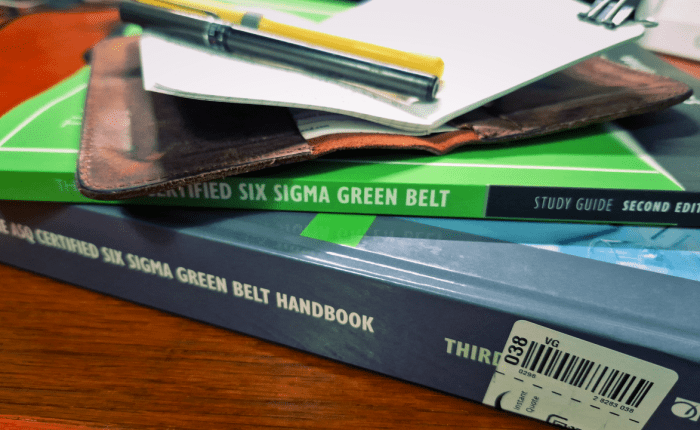
While I waited to figure out how to learn the material, I looked up the ASQ requirements and purchased used copies of the Six Sigma green belt handbook and a test prep study guide with practice questions.
Knowing that getting started is better than waiting around for a perfect plan, I started reading the handbook and planned to sort out my study strategy as I went. Almost immediately, I began connecting concepts to my past work and imagining how I could apply them now in my current role.
That’s when I realized: I’d done this before.
Paramedicine (2015–2016)
In 2015, I hit the transition point between early and mid-career phases and started questioning if I was on the right path (I found office work not very fulfilling). I thought it was a good opportunity to seek a career change and embark into paramedicine – I had a passion for first aid, I was a first responder on a few occasions in university (shoutout to University of Waterloo Campus Response Team!), dealt with emergencies while working as a bouncer, and I had written my masters thesis on the ethics of first aid. It aligned with my values of helping people and provided a fast-paced technical job that would give me fulfilment.
The first step was meeting the admissions requirements, which included needing a high school biology credit. I enrolled in a self-paced college prep biology course.
There was no active instructor; just a course outline, a textbook, weekly tests, and two major summative exams. Here’s how I approached it:
Used the course outline and test schedule as a learning roadmap – Matched unit outcomes in the course outline to textbook chapters covered on tests – Prioritized readings based on the self-paced testing schedule
Created active study tools – Flashcards for definitions and concepts – Hand-drawing diagrams (cells, organs, systems) labeled front-and-back for drill practice
Focused on comprehension-level mastery – Enough to explain, label, and connect systems without unnecessary complexity – The test was multiple choice, true/false, and labelling diagrams, so sticking to the first two levels in Bloom’s taxonomy was sufficient.
This gave me a clear plan and a feedback loop through frequent testing. I passed the course with an above 90% final grade.
Samples of my flash cards and hand-drawn diagrams.
The Present
For my Green Belt prep, I have:
A roadmap: The Body of Knowledge in the handbook’s appendix, which outlines each section, topics, and the number of exam questions per section.
Content: The handbook itself for deep reading and marginalia.
Practice: A test prep guide with exam-style questions.
By combining these, I can map my study plan to the exam structure. I also asked AI to use my weekly time constraints to suggest a manageable plan to break up the work and prepare to take the test by mid-Fall. Then, I can prioritize topics by weighting and test my knowledge incrementally as I go.
The Lesson
I realized I don’t always need a formal course, especially for a certification with a defined body of knowledge and predictable exam format. By having a clear syllabus, a learning map, a primary content source to learn from, and a way to test and reinforce learning, I can direct my learning effectively.
Courses have advantages: expert guidance, tailored examples, real-time feedback, and adaptive teaching. However, courses are not the only route for learning and self-development. By having a well-defined body of knowledge to study from, and using active learning methods like taking notes, journaling on my learning, short feedback cycles, and finding ways to apply the content to my work and experience, I have all that I need to be successful. All it will cost is some used textbooks, a registration fee, and remembering a lesson I learned a decade ago.
Here is a note I wrote to myself watching a training video:
“While a lot of these (insights) are basics that I already know, I am doing a terrible job at following them (to use my time effectively during the work day). Yes, I’m procrastinating by watching (the) video as if it will be the magical thing that fixes all my problems. Still, I also believe in the need to repeat messages, messages resonating at different times, and new ways to view old problems.”
There is something to be said for shiny new toys distracting us from just sitting down to get the work done. It’s not a knowledge problem, it’s an application problem. As Derek Sivers points out, if it were a matter of knowing, we’d all have six-pack abs and a million dollars in the bank. I fully acknowledge that I don’t need another video to teach me how to be more productive.
As it is said, there are many paths up the mountain. Some are harder, some are more direct. I have to allow myself some space and grace to realize that I don’t know everything, that I’m going to make mistakes, and that each day resets to zero to try again.
Exercise teaches us that to become stronger (read: more capable), you must grow through a process of exposure to controlled stress, recovery, then adaptation, so that you can handle the same stress loads with less conscious, intentional effort. This is a useful metaphor for handing other kinds of stress in our lives. Therefore, to overcome, you must develop your stress-capacity beyond whatever it is that is creating your fear, anxiety, or pain.
There are limitations to this simplification, such as bodily ailments and chronic systemic issues, but as a general idea, this shows an empowering approach that allows you to take responsibility over finding paths forward to good outcomes. You don’t have to resign yourself to passivity; it is possible to be active in redefining what you are capable of.
Michael Sugrue recently posted a series of one-liner observations on his YouTube Community page; one of them grabbed a hold of me, and I wanted to share it.
“Brakes make a car go faster: self-discipline produces freedom”
While it reminded me of Jocko Willink’s Discipline Equals Freedom mantra, it still gave me pause to reflect on this quasi-koan. There are two paths for speed – you either are able to control it, or you give over to speed for its own sake. Unless you disregard all safety and practicality, there is little benefit to unrestrained speed or freedom. It is through imposing limits (or the ability to control the forces at play) that you are truly able to take advantage of what speed (or it is a proxy of) has to offer. It is narrow-minded to believe in absolute freedom without guardrails. To believe we should live without restraint is to place yourself and your needs above everyone else. You might win on a few games, but it is a poor strategy in the long term that hurts everyone.
I had my latest performance appraisal last week. I found I had a much easier time identifying areas of growth this time over last year after having gone through an accreditation visit for one of our programs. In the past, I would look at my current skillset, look at the friction points I was experiencing, and project forward a better future based on picking up some new skills or experience. This process is fine, but I realize the flaw is that the path you choose to develop in is not based on experience. It’s a guess about what might be helpful.
Contrast this to going through the accreditation process. To prepare for the performance appraisal, I reviewed the last year’s worth of information (my calendar, my one-on-one meeting notes, and notes I’ve taken about my job) and saw patterns of missed opportunities and under-performance. In these areas, I can reflect and see how if I had more skills or experience in these particular areas, I would have had a better time navigating the issues we faced.
Based on this backwards reflection (rather than guessing or projecting forward), I could more clearly articulate what I’m weak in and where I would gain the highest value in focusing on.
I think this marks for me the formal transition from the “start of career” phase to a more mature “middle career phase.” I have enough work experience and self-knowledge to draw meaningfully from, and that allows me to make smarter choices moving forward.
At my college, there is a yearly multi-day event for employees to deliver PD workshops to each others to teach skills and share experiences. The college invites thought-leaders to delivery keynote addresses to kick-off and close-out the event.
This year, the closing address was delivered by Canadian astronaut Col. Chris Hadfield. After his inspiring talk, he fielded a few questions. I was one of the lucky ones whose question was posed to him. Here is a summary of his key lessons to my question:
“How do you and fellow astronauts handle coming back to Earth? That is, the depression that comes after the high of achieving your goal/mission. “I just did that… now what?””
There is a misperception about going to space. It’s not just a random good thing that happens to you out of the blue – the mission has been an endeavor that is decades in the making (26-years for him from the time he decided to become an astronaut to his first mission). Even if he wasn’t chosen to go to space, he still enjoyed his job. Going to space afforded him unique experiences that honed his skills. He was gathering experiences and capabilities, then after coming back from space he could take those skills to support others and apply them in other areas of his life. He sees it as a tremendous set of gifts, tools, and new abilities to tackle the rest of his life. If you try to measure your life by one or two shiny peaks, then by definition you’ll make your life dismal. (As a side note, I read his book “An Astronaut’s Guide To Life on Earth” after his speech, and in it he goes into greater detail of what happens to astronauts after they come back. The experience doesn’t end; the job of being an astronaut has succession plans built into it that keeps astronauts useful. They spend months debriefing the mission to identify best practices that will keep future astronauts safe. They help train others, and handle mission control duties. They also help support the families of other astronauts when their loved ones are away on mission. The impression I got is that the job is designed to be a.) in service of others, and b.) purpose-driven).
Don’t spend a lot of time looking backwards. “If you spend a lot of your life looking backwards, you’re going to bump into your future. That’s not where things are coming from; they’re not coming from the past.”
The most important decision you’ll ever make is “What am I going to do next?” Some of your opportunities and skills will diminish as you age, but that doesn’t mean it can’t be vital, important, interesting, or challenging to you.
There are cool things happening to you everyday. Allow yourself to succeed everyday, it doesn’t have to matter to anyone else. Celebrate it. Recognize that yeah, there is crappy stuff happening, but there are cool things happening to you too, so try and choose to focus on them. There are compulsory things you have to do, but like in figure skating there are freestyle points. Try to revel in the freestyle. That leads to a life well-lived.
I’m so glad I got a chance to hear him speak and that my question was selected for response. I devoured his book and dropped many bookmarks in to return to so that I can absorb his experiences. It really drove home the problem with many self-help books that are released today – the books are written by people who are telling the stories of others. The purpose of the book (aside from sales) is to collect stories from the deeds of others in order to fit a narrative or thesis. There is an assumption that because someone else made things work that the author has the borrowed authority to provide advice to others.
I’ve learned that it’s much more instructive to turn to the primary sources and read the undiluted message from those who’ve actually been “in the arena.”
I’ve been thinking about personal weaknesses I have in the workplace – besides missing my regular posts for this blog…
Focus and persistence are two things I think I am weakest at. On a macro level, I have poor focus to stay on task. The consequence of poor focus means I either flit from project to project, or I self-sooth to avoid the pain of friction (typically by going on YouTube).
Poor day-to-day focus leads to poor persistence, which means I don’t carry things to completion. I stick in the ideas or early implementation phase. I chase the next shiny distraction. This would be somewhat remediated through better habits and intentional prioritization of my tasks and time. It would also be partially addressed through better task management, where everything is organized and resurfaced at the times I need them.
Solutions:
Focus – short work sprints (pomodoros) -discrete tasks (break projects into small, well-defined, finite steps) -block out the world (headphones and white noise) -block out distractions (website blockers)
Persistence -organized task management system -calendar blocking -show up each day with focus habits (see above) -project and tasks planning -recognize that progress is made in small steps
It’s been a busy few weeks between work and a sick kiddo at home. Sorry for missing the last two posts.
The changes I’ve recently experienced at work has inspired some thinking on this post’s topic. While I typically have a good mind for keeping track of projects (with some liberal use of a notebook), the updates to my job and the sheer scope of accrediting an engineering degree has proven to be more than my current organizational and productivity systems are capable of managing. Tasks were rapidly multiplying and open-loops weren’t being migrated for tracking; there was no translation between meeting notes and what was getting scheduled into my calendar.
I functionally hit a crossroad. One path was to keep trying to do the same thing and fall further behind, and the other was to force a systems growth to accommodate my new workload. What got me here won’t get me there, if you will. Put another way, my outputs were optimized to how I managed my workload, so if I wanted to change or improve my output, I would have to change the system. Changes in work forced the system to grow.
On one level, I want to deny this – why do I have to constantly adapt the system to new work? Can’t I find one universally applicable approach to managing my workload? Sadly, no. This is the pipedream sold by productivity wizards who claim their one system will take care of everything. The reality is that those systems are often tweaked to meet the unique cognitive needs of the person. If you want to use those prescribed systems (GTD, Building a Second Brain, etc), you will need to adapt it to how your mind processes information. And it makes sense that as you grow in your career, you will need to grow the systems that you use to keep on top of things.
Most of my systems have developed “organically.” I would implement new features on an ad hoc basis in response to specific needs. This is one of the first times that I’ve had to make large changes by first thinking through what I needed and how I wanted things to play out. As weird as it is, it reminds me of Stephen Covey and seems to combine two of his principles – begin with the end in mind, and sharpen your axe. By knowing where you want to go, and by spending a lot of front-loaded work setting things up, you have a better chance of dealing with bumps as you go.

 A Paramedic's Notebook