Work Focus While Home Alone

Working from home poses challenges for most folks when it comes to being able to focus. Many of my colleagues noted how difficult the summer months could be while children were home from school. For me, with an infant at home, the distractions were fairly minimal, especially because my wife handled 99% of the care during the working day during her leave from work.

But now she’s gone back to work and our child is at daycare during the day. While you’d think this means my productivity output has jumped by leaps and bounds, it’s actually done the opposite. With no one in the house to bother me, with no one to look over my shoulder, or for me to quickly hide the fact that I’m goofing off watching irrelevant videos on YouTube instead of looking at spreadsheets, the seeming unlimited time means I have a hard time getting started.

This almost seems like a cousin of Parkinson’s law, but instead of work filling the allotted time, the strength of the impulse to get started is negatively correlated with the amount of free (unsupervised) time I find myself with. Quite the opposite, there seems to be more inertia to overcome.

Stay Awesome,

Ryan

PS – as a note to my future-self: there is a connection here with what Mel Robbins says about procrastination, that it’s not a function of laziness but instead a coping mechanism for the anxiety felt by the task. I should look into this more.

Nicola McDermott’s Notebook

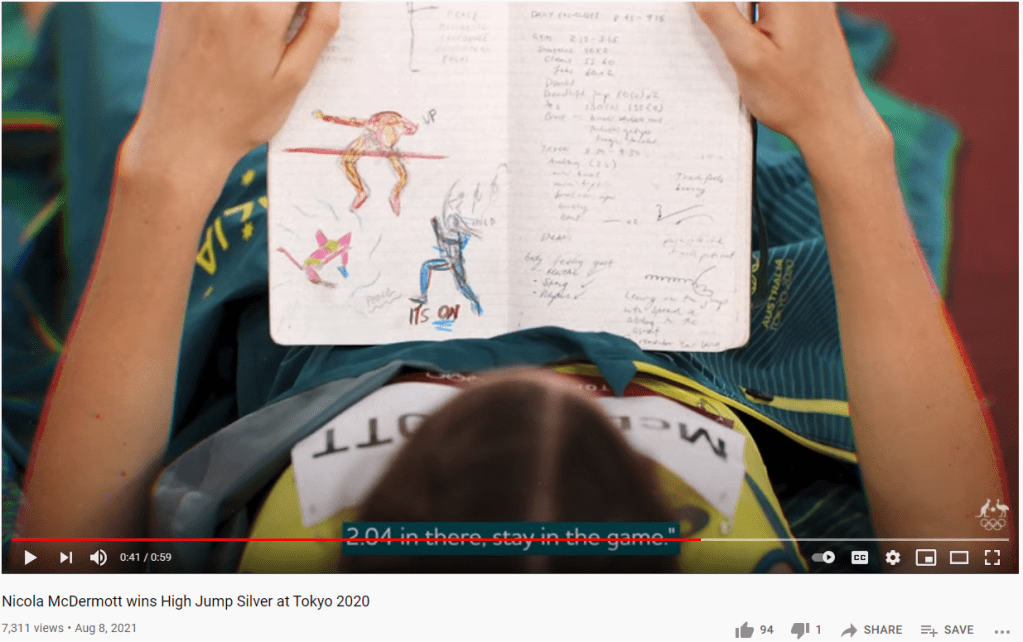
As my wife and I were watching some of the Olympic coverage, we caught a recap of the finals for the women’s high jump event. I was always terrible at high jump as a child, but I stand at around 191cm (over 6-feet tall), so watching the athletes jumping heights that would clear my head instils a lot of awe in me. One jumper in particular caught my eye – silver-medalist Nicola McDermott from Australia. After each of her jumps, the camera would catch her diligently writing in a notebook.

Screencap from video: https://youtu.be/tYFV02xldbE

I have heard of athletes who meticulously journal to help with performance psychology, but this was the first time I caught it live. You can learn a bit more about what she records after each jump in this Guardian piece. One quote from the piece caught my eye:

“The 2.04m – I gave myself a 10/10 for that jump, the execution,” McDermott explained. “I felt the clearance in the air. But the lack of experience with the timing meant that it just didn’t happen today.”

I like that she framed it not as a failure of her abilities, but instead a lack of experience with the execution. Instead of seeing it as “I can’t do this,” it’s “I haven’t done this yet.” The productivity sphere labels this as an example of growth mindset, and given the stakes of the Olympics it’s inspiring to see an athlete have such an upbeat, positive attitude that would likely cause me to beat myself down in defeat.

While mere mortals like myself typically go through the motions of any given action, Nicola’s journaling habit and mindset is worth modelling as a method of providing yourself with immediate feedback and a view from without – one that gets you out of your own head. It also takes ownership over the process, because it forces you to break the activity down into discrete parts that you can focus on and improve.

Congratulations to Nicola on her personal best, and the example she sets in performance excellence.

Stay Awesome,

Ryan

Shrinking the Change

In recent weeks, I’ve built reading time intentionally into my work day. I’ve had it “in my calendar” for quite a while as an intention, but I haven’t meaningfully engaged with that blocked-off time since I first put it into my calendar. The intention was to recognize that my skills and career path would require me to commit time to learning and personal development, but I quickly got lazy and found other less productive things to occupy that time with.

I was annoyed with how I’d allow the whole day to slip by without getting a good start to my tasks (my vice being YouTube’s algorithm), so I thought I’d redirect my attention a bit. I reasoned that if my brain wanted to fight engaging with work (because it’s hard), then I could use that time to read. I set the timer and once I finish the sprint, I would start on some task for the day.

Surprisingly, I’m having some success with the process. It’s not perfect, but on the days I start with reading, I’m more likely to resist temptation and tackle items on my to do list.

Coincidentally I’m reading the book Switch by Chip and Dan Heath. One of the chapters discusses the concept of shrinking the change, which is just a fancy way of expressing the idea that we should break big scary tasks into smaller, more manageable bites. Committing to something that is long and ill-defined is hard for my lazy brain to comply with, but it will comply with an easy edict, like “read for the next 25-minutes,” or “spend the next 25-minutes downloading course information files to be processed.”

These tips and hacks are not new – everyone has some flavour of it as part of their productivity system. But like losing weight, it’s not a knowledge problem. Learning and reading about how to lose weight won’t make you shed the fat, nor will it help you amp up productivity.

The challenge for me is tricking myself into not being lazy. If the only way I can do that is making an Odysseus pact, or treating myself like a child, setting a timer, and promising to do a little bit before I get a reward, then so be it.

Stay Awesome,

Ryan

A Decent Day

My productivity has been garbage recently. Maybe the lingering effects of working from home during the pandemic has finally ground me down, but I’ve been struggling with staying on task. I’m failing to prioritize my work, I’m failing to follow-through on intentions, and while I’m keeping up with some deliverables, it’s a real slog to turn stuff around. Even this blog consistently goes up days late.

I try to not take this to heart, because it genuinely wears me down. On a good day, I cross items off my list and stick to the pomodoro timer, letting its ticking provide a meditative soundtrack to my flow. On bad days, it feels like the whole days gets past me with nothing of substance to show; time that’s gobbled up by the Past forever.

On the days when I catch myself heading towards an abysmal performance by 5pm, I tell myself to just get one thing done. It doesn’t have to be huge or complicated, but get at least one important thing done and shipped, and you’ll have had a decent day.

It’s not the best day, it’s not a great day, but a decent day is better than nothing. And it’s easier to chain decent days together to push forward in your work.

Aim for decent days, when you get at least one thing done, then give yourself permission to be satisfied with that.

If you aim for perfection, you stall yourself out. If you aim for decent, you get at least this blog post out.

Stay Awesome,

Ryan

Parenting and the Return to “Normal”

I’ve been very fortunate to work from home since the start of the pandemic. I have only stepped foot in the office once in the last year, and have otherwise been plugging away at tasks from home. I was also fortunate that this time overlapped with the birth of our son, so I have been home for his first year of life. My wife returns to work in September, and our son will head off to daycare, signaling our first steps towards a return to “normal.” At present, I will likely continue working from home until January, assuming public health doesn’t pull back on restrictions to limit the virus spread.

Two recent podcasts had me reflecting on the kinds of things that changed about life both as a result of the pandemic as well as experiencing parenthood while at home. The first was a musing from The Daily Dad on the slow life of the pandemic, and the second was from Scott Young on how parenting changed his views on productivity.

The pandemic hit a hard stop to the busy lifestyle I had adopted. This isn’t to say I embraced “busyness” as a mark of distinction, but rather I was the kind of person who said yes to a lot of things and wanted to be involved in cool stuff. My calendar was filled with lots of obligations, work and social alike. I juggled three jobs while running a non-profit, a social club, and podcasting and vlogging projects. I enjoyed being busy and helping others.

But as a parent, I carry a different set of responsibilities that conflict with this kind of lifestyle. I was never faced with the choices to prune back my (mostly) optional obligations in order to fulfill my parental duties – the pandemic largely did that for me.

And as we think about returning to “normal,” I will obviously have to think carefully about what sorts of things I add back into my life (the pandemic will end, but being a parent won’t). Some of the effects from the pandemic and being at home to take a greater prominence in co-parenting our child makes me reflect on what kind of home life I wish to cultivate, and ask which elements of the pandemic do I want to carry forward into the new normal. For instance, in thinking about the slow life, things like bedtime routines, long blocks of time with kid(s), weekends set aside for family time, are all things I want to hold sacred.

The pandemic was referred to as The Great Pause. I should get some more of this thinking done before we un-pause and move on with life.

Stay Awesome,

Ryan

The Insidious Internet Business

I love Hank and John Green from the vlogbrothers YouTube channel. I don’t know how they manage to crank out so many thoughtful videos, but each time I check-in, I’m treated to another video where they somehow connect a thoughtful musing into a reflection of substance.

Feel free to check out the full video of one of Hank’s recent entries “Wrong on the Internet,” but below I have captured some of the interesting points that connected with thoughts I’ve had and resonated with me.

  • Layperson epistemology – it’s difficult for the average layperson to make sense of conflicting/contrary pieces of information when the business of the internet is motivated towards churning out content that screams for your attention.
  • Similar to the incompleteness theorem, solutions we create for problems will be temporary until we innovate new solutions based on updated information and advances in technology. This can bring about cynicism related to Kuhnian-style revolutions of our worldviews, that problems never seem to go away.
  • The internet business is not an information game, it’s a rhetoric game. Rhetoric is the prime mover of information, especially when hard data is absent. You can whinge about how “the other side” is devoid of logic and refuses to see the truth before their eyes, or you can accept this as a fact and play the game to win the rhetoric game.
  • Memes (of the information variety, not the funny pictures kind) that make you feel good smug are super dangerous for distracting the issues. Corporations might be the biggest cause of our climate or capitalist problems, but we can’t just immediately remove them and expect all our woes to be solved. The services they provide are still required for society to function.
  • Shifting blame breeds complacency. Instead, personal accountability and action at the individual level are still important.
  • A problem well-formed is half solved, but the internet business is not about forming good problems. In our smugness, we play games to win or gain prestige, and so reactions move far quicker and are easier than responses. In order to create well-formed problems, we need to place greater value on responding to solutions, articulating our values, and using tools like science, politics, and economics to optimize according to our values. (h/t to Seth Godin’s thinking that influenced me here)
  • On the topic of responding to emergencies (starting at 2:40 of the video), it’s important to remember in our smugness that we are not, in fact, rational creatures.
  • The insidious effect of the internet business: “If the tweet makes us feel good, we don’t tend to spend a lot of time doing a bunch of research to tell us whether or not it actually is good.”

Stay Awesome,

Ryan

1,111 Days of Practice

I hit a new milestone on Sunday with learning German on Duolingo. I hit 1,111 consecutive days of practice.

I’ve discussed before how I’m a little skeptical of the learning process, especially with how easy it is for me to mindlessly snap off a quick lesson by repeating modules so that I preserve my momentum. Still, I am pleased to hit this milestone after 3 years of consistency. While we can question whether I’m gaining true fluency in the language, we should at least acknowledge when we stick with learning habits.

Stay Awesome,

Ryan

Banded Work-out

I’ve been neglecting to care for my body these last few months of the pandemic. Last year I was progressing well with exercising on the elliptical, however I had to pause my challenge when my son was born. I didn’t have a good contingency plan in place, and so the whole running challenge fell by the wayside. Other than walks with the dog, I haven’t been intentionally setting out to move my body in some time.

One thing I’ve learned about myself and exercising is that injecting novelty into the process can be enough to spur on some change in my behaviours, such as the time I shopped my way to the gym. As a similar approach, I purchased an exercise program from the creators of a YouTube channel I follow – Buff Dudes. Brothers Brandon and Hudson put out great content and the idea of doing exercises at home with minimal equipment like exercise bands seemed like an interesting way to attempt exercise (without facing the humiliation of not being able to do proper pushups). I purchased some inexpensive bands online and ordered a copy of the workout plan.

I tried the first workout Thursday of last week, and attempted to stay humble by going through the routine with the lightest resistance band in the package. Somehow even the lightest band proved too much for my sedentary body and I suffered from D.O.M.S all weekend. I cursed my inactivity and reflected fondly on my days of regularly going to the gym and lifting waaaaay more weight without the same soreness nagging me days later.

Having recovered, I’ll be trying day 2 tomorrow, and hoping to suffer a little less in my recovery.

Stay Awesome,

Ryan

The Duke of Edinburgh’s Impact on My Life

With the passing of Prince Philip last week, I reflected on his impact on my life. Normally, the goings-on of the Royal family impacts me little directly, albeit I am a commonwealth subject as a Canadian. However, Prince Philip was also the creator of the Duke of Edinburgh Award Program, which I participated in as a youth. I was fortunate to be introduced to the program during my Army Cadet days, and I progressed through each of the three levels before I aged out of the program, completing my Gold Level in late 2011.

I recently participated in a survey of Gold Level holders asking about the program’s impact on my life. At the time, I answered that the program had little lasting impact on me. I said this in relation to each of the four core areas of the program – physical fitness, skill development, community service, and the adventure component. For each of these areas, I felt like little had directly carried over all these years later. I’m not a particularly fit person, I don’t remember any of the skills I had developed, and I haven’t gone camping in about a decade. The only domain that I am still highly active in concerns volunteering.

So, on the surface, I feel somewhat disconnected from my achievements in the DofE program. Yet, as I reflected over the weekend, I was struck by a realization: had it not been for my gold level trip to Kenya (I joined a group who travelled to Kenya in 2007 to perform a service project and climb Mt. Kenya), I would not be where I am today.

My trip overseas came at the midpoint of my undergraduate experience. As I returned home and went back to school in September 2007 for my third year, I had a profound change in outlook. Prior to my trip, I was a residence-body. I rarely ventured out beyond the dorms and was too shy to join on-campus clubs and groups. But after returning from the trip, when I was faced with an opportunity that I was nervous to attempt, I would remind myself that I had just climbed a mountain, and now anything seemed possible. It gave me the confidence to step outside of my shyness and embrace new challenges.

I joined the campus first aid team and the departmental undergraduate society. In time, I took over both groups and lead my peers through successful tenures as Operations Coordinator and Society President respectively. I committed more fully to my studies, and continued my education into graduate school. The friends I made on the first aid team lead me to a job in the gambling lab as a field researcher. It also lead me through the same connections to volunteering for a local non-profit board and working with the local Community Foundation. Those experiences then helped me get my first full time job at Conestoga College, where I currently am employed.

I’m not saying that I wouldn’t be where I am had I not been in the DofE program. However, I can draw a strong link through each of these personal developments that traces back to a decision I made one day to join in when a friend told me about this fun opportunity to travel abroad. And while I don’t often remind myself anymore that I climbed a mountain when I’m trying to convince myself to be brave, I feel a deep sense of gratitude for being a part of something that pushed me to grow beyond what I thought I was capable.

Kurt Hahn was a mentor of Prince Philip who provide inspiration for what would become the DofE program. He is known for saying that “there is more in us than we know if we could be made to see it; perhaps, for the rest of our lives we will be unwilling to settle for less.” Without realizing it, these words infused themselves into who I am as a person, and I didn’t understand what it meant or its impact until the passing of Prince Philip.

Rest in Peace, His Royal Highness, The Prince Philip, Duke of Edinburgh.

Stay Awesome,

Ryan