Here’s a reminder to myself: learning is always uncomfortable.
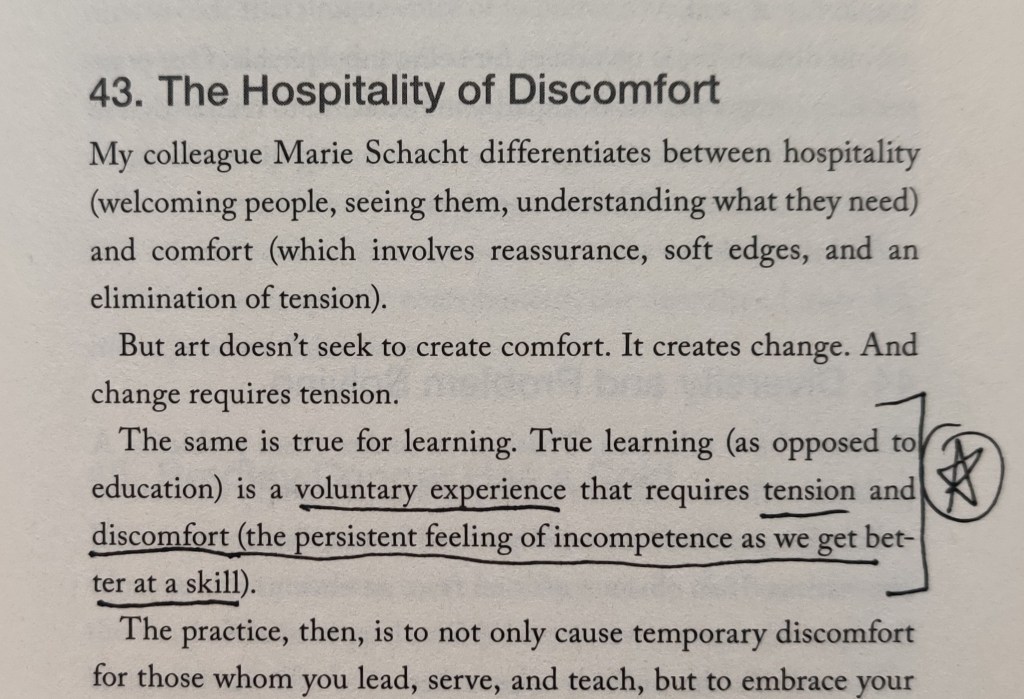
As I was reading through Seth Godin’s latest book, The Practice, I came across this gem of insight.
“The Practice” by Seth Godin (2020), pg. 53
It is often the discomfort and tension that causes me to avoid learning new things and settling into my work. When I feel the anxiety rise, I’ll switch gears to something more comfortable or distracting. Instead, I need to embrace the suck.
Learning is voluntary – I must want to engage with it.
Learning creates tension – personal discovery in unfamiliar territory creates questions of tension, and each answer I find resolves the tension. Tension and release.
Learning is uncomfortable – it’s hard to willingly feel incompetent when our careers are geared towards increasing competence and confidence.
I need to learn that when I feel uncomfortable in the learning process, this means I’m on the right track and should embrace the feeling.
I took a new step today in the evolution of my personal giving. For Giving Tuesday 2020, I finally set up my first set of recurring monthly donations. Now, every month the The Food Bank of Waterloo Region and the Brantford Food Bank will each receive a deposit of $10 from me. It’s a small, almost embarrassing amount to type (when I think of charitable giving, I’m thinking of impressive amounts with more than two zero’s to the left of the decimal point), but the important thing to keep in mind is a.) it’s my initial amount that I expect to grow over time as my circumstances allow, and b.) the total for the year will actually be higher than what I would normally have given.
I’ve been growing more intentional over time with my charitable giving. Many moons ago, I was involved with a program created by the Kitchener Waterloo Community Foundation called Engage. The program has since ended, but the experiences have stuck with me. If I want to live in a vibrant and thriving community, it’s important that I take the benefits and privileges I’ve accumulated to help others in different living circumstances than my own.
In philosophy, there is a thought experiment called the veil of ignorance, where if I were to be placed randomly in a society, I would obviously want to choose a position that afforded me a degree of wealth, freedom, security, and privilege. To me, this translates into a moral imperative that we should actively work to raise the living situations for all persons in our community to promote flourishing and happiness. I don’t want to live in a world where people have to rely on charity, but it’s an inescapable reality and therefore it must be confronted.
If we are being technical, charitable giving breaks down into three kinds of support, known as the three “t’s” – time, talent, and treasure. Time and talent were my first introduction to giving back to my community. It started in my various youth groups, where I would exchange my time to support a cause: raising money for Beavers/Cubs/Scouts/Army Cadets/swim club, marching in Remembrance Day parades, highway cleanups, and building a library abroad. Later, when I was but a poor student, I volunteered my talents to support causes for school and to help fundraising efforts for the HopeSpring Cancer Support Centre (and eventually I became the minute-taker for their Board of Directors). I also supported my friends with their charitable causes, such as helping with my buddy’s Headshots from the Heart videogame marathon event. As I started to transition out of my student phase of life, I began exploring the third “t” – treasure.
My history of charitable monetary giving started in my mid-20’s. I created an elaborate birthday ritual for myself in an attempt to imbue the day with significance (after 21, there weren’t any milestones I cared to look forward to). One ritual I set for myself was to make a donation to a cause I was interested in. When I was a student of the Engage program, I reflected that I wanted my charitable giving to go to “feeding bellies and minds,” and so I would make a yearly donation to the local food bank. Despite having never used it myself, I recognize the value they bring.
My first donations were in physical goods. I would save up rewards points from the grocery store, then buy as much food as I could for a few hundred dollars, and bring all the canned goods in for donation. Then I found out that their purchasing power was much higher than mine, so I switched to monetary donations once a year on my birthday.
The next evolution in my charitable giving happened a few years back when I wanted to help support the preservation of our environment. The Bruce Trail is a massive network of linked trails that allows one to hike 900km from Niagara to Tobermory in Ontario. Despite having never hiked on the trail myself (though I have ambitions to take up the activity), this seemed like a good cause to support, so I started purchasing yearly memberships. This year, I switched from a buying a membership each year to an automatic renewal system.
Switching back to the Food Bank, my next evolution in giving started in January of this year. I emailed to follow up on the Christmas drive and to ask what kind of shortfall the KW Food Bank saw. They kindly shared their yearly report, but what stuck out was a throwaway comment that they were successful with the campaign, but that the regular commitments were more important to ensure meals throughout the year. So, I decided I would eventually switch to small monthly donations that would increase over time as my circumstances allowed.
It was accelerated this summer with the BLM protests. I wanted to do more than empty social media posts, so I started to think about how I could contribute financially to important causes. A close friend of mine has created a line in his budget for philanthropy, which I took some inspiration from.
But in the Canadian context, I thought I should find a way to support Indigenous causes. Truthfully, I haven’t yet made that commitment – I’m still on the lookout for an ongoing support cause that resonates with me. I value the input of my peers, so if you have any suggestions, I’d love to hear your input.
That brings us to today. I decided to finally set up my regular payments to support these organizations that do so much good in our community. While I don’t live in KW anymore, I still feel called to help them in their mission. And since I support KW, I thought it appropriate to also give money to support the same cause but for my neighbors. The $10 per month I’ve committed is indeed small, but over the year will amount to a higher giving than my one-off donations. Also, it’s important to note that these campaigns help to raise awareness (and it feels good to help feed people at Christmas), but the need is felt year-round. The reality is that these campaigns serve as a funnel to bring donors into the organization.
This isn’t to say that I will stop giving one-off donations. A lesson I took from Engage is that it’s ok to say no to charitable asks that come your way. You do it each time you decline to contribute a few dollars at the cash register when you check-out at the store. Rather than having to give to every cause, it’s important to determine how much you feel you can give, then to be selective with where you allocate your funds. During Charitable Tuesday today, I also made one off contributions to my alma mater’s Arts student fund because I value the time and experiences I collected when I was a student. I also made an additional donation to the Bruce Trail’s latest campaign to purchase and preserve additional land in the Niagara region for the trail. I doubt I’ll ever get out to see that portion of the trail, but it’s important to enable the organization to leverage its resources to improve access for everyone (include some of my friends who I saw posting to social media from the trail this summer!).
My birthday is coming up, and I plan to give another one-off donation to the Food Bank to keep with tradition. And in time, I’ll find new ways to offer support. There is no one right way to give, but regardless of the type and degree of your impact, there will always be needs that go unmet in our communities. In addition to my monetary donations, I still volunteer where time allows, such as on the two ethics boards I serve.
Both Stats Can and Imagine Canada are seeing that while average donation amounts are trending upwards, the average donation rate is holding-to-declining over time. I hope to do my part in reversing this trend.
Thank-you for reading my story, and perhaps it might inspire you to reflect on your giving history.
According to Seth Godin, there is no such thing as writer’s block. He’s been on my mind recently, not just because I listen to his regular podcast, but also because he’s doing the book marketing circuit on the podcast shows I typically listen to. As of writing (November 3rd), his latest book was just delivered to my door.
From what I understand, Seth’s belief is that writer’s block is a function of our desire to not ship bad work. Instead, we hold out until a good idea arrives and we work on it. His advice to overcome “writer’s block” is to constantly write regardless of how bad you think it is. It’s a bit of a spaghetti approach – you throw as much at the wall and see what sticks. He maintains that buried under all the bad writing, there is bound to be some good stuff. The job of writing bad stuff is to eventually unearth the good stuff for you to work on and polish to completion.
Seth is known for having posted on his blog every day for over a decade, tallying over 7000 posts. He says that for every post we read, there are up to 8 that didn’t get published.
This week’s post is late. The proximal cause is that because of the Tech Shabbat experiment, I was shutting my computer down for the weekend. Weekends are the most common time I write and prepare to publish my posts. Therefore, an unintended consequence of the Tech Shabbat is that I didn’t have a post ready for Monday.
However, that is a poor excuse when we consider the distal causes of why the post is late, because the Tech Shabbat was a known event in my calendar. It wasn’t something that was unanticipated, and I knew roughly what participating in the Tech Shabbat would entail. I knew, for example, that I had to get my course marking done before the Shabbat if I wanted to give my students their feedback with sufficient time for them to use my feedback in their next assignment. I was able to always get my grading done before the Tech Shabbat began each week of the experiment, so why did I not do the same for the weekly blog posts?
The Tech Shabbat became a convenient excuse to blame, when really the blame lies with a poor writing habit. Maybe I would have finished the posts had I not participated in the Tech Shabbat, but instead of dwelling in a possible else-world, I should focus on fixing the things I have control over, such as my schedule and how I set my priorities.
Proximal causes are easy to fixate on, and are often more expensive to address (it’s why we spend lots of money on shiny new toys that promise to fix our problems). Distal causes can be harder to spot and require longer, steady investment to overcome.
Almost a decade ago, I co-started a semi-formal group with some friends. It was intended as a bit of a mutual-beneficial group – we were all just starting out in our careers and felt that getting together monthly to practice public speaking would help us in our jobs. The nature of the group has evolved somewhat now that we are having kids and have grown comfortable in our jobs. Instead, we treat the monthly meetup as both social time and a chance for us to share experiences with each other.
This month, we’ve been challenged to try out the Tech Shabbat as discussed in Tiffany Shlain’s book 24/6: The Power of Unplugging One Day a Week (note: I haven’t read the book). In essence, we pick one day a week to abstain from screens – no smartphones, no computers, no television. It’s not a complete removal from all technology (for instance, I use my smart speaker to stream podcast episodes and listen to live radio), but instead we seek to disconnect from an increasingly interconnected existence.
I have completed three of the Shabbats, with the final one this weekend. Overall, this has been a very positive experience for me. There are some challenges and moments where I have to play fast and loose with the rules (like this weekend when I got lost on a hike…).
It’s also not clear if I should abstain from using our smart speaker at home; I’ve been using it to listen to podcast episodes and radio over the internet. I’ll even admit that there are moments of boredom or tedium where I feel a strong pull to give up the challenge and open a social media app. But despite any of these missteps or moments of weakness, I can say without any qualification that I’ve enjoyed the experience. I may look forward to the close of the 24-hours, but I do so with a sense of mental calm. The break gives me a bit of a reset, a chance to journal and bring order to my life. Instead of mindlessly consuming content, I’ve chosen activities that create memories and allow me to be more present in the now.
I’m not sure if I’ll keep the Tech Shabbat once the group activity is over, but it has given me a lot to reflect on. Cal Newport has discussed taking a more hardline stance on cutting unnecessary tech out of our lives. I’m sympathetic to the idea, though in practice I have to balance my quirky experiments with my wife’s needs, and I doubt she would entertain any drastic measures like what Newport suggests. Regardless, just taking the opportunity to pause and reflect is a worthwhile activity, which the Tech Shabbat has afforded me over the month.
The book has been circling my periphery for some time, coming up in recommended reads lists for at least a year. When it came time for me to suggest the next read, I chose this book without really knowing much about the subject. I was vaguely aware that Henrietta Lacks’s cells were instrumental to many scientific and medical advances, and I was aware that the obtaining of the cells was likely done unethically, as was the case for many Black Americans who found themselves under medical scrutiny in the middle of the last century. Since I review research ethics applications on two ethics boards I serve on, and because of the ongoing conversation around Black lives, I thought this would be a good book for us to read and learn from.
In short, the book is fantastic as a piece of writing.
But the story of Henrietta Lacks and her family is heartbreaking. The book paints a vivid portrait of who Henrietta was, and gives intimate glimpses into the life of her decedents. It also presents a comprehensive history of both the rise of research ethics since the end of World War Two and of the many advances made by science thanks to Henrietta’s cells. However, those advances were done with cells acquired neither with proper consent nor compensation. For many years after her early death, Henrietta’s name became lost to obscurity outside of her family, but everyone in the cellular biology community knew her cells because of how abundant they were. In a tragic twist, the very medical advances that gave way to better understandings of radiation, viruses, and vaccines, were often not available to the impoverished Lacks family. While the Lacks’s remained stuck in poverty, others profited.
I highly recommend everyone read this book.
As we discussed the book last week, I realized that this was an example of why it’s important to enlarge the domain of one’s ignorance. Learning about history shouldn’t be an exercise in theory; often we forget that history is presented as an abstraction away from the stories of individual people. If we forget about their individual lives, we can sometimes take the wrong lessons from history. As the saying goes, those who don’t learn from history are doomed to repeat it. In this case, we continue to exploit the voiceless, and profit on the backs of the disenfranchised – those who don’t have the power to speak back.
Reading books like this gives me a greater context for history, and it helps me understand the lived-history of people. I review research projects to understand the ethical consequences of our search for knowledge. If I lack a historical context – the history of how research was and is carried out – then I run the risk of perpetuating the same injustices on the people of today that the research is meant to help.
Research is supposed to be dispassionate, but we must understand and situate it within its proper historical context.
In an allusion to Picard, I close with this: constant vigilance is the price we must pay for progress.
I have this bad habit of coming up with thoughts for blogs as I’m trying to sleep. I promise myself I’ll remember to jot it down in the morning – that it’s not worth staring at my screen in the darkness when sleep is so close by.
And yet, here I am – kicking myself over the n-th missed idea that never came to fruition.
Perhaps there’s not a lot I can do when inspiration strikes me other than keeping a notebook on hand to capture transient thoughts. However, if the pandemic and working from home has taught me anything about creative activities, it’s that I shouldn’t wait for inspiration to take hold, but rather inspiration should find me already hard at work at the process of making. That is to say, it’s more important that I build regular practice and development into my routines so that I increase the chances of inspiration catching me as I work.
I’m not the first person to suggest this strategy. It’s common advice from many creative folks. What’s new is that I’m seeing the advice in action in my own work: the more I write and practice, the more ideas flow out of me.
If I do this, if I do the work in between the deliverables, I suspect I’ll capture a lot more of those posts from the ether.
I’ve been mulling over a quote I wrote down in my notebook back in March, especially as it relates to my productive output at both work and for my personal projects:
“Every system is perfectly designed to get the results it gets.” ~Paul Batalden
At the end of the day, I’ll look back at my lists of tasks and feel frustrated that another day has slipped by thanks to my monkey brain’s inability to focus. Of course, this is placing the blame on the wrong focus because it’s ignoring two important facts: it assumes I’m not in control of my behaviours when I blame it on my “monkey brain,” and it assumes that I’m setting myself up for success merely by sitting at my computer. Both of these are patently untrue. I have control over my environment and (to borrow a phrase from Jocko Willink) I should be taking extreme ownership over my work situation.
If I find myself frustrated with my lack of output, I have to look at the system that my productivity is set against. If I spend my day getting lost down YouTube video and blog holes, then it’s because my system is optimized for it.
If I’m allowing myself to give in to temptation or distraction, it’s because it’s easier to fall back on things that are psychologically comforting and there is too much friction to get started on the real work.
Motivation is a flywheel – I have to overcome inertia to get the wheel turning, and it takes time before inertia helps the wheel turn freely. If the system is optimized to prevent me turning the flywheel, then it’s important to look at the system for fixes, rather than bemoaning the outcomes.
It’s not a quick fix. It will take time, effort, and a direction to push towards that will start the flywheel. I shouldn’t be so hard on myself. If the flywheel grounds to a halt, then it’s my job to stop, reset, appraise, and re-engage.
After a poor performance last week left me with no Friday post, and even though today’s post is much later than I intended, here I am to make good on my promise to do better.
Here is my round-up list for the week ending on June 19th:
Sorry if you hit a paywall on this article (I managed to read it fine from Pocket). I’ve lamented elsewhere that I genuinely miss Jon Stewart, not just from his tenure on the Daily Show, but also from other initiatives he’s thrown his weight behind (remember his masterclass in oration?). While this interview is part of Stewart’s media blitz for his upcoming movie release, it is also chocked-full of wonderful insights and observations about the world we find ourselves in. He’s ever poignant in his wit, but also speaks from a cautious place. The interview is so good, I quickly reached the limit of my free highlights in Pocket.
💭 Reflection Mega-Thread – How We Process Information
I want to turn this into a more formal blog post in the near future, but for now I’d like to lay out a few strands that have come together over the last two weeks about how we process, curate, and digest information.
First, a short listen from the Daily Stoic reflecting on how our minds are not reliable when it comes to processing truth. Instead, we are bound up in our own biases that we seek to confirm. If we want to be functioning, contributing members of society, we must actively exercise our critical faculties, including seeking out when we are wrong. Or as the closing lines state: “It’s the snowflakes who fly into a rage when someone challenges their views. It’s the snowflakes who can never admit they’re wrong or address deserved criticism or feedback.”
Next, a thought-provoking podcast episode from the CBC that tackles expertise in a seeming post-truth world. There is a lot of good information floating around in the ether, waiting for us to latch on to its wisdom. And yet, despite good information there for us to seize, we see many people in our peer groups turn away and distrust the experts. Shunning the norms of knowledge communities, they instead embrace their own norms of knowledge and assertion.
Speaking of experts, one of the voices I’ve turned to on Twitter to help me filter the signal from the noise is Mr. Bergstrom. He has provided both some levity :
I have a blog post percolating in my mind about curating news feeds, but I’ll leave that breadcrumb here for now.
🏳🌈🎧 Listen – I Don’t Want To Get Over You (Season 3 Mission 9) | Zombies, Run!🏳🌈
Finally, I want to give a huge shout-out to the writers and folks behind Zombies, Run! for this episode I listened to last week. The episode really stuck out for me. A large portion of the dialogue involves two lesbian characters discussing a mutual love interest (the love interest is the current partner of one of the characters, and a former lover of the other character in the conversation). The conversation between the characters touches on topics like “gold stars” and the fears that bisexual partners may have, even in committed relationships. I’ve heard my own queer friends discuss these topics, and while it felt noteworthy that the development team included “voices” from a wide range of folks, it was awesome to hear conversations that weren’t centered on the heterosexual experience that’s often given as the default in media. It gives the game a sense of realness and depth, despite it being about living in a post-apocalyptic zombie wasteland. It’s also important, as we reflect on this Pride month, to think about the kinds of voices we engage with that represents life, and whether we are seeking out sources that look to bring more diversity to the table. I’m happy to be supporting the app and the team.


 A Paramedic's Notebook