I received some sad news last week – my time as a teacher has (for now) come to a close. The Chair has decided to take the course out of the general education elective rotation and will offer a different slate of courses to ensure students have a variety of electives to choose from.
This is not entirely unexpected. I taught my first section in September 2016, and am currently in my 13th straight delivery. In this time, I’ve had a little over 300 students, meaning I’ve graded some 3,000 assignments and 600 essays.
Back in 2016, I snapped this photo of my last day in the classroom for my very first semester of teaching (all the rest of my deliveries have been online).
It has been a great experience and has taught me a lot about empathizing with students and overcoming my biases and assumptions of how one ought to teach. It was also humbling to see some student work come in that, frankly, was better than anything I could have written.
I appreciate the patience my students have shown me these last four years as I have moved cities, gotten married, graded while on my honeymoon, and when welcoming our child into the world.
I’m looking forward to a bit of a break from teacher life, but I hope to get another opportunity in the future.
Our bookclub tackled A Christmas Carol as one of the last reads for the year. It was a wonderful chat about what the holidays means to us, how things have changed over time, and what the moral lessons are from the short story.
This was my second time reading the story, so in addition to my knowledge of it from cinema (thanks largely to the Muppets), I was able to pay closer attention to the themes threaded through the story.
I noticed, for instance, that while the story is largely about redeeming one’s soul and the spirit of giving during the holidays, knowledge kept popping in. For instance, when Scrooge is haunted by Jacob Marley, Marley notes that he walks the earth as a result of not letting his spirit roam while alive. This unfinished business suggests that experiencing the world (cultivating awareness of those beyond yourself) was an important element of living a fulfilling live (after all, why would a spirit need to roam if they had a fulfilling life?).
The chains worn by Marley were a symbolic reminder of the knowledge he now possessed of his life’s actions. Each link forged by his life’s misdeeds are discrete representations of his lack of personal knowledge of his actions while alive.
Scrooge is unable to be receptive to the ghosts’ messages of redemption until he gains personal knowledge of himself by traveling to the past and understanding the choices that lead him to this point.
The Ghost of Christmas Present beckons Scrooge with “Come in man, and know me better!” Becoming acquainted with the present requires one to be present in the moment.
Scrooge’s redemption is only realized because he confronts the Spirit of Christmas-Yet-To-Come, pleading to know whether the shadows he sees are set. Why would you show these images to me if my knowledge of them won’t change what’s to come! he cries to the ghost.
I couldn’t help but draw a connection to our own problems with empathy in our charged political moment. We often lament our failures to connect with folks “on the other side.” We lack the empathy to understand their position to see how our similarities vastly outweigh our differences.
Dickens’s solution to the problem of empathy is rooted in knowledge. Yes, Scrooge is motivated initially by the desire to redeem his immortal soul and to avoid the fate of Marley. But his change of heart comes by letting his soul out to walk around and to know others. He connects with them, which in turn creates empathy and a desire to help.
It’s a delightful story that I was more than happy to revisit at this time of year.
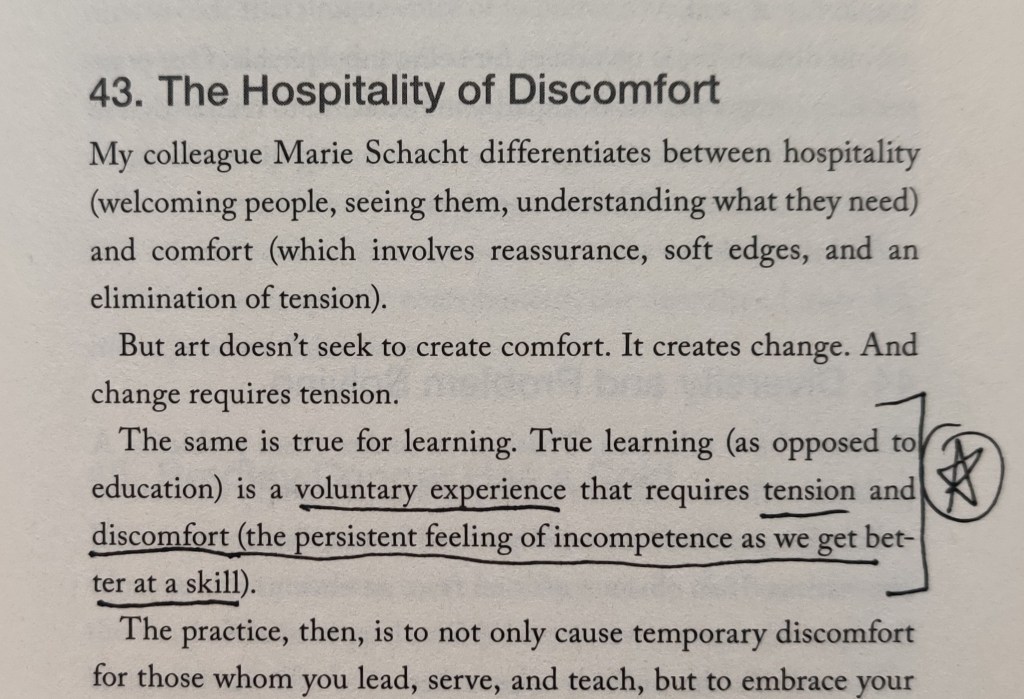
Here’s a reminder to myself: learning is always uncomfortable.
As I was reading through Seth Godin’s latest book, The Practice, I came across this gem of insight.
“The Practice” by Seth Godin (2020), pg. 53
It is often the discomfort and tension that causes me to avoid learning new things and settling into my work. When I feel the anxiety rise, I’ll switch gears to something more comfortable or distracting. Instead, I need to embrace the suck.
Learning is voluntary – I must want to engage with it.
Learning creates tension – personal discovery in unfamiliar territory creates questions of tension, and each answer I find resolves the tension. Tension and release.
Learning is uncomfortable – it’s hard to willingly feel incompetent when our careers are geared towards increasing competence and confidence.
I need to learn that when I feel uncomfortable in the learning process, this means I’m on the right track and should embrace the feeling.
I took a new step today in the evolution of my personal giving. For Giving Tuesday 2020, I finally set up my first set of recurring monthly donations. Now, every month the The Food Bank of Waterloo Region and the Brantford Food Bank will each receive a deposit of $10 from me. It’s a small, almost embarrassing amount to type (when I think of charitable giving, I’m thinking of impressive amounts with more than two zero’s to the left of the decimal point), but the important thing to keep in mind is a.) it’s my initial amount that I expect to grow over time as my circumstances allow, and b.) the total for the year will actually be higher than what I would normally have given.
I’ve been growing more intentional over time with my charitable giving. Many moons ago, I was involved with a program created by the Kitchener Waterloo Community Foundation called Engage. The program has since ended, but the experiences have stuck with me. If I want to live in a vibrant and thriving community, it’s important that I take the benefits and privileges I’ve accumulated to help others in different living circumstances than my own.
In philosophy, there is a thought experiment called the veil of ignorance, where if I were to be placed randomly in a society, I would obviously want to choose a position that afforded me a degree of wealth, freedom, security, and privilege. To me, this translates into a moral imperative that we should actively work to raise the living situations for all persons in our community to promote flourishing and happiness. I don’t want to live in a world where people have to rely on charity, but it’s an inescapable reality and therefore it must be confronted.
If we are being technical, charitable giving breaks down into three kinds of support, known as the three “t’s” – time, talent, and treasure. Time and talent were my first introduction to giving back to my community. It started in my various youth groups, where I would exchange my time to support a cause: raising money for Beavers/Cubs/Scouts/Army Cadets/swim club, marching in Remembrance Day parades, highway cleanups, and building a library abroad. Later, when I was but a poor student, I volunteered my talents to support causes for school and to help fundraising efforts for the HopeSpring Cancer Support Centre (and eventually I became the minute-taker for their Board of Directors). I also supported my friends with their charitable causes, such as helping with my buddy’s Headshots from the Heart videogame marathon event. As I started to transition out of my student phase of life, I began exploring the third “t” – treasure.
My history of charitable monetary giving started in my mid-20’s. I created an elaborate birthday ritual for myself in an attempt to imbue the day with significance (after 21, there weren’t any milestones I cared to look forward to). One ritual I set for myself was to make a donation to a cause I was interested in. When I was a student of the Engage program, I reflected that I wanted my charitable giving to go to “feeding bellies and minds,” and so I would make a yearly donation to the local food bank. Despite having never used it myself, I recognize the value they bring.
My first donations were in physical goods. I would save up rewards points from the grocery store, then buy as much food as I could for a few hundred dollars, and bring all the canned goods in for donation. Then I found out that their purchasing power was much higher than mine, so I switched to monetary donations once a year on my birthday.
The next evolution in my charitable giving happened a few years back when I wanted to help support the preservation of our environment. The Bruce Trail is a massive network of linked trails that allows one to hike 900km from Niagara to Tobermory in Ontario. Despite having never hiked on the trail myself (though I have ambitions to take up the activity), this seemed like a good cause to support, so I started purchasing yearly memberships. This year, I switched from a buying a membership each year to an automatic renewal system.
Switching back to the Food Bank, my next evolution in giving started in January of this year. I emailed to follow up on the Christmas drive and to ask what kind of shortfall the KW Food Bank saw. They kindly shared their yearly report, but what stuck out was a throwaway comment that they were successful with the campaign, but that the regular commitments were more important to ensure meals throughout the year. So, I decided I would eventually switch to small monthly donations that would increase over time as my circumstances allowed.
It was accelerated this summer with the BLM protests. I wanted to do more than empty social media posts, so I started to think about how I could contribute financially to important causes. A close friend of mine has created a line in his budget for philanthropy, which I took some inspiration from.
But in the Canadian context, I thought I should find a way to support Indigenous causes. Truthfully, I haven’t yet made that commitment – I’m still on the lookout for an ongoing support cause that resonates with me. I value the input of my peers, so if you have any suggestions, I’d love to hear your input.
That brings us to today. I decided to finally set up my regular payments to support these organizations that do so much good in our community. While I don’t live in KW anymore, I still feel called to help them in their mission. And since I support KW, I thought it appropriate to also give money to support the same cause but for my neighbors. The $10 per month I’ve committed is indeed small, but over the year will amount to a higher giving than my one-off donations. Also, it’s important to note that these campaigns help to raise awareness (and it feels good to help feed people at Christmas), but the need is felt year-round. The reality is that these campaigns serve as a funnel to bring donors into the organization.
This isn’t to say that I will stop giving one-off donations. A lesson I took from Engage is that it’s ok to say no to charitable asks that come your way. You do it each time you decline to contribute a few dollars at the cash register when you check-out at the store. Rather than having to give to every cause, it’s important to determine how much you feel you can give, then to be selective with where you allocate your funds. During Charitable Tuesday today, I also made one off contributions to my alma mater’s Arts student fund because I value the time and experiences I collected when I was a student. I also made an additional donation to the Bruce Trail’s latest campaign to purchase and preserve additional land in the Niagara region for the trail. I doubt I’ll ever get out to see that portion of the trail, but it’s important to enable the organization to leverage its resources to improve access for everyone (include some of my friends who I saw posting to social media from the trail this summer!).
My birthday is coming up, and I plan to give another one-off donation to the Food Bank to keep with tradition. And in time, I’ll find new ways to offer support. There is no one right way to give, but regardless of the type and degree of your impact, there will always be needs that go unmet in our communities. In addition to my monetary donations, I still volunteer where time allows, such as on the two ethics boards I serve.
Both Stats Can and Imagine Canada are seeing that while average donation amounts are trending upwards, the average donation rate is holding-to-declining over time. I hope to do my part in reversing this trend.
Thank-you for reading my story, and perhaps it might inspire you to reflect on your giving history.
Last week, I finished reading As A Man Thinketh & From Poverty to Power by James Allen for the book club I am in. I noticed I hadn’t updated my reading tracker for the year, so I quickly updated my progress in 2020 to date.
195
The Kite Runner
Khaled Hosseini
363
2020
196
My Own Words
Ruth Bader Ginsburg
400
2020
197
Kitchen Confidential
Anthony Bourdain
384
2020
198
Stillness is the Key
Ryan Holiday
288
2020
199
The Oxford Inklings
Colin Duriez
276
2020
200
The Infinite Game
Simon Sinek
272
2020
201
The Ride of a Lifetime
Robert Iger
272
2020
202
As a Man Thinketh & From Poverty to Power
James Allen
182
2020
65981
pages
I have been maintaining my reading tracker since 2016 when I chose to make reading a priority in my life. I was pleasantly surprised to see that I had surpassed 200 books in the last 5 years, which amounts to around 65,000 pages (caveat – a lot of these books are in audiobook format, and the page counts are taken from Amazon’s book listings, so the amount is inflated to include front and back matter).
I’ll be posting my 2020 reading list in January, but I thought it would be fun to boast about this a little bit in the interim. I may not remember everything that I’ve read, but on the whole I find this time very much well spent. Through slow, incremental steps, I’ve made a lot of progress.
Upon sharing the news with a friend, he asked how fluent I feel. Truthfully, I still feel like I’m pattern-matching. I’m fairly decent at decoding messages and generating approximately correct statements, but I don’t feel that I could carry on a conversation.
That’s not to say there is no value in what I’ve invested so much time in. Last year, my wife and I spent a few days visiting her family in Germany, and I knew enough from practicing on Duolingo to utter a few sentences and follow along on some simple conversations. However, it was a valuable lesson that just because I unlock levels, it doesn’t mean I’m gaining competence. Sometimes, what you think you are learning doesn’t match what you are actually practicing. It’s good to keep this distinction in mind.
One thing I love about reading Seth Godin is how he tends to reframe how I think about things. Like many other people, I’ve been feeling in a bit of a rut with work. Without the context shift of going to work in an office, the days start to blur, and working from a distance keeps me detached from my colleagues. Instead, my work is largely done on documents and spreadsheets, and the tedium easily sets in. It feels monotonous and largely procedural.
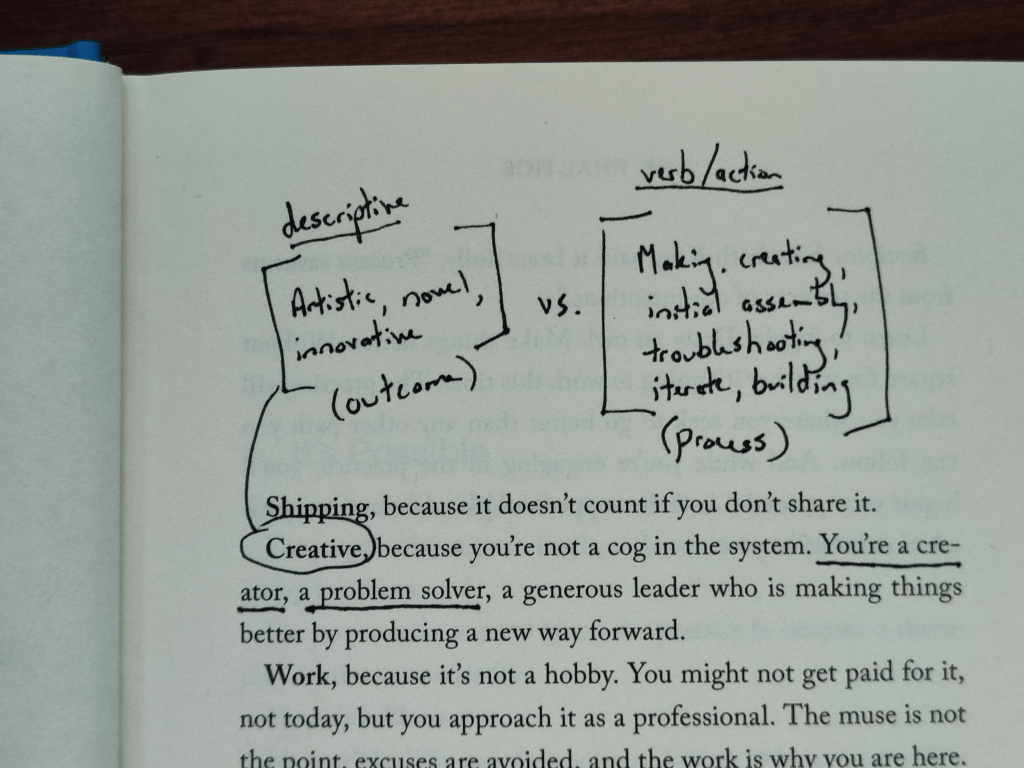
However, the first page of Seth’s new book forced me to reconsider how I view my work. When reflecting on my work, I realized that I was defining “creative” narrowly.
“The Practice” by Seth Godin (2020), page 3
Were you to ask me whether my job is creative, I would probably take a view that conforms to my notes on the left. My job has some elements that I have “artistic” control over, but largely “no” because it’s process driven. However, if I define “creative” more broadly, it’s easy to see how my job is creative. I create tools and process flows. I define problems and find creative solutions, then teach them to others.
We often bind our thinking about “creative” to notions like innovation and novelty (divinely given?), when instead we should think of “creative” as deriving from “create,” which is more process driven than outcomes driven.
This doesn’t solve my tedium with spreadsheets, but it helps me frame my work within a different context. I am not just a cog, but instead I have the ability to adapt the cogs I use to suit my needs.
According to Seth Godin, there is no such thing as writer’s block. He’s been on my mind recently, not just because I listen to his regular podcast, but also because he’s doing the book marketing circuit on the podcast shows I typically listen to. As of writing (November 3rd), his latest book was just delivered to my door.
From what I understand, Seth’s belief is that writer’s block is a function of our desire to not ship bad work. Instead, we hold out until a good idea arrives and we work on it. His advice to overcome “writer’s block” is to constantly write regardless of how bad you think it is. It’s a bit of a spaghetti approach – you throw as much at the wall and see what sticks. He maintains that buried under all the bad writing, there is bound to be some good stuff. The job of writing bad stuff is to eventually unearth the good stuff for you to work on and polish to completion.
Seth is known for having posted on his blog every day for over a decade, tallying over 7000 posts. He says that for every post we read, there are up to 8 that didn’t get published.
Something that I’ve started taking more seriously as of late is the idea that there is a seasonality to learning some things in life. In this case, I mean “seasonality” not in the calendar sense that we experience during the year (Spring, Summer, etc.), but more in a broad metaphorical sense, such as seasons of life. I think there are seasons of our lives where certain lessons are easier to learn than others. This is not to say that you can’t learn them outside of the “right” season, but that some lessons are easier to learn at certain points in your life.
For instance, I’ve heard complaints about the secondary school system’s curriculum not teaching useful skills. Where the modern high school student is wasting their time learning about Shakespeare, the argument goes, they should instead be focusing their attention on more practical matters such as learning how to budget.
I’ve long been skeptical of this criticism for two reasons. First, I don’t think it should be the job of the school to teach every skill that’s deemed important. When people complain that they didn’t learn useful things in school like how to do laundry, how to eat properly, how to do taxes, etc., I place the blame of the lack of skills on them and their parents. Those bits of know-how are readily searchable online now, and short of an accessibility issue with being able to use technology, I see no reason for being ignorant. No, instead, I see school as the domain of more specialized knowledge that would be challenging to teach in the home environment by your parents who otherwise might not be skilled in teaching subjects like the maths, sciences, and humanities.
However, the second reason why I don’t find those arguments persuasive is that there are some concepts that are not easily absorbed at that time of your life. I can only speak from my experience, but when I was a teen, I wasn’t earning an income to support myself, nor was I carrying the bills and debts that would require me to keep a budget. I didn’t have the frame of reference, experience, or need to learn those kinds of skills. Instead, I understood what it meant to set up a budget, but not how to actually keep it.
I’m finding the same for home repair during this season of my life. Prior to owning my own home (where I am directly responsible for its upkeep and my family’s comfort and security), I didn’t feel an incentive to invest time and energy into learning how to maintain the home. Growing up, I would help with the chores and some light maintenance, but otherwise my parents largely were the ones who did the important stuff with troubleshooting problems. Now, those responsibilities fall squarely on my shoulders, and I’ve had a number of instances where I’ve had to pay costly invoices to tradespeople for repairs and work that largely could have been handled by me had I possessed a better understanding of how my home worked.
This is not to say that people don’t learn these skills when they are young. Whether it is through personal interested, a keen disposition, or a patient and knowledgeable parent/mentor, plenty of people know how to do amazing things by hand that puts my simple repairs to shame. Nevertheless, I have now reached a season where I’m more receptive to these lessons, and I’m embracing them with an open mind and a willingness to try.

 A Paramedic's Notebook