Last week, I reflected on competence, confidence, and parenting. Turns out Eleanor Roosevelt had a more inspiring insight:
“You gain strength, courage, and confidence by every experience in which you really stop to look fear in the face. You are able to say to yourself, ‘I have lived through this horror. I can take the next thing that comes along. … You must do the thing you think you cannot do.” (~You Learn By Living)
During my period of unemployment, I reflected on my career and identified a few areas I could develop now that I had some spare time on my hands. One of those development areas is seeking an ASQ certification as a Six Sigma Green Belt (h/t to Andrea for the suggestion!). At first, I delayed starting because I was looking for a low-cost near-free course to guide my study, such as something on Coursera I could audit, learning paths on LinkedIn Learning, or a discounted Udemy class I’d already purchased. But as I started watching the video modules, I quickly realized I wasn’t truly engaging. I was watching lecture content without retaining much. While yes, watching at 2x speed is largely to blame for it, I couldn’t escape the fact that I was engaging in passive consumption.
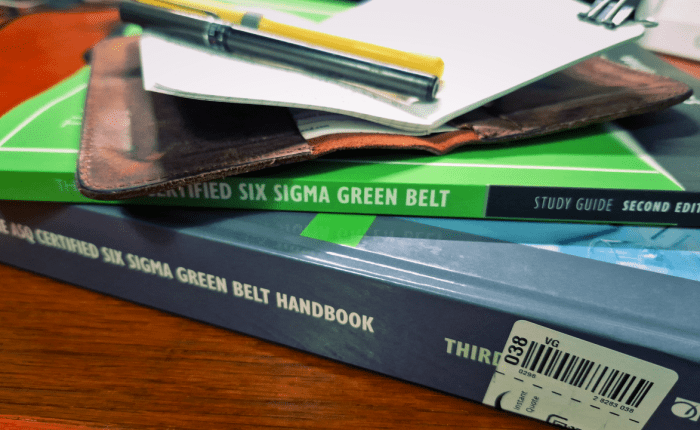
While I waited to figure out how to learn the material, I looked up the ASQ requirements and purchased used copies of the Six Sigma green belt handbook and a test prep study guide with practice questions.
Knowing that getting started is better than waiting around for a perfect plan, I started reading the handbook and planned to sort out my study strategy as I went. Almost immediately, I began connecting concepts to my past work and imagining how I could apply them now in my current role.
That’s when I realized: I’d done this before.
Paramedicine (2015–2016)
In 2015, I hit the transition point between early and mid-career phases and started questioning if I was on the right path (I found office work not very fulfilling). I thought it was a good opportunity to seek a career change and embark into paramedicine – I had a passion for first aid, I was a first responder on a few occasions in university (shoutout to University of Waterloo Campus Response Team!), dealt with emergencies while working as a bouncer, and I had written my masters thesis on the ethics of first aid. It aligned with my values of helping people and provided a fast-paced technical job that would give me fulfilment.
The first step was meeting the admissions requirements, which included needing a high school biology credit. I enrolled in a self-paced college prep biology course.
There was no active instructor; just a course outline, a textbook, weekly tests, and two major summative exams. Here’s how I approached it:
Used the course outline and test schedule as a learning roadmap – Matched unit outcomes in the course outline to textbook chapters covered on tests – Prioritized readings based on the self-paced testing schedule
Created active study tools – Flashcards for definitions and concepts – Hand-drawing diagrams (cells, organs, systems) labeled front-and-back for drill practice
Focused on comprehension-level mastery – Enough to explain, label, and connect systems without unnecessary complexity – The test was multiple choice, true/false, and labelling diagrams, so sticking to the first two levels in Bloom’s taxonomy was sufficient.
This gave me a clear plan and a feedback loop through frequent testing. I passed the course with an above 90% final grade.
Samples of my flash cards and hand-drawn diagrams.
The Present
For my Green Belt prep, I have:
A roadmap: The Body of Knowledge in the handbook’s appendix, which outlines each section, topics, and the number of exam questions per section.
Content: The handbook itself for deep reading and marginalia.
Practice: A test prep guide with exam-style questions.
By combining these, I can map my study plan to the exam structure. I also asked AI to use my weekly time constraints to suggest a manageable plan to break up the work and prepare to take the test by mid-Fall. Then, I can prioritize topics by weighting and test my knowledge incrementally as I go.
The Lesson
I realized I don’t always need a formal course, especially for a certification with a defined body of knowledge and predictable exam format. By having a clear syllabus, a learning map, a primary content source to learn from, and a way to test and reinforce learning, I can direct my learning effectively.
Courses have advantages: expert guidance, tailored examples, real-time feedback, and adaptive teaching. However, courses are not the only route for learning and self-development. By having a well-defined body of knowledge to study from, and using active learning methods like taking notes, journaling on my learning, short feedback cycles, and finding ways to apply the content to my work and experience, I have all that I need to be successful. All it will cost is some used textbooks, a registration fee, and remembering a lesson I learned a decade ago.
You never intend to step away for very long. A week goes by, then another. Without realizing it, a month has passed.
It can sometimes be hard to keep up a weekly blog. I don’t know how the daily folks do it – Seth Godin says it’s just consistency, but does that mean it’s easier to show up everyday than once per week? Maybe… It’s harder to push off to tomorrow when the deadline is always midnight. I’m not impressed by the folks whose job is to churn out multiple pieces of content per day. Creative burnout aside, there is a difference between being paid for the content and doing it without pay.
Excuses are easy, especially when they are real. Yes, I didn’t set time aside to write, but I also had a major deliverable due at work. I even set up auto-responders on my emails to manage people’s expectations while I was in focus mode. These are reasons, but they do not excuse the absence when you know what you are getting yourself in to.
And when you return to the notion of an update, you feel the need to write something profound to offset the time away, but the ideas feel crusted and not worth sharing. Instead, you hide away, and figure you’ll get back to it next week, meanwhile the feeling of panic and dread increases at the thought of delivering that perfect post.
But next week comes and goes.
There is no magic solution beyond showing yourself compassion, resetting the clock or counter, and shipping the next thing by trying again.
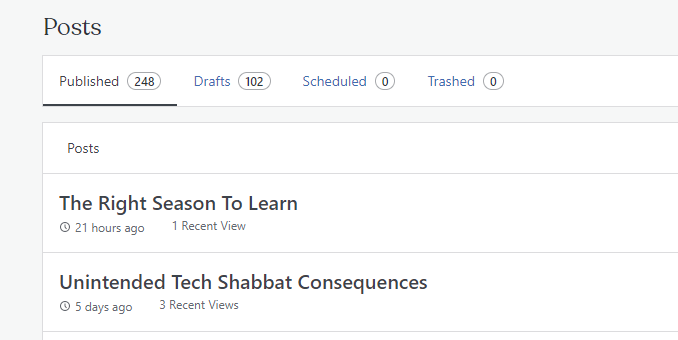
I uploaded my post last week without much thought. When I went back to draft some ideas for a future post, I saw that Beachhead was my 301st post. I missed the opportunity to both celebrate the milestone and reflect on its significance.
Earlier this year, I missed the 5-year anniversary of this blog. I let the milestone pass by, unlike yearspast. I think part of the lack of enthusiasm for these significant milestones is due to general pandemic-induced apathy (we’re all feeling it). But the optimistic side of me also thinks that these milestones are less important than the work itself. I used to be more metrics-driven with my blog, excitedly noting the passing of the first year or the first 100-posts. However now I’m not concerned with reaching a future target but instead focus more on ensuring I’m keeping up with the weekly schedule and trying to come up with decent thoughts worth publishing.
That’s not to say that all of my posts are worth reading. I wouldn’t say I take a lot of pride in the final product of what goes up weekly; I’m not ashamed either. It’s just that the quality of the final draft isn’t as important as sitting down to do the work. Of taking an idea from brainstorm to coherent narrative. I find more satisfaction in putting in the work than the bragging rights of the final product. I try to think of it as more of a craft-mentality rather than creating a masterpiece corpus of writing.
Each post is an exercise that stretches the muscles, practices the movements, and gives me an opportunity to learn and develop slowly over time. At present, this blog operates at a loss (no income is generated to offset the nominal fees I pay for the site and URL). And I’m completely fine with that. At one time I thought about turning this into a brand and trying to monetize it. I’m not opposed to scraping money out of the endeavor, but it’s not the primary focus of this blog.
When I shifted away from the blog being an exercise in becoming a paramedic, it merely became a place to publicly share my practice of writing to meet a deadline. That’s good enough for me. It doesn’t have to seek to achieve anything grand – not everything has to be epic or monetizable. It’s still fun and I feel good shipping the work. As the mass of posts grow, I can look at the incremental progress and take satisfaction in what it represents – time well spent.
Last week, Seth Godin wrote a poignant observation about the wisdom of refilling your gas tank at the right time. This of course was a metaphor; it’s not about literally filling your gas tank (except when it is). Instead, the observation is about recognizing that you are better able to weather uncertainty when you are mindful about resources, whether that’s financial, physical, human, or even your own attention.
Yes, sometimes we are so strapped for time that it’s hard to remember to prioritize fil1ing before empty, but if you pay attention to your resources, then as he says you can “have your emergency on your own schedule.”
His post was well-timed, because I’ve found myself falling behind this week on some critical tasks. When I reflected on it in my journal, it’s easy to say I was busy. It’s true, I was busy – I was in a lot of long meetings, I had appointments, and obligations at home. But I’m always busy, so this week wasn’t necessarily out of the ordinary.
Instead, my lack of progress is due less in part to other people’s demands on my time, and instead it’s largely due to my own poor planning and preparation. Without an appropriate plan for the time that was all my own, I was left to flit carelessly to this whim and that urgent thing.
As a reminder to myself, open blocks of time in my calendar are not default downtime. I have more control over my time than I realize (or behave).
According to Seth Godin, there is no such thing as writer’s block. He’s been on my mind recently, not just because I listen to his regular podcast, but also because he’s doing the book marketing circuit on the podcast shows I typically listen to. As of writing (November 3rd), his latest book was just delivered to my door.
From what I understand, Seth’s belief is that writer’s block is a function of our desire to not ship bad work. Instead, we hold out until a good idea arrives and we work on it. His advice to overcome “writer’s block” is to constantly write regardless of how bad you think it is. It’s a bit of a spaghetti approach – you throw as much at the wall and see what sticks. He maintains that buried under all the bad writing, there is bound to be some good stuff. The job of writing bad stuff is to eventually unearth the good stuff for you to work on and polish to completion.
Seth is known for having posted on his blog every day for over a decade, tallying over 7000 posts. He says that for every post we read, there are up to 8 that didn’t get published.
Note – this is an experimental posting format. I’ve thought about increasing the number of posts I commit to per week, but I don’t want to add unnecessary work if I’m not willing to stick it out. Let’s be honest: sometimes it’s really hard to get a single post out each Monday that I’m satisfied with, so increasing my posting frequency just to for the sake of increasing my output is a terrible idea. I will run a short experiment to see how easy it is for me to get out a Friday Round-up for the next month. If the experiment goes well, I’ll consider making it a part of the regular rotation.
Many of the bloggers and thinkers I follow have some sort of curated list they share on a regular basis of the best pieces of content they came across in their weekly browsing. During this week, I came across a few thought provoking posts that I felt deserved to be shared.
Here is my round-up list for the week ending on April 24th:
We should be reminded that maps are not the terrain, and that models are predictions (read: guesses), not certainty. We rely on models to help us understand the world, but we should remember that they have their limitations.
Paired nicely with Seth Godin’s post above, Dr. Attia gives a good lay-primer on how a model is created, and what the limitations are when trying to model something like a virus when so little is known about it. The two takeaways I have from this piece are: we should be more willing to accept that good models gives us ranges, not fixed numbers (and we should be more comfortable with the ambiguity); and just because the worst case didn’t arrive, it doesn’t mean that the model was overblown – we need to find out more about why the model was off. It might be that the virus isn’t as dangerous as we initially thought, or it might be that physical distancing greatly impacted the viruses capacity to spread (it’s probably a little of both), but until we know which side maps to reality, we can’t be confident of what we should do next.
This is actually something I’ve used for some time, but wanted to share. When I’m trying to focus, I have discovered that I can’t listen to music (even of the lo-fi variety) because I find the melodies too distracting. However, I’ve found it helpful for me to listen to regularly repeating noises, such as white noise and ticking metronome sounds. I’ve experimented with a few options, such as a 10-hour “cosmic white noise” video, but while working from home during the pandemic, I’ve settled on this Pomodoro video that I also have paired with a Pomodoro Chrome browser extension that plays white noise (the ticking gives me focus, the white noise blocks out ambient sounds in my room). Forcing myself to focus in 25-minute spurts keeps me on track while I move through my to do list.
Let me know if you find any of these interesting or useful. Also, feel free to share your best round-ups in the comments below.
I normally post on Monday’s, but today is the 4 year anniversary of my first post on this site (tomorrow if the 4 year anniversary of my substantive first post, but let’s batch them into this post for funsies).
With everything that’s going on, I wanted to pause for a moment to commemorate my “Hello World” moment on this blog. Even though I still don’t have any concrete plans for this site, I’m still going strong by committing myself to consistently putting in the work. If I’ve learned anything in 4 years, it’s less about the business plan and more about putting in the work. In this case, it’s better to focus on quantity, rather than waiting for the quality to start.
I’ve hit a couple of milestones recently. For instance, last week I hit a nice big milestone in Duolingo when I hit 600 consistent days of doing lessons.
I wouldn’t say I’m particularly fluent in German, but during my trip in October of last year, I was able to follow some of the conversation going on around me and put into practice the lessons given by the app. I was able to manage thanks to small, consistent daily micro-lessons that expanded my vocabulary a bit at a time.
Something similar happened for this blog as well. From time to time I check-in on the site’s stats and analytics. I don’t have any plans or intentions to seek monetization, so I only check in on things out of a sense of curiosity rather than seeking optimization. I originally set up this blog as an exercise to see if I could keep a consistent weekly writing schedule. At the time, I had the aspirations to go back to school to become a paramedic, and so I also had intended to use this blog to apply the concepts I was learning to help me reinforce my learning. I’ve sinceabandoned that path, and so the blog largely remains a project to force me to come up with something to post on a weekly schedule.
I was looking at the stats last week and felt a sense of satisfaction for hitting a couple of milestones. First, it appears that I have not missed a weekly post in the last three years (I might be late posting, but I still get something up). Also, I’m happy to see that overall my words per post are trending upwards, though I hope this means I’m providing more meaningful, nuanced posts rather than just being verbose.
Then, I decided to check on how many words I had written for this blog.
Year
Total Posts
Total Words
Avg Words per Post
2016
37
17,660
477
2017
54
28,625
530
2018
52
26,545
511
2019
52
32,210
619
2020
3
3,075
1,025
Sum
108,115
As it turns out, I had written the rough equivalent of a book in the four years I’ve been at this. Beyond the urge to create something and a desire to force myself to “write more,” the steady drip of a weekly schedule has now pooled into a large body of words.
I take a lot of inspiration from Seth Godin, and I learned from him the value of consistently showing up and putting in the work. It’s not about creating high quality giant pieces of work from fiat, but instead the slow, plodding, steady work of creating a little bit at a time. When you look back, you see the vast distance you’ve covered by forcing yourself to focus on putting one foot in front of the other. Not everything is going to be good – in fact, most of it will suck. But, over time you get better at the work, and sometimes you can find the good stuff emerging from the mediocre.


 A Paramedic's Notebook