Editing with Rapt Attention

Last week I discussed how I created a video training series for one of the ethics boards I serve on. All told, I’d estimate it took me around twenty hours to sketch, film, edit, and publish the series (this is an ad hoc estimate; sadly I didn’t do any time tracking to appreciate the effort). While I’m comfortable with the filming, I noticed a particular period of the work that created a bit of a flow state for me.

On the last day of editing, I was up against a bit of a deadline to finish the videos and push them out to the trainees. I admit that the deadline helped me to focus more (or at least resist the temptation to get distracted), but I noticed that when I was editing the videos, I hit a bit of a flow state. It’s not that I found the tasks particularly challenging, but there was something about the rote, somewhat monotonous task of watching and cutting footage that helped me move through the videos fairly quickly. It was almost 4-hours of editing before I felt like I should take a break to stretch and shift my mind to something else – the time seemed to go quickly. Then, after my break, I returned for another multi-hour stretch to finish off the last of the videos for the rendering queue.

It’s not often that I feel myself working in this state, where time gets away from me for hours at a time. In fact, most of the time I feel somewhat disengaged with my work, and I have to apply discipline in order to work on tasks. This was a rare example of working on something that felt right.

I joked with my wife that I wish I found a job as an editor, but I was only half joking. The lesson I take from this is to be mindful with how I engage with activities that trigger flow, and find a way to go back to that state in other areas of my work.

Stay Awesome,

Ryan
Meaningful Actions

Over the weekend, I attended a virtual board meeting for engineering education. One of the reports pertained to a working-group’s findings and recommended actions to support the aims the 30 by 30 Campaign to address low representation of women in the engineering profession. This is a great initiative and I’m looking at ways we can improve our own processes to support women in STEM in our programs at the college. There was a comment that made me think, and it’s worth considering.

One of the board members expressed support for the report, but also commented that she had provided input as early as the 1990’s on this very initiative. Her comment was not meant to cast doubt over the process, but instead highlighted two important things – that this is not a new issue, and that many people have tried to make sweeping changes for the profession, which clearly hasn’t been entirely successful. Her advice was to be cautious about taking on too much scope with the recommendations, and instead to support a “divide and conquer” strategy for making targeted, meaningful actions to promote change.

I don’t hold any illusions that we will solve systemic issues overnight. If I’ve learned anything this past year, it’s that my hopes for reform are likely to fail and that instead of refinement, we should be aiming at transformative changes.

There is also another tension – on some level, this line of thinking suggests a teleological progression of progress for society and culture. I want to think that our culture is aiming at progress (“the arc of the moral universe is long, but it bends towards justice” is a powerful vision to work towards), but a skeptical voice reminds me that, like our misunderstanding of Darwinian evolution, there is nothing inherent in the progress of change that aims towards a higher, final form. A kind of defeatism can creep in when one thinks that meaningful actions do not contribute towards progress, but instead are just the spinning of our collective wheels.

I reject this defeatist view and want to aim towards a higher vision. I grant that the universe is largely amoral and unconcerned with our progress. So, instead, we must clearly define our values and principles, and take actions towards achieving these ends. The actions are neither good nor bad in an absolute sense. Rather, we mark progress with how close we come to realizing the values we want to see manifested in our lives. Meaningful actions are measured not against morality, but instead on efficacy for the outcomes. There are trade-offs and consequences along the way, and so we must be prudent. Both history and mythology have given us plenty of examples of why hubris should be avoided.

I don’t have a good answer on what meaningful actions we ought to settle on as part of our agenda. As noted, this issue has been discussed far longer than my tenure in the employment game. I’ll defer to folks much smarter than I, and try to learn from their efforts to do my part.

Stay Awesome,

Ryan

Falling Through My Systems

This late post is a nice springboard into something I’ve been thinking about throughout the pandemic. Pre-pandemic, when I was still commuting to work, I had a fair number of systems to help me get stuff done. My commute to work helped me film daily vlogs, listen to books, and think about big ideas for blog posts and Stay Awesome vlogs. When we started working from home, those outputs began fading. Now, I feel behind on my blog posts, I *maybe* film a personal vlog once every two weeks, and Stay Awesome has been put on an indefinite hiatus until Jim and I get some extra headspace bandwidth to devote attention to it.

I was also known for my notebook. I carried a Field Notes notebook everywhere with me, and was constantly scribbling notes into it. Then, around 4 months into working from home, I found myself abandoning the monthly notebook and appropriating a disused larger notebook to jot down tasks, lists, and random thoughts. The Field Notes book was small, portable, convenient, and had many systems to track things I found important, such as exercise, health, habits, etc. Now, my notebook is largely devoted to task management, because when every day feels the same, you can quickly find yourself several weeks down the line having nothing to show for your time.

In a sense, I’ve fallen through my systems. The various “systems” I implemented succumbed to inertia when I both lost the cues that triggered them and lost the will to keep putting effort in the system to power the flywheel, and friction has ground them to a halt.

James Clear has a pithy phrase, that “you do not rise to the level of your goals. You fall to the level of your systems.” This is a riff on an older Greek observation from Archilochus: “We don’t rise to the level of our expectations, we fall to the level of our training.”

Regardless, the question I have is whether I truly had a system if it was a fair-weather operation that wasn’t robust enough to adapt to these kinds of radical changes. When I lost the external liminal cues that came from commuting to work, or from even leaving the house on a regular basis, the things I called systems disappeared as well. Is it charitable to call these things “systems”? In virtue ethics, you aren’t said to possess a virtue if you only exercise it some of the time – you aren’t considered courageous if you don’t act courageously in a moment that requires it. Does this apply to systems as well?

Part of me says yes, but that’s not very helpful. Perhaps I should reframe my thinking and consider the quality and attributes of the system. Borrowing from Taleb, some systems are fragile, some are robust, and I suppose some are antifragile. I understand antifragile systems in the context of biology (e.g. stressing muscles can allow them to get stronger over time), though as of writing I can’t think of any productivity system that get stronger under pressure.

Regardless, it’s clear that much of my productivity was built upon what can now be labelled as fragile systems. They worked under certain conditions, but outside of that narrower band they are less able to withstand fluctuations or variance. In my reflections over the last few months, I’ve been seeing the value in understanding the causes of system failures so that I can create new processes to help me in work and life. For now, the first step is to acknowledge that I’ve fallen through my systems, and having acknowledged this, I can stop spinning my wheels and start seeking traction.

Stay Awesome,

Ryan

WFH: Struggles in Focus

In March, I will have been working from home (WFH) for a full year. You’d think that with my experience being employed pre-pandemic, I’d know how to manage my time and motivate myself. But, I have to be honest that working from home has had its challenges. Every time I think I’ve got it figured out, I somehow end up reverting back to a less productive mode of work.

You’d also think that after working from home for a year that I’d have a handle on the situation, yet there, too, I’m finding it difficult. I could attribute it to having a child and the challenges that come with that level of life adjustment, but I feel that would be a disingenuous excuse for my poor integrity.

I know I’m not alone; many people are feeling this. In the beginning, the articles were about learning to draw boundaries in work/life balance. Then came the articles urging us to dress for the office, trying to capture the liminality inherent in a structured schedule. Then came the posts lamenting the late nights with alcohol and doom-scrolling. We all are feeling the anxiety of trying to remain in the present while our focus is pulled towards thoughts about a dimly lit uncertain future.

The best I can do is continue to experiment and see what sticks for me. At the moment I’m trying to be more intentional with my work calendar. I set up to three priorities for the week, block off time in my calendar to work, and spend the first moments at the beginning and the last moments at the end of the day to plan, reflect, plan, and review.

One thing I’m enjoying with this approach is that I’m having an ongoing dialogue with myself in my work calendar. At a high level, I’m leaving a paper-trail of my thoughts, and with that trail I can autopsy where I’m successful and why I fail. But in the day-to-day moments, voices from the past come to help my present understand itself, then I leave little notes for the future to pick things up after rest.

I’ll keep practicing this approach and write some comments in the future, if it sticks.

Stay Awesome,

Ryan

The Discomfort of Learning

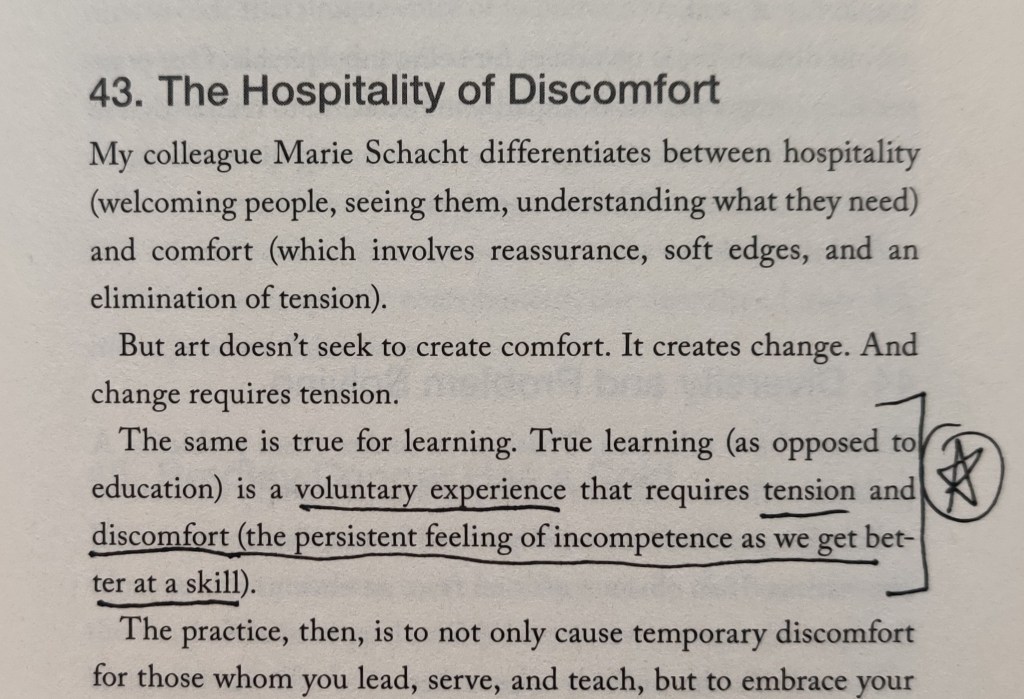
Here’s a reminder to myself: learning is always uncomfortable.

As I was reading through Seth Godin’s latest book, The Practice, I came across this gem of insight.

“The Practice” by Seth Godin (2020), pg. 53

It is often the discomfort and tension that causes me to avoid learning new things and settling into my work. When I feel the anxiety rise, I’ll switch gears to something more comfortable or distracting. Instead, I need to embrace the suck.

Learning is voluntary – I must want to engage with it.

Learning creates tension – personal discovery in unfamiliar territory creates questions of tension, and each answer I find resolves the tension. Tension and release.

Learning is uncomfortable – it’s hard to willingly feel incompetent when our careers are geared towards increasing competence and confidence.

I need to learn that when I feel uncomfortable in the learning process, this means I’m on the right track and should embrace the feeling.

Stay Awesome,

Ryan

What Is “Creative” Work?

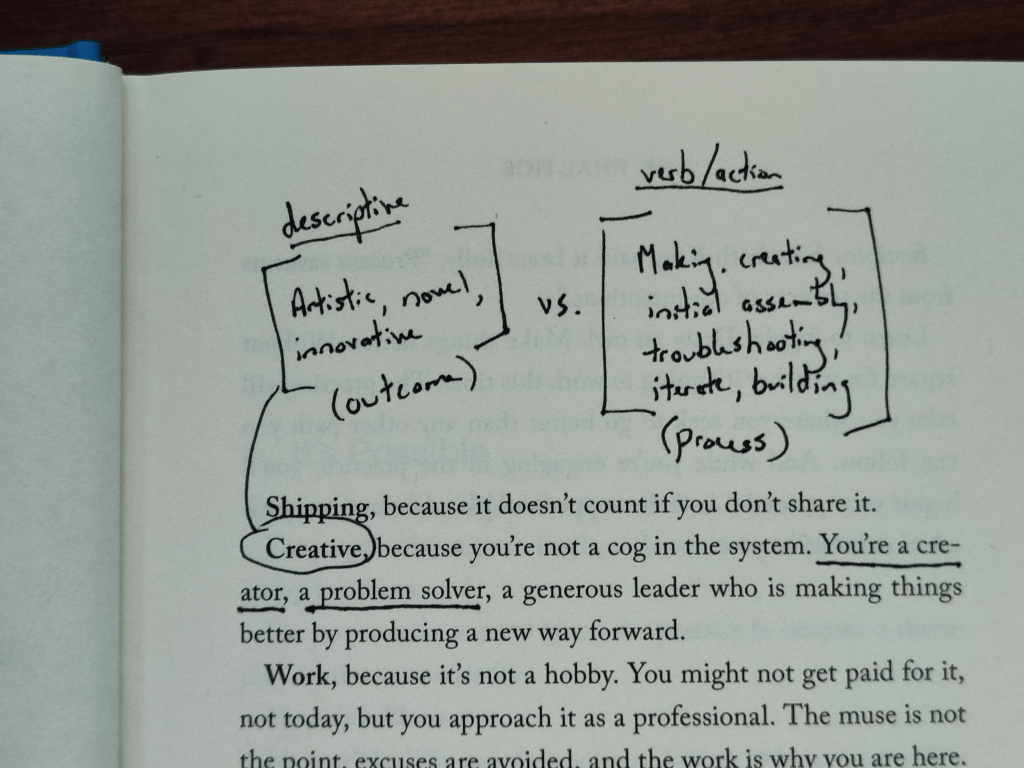
One thing I love about reading Seth Godin is how he tends to reframe how I think about things. Like many other people, I’ve been feeling in a bit of a rut with work. Without the context shift of going to work in an office, the days start to blur, and working from a distance keeps me detached from my colleagues. Instead, my work is largely done on documents and spreadsheets, and the tedium easily sets in. It feels monotonous and largely procedural.

However, the first page of Seth’s new book forced me to reconsider how I view my work. When reflecting on my work, I realized that I was defining “creative” narrowly.

“The Practice” by Seth Godin (2020), page 3

Were you to ask me whether my job is creative, I would probably take a view that conforms to my notes on the left. My job has some elements that I have “artistic” control over, but largely “no” because it’s process driven. However, if I define “creative” more broadly, it’s easy to see how my job is creative. I create tools and process flows. I define problems and find creative solutions, then teach them to others.

We often bind our thinking about “creative” to notions like innovation and novelty (divinely given?), when instead we should think of “creative” as deriving from “create,” which is more process driven than outcomes driven.

This doesn’t solve my tedium with spreadsheets, but it helps me frame my work within a different context. I am not just a cog, but instead I have the ability to adapt the cogs I use to suit my needs.

Stay Awesome,

Ryan

Unintended Tech Shabbat Consequences

This week’s post is late. The proximal cause is that because of the Tech Shabbat experiment, I was shutting my computer down for the weekend. Weekends are the most common time I write and prepare to publish my posts. Therefore, an unintended consequence of the Tech Shabbat is that I didn’t have a post ready for Monday.

However, that is a poor excuse when we consider the distal causes of why the post is late, because the Tech Shabbat was a known event in my calendar. It wasn’t something that was unanticipated, and I knew roughly what participating in the Tech Shabbat would entail. I knew, for example, that I had to get my course marking done before the Shabbat if I wanted to give my students their feedback with sufficient time for them to use my feedback in their next assignment. I was able to always get my grading done before the Tech Shabbat began each week of the experiment, so why did I not do the same for the weekly blog posts?

The Tech Shabbat became a convenient excuse to blame, when really the blame lies with a poor writing habit. Maybe I would have finished the posts had I not participated in the Tech Shabbat, but instead of dwelling in a possible else-world, I should focus on fixing the things I have control over, such as my schedule and how I set my priorities.

Proximal causes are easy to fixate on, and are often more expensive to address (it’s why we spend lots of money on shiny new toys that promise to fix our problems). Distal causes can be harder to spot and require longer, steady investment to overcome.

Stay Awesome,

Ryan

Still Adjusting

I had planned intended to write a post over the weekend. No plan survives contact with the enemy, as Helmuth von Moltke quipped, and between the Canadian long weekend and a new baby, my intentions are still not getting turned into plans or actions. It’s all part of the learning process, and I have a ways to go.

As I continue to adjust to my new life, I will have to continue to adapt and learn new ways to get things done.

Stay Awesome,

Ryan

Friday Round-up – July 24, 2020

Let’s keep the momentum going from last week!

Here is my round-up list for the week ending on July 24th:

💭Reflection – Books as Monuments – Ryan Holiday (Instagram)

Last week Ryan shared the following post:

I have a vague recollection of when Madison Holleran died by suicide in 2014, though less about her as a person and more because of the conversation it sparked around mental health and how social media can portray a perfect life despite the hidden struggles of the person. I’ve yet to read this book, however as I was reflecting on this post I realized that this isn’t a book about a famous person, but it still stands as a monument to a life. That felt like a weird mental juxtaposition against the conversation going on about monuments in general and what we choose to remember. During a recent conversation with my grandmother, she was showing me photos of friends from her past that have since passed away. For nearly every person on the planet, your legacy extends only as far as your genes and the living memories of those who knew you. And yet, sometimes we pulp trees into paper and create a monument that will be read in the future. Monuments are not accidental – it’s a reflection of what we choose to remember. Madison’s life was tragically cut short, but at least she remains more than a fragile memory.

🎧Listen – What You Need To Know About Protective Face Masks – NPR Life Kit

There is a lot of misinformation around the effects of wearing a mask. Here is a good quick summary. tldr: it prevents the wearer from spreading germs and it does not prevent one from breathing adequately. I’ve demonstrated this for myself by donning a non-surgical mask for the last two weeks of running on the elliptical. To date, in the 30 masked-miles I’ve run (roughly 3.5-hours of exertion), I have yet to have any symptoms related to hypoxia.

📖Read – Graduating during a downturn | A Learning a Day blog

Two paragraphs stood out in this post that resonated with me:

By all accounts, COVID-19 is a ridiculously bad time to graduate. It isn’t just a bizarre year from the perspective of the job market. Graduates who have a job will face an unusual first year as part of the workforce. With organizations and the people generally unprepared and dealing with multiple stressors, they’re unlikely to get the training that they need on the job.

These are moments when you realize how big a role dumb luck plays in any professional success we enjoy. It is so easy to attribute things that are going well to our smarts and hard work. But, there’s so much more to any success than that.

Reading this made me reflect on my own career to this point. I finished my undergrad in 2009, the year after the 2008 economic downturn. I was fortunate to be accepted into grad school, where I stretched a 1-year program into a 3-year experience by the time I finished writing my thesis. That put me into the formal job market at the tail end of 2012, four full years after the markets took a dive. I was lucky to enter the working world while the economy was rebounding, and I didn’t have to face the same setbacks and struggles that many of my cohort felt (that is, had I not did my 5th year “victory lap” in high school, I would have finished undergrad a year earlier with my secondary school classmates). In this, I was very fortunate that my choices became opportunities of timing, and something worth keeping in mind as context.

Stay Awesome,

Ryan