History vs The Past

While listening to a BBC podcast about Heroditus, the panelists described how Heroditus set about his project with the purpose of recording events with some accuracy before the details were lost from memory. Unlike some historians from Greek antiquity, Heroditus was writing about events that were within his lifetime. This created a new kind of writing that set itself apart from others in his genre because it aimed at corroborating stories rather than recording myth.

This is an interesting distinction worth keeping in mind. There is a difference between “history” and “the past.” It can be helpful to think of history as a subset of the past. History is the collection of stories we tell, and as a consequence it is necessarily selective in what gets included and what is left out. This makes sense from a practical standpoint – it is nearly impossible to capture every detail, nor does every fact in the past bear a tangible, causal relationship to the story being told (even if arguably from a systems perspective, many things create ripples of unknown influence that overlap with other events).

The challenge of history is accuracy – capturing events that happened with fidelity and charity. As new facts are discovered, and as new facits of importance enter the discourse, history is revised to (hopefully) move closer to our aim of truth. (For the moment, let’s ignore questions about power and who tells these stories and for what aim).

However, we must not confuse history (the stories we tell) with the past (events that happened prior to the now). Ignoring this distinction places us in danger of imbuing our myths with an illusion of objectivity. The stories we tell ouselves matter, of course, but they also carry power. Who tells the stories, and whose stories get left out, can carry harmful consequences.

We try to learn the lessons from history, but we cannot be so arrogant to think that history is complete.

Stay Awesome,

Ryan

My Best Interest

If you want a good newsletter, you should check out Arnold Schwarzenegger’s newsletter. I signed up a few months back and have thoroughly enjoyed each update. I find him such a fascinating and inspiring person, not just from his bodybuilding work, his acting career, or even his time in politics, but above all because he strikes me as a fundamentally decent person.

He made two interrelated observations in the latest issue that stuck out for me. A significant portion of the email dealt with his clarifying and elaborating on his viral “screw your freedoms” moment during an interview talking about why people should get their vaccines. In his expanded comments, he urges his readers to pay attention to the motivations of people trying to give them advice, and discard those opinions which are not in your best interest (including his own). By this, he means fitness influencers and politicians, whose motivations are clicks and ad revenue in the former, as well as outrage, donations, and votes in the latter. When it comes to your health, these people are not giving advice based on your own health and wellbeing.

The second related comment is that if you can’t trust government or social media, who should you trust? To that, he says you should trust your doctor because your doctor took an oath to protect you. Your doctor is paid with only one expectation in return – the promotion of your wellbeing and health.

Talk to your doctor, not people who don’t have your health as their main responsibility. The Instagram and Facebook accounts you follow that give information on vaccines are not concerned about your health. They are concerned with getting more followers and making money.

I have seen way too many stories about people who listened to politicized information about the vaccine instead of their doctors, and then changed their minds when it was too late.

At the end of the day, everyone has to make their own decision about getting vaccinated. But if I can inspire even a few of you or your friends or family to avoid another one of these tragic stories that tore families apart, I want to do it.

He urges us to trust the experts and take wisdom from their experience. When presented with advice, we should ask ourselves what the advice-giver gets in return for our compliance. Do they benefit from our participation? What do we lose by their gain? These are important checks that we should make when deciding what’s in our best interest.

Stay Awesome,

Ryan

The Insidious Internet Business

I love Hank and John Green from the vlogbrothers YouTube channel. I don’t know how they manage to crank out so many thoughtful videos, but each time I check-in, I’m treated to another video where they somehow connect a thoughtful musing into a reflection of substance.

Feel free to check out the full video of one of Hank’s recent entries “Wrong on the Internet,” but below I have captured some of the interesting points that connected with thoughts I’ve had and resonated with me.

  • Layperson epistemology – it’s difficult for the average layperson to make sense of conflicting/contrary pieces of information when the business of the internet is motivated towards churning out content that screams for your attention.
  • Similar to the incompleteness theorem, solutions we create for problems will be temporary until we innovate new solutions based on updated information and advances in technology. This can bring about cynicism related to Kuhnian-style revolutions of our worldviews, that problems never seem to go away.
  • The internet business is not an information game, it’s a rhetoric game. Rhetoric is the prime mover of information, especially when hard data is absent. You can whinge about how “the other side” is devoid of logic and refuses to see the truth before their eyes, or you can accept this as a fact and play the game to win the rhetoric game.
  • Memes (of the information variety, not the funny pictures kind) that make you feel good smug are super dangerous for distracting the issues. Corporations might be the biggest cause of our climate or capitalist problems, but we can’t just immediately remove them and expect all our woes to be solved. The services they provide are still required for society to function.
  • Shifting blame breeds complacency. Instead, personal accountability and action at the individual level are still important.
  • A problem well-formed is half solved, but the internet business is not about forming good problems. In our smugness, we play games to win or gain prestige, and so reactions move far quicker and are easier than responses. In order to create well-formed problems, we need to place greater value on responding to solutions, articulating our values, and using tools like science, politics, and economics to optimize according to our values. (h/t to Seth Godin’s thinking that influenced me here)
  • On the topic of responding to emergencies (starting at 2:40 of the video), it’s important to remember in our smugness that we are not, in fact, rational creatures.
  • The insidious effect of the internet business: “If the tweet makes us feel good, we don’t tend to spend a lot of time doing a bunch of research to tell us whether or not it actually is good.”

Stay Awesome,

Ryan

Beyond the European Default Follow-up (7/4 time)

Last week I shared some thoughts on appreciating musical languages developed beyond the European music theory standard, and how it can be inappropriate to judge musical modalities using the vocabulary and standards of your cultural (musical) heritage. This isn’t to say that viewing art through different lenses can’t bring about interesting discoveries of the artform, but rather using one standard to pass a value-judgement of the merits of an artform can be fraught with problems.

Thanks to YouTube’s algorithm, the recommended videos feed provided some great gems appreciating the original. Through a drum cover, I learned the original was in 7/4 time (whereas I thought it might have been alternating 2/4-2/8 measures; sounds like I missed a 1/8 beat).

And here was another drum cover with some artistic interpretations on the beat.

I was able to learn a bit more about Konnakkol, and how it builds increasing complexity to the music.

And here was a great beatbox cover that got a shoutout from the male performer in the original video, Somashekar Jois.

Finally, I found that Somashekar Jois has a YouTube channel where he teaches lessons in Konnakkol. I was a little nervous about posting this since one of his past videos was an artist’s endorsement for Prime Minister Modi of India, but I still felt it important to provide the link here to learn more about the artform. If possible, I’m trying to focus on the art, rather than the artist (or his whatever his politics happens to be).

Oh, and a recent video from Adam Neely again touched on the problems with passing judgement on musical performance when you don’t critically engage with the sources of your musical taste. At best, you are falsely applying a single standard as a universal judge of taste, and at worst you are using music theory to justify sexist bullying of people just trying to have fun creating.

Stay Awesome,

Ryan

Initial Assumptions

I was reflecting on Seth Godin’s musings about the number of moons in our solar system. The initial assumptions we use to make predictions about our world can sometimes be orders of magnitude off from truth.

We as humans don’t like to be wrong, but we shouldn’t be overly concerned with our initial assumptions being off the mark. After all, if we knew the truth (whatever “truth” happens to be in this case), there would be no need to start from initial assumptions. It is because we are starting from a place of ignorance that we have to start from an assumption (or hypothesis) in order to move forward.

The problem lies with whether we realize we are making assumptions, and how committed we are to holding on to them. Assumptions made about the physical world can often be value-neutral, but assumptions that intersect with the lived experiences of people always come pre-packaged with history that’s value-loaded. It’s fine to make an assumption that your experiences are shared with others, but that assumption can only be carried so far. At some point, you have to acknowledge that there will be a lot missing in your initial assumptions that need to be accounted for.

The lesson then is this: when working from an estimation or prediction, be careful with your initial assumptions. It’s fine to begin with your own experiences, but always put an asterisks beside it because your experience is likely not universal. We must guess, then check. Test, verify, then revise.

Aiming at truth is a noble goal, but we should settle for asymptotically moving closer towards it as it more likely reflects reality.

Stay Awesome,

Ryan

Falling Through My Systems

This late post is a nice springboard into something I’ve been thinking about throughout the pandemic. Pre-pandemic, when I was still commuting to work, I had a fair number of systems to help me get stuff done. My commute to work helped me film daily vlogs, listen to books, and think about big ideas for blog posts and Stay Awesome vlogs. When we started working from home, those outputs began fading. Now, I feel behind on my blog posts, I *maybe* film a personal vlog once every two weeks, and Stay Awesome has been put on an indefinite hiatus until Jim and I get some extra headspace bandwidth to devote attention to it.

I was also known for my notebook. I carried a Field Notes notebook everywhere with me, and was constantly scribbling notes into it. Then, around 4 months into working from home, I found myself abandoning the monthly notebook and appropriating a disused larger notebook to jot down tasks, lists, and random thoughts. The Field Notes book was small, portable, convenient, and had many systems to track things I found important, such as exercise, health, habits, etc. Now, my notebook is largely devoted to task management, because when every day feels the same, you can quickly find yourself several weeks down the line having nothing to show for your time.

In a sense, I’ve fallen through my systems. The various “systems” I implemented succumbed to inertia when I both lost the cues that triggered them and lost the will to keep putting effort in the system to power the flywheel, and friction has ground them to a halt.

James Clear has a pithy phrase, that “you do not rise to the level of your goals. You fall to the level of your systems.” This is a riff on an older Greek observation from Archilochus: “We don’t rise to the level of our expectations, we fall to the level of our training.”

Regardless, the question I have is whether I truly had a system if it was a fair-weather operation that wasn’t robust enough to adapt to these kinds of radical changes. When I lost the external liminal cues that came from commuting to work, or from even leaving the house on a regular basis, the things I called systems disappeared as well. Is it charitable to call these things “systems”? In virtue ethics, you aren’t said to possess a virtue if you only exercise it some of the time – you aren’t considered courageous if you don’t act courageously in a moment that requires it. Does this apply to systems as well?

Part of me says yes, but that’s not very helpful. Perhaps I should reframe my thinking and consider the quality and attributes of the system. Borrowing from Taleb, some systems are fragile, some are robust, and I suppose some are antifragile. I understand antifragile systems in the context of biology (e.g. stressing muscles can allow them to get stronger over time), though as of writing I can’t think of any productivity system that get stronger under pressure.

Regardless, it’s clear that much of my productivity was built upon what can now be labelled as fragile systems. They worked under certain conditions, but outside of that narrower band they are less able to withstand fluctuations or variance. In my reflections over the last few months, I’ve been seeing the value in understanding the causes of system failures so that I can create new processes to help me in work and life. For now, the first step is to acknowledge that I’ve fallen through my systems, and having acknowledged this, I can stop spinning my wheels and start seeking traction.

Stay Awesome,

Ryan

The Discomfort of Learning

Here’s a reminder to myself: learning is always uncomfortable.

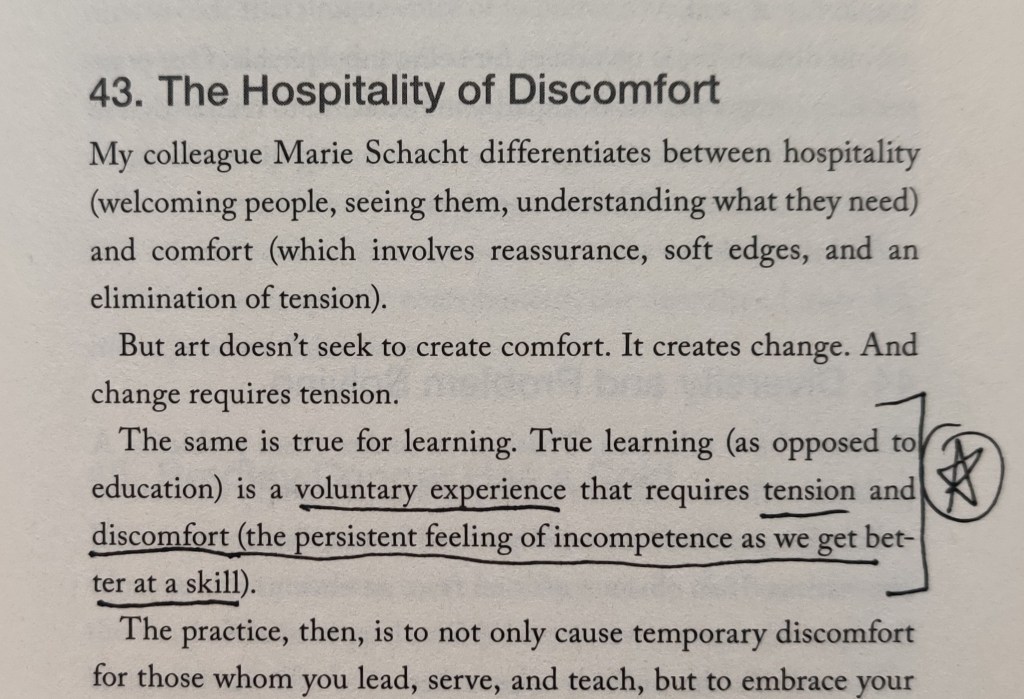
As I was reading through Seth Godin’s latest book, The Practice, I came across this gem of insight.

“The Practice” by Seth Godin (2020), pg. 53

It is often the discomfort and tension that causes me to avoid learning new things and settling into my work. When I feel the anxiety rise, I’ll switch gears to something more comfortable or distracting. Instead, I need to embrace the suck.

Learning is voluntary – I must want to engage with it.

Learning creates tension – personal discovery in unfamiliar territory creates questions of tension, and each answer I find resolves the tension. Tension and release.

Learning is uncomfortable – it’s hard to willingly feel incompetent when our careers are geared towards increasing competence and confidence.

I need to learn that when I feel uncomfortable in the learning process, this means I’m on the right track and should embrace the feeling.

Stay Awesome,

Ryan

Unintended Tech Shabbat Consequences

This week’s post is late. The proximal cause is that because of the Tech Shabbat experiment, I was shutting my computer down for the weekend. Weekends are the most common time I write and prepare to publish my posts. Therefore, an unintended consequence of the Tech Shabbat is that I didn’t have a post ready for Monday.

However, that is a poor excuse when we consider the distal causes of why the post is late, because the Tech Shabbat was a known event in my calendar. It wasn’t something that was unanticipated, and I knew roughly what participating in the Tech Shabbat would entail. I knew, for example, that I had to get my course marking done before the Shabbat if I wanted to give my students their feedback with sufficient time for them to use my feedback in their next assignment. I was able to always get my grading done before the Tech Shabbat began each week of the experiment, so why did I not do the same for the weekly blog posts?

The Tech Shabbat became a convenient excuse to blame, when really the blame lies with a poor writing habit. Maybe I would have finished the posts had I not participated in the Tech Shabbat, but instead of dwelling in a possible else-world, I should focus on fixing the things I have control over, such as my schedule and how I set my priorities.

Proximal causes are easy to fixate on, and are often more expensive to address (it’s why we spend lots of money on shiny new toys that promise to fix our problems). Distal causes can be harder to spot and require longer, steady investment to overcome.

Stay Awesome,

Ryan

Friday Round-up – August 7, 2020

This was a light week for consuming content that stuck with me, so here is the sole round-up list for the week ending on August 7th:

💭Reflection – Citing our sources – How to Think for Yourself | Ozan Varol blog post and Don’t Quote. Make it Yours and Say it Yourself | Derek Sivers blog post

The Varol piece was new, and as I read it, it reminded me of the Sivers piece, so I’m pairing them together. I’m a little conflicted with the message. On the one hand, I agree with both writers about the sentiments they are expressing. In Varol’s case, often citation becomes a short-hand for original thinking. Rather than expression your own unique ideas, you regurgitate what you’ve consumed from others (whether you are citing it or not, as is on display in the Good Will Hunting example). Likewise, Sivers is on to something when he suggests that integrating facts into our mental apparatus should not require us to cite our sources when it’s no longer the appropriate context. It makes sense to cite sources when writing something that will be graded in school, but it is stilted while in informal settings.

Where I feel conflicted is when there is a need to trace ideas back to verify the content. I don’t think it’s a new phenomenon, but it has certainly accelerated in recent years that misinformation is being thrown out into the void at a rapid pace. The internet has optimized itself on three facts of human nature – we like sensation, we like things that are familiar (that accords with what we already believe), and we are less critical of our in-group. Therefore, information bubbles get set up online, which creates a digital environment that’s conducive to rapid spreading of memetic viruses. When you think about it, it’s a marvelous analogy: the online information bubble is a closed environment where people are like-minded, which amounts to a roughly analogical immune system. A memetic virus then latches hold on one person, who spreads it to people in their network. Since the folks in the network share similar belief structures, the homogeneous group quickly spreads the meme throughout the information bubble. The meme is then incorporated into the belief network of the individuals through repetition and confirmation bias exposure. It writes itself into the belief web, in the same way viruses incorporate themselves into DNA.

I’m using the example of a memetic virus, but I think this framework is equally applied to more benign examples. Scientists release findings in the form of pre-peer reviewed news releases, which gets amplified and distorted through the media, which is then amplified and distorted through information bubbles. See here for an example:

At each phase, part of the signal is lost or transformed, like a social media game of telephone. When one person in the chain misunderstands the data, that impacts how the idea gets replicated. Over time, it becomes the digital version of a cancerous mutation of the base information.

This is why it’s important that we take care of how information is communicated, because as soon as you print something like “the majority of people believe x,” or “studies showed a y% decrease in the effect,” without a proper context of what the data is saying (or its limitations), that gets incorporated into people’s webs of belief. If you are a part of the population that believes something and you read that information, it reinforces your prior beliefs and you continue on in replicating the idea.

And so I’m torn. On the one hand, I shouldn’t need to cite my sources when having a casual conversation (a la Sivers), and I shouldn’t be substituting original thoughts with the ideas of others (a la Varol), but at the same time, I want it to be the case that when I encounter something that it should be verifiable and scruitable. I don’t know what the solution to this is, other than to flag it and remind myself to be wary of absolutist language.

Stay Awesome,

Ryan